Conflict Management Strategies and Organizational Development

Verified

Added on  2023/01/18

|4
|432
|37
Report
AI Summary
This report provides an overview of conflict management strategies, focusing on their application in organizational settings. It explores various techniques, including collaborating, competing, compromising, avoiding, and accommodating. The report discusses the context in which each strategy is most effective, such as emergency situations, maintaining peace, or addressing specific issues. Furthermore, it highlights the role of conflict management in organizational development, emphasizing the importance of leadership in reducing conflict and increasing productivity. The report also touches upon the implementation of an organization development plan, including the development of a leadership framework and strategies for managing resistance to change within an organization. The analysis aims to assist leaders in creating a more effective and productive workplace by effectively managing conflict and developing their leadership skills. Desklib provides additional resources for students to study these topics, including past papers and solved assignments.
Document Page
Conflict management 0
Conflict Management Techniques
Student’s Name
4/10/2019
tabler-icon-diamond-filled.svg

Paraphrase This Document

Need a fresh take? Get an instant paraphrase of this document with our AI Paraphraser
Document Page
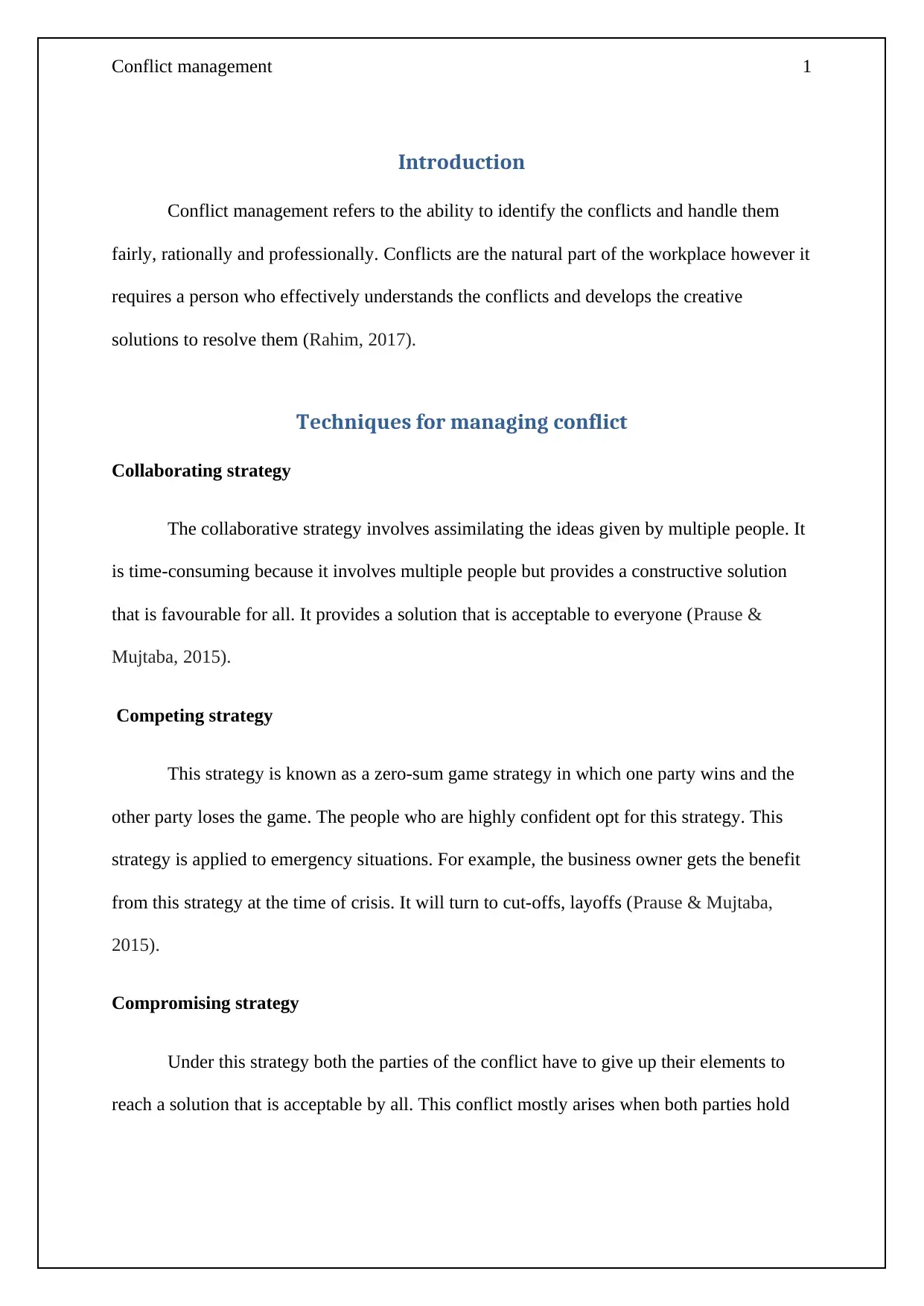
Conflict management 1
Introduction
Conflict management refers to the ability to identify the conflicts and handle them
fairly, rationally and professionally. Conflicts are the natural part of the workplace however it
requires a person who effectively understands the conflicts and develops the creative
solutions to resolve them (Rahim, 2017).
Techniques for managing conflict
Collaborating strategy
The collaborative strategy involves assimilating the ideas given by multiple people. It
is time-consuming because it involves multiple people but provides a constructive solution
that is favourable for all. It provides a solution that is acceptable to everyone (Prause &
Mujtaba, 2015).
Competing strategy
This strategy is known as a zero-sum game strategy in which one party wins and the
other party loses the game. The people who are highly confident opt for this strategy. This
strategy is applied to emergency situations. For example, the business owner gets the benefit
from this strategy at the time of crisis. It will turn to cut-offs, layoffs (Prause & Mujtaba,
2015).
Compromising strategy
Under this strategy both the parties of the conflict have to give up their elements to
reach a solution that is acceptable by all. This conflict mostly arises when both parties hold
Document Page
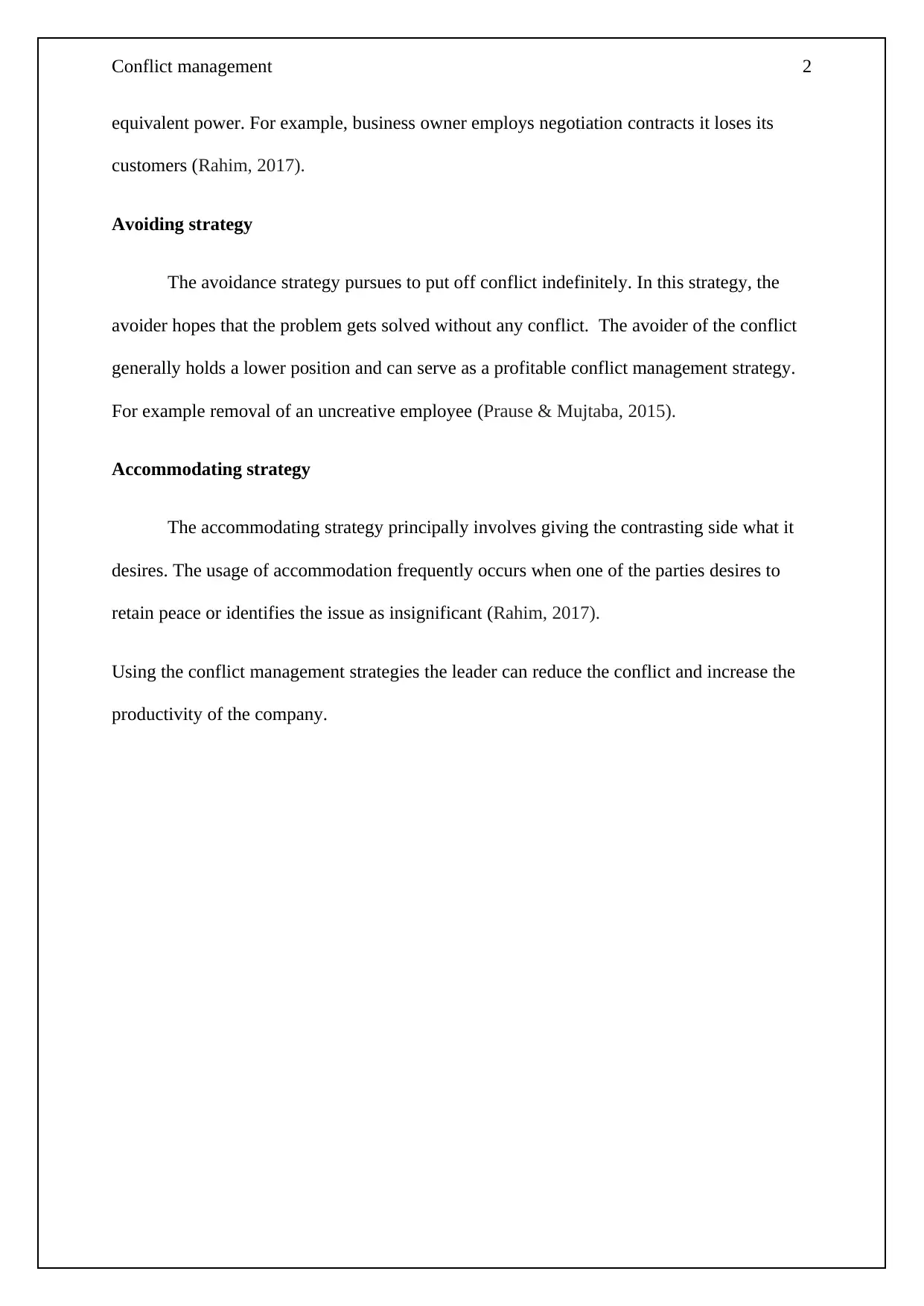
Conflict management 2
equivalent power. For example, business owner employs negotiation contracts it loses its
customers (Rahim, 2017).
Avoiding strategy
The avoidance strategy pursues to put off conflict indefinitely. In this strategy, the
avoider hopes that the problem gets solved without any conflict. The avoider of the conflict
generally holds a lower position and can serve as a profitable conflict management strategy.
For example removal of an uncreative employee (Prause & Mujtaba, 2015).
Accommodating strategy
The accommodating strategy principally involves giving the contrasting side what it
desires. The usage of accommodation frequently occurs when one of the parties desires to
retain peace or identifies the issue as insignificant (Rahim, 2017).
Using the conflict management strategies the leader can reduce the conflict and increase the
productivity of the company.
Document Page
Conflict management 3
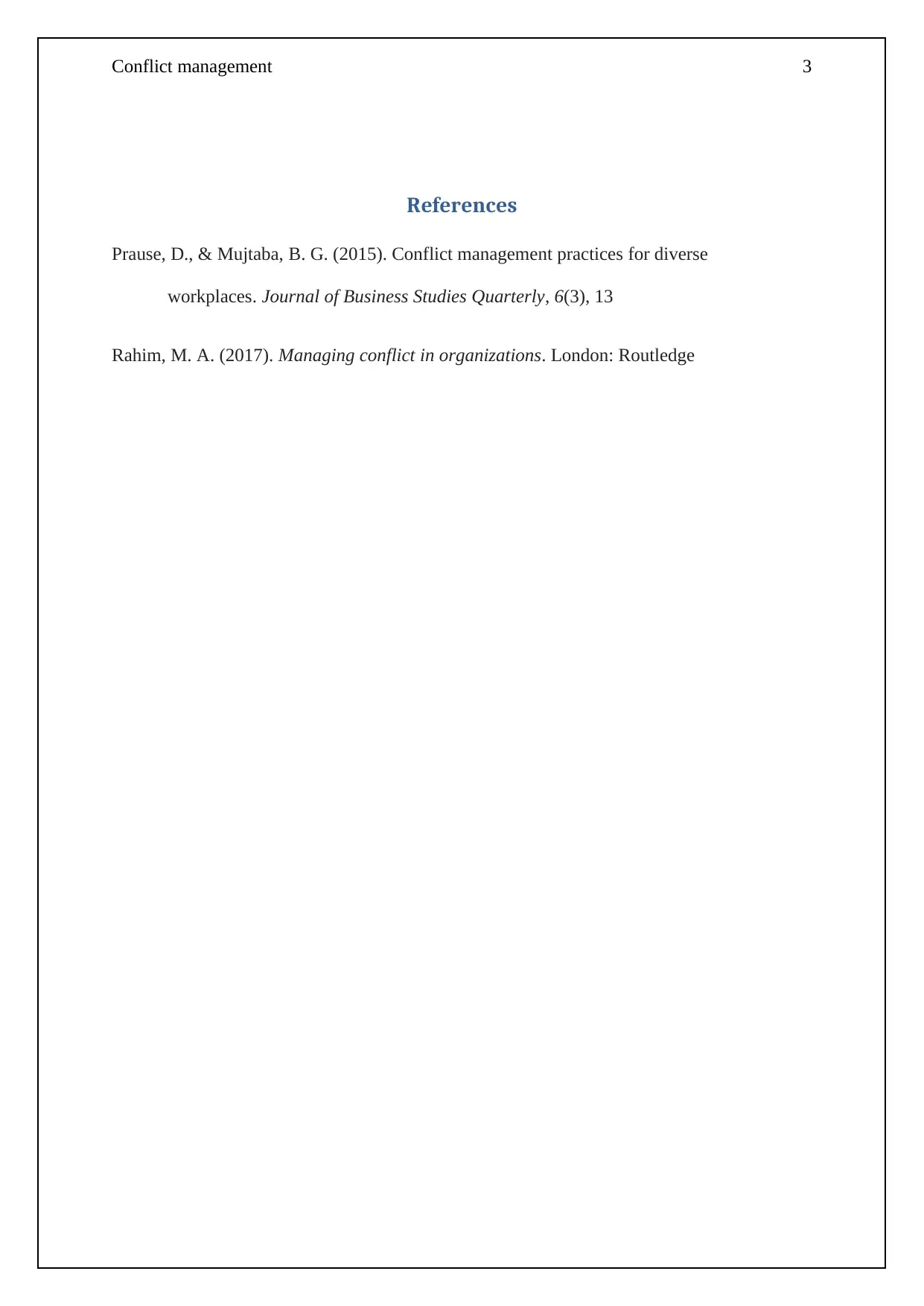
References
Prause, D., & Mujtaba, B. G. (2015). Conflict management practices for diverse
workplaces. Journal of Business Studies Quarterly, 6(3), 13
Rahim, M. A. (2017). Managing conflict in organizations. London: Routledge
chevron_up_icon
1 out of 4
circle_padding
hide_on_mobile
zoom_out_icon
[object Object]