Organic Food Supply Chain Challenges in International Logistics
VerifiedAdded on 2022/08/21
|13
|3849
|11
Report
AI Summary
This report delves into the challenges of international purchasing within the organic food sector, highlighting issues faced by purchasers in the global market. It addresses the increasing demand for organic products and the complexities of maintaining a consistent supply chain. Key challenges include the high costs associated with transporting organic foods separately from non-organic products, the labor-intensive nature of organic farming which drives up production costs, and the difficulties in sourcing certified organic foods. The report also discusses risks such as pests, insufficient growth of organic food affecting supply, potential co-mingling and contamination, and competition. It touches upon the importance of cold chain technology for transportation and concludes with recommendations for improving the organic food supply chain. Desklib provides access to this and other solved assignments.
International Logistics and Supply Chain Management
2/8/2020
2/8/2020

Paraphrase This Document
Need a fresh take? Get an instant paraphrase of this document with our AI Paraphraser
Supply Chain 1
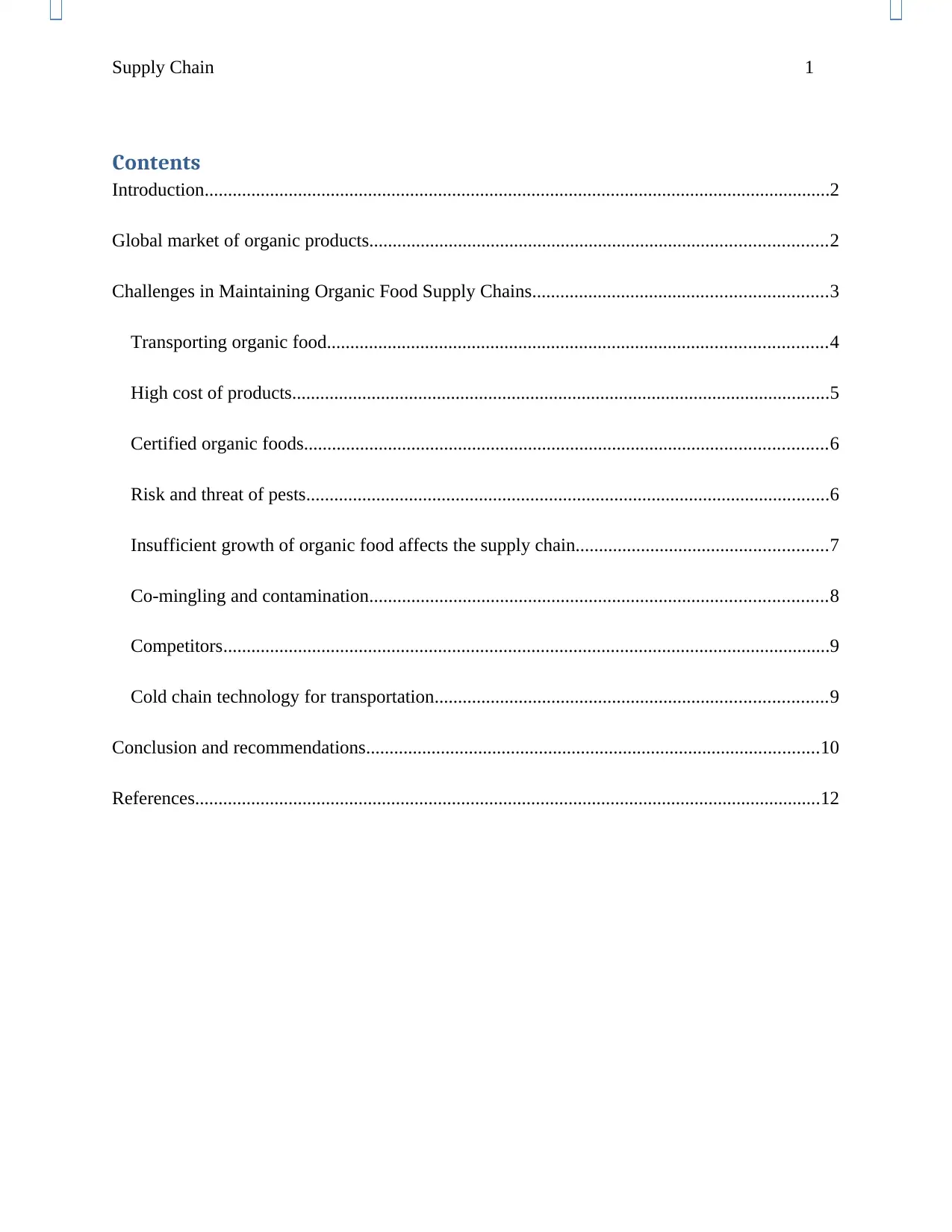
Contents
Introduction......................................................................................................................................2
Global market of organic products..................................................................................................2
Challenges in Maintaining Organic Food Supply Chains...............................................................3
Transporting organic food...........................................................................................................4
High cost of products...................................................................................................................5
Certified organic foods................................................................................................................6
Risk and threat of pests................................................................................................................6
Insufficient growth of organic food affects the supply chain......................................................7
Co-mingling and contamination..................................................................................................8
Competitors..................................................................................................................................9
Cold chain technology for transportation....................................................................................9
Conclusion and recommendations.................................................................................................10
References......................................................................................................................................12
Contents
Introduction......................................................................................................................................2
Global market of organic products..................................................................................................2
Challenges in Maintaining Organic Food Supply Chains...............................................................3
Transporting organic food...........................................................................................................4
High cost of products...................................................................................................................5
Certified organic foods................................................................................................................6
Risk and threat of pests................................................................................................................6
Insufficient growth of organic food affects the supply chain......................................................7
Co-mingling and contamination..................................................................................................8
Competitors..................................................................................................................................9
Cold chain technology for transportation....................................................................................9
Conclusion and recommendations.................................................................................................10
References......................................................................................................................................12
Supply Chain 2
Introduction
In the current era, international purchasing is one of the major roles performed by the companies
to meet the needs of the customers and also to attain their business goals. The term purchasing is
referred to as the activities that are related to the acquisition of the goods, raw material or the
services that are required for the companies to attain the business goals. Presently, the companies
are performing the actions of international purchasing which is an act of procuring the goods or
services in the commercial transaction from the suppliers that are placed in a foreign country. In
general, this is viewed that the quality of product, price, and availability of the products are
considered as some of the reasons to make the purchase internationally. The change in the
practices of farming has brought the emergence in the use of the organic food that generally
remains free from the pesticides, chemicals, and fertilizers. The analysis of the international
purchasing of organic food products is analyzed which consists of different challenges.
Considering the perspective of the purchaser, it has been determined that there are different
issues that are witnessed at the time of purchasing organic products from international marketing.
Global market of organic products
It is the fact that the global market of organic products is continuously growing across the world
due to which they need for products by the companies have been increased. The purchasing team
of the company needs to source the organic products that they can use for manufacturing the
products and offering the same to the customers which is the only source to meet the needs of the
clients (Fredendall and Hill, 2016). It has been witnessed that the global market for the organic
product is considered as approximately US $18 billion at the end of 2000 than US$23 billion in
Introduction
In the current era, international purchasing is one of the major roles performed by the companies
to meet the needs of the customers and also to attain their business goals. The term purchasing is
referred to as the activities that are related to the acquisition of the goods, raw material or the
services that are required for the companies to attain the business goals. Presently, the companies
are performing the actions of international purchasing which is an act of procuring the goods or
services in the commercial transaction from the suppliers that are placed in a foreign country. In
general, this is viewed that the quality of product, price, and availability of the products are
considered as some of the reasons to make the purchase internationally. The change in the
practices of farming has brought the emergence in the use of the organic food that generally
remains free from the pesticides, chemicals, and fertilizers. The analysis of the international
purchasing of organic food products is analyzed which consists of different challenges.
Considering the perspective of the purchaser, it has been determined that there are different
issues that are witnessed at the time of purchasing organic products from international marketing.
Global market of organic products
It is the fact that the global market of organic products is continuously growing across the world
due to which they need for products by the companies have been increased. The purchasing team
of the company needs to source the organic products that they can use for manufacturing the
products and offering the same to the customers which is the only source to meet the needs of the
clients (Fredendall and Hill, 2016). It has been witnessed that the global market for the organic
product is considered as approximately US $18 billion at the end of 2000 than US$23 billion in
⊘ This is a preview!⊘
Do you want full access?
Subscribe today to unlock all pages.

Trusted by 1+ million students worldwide
Supply Chain 3
the year 2002 and the market continuous improved by 43% which reached till the US $33billion
in the year 2005 and then the US $50 billion in 2008. Across the world, there are more than
633891 farms that are managing more than 31 million hectares of organic land. This allows the
companies to source most of the organic products from the market of the US which leads to the
rise in the revenue of the country. In the news, this has been witnessed that the record of the
organic sales in the US is totally approximately $50 billion in the year 2017 as per the Organic
Trade Association (Reiley, 2019). Considering the fact that the organic food market is growing,
it has been determined that the purchasers of the company deal with the different issues related to
organic food sourcing. Some of the issues which are faced by the purchaser in the international
market are discussed.
Challenges in Maintaining Organic Food Supply Chains
In the recent news article, this has been witnessed that a rise in popularity as well as demand for
organic food. There are many companies that are operating the business in the food and beverage
industry are forced to adapt to industry demand and also to determine the new and innovative
ways of procuring and sourcing the products related to the food (Pardillo Baez, Sequeira,
Hilletofth and Andersson, 2019). There are different challenges that are witnessed and to keep
pace with the supply chain is one of the major issues. However, the purchasing department needs
to purchase the products as it allows them to revise the procurement strategies that help them to
cater to the clients and to remain competitive. The purchaser needs to think about the different
issues which affect the purchase decision of organic food products. The below given are some of
the issues that have been witnessed by the purchaser that generally occur at the time of
purchasing the organic food which is a part of the supply chain.
the year 2002 and the market continuous improved by 43% which reached till the US $33billion
in the year 2005 and then the US $50 billion in 2008. Across the world, there are more than
633891 farms that are managing more than 31 million hectares of organic land. This allows the
companies to source most of the organic products from the market of the US which leads to the
rise in the revenue of the country. In the news, this has been witnessed that the record of the
organic sales in the US is totally approximately $50 billion in the year 2017 as per the Organic
Trade Association (Reiley, 2019). Considering the fact that the organic food market is growing,
it has been determined that the purchasers of the company deal with the different issues related to
organic food sourcing. Some of the issues which are faced by the purchaser in the international
market are discussed.
Challenges in Maintaining Organic Food Supply Chains
In the recent news article, this has been witnessed that a rise in popularity as well as demand for
organic food. There are many companies that are operating the business in the food and beverage
industry are forced to adapt to industry demand and also to determine the new and innovative
ways of procuring and sourcing the products related to the food (Pardillo Baez, Sequeira,
Hilletofth and Andersson, 2019). There are different challenges that are witnessed and to keep
pace with the supply chain is one of the major issues. However, the purchasing department needs
to purchase the products as it allows them to revise the procurement strategies that help them to
cater to the clients and to remain competitive. The purchaser needs to think about the different
issues which affect the purchase decision of organic food products. The below given are some of
the issues that have been witnessed by the purchaser that generally occur at the time of
purchasing the organic food which is a part of the supply chain.
Paraphrase This Document
Need a fresh take? Get an instant paraphrase of this document with our AI Paraphraser
Supply Chain 4
Transporting organic food
International purchasing allows the company to get the product transported from different areas.
The transportation of organic products is required to take care of the purchaser because they
want to manage the cost in an effective manner. The research reflects that transporting the
organic foods and keeping it separate from the non-organic products is considered as one of the
major challenges which are faced by the purchaser (Aggestam, Fleiß, and Posch, 2017). There
are different companies that are offering organic and non-organic products that need to make use
of the different machines for their every of the production through which they can maintain the
organic food practices as well as standards. This leads to the rise in the cost of production
because at every stage there is a need to make the expenditure in terms of transportation the
organic products. The true cost of organic products which include substituting labor, intensive
management for chemicals, growing, harvest, transportation and storage cost.
The transportation of organic products is considered as one of the costly ways for the purchaser
because it includes the post-harvest handling cost. In order to avoid the cross-contamination, it is
essential that the organic produce can be separated from the conventional produce that is being
harvested. In the research, it has been witnessed that the conventional crops are shipped in larger
quantities because these goods are manufactured by the farmers in bulk. However, comparing it
with the organic products, it has been determined that these products are handled and shipped in
smaller quantities since the organic farms tend to manufacture less and it leads to a higher cost
(Jouzi, et al, 2017). In addition to this, the organic farms are generally placed farther from the
different cities which lead to the rise in the cost of shipping. The news article shows that high
difference among the places leads to the rise in the transportation cost which influences the
decision making of the purchaser (Business Wire, 2019). It has been witnessed when the
Transporting organic food
International purchasing allows the company to get the product transported from different areas.
The transportation of organic products is required to take care of the purchaser because they
want to manage the cost in an effective manner. The research reflects that transporting the
organic foods and keeping it separate from the non-organic products is considered as one of the
major challenges which are faced by the purchaser (Aggestam, Fleiß, and Posch, 2017). There
are different companies that are offering organic and non-organic products that need to make use
of the different machines for their every of the production through which they can maintain the
organic food practices as well as standards. This leads to the rise in the cost of production
because at every stage there is a need to make the expenditure in terms of transportation the
organic products. The true cost of organic products which include substituting labor, intensive
management for chemicals, growing, harvest, transportation and storage cost.
The transportation of organic products is considered as one of the costly ways for the purchaser
because it includes the post-harvest handling cost. In order to avoid the cross-contamination, it is
essential that the organic produce can be separated from the conventional produce that is being
harvested. In the research, it has been witnessed that the conventional crops are shipped in larger
quantities because these goods are manufactured by the farmers in bulk. However, comparing it
with the organic products, it has been determined that these products are handled and shipped in
smaller quantities since the organic farms tend to manufacture less and it leads to a higher cost
(Jouzi, et al, 2017). In addition to this, the organic farms are generally placed farther from the
different cities which lead to the rise in the cost of shipping. The news article shows that high
difference among the places leads to the rise in the transportation cost which influences the
decision making of the purchaser (Business Wire, 2019). It has been witnessed when the
Supply Chain 5
purchaser of the organic product will find the high cost of the products then they will search for
alternative options that help them to reduce the cost.
High cost of products
It has been determined that organic farming include no chemicals and pesticides as they end up
reducing the actual cost of the production and conduct the operations of farming faster and more
efficiently. However, it has been determined that farmers need to hire more workers in organic
farming for the different purpose which include hand-weeding, clean-up of water that is polluted
and other. All these procedures enhance the actual cost of organic food which leads to the
challenge for the purchase to buy such products from the international market. In addition to this,
it has been found that higher cost of fertilizer for the organic crops which include sewage sludge
as well as the fertilizers (Fox News, 2012). In addition to this, the organic framers eschew these
inexpensive solutions with the motive to keep their entire crops natural and instead to make use
of compost as well as the animal manure which is considered as one of the expensive ways to
ship. Thus, purchasing the products from the international market is considered as one of the
expensive ways.
The research shows that the prices of the organic foods consist of not only the cost of the food
production itself but it also consist of the range of the different factors that are not captured in the
price of the conventional food like higher standards for the animal welfares. In addition to this,
the price of the organic good consists of environmental protection as well as the enhancement
(Chait, 2019). This can be understood with the help of the higher prices of the cash crops in
organic food that compensate for the low returns of finances for the rotational periods that are
very essential to form the soil fertility. This improvement in the price made the purchaser search
for the same organic food at a different location so that they can easily source it at a low cost.
purchaser of the organic product will find the high cost of the products then they will search for
alternative options that help them to reduce the cost.
High cost of products
It has been determined that organic farming include no chemicals and pesticides as they end up
reducing the actual cost of the production and conduct the operations of farming faster and more
efficiently. However, it has been determined that farmers need to hire more workers in organic
farming for the different purpose which include hand-weeding, clean-up of water that is polluted
and other. All these procedures enhance the actual cost of organic food which leads to the
challenge for the purchase to buy such products from the international market. In addition to this,
it has been found that higher cost of fertilizer for the organic crops which include sewage sludge
as well as the fertilizers (Fox News, 2012). In addition to this, the organic framers eschew these
inexpensive solutions with the motive to keep their entire crops natural and instead to make use
of compost as well as the animal manure which is considered as one of the expensive ways to
ship. Thus, purchasing the products from the international market is considered as one of the
expensive ways.
The research shows that the prices of the organic foods consist of not only the cost of the food
production itself but it also consist of the range of the different factors that are not captured in the
price of the conventional food like higher standards for the animal welfares. In addition to this,
the price of the organic good consists of environmental protection as well as the enhancement
(Chait, 2019). This can be understood with the help of the higher prices of the cash crops in
organic food that compensate for the low returns of finances for the rotational periods that are
very essential to form the soil fertility. This improvement in the price made the purchaser search
for the same organic food at a different location so that they can easily source it at a low cost.
⊘ This is a preview!⊘
Do you want full access?
Subscribe today to unlock all pages.
Trusted by 1+ million students worldwide
Supply Chain 6
Certified organic foods
In the international market, the purchase likes to make the purchase of certified organic products
that helps them to provide actual and genuine products. In the research, it has been determined
that the organic food supply is limited while comparing the same with the demand for the
product because of the organic food certification. The purchaser of the organic food finds it
challenging to source the certified organic supply (Mutiara, and Arai, 2017). Certified organic
products are generally considered as one of the most expensive than their conventional
counterparts for the different number of reasons which include that supply of the organic food is
very limited while comparing the same with the demand. The cost of the production for the
organic foods are typically higher due to greater labor inputs per unit of the output and also
because of the greater diversity of the enterprise that refers to the economies of scale that cannot
be accomplished. In addition to this, the purchaser's perspective shows that there is an issue of
the marketing and distribution chains for the organic product that is relatively insufficient as well
as costs are higher due to the relatively small volumes (Dani, 2015).
Risk and threat of pests
In the research, it has been determined that the chain of organic food majorly rely on the farming
of organic. They find the issue of the unprecedented risks from pests as well as other crop-
destroying factors. In addition to this, it is considered as costly and time consuming for the
farmers to get a switch to organic farming. The company can’t make use of the prohibited
substances and also the pesticides 36 months before the goods are actually grown thereby decline
in the number of the organic suppliers as well as farmers that can contribute effectively in
attaining demands of industry (Business Wire, 2019). This affects the purchaser with their supply
chain as there is a possibility that pests can affect organic food.
Certified organic foods
In the international market, the purchase likes to make the purchase of certified organic products
that helps them to provide actual and genuine products. In the research, it has been determined
that the organic food supply is limited while comparing the same with the demand for the
product because of the organic food certification. The purchaser of the organic food finds it
challenging to source the certified organic supply (Mutiara, and Arai, 2017). Certified organic
products are generally considered as one of the most expensive than their conventional
counterparts for the different number of reasons which include that supply of the organic food is
very limited while comparing the same with the demand. The cost of the production for the
organic foods are typically higher due to greater labor inputs per unit of the output and also
because of the greater diversity of the enterprise that refers to the economies of scale that cannot
be accomplished. In addition to this, the purchaser's perspective shows that there is an issue of
the marketing and distribution chains for the organic product that is relatively insufficient as well
as costs are higher due to the relatively small volumes (Dani, 2015).
Risk and threat of pests
In the research, it has been determined that the chain of organic food majorly rely on the farming
of organic. They find the issue of the unprecedented risks from pests as well as other crop-
destroying factors. In addition to this, it is considered as costly and time consuming for the
farmers to get a switch to organic farming. The company can’t make use of the prohibited
substances and also the pesticides 36 months before the goods are actually grown thereby decline
in the number of the organic suppliers as well as farmers that can contribute effectively in
attaining demands of industry (Business Wire, 2019). This affects the purchaser with their supply
chain as there is a possibility that pests can affect organic food.
Paraphrase This Document
Need a fresh take? Get an instant paraphrase of this document with our AI Paraphraser
Supply Chain 7
Insufficient growth of organic food affects the supply chain
In the new article, it has been found that the purchaser of the organic product can find the issue
of the insufficient growth of organic food. The seasonality of the organic food crops leads to the
challenges for the suppliers to attain the demand of the supply chain. It has been determined that
the companies have to collaborate with the different suppliers from the various regions with the
motive to source the items majorly for one sort of product (Cagliano, Worley and Caniato, 2016).
Thus, this contributes to the high cost of the imports as well as complicates the entire supply
chain. Along with this, the purchaser needs to form contacts with the distributor that helps them
in purchasing the products from the different regions.
It has been witnessed in the research that the major organic agriculture is its lower productivity at
the time when the production of the food has to improve the sustainability with the motive to
feed a growing and also more affluent population global (Kroll, 2019). The rise in the demand
for global organic products is that the present agriculture land will not deal and further the
expansion of the agriculture land into the pristine ecosystem leads to the expansion of organic
agriculture. It is very clear that the purchaser finds the issue of buying the products with high
demand due to the low production issue. The high demand for the products affects the price of
the organic food which affects the decision of the purchaser in the supply chain and then they
shift to non-organic food products.
Co-mingling and contamination
The research on the purchasing of organic food shows that the purchaser needs to deal with
different issues because it is hard to handle the supply of organic products. Careful handling is
needed for the different food items to become more essential with the organic food that needs
extra TLC. In this part, it is due to the lack of preservatives that can allow it to become more
Insufficient growth of organic food affects the supply chain
In the new article, it has been found that the purchaser of the organic product can find the issue
of the insufficient growth of organic food. The seasonality of the organic food crops leads to the
challenges for the suppliers to attain the demand of the supply chain. It has been determined that
the companies have to collaborate with the different suppliers from the various regions with the
motive to source the items majorly for one sort of product (Cagliano, Worley and Caniato, 2016).
Thus, this contributes to the high cost of the imports as well as complicates the entire supply
chain. Along with this, the purchaser needs to form contacts with the distributor that helps them
in purchasing the products from the different regions.
It has been witnessed in the research that the major organic agriculture is its lower productivity at
the time when the production of the food has to improve the sustainability with the motive to
feed a growing and also more affluent population global (Kroll, 2019). The rise in the demand
for global organic products is that the present agriculture land will not deal and further the
expansion of the agriculture land into the pristine ecosystem leads to the expansion of organic
agriculture. It is very clear that the purchaser finds the issue of buying the products with high
demand due to the low production issue. The high demand for the products affects the price of
the organic food which affects the decision of the purchaser in the supply chain and then they
shift to non-organic food products.
Co-mingling and contamination
The research on the purchasing of organic food shows that the purchaser needs to deal with
different issues because it is hard to handle the supply of organic products. Careful handling is
needed for the different food items to become more essential with the organic food that needs
extra TLC. In this part, it is due to the lack of preservatives that can allow it to become more
Supply Chain 8
perishable. In addition to this, the manufacturer of organic food requires to watch majorly for the
contamination as well as the commingling (Copacino, 2019). It has been determined that the
contamination generally appears when the organic products come into contact with the different
prohibited elements like pesticides. The commingling generally appears when the organic food
remains in contact with the non-organic products. Thus, this contamination leads to the issue for
the purchaser as they need to pack the organic products in different packets which are considered
as one of the expensive sources.
The research on the purchase of organic products shows that USDA has determined different
practices that can contribute in declining the risk of commingling and are accepted majorly for
organic foods. The first practice that can lead to the risk of commingling includes buffer strips or
the plots of land that are situated along with the edges of the field that can permit to capture the
different pesticides and pollens possibly from the neighboring farms (Hugos, 2018).
Furthermore, obviously, the labeling of organic foods or ingredients can support to avoid the
commingling that occurs accidentally. At the time of the practices as it supports to maintain the
integrity of the supply chain of the organic products as they also add to their expenses with the
complexity. Thus, the purchaser of the organic products needs to pay the high amount for getting
it to pack and allowing for transportation. The distance from the home place to the place from
where the organic products are actually sourced will decide the expenses made by the purchaser
for purchasing the products (Mangan and Lalwani, 2016).
Competitors
The base of the organic products includes the farmers who grow these crops and they are the
ones who decide the price of the products. Organic farmers must face the small percentage of the
competitors who are willing to capture the premium prices of the organic goods and they are the
perishable. In addition to this, the manufacturer of organic food requires to watch majorly for the
contamination as well as the commingling (Copacino, 2019). It has been determined that the
contamination generally appears when the organic products come into contact with the different
prohibited elements like pesticides. The commingling generally appears when the organic food
remains in contact with the non-organic products. Thus, this contamination leads to the issue for
the purchaser as they need to pack the organic products in different packets which are considered
as one of the expensive sources.
The research on the purchase of organic products shows that USDA has determined different
practices that can contribute in declining the risk of commingling and are accepted majorly for
organic foods. The first practice that can lead to the risk of commingling includes buffer strips or
the plots of land that are situated along with the edges of the field that can permit to capture the
different pesticides and pollens possibly from the neighboring farms (Hugos, 2018).
Furthermore, obviously, the labeling of organic foods or ingredients can support to avoid the
commingling that occurs accidentally. At the time of the practices as it supports to maintain the
integrity of the supply chain of the organic products as they also add to their expenses with the
complexity. Thus, the purchaser of the organic products needs to pay the high amount for getting
it to pack and allowing for transportation. The distance from the home place to the place from
where the organic products are actually sourced will decide the expenses made by the purchaser
for purchasing the products (Mangan and Lalwani, 2016).
Competitors
The base of the organic products includes the farmers who grow these crops and they are the
ones who decide the price of the products. Organic farmers must face the small percentage of the
competitors who are willing to capture the premium prices of the organic goods and they are the
⊘ This is a preview!⊘
Do you want full access?
Subscribe today to unlock all pages.
Trusted by 1+ million students worldwide
Supply Chain 9
ones who typically enjoy without actually following the growing regulations of the organic
products. The farmers who want to get the premium prices of the products will lead to the high
cost for the purchaser of the organic food products because they will find the products at high
cost plus the additional charges (Roos, et al, 2018). The rise in the cost of the raw products will
allow the company to increase the prices for the customer but this generally leads to a decline in
the sales of the products that are offered by the company. In addition to this, sometimes in order
to meet the needs of the customers, the company considers the non-organic products as organic
which affected farmers of the organic products.
Cold chain technology for transportation
In the research, this has been found that the transportation of organic food is not that easy for
companies or farmers as it needs extra care. It has been found that the distributor of the organic
produce based in Eugene, Oregon need all its carriers to the pre-cool their trailers before making
any sort of pick-ups. The loading pick-up with the pre-cool helps to maintain organic food at the
time of the transportation (Christopher, 2016). It has been found that organically grown also
makes use of the temperature loggers with the help of which they can continuously track the
temperature once its food is on the truck. At the time of the deliveries, the sales of the dock and
large pads the trailer backs up with the motive to form a seal among the truck as well as building.
This allows keeping the pest as well as debris out while keeping the product cold in. Thus, it has
been found that the zero break in the cold chain. In the research, this has been found that
purchase will find a challenge with the warehousing of the organic products as they need the
place where they can keep the products at the cold (Kroll, 2019). Further, the purchaser finds the
issue as there is a need for temperature-controlled warehouses, labor, and energy as their largest
costs. There are wide ranges of cold storage companies that are making the investment in the
ones who typically enjoy without actually following the growing regulations of the organic
products. The farmers who want to get the premium prices of the products will lead to the high
cost for the purchaser of the organic food products because they will find the products at high
cost plus the additional charges (Roos, et al, 2018). The rise in the cost of the raw products will
allow the company to increase the prices for the customer but this generally leads to a decline in
the sales of the products that are offered by the company. In addition to this, sometimes in order
to meet the needs of the customers, the company considers the non-organic products as organic
which affected farmers of the organic products.
Cold chain technology for transportation
In the research, this has been found that the transportation of organic food is not that easy for
companies or farmers as it needs extra care. It has been found that the distributor of the organic
produce based in Eugene, Oregon need all its carriers to the pre-cool their trailers before making
any sort of pick-ups. The loading pick-up with the pre-cool helps to maintain organic food at the
time of the transportation (Christopher, 2016). It has been found that organically grown also
makes use of the temperature loggers with the help of which they can continuously track the
temperature once its food is on the truck. At the time of the deliveries, the sales of the dock and
large pads the trailer backs up with the motive to form a seal among the truck as well as building.
This allows keeping the pest as well as debris out while keeping the product cold in. Thus, it has
been found that the zero break in the cold chain. In the research, this has been found that
purchase will find a challenge with the warehousing of the organic products as they need the
place where they can keep the products at the cold (Kroll, 2019). Further, the purchaser finds the
issue as there is a need for temperature-controlled warehouses, labor, and energy as their largest
costs. There are wide ranges of cold storage companies that are making the investment in the
Paraphrase This Document
Need a fresh take? Get an instant paraphrase of this document with our AI Paraphraser
Supply Chain 10
automation that allows more efficient labor usage. This simply shows that the purchaser deals
with the issue of managing the cold storage area and they make the high expenditure on the new
and updated technology.
Conclusion and recommendations
At the end of the report, this can be concluded that the purchaser of the organic product deals
with the different types of issues that affect them while making the purchase of products. The
purchaser of the products finds the issue that includes transportation of the organic foods, high
cost of the products, risk, and threat of pest which affects the purchase of products and many
others. The major issue that is identified includes co-mingling and contamination of the organic
foods with the non-organic products and many others. It can be summarized from the perspective
of the purchaser that they need to spend the amount which includes expansion of the business,
expending high cost, inefficient growth, and many others. Furthermore, this has been witnessed
that the purchaser finds it challenging to get certified organic foods. It has been found that for
certified products, the purchaser of the company needs to spend the high amount for purchasing
the organic products.
It is suggested to the purchaser that they should get the quote from the different organic food
supplier which helps them to meet the demand of the organic products. Thus, it allows them to
make the purchase of organic products with the cost-benefit. Along with this, it is suggested to
the purchaser that they should take the advice of the expert while purchasing the products. The
purchaser should manage the transportation of organic products in an effective manner by using
different transport carriers.
automation that allows more efficient labor usage. This simply shows that the purchaser deals
with the issue of managing the cold storage area and they make the high expenditure on the new
and updated technology.
Conclusion and recommendations
At the end of the report, this can be concluded that the purchaser of the organic product deals
with the different types of issues that affect them while making the purchase of products. The
purchaser of the products finds the issue that includes transportation of the organic foods, high
cost of the products, risk, and threat of pest which affects the purchase of products and many
others. The major issue that is identified includes co-mingling and contamination of the organic
foods with the non-organic products and many others. It can be summarized from the perspective
of the purchaser that they need to spend the amount which includes expansion of the business,
expending high cost, inefficient growth, and many others. Furthermore, this has been witnessed
that the purchaser finds it challenging to get certified organic foods. It has been found that for
certified products, the purchaser of the company needs to spend the high amount for purchasing
the organic products.
It is suggested to the purchaser that they should get the quote from the different organic food
supplier which helps them to meet the demand of the organic products. Thus, it allows them to
make the purchase of organic products with the cost-benefit. Along with this, it is suggested to
the purchaser that they should take the advice of the expert while purchasing the products. The
purchaser should manage the transportation of organic products in an effective manner by using
different transport carriers.
Supply Chain 11
References
Aggestam, V., Fleiß, E. and Posch, A. (2017) Scaling-up short food supply chains? A survey
study on the drivers behind the intention of food producers. Journal of rural studies, 51, pp.64-
72.
Business Wire (2019) Challenges in Maintaining Organic Food Supply Chains [Online].
Available from: https://www.businesswire.com/news/home/20191201005248/en/Biggest-
Challenges-Facing-Organic-Food-Supply-Chains [Accessed on 8th February 2020]
Cagliano, R., Worley, C.G. and Caniato, F.F. (2016) The challenge of sustainable innovation in
agri-food supply chains. Organizing for Sustainable Effectiveness, 5, pp.1-30.
Chait, J. (2019) 10 Reasons Organic Food Costs More [Online]. Available from:
https://www.thebalancesmb.com/reasons-organic-food-costs-more-2538165 [Accessed on 8th
February 2020]
Christopher, M. (2016) Logistics & supply chain management. Pearson UK.
Copacino, W.C. (2019) Supply chain management: The basics and beyond. Routledge.
Dani, S. (2015) Food supply chain management and logistics: From farm to fork. Kogan Page
Publishers.
Fox News (2012) 10 reasons organic food is so expensive [Online]. Available from:
https://www.foxnews.com/food-drink/10-reasons-organic-food-is-so-expensive [Accessed on 8th
February 2020]
Fredendall, L.D. and Hill, E. (2016) Basics of supply chain management. CRC Press.
References
Aggestam, V., Fleiß, E. and Posch, A. (2017) Scaling-up short food supply chains? A survey
study on the drivers behind the intention of food producers. Journal of rural studies, 51, pp.64-
72.
Business Wire (2019) Challenges in Maintaining Organic Food Supply Chains [Online].
Available from: https://www.businesswire.com/news/home/20191201005248/en/Biggest-
Challenges-Facing-Organic-Food-Supply-Chains [Accessed on 8th February 2020]
Cagliano, R., Worley, C.G. and Caniato, F.F. (2016) The challenge of sustainable innovation in
agri-food supply chains. Organizing for Sustainable Effectiveness, 5, pp.1-30.
Chait, J. (2019) 10 Reasons Organic Food Costs More [Online]. Available from:
https://www.thebalancesmb.com/reasons-organic-food-costs-more-2538165 [Accessed on 8th
February 2020]
Christopher, M. (2016) Logistics & supply chain management. Pearson UK.
Copacino, W.C. (2019) Supply chain management: The basics and beyond. Routledge.
Dani, S. (2015) Food supply chain management and logistics: From farm to fork. Kogan Page
Publishers.
Fox News (2012) 10 reasons organic food is so expensive [Online]. Available from:
https://www.foxnews.com/food-drink/10-reasons-organic-food-is-so-expensive [Accessed on 8th
February 2020]
Fredendall, L.D. and Hill, E. (2016) Basics of supply chain management. CRC Press.
⊘ This is a preview!⊘
Do you want full access?
Subscribe today to unlock all pages.
Trusted by 1+ million students worldwide

1 out of 13


Related Documents


Your All-in-One AI-Powered Toolkit for Academic Success.
+13062052269
info@desklib.com
Available 24*7 on WhatsApp / Email
![[object Object]](/_next/static/media/star-bottom.7253800d.svg)
Unlock your academic potential
Copyright © 2020–2025 A2Z Services. All Rights Reserved. Developed and managed by ZUCOL.