Organisational Behaviour Essay: Impact of Personality on Organisations

Verified

Added on  2020/05/16

|8
|2009
|73
Essay
AI Summary
This essay delves into the realm of organisational behaviour, specifically examining how personality traits influence individual performance and overall organisational success. It begins by defining personality and exploring various personality types, such as the inspector, counsellor, and mastermind, highlighting their potential contributions in a work environment. The essay then transitions to the Big Five personality model (OCEAN), detailing its factors like openness, conscientiousness, extraversion, agreeableness, and neuroticism, and illustrating their impact through the example of Steve Jobs. The essay concludes by emphasizing the importance of understanding personality in the workplace, suggesting that organisations can leverage personality assessments to optimise task delegation and foster a more effective and productive environment.
Document Page
Running head: ORGANISATIONAL BEHAVIOURS
Organisational Behaviours
Name of Student
Name of University
Author Note
tabler-icon-diamond-filled.svg

Paraphrase This Document

Need a fresh take? Get an instant paraphrase of this document with our AI Paraphraser
Document Page
1
ORGANISATIONAL BEHAVIOURS
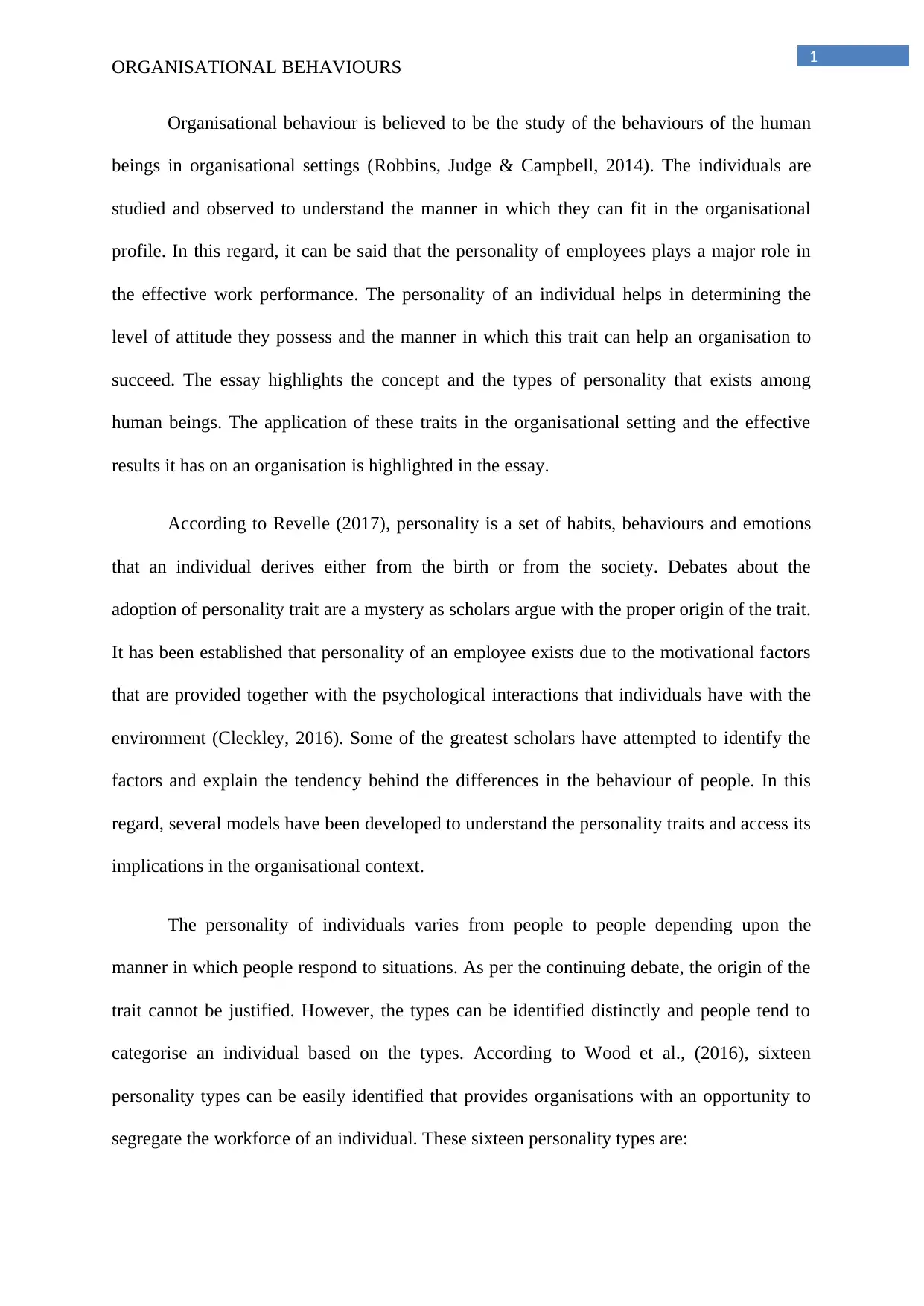
Organisational behaviour is believed to be the study of the behaviours of the human
beings in organisational settings (Robbins, Judge & Campbell, 2014). The individuals are
studied and observed to understand the manner in which they can fit in the organisational
profile. In this regard, it can be said that the personality of employees plays a major role in
the effective work performance. The personality of an individual helps in determining the
level of attitude they possess and the manner in which this trait can help an organisation to
succeed. The essay highlights the concept and the types of personality that exists among
human beings. The application of these traits in the organisational setting and the effective
results it has on an organisation is highlighted in the essay.
According to Revelle (2017), personality is a set of habits, behaviours and emotions
that an individual derives either from the birth or from the society. Debates about the
adoption of personality trait are a mystery as scholars argue with the proper origin of the trait.
It has been established that personality of an employee exists due to the motivational factors
that are provided together with the psychological interactions that individuals have with the
environment (Cleckley, 2016). Some of the greatest scholars have attempted to identify the
factors and explain the tendency behind the differences in the behaviour of people. In this
regard, several models have been developed to understand the personality traits and access its
implications in the organisational context.
The personality of individuals varies from people to people depending upon the
manner in which people respond to situations. As per the continuing debate, the origin of the
trait cannot be justified. However, the types can be identified distinctly and people tend to
categorise an individual based on the types. According to Wood et al., (2016), sixteen
personality types can be easily identified that provides organisations with an opportunity to
segregate the workforce of an individual. These sixteen personality types are:
Document Page
2
ORGANISATIONAL BEHAVIOURS
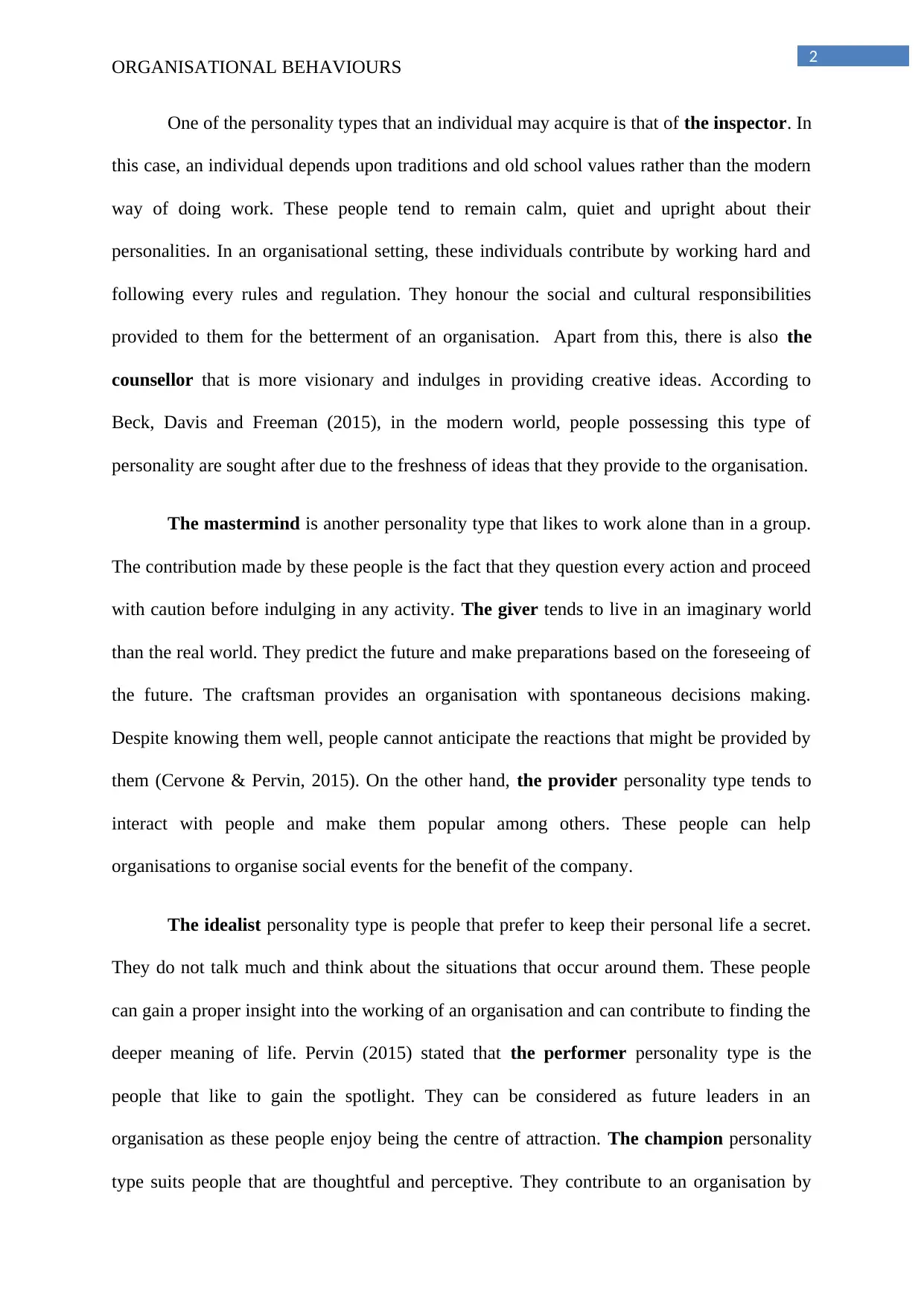
One of the personality types that an individual may acquire is that of the inspector. In
this case, an individual depends upon traditions and old school values rather than the modern
way of doing work. These people tend to remain calm, quiet and upright about their
personalities. In an organisational setting, these individuals contribute by working hard and
following every rules and regulation. They honour the social and cultural responsibilities
provided to them for the betterment of an organisation. Apart from this, there is also the
counsellor that is more visionary and indulges in providing creative ideas. According to
Beck, Davis and Freeman (2015), in the modern world, people possessing this type of
personality are sought after due to the freshness of ideas that they provide to the organisation.
The mastermind is another personality type that likes to work alone than in a group.
The contribution made by these people is the fact that they question every action and proceed
with caution before indulging in any activity. The giver tends to live in an imaginary world
than the real world. They predict the future and make preparations based on the foreseeing of
the future. The craftsman provides an organisation with spontaneous decisions making.
Despite knowing them well, people cannot anticipate the reactions that might be provided by
them (Cervone & Pervin, 2015). On the other hand, the provider personality type tends to
interact with people and make them popular among others. These people can help
organisations to organise social events for the benefit of the company.
The idealist personality type is people that prefer to keep their personal life a secret.
They do not talk much and think about the situations that occur around them. These people
can gain a proper insight into the working of an organisation and can contribute to finding the
deeper meaning of life. Pervin (2015) stated that the performer personality type is the
people that like to gain the spotlight. They can be considered as future leaders in an
organisation as these people enjoy being the centre of attraction. The champion personality
type suits people that are thoughtful and perceptive. They contribute to an organisation by
Document Page
3
ORGANISATIONAL BEHAVIOURS
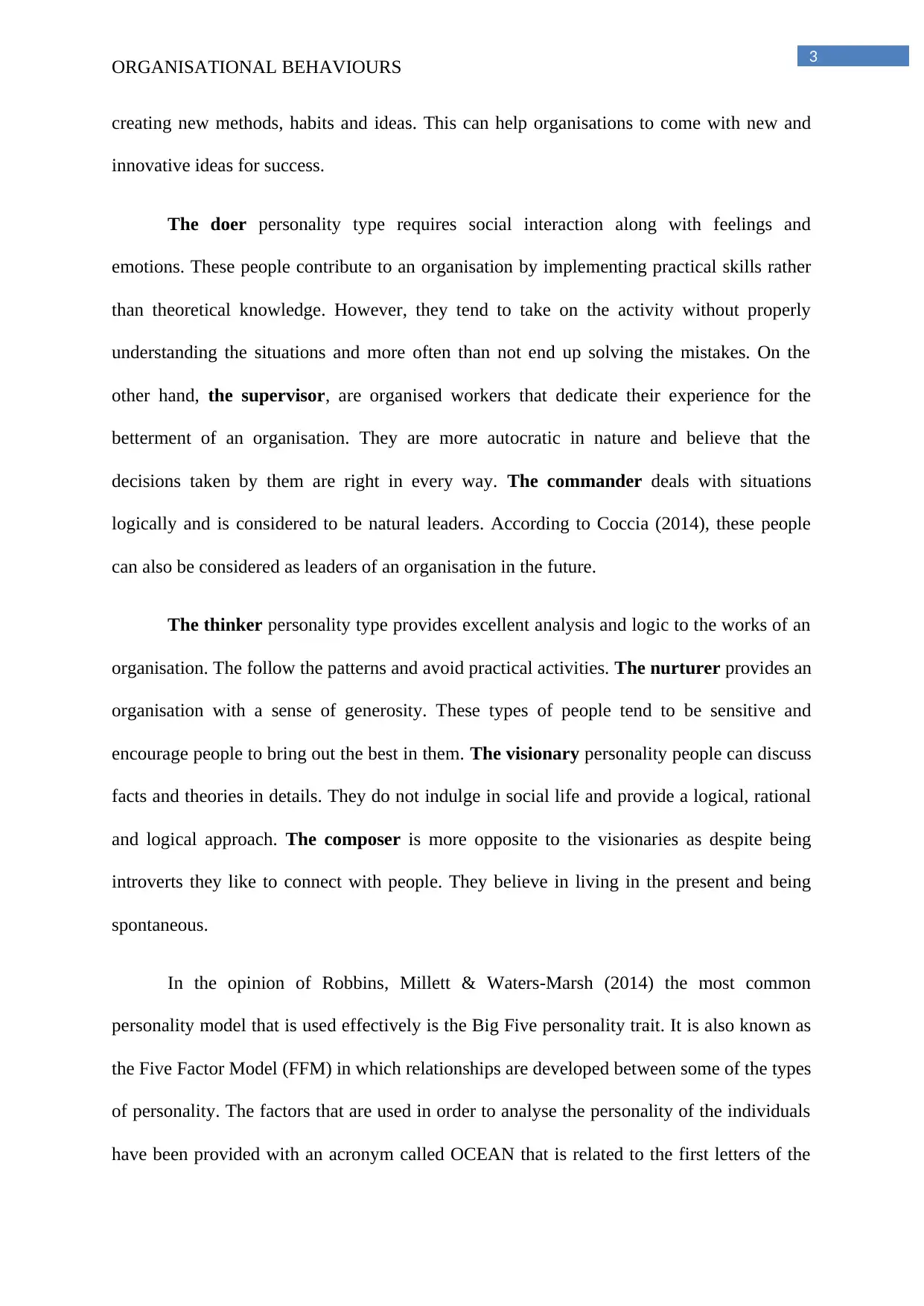
creating new methods, habits and ideas. This can help organisations to come with new and
innovative ideas for success.
The doer personality type requires social interaction along with feelings and
emotions. These people contribute to an organisation by implementing practical skills rather
than theoretical knowledge. However, they tend to take on the activity without properly
understanding the situations and more often than not end up solving the mistakes. On the
other hand, the supervisor, are organised workers that dedicate their experience for the
betterment of an organisation. They are more autocratic in nature and believe that the
decisions taken by them are right in every way. The commander deals with situations
logically and is considered to be natural leaders. According to Coccia (2014), these people
can also be considered as leaders of an organisation in the future.
The thinker personality type provides excellent analysis and logic to the works of an
organisation. The follow the patterns and avoid practical activities. The nurturer provides an
organisation with a sense of generosity. These types of people tend to be sensitive and
encourage people to bring out the best in them. The visionary personality people can discuss
facts and theories in details. They do not indulge in social life and provide a logical, rational
and logical approach. The composer is more opposite to the visionaries as despite being
introverts they like to connect with people. They believe in living in the present and being
spontaneous.
In the opinion of Robbins, Millett & Waters-Marsh (2014) the most common
personality model that is used effectively is the Big Five personality trait. It is also known as
the Five Factor Model (FFM) in which relationships are developed between some of the types
of personality. The factors that are used in order to analyse the personality of the individuals
have been provided with an acronym called OCEAN that is related to the first letters of the
tabler-icon-diamond-filled.svg

Paraphrase This Document

Need a fresh take? Get an instant paraphrase of this document with our AI Paraphraser
Document Page
4
ORGANISATIONAL BEHAVIOURS
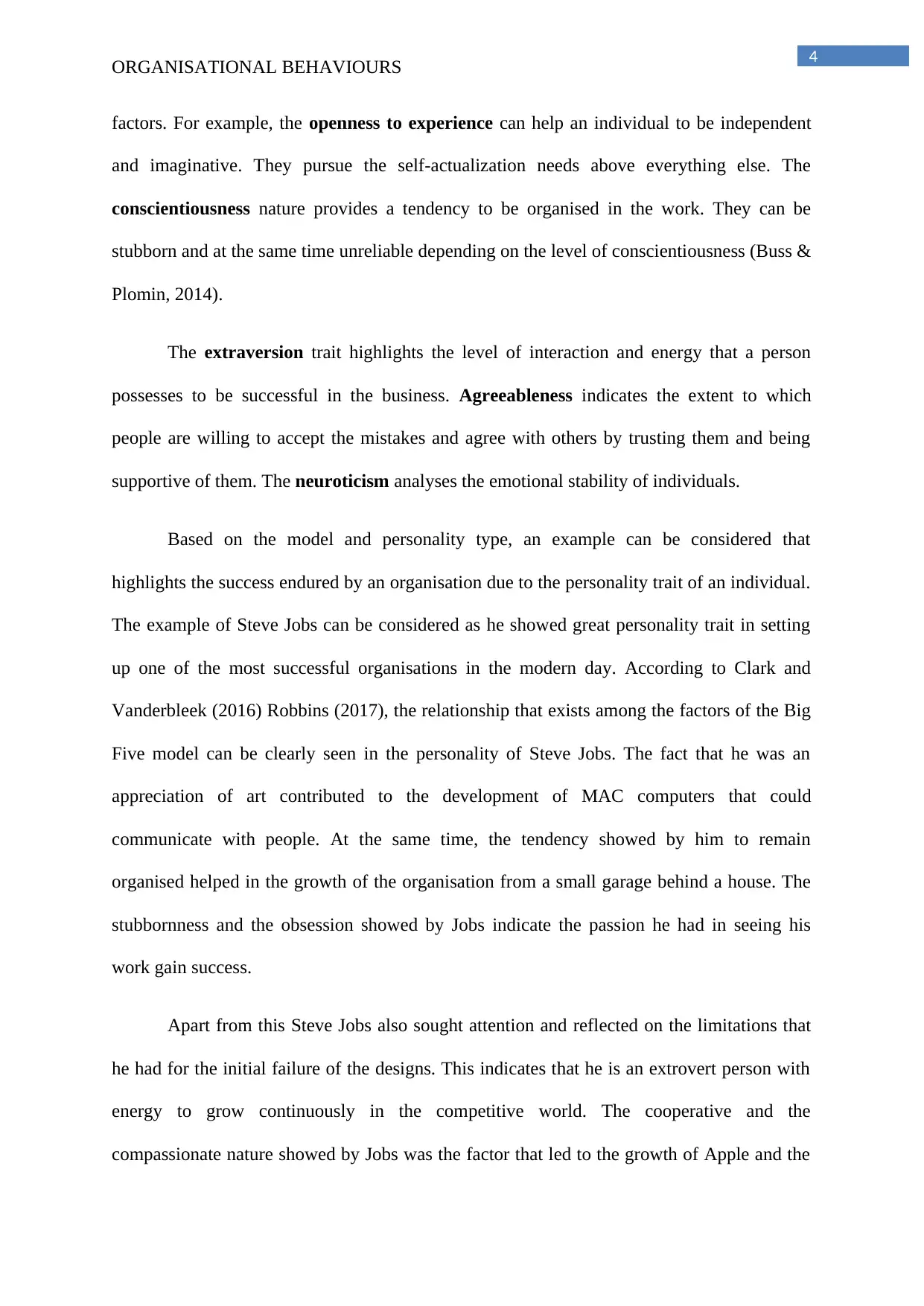
factors. For example, the openness to experience can help an individual to be independent
and imaginative. They pursue the self-actualization needs above everything else. The
conscientiousness nature provides a tendency to be organised in the work. They can be
stubborn and at the same time unreliable depending on the level of conscientiousness (Buss &
Plomin, 2014).
The extraversion trait highlights the level of interaction and energy that a person
possesses to be successful in the business. Agreeableness indicates the extent to which
people are willing to accept the mistakes and agree with others by trusting them and being
supportive of them. The neuroticism analyses the emotional stability of individuals.
Based on the model and personality type, an example can be considered that
highlights the success endured by an organisation due to the personality trait of an individual.
The example of Steve Jobs can be considered as he showed great personality trait in setting
up one of the most successful organisations in the modern day. According to Clark and
Vanderbleek (2016) Robbins (2017), the relationship that exists among the factors of the Big
Five model can be clearly seen in the personality of Steve Jobs. The fact that he was an
appreciation of art contributed to the development of MAC computers that could
communicate with people. At the same time, the tendency showed by him to remain
organised helped in the growth of the organisation from a small garage behind a house. The
stubbornness and the obsession showed by Jobs indicate the passion he had in seeing his
work gain success.
Apart from this Steve Jobs also sought attention and reflected on the limitations that
he had for the initial failure of the designs. This indicates that he is an extrovert person with
energy to grow continuously in the competitive world. The cooperative and the
compassionate nature showed by Jobs was the factor that led to the growth of Apple and the
Document Page
5
ORGANISATIONAL BEHAVIOURS
fact that the organisation is currently run by over 123,000 employees. The emotional stability
shown by Jobs is another reason for his success. Despite the initial failure, Steve Jobs did not
show any vulnerability and continued with the expansion of the company.
Thus, it can be concluded that personality plays an important role for employees to
get their desired jobs. The manner in which, organisations delegate tasks to employees are
depended on the personality types of the individuals. The application of the Big Five model
helps in understanding the connectivity that exists among the personality traits. The success
story of Steve Jobs can be considered as inspiring as it highlights the achievement of a
successful career due to the personality trait. Hence, organisations need to manage people
based on their personality. One of the ways that can be used to access the personality of
individuals is by conducting a personality test. To do so organisations can take up the Big
Five model test and analyse the personalities of the individuals.
Document Page
6
ORGANISATIONAL BEHAVIOURS
Reference
Beck, A. T., Davis, D. D., & Freeman, A. (Eds.). (2015). Cognitive therapy of personality
disorders. Guilford Publications.
Buss, A. H., & Plomin, R. (2014). Temperament (PLE: Emotion): Early developing
personality traits (Vol. 3). Psychology Press.
Cervone, D., & Pervin, L. A. (2015). Personality, binder ready version: theory and research.
John Wiley & Sons.
Clark, L. A., & Vanderbleek, E. (2016). Schedule for nonadaptive and adaptive
personality. Encyclopedia of Personality and Individual Differences, 1-4.
Cleckley, H. M. (2016). The Mask Of Sanity: An Attempt To Clarify Some Issues About the
So-Called Psychopathic Personality 3rd Edition. Pickle Partners Publishing.
Coccia, M. (2014). Structure and organisational behaviour of public research institutions
under unstable growth of human resources. International Journal of Services
Technology and Management, 20(4-6), 251-266.
Pervin, L. A. (Ed.). (2015). Goal concepts in personality and social psychology. Psychology
Press.
Revelle, W. R. (2017). psych: Procedures for personality and psychological research.
Robbins, S. P. (2017). Organizational Behavior, 13/E. Pearson Education
Robbins, S. P., Judge, T., & Campbell, T. T. (2014). Organizational behaviour. Financial
Times Prentice Hall.
Robbins, S., Millett, B., & Waters-Marsh, T. (2014). Organisational behaviour.
tabler-icon-diamond-filled.svg

Paraphrase This Document

Need a fresh take? Get an instant paraphrase of this document with our AI Paraphraser
Document Page
7
ORGANISATIONAL BEHAVIOURS
Wood, J. M., Zeffane, R. M., Fromholtz, M., Wiesner, R., Morrison, R., Factor, A., ... &
Osborn, R. N. (2016). Organisational behaviour: Core concepts and applications.
John Wiley & Sons Australia, Ltd..
chevron_up_icon
1 out of 8
circle_padding
hide_on_mobile
zoom_out_icon
[object Object]