Organisational Behaviour: Culture, Motivation & Teams - BTEC HND
VerifiedAdded on 2023/06/18
|18
|3845
|306
Report
AI Summary
This report delves into organisational behaviour, examining the influence of organisational culture, politics, and power on individual and team performance, using Marks and Spencer as a case study. It analyses content and process theories of motivation, including Maslow's hierarchy of needs and Vroom's expectancy theory, and discusses the characteristics of effective versus ineffective teams, referencing Tuckman's theory of team development. The report evaluates how these concepts impact goal achievement and overall organisational effectiveness, highlighting the importance of a supportive and motivational environment for employees.
Organisational Behaviour
1
1

Paraphrase This Document
Need a fresh take? Get an instant paraphrase of this document with our AI Paraphraser
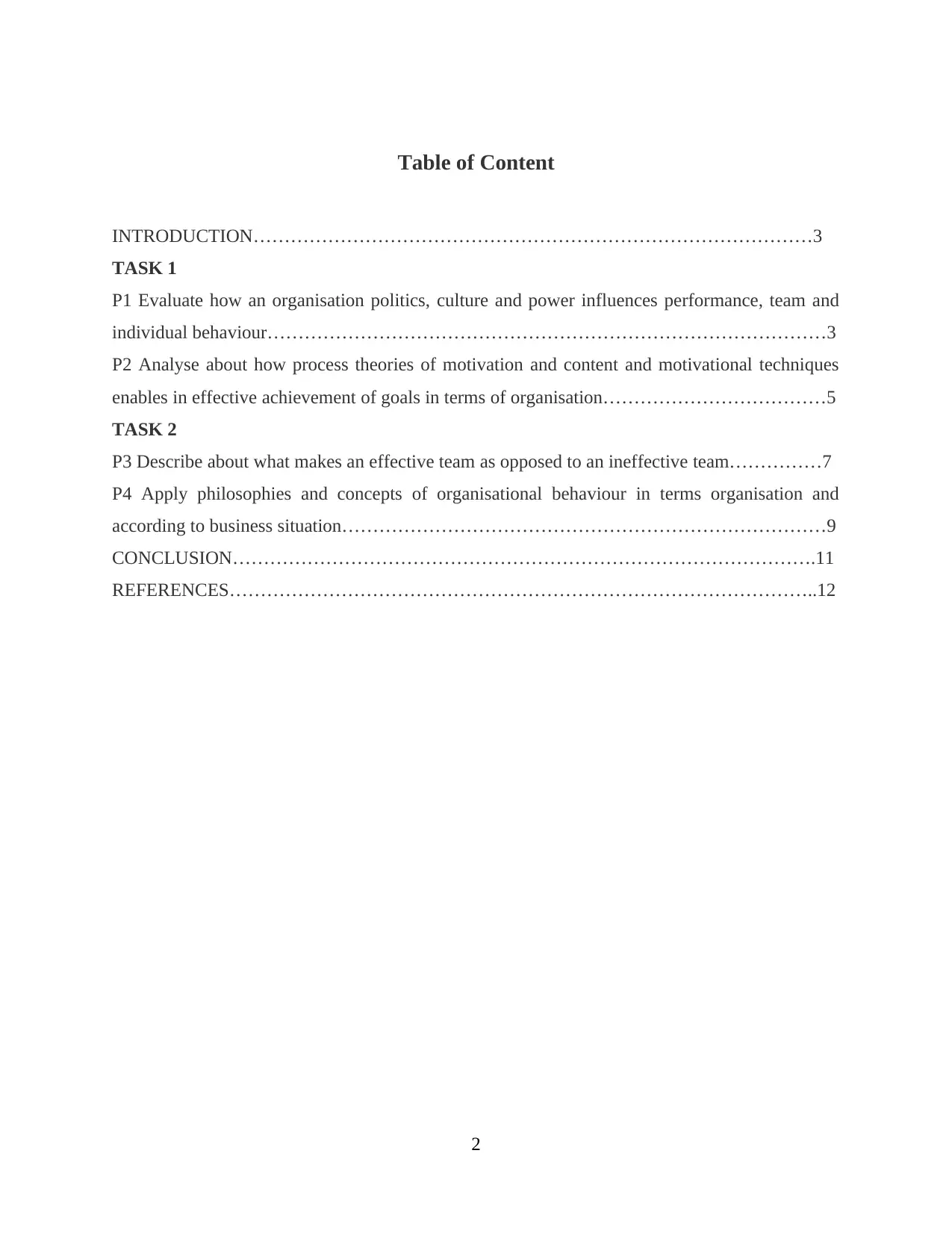
Table of Content
INTRODUCTION………………………………………………………………………………3
TASK 1
P1 Evaluate how an organisation politics, culture and power influences performance, team and
individual behaviour………………………………………………………………………………3
P2 Analyse about how process theories of motivation and content and motivational techniques
enables in effective achievement of goals in terms of organisation………………………………5
TASK 2
P3 Describe about what makes an effective team as opposed to an ineffective team……………7
P4 Apply philosophies and concepts of organisational behaviour in terms organisation and
according to business situation……………………………………………………………………9
CONCLUSION………………………………………………………………………………….11
REFERENCES…………………………………………………………………………………..12
2
INTRODUCTION………………………………………………………………………………3
TASK 1
P1 Evaluate how an organisation politics, culture and power influences performance, team and
individual behaviour………………………………………………………………………………3
P2 Analyse about how process theories of motivation and content and motivational techniques
enables in effective achievement of goals in terms of organisation………………………………5
TASK 2
P3 Describe about what makes an effective team as opposed to an ineffective team……………7
P4 Apply philosophies and concepts of organisational behaviour in terms organisation and
according to business situation……………………………………………………………………9
CONCLUSION………………………………………………………………………………….11
REFERENCES…………………………………………………………………………………..12
2
INTRODUCTION
Organisational behaviour can be defined in a manner that it is basically study of human
behaviour in organisational settings and it act as a interface between human behaviour and the
organisation. It is the academic study of how people interact within groups and its principles are
applied in such a manner that to make business more effective in nature. In this report, the
analysis has been done on organisational culture, politics and power which influences individual
and team behaviour and their performance (Widmer, T. and Prior, D., 2019). The analysis has
also been done on content and process theories of motivation which enables the effective
achievement of goals. Research has been done on factors which make effective team as opposed
to ineffective team. Research has also been done on concepts and philosophies of organisational
behaviour within organisational context. The chosen organisation is Marks and Spencer. It is a
company which is a major British multinational retailer company which has headquarter in
London, England. This company is specialised in selling clothes, home and food products and
they are mostly of their own label.
TASK 1
P1 Evaluate how an organisation politics, culture and power influences performance, team and
individual behaviour
With an organisation, if culture is in positive framework and politics and power are in
controlled pattern then it can lead towards positive outcome in terms of performance as well as
team and individual behaviour. When organisation provides such an environment where people
can work into flexible manner and can share their ideas into free way then it has been observed
that performance of team has increased into result oriented and effective manner. If organisation
environment is not supportive for employees then there are chances that unfavourable things has
happened within an organisation and due to effect of politics every team member does not get
equal opportunity(Salin, and et.al., 2019).Within an organisation, if senior person uses its power
into positive spectrum then an environment has been created in terms of discipline manner and
due to which potential of performance of team has been increased into effective manner.
With this kind of behaviour, an individual also feel confident while working because they know
that in any challenging and unfavourable situation senior person will take decision into positive
and decisive manner. If organisation environment is in terms of motivational way, supportive
3
Organisational behaviour can be defined in a manner that it is basically study of human
behaviour in organisational settings and it act as a interface between human behaviour and the
organisation. It is the academic study of how people interact within groups and its principles are
applied in such a manner that to make business more effective in nature. In this report, the
analysis has been done on organisational culture, politics and power which influences individual
and team behaviour and their performance (Widmer, T. and Prior, D., 2019). The analysis has
also been done on content and process theories of motivation which enables the effective
achievement of goals. Research has been done on factors which make effective team as opposed
to ineffective team. Research has also been done on concepts and philosophies of organisational
behaviour within organisational context. The chosen organisation is Marks and Spencer. It is a
company which is a major British multinational retailer company which has headquarter in
London, England. This company is specialised in selling clothes, home and food products and
they are mostly of their own label.
TASK 1
P1 Evaluate how an organisation politics, culture and power influences performance, team and
individual behaviour
With an organisation, if culture is in positive framework and politics and power are in
controlled pattern then it can lead towards positive outcome in terms of performance as well as
team and individual behaviour. When organisation provides such an environment where people
can work into flexible manner and can share their ideas into free way then it has been observed
that performance of team has increased into result oriented and effective manner. If organisation
environment is not supportive for employees then there are chances that unfavourable things has
happened within an organisation and due to effect of politics every team member does not get
equal opportunity(Salin, and et.al., 2019).Within an organisation, if senior person uses its power
into positive spectrum then an environment has been created in terms of discipline manner and
due to which potential of performance of team has been increased into effective manner.
With this kind of behaviour, an individual also feel confident while working because they know
that in any challenging and unfavourable situation senior person will take decision into positive
and decisive manner. If organisation environment is in terms of motivational way, supportive
3
⊘ This is a preview!⊘
Do you want full access?
Subscribe today to unlock all pages.

Trusted by 1+ million students worldwide
and in encouraging form then it will result into better performance of an individual as well as of
a team into collective manner.
There is a theory which is linked to culture of an organisation which is named as Charles
handy theory. He has talked about four different types of power culture and it has been explained
into following manner:
Power Culture: Under this type of culture, decision-making is in hands of very rare
people who hold real authority and power within an organisation.
Role Culture: Role culture are kind of hierarchical bureaucracies where power derives
from authority and kind of responsibilities hold by an individual .
Task Culture: Under this type of culture, teams are formed for purpose of executing task
on specific areas or solve specific problems. Within an organisation it is important that
task should be completed within a period of time.
Person Culture: Under this type of culture, organisation is consist of people with similar
training and background (Sobaih, and et.al., 2020). Organisation basically formed from
collective of individuals who are loosely aligned such as group of barristers or head-
hunters.
Within an organisation, power plays a very important role there are majorly seven types of
power.
Legitimate Power: This is a power which derives from formal position or work place
which is held in organisational hierarchy of authority.
Coercive Power: Under this type of power, it is the ability of a manager that to force an
employee to follow an order which threatens the employee with punishment if employee
does not follow the order.
Expert Power: It is a kind of power where it has perception that a certain person has an
elevated level of knowledge or particular kind of skill set which no one has within an
organisation.
Informational power: Under this power, an individual want, possess or needed
information.
Power of reward: It has been used to convey through rewarding individuals for
compliance of one's wishes.
4
a team into collective manner.
There is a theory which is linked to culture of an organisation which is named as Charles
handy theory. He has talked about four different types of power culture and it has been explained
into following manner:
Power Culture: Under this type of culture, decision-making is in hands of very rare
people who hold real authority and power within an organisation.
Role Culture: Role culture are kind of hierarchical bureaucracies where power derives
from authority and kind of responsibilities hold by an individual .
Task Culture: Under this type of culture, teams are formed for purpose of executing task
on specific areas or solve specific problems. Within an organisation it is important that
task should be completed within a period of time.
Person Culture: Under this type of culture, organisation is consist of people with similar
training and background (Sobaih, and et.al., 2020). Organisation basically formed from
collective of individuals who are loosely aligned such as group of barristers or head-
hunters.
Within an organisation, power plays a very important role there are majorly seven types of
power.
Legitimate Power: This is a power which derives from formal position or work place
which is held in organisational hierarchy of authority.
Coercive Power: Under this type of power, it is the ability of a manager that to force an
employee to follow an order which threatens the employee with punishment if employee
does not follow the order.
Expert Power: It is a kind of power where it has perception that a certain person has an
elevated level of knowledge or particular kind of skill set which no one has within an
organisation.
Informational power: Under this power, an individual want, possess or needed
information.
Power of reward: It has been used to convey through rewarding individuals for
compliance of one's wishes.
4
Paraphrase This Document
Need a fresh take? Get an instant paraphrase of this document with our AI Paraphraser
Connection power: Under this power, an individual attains influence by gaining favour.
Referent power: It is a kind of power where it talks about ability of a leader or boss to
influence an employee through administration and respect.
In terms of M & S, employees are rewarded on basis of their performance and there is a kind of
positive and motivational kind of framework is there into the organisation. With positive kind of
environment provided by company, it has been identified that employees and work force behave
into an appropriate manner in the company (Carvalho, and et.al., 2019).With support of healthy
organisational culture the individual behaviour has been nourished on continuous basis. For
purpose of achieving market competitiveness, internal competitiveness has been arises due to
which it affect behaviour of an individual as well as team within an organisation. In this way, all
these three factors plays a major role in influencing behaviour of an individual as well as
performance of a team.
P2 Analyse about how process theories of motivation and content and motivational techniques
enables in effective achievement of goals in terms of organisation
Under this process theories of motivation it includes two types of theories which are
named as content and process theories.
Content theories: It includes six types of theories which are named as Maslow's hierarchy of
needs, Herzberg's two factor theory, Mcclelland's three needs theory, Mcgregor's theory X and Y
, A lderter's ERG theory and Mayo's motivation theory.
Within an organisation, Maslow's hierarchy of needs can be applied for successful
implementation of work and goals need to be achieved into positive manner.
Maslow's hierarchy of needs: This has displayed in form of a pyramid. The lowed level of
pyramid has been made from basic needs while the complex needs are at the top level of pyramid
(Balmer, J. M. and Burghausen, M., 2015).These five levels has been explained into following
manner:
Physiological Needs: These are the things which are vital for an individual survival.
Examples of it include are food, water, breathing.
Security and safety needs: At this level, people want control and order in their lives. This
level majorly contributes towards behaviours of people. Basic safety and security include
financial security, health and wellness, safety against injury and accidents.
5
Referent power: It is a kind of power where it talks about ability of a leader or boss to
influence an employee through administration and respect.
In terms of M & S, employees are rewarded on basis of their performance and there is a kind of
positive and motivational kind of framework is there into the organisation. With positive kind of
environment provided by company, it has been identified that employees and work force behave
into an appropriate manner in the company (Carvalho, and et.al., 2019).With support of healthy
organisational culture the individual behaviour has been nourished on continuous basis. For
purpose of achieving market competitiveness, internal competitiveness has been arises due to
which it affect behaviour of an individual as well as team within an organisation. In this way, all
these three factors plays a major role in influencing behaviour of an individual as well as
performance of a team.
P2 Analyse about how process theories of motivation and content and motivational techniques
enables in effective achievement of goals in terms of organisation
Under this process theories of motivation it includes two types of theories which are
named as content and process theories.
Content theories: It includes six types of theories which are named as Maslow's hierarchy of
needs, Herzberg's two factor theory, Mcclelland's three needs theory, Mcgregor's theory X and Y
, A lderter's ERG theory and Mayo's motivation theory.
Within an organisation, Maslow's hierarchy of needs can be applied for successful
implementation of work and goals need to be achieved into positive manner.
Maslow's hierarchy of needs: This has displayed in form of a pyramid. The lowed level of
pyramid has been made from basic needs while the complex needs are at the top level of pyramid
(Balmer, J. M. and Burghausen, M., 2015).These five levels has been explained into following
manner:
Physiological Needs: These are the things which are vital for an individual survival.
Examples of it include are food, water, breathing.
Security and safety needs: At this level, people want control and order in their lives. This
level majorly contributes towards behaviours of people. Basic safety and security include
financial security, health and wellness, safety against injury and accidents.
5
Social Needs: In this level of hierarchy it includes such things as love, acceptance and
belonging(Cafferkey, K. and Dundon, T., 2015). Human behaviour has been driven
through the need of emotional relationships. This need has been satisfied through some of
the things which include friendships, romantic attachments, family, social groups.
Esteem Needs: At this level, it is need for appreciation and respect. People have need to
accomplish their goals and needs and after that their efforts have been recognized.
Esteem needs include self esteem and personal worth(Green, P. and Adekanmbi, O.,
2015). In terms of example it includes professional activities, academic accomplishments
personal hobbies can play an important role in fulfilling the esteem needs.
Self actualisation needs:This level has been described in a manner that it is the full use
and exploitation of capabilities, talents, potentialities etc. At this level, people are
developed in full manner and developing themselves to their highest level.
It has been implemented into an organisation in such a manner that employees should be
satisfied from their work in this way that they can fulfil their basic needs and by support of
learning and practical challenges they have achieved their highest goals through hard work and
smartness.
6
belonging(Cafferkey, K. and Dundon, T., 2015). Human behaviour has been driven
through the need of emotional relationships. This need has been satisfied through some of
the things which include friendships, romantic attachments, family, social groups.
Esteem Needs: At this level, it is need for appreciation and respect. People have need to
accomplish their goals and needs and after that their efforts have been recognized.
Esteem needs include self esteem and personal worth(Green, P. and Adekanmbi, O.,
2015). In terms of example it includes professional activities, academic accomplishments
personal hobbies can play an important role in fulfilling the esteem needs.
Self actualisation needs:This level has been described in a manner that it is the full use
and exploitation of capabilities, talents, potentialities etc. At this level, people are
developed in full manner and developing themselves to their highest level.
It has been implemented into an organisation in such a manner that employees should be
satisfied from their work in this way that they can fulfil their basic needs and by support of
learning and practical challenges they have achieved their highest goals through hard work and
smartness.
6
⊘ This is a preview!⊘
Do you want full access?
Subscribe today to unlock all pages.
Trusted by 1+ million students worldwide
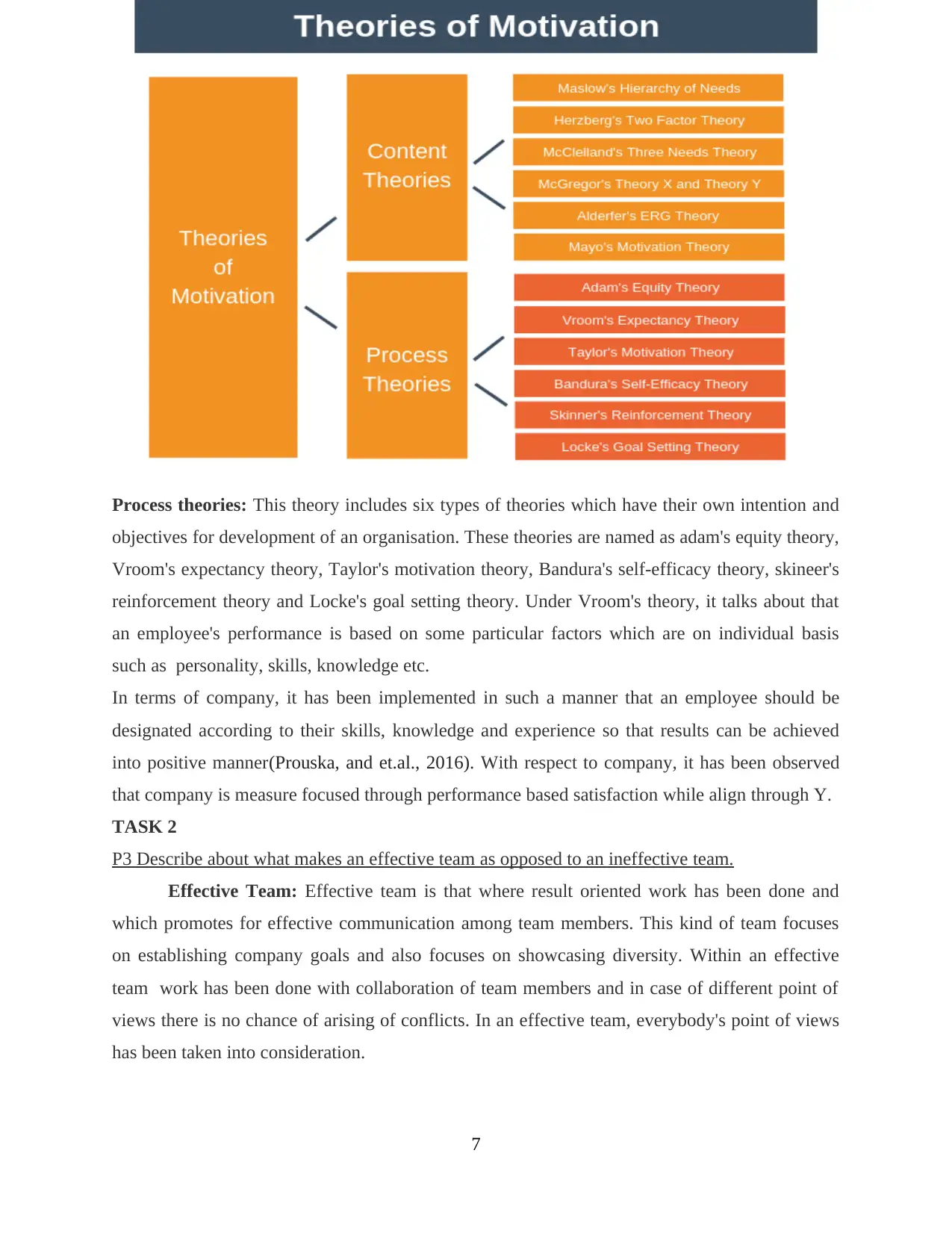
Process theories: This theory includes six types of theories which have their own intention and
objectives for development of an organisation. These theories are named as adam's equity theory,
Vroom's expectancy theory, Taylor's motivation theory, Bandura's self-efficacy theory, skineer's
reinforcement theory and Locke's goal setting theory. Under Vroom's theory, it talks about that
an employee's performance is based on some particular factors which are on individual basis
such as personality, skills, knowledge etc.
In terms of company, it has been implemented in such a manner that an employee should be
designated according to their skills, knowledge and experience so that results can be achieved
into positive manner(Prouska, and et.al., 2016). With respect to company, it has been observed
that company is measure focused through performance based satisfaction while align through Y.
TASK 2
P3 Describe about what makes an effective team as opposed to an ineffective team.
Effective Team: Effective team is that where result oriented work has been done and
which promotes for effective communication among team members. This kind of team focuses
on establishing company goals and also focuses on showcasing diversity. Within an effective
team work has been done with collaboration of team members and in case of different point of
views there is no chance of arising of conflicts. In an effective team, everybody's point of views
has been taken into consideration.
7
objectives for development of an organisation. These theories are named as adam's equity theory,
Vroom's expectancy theory, Taylor's motivation theory, Bandura's self-efficacy theory, skineer's
reinforcement theory and Locke's goal setting theory. Under Vroom's theory, it talks about that
an employee's performance is based on some particular factors which are on individual basis
such as personality, skills, knowledge etc.
In terms of company, it has been implemented in such a manner that an employee should be
designated according to their skills, knowledge and experience so that results can be achieved
into positive manner(Prouska, and et.al., 2016). With respect to company, it has been observed
that company is measure focused through performance based satisfaction while align through Y.
TASK 2
P3 Describe about what makes an effective team as opposed to an ineffective team.
Effective Team: Effective team is that where result oriented work has been done and
which promotes for effective communication among team members. This kind of team focuses
on establishing company goals and also focuses on showcasing diversity. Within an effective
team work has been done with collaboration of team members and in case of different point of
views there is no chance of arising of conflicts. In an effective team, everybody's point of views
has been taken into consideration.
7
Paraphrase This Document
Need a fresh take? Get an instant paraphrase of this document with our AI Paraphraser
Advantages of effective team: There are various types of advantages of effective team within an
organisation due to which they can achieve their goals and objectives into the result oriented
manner(Auschra, C., 2018). Effective team leads towards idea creation and creativity due to
which better results and unique product can be given into the market. Within an effective, it leads
towards for improving productivity and brings better results into business. It also supports in
boosting employee morale and motivation and also helps in taking healthy risks.
Ineffective Team: An ineffective team is basically considered under conflict-ridden category
which is filled with all kinds of disturbances, negative competition and also on unfocused area.
This type of team basically leads towards manifesting themselves high turnover and
absenteeism,frustration levels, intolerance and communication.
Disadvantages of ineffective team: In an ineffective team, it is very challenging to achieve
goals and objectives of an organisation because there is no trend of considering everybody's
point of views. Within an ineffective team it is difficult to understand each and everyone because
no one has patience level to understand everybody's idea and expression. It is also impossible to
achieve daily basis task into successful manner and also there is no collaboration among team
members(Globocnik, and et.al., 2020). In an ineffective team, it has been observed that the focus
is more on gossiping and friction rather than doing work and achieving targets into effective
manner. Work process also becomes difficult and information has also conveyed into
inappropriate manner. There is also loss of engagement among team members because they are
not ready to support each other.
There is a theory attached with effective and ineffective team work which is named as
Tuckman's theory. It has been defined into following manner:
This model has been developed by Bruce Tuckman and it has focus towards the team in
tackling a task from the initial formation of the team through to the completion of the project.
This theory involves four parameters of this model which are named as forming, storming,
norming.
Forming: Under this head, the team needs to be assembled in a proper way and task
should be allocated into effective manner. Team members need to behave into
independent manner.
8
organisation due to which they can achieve their goals and objectives into the result oriented
manner(Auschra, C., 2018). Effective team leads towards idea creation and creativity due to
which better results and unique product can be given into the market. Within an effective, it leads
towards for improving productivity and brings better results into business. It also supports in
boosting employee morale and motivation and also helps in taking healthy risks.
Ineffective Team: An ineffective team is basically considered under conflict-ridden category
which is filled with all kinds of disturbances, negative competition and also on unfocused area.
This type of team basically leads towards manifesting themselves high turnover and
absenteeism,frustration levels, intolerance and communication.
Disadvantages of ineffective team: In an ineffective team, it is very challenging to achieve
goals and objectives of an organisation because there is no trend of considering everybody's
point of views. Within an ineffective team it is difficult to understand each and everyone because
no one has patience level to understand everybody's idea and expression. It is also impossible to
achieve daily basis task into successful manner and also there is no collaboration among team
members(Globocnik, and et.al., 2020). In an ineffective team, it has been observed that the focus
is more on gossiping and friction rather than doing work and achieving targets into effective
manner. Work process also becomes difficult and information has also conveyed into
inappropriate manner. There is also loss of engagement among team members because they are
not ready to support each other.
There is a theory attached with effective and ineffective team work which is named as
Tuckman's theory. It has been defined into following manner:
This model has been developed by Bruce Tuckman and it has focus towards the team in
tackling a task from the initial formation of the team through to the completion of the project.
This theory involves four parameters of this model which are named as forming, storming,
norming.
Forming: Under this head, the team needs to be assembled in a proper way and task
should be allocated into effective manner. Team members need to behave into
independent manner.
8
Storming: Under this head, team needs to address all types of ideas given from team
members(Camilleri, M. A., 2015). There are different types of people within an
organisation so everybody has their own point of view with respect to particular topic.
Norming: Under this head, roles and responsibilities have been assigned into very clear
manner and are accepted by all team members. Among the team consensus and
agreement has been made on a large scale. Through support of group agreement big
decisions have been made and under this head commitment and unity has been done on a
large scale.
Performing: Under this head, team has to execute their work and perform their work into
well mannered way. Under this particular stage, consensus and cooperation have been
well established and the team is enough mature, well functioning and in a organised
manner. Clear and stable structure have been provided and members are committed to the
team’s mission. In the constructive manner, problems and conflicts have still emerged.
With context to company, for effective communication within team M & S currently focused on
Microsoft teams for purpose of internal communication whether it is across managers or within
specific stores(Zheng, and et.al., 2016). Within company, employees have worked in a
collaborative manner and managers also give support system to team and on the basis of
requirements employees can be sent to other departments to help out people. For creating
collaborative cultivation, they use office 365 groups to collaborate in Microsoft outlook for
creating more than five hundred office 365 groups. Each team has facility and flexibility for
setting its own modus operandi which supports for creativity in the work place. In this way, M &
S team has worked into collaborative and into positive manner.
P4 Apply philosophies and concepts of organisational behaviour in terms organisation and
according to business situation
Concept and philosophies of organisational behaviour are based on certain key elements
which are of nature of people as well as the organisation. Nature of people can be defined in a
manner where it refers to their basic qualities of an individual within an organisation. There are
some factors which affect nature of people it includes individual difference, whole person and
motivated behaviour and perception. It has been observed that according to first factor individual
has been approached according to one on one basis. With reference to Marks & Spencer, for
identifying point of views of an individual one on one discussion has been conducted on
9
members(Camilleri, M. A., 2015). There are different types of people within an
organisation so everybody has their own point of view with respect to particular topic.
Norming: Under this head, roles and responsibilities have been assigned into very clear
manner and are accepted by all team members. Among the team consensus and
agreement has been made on a large scale. Through support of group agreement big
decisions have been made and under this head commitment and unity has been done on a
large scale.
Performing: Under this head, team has to execute their work and perform their work into
well mannered way. Under this particular stage, consensus and cooperation have been
well established and the team is enough mature, well functioning and in a organised
manner. Clear and stable structure have been provided and members are committed to the
team’s mission. In the constructive manner, problems and conflicts have still emerged.
With context to company, for effective communication within team M & S currently focused on
Microsoft teams for purpose of internal communication whether it is across managers or within
specific stores(Zheng, and et.al., 2016). Within company, employees have worked in a
collaborative manner and managers also give support system to team and on the basis of
requirements employees can be sent to other departments to help out people. For creating
collaborative cultivation, they use office 365 groups to collaborate in Microsoft outlook for
creating more than five hundred office 365 groups. Each team has facility and flexibility for
setting its own modus operandi which supports for creativity in the work place. In this way, M &
S team has worked into collaborative and into positive manner.
P4 Apply philosophies and concepts of organisational behaviour in terms organisation and
according to business situation
Concept and philosophies of organisational behaviour are based on certain key elements
which are of nature of people as well as the organisation. Nature of people can be defined in a
manner where it refers to their basic qualities of an individual within an organisation. There are
some factors which affect nature of people it includes individual difference, whole person and
motivated behaviour and perception. It has been observed that according to first factor individual
has been approached according to one on one basis. With reference to Marks & Spencer, for
identifying point of views of an individual one on one discussion has been conducted on
9
⊘ This is a preview!⊘
Do you want full access?
Subscribe today to unlock all pages.
Trusted by 1+ million students worldwide
quarterly basis by managers of company(Lu, and et.al., 2017). There is second factor which is
perception which is a kind of ability to observe and conclude things. Behaviour of individual has
been influenced in positive as well as in negative manner by another factor which is named as
motivation. Employees of Marks & Spencer are motivated in positive manner by HR strategies
as well as by the management strategies offered by the management.
There are some people who are of low level are not satisfied from policies of company which
instils negative behaviour of employees. Whole person can be defined in a manner that it
involves the emotional conditions of the employees which are not separated from physical
conditions. Here social system is also very important it is a kind of social connectivity of
organisation to its customers, suppliers as well as to their stakeholders. It can be in form of
formal and in informal way(Szczepańska-Woszczyna, K., 2015). The behaviour of individual
also affected by these social system and it also act as mirror reflection of the values and beliefs
of organisation. Behaviour is also driven by group and individuals and ethics are moral
principles of organisation. Values, integrity, discipline and client centricity are some of the moral
standards and ethics in its business operations. The code of ethics training rewards has been
recently added to the company’s culture for notable ethical behaviour.
Mutual interest here refers to the mutual understanding of organisation as well as employees. In
the professional manner, mutual interest is an important determinant of behaviour. In terms of
company, it has been observed that company has to face various types of challenges in terms of
mutual understanding between organisation as well as employees. Mutual interest can lead
towards the positive as well as negative behaviour of an individual and according to theory of
Tuckman it has been analysed that all the elements of concepts and philosophies of
organisational behaviour are in complete alignment with all four phases of this theory which are
named as norming, forming, storming and performing(Soane, and et.al., 2015). With context to
concept and philosophies of organisational behaviour, it is basically a study of individuals,
groups and structures which investigates about impact on behaviour within an organisation. To
create a unique field, organisational behaviour has drawn from other disciplines. There are
various concepts attached to organisation which includes work specialisation, chain of command,
authority, delegation, span of control and centralisation. So these concepts and philosophies
plays a very important role in terms of business context for maintaining a proper organisational
behaviour into professional manner.
10
perception which is a kind of ability to observe and conclude things. Behaviour of individual has
been influenced in positive as well as in negative manner by another factor which is named as
motivation. Employees of Marks & Spencer are motivated in positive manner by HR strategies
as well as by the management strategies offered by the management.
There are some people who are of low level are not satisfied from policies of company which
instils negative behaviour of employees. Whole person can be defined in a manner that it
involves the emotional conditions of the employees which are not separated from physical
conditions. Here social system is also very important it is a kind of social connectivity of
organisation to its customers, suppliers as well as to their stakeholders. It can be in form of
formal and in informal way(Szczepańska-Woszczyna, K., 2015). The behaviour of individual
also affected by these social system and it also act as mirror reflection of the values and beliefs
of organisation. Behaviour is also driven by group and individuals and ethics are moral
principles of organisation. Values, integrity, discipline and client centricity are some of the moral
standards and ethics in its business operations. The code of ethics training rewards has been
recently added to the company’s culture for notable ethical behaviour.
Mutual interest here refers to the mutual understanding of organisation as well as employees. In
the professional manner, mutual interest is an important determinant of behaviour. In terms of
company, it has been observed that company has to face various types of challenges in terms of
mutual understanding between organisation as well as employees. Mutual interest can lead
towards the positive as well as negative behaviour of an individual and according to theory of
Tuckman it has been analysed that all the elements of concepts and philosophies of
organisational behaviour are in complete alignment with all four phases of this theory which are
named as norming, forming, storming and performing(Soane, and et.al., 2015). With context to
concept and philosophies of organisational behaviour, it is basically a study of individuals,
groups and structures which investigates about impact on behaviour within an organisation. To
create a unique field, organisational behaviour has drawn from other disciplines. There are
various concepts attached to organisation which includes work specialisation, chain of command,
authority, delegation, span of control and centralisation. So these concepts and philosophies
plays a very important role in terms of business context for maintaining a proper organisational
behaviour into professional manner.
10
Paraphrase This Document
Need a fresh take? Get an instant paraphrase of this document with our AI Paraphraser
CONCLUSION
It has been concluded from above report that organisational behaviour plays a very
important role within an organisation. It has been observed that power, politics and culture has
major influence on performance of team members as well as on individual. Process theories and
motivational techniques has major key role in enabling effective achievement of goals in terms
of organisation. There are some advantages of having effective team within an organisation and
also there are some disadvantages of having an ineffective team which does not contribute in
achieving goals and objectives of an organisation. There are some concepts and philosophies of
organisational behaviour which needs to be applied within an organisation into effective manner
for purpose of achieving result oriented work. So organisational behaviour is very important for
understanding each and every team member with respect to functions of an organisation. Under
this concept, employees contribution and their way of working and also their attitude towards
organisation also defines that up to which extent they are taking their responsibility into serious
manner.
11
It has been concluded from above report that organisational behaviour plays a very
important role within an organisation. It has been observed that power, politics and culture has
major influence on performance of team members as well as on individual. Process theories and
motivational techniques has major key role in enabling effective achievement of goals in terms
of organisation. There are some advantages of having effective team within an organisation and
also there are some disadvantages of having an ineffective team which does not contribute in
achieving goals and objectives of an organisation. There are some concepts and philosophies of
organisational behaviour which needs to be applied within an organisation into effective manner
for purpose of achieving result oriented work. So organisational behaviour is very important for
understanding each and every team member with respect to functions of an organisation. Under
this concept, employees contribution and their way of working and also their attitude towards
organisation also defines that up to which extent they are taking their responsibility into serious
manner.
11
REFERENCES
Books and Journals
Cafferkey, K. and Dundon, T., 2015. Explaining the black box: HPWS and organisational
climate. Personnel Review.
Widmer, T. and Prior, D., 2019. Institutional Isomorphism, Institutional Logics and
Organisational Fields: An Institutionalist Perspective on Circular Economy. In Proceedings of
the Spring Servitization Conference 2019, May.
Salin, and et.al., 2019. Workplace bullying across the globe: A cross-cultural
comparison. Personnel Review.
Sobaih, and et.al., 2020. The impact of transactional and transformational leadership on
employee intention to stay in deluxe hotels: Mediating role of organisational
commitment. Tourism and Hospitality Research, p.1467358420972156.
Carvalho, and et.al., 2019. Operational excellence, organisational culture and agility: the missing
link?. Total Quality Management & Business Excellence, 30(13-14), pp.1495-1514.
Balmer, J. M. and Burghausen, M., 2015. Corporate heritage, corporate heritage brands and
organisational heritage. Journal of Brand Management, 22(5), pp.361-364.
Green, P. and Adekanmbi, O., 2015. Examination of employee factors influencing organisational
productivity: Perspective of a public entity. Corporate board: role, duties & composition
(Online).
Prouska, and et.al., 2016. Rewarding employees in turbulent economies for improved
organisational performance: Exploring SMEs in the South-Eastern European region. Personnel
Review.
Auschra, C., 2018. Barriers to the integration of care in inter-organisational settings: a literature
review. International journal of integrated care, 18(1).
Globocnik, and et.al., 2020. Synergy or conflict? The relationships among organisational culture,
sustainability-related innovation performance, and economic innovation
performance. International Journal of Innovation Management, 24(01), p.2050004.
Camilleri, M. A., 2015. Valuing stakeholder engagement and sustainability reporting. Corporate
Reputation Review, 18(3), pp.210-222.
Zheng, and et.al., 2016. Impact of individual coping strategies and organisational work–life
balance programmes on Australian employee well-being. The International Journal of Human
Resource Management, 27(5), pp.501-526.
Lu, and et.al., 2017. The dark side of going abroad: How broad foreign experiences increase
immoral behavior. Journal of personality and social psychology, 112(1), p.1.
Szczepańska-Woszczyna, K., 2015. Leadership and organizational culture as the normative
influence of top management on employee's behaviour in the innovation process. Procedia
Economics and Finance, 34, pp.396-402.
Soane, and et.al., 2015. Followers’ personality, transformational leadership and
performance. Sport, Business and Management: An International Journal.
12
Books and Journals
Cafferkey, K. and Dundon, T., 2015. Explaining the black box: HPWS and organisational
climate. Personnel Review.
Widmer, T. and Prior, D., 2019. Institutional Isomorphism, Institutional Logics and
Organisational Fields: An Institutionalist Perspective on Circular Economy. In Proceedings of
the Spring Servitization Conference 2019, May.
Salin, and et.al., 2019. Workplace bullying across the globe: A cross-cultural
comparison. Personnel Review.
Sobaih, and et.al., 2020. The impact of transactional and transformational leadership on
employee intention to stay in deluxe hotels: Mediating role of organisational
commitment. Tourism and Hospitality Research, p.1467358420972156.
Carvalho, and et.al., 2019. Operational excellence, organisational culture and agility: the missing
link?. Total Quality Management & Business Excellence, 30(13-14), pp.1495-1514.
Balmer, J. M. and Burghausen, M., 2015. Corporate heritage, corporate heritage brands and
organisational heritage. Journal of Brand Management, 22(5), pp.361-364.
Green, P. and Adekanmbi, O., 2015. Examination of employee factors influencing organisational
productivity: Perspective of a public entity. Corporate board: role, duties & composition
(Online).
Prouska, and et.al., 2016. Rewarding employees in turbulent economies for improved
organisational performance: Exploring SMEs in the South-Eastern European region. Personnel
Review.
Auschra, C., 2018. Barriers to the integration of care in inter-organisational settings: a literature
review. International journal of integrated care, 18(1).
Globocnik, and et.al., 2020. Synergy or conflict? The relationships among organisational culture,
sustainability-related innovation performance, and economic innovation
performance. International Journal of Innovation Management, 24(01), p.2050004.
Camilleri, M. A., 2015. Valuing stakeholder engagement and sustainability reporting. Corporate
Reputation Review, 18(3), pp.210-222.
Zheng, and et.al., 2016. Impact of individual coping strategies and organisational work–life
balance programmes on Australian employee well-being. The International Journal of Human
Resource Management, 27(5), pp.501-526.
Lu, and et.al., 2017. The dark side of going abroad: How broad foreign experiences increase
immoral behavior. Journal of personality and social psychology, 112(1), p.1.
Szczepańska-Woszczyna, K., 2015. Leadership and organizational culture as the normative
influence of top management on employee's behaviour in the innovation process. Procedia
Economics and Finance, 34, pp.396-402.
Soane, and et.al., 2015. Followers’ personality, transformational leadership and
performance. Sport, Business and Management: An International Journal.
12
⊘ This is a preview!⊘
Do you want full access?
Subscribe today to unlock all pages.
Trusted by 1+ million students worldwide

1 out of 18


Related Documents


Your All-in-One AI-Powered Toolkit for Academic Success.
+13062052269
info@desklib.com
Available 24*7 on WhatsApp / Email
![[object Object]](/_next/static/media/star-bottom.7253800d.svg)
Unlock your academic potential
Copyright © 2020–2026 A2Z Services. All Rights Reserved. Developed and managed by ZUCOL.