Organisational Behaviour: Analysing Mood and Emotion in the Workplace
VerifiedAdded on 2022/09/17
|9
|2087
|21
Essay
AI Summary
This essay delves into the critical roles of mood and emotion in shaping organizational behaviour. It explores the distinctions between mood and emotion, and their impacts on employee performance, job satisfaction, and overall workplace dynamics. The essay examines the influence of emotional intelligence, the challenges posed by online communication, and the application of affective events theory. It highlights how positive attitudes, emotional management, and leadership skills can enhance employee relationships and improve organizational outcomes. The analysis covers various aspects, including the interplay of personality, work environment, and emotional episodes, providing a comprehensive understanding of the topic.
ORGANISATIONAL BEHAVIOUR

Paraphrase This Document
Need a fresh take? Get an instant paraphrase of this document with our AI Paraphraser
Contents
Introduction...........................................................................................................................................2
Mood and emotion at the workplace....................................................................................................2
Conclusion.............................................................................................................................................6
References.............................................................................................................................................7
Introduction...........................................................................................................................................2
Mood and emotion at the workplace....................................................................................................2
Conclusion.............................................................................................................................................6
References.............................................................................................................................................7
Introduction
Emotion is a short feeling, which occur from an identified cause whereas mood depicts the
state of mind, which is longer than emotion. Emotions range from sad, pride, happy, and
ecstatic where moods can be positive or negative. This essay and literature review is based on
the one of current issues occurring at the workplace such as emotions and moods (Davis,
Cheston, Locker, Bowser, & Wibran, 2017). This will be analysed and examined as per the
issue of changing moods and emotion among the employees at the workplace whether it is
effective tool or wrong tool to execute an effective performance at the workplace in regards
to the organisational objectives. According to Jung, & Yoon, (2015), there is a huge
difference between emotions and moods. Emotions are being caused by specific event and it
is specific to numerous event in nature. It is usually accomplished by different facial
expressions and it is action oriented. While evaluating the mood in the organisation, causes
are unclear and general that last long then the emotions. It can be both negative as well as
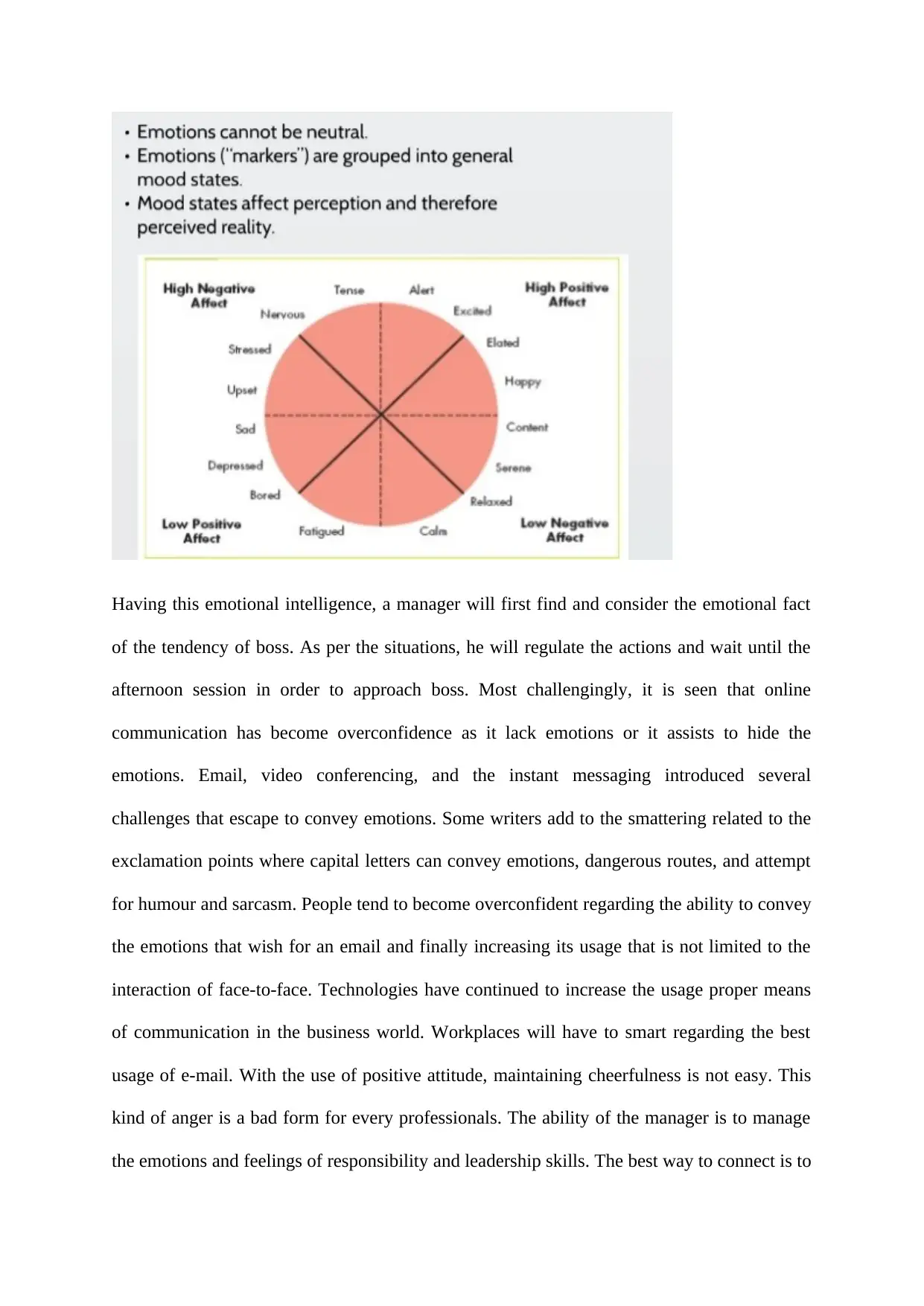
positive. It is cognitive in nature. Higher negativity can affect to lower down the positive
affect into tense, stressed, sad, fatigued, bared, depressed, and nervous. On the other hand,
higher positive effect can lower negative impact such as content, happy, relaxed, calm, and
excited (Davis, Cheston, Locker, Bowser, & Wibran, 2017).
Mood and emotion at the workplace
Understanding of moods and emotion suggests the evaluation of behaviour at the workplace
with the help of effective examples. For instance- employee`s basic behaviour might always
signify negativity such as at the weekly meeting and at the cafeteria line, it can lead to
sucking at that place due to brainstorming and rigid choice (Pekrun, 2016). Negativity can
even contaminate good news that can affect the behaviour at the workplace. Issues in Moods
and emotions can also occur due to clashes in personal life and professional life (Davis,
Cheston, Locker, Bowser, & Wibran, 2017). Issues and brainstorming can any one of them
Emotion is a short feeling, which occur from an identified cause whereas mood depicts the
state of mind, which is longer than emotion. Emotions range from sad, pride, happy, and
ecstatic where moods can be positive or negative. This essay and literature review is based on
the one of current issues occurring at the workplace such as emotions and moods (Davis,
Cheston, Locker, Bowser, & Wibran, 2017). This will be analysed and examined as per the
issue of changing moods and emotion among the employees at the workplace whether it is
effective tool or wrong tool to execute an effective performance at the workplace in regards
to the organisational objectives. According to Jung, & Yoon, (2015), there is a huge
difference between emotions and moods. Emotions are being caused by specific event and it
is specific to numerous event in nature. It is usually accomplished by different facial
expressions and it is action oriented. While evaluating the mood in the organisation, causes
are unclear and general that last long then the emotions. It can be both negative as well as
positive. It is cognitive in nature. Higher negativity can affect to lower down the positive
affect into tense, stressed, sad, fatigued, bared, depressed, and nervous. On the other hand,
higher positive effect can lower negative impact such as content, happy, relaxed, calm, and
excited (Davis, Cheston, Locker, Bowser, & Wibran, 2017).
Mood and emotion at the workplace
Understanding of moods and emotion suggests the evaluation of behaviour at the workplace
with the help of effective examples. For instance- employee`s basic behaviour might always
signify negativity such as at the weekly meeting and at the cafeteria line, it can lead to
sucking at that place due to brainstorming and rigid choice (Pekrun, 2016). Negativity can
even contaminate good news that can affect the behaviour at the workplace. Issues in Moods
and emotions can also occur due to clashes in personal life and professional life (Davis,
Cheston, Locker, Bowser, & Wibran, 2017). Issues and brainstorming can any one of them
⊘ This is a preview!⊘
Do you want full access?
Subscribe today to unlock all pages.

Trusted by 1+ million students worldwide
can affect both of them. While conducting critical analysis on each types, it is seen that
feeling can remain contagious whereas emotion do not have any great and severe impact
(Pekrun, 2016). For example- if a boss has good behaviour with whole humour then it can
seem him at the meetings with enthusiastic eyes while declaring any valuable information
that is the centre of meeting emotion. When a person or employees are good at controlling
their emotion, which does not mean that employees are not picking up their as per their
mood. This research paper introduces new concept of emotional labour where employees are
regulated as per their public displaying of emotion complying with the certain expectation.
For example- situations often enforces us to smile and become friendly even when the
employee is not in mood (Pekrun, 2016). This leads to deep acting might be acted just to
sympathise the stressed out workers and customers with lowered emotion (might be one who
lost his luggage). For instance- An airline worker will start to show sympathy to the
customers. The another approach can be healthier where it causes less burnouts and stress, it
can be helpful to straightforwardly regulate one`s emotion into an role play (Krueger, &
Szanto, 2016). Business schools often teach that before entering into an corporate world, a
student should become certainly emotionally intelligent and how the emotions of employees
can be managed. The main idea undertaken to foresee workplace where there is a skillset
treated by the employees as a treatment of emotion of the employee valuable (Krueger, &
Szanto, 2016). For example- when sales manager comes up with amazing idea of increasing
the corporate revenues by 200 percent but a manager thinks that his boss is short-tempered so
he should undertake to understand the mood of the boss after coming to office (Jung, &
Yoon, 2015).
feeling can remain contagious whereas emotion do not have any great and severe impact
(Pekrun, 2016). For example- if a boss has good behaviour with whole humour then it can
seem him at the meetings with enthusiastic eyes while declaring any valuable information
that is the centre of meeting emotion. When a person or employees are good at controlling
their emotion, which does not mean that employees are not picking up their as per their
mood. This research paper introduces new concept of emotional labour where employees are
regulated as per their public displaying of emotion complying with the certain expectation.
For example- situations often enforces us to smile and become friendly even when the
employee is not in mood (Pekrun, 2016). This leads to deep acting might be acted just to
sympathise the stressed out workers and customers with lowered emotion (might be one who
lost his luggage). For instance- An airline worker will start to show sympathy to the
customers. The another approach can be healthier where it causes less burnouts and stress, it
can be helpful to straightforwardly regulate one`s emotion into an role play (Krueger, &
Szanto, 2016). Business schools often teach that before entering into an corporate world, a
student should become certainly emotionally intelligent and how the emotions of employees
can be managed. The main idea undertaken to foresee workplace where there is a skillset
treated by the employees as a treatment of emotion of the employee valuable (Krueger, &
Szanto, 2016). For example- when sales manager comes up with amazing idea of increasing
the corporate revenues by 200 percent but a manager thinks that his boss is short-tempered so
he should undertake to understand the mood of the boss after coming to office (Jung, &
Yoon, 2015).
Paraphrase This Document
Need a fresh take? Get an instant paraphrase of this document with our AI Paraphraser
Having this emotional intelligence, a manager will first find and consider the emotional fact
of the tendency of boss. As per the situations, he will regulate the actions and wait until the
afternoon session in order to approach boss. Most challengingly, it is seen that online
communication has become overconfidence as it lack emotions or it assists to hide the
emotions. Email, video conferencing, and the instant messaging introduced several
challenges that escape to convey emotions. Some writers add to the smattering related to the
exclamation points where capital letters can convey emotions, dangerous routes, and attempt
for humour and sarcasm. People tend to become overconfident regarding the ability to convey
the emotions that wish for an email and finally increasing its usage that is not limited to the
interaction of face-to-face. Technologies have continued to increase the usage proper means
of communication in the business world. Workplaces will have to smart regarding the best
usage of e-mail. With the use of positive attitude, maintaining cheerfulness is not easy. This
kind of anger is a bad form for every professionals. The ability of the manager is to manage
the emotions and feelings of responsibility and leadership skills. The best way to connect is to
of the tendency of boss. As per the situations, he will regulate the actions and wait until the
afternoon session in order to approach boss. Most challengingly, it is seen that online
communication has become overconfidence as it lack emotions or it assists to hide the
emotions. Email, video conferencing, and the instant messaging introduced several
challenges that escape to convey emotions. Some writers add to the smattering related to the
exclamation points where capital letters can convey emotions, dangerous routes, and attempt
for humour and sarcasm. People tend to become overconfident regarding the ability to convey
the emotions that wish for an email and finally increasing its usage that is not limited to the
interaction of face-to-face. Technologies have continued to increase the usage proper means
of communication in the business world. Workplaces will have to smart regarding the best
usage of e-mail. With the use of positive attitude, maintaining cheerfulness is not easy. This
kind of anger is a bad form for every professionals. The ability of the manager is to manage
the emotions and feelings of responsibility and leadership skills. The best way to connect is to
set the connection regarding the negativity at the workplace and negativity in balance sheet.
Expressing all the positive emotions and relative mood will tend to enhance the performance
at organisational, group, and personal level. In order to remove bad experience such as fear,
failure, fury that can be real and fake. The first step to conceive and perceive self-awareness
as controlled by the followers. Workplace is considered as mood and emotion free place in
the world. A business has no matter to do with moods and emotions where a person can be
emotions free. Two possible explanation is related to rationality and emotions are disruptive.
These two possible explanation such as no fear, no love, no hate, no anger, and same feeling
on the job. Emotions are quite disruptive including frustration, negativity, rarely constructive
and finally enhancing performance. Three most important terms include affect, emotion, and
moods. Affect refers to a broad range of feelings, which is experienced by people through the
form of moods and emotions. Intense feelings have been directed someone. Mood tend to be
less intensive where it lacks contextual stimulus. Emotions can help in decision-making.
There is an renowned theory related to Affective events theory where a event at the
workplace can trigger positivity and negativity in regards to the negative emotional reactive
actions. Personality and mood can determine the intensive response where emotions have
wide variety of work variables. This theory covers work environment that includes features of
the job, job demands, and needs of an emotional labour. Work events consider daily hassles
and daily uplifts. It is a personal disposition where personality and mood can affect emotional
reaction leading to either positive or negative. This theory depicts that these emotions and
personality can finally lead to severe effect on job satisfaction and job performance. Impact
of AET is the emotional episode that is resulted from a series of certain emotional aspects as
being triggered by any single event (Kourtidis, Šević, & Chatzoglou, 2016). It is seen that
past and recent emotion can affect the level of job satisfaction. Emotional fluctuation over the
time can create variations in regards to the job performance. Negative and positive feelings
Expressing all the positive emotions and relative mood will tend to enhance the performance
at organisational, group, and personal level. In order to remove bad experience such as fear,
failure, fury that can be real and fake. The first step to conceive and perceive self-awareness
as controlled by the followers. Workplace is considered as mood and emotion free place in
the world. A business has no matter to do with moods and emotions where a person can be
emotions free. Two possible explanation is related to rationality and emotions are disruptive.
These two possible explanation such as no fear, no love, no hate, no anger, and same feeling
on the job. Emotions are quite disruptive including frustration, negativity, rarely constructive
and finally enhancing performance. Three most important terms include affect, emotion, and
moods. Affect refers to a broad range of feelings, which is experienced by people through the
form of moods and emotions. Intense feelings have been directed someone. Mood tend to be
less intensive where it lacks contextual stimulus. Emotions can help in decision-making.
There is an renowned theory related to Affective events theory where a event at the
workplace can trigger positivity and negativity in regards to the negative emotional reactive
actions. Personality and mood can determine the intensive response where emotions have
wide variety of work variables. This theory covers work environment that includes features of
the job, job demands, and needs of an emotional labour. Work events consider daily hassles
and daily uplifts. It is a personal disposition where personality and mood can affect emotional
reaction leading to either positive or negative. This theory depicts that these emotions and
personality can finally lead to severe effect on job satisfaction and job performance. Impact
of AET is the emotional episode that is resulted from a series of certain emotional aspects as
being triggered by any single event (Kourtidis, Šević, & Chatzoglou, 2016). It is seen that
past and recent emotion can affect the level of job satisfaction. Emotional fluctuation over the
time can create variations in regards to the job performance. Negative and positive feelings
⊘ This is a preview!⊘
Do you want full access?
Subscribe today to unlock all pages.
Trusted by 1+ million students worldwide
can distract the workers and also can reduce job performance. It is important to understand
the importance of emotions and feelings such as poor decision-making can hinder the effect
of the performance and finally can make it to bad decision affecting company. Emotion is
related to subjective lens that lead to an objective world where decision-making should
discard each emotion. This is merely important for the managers that becomes significant
(Kourtidis, Šević, & Chatzoglou, 2016). The implication of behaviour is on both manager as
well as the subordinates. Workers can identify when it is seen that emotional predisposition
has been affecting judgements and behaviour to ensure that repercussions can be either
neutral or positive. This positive emotion can become a great thing if it produces energy, job
satisfaction and produce extroversion. Both negative and positive emotions can lead to the
validity of any decision (Kourtidis, Šević, & Chatzoglou, 2016).
Conclusion
With the encouragement of positive attitude, employee manager’s relationship can be
enhanced and improved with the employee dynamics, where a company can balance person`s
mood and emotions at the same time. Improvement in the level of job satisfaction for the
employees can influence the mood of the employee. When a person is satisfied with the
employee`s mood where it will lead to reduction in the stress level of employees with
emotional state.
the importance of emotions and feelings such as poor decision-making can hinder the effect
of the performance and finally can make it to bad decision affecting company. Emotion is
related to subjective lens that lead to an objective world where decision-making should
discard each emotion. This is merely important for the managers that becomes significant
(Kourtidis, Šević, & Chatzoglou, 2016). The implication of behaviour is on both manager as
well as the subordinates. Workers can identify when it is seen that emotional predisposition
has been affecting judgements and behaviour to ensure that repercussions can be either
neutral or positive. This positive emotion can become a great thing if it produces energy, job
satisfaction and produce extroversion. Both negative and positive emotions can lead to the
validity of any decision (Kourtidis, Šević, & Chatzoglou, 2016).
Conclusion
With the encouragement of positive attitude, employee manager’s relationship can be
enhanced and improved with the employee dynamics, where a company can balance person`s
mood and emotions at the same time. Improvement in the level of job satisfaction for the
employees can influence the mood of the employee. When a person is satisfied with the
employee`s mood where it will lead to reduction in the stress level of employees with
emotional state.
Paraphrase This Document
Need a fresh take? Get an instant paraphrase of this document with our AI Paraphraser
References
Crawford, M. (2018). Personal engagement, emotion and the educational workplace. Journal
of Professional Capital and Community, 3(3), 212-222.
Davis, M. C., Cheston, R. W., Locker, H. J., Bowser, R. A., & Wibran, G. H. (2017). U.S.
Patent Application No. 15/583,127.
Elpidorou, A., & Freeman, L. (2015). Affectivity in Heidegger I: Moods and emotions in
Being and Time. Philosophy Compass, 10(10), 661-671.
Jawahar, I. M., & Stone, T. H. (2017). Do career satisfaction and support mediate the effects
of justice on organizational citizenship behaviour and counterproductive work
behaviour?. Canadian Journal of Administrative Sciences/Revue Canadienne des
Sciences de l'Administration, 34(3), 215-228.
Jung, H. S., & Yoon, H. H. (2015). The impact of employees’ positive psychological capital
on job satisfaction and organizational citizenship behaviors in the hotel. International
Journal of Contemporary Hospitality Management, 27(6), 1135-1156.
Koelsch, S. (2015). Music‐evoked emotions: principles, brain correlates, and implications for
therapy. Annals of the New York Academy of Sciences, 1337(1), 193-201.
Kotzé, M., & Nel, P. (2015). The influence of trait-emotional intelligence on authentic
leadership. SA Journal of Human Resource Management, 13(1), 9.
Kourtidis, D., Šević, Ž., & Chatzoglou, P. (2016). Mood and stock returns: evidence from
Greece. Journal of Economic Studies, 43(2), 242-258.
Krueger, J., & Szanto, T. (2016). Extended emotions. Philosophy Compass, 11(12), 863-878.
Crawford, M. (2018). Personal engagement, emotion and the educational workplace. Journal
of Professional Capital and Community, 3(3), 212-222.
Davis, M. C., Cheston, R. W., Locker, H. J., Bowser, R. A., & Wibran, G. H. (2017). U.S.
Patent Application No. 15/583,127.
Elpidorou, A., & Freeman, L. (2015). Affectivity in Heidegger I: Moods and emotions in
Being and Time. Philosophy Compass, 10(10), 661-671.
Jawahar, I. M., & Stone, T. H. (2017). Do career satisfaction and support mediate the effects
of justice on organizational citizenship behaviour and counterproductive work
behaviour?. Canadian Journal of Administrative Sciences/Revue Canadienne des
Sciences de l'Administration, 34(3), 215-228.
Jung, H. S., & Yoon, H. H. (2015). The impact of employees’ positive psychological capital
on job satisfaction and organizational citizenship behaviors in the hotel. International
Journal of Contemporary Hospitality Management, 27(6), 1135-1156.
Koelsch, S. (2015). Music‐evoked emotions: principles, brain correlates, and implications for
therapy. Annals of the New York Academy of Sciences, 1337(1), 193-201.
Kotzé, M., & Nel, P. (2015). The influence of trait-emotional intelligence on authentic
leadership. SA Journal of Human Resource Management, 13(1), 9.
Kourtidis, D., Šević, Ž., & Chatzoglou, P. (2016). Mood and stock returns: evidence from
Greece. Journal of Economic Studies, 43(2), 242-258.
Krueger, J., & Szanto, T. (2016). Extended emotions. Philosophy Compass, 11(12), 863-878.
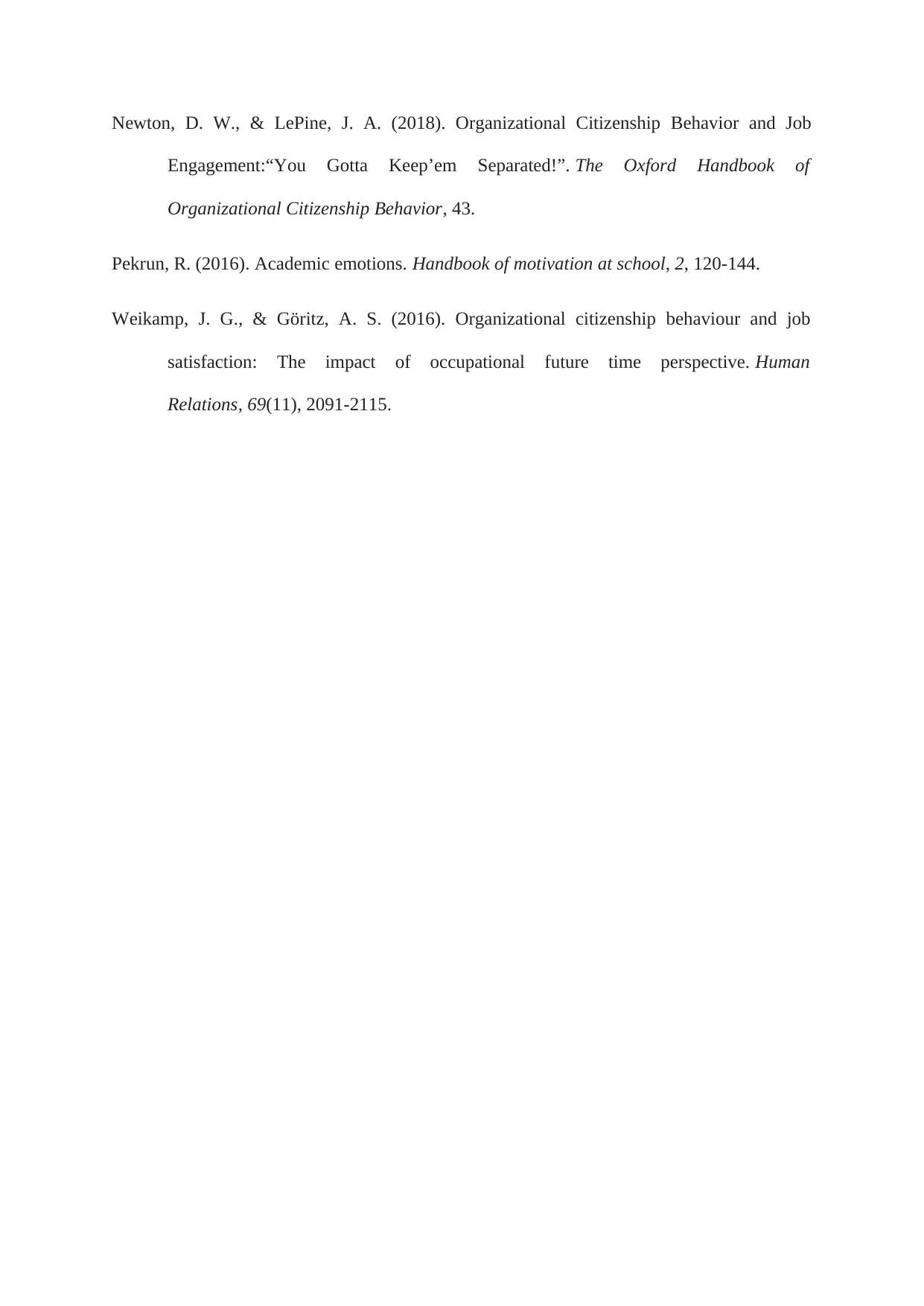
Newton, D. W., & LePine, J. A. (2018). Organizational Citizenship Behavior and Job
Engagement:“You Gotta Keep’em Separated!”. The Oxford Handbook of
Organizational Citizenship Behavior, 43.
Pekrun, R. (2016). Academic emotions. Handbook of motivation at school, 2, 120-144.
Weikamp, J. G., & Göritz, A. S. (2016). Organizational citizenship behaviour and job
satisfaction: The impact of occupational future time perspective. Human
Relations, 69(11), 2091-2115.
Engagement:“You Gotta Keep’em Separated!”. The Oxford Handbook of
Organizational Citizenship Behavior, 43.
Pekrun, R. (2016). Academic emotions. Handbook of motivation at school, 2, 120-144.
Weikamp, J. G., & Göritz, A. S. (2016). Organizational citizenship behaviour and job
satisfaction: The impact of occupational future time perspective. Human
Relations, 69(11), 2091-2115.
⊘ This is a preview!⊘
Do you want full access?
Subscribe today to unlock all pages.
Trusted by 1+ million students worldwide

1 out of 9


Related Documents


Your All-in-One AI-Powered Toolkit for Academic Success.
+13062052269
info@desklib.com
Available 24*7 on WhatsApp / Email
![[object Object]](/_next/static/media/star-bottom.7253800d.svg)
Unlock your academic potential
Copyright © 2020–2025 A2Z Services. All Rights Reserved. Developed and managed by ZUCOL.