Organisation and Behaviour: City College and Enterprise Report
VerifiedAdded on 2020/01/28
|16
|4207
|435
Report
AI Summary
This report delves into the realm of organisational behaviour, exploring its influence on employee conduct and business performance. It investigates the interplay between organisational structure, culture, and leadership styles, highlighting how these elements shape the success of businesses like City College and Enterprise Rent a Car. The report examines various leadership approaches, including autocratic, participative, and laissez-faire styles, and their effects on staff motivation and behaviour. It also discusses motivational theories and their practical applications for managers. Furthermore, the report analyses the impact of technology on team functioning and explores the significance of organisational theory in management practices, encompassing rational system perspectives, division of labour, and contingency theory. The report provides a comprehensive analysis of key factors influencing individual behaviour in the workplace, such as abilities, attitudes, race, and culture. The report concludes with a synthesis of the major findings and recommendations for enhancing organisational effectiveness.
ORGANISATION AND
BEHAVIOUR
BEHAVIOUR

Paraphrase This Document
Need a fresh take? Get an instant paraphrase of this document with our AI Paraphraser
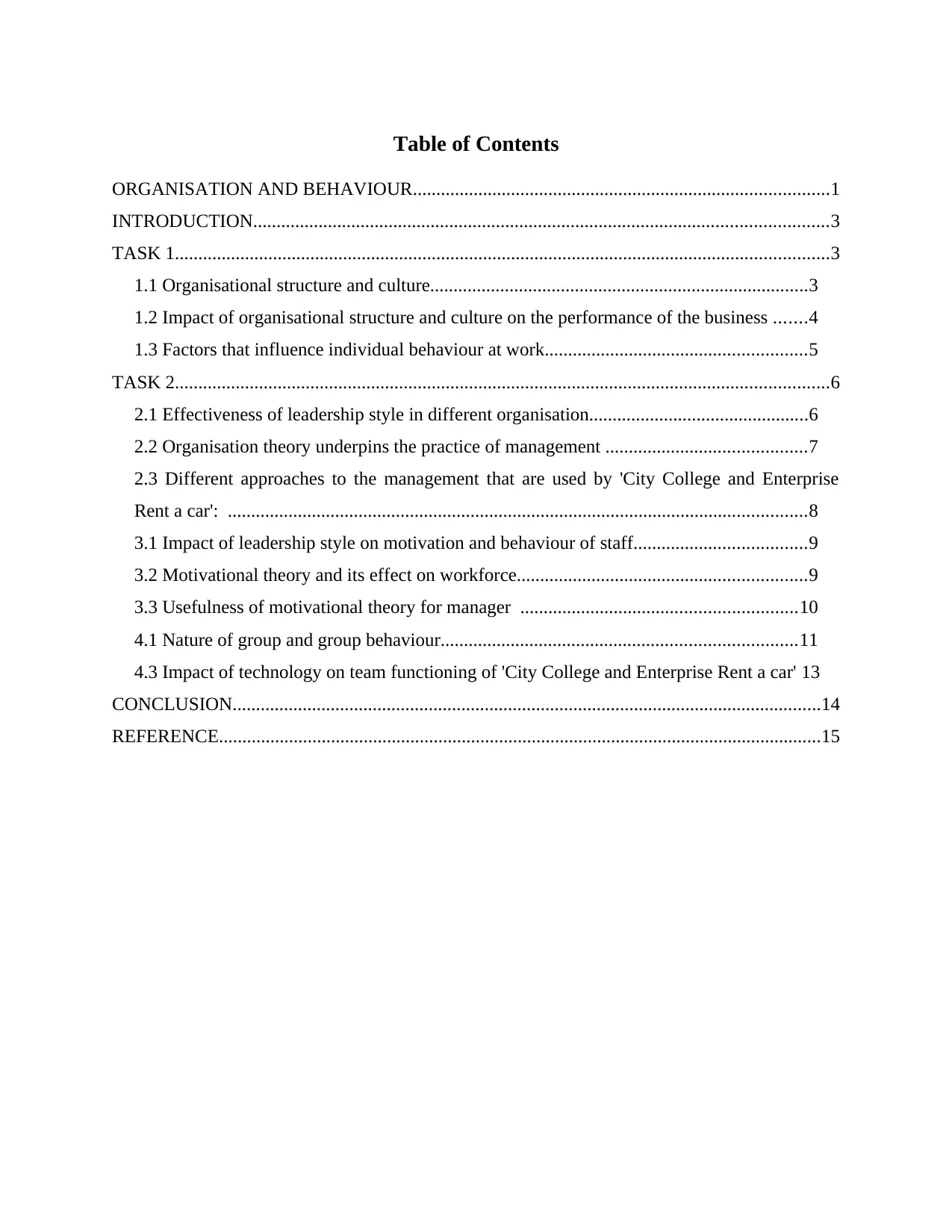
Table of Contents
ORGANISATION AND BEHAVIOUR.........................................................................................1
INTRODUCTION...........................................................................................................................3
TASK 1............................................................................................................................................3
1.1 Organisational structure and culture.................................................................................3
1.2 Impact of organisational structure and culture on the performance of the business .......4
1.3 Factors that influence individual behaviour at work........................................................5
TASK 2............................................................................................................................................6
2.1 Effectiveness of leadership style in different organisation...............................................6
2.2 Organisation theory underpins the practice of management ...........................................7
2.3 Different approaches to the management that are used by 'City College and Enterprise
Rent a car': ............................................................................................................................8
3.1 Impact of leadership style on motivation and behaviour of staff.....................................9
3.2 Motivational theory and its effect on workforce..............................................................9
3.3 Usefulness of motivational theory for manager ...........................................................10
4.1 Nature of group and group behaviour............................................................................11
4.3 Impact of technology on team functioning of 'City College and Enterprise Rent a car' 13
CONCLUSION..............................................................................................................................14
REFERENCE.................................................................................................................................15
ORGANISATION AND BEHAVIOUR.........................................................................................1
INTRODUCTION...........................................................................................................................3
TASK 1............................................................................................................................................3
1.1 Organisational structure and culture.................................................................................3
1.2 Impact of organisational structure and culture on the performance of the business .......4
1.3 Factors that influence individual behaviour at work........................................................5
TASK 2............................................................................................................................................6
2.1 Effectiveness of leadership style in different organisation...............................................6
2.2 Organisation theory underpins the practice of management ...........................................7
2.3 Different approaches to the management that are used by 'City College and Enterprise
Rent a car': ............................................................................................................................8
3.1 Impact of leadership style on motivation and behaviour of staff.....................................9
3.2 Motivational theory and its effect on workforce..............................................................9
3.3 Usefulness of motivational theory for manager ...........................................................10
4.1 Nature of group and group behaviour............................................................................11
4.3 Impact of technology on team functioning of 'City College and Enterprise Rent a car' 13
CONCLUSION..............................................................................................................................14
REFERENCE.................................................................................................................................15
INTRODUCTION
Organisation behaviour is the way that tells about the behaviour of the employees of the
organisation with the others. It is a systematic approach which tells about the behavioural
manner that applied to management of worker. It studies individual as well as activities in
organisation (Moussaïd, Helbing and Theraulaz, 2011). It also determines human behaviour in
job structure, motivation and communication, leadership etc. it helps in to improve the worker's
performance and provide adequate safety to the worker. It is the human behaviour with the others
and it also describes to motivate the worker so that they may contribute to the success of the
organisation.
TASK 1
1.1 Organisational structure and culture
Organisational culture creates friendly environment and encourage more creativity and
organisational structure is the structure of the organisation in which it operates which is actual.
Organisational structure consist of top organisational structure which has many levels of
hierarchy. In this structure there are many managers and each manager has small part to control.
Organisational culture:
Organisational structure has following characteristics:
1. Believes in doing, not in discussion.
2. It encouraged to think.
3. It rewards more effort to increase productivity.
4. Encouraged to think.
Following are the structure that are followed by the
1. Functional Structure:
Functional structure of organisation divides the organisation into different different part
as per their function as sales department, finance department, production department and
marketing department (Mai and Paxinos, 2011). 'Enterprise Rent a car' follows functional
structure. Functional structure has its own skilled and talented person but required to make
coordination among the different department. Functional structure is managed by the
experienced person.
2. Geographical structure:
Organisation behaviour is the way that tells about the behaviour of the employees of the
organisation with the others. It is a systematic approach which tells about the behavioural
manner that applied to management of worker. It studies individual as well as activities in
organisation (Moussaïd, Helbing and Theraulaz, 2011). It also determines human behaviour in
job structure, motivation and communication, leadership etc. it helps in to improve the worker's
performance and provide adequate safety to the worker. It is the human behaviour with the others
and it also describes to motivate the worker so that they may contribute to the success of the
organisation.
TASK 1
1.1 Organisational structure and culture
Organisational culture creates friendly environment and encourage more creativity and
organisational structure is the structure of the organisation in which it operates which is actual.
Organisational structure consist of top organisational structure which has many levels of
hierarchy. In this structure there are many managers and each manager has small part to control.
Organisational culture:
Organisational structure has following characteristics:
1. Believes in doing, not in discussion.
2. It encouraged to think.
3. It rewards more effort to increase productivity.
4. Encouraged to think.
Following are the structure that are followed by the
1. Functional Structure:
Functional structure of organisation divides the organisation into different different part
as per their function as sales department, finance department, production department and
marketing department (Mai and Paxinos, 2011). 'Enterprise Rent a car' follows functional
structure. Functional structure has its own skilled and talented person but required to make
coordination among the different department. Functional structure is managed by the
experienced person.
2. Geographical structure:
⊘ This is a preview!⊘
Do you want full access?
Subscribe today to unlock all pages.

Trusted by 1+ million students worldwide
Large organisation like 'City College' use this structure because they face logistical challenges
and this structure makes regional and area structure to make effective decision and control. It
focuses on decentralised approach as being responsive to regional market pressure. It beehives in
to establish face to face relationship so that it beats the self defeating competition.
3. Divisional structure:
Divisional structure leads to overcome the problem associated with the market strategy and
establish response to the problem that is assigned with each division. Divisional manager has a
responsibility to the strategy and team for the development of market range (Nadiri and Tanova,
2010).
4. Matrix structure:
Matrix structure is more traditional vertical structure. It introduces multiple line of responsibility
to deliver flexibility to the team and it improves the cross functional cooperation. It create
confusion in command and control over the organisation.
1.2 Impact of organisational structure and culture on the performance of the business
The success of the business depends upon the strong management skills and leadership
quality. Without it, it is not possible to run the business. For the success of the business it is
required to have organisational behaviour associated with the filed of the management.
Organisational structure defines the process of the management which help in to make order and
command that help in planning, organising, directing and controlling. Organisational culture
believes in assumption, beliefs and values.
Organisational structure and culture have an impact over the 'City College and Enterprise
Rent a car' (Heyes, 2010). Business performance is a tool to measure the performance of the
company in to achieve the goals of the company by effective use of the available resources.
Organisation structure and culture plays very important role in the success of the business of
'City College and Enterprise Rent a car'.
Organisational structure of both the organisation provides future growth to the business
of the company and it provides growth, customer satisfaction and advance technology.
Organisational structure refers number of methods and practices to operate with more
competency. If organisation has strong organisational structure and culture then it may attract the
consumer toward them and increase competition in the market. If the firm maintains the effective
culture then it develops well planned organisational structure.
and this structure makes regional and area structure to make effective decision and control. It
focuses on decentralised approach as being responsive to regional market pressure. It beehives in
to establish face to face relationship so that it beats the self defeating competition.
3. Divisional structure:
Divisional structure leads to overcome the problem associated with the market strategy and
establish response to the problem that is assigned with each division. Divisional manager has a
responsibility to the strategy and team for the development of market range (Nadiri and Tanova,
2010).
4. Matrix structure:
Matrix structure is more traditional vertical structure. It introduces multiple line of responsibility
to deliver flexibility to the team and it improves the cross functional cooperation. It create
confusion in command and control over the organisation.
1.2 Impact of organisational structure and culture on the performance of the business
The success of the business depends upon the strong management skills and leadership
quality. Without it, it is not possible to run the business. For the success of the business it is
required to have organisational behaviour associated with the filed of the management.
Organisational structure defines the process of the management which help in to make order and
command that help in planning, organising, directing and controlling. Organisational culture
believes in assumption, beliefs and values.
Organisational structure and culture have an impact over the 'City College and Enterprise
Rent a car' (Heyes, 2010). Business performance is a tool to measure the performance of the
company in to achieve the goals of the company by effective use of the available resources.
Organisation structure and culture plays very important role in the success of the business of
'City College and Enterprise Rent a car'.
Organisational structure of both the organisation provides future growth to the business
of the company and it provides growth, customer satisfaction and advance technology.
Organisational structure refers number of methods and practices to operate with more
competency. If organisation has strong organisational structure and culture then it may attract the
consumer toward them and increase competition in the market. If the firm maintains the effective
culture then it develops well planned organisational structure.
Paraphrase This Document
Need a fresh take? Get an instant paraphrase of this document with our AI Paraphraser
1.3 Factors that influence individual behaviour at work
Following are the key factors that influence the individual; behaviour at work-
1. Abilities
Abilities are the qualities of a person that learned from the environment and it is gifted by birth.
These qualities are classified in:
Intellectual ability
Physical ability
Self awareness ability
2. Gender
Importance to the gender is given equally in job performance. Organisation do not make any
difference on the basis of gender and encourages both the gender to work more efficiently to
achieve the goals of the organisation (Walumbwa and et. al., 2010). No specific demotion is
given on the basis of gender.
3. Race and culture
Culture is common qualities, ideas, tradition that is followed by a person or group of person as
celebration of Diwali. Race and culture both has influence at the workplace and according to the
race and culture factors it influences the individual behaviour. For the success of the business it
is required to be diverse in different culture, values to create comfortable culture (Samuels and
Shugart, 2010).
4. Attitude
Attitude is reaction and response of person's progress over a time period. It reflects the factors
that are responsible to behave. It recognizes the factors that are responsible for walk, talk and
socialize factors etc.
5. Attribution:
It has following criteria-
Consensus
Distinctiveness
Consistency
6. Perception:
Perception is intellectual quality of an individual to transfer meaningful information. Perception
is divided into following parts:
Following are the key factors that influence the individual; behaviour at work-
1. Abilities
Abilities are the qualities of a person that learned from the environment and it is gifted by birth.
These qualities are classified in:
Intellectual ability
Physical ability
Self awareness ability
2. Gender
Importance to the gender is given equally in job performance. Organisation do not make any
difference on the basis of gender and encourages both the gender to work more efficiently to
achieve the goals of the organisation (Walumbwa and et. al., 2010). No specific demotion is
given on the basis of gender.
3. Race and culture
Culture is common qualities, ideas, tradition that is followed by a person or group of person as
celebration of Diwali. Race and culture both has influence at the workplace and according to the
race and culture factors it influences the individual behaviour. For the success of the business it
is required to be diverse in different culture, values to create comfortable culture (Samuels and
Shugart, 2010).
4. Attitude
Attitude is reaction and response of person's progress over a time period. It reflects the factors
that are responsible to behave. It recognizes the factors that are responsible for walk, talk and
socialize factors etc.
5. Attribution:
It has following criteria-
Consensus
Distinctiveness
Consistency
6. Perception:
Perception is intellectual quality of an individual to transfer meaningful information. Perception
is divided into following parts:
of sound
of speech
touch
taste
other sense as pain, time, sensation felt
of social world
TASK 2
2.1 Effectiveness of leadership style in different organisation
Following are the leadership style that resulted in the success of the business of City college and
Enterprise Rent a car:
1. Autocratic and Authoritarian leadership:
Autocratic leadership style creates effective decision making without consider the inputs of
others. Manager imposes responsibility on their employees and no one have the power to change
the decision of the Autocratic leader (Nadiri and Tanova, 2010).
Autocratic leadership is divided into three category as-
The hard boiled autocrat
The benevolent autocrat
The manipulative autocrat
2. Participative leadership:
It increase the value of the team member but final responsibility in regard to decision is in the
hand of the leader. Leader must have the quality to make the team more participative so that
innovative ideas can come out. Participation is very important for the success of the team and
active participation of team leads to the success of the business (Moussaïd, Helbing and
Theraulaz, 2011).
3. Paternalistic leadership:
It means papa know best. Relation between the leader and the team member is like the
relationship between the father and son. The leader must have the quality to protect their team
member as they are their family member.
4. The laissez faire or free rein leadership:
of speech
touch
taste
other sense as pain, time, sensation felt
of social world
TASK 2
2.1 Effectiveness of leadership style in different organisation
Following are the leadership style that resulted in the success of the business of City college and
Enterprise Rent a car:
1. Autocratic and Authoritarian leadership:
Autocratic leadership style creates effective decision making without consider the inputs of
others. Manager imposes responsibility on their employees and no one have the power to change
the decision of the Autocratic leader (Nadiri and Tanova, 2010).
Autocratic leadership is divided into three category as-
The hard boiled autocrat
The benevolent autocrat
The manipulative autocrat
2. Participative leadership:
It increase the value of the team member but final responsibility in regard to decision is in the
hand of the leader. Leader must have the quality to make the team more participative so that
innovative ideas can come out. Participation is very important for the success of the team and
active participation of team leads to the success of the business (Moussaïd, Helbing and
Theraulaz, 2011).
3. Paternalistic leadership:
It means papa know best. Relation between the leader and the team member is like the
relationship between the father and son. The leader must have the quality to protect their team
member as they are their family member.
4. The laissez faire or free rein leadership:
⊘ This is a preview!⊘
Do you want full access?
Subscribe today to unlock all pages.
Trusted by 1+ million students worldwide
In the responsibility to take decision is passed to the subordinate and leader have a minimum
initiative in administration.
Leadership style that are explained above are followed by the City college and Enterprise
Rent a car which resulted in more effectiveness of the organisation and provide growth to the
business of the company. Leadership style make the organisation more growth oriented and it
helps in to achieve the task that is assigned to the team. Leader is the one who has the prime
responsibility to manage all the members of the team and allocate task according to their level of
competency. When effective leadership quality is followed by both the company then it will
resulted in the progress of the company in future (Walumbwa and et. al., 2010).
2.2 Organisation theory underpins the practice of management
Organisation theory includes rational system perspective, division of labour,
modernization theory, bureaucratic theory and contingency theory. Theses theories are for the
organizational analysis. Rational system perspective has its two parts specificity of goal and
formalization. Goal specificity provides guidance to perform the task so that target can be
achieved and formalization is to give the standard to the organisational behaviour. Division of
labour to the specialization sector result in the better achievement of the goals of the
organisation. These division of work is based on the level of skills and knowledge according to
the competency of the worker. Modernization theory consider modern institution that provides
more efficiency to the work. Contingency theory consider all those factors that are necessary to
consider for the future contingency so that organisation be prepared for the future problems and
hurdles that may be created due to environmental changes. Traditional methods are used to
pursue more competency to the organisation (Liu, Zhu and Yang, 2010). Organisation which is
governed under bureaucratic theory consider the characteristics of presence of impersonal
position that is not inherited.
There are several features of bureaucratic theory-
1. Find out the subordinate to the bureaucratic structure which means senior officer
supervise lower level offices.
2. Personal position of money is separated from the enterprise.
3. People of bureaucratic are trained in their field.
initiative in administration.
Leadership style that are explained above are followed by the City college and Enterprise
Rent a car which resulted in more effectiveness of the organisation and provide growth to the
business of the company. Leadership style make the organisation more growth oriented and it
helps in to achieve the task that is assigned to the team. Leader is the one who has the prime
responsibility to manage all the members of the team and allocate task according to their level of
competency. When effective leadership quality is followed by both the company then it will
resulted in the progress of the company in future (Walumbwa and et. al., 2010).
2.2 Organisation theory underpins the practice of management
Organisation theory includes rational system perspective, division of labour,
modernization theory, bureaucratic theory and contingency theory. Theses theories are for the
organizational analysis. Rational system perspective has its two parts specificity of goal and
formalization. Goal specificity provides guidance to perform the task so that target can be
achieved and formalization is to give the standard to the organisational behaviour. Division of
labour to the specialization sector result in the better achievement of the goals of the
organisation. These division of work is based on the level of skills and knowledge according to
the competency of the worker. Modernization theory consider modern institution that provides
more efficiency to the work. Contingency theory consider all those factors that are necessary to
consider for the future contingency so that organisation be prepared for the future problems and
hurdles that may be created due to environmental changes. Traditional methods are used to
pursue more competency to the organisation (Liu, Zhu and Yang, 2010). Organisation which is
governed under bureaucratic theory consider the characteristics of presence of impersonal
position that is not inherited.
There are several features of bureaucratic theory-
1. Find out the subordinate to the bureaucratic structure which means senior officer
supervise lower level offices.
2. Personal position of money is separated from the enterprise.
3. People of bureaucratic are trained in their field.
Paraphrase This Document
Need a fresh take? Get an instant paraphrase of this document with our AI Paraphraser
These organisational theory makes the impact on the business of the organisation. It is required
to consider by the management while taking decision in the business for the success and growth
of the business.
2.3 Different approaches to the management that are used by 'City College and Enterprise Rent a
car':
There are two approaches that are used by the both the organisation:
1. Human relation approach
2. The contingency approach
These approaches resulted in the success of the organisation and provide better targets to achieve
the goal and objective of the organisation (Parker and Collins, 2010).
1. Human Relation approach:
Human relation approach is used by the big industry as Microsoft and FedEx to establish
relationship among the various department of the organisation. Human relationship approach is
used to establish effective and efficient human resources so that growth of the business can be
achieved (Yuan and Woodman, 2010).
2. The contingency approach:
It is the duty of the manager to manage all the task associated with their work that they allot to
their team. Contingency is the happening of an uncertain event. So it is required to consider the
contingencies that may affect the future of the company so that decided target can be achieved
with in the given time. It is required to consider by the enterprises that are governing their
business internationally because everything is at international level, everything is new and faster
so there is high degree of contingency.
As per my personal opinion both the organisation must use both the approaches so that effective
human relation can be established and business will be ready to settle all the contingencies that
may affect their business in future (Parker and Collins, 2010).
3.1 Impact of leadership style on motivation and behaviour of staff
Leadership is very important function of any organisation for the success of the business.
Following are the impacts that may have on the behaviour of the staff:
1. Initiate Action:
to consider by the management while taking decision in the business for the success and growth
of the business.
2.3 Different approaches to the management that are used by 'City College and Enterprise Rent a
car':
There are two approaches that are used by the both the organisation:
1. Human relation approach
2. The contingency approach
These approaches resulted in the success of the organisation and provide better targets to achieve
the goal and objective of the organisation (Parker and Collins, 2010).
1. Human Relation approach:
Human relation approach is used by the big industry as Microsoft and FedEx to establish
relationship among the various department of the organisation. Human relationship approach is
used to establish effective and efficient human resources so that growth of the business can be
achieved (Yuan and Woodman, 2010).
2. The contingency approach:
It is the duty of the manager to manage all the task associated with their work that they allot to
their team. Contingency is the happening of an uncertain event. So it is required to consider the
contingencies that may affect the future of the company so that decided target can be achieved
with in the given time. It is required to consider by the enterprises that are governing their
business internationally because everything is at international level, everything is new and faster
so there is high degree of contingency.
As per my personal opinion both the organisation must use both the approaches so that effective
human relation can be established and business will be ready to settle all the contingencies that
may affect their business in future (Parker and Collins, 2010).
3.1 Impact of leadership style on motivation and behaviour of staff
Leadership is very important function of any organisation for the success of the business.
Following are the impacts that may have on the behaviour of the staff:
1. Initiate Action:
Initiation is the main task of the team leader. Initiation is the primary step that is taken by the
leader. In this step, team leader communicate policies and plan to their them member so that
work can get start.
2. Motivation:
Leadership provides motivation to the team member. Leader must have the quality to provide
adequate motivation to their sub ordinate so that they may work with more efficiency (Parker
and Collins, 2010).
3. Providing guidance:
Leader gives adequate guidance to their subordinate which help in to effective execution of the
task. Leader provides guidance according to the task that assigned to the team member which
motivates and help them to work.
4. Confidence:
Confidence is important aspect which provides work effort to the team member explains roles
and responsibility to their sub ordinates.
5. Building morale:
Morale means willing of the employees toward the work. Leader must have the quality to
provide morale booster to their subordinates. Leader must have good relationship with their
employees and have the quality to listen and provide solution to the problems of the team
member.
6. Co-ordination:
It can be achieved only when personal interest reconcile with organisational interest. Primary
motive of leader must be to make effective co-ordination (Walumbwa, Hartnell and Oke, 2010).
3.2 Motivational theory and its effect on workforce
Following are the motivational theory that must be adopted by the City college and Enterprise
Rent a car:
1. Needs motivation theory:
Motivation is to determine the needs and make effort toward the organisational goal and to
satisfy the needs of an individuals. Unsatisfied needs and wants creates tension in the mind and if
satisfaction is provided then it leads to reduce the tension in the mind. Need theory is the basis of
many motivational theory.
leader. In this step, team leader communicate policies and plan to their them member so that
work can get start.
2. Motivation:
Leadership provides motivation to the team member. Leader must have the quality to provide
adequate motivation to their sub ordinate so that they may work with more efficiency (Parker
and Collins, 2010).
3. Providing guidance:
Leader gives adequate guidance to their subordinate which help in to effective execution of the
task. Leader provides guidance according to the task that assigned to the team member which
motivates and help them to work.
4. Confidence:
Confidence is important aspect which provides work effort to the team member explains roles
and responsibility to their sub ordinates.
5. Building morale:
Morale means willing of the employees toward the work. Leader must have the quality to
provide morale booster to their subordinates. Leader must have good relationship with their
employees and have the quality to listen and provide solution to the problems of the team
member.
6. Co-ordination:
It can be achieved only when personal interest reconcile with organisational interest. Primary
motive of leader must be to make effective co-ordination (Walumbwa, Hartnell and Oke, 2010).
3.2 Motivational theory and its effect on workforce
Following are the motivational theory that must be adopted by the City college and Enterprise
Rent a car:
1. Needs motivation theory:
Motivation is to determine the needs and make effort toward the organisational goal and to
satisfy the needs of an individuals. Unsatisfied needs and wants creates tension in the mind and if
satisfaction is provided then it leads to reduce the tension in the mind. Need theory is the basis of
many motivational theory.
⊘ This is a preview!⊘
Do you want full access?
Subscribe today to unlock all pages.
Trusted by 1+ million students worldwide
2. Equity theory:
Equity theory says about the facts that equal treatment must be given to all the subordinates so
that their rights can not be conflicted like to give promotion or extra pay to one individuals paste
negative impact on others (Forbes and Dahl, 2010).
3. Expectancy theory of motivation:
Expectancy theory is regarding the choice and choosing. Expectation is the desire of the
individual that if not satisfied then it creates conflicts in the mind of the others.
4. Herzberg's motivation theory:
It is a factual theory about the motivation. This theory removes the barrier of demotivating
factors from the true motivators. This theory produce more clone than other industrial and
organizational factors.
Effect of motivation on workforces:
Motivation make positive impact on the performance of the work. It provides larger level
of satisfaction to the employees who are working with organisation. Leader who does not
motivate their employee, paste adverse impact on the performance of the task of the businesses.
When motivation is provided by the manager to their sub ordinate then employees work with
more competency and grant their best effort to the work. It builds up the confidence and help in
to make coordination among the various sector (Norman and et. al., 2010).
3.3 Usefulness of motivational theory for manager
1. Puts human resources into action:
When motivation is provided to the employees by the manager then employees contribute more
effort to the work and make best use of available resources for the success of the project.
2. Improve level of efficiency of employees:
Motivation improves level of efficiency of the employees. It improves following-
Increase in productivity
Improve efficiency
Reduction in cost
3. Achievement of organisational goal:
Goals can be achieved only when following factors take place:
Effective utilization of resources
Equity theory says about the facts that equal treatment must be given to all the subordinates so
that their rights can not be conflicted like to give promotion or extra pay to one individuals paste
negative impact on others (Forbes and Dahl, 2010).
3. Expectancy theory of motivation:
Expectancy theory is regarding the choice and choosing. Expectation is the desire of the
individual that if not satisfied then it creates conflicts in the mind of the others.
4. Herzberg's motivation theory:
It is a factual theory about the motivation. This theory removes the barrier of demotivating
factors from the true motivators. This theory produce more clone than other industrial and
organizational factors.
Effect of motivation on workforces:
Motivation make positive impact on the performance of the work. It provides larger level
of satisfaction to the employees who are working with organisation. Leader who does not
motivate their employee, paste adverse impact on the performance of the task of the businesses.
When motivation is provided by the manager to their sub ordinate then employees work with
more competency and grant their best effort to the work. It builds up the confidence and help in
to make coordination among the various sector (Norman and et. al., 2010).
3.3 Usefulness of motivational theory for manager
1. Puts human resources into action:
When motivation is provided to the employees by the manager then employees contribute more
effort to the work and make best use of available resources for the success of the project.
2. Improve level of efficiency of employees:
Motivation improves level of efficiency of the employees. It improves following-
Increase in productivity
Improve efficiency
Reduction in cost
3. Achievement of organisational goal:
Goals can be achieved only when following factors take place:
Effective utilization of resources
Paraphrase This Document
Need a fresh take? Get an instant paraphrase of this document with our AI Paraphraser
Co-operative environmental
4. Builds friendly relationship:
Motivation helps to establish healthy relationship among the employees and it is the quality of
the leader to provide equal treatment to all the employees so that they can work with more skills
and intelligence (Moussaïd, Helbing and Theraulaz, 2011). Manger must provide motivation to
their sub ordinates so that they can work with more efficiency and contribute to the growth of the
business which result in establishing healthy relationship.
5. Improve performance level:
when manager provides motivation to the employees then the employees get motivated and work
with more efficiency which overall improve the performance of the employees.
Application of motivational theory-
1. Motivational theory can be used with traditional and innovative compensation strategy so
that effective measurement can be established (Mai and Paxinos, 2011).
2. Tie compensation directly to the performance objective.
3. Motivational theory can be applied by conducting employees development programmes.
4.1 Nature of group and group behaviour
Group is the collection of the individual which work together for achievement of
common goal and objective. Groups help in many ways to the organisation. It helps in to achieve
the goal and objective of the organisation and in to maintain heigh level of quality of work that
they perform and provide satisfaction to the member's needs and wants (Nadiri and Tanova,
2010).
Nature of Group:
1. Synergy
Effective group offers the energy to the other subordinate.
It helps in to achieve the long term high performance.
2. Situation:
By the word Situation it means conditions in which groups are superior than others when no
expert is available to solve the problem.
3. Social loafing
4. Social facilitation
4. Builds friendly relationship:
Motivation helps to establish healthy relationship among the employees and it is the quality of
the leader to provide equal treatment to all the employees so that they can work with more skills
and intelligence (Moussaïd, Helbing and Theraulaz, 2011). Manger must provide motivation to
their sub ordinates so that they can work with more efficiency and contribute to the growth of the
business which result in establishing healthy relationship.
5. Improve performance level:
when manager provides motivation to the employees then the employees get motivated and work
with more efficiency which overall improve the performance of the employees.
Application of motivational theory-
1. Motivational theory can be used with traditional and innovative compensation strategy so
that effective measurement can be established (Mai and Paxinos, 2011).
2. Tie compensation directly to the performance objective.
3. Motivational theory can be applied by conducting employees development programmes.
4.1 Nature of group and group behaviour
Group is the collection of the individual which work together for achievement of
common goal and objective. Groups help in many ways to the organisation. It helps in to achieve
the goal and objective of the organisation and in to maintain heigh level of quality of work that
they perform and provide satisfaction to the member's needs and wants (Nadiri and Tanova,
2010).
Nature of Group:
1. Synergy
Effective group offers the energy to the other subordinate.
It helps in to achieve the long term high performance.
2. Situation:
By the word Situation it means conditions in which groups are superior than others when no
expert is available to solve the problem.
3. Social loafing
4. Social facilitation
High level group helps in to achieve organisational objective and other factors as-
Task performance-
It helps in to complete the task with in given time period and also maintains level of quality to
the work because they are group of high skilled person.
Member's satisfaction:
Group behaviour focus on the needs and wants of the other group member so overall it gives
satisfaction to the member(Mai and Paxinos, 2011).
4.2 Factors that promote or inhibit the development of effective teamwork:
Following are the factors that promote or inhibit the effective teamwork are as follows-
1. Individuals:
Group can be said successful only when individuals who are associated with it make their
positive and skilled effort toward the achievement of the organisational goal and objective. It is
required to focus on the roles and responsibility that an individual needs to perform then group
can be successful otherwise not.
2. Group Size:
It is important to consider the size of the group so that complexity can be addressed. It is good to
have small size as comparison to large group. Group helps in to provide solution to the complex
problem because group consist of the intellectual as well as skilled individuals.
3. Synergy:
Synergy is to achieve the collective performance which is better than the individual performance
(Samuels and Shugart, 2010). Synergy gives advantages to the manager as it gives special
advantages of cost, technology and market power.
4. Leadership:
Informal group does not have its manager and leaders but formal groups have their manager and
supervisor. Leader must have the quality to influence their subordinates.
5. Group Norms:
Norms are the guidelines that provide the guidance to the activities and operations. Norms are
required to be followed by all the group members.
Task performance-
It helps in to complete the task with in given time period and also maintains level of quality to
the work because they are group of high skilled person.
Member's satisfaction:
Group behaviour focus on the needs and wants of the other group member so overall it gives
satisfaction to the member(Mai and Paxinos, 2011).
4.2 Factors that promote or inhibit the development of effective teamwork:
Following are the factors that promote or inhibit the effective teamwork are as follows-
1. Individuals:
Group can be said successful only when individuals who are associated with it make their
positive and skilled effort toward the achievement of the organisational goal and objective. It is
required to focus on the roles and responsibility that an individual needs to perform then group
can be successful otherwise not.
2. Group Size:
It is important to consider the size of the group so that complexity can be addressed. It is good to
have small size as comparison to large group. Group helps in to provide solution to the complex
problem because group consist of the intellectual as well as skilled individuals.
3. Synergy:
Synergy is to achieve the collective performance which is better than the individual performance
(Samuels and Shugart, 2010). Synergy gives advantages to the manager as it gives special
advantages of cost, technology and market power.
4. Leadership:
Informal group does not have its manager and leaders but formal groups have their manager and
supervisor. Leader must have the quality to influence their subordinates.
5. Group Norms:
Norms are the guidelines that provide the guidance to the activities and operations. Norms are
required to be followed by all the group members.
⊘ This is a preview!⊘
Do you want full access?
Subscribe today to unlock all pages.
Trusted by 1+ million students worldwide

1 out of 16


Related Documents


Your All-in-One AI-Powered Toolkit for Academic Success.
+13062052269
info@desklib.com
Available 24*7 on WhatsApp / Email
![[object Object]](/_next/static/media/star-bottom.7253800d.svg)
Unlock your academic potential
Copyright © 2020–2026 A2Z Services. All Rights Reserved. Developed and managed by ZUCOL.