Organisational Behaviour: Leadership, Culture, and Structure Report
VerifiedAdded on 2020/01/23
|15
|4990
|496
Report
AI Summary
This report delves into the realm of organisational behaviour, examining the dynamics within City College and Enterprise. It explores the significance of organisational culture and structure, highlighting the differences between flat and tall structures, and power versus task cultures. The report then investigates the impact of these factors on company performance and employee behaviour. Furthermore, it analyzes different leadership styles, specifically contrasting autocratic and democratic approaches, and their respective influences on decision-making and employee engagement. The report also evaluates the application of bureaucratic and contingent management theories within the context of the two organizations. Finally, the report discusses the advantages and disadvantages of democratic leadership, and provides insights into how to effectively manage employee behaviour through various components such as work environments, perceptions, job responsibilities, and diversity factors.
ORGANISATION
AND BEHAVIOUR
AND BEHAVIOUR

Paraphrase This Document
Need a fresh take? Get an instant paraphrase of this document with our AI Paraphraser
TABLE OF CONTENTS
INTRODUCTION...........................................................................................................................1
TASK 1............................................................................................................................................1
AC 1.1.....................................................................................................................................1
AC 1.2.....................................................................................................................................2
AC 1.3.....................................................................................................................................3
TASK 2............................................................................................................................................4
AC 2.1.....................................................................................................................................4
AC 2.2.....................................................................................................................................4
AC 2.3.....................................................................................................................................5
TASK 3............................................................................................................................................6
AC 3.1.....................................................................................................................................6
AC 3.2.....................................................................................................................................7
AC 3.3.....................................................................................................................................8
TASK 4............................................................................................................................................9
AC 4.1.....................................................................................................................................9
AC 4.2...................................................................................................................................10
AC 4.3...................................................................................................................................11
CONCLUSION..............................................................................................................................11
REFERENCE.................................................................................................................................12
INTRODUCTION...........................................................................................................................1
TASK 1............................................................................................................................................1
AC 1.1.....................................................................................................................................1
AC 1.2.....................................................................................................................................2
AC 1.3.....................................................................................................................................3
TASK 2............................................................................................................................................4
AC 2.1.....................................................................................................................................4
AC 2.2.....................................................................................................................................4
AC 2.3.....................................................................................................................................5
TASK 3............................................................................................................................................6
AC 3.1.....................................................................................................................................6
AC 3.2.....................................................................................................................................7
AC 3.3.....................................................................................................................................8
TASK 4............................................................................................................................................9
AC 4.1.....................................................................................................................................9
AC 4.2...................................................................................................................................10
AC 4.3...................................................................................................................................11
CONCLUSION..............................................................................................................................11
REFERENCE.................................................................................................................................12
INTRODUCTION
Organisation behaviour is the study of individuals in terms of their performance,
behaviour and activities they perform at workplace (Definition of Organizational Behaviour,
2016). Further, it can be said that it is a process of understanding, analysing and observing
attitude towards business goals and objectives (Dunphy 2016). With the assistance of this aspect,
manager can investigate about the emotions, communication and their motivation within team. In
this project report, various management theories and approaches with respect to firms; City
College and Enterprise have been studied. In addition to this, culture and structure of these
mentioned companies have been discussed in this present report. Moreover, autocratic and
democratic leadership style will also be systematically evaluated in context of City College and
Enterprise. Main objective of this report is to understand individual’s behaviour in organisation
and manage them in such a way that they can be motivated to render higher productivity.
TASK 1
AC 1.1
Organisational culture and structure are important aspects to create a healthy environment
at workplace. City College and Enterprise are two different business organisations that are
running their business with different purpose, size and culture. Further, both business units adopt
such practices and policies, which assist in attaining their set goal. According to the nature of
business activities, City College and Enterprise have to adopt specific and suitable organizational
culture and structure depending on their nature of businesses.
Organisational structure determines the way in which roles, power and responsibilities
are assigned, controlled and coordinated between various departments in business enterprise.
Structure reflects the manner in which company delegate responsibilities and authority to various
departments. City College has adopted flat organisation structure and as per this concept, firm
has fewer management levels (Cilliers and Flotman, 2016). Flat organisational structure
supervises employees less while promoting their increased involvement in the decision making
process. Under the mentioned aspects, employees are empowered by providing encouragement,
autonomy and right direction. In this aspect, excess layers of management are removed which
certainly improve the coordination and speed of communication between various departments.
1
Organisation behaviour is the study of individuals in terms of their performance,
behaviour and activities they perform at workplace (Definition of Organizational Behaviour,
2016). Further, it can be said that it is a process of understanding, analysing and observing
attitude towards business goals and objectives (Dunphy 2016). With the assistance of this aspect,
manager can investigate about the emotions, communication and their motivation within team. In
this project report, various management theories and approaches with respect to firms; City
College and Enterprise have been studied. In addition to this, culture and structure of these
mentioned companies have been discussed in this present report. Moreover, autocratic and
democratic leadership style will also be systematically evaluated in context of City College and
Enterprise. Main objective of this report is to understand individual’s behaviour in organisation
and manage them in such a way that they can be motivated to render higher productivity.
TASK 1
AC 1.1
Organisational culture and structure are important aspects to create a healthy environment
at workplace. City College and Enterprise are two different business organisations that are
running their business with different purpose, size and culture. Further, both business units adopt
such practices and policies, which assist in attaining their set goal. According to the nature of
business activities, City College and Enterprise have to adopt specific and suitable organizational
culture and structure depending on their nature of businesses.
Organisational structure determines the way in which roles, power and responsibilities
are assigned, controlled and coordinated between various departments in business enterprise.
Structure reflects the manner in which company delegate responsibilities and authority to various
departments. City College has adopted flat organisation structure and as per this concept, firm
has fewer management levels (Cilliers and Flotman, 2016). Flat organisational structure
supervises employees less while promoting their increased involvement in the decision making
process. Under the mentioned aspects, employees are empowered by providing encouragement,
autonomy and right direction. In this aspect, excess layers of management are removed which
certainly improve the coordination and speed of communication between various departments.
1
⊘ This is a preview!⊘
Do you want full access?
Subscribe today to unlock all pages.

Trusted by 1+ million students worldwide
On the other hand, Enterprise has adopted tall organisation structure. It has more
management levels and provides a clear distinct layer with obvious lines of responsibility and
control. In this structure of management, there has complex in communication due to many
layers of departments.
Organisation culture is a system of shared assumptions, values and beliefs, which govern
the way in which individuals behave in company. Every business enterprise shared values have
strong influence on individuals and dictate the way they act, dress and perform their job and
responsibility (Alessandri and et.al., 2012). City College has adopted power culture under which
decisions can be taken by only top management. They do not allow participation of employees in
decision-making process. Further, there are strict rules, regulations and principles which are to be
adopted by every individual in the corporation. There is strict command of manager over their
employees.
On the other hand, Enterprise has adopted task culture under which employees work in a
team and adopt matrix or project based structure design. It can be said that mentioned culture
depends on the unifying power of group to improve efficiency and to support the individuals to
meet with the objective of corporation.
AC 1.2
As per the above discussion, it has been ascertained that City College and Enterprise has
been adopted different business structures and culture to make their business survive with
sustainability. There is a direct relationship between company’s performance and its culture and
structure. If business unit adopts that culture and structure which is suitable for employees then it
assists in increasing the profitability and productivity of business (Avery and Jing, 2011).
However, if it does not match with employee’s working condition and responsibilities, then it
will give a negative impact on the performance of business. According to the above discussion, it
has been witnessed that Enterprise has adopted tall structure and person culture. According to
these practices, employees of enterprise are free to share their views and conflicts related to
assignments (Baur and Haase, 2015). By this, they can be highly motivated and encouraged for
rendering higher performance. On the other hand, City College has adopted flat structure and
power culture. Under this, all decisions are in the hands of top authority and there are strict rules
and regulations in company. Employees are more disciplinary with respect to their work.
2
management levels and provides a clear distinct layer with obvious lines of responsibility and
control. In this structure of management, there has complex in communication due to many
layers of departments.
Organisation culture is a system of shared assumptions, values and beliefs, which govern
the way in which individuals behave in company. Every business enterprise shared values have
strong influence on individuals and dictate the way they act, dress and perform their job and
responsibility (Alessandri and et.al., 2012). City College has adopted power culture under which
decisions can be taken by only top management. They do not allow participation of employees in
decision-making process. Further, there are strict rules, regulations and principles which are to be
adopted by every individual in the corporation. There is strict command of manager over their
employees.
On the other hand, Enterprise has adopted task culture under which employees work in a
team and adopt matrix or project based structure design. It can be said that mentioned culture
depends on the unifying power of group to improve efficiency and to support the individuals to
meet with the objective of corporation.
AC 1.2
As per the above discussion, it has been ascertained that City College and Enterprise has
been adopted different business structures and culture to make their business survive with
sustainability. There is a direct relationship between company’s performance and its culture and
structure. If business unit adopts that culture and structure which is suitable for employees then it
assists in increasing the profitability and productivity of business (Avery and Jing, 2011).
However, if it does not match with employee’s working condition and responsibilities, then it
will give a negative impact on the performance of business. According to the above discussion, it
has been witnessed that Enterprise has adopted tall structure and person culture. According to
these practices, employees of enterprise are free to share their views and conflicts related to
assignments (Baur and Haase, 2015). By this, they can be highly motivated and encouraged for
rendering higher performance. On the other hand, City College has adopted flat structure and
power culture. Under this, all decisions are in the hands of top authority and there are strict rules
and regulations in company. Employees are more disciplinary with respect to their work.
2
Paraphrase This Document
Need a fresh take? Get an instant paraphrase of this document with our AI Paraphraser
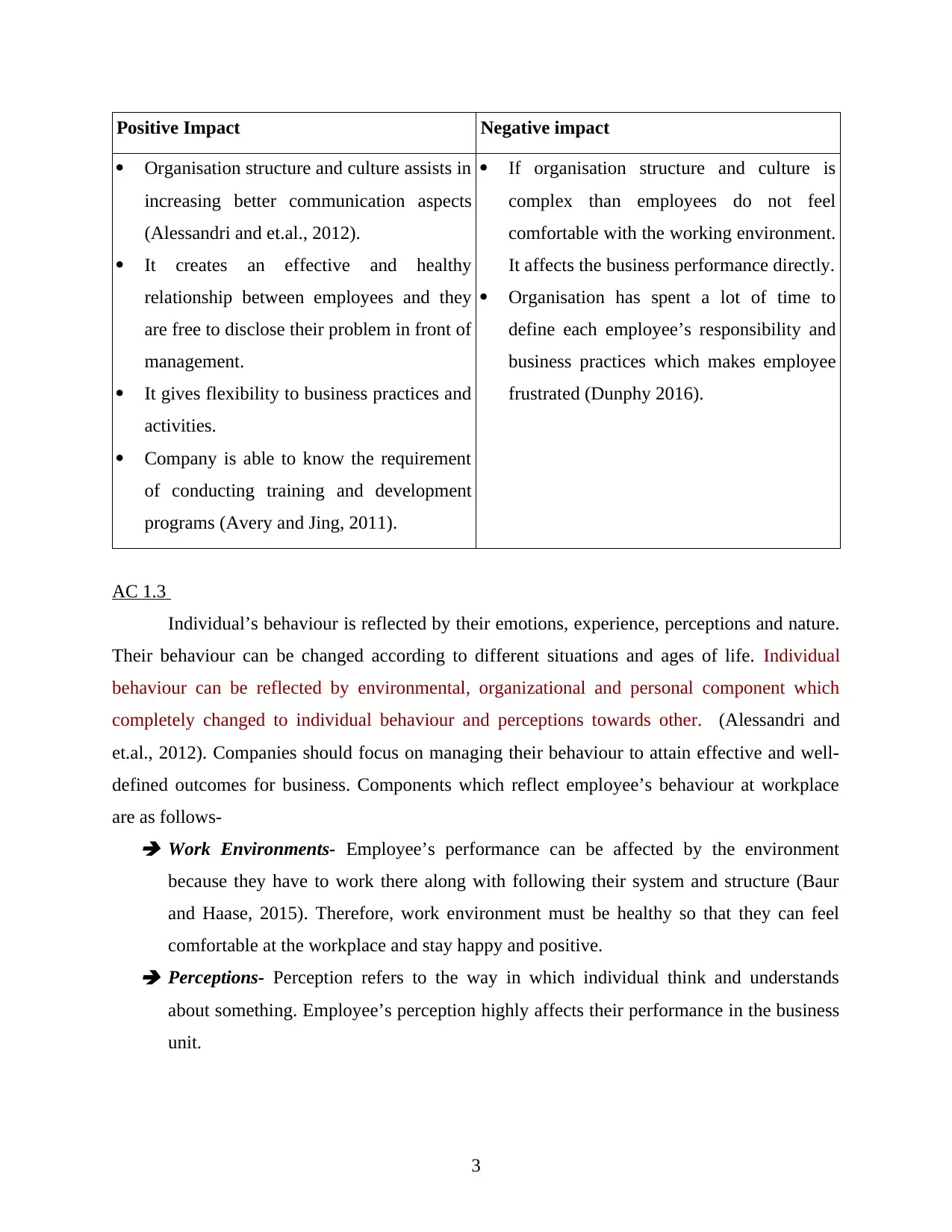
Positive Impact Negative impact
Organisation structure and culture assists in
increasing better communication aspects
(Alessandri and et.al., 2012).
It creates an effective and healthy
relationship between employees and they
are free to disclose their problem in front of
management.
It gives flexibility to business practices and
activities.
Company is able to know the requirement
of conducting training and development
programs (Avery and Jing, 2011).
If organisation structure and culture is
complex than employees do not feel
comfortable with the working environment.
It affects the business performance directly.
Organisation has spent a lot of time to
define each employee’s responsibility and
business practices which makes employee
frustrated (Dunphy 2016).
AC 1.3
Individual’s behaviour is reflected by their emotions, experience, perceptions and nature.
Their behaviour can be changed according to different situations and ages of life. Individual
behaviour can be reflected by environmental, organizational and personal component which
completely changed to individual behaviour and perceptions towards other. (Alessandri and
et.al., 2012). Companies should focus on managing their behaviour to attain effective and well-
defined outcomes for business. Components which reflect employee’s behaviour at workplace
are as follows- Work Environments- Employee’s performance can be affected by the environment
because they have to work there along with following their system and structure (Baur
and Haase, 2015). Therefore, work environment must be healthy so that they can feel
comfortable at the workplace and stay happy and positive. Perceptions- Perception refers to the way in which individual think and understands
about something. Employee’s perception highly affects their performance in the business
unit.
3
Organisation structure and culture assists in
increasing better communication aspects
(Alessandri and et.al., 2012).
It creates an effective and healthy
relationship between employees and they
are free to disclose their problem in front of
management.
It gives flexibility to business practices and
activities.
Company is able to know the requirement
of conducting training and development
programs (Avery and Jing, 2011).
If organisation structure and culture is
complex than employees do not feel
comfortable with the working environment.
It affects the business performance directly.
Organisation has spent a lot of time to
define each employee’s responsibility and
business practices which makes employee
frustrated (Dunphy 2016).
AC 1.3
Individual’s behaviour is reflected by their emotions, experience, perceptions and nature.
Their behaviour can be changed according to different situations and ages of life. Individual
behaviour can be reflected by environmental, organizational and personal component which
completely changed to individual behaviour and perceptions towards other. (Alessandri and
et.al., 2012). Companies should focus on managing their behaviour to attain effective and well-
defined outcomes for business. Components which reflect employee’s behaviour at workplace
are as follows- Work Environments- Employee’s performance can be affected by the environment
because they have to work there along with following their system and structure (Baur
and Haase, 2015). Therefore, work environment must be healthy so that they can feel
comfortable at the workplace and stay happy and positive. Perceptions- Perception refers to the way in which individual think and understands
about something. Employee’s perception highly affects their performance in the business
unit.
3
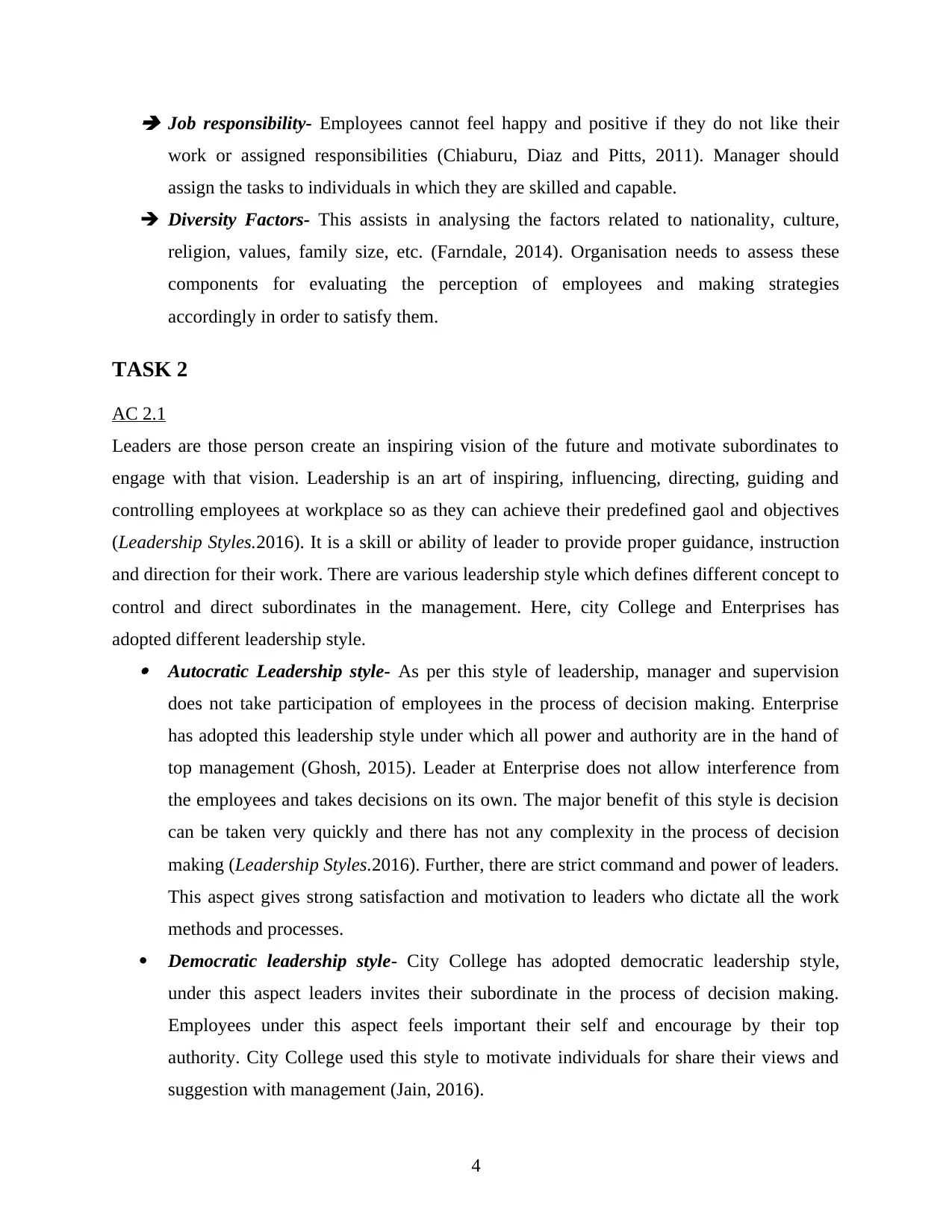
Job responsibility- Employees cannot feel happy and positive if they do not like their
work or assigned responsibilities (Chiaburu, Diaz and Pitts, 2011). Manager should
assign the tasks to individuals in which they are skilled and capable.
Diversity Factors- This assists in analysing the factors related to nationality, culture,
religion, values, family size, etc. (Farndale, 2014). Organisation needs to assess these
components for evaluating the perception of employees and making strategies
accordingly in order to satisfy them.
TASK 2
AC 2.1
Leaders are those person create an inspiring vision of the future and motivate subordinates to
engage with that vision. Leadership is an art of inspiring, influencing, directing, guiding and
controlling employees at workplace so as they can achieve their predefined gaol and objectives
(Leadership Styles.2016). It is a skill or ability of leader to provide proper guidance, instruction
and direction for their work. There are various leadership style which defines different concept to
control and direct subordinates in the management. Here, city College and Enterprises has
adopted different leadership style. Autocratic Leadership style- As per this style of leadership, manager and supervision
does not take participation of employees in the process of decision making. Enterprise
has adopted this leadership style under which all power and authority are in the hand of
top management (Ghosh, 2015). Leader at Enterprise does not allow interference from
the employees and takes decisions on its own. The major benefit of this style is decision
can be taken very quickly and there has not any complexity in the process of decision
making (Leadership Styles.2016). Further, there are strict command and power of leaders.
This aspect gives strong satisfaction and motivation to leaders who dictate all the work
methods and processes.
Democratic leadership style- City College has adopted democratic leadership style,
under this aspect leaders invites their subordinate in the process of decision making.
Employees under this aspect feels important their self and encourage by their top
authority. City College used this style to motivate individuals for share their views and
suggestion with management (Jain, 2016).
4
work or assigned responsibilities (Chiaburu, Diaz and Pitts, 2011). Manager should
assign the tasks to individuals in which they are skilled and capable.
Diversity Factors- This assists in analysing the factors related to nationality, culture,
religion, values, family size, etc. (Farndale, 2014). Organisation needs to assess these
components for evaluating the perception of employees and making strategies
accordingly in order to satisfy them.
TASK 2
AC 2.1
Leaders are those person create an inspiring vision of the future and motivate subordinates to
engage with that vision. Leadership is an art of inspiring, influencing, directing, guiding and
controlling employees at workplace so as they can achieve their predefined gaol and objectives
(Leadership Styles.2016). It is a skill or ability of leader to provide proper guidance, instruction
and direction for their work. There are various leadership style which defines different concept to
control and direct subordinates in the management. Here, city College and Enterprises has
adopted different leadership style. Autocratic Leadership style- As per this style of leadership, manager and supervision
does not take participation of employees in the process of decision making. Enterprise
has adopted this leadership style under which all power and authority are in the hand of
top management (Ghosh, 2015). Leader at Enterprise does not allow interference from
the employees and takes decisions on its own. The major benefit of this style is decision
can be taken very quickly and there has not any complexity in the process of decision
making (Leadership Styles.2016). Further, there are strict command and power of leaders.
This aspect gives strong satisfaction and motivation to leaders who dictate all the work
methods and processes.
Democratic leadership style- City College has adopted democratic leadership style,
under this aspect leaders invites their subordinate in the process of decision making.
Employees under this aspect feels important their self and encourage by their top
authority. City College used this style to motivate individuals for share their views and
suggestion with management (Jain, 2016).
4
⊘ This is a preview!⊘
Do you want full access?
Subscribe today to unlock all pages.
Trusted by 1+ million students worldwide
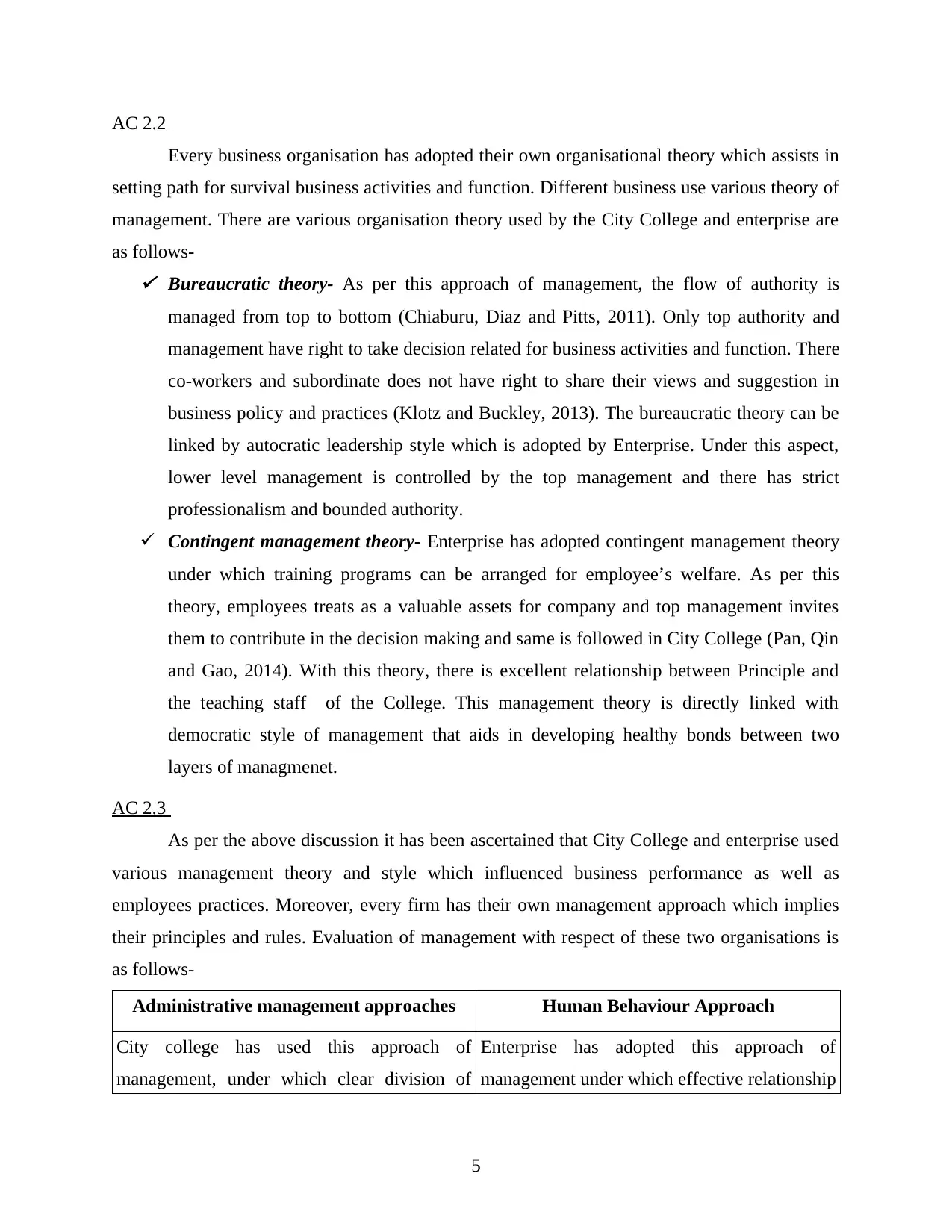
AC 2.2
Every business organisation has adopted their own organisational theory which assists in
setting path for survival business activities and function. Different business use various theory of
management. There are various organisation theory used by the City College and enterprise are
as follows- Bureaucratic theory- As per this approach of management, the flow of authority is
managed from top to bottom (Chiaburu, Diaz and Pitts, 2011). Only top authority and
management have right to take decision related for business activities and function. There
co-workers and subordinate does not have right to share their views and suggestion in
business policy and practices (Klotz and Buckley, 2013). The bureaucratic theory can be
linked by autocratic leadership style which is adopted by Enterprise. Under this aspect,
lower level management is controlled by the top management and there has strict
professionalism and bounded authority.
Contingent management theory- Enterprise has adopted contingent management theory
under which training programs can be arranged for employee’s welfare. As per this
theory, employees treats as a valuable assets for company and top management invites
them to contribute in the decision making and same is followed in City College (Pan, Qin
and Gao, 2014). With this theory, there is excellent relationship between Principle and
the teaching staff of the College. This management theory is directly linked with
democratic style of management that aids in developing healthy bonds between two
layers of managmenet.
AC 2.3
As per the above discussion it has been ascertained that City College and enterprise used
various management theory and style which influenced business performance as well as
employees practices. Moreover, every firm has their own management approach which implies
their principles and rules. Evaluation of management with respect of these two organisations is
as follows-
Administrative management approaches Human Behaviour Approach
City college has used this approach of
management, under which clear division of
Enterprise has adopted this approach of
management under which effective relationship
5
Every business organisation has adopted their own organisational theory which assists in
setting path for survival business activities and function. Different business use various theory of
management. There are various organisation theory used by the City College and enterprise are
as follows- Bureaucratic theory- As per this approach of management, the flow of authority is
managed from top to bottom (Chiaburu, Diaz and Pitts, 2011). Only top authority and
management have right to take decision related for business activities and function. There
co-workers and subordinate does not have right to share their views and suggestion in
business policy and practices (Klotz and Buckley, 2013). The bureaucratic theory can be
linked by autocratic leadership style which is adopted by Enterprise. Under this aspect,
lower level management is controlled by the top management and there has strict
professionalism and bounded authority.
Contingent management theory- Enterprise has adopted contingent management theory
under which training programs can be arranged for employee’s welfare. As per this
theory, employees treats as a valuable assets for company and top management invites
them to contribute in the decision making and same is followed in City College (Pan, Qin
and Gao, 2014). With this theory, there is excellent relationship between Principle and
the teaching staff of the College. This management theory is directly linked with
democratic style of management that aids in developing healthy bonds between two
layers of managmenet.
AC 2.3
As per the above discussion it has been ascertained that City College and enterprise used
various management theory and style which influenced business performance as well as
employees practices. Moreover, every firm has their own management approach which implies
their principles and rules. Evaluation of management with respect of these two organisations is
as follows-
Administrative management approaches Human Behaviour Approach
City college has used this approach of
management, under which clear division of
Enterprise has adopted this approach of
management under which effective relationship
5
Paraphrase This Document
Need a fresh take? Get an instant paraphrase of this document with our AI Paraphraser
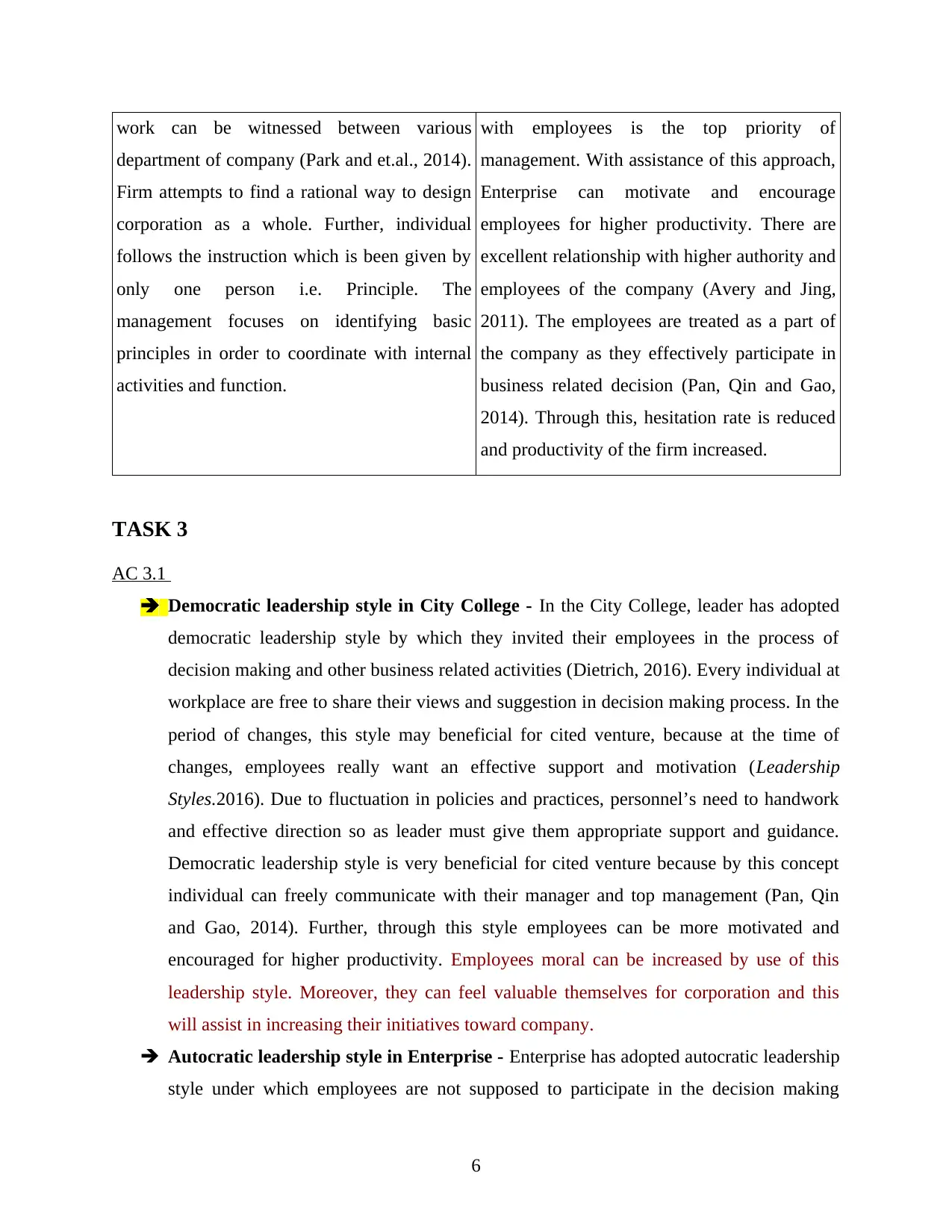
work can be witnessed between various
department of company (Park and et.al., 2014).
Firm attempts to find a rational way to design
corporation as a whole. Further, individual
follows the instruction which is been given by
only one person i.e. Principle. The
management focuses on identifying basic
principles in order to coordinate with internal
activities and function.
with employees is the top priority of
management. With assistance of this approach,
Enterprise can motivate and encourage
employees for higher productivity. There are
excellent relationship with higher authority and
employees of the company (Avery and Jing,
2011). The employees are treated as a part of
the company as they effectively participate in
business related decision (Pan, Qin and Gao,
2014). Through this, hesitation rate is reduced
and productivity of the firm increased.
TASK 3
AC 3.1
Democratic leadership style in City College - In the City College, leader has adopted
democratic leadership style by which they invited their employees in the process of
decision making and other business related activities (Dietrich, 2016). Every individual at
workplace are free to share their views and suggestion in decision making process. In the
period of changes, this style may beneficial for cited venture, because at the time of
changes, employees really want an effective support and motivation (Leadership
Styles.2016). Due to fluctuation in policies and practices, personnel’s need to handwork
and effective direction so as leader must give them appropriate support and guidance.
Democratic leadership style is very beneficial for cited venture because by this concept
individual can freely communicate with their manager and top management (Pan, Qin
and Gao, 2014). Further, through this style employees can be more motivated and
encouraged for higher productivity. Employees moral can be increased by use of this
leadership style. Moreover, they can feel valuable themselves for corporation and this
will assist in increasing their initiatives toward company.
Autocratic leadership style in Enterprise - Enterprise has adopted autocratic leadership
style under which employees are not supposed to participate in the decision making
6
department of company (Park and et.al., 2014).
Firm attempts to find a rational way to design
corporation as a whole. Further, individual
follows the instruction which is been given by
only one person i.e. Principle. The
management focuses on identifying basic
principles in order to coordinate with internal
activities and function.
with employees is the top priority of
management. With assistance of this approach,
Enterprise can motivate and encourage
employees for higher productivity. There are
excellent relationship with higher authority and
employees of the company (Avery and Jing,
2011). The employees are treated as a part of
the company as they effectively participate in
business related decision (Pan, Qin and Gao,
2014). Through this, hesitation rate is reduced
and productivity of the firm increased.
TASK 3
AC 3.1
Democratic leadership style in City College - In the City College, leader has adopted
democratic leadership style by which they invited their employees in the process of
decision making and other business related activities (Dietrich, 2016). Every individual at
workplace are free to share their views and suggestion in decision making process. In the
period of changes, this style may beneficial for cited venture, because at the time of
changes, employees really want an effective support and motivation (Leadership
Styles.2016). Due to fluctuation in policies and practices, personnel’s need to handwork
and effective direction so as leader must give them appropriate support and guidance.
Democratic leadership style is very beneficial for cited venture because by this concept
individual can freely communicate with their manager and top management (Pan, Qin
and Gao, 2014). Further, through this style employees can be more motivated and
encouraged for higher productivity. Employees moral can be increased by use of this
leadership style. Moreover, they can feel valuable themselves for corporation and this
will assist in increasing their initiatives toward company.
Autocratic leadership style in Enterprise - Enterprise has adopted autocratic leadership
style under which employees are not supposed to participate in the decision making
6
process (Leadership Styles. 2016). Sometime, control is necessary on individual when
they adopt casual attitude towards business practices and activity as well as they get
involved in conflicts. As per this style, leader has strict command over his subordinates in
order to create a disciplinary environment at workplace (Park and et.al., 2014). Apart
from this, targets are generally meet on time through this at Enterprise. The mentioned
style can be used effectively in critical situations when target have to be attained in short
time duration (Leadership Styles.2016). Furthermore, employees are concentrated only to
accomplish their assignments with high efficiency and quality due to strict monitoring.
AC 3.2
Motivation is an urge to perform better with in corporation. It is a process of
encouraging, appreciating and inspiring individual for their effective performance at workplace.
It assists in developing a well defined impact on business growth and development. Various
motivation theories have different aspect of motivation which aids in providing depth knowledge
of this concept.
Maslow's theory adopted by Enterprise- Enterprise has adopted Maslow’s theory of motivation
for their personnel. As per this theory, individual required five kinds of needs that are
physiological, safety, love belongings, self esteem and self actualisation. Maslow's stated that
people are motivated only when these mentioned needs is satisfied. In order to satisfy these
desires, enterprise provides special arrangements in corporation. Physiological needs can be
satisfied by natural resources such as air, water, food, sleep and shelter (Peng and Zhao, 2012).
For this cited venture provides effective working environments where proper arrangement of
these aspects is there. If employees basic needs are not met, they will get demotivated and leads
to decline in their productivity (Chambers and et.al., 2016). In order to meet with self
actualisation and self esteem needs, cited venture can create an environment where staff
members are rewarded for their best performance. Further top management appreciate individual
for their efficiency and provide monetary and non monetary reward to them. This will assist in
satisfying their self actualisation needs. Moreover, employees need to involve in business matters
and discussion for meeting their esteem needs. For this, enterprise manager invites individuals
for taking participation in decision making.
7
they adopt casual attitude towards business practices and activity as well as they get
involved in conflicts. As per this style, leader has strict command over his subordinates in
order to create a disciplinary environment at workplace (Park and et.al., 2014). Apart
from this, targets are generally meet on time through this at Enterprise. The mentioned
style can be used effectively in critical situations when target have to be attained in short
time duration (Leadership Styles.2016). Furthermore, employees are concentrated only to
accomplish their assignments with high efficiency and quality due to strict monitoring.
AC 3.2
Motivation is an urge to perform better with in corporation. It is a process of
encouraging, appreciating and inspiring individual for their effective performance at workplace.
It assists in developing a well defined impact on business growth and development. Various
motivation theories have different aspect of motivation which aids in providing depth knowledge
of this concept.
Maslow's theory adopted by Enterprise- Enterprise has adopted Maslow’s theory of motivation
for their personnel. As per this theory, individual required five kinds of needs that are
physiological, safety, love belongings, self esteem and self actualisation. Maslow's stated that
people are motivated only when these mentioned needs is satisfied. In order to satisfy these
desires, enterprise provides special arrangements in corporation. Physiological needs can be
satisfied by natural resources such as air, water, food, sleep and shelter (Peng and Zhao, 2012).
For this cited venture provides effective working environments where proper arrangement of
these aspects is there. If employees basic needs are not met, they will get demotivated and leads
to decline in their productivity (Chambers and et.al., 2016). In order to meet with self
actualisation and self esteem needs, cited venture can create an environment where staff
members are rewarded for their best performance. Further top management appreciate individual
for their efficiency and provide monetary and non monetary reward to them. This will assist in
satisfying their self actualisation needs. Moreover, employees need to involve in business matters
and discussion for meeting their esteem needs. For this, enterprise manager invites individuals
for taking participation in decision making.
7
⊘ This is a preview!⊘
Do you want full access?
Subscribe today to unlock all pages.
Trusted by 1+ million students worldwide
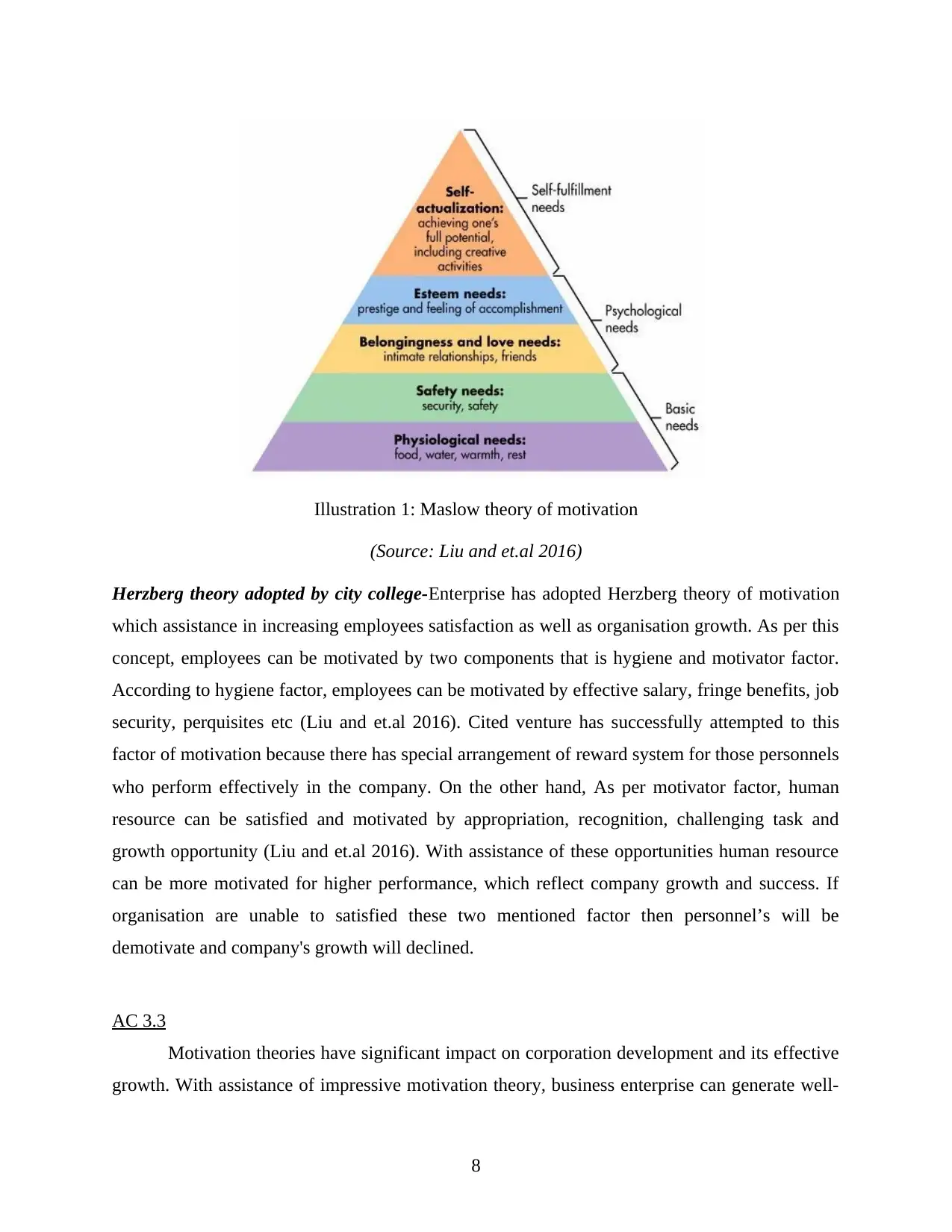
Illustration 1: Maslow theory of motivation
(Source: Liu and et.al 2016)
Herzberg theory adopted by city college-Enterprise has adopted Herzberg theory of motivation
which assistance in increasing employees satisfaction as well as organisation growth. As per this
concept, employees can be motivated by two components that is hygiene and motivator factor.
According to hygiene factor, employees can be motivated by effective salary, fringe benefits, job
security, perquisites etc (Liu and et.al 2016). Cited venture has successfully attempted to this
factor of motivation because there has special arrangement of reward system for those personnels
who perform effectively in the company. On the other hand, As per motivator factor, human
resource can be satisfied and motivated by appropriation, recognition, challenging task and
growth opportunity (Liu and et.al 2016). With assistance of these opportunities human resource
can be more motivated for higher performance, which reflect company growth and success. If
organisation are unable to satisfied these two mentioned factor then personnel’s will be
demotivate and company's growth will declined.
AC 3.3
Motivation theories have significant impact on corporation development and its effective
growth. With assistance of impressive motivation theory, business enterprise can generate well-
8
(Source: Liu and et.al 2016)
Herzberg theory adopted by city college-Enterprise has adopted Herzberg theory of motivation
which assistance in increasing employees satisfaction as well as organisation growth. As per this
concept, employees can be motivated by two components that is hygiene and motivator factor.
According to hygiene factor, employees can be motivated by effective salary, fringe benefits, job
security, perquisites etc (Liu and et.al 2016). Cited venture has successfully attempted to this
factor of motivation because there has special arrangement of reward system for those personnels
who perform effectively in the company. On the other hand, As per motivator factor, human
resource can be satisfied and motivated by appropriation, recognition, challenging task and
growth opportunity (Liu and et.al 2016). With assistance of these opportunities human resource
can be more motivated for higher performance, which reflect company growth and success. If
organisation are unable to satisfied these two mentioned factor then personnel’s will be
demotivate and company's growth will declined.
AC 3.3
Motivation theories have significant impact on corporation development and its effective
growth. With assistance of impressive motivation theory, business enterprise can generate well-
8
Paraphrase This Document
Need a fresh take? Get an instant paraphrase of this document with our AI Paraphraser
defined results and outcome. As per the above discussion it has been ascertained that City
college and Enterprise has been adopted different motivation concepts for enhancing motivation
and encouragement within workforce (Liu and et.al 2016). Maslows need Hierarchy theory is
very helpful aspect for company. As per this concept corporation can consider on employees
basic needs such as food, air, water, shelter and sleep. A business unit can attain same by
developing effective work environment at workplace. The requirement of safety can be fulfilled
by job security and workplace safety. The next level of employees need involves social needs.
Every employees required social support and recognition for their effective work (Tesson and
et.al., 2016). Business unit has developed team-working measures to attain social needs of
individuals. Furthermore, the self-esteem needs is the most important aspect for every employees
at workplace. This need can be attained by providing appreciation, encouragement and
recognition to employee for outstanding performance. Enterprise has highly beneficial with assist
of this theory of motivation (Liu and et.al 2016). Human resource of cited venture has more
motivated and encourage for higher productivity and quality performance in the firm.
TASK 4
AC 4.1
When an organisation develops a group, it helps in dividing complete task in small
activities, which get completed with the assistance of created group. In order to attain the set of
objectives of corporation, there is requirement of developing an effective team (Teams and
Teamwork. 2014). Developing effectual measures of group behaviour aids employees in
improving working system and healthy culture within company. Employees working together in
corporation generate high and well-defined results of business, which develop a positive impact
on business operations. There are two different kinds of group, that is, formal and informal.
Formal – In context of formal group, individuals have aim to accomplish the particular purpose
of organisation. Formal groups are formed and operated through set of rules and regulations.
There is formal relationship between team members. They share their roles and responsibilities
to attain specified goals of the firm (TEAMS AND TEAMWORK, 2014). Tuckman theory of
group formation defines various stages of group formation that is forming (Comes individual
together), storming (Generate formal relation), norming (Delegating responsibility and
authority), performing (perform their activities).
9
college and Enterprise has been adopted different motivation concepts for enhancing motivation
and encouragement within workforce (Liu and et.al 2016). Maslows need Hierarchy theory is
very helpful aspect for company. As per this concept corporation can consider on employees
basic needs such as food, air, water, shelter and sleep. A business unit can attain same by
developing effective work environment at workplace. The requirement of safety can be fulfilled
by job security and workplace safety. The next level of employees need involves social needs.
Every employees required social support and recognition for their effective work (Tesson and
et.al., 2016). Business unit has developed team-working measures to attain social needs of
individuals. Furthermore, the self-esteem needs is the most important aspect for every employees
at workplace. This need can be attained by providing appreciation, encouragement and
recognition to employee for outstanding performance. Enterprise has highly beneficial with assist
of this theory of motivation (Liu and et.al 2016). Human resource of cited venture has more
motivated and encourage for higher productivity and quality performance in the firm.
TASK 4
AC 4.1
When an organisation develops a group, it helps in dividing complete task in small
activities, which get completed with the assistance of created group. In order to attain the set of
objectives of corporation, there is requirement of developing an effective team (Teams and
Teamwork. 2014). Developing effectual measures of group behaviour aids employees in
improving working system and healthy culture within company. Employees working together in
corporation generate high and well-defined results of business, which develop a positive impact
on business operations. There are two different kinds of group, that is, formal and informal.
Formal – In context of formal group, individuals have aim to accomplish the particular purpose
of organisation. Formal groups are formed and operated through set of rules and regulations.
There is formal relationship between team members. They share their roles and responsibilities
to attain specified goals of the firm (TEAMS AND TEAMWORK, 2014). Tuckman theory of
group formation defines various stages of group formation that is forming (Comes individual
together), storming (Generate formal relation), norming (Delegating responsibility and
authority), performing (perform their activities).
9
Informal – Individuals follow friendly approach in informal group. Developing group is highly
beneficial for attaining business objectives and creating bonds of relationship among personnel.
This type of group is generally developed on a deliberate basis due to common interests, beliefs,
friendships, preferences etc.
As the scenario of City College, well-defined formal group is developed because
informal group is not suitable due to causal attitude of employees towards organisation.
AC 4.2
Teamwork is an important aspect of activity in business operations. When an group is
developed then various factors are needed to be considered. In order to gain success and
outcomes, corporation needs to develop a sound team because when people work together then
there will enhanced unity that aids in in reducing employees turnover. Different factors
contribute in the effectiveness of group. Following are some major factors, which influence the
team, which is as follows- Size of team – Within a team, if there are large numbers of members then more
innovative ideas and creativity will be generated. Furthermore, members can attain their
predefined goals within short time period (TEAMS AND TEAMWORK, 2014). If size of
team is large then there will be more resources, which would help in developing quality
output. However, large group may create misunderstanding and conflicts within team
members because there are various views and opinions. Communication and supervision – Sound channel of communication is very important
within team. Therefore, individuals can easily share their problems with the team leader
or supervisor (Blanchard, 2010). Employees can communicate freely with each other
which includes effective conversation tone, willingness to consider all opinions and
solving the conflicts between employees.
Team composition – Appropriate team composition of corporation results into business
growth within economy (Liu and et.al 2016). An efficient team must require appropriate
composition of talent, which can complete the business goals and team objective
efficiently.
AC 4.3
Technology is significant for achieving company's success and growth. In the present era,
technology assists in every aspect of business either it is production, marketing, operation or
10
beneficial for attaining business objectives and creating bonds of relationship among personnel.
This type of group is generally developed on a deliberate basis due to common interests, beliefs,
friendships, preferences etc.
As the scenario of City College, well-defined formal group is developed because
informal group is not suitable due to causal attitude of employees towards organisation.
AC 4.2
Teamwork is an important aspect of activity in business operations. When an group is
developed then various factors are needed to be considered. In order to gain success and
outcomes, corporation needs to develop a sound team because when people work together then
there will enhanced unity that aids in in reducing employees turnover. Different factors
contribute in the effectiveness of group. Following are some major factors, which influence the
team, which is as follows- Size of team – Within a team, if there are large numbers of members then more
innovative ideas and creativity will be generated. Furthermore, members can attain their
predefined goals within short time period (TEAMS AND TEAMWORK, 2014). If size of
team is large then there will be more resources, which would help in developing quality
output. However, large group may create misunderstanding and conflicts within team
members because there are various views and opinions. Communication and supervision – Sound channel of communication is very important
within team. Therefore, individuals can easily share their problems with the team leader
or supervisor (Blanchard, 2010). Employees can communicate freely with each other
which includes effective conversation tone, willingness to consider all opinions and
solving the conflicts between employees.
Team composition – Appropriate team composition of corporation results into business
growth within economy (Liu and et.al 2016). An efficient team must require appropriate
composition of talent, which can complete the business goals and team objective
efficiently.
AC 4.3
Technology is significant for achieving company's success and growth. In the present era,
technology assists in every aspect of business either it is production, marketing, operation or
10
⊘ This is a preview!⊘
Do you want full access?
Subscribe today to unlock all pages.
Trusted by 1+ million students worldwide

1 out of 15


Related Documents


Your All-in-One AI-Powered Toolkit for Academic Success.
+13062052269
info@desklib.com
Available 24*7 on WhatsApp / Email
![[object Object]](/_next/static/media/star-bottom.7253800d.svg)
Unlock your academic potential
Copyright © 2020–2026 A2Z Services. All Rights Reserved. Developed and managed by ZUCOL.