Organisational Behaviour: Influence of Culture, Power, and Motivation
VerifiedAdded on 2020/12/09
|16
|4868
|116
Report
AI Summary
This report delves into the realm of organizational behaviour, examining how organizational culture, power dynamics, and motivational theories influence individual and team performance. It explores various aspects of organizational culture, including power, task, person, and role cultures, and analyzes the impact of power on individual and team behaviour, outlining different types of power such as legitimate, reward, coercive, informational, personal, and expert power. The report also investigates motivational theories, encompassing both content theories like Alderfer's ERG theory and McClelland's theory, and process theories like equity and goal-setting theories. Furthermore, it differentiates between effective and ineffective teams, with a focus on various team types within Waitrose. The report also touches upon the concepts and philosophies of organizational behaviour, providing a comprehensive overview of these crucial aspects of management and leadership.
Organisational
Behaviour
Behaviour

Paraphrase This Document
Need a fresh take? Get an instant paraphrase of this document with our AI Paraphraser
Table of Contents
INTRODUCTION...........................................................................................................................1
TASK 1............................................................................................................................................1
P1. How Organisational culture, Power and politics can influence individual, team behaviour
and performance..........................................................................................................................1
P2 Content and process theories of motivation...........................................................................3
TASK 2............................................................................................................................................6
P3. What makes an effective team, as opposed to an ineffective team.......................................6
P4. The concepts and philosophies of Organisational Behaviour...............................................9
CONCLUSION..............................................................................................................................12
REFERENCES..............................................................................................................................13
INTRODUCTION...........................................................................................................................1
TASK 1............................................................................................................................................1
P1. How Organisational culture, Power and politics can influence individual, team behaviour
and performance..........................................................................................................................1
P2 Content and process theories of motivation...........................................................................3
TASK 2............................................................................................................................................6
P3. What makes an effective team, as opposed to an ineffective team.......................................6
P4. The concepts and philosophies of Organisational Behaviour...............................................9
CONCLUSION..............................................................................................................................12
REFERENCES..............................................................................................................................13
INTRODUCTION
Organization is a social portion of the individuals that is organized to meet collective
goals of the company. All organization have a structure that show the relationship between
company activities and their members. Each company staffed their members in such a way that
they can operate their performing activities in a coordinated way.
Organisation behaviour is a field of work that can directly effect by its stakeholder that
how there behaviour can impact on the performance of the organisation (Alvesson and
Sveningsson 2015).So company can manage their culture inside the organisation it can help them
to achieve collective goals of the organisation under minimum time with maximum
effectiveness. It can be easily understand by view the organisation culture of Waitrose.
Waitrose is an international company situated in UK which are running their supermarket
chain in all over the world. Company achieve its success and fame by providing organic foods
for special occasion. In these topic lets discuss how Waitrose can manage their organization
culture and analyse what factors can help them to achieve more growth in the organisation.
Impact of organisation's culture on individuals and team behaviour.
Organisation culture- it is the culture that can be share mutually between the organisation and its
members. The corporate culture include different factors like belief, attitude, value, assumption
etc. this all factors develop a environment inside the organisation that can knot together the
members of the organisation and it is shared among them to achieve the goals of the
organisation.
TASK 1
P1. How Organisational culture, Power and politics can influence individual, team behaviour and
performance
Start with the Charles Handy typology there are four different types of culture which are as
follow.
Power culture
in this culture the power is in hands of few people of the organisation only and they are
responsible to take management decision (Bolino and et. al., 2015). They are most important
person in the organisation further after taking decision they can be delegate their responsibilities
to other employees also. Power culture affect behaviour of individuals and team as they feel
Organization is a social portion of the individuals that is organized to meet collective
goals of the company. All organization have a structure that show the relationship between
company activities and their members. Each company staffed their members in such a way that
they can operate their performing activities in a coordinated way.
Organisation behaviour is a field of work that can directly effect by its stakeholder that
how there behaviour can impact on the performance of the organisation (Alvesson and
Sveningsson 2015).So company can manage their culture inside the organisation it can help them
to achieve collective goals of the organisation under minimum time with maximum
effectiveness. It can be easily understand by view the organisation culture of Waitrose.
Waitrose is an international company situated in UK which are running their supermarket
chain in all over the world. Company achieve its success and fame by providing organic foods
for special occasion. In these topic lets discuss how Waitrose can manage their organization
culture and analyse what factors can help them to achieve more growth in the organisation.
Impact of organisation's culture on individuals and team behaviour.
Organisation culture- it is the culture that can be share mutually between the organisation and its
members. The corporate culture include different factors like belief, attitude, value, assumption
etc. this all factors develop a environment inside the organisation that can knot together the
members of the organisation and it is shared among them to achieve the goals of the
organisation.
TASK 1
P1. How Organisational culture, Power and politics can influence individual, team behaviour and
performance
Start with the Charles Handy typology there are four different types of culture which are as
follow.
Power culture
in this culture the power is in hands of few people of the organisation only and they are
responsible to take management decision (Bolino and et. al., 2015). They are most important
person in the organisation further after taking decision they can be delegate their responsibilities
to other employees also. Power culture affect behaviour of individuals and team as they feel
⊘ This is a preview!⊘
Do you want full access?
Subscribe today to unlock all pages.

Trusted by 1+ million students worldwide

demotivated because they can only follow instruction of their superior sometimes it create biased
towards some employees.
2
towards some employees.
2
Paraphrase This Document
Need a fresh take? Get an instant paraphrase of this document with our AI Paraphraser
Task culture
company in which teams can be made to achieve the targets and to find solution for
different problems can follow the task culture. in these employees with common interest came
together to form a team and they bring equal efforts to accompany the goal of the company
(Borkowski 2015).
Person culture
In this culture employees give more importance to themselves rather than the
organisation. Employee gives more priority to their goals as compare with organisation goal.
Role culture
In this culture employees got roles as per their specialization, qualification and interest
so the company can extract best out of their employees. Every employee is responsible for work
which is assigned to him. In these employee face those challenge which are willing accept by
them. In these culture employee and team both are motivated because work assigned to them is
similar to their requirements.
Effect of power on individual and team behaviour
Power is a way by which an individual can influence other people. Power refer that how a
person can affect behaviour of his subordinate by controlling the resources. In simple words
there is a agent and other is target. Agent is one who hold the power and target is acquire by
agent power.
In organisation behaviour there are five types of power which can be describe by French and
Raven as follow.
Legitimate power- it is the power which can be influenced with the position. If a person loose
the position at that time power is also disappear from the hands of that person (Miner 2015).In
organisation it is seen many times like subordinate are more influenced by position rather than
the person.
Reward power- In these employee are given rewards based on their performance like promotion,
monetary benefits etc. if employee expectation are fulfilled then it is sure that they can complete
organisation task also. In these individual and team behaviour are affected because for giving
rewards to employees superior also have to take permission from management or board of
directors.
3
company in which teams can be made to achieve the targets and to find solution for
different problems can follow the task culture. in these employees with common interest came
together to form a team and they bring equal efforts to accompany the goal of the company
(Borkowski 2015).
Person culture
In this culture employees give more importance to themselves rather than the
organisation. Employee gives more priority to their goals as compare with organisation goal.
Role culture
In this culture employees got roles as per their specialization, qualification and interest
so the company can extract best out of their employees. Every employee is responsible for work
which is assigned to him. In these employee face those challenge which are willing accept by
them. In these culture employee and team both are motivated because work assigned to them is
similar to their requirements.
Effect of power on individual and team behaviour
Power is a way by which an individual can influence other people. Power refer that how a
person can affect behaviour of his subordinate by controlling the resources. In simple words
there is a agent and other is target. Agent is one who hold the power and target is acquire by
agent power.
In organisation behaviour there are five types of power which can be describe by French and
Raven as follow.
Legitimate power- it is the power which can be influenced with the position. If a person loose
the position at that time power is also disappear from the hands of that person (Miner 2015).In
organisation it is seen many times like subordinate are more influenced by position rather than
the person.
Reward power- In these employee are given rewards based on their performance like promotion,
monetary benefits etc. if employee expectation are fulfilled then it is sure that they can complete
organisation task also. In these individual and team behaviour are affected because for giving
rewards to employees superior also have to take permission from management or board of
directors.
3
Coercive power- threat and punishment are two major tools that can be applied in the coercive
power. In these a employees are frighten by saying that they will be fired or demoted etc. in
coercive power individual or team can be affected if organisation use more coercive power they
will leave the organisation.
Informational power- This power grip in the hands of the person who have access over useful
information. In present scenario information is a strong way of power. (Brickley, Smith, and
Zimmerman 2015). This can affect the individual behaviour like agent will try to influence on
other people.
Personal power- in this to gain such type of power a person should have charming personality,
it can be a type of needy form of leadership. True leader have such types of power. In teams
behaviour it can be seen easily like they are responsible and accountable for their project.
Expert power- when a employee is expert in a particular field like they have skill that can help
them to understand a situation and find solution of this problems. As they are more confident
because they have good subject knowledge of a particular field. In these case individual perform
more better as they are enable to understand their field easily.
Organizational politics is a mixture of different activities that are connected with different
individuals and organisation that help them to increase the performance of them. It is shown that
employees who have political skill can perform more better to gain more power.
Positive effect of politics in an organisation is that productivity of the employees is
increased as they want more power so they can perform more better to achieve their powerful
position. Employees will show more productivity in their work like manager should not fail to
match with structural equality of management (Hansen and Taylor 2017). Negative effect of
political behaviour is that sometimes company have to face bad environment inside the
organisation because for gain high power in company employees will spread rumour and wrong
information which create confusion and conflicts.
P2 Content and process theories of motivation
Theories of motivation
Motivation is a process by which internal and external factors of an individual can create
desire and energy inside the person which can help the person to get more interest and
commitment towards his job. In these context lets some theories of motivation which are as
follows:
4
power. In these a employees are frighten by saying that they will be fired or demoted etc. in
coercive power individual or team can be affected if organisation use more coercive power they
will leave the organisation.
Informational power- This power grip in the hands of the person who have access over useful
information. In present scenario information is a strong way of power. (Brickley, Smith, and
Zimmerman 2015). This can affect the individual behaviour like agent will try to influence on
other people.
Personal power- in this to gain such type of power a person should have charming personality,
it can be a type of needy form of leadership. True leader have such types of power. In teams
behaviour it can be seen easily like they are responsible and accountable for their project.
Expert power- when a employee is expert in a particular field like they have skill that can help
them to understand a situation and find solution of this problems. As they are more confident
because they have good subject knowledge of a particular field. In these case individual perform
more better as they are enable to understand their field easily.
Organizational politics is a mixture of different activities that are connected with different
individuals and organisation that help them to increase the performance of them. It is shown that
employees who have political skill can perform more better to gain more power.
Positive effect of politics in an organisation is that productivity of the employees is
increased as they want more power so they can perform more better to achieve their powerful
position. Employees will show more productivity in their work like manager should not fail to
match with structural equality of management (Hansen and Taylor 2017). Negative effect of
political behaviour is that sometimes company have to face bad environment inside the
organisation because for gain high power in company employees will spread rumour and wrong
information which create confusion and conflicts.
P2 Content and process theories of motivation
Theories of motivation
Motivation is a process by which internal and external factors of an individual can create
desire and energy inside the person which can help the person to get more interest and
commitment towards his job. In these context lets some theories of motivation which are as
follows:
4
⊘ This is a preview!⊘
Do you want full access?
Subscribe today to unlock all pages.
Trusted by 1+ million students worldwide
Content theory of motivation suggest by Alderfer ERG theory of motivation is as follow:
In these there are three factors ERG in which E refer for existence which cover basic
needs of an employee like food, shelter, water etc. and R stand for relatedness in these individual
want to connect with the society. Like to develop social relationship and at last G show the
growth in these employees want to fulfil their desire and wish (Hansen and Taylor 2017).
Waitrose can apply this theory on their employees like which employ is on E stage and who is G
stage and then they support their employees to achieve more growth for their employees. In case
when a employees is not able to match with high stage at that time they can satisfy their lower
stage of motivation.
Another content theory is McClelland's theory of motivation
In this first is need for achievement like an individual want to achieve some difficult task.
These individual are those person who are master in their field and want to complete difficult
task. When an individual match with achievement stage then other desire is to consume some
time with in the society, person want to maintain relation with other peoples of the society and
last stage is to teach others that how they can complete their work to encourage in simple words
they want some power to control their own work.
In case of waitrose company can find out that which employees is not able to perform good
which of them are not filling their responsibility it is difficult to find too divide the power into
employees because it can create conflict between superior and subordinates.
Process theory of motivation.
Evaluation of content theory- in this theory an employee can see the formation of their reward
system as they are positive response on employee performance of the management. If waitrose
can apply this theory of motivation this concentrate there are optimistic result of the
organisation in the company. In this type of environment employees performance is unbeatable
and they are more towards the success (Hogan and Coote 2014). Like in this theories of
motivation company can develop the behaviour of all members of the organisation.
While other way to improve the performance of the employees is that they can use the act of
forcing and threaten employees of the organisation if they are not taking responsibilities
seriously. Sometimes different king of impairment can also be include in negative motivation.
Equity theory- It is the perception of the individual that how they are treated in the
organisation. They compare themselves with others who are working with them at same level in
5
In these there are three factors ERG in which E refer for existence which cover basic
needs of an employee like food, shelter, water etc. and R stand for relatedness in these individual
want to connect with the society. Like to develop social relationship and at last G show the
growth in these employees want to fulfil their desire and wish (Hansen and Taylor 2017).
Waitrose can apply this theory on their employees like which employ is on E stage and who is G
stage and then they support their employees to achieve more growth for their employees. In case
when a employees is not able to match with high stage at that time they can satisfy their lower
stage of motivation.
Another content theory is McClelland's theory of motivation
In this first is need for achievement like an individual want to achieve some difficult task.
These individual are those person who are master in their field and want to complete difficult
task. When an individual match with achievement stage then other desire is to consume some
time with in the society, person want to maintain relation with other peoples of the society and
last stage is to teach others that how they can complete their work to encourage in simple words
they want some power to control their own work.
In case of waitrose company can find out that which employees is not able to perform good
which of them are not filling their responsibility it is difficult to find too divide the power into
employees because it can create conflict between superior and subordinates.
Process theory of motivation.
Evaluation of content theory- in this theory an employee can see the formation of their reward
system as they are positive response on employee performance of the management. If waitrose
can apply this theory of motivation this concentrate there are optimistic result of the
organisation in the company. In this type of environment employees performance is unbeatable
and they are more towards the success (Hogan and Coote 2014). Like in this theories of
motivation company can develop the behaviour of all members of the organisation.
While other way to improve the performance of the employees is that they can use the act of
forcing and threaten employees of the organisation if they are not taking responsibilities
seriously. Sometimes different king of impairment can also be include in negative motivation.
Equity theory- It is the perception of the individual that how they are treated in the
organisation. They compare themselves with others who are working with them at same level in
5
Paraphrase This Document
Need a fresh take? Get an instant paraphrase of this document with our AI Paraphraser
similar organisation. They are motivated only when they have similar awards like there main
focus is to see that awards are equally distributed in the organisation. (Lăzăroiu 2015). In these
case Waitrose can apply this theory of motivation by announce necessary information in the
organisation that how management take the decision and it is fair that the decision are agreeable
and unbiased in the company.
Goal setting theory of motivation- In this individual goals are related with the goal difficulty
and commitment of employee that how an employee achieve the goal. In these employees efforts
and abilities are supported by the organisation which result in good performance of the company.
In goal oriented theory employees are focused towards the goal which work as a major source of
motivation. Like for waitrose employee company can tell them these are particular goals of the
company and if they achieve these goals they should be paid higher because the more difficult is
goal to achieve higher result and productivity can be gained in the performance. (Lee park and
Koo, B. 2015.)
Evaluation of process theory of motivation.
In process theory a superior should be able to teach that how employees can understand different
needs of the organisation. As per difference in individual performance superior or trainer require
that what kind of motivation is necessary to deal with employees.
If process theory is used incorrectly these could affect the performance of employees and they
leave organisation so trainer should have good understanding about their employees capability
and personality.
6
focus is to see that awards are equally distributed in the organisation. (Lăzăroiu 2015). In these
case Waitrose can apply this theory of motivation by announce necessary information in the
organisation that how management take the decision and it is fair that the decision are agreeable
and unbiased in the company.
Goal setting theory of motivation- In this individual goals are related with the goal difficulty
and commitment of employee that how an employee achieve the goal. In these employees efforts
and abilities are supported by the organisation which result in good performance of the company.
In goal oriented theory employees are focused towards the goal which work as a major source of
motivation. Like for waitrose employee company can tell them these are particular goals of the
company and if they achieve these goals they should be paid higher because the more difficult is
goal to achieve higher result and productivity can be gained in the performance. (Lee park and
Koo, B. 2015.)
Evaluation of process theory of motivation.
In process theory a superior should be able to teach that how employees can understand different
needs of the organisation. As per difference in individual performance superior or trainer require
that what kind of motivation is necessary to deal with employees.
If process theory is used incorrectly these could affect the performance of employees and they
leave organisation so trainer should have good understanding about their employees capability
and personality.
6
TASK 2
P3. What makes an effective team, as opposed to an ineffective team
Team refers to where two or more people work towards a common goal. The effective
team of an organization can lead to enhance motivation level of an employee and also business
productivity.
Different type of teams in WAITROSE
There are various types of team in the company and each have different work and responsibility
according to their functionality such as:
Self -Managed Team
The employees of the same company work together to achieve a common result. In
respect to this team there is no need of manager and the responsibilities, rules, expectations and
problems are solved by employees only. (Miner 2015.)WAITROSE could make this types of
teams in every six months as a result, to motivate them accomplish their task effectively.
Moreover, which will ensure their engagement over this firm.
Functional Team
In this type of team the manager manages everything. The manager ensures that there is
no problem if transfer the work from one team to another. The WAITROSE could do same thing
in their organization at any emergency which will show the commitment of employees towards
organization.
Problem Solving Team
This team work as a temporary team of an organization. This team come into action when
there is any financial crises or unplanned event takes place in the organization (Pentland and
Hærem, 2015) The company could adopt this technique which helps in to remove various types
of conflicts within the organization.
Operational Team
This team supports other teams of the organization and ensure that all process go
smoothly. The company could choose this method to determine all the processes on time
effectively and efficiently.
7
P3. What makes an effective team, as opposed to an ineffective team
Team refers to where two or more people work towards a common goal. The effective
team of an organization can lead to enhance motivation level of an employee and also business
productivity.
Different type of teams in WAITROSE
There are various types of team in the company and each have different work and responsibility
according to their functionality such as:
Self -Managed Team
The employees of the same company work together to achieve a common result. In
respect to this team there is no need of manager and the responsibilities, rules, expectations and
problems are solved by employees only. (Miner 2015.)WAITROSE could make this types of
teams in every six months as a result, to motivate them accomplish their task effectively.
Moreover, which will ensure their engagement over this firm.
Functional Team
In this type of team the manager manages everything. The manager ensures that there is
no problem if transfer the work from one team to another. The WAITROSE could do same thing
in their organization at any emergency which will show the commitment of employees towards
organization.
Problem Solving Team
This team work as a temporary team of an organization. This team come into action when
there is any financial crises or unplanned event takes place in the organization (Pentland and
Hærem, 2015) The company could adopt this technique which helps in to remove various types
of conflicts within the organization.
Operational Team
This team supports other teams of the organization and ensure that all process go
smoothly. The company could choose this method to determine all the processes on time
effectively and efficiently.
7
⊘ This is a preview!⊘
Do you want full access?
Subscribe today to unlock all pages.
Trusted by 1+ million students worldwide
Importance of Team in WAITROSE
There is various advantage of a team in WAITROSE. Through with the help of an
effective team which lead to increase the productivity of the company in long term. As in teams
the individuals have different brains, ideas, quality, experiences which bring out strong results
and better performances. With the help of teams the company provides a good opportunity to
every employees to learn and explore themselves as much as they can. In respect to this the new
employees get knowledge and information from experienced employees. If the WAITROSE
places right person at the right job according to their skills, knowledge, experiences as a result
the employees completed the work on time in very efficient manner (Petrou, Demerouti, and
Schaufeli 2018).
It is necessary to formulate the teams in the organization to achieve desired goals and increase
the productivity.
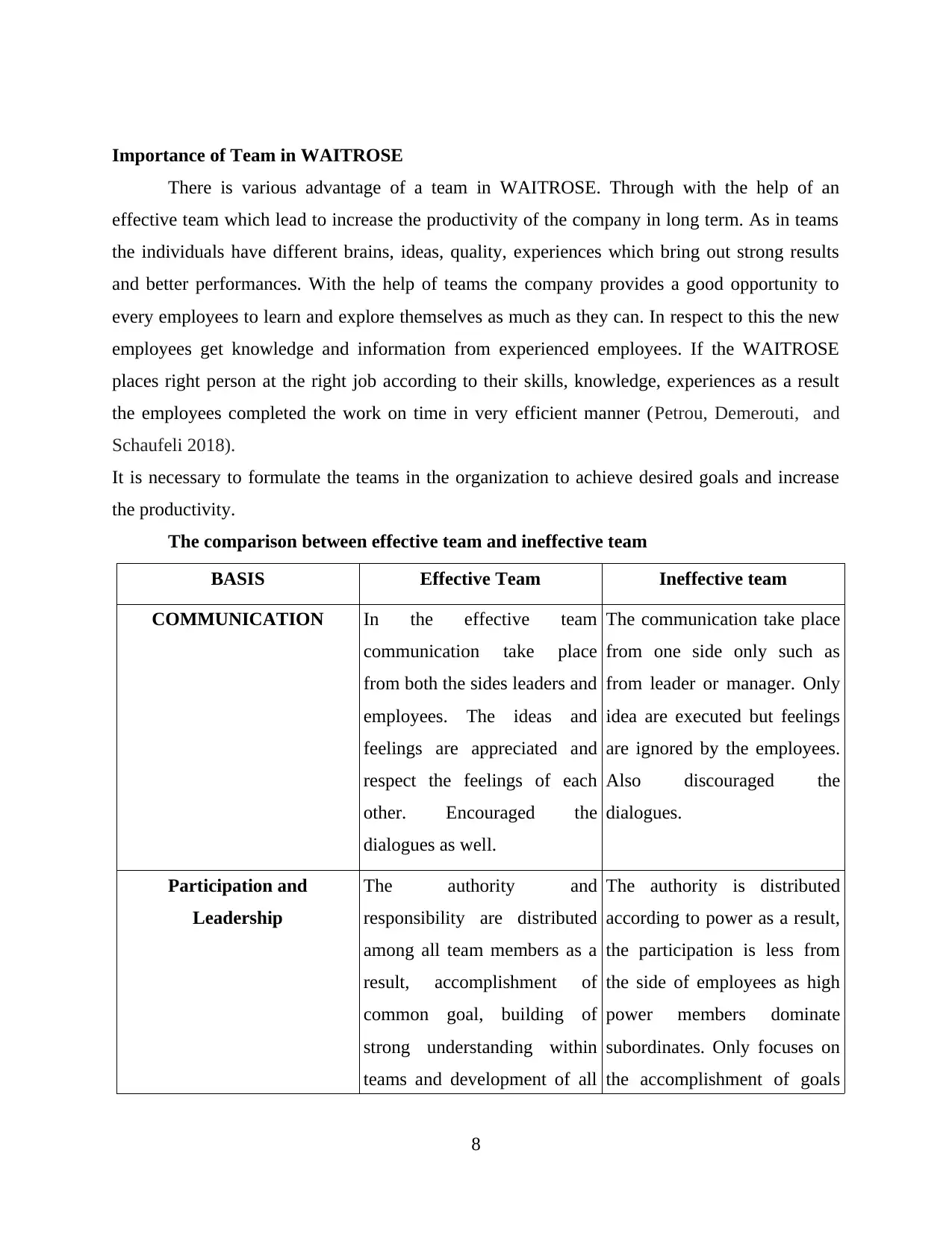
The comparison between effective team and ineffective team
BASIS Effective Team Ineffective team
COMMUNICATION In the effective team
communication take place
from both the sides leaders and
employees. The ideas and
feelings are appreciated and
respect the feelings of each
other. Encouraged the
dialogues as well.
The communication take place
from one side only such as
from leader or manager. Only
idea are executed but feelings
are ignored by the employees.
Also discouraged the
dialogues.
Participation and
Leadership
The authority and
responsibility are distributed
among all team members as a
result, accomplishment of
common goal, building of
strong understanding within
teams and development of all
The authority is distributed
according to power as a result,
the participation is less from
the side of employees as high
power members dominate
subordinates. Only focuses on
the accomplishment of goals
8
There is various advantage of a team in WAITROSE. Through with the help of an
effective team which lead to increase the productivity of the company in long term. As in teams
the individuals have different brains, ideas, quality, experiences which bring out strong results
and better performances. With the help of teams the company provides a good opportunity to
every employees to learn and explore themselves as much as they can. In respect to this the new
employees get knowledge and information from experienced employees. If the WAITROSE
places right person at the right job according to their skills, knowledge, experiences as a result
the employees completed the work on time in very efficient manner (Petrou, Demerouti, and
Schaufeli 2018).
It is necessary to formulate the teams in the organization to achieve desired goals and increase
the productivity.
The comparison between effective team and ineffective team
BASIS Effective Team Ineffective team
COMMUNICATION In the effective team
communication take place
from both the sides leaders and
employees. The ideas and
feelings are appreciated and
respect the feelings of each
other. Encouraged the
dialogues as well.
The communication take place
from one side only such as
from leader or manager. Only
idea are executed but feelings
are ignored by the employees.
Also discouraged the
dialogues.
Participation and
Leadership
The authority and
responsibility are distributed
among all team members as a
result, accomplishment of
common goal, building of
strong understanding within
teams and development of all
The authority is distributed
according to power as a result,
the participation is less from
the side of employees as high
power members dominate
subordinates. Only focuses on
the accomplishment of goals
8
Paraphrase This Document
Need a fresh take? Get an instant paraphrase of this document with our AI Paraphraser
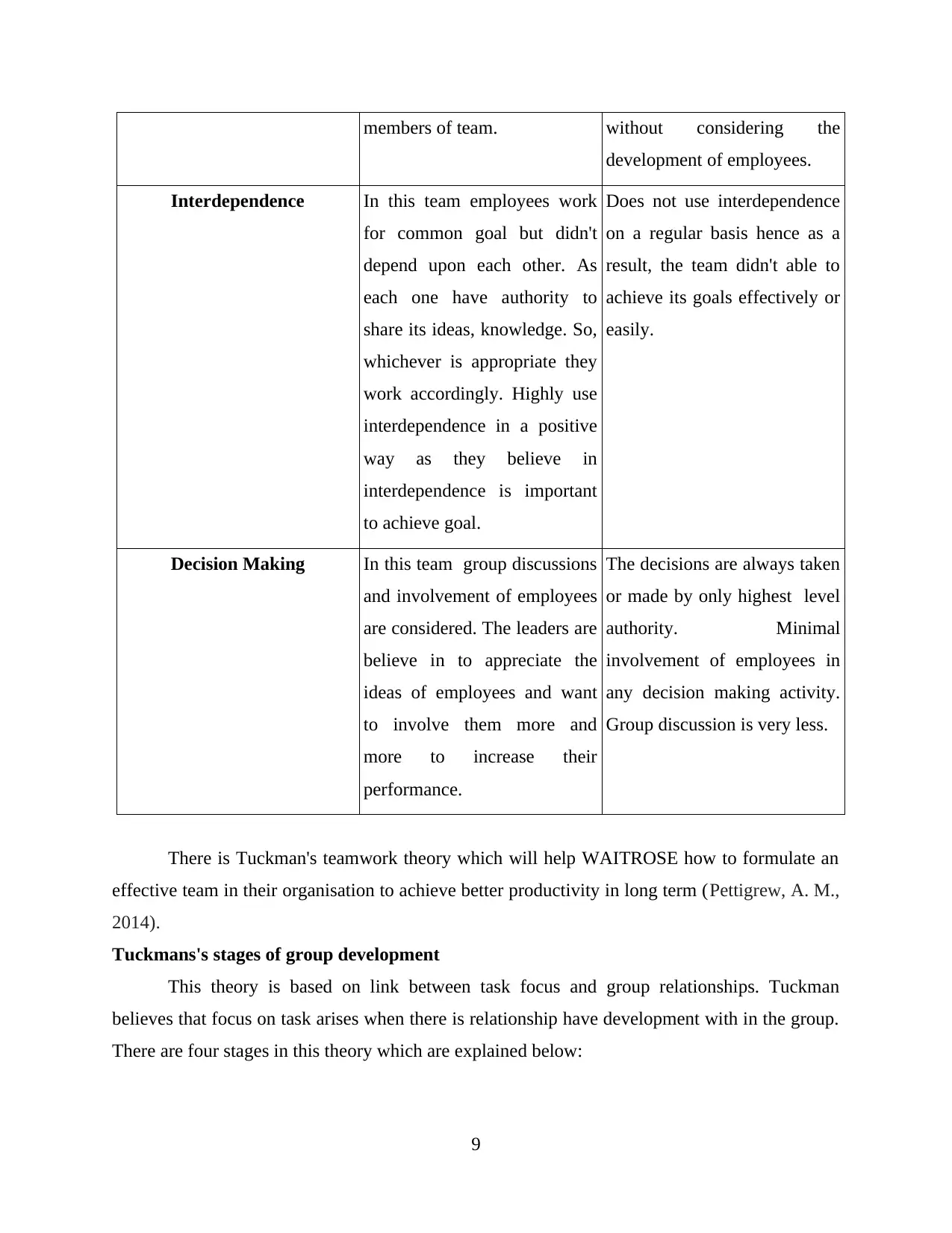
members of team. without considering the
development of employees.
Interdependence In this team employees work
for common goal but didn't
depend upon each other. As
each one have authority to
share its ideas, knowledge. So,
whichever is appropriate they
work accordingly. Highly use
interdependence in a positive
way as they believe in
interdependence is important
to achieve goal.
Does not use interdependence
on a regular basis hence as a
result, the team didn't able to
achieve its goals effectively or
easily.
Decision Making In this team group discussions
and involvement of employees
are considered. The leaders are
believe in to appreciate the
ideas of employees and want
to involve them more and
more to increase their
performance.
The decisions are always taken
or made by only highest level
authority. Minimal
involvement of employees in
any decision making activity.
Group discussion is very less.
There is Tuckman's teamwork theory which will help WAITROSE how to formulate an
effective team in their organisation to achieve better productivity in long term (Pettigrew, A. M.,
2014).
Tuckmans's stages of group development
This theory is based on link between task focus and group relationships. Tuckman
believes that focus on task arises when there is relationship have development with in the group.
There are four stages in this theory which are explained below:
9
development of employees.
Interdependence In this team employees work
for common goal but didn't
depend upon each other. As
each one have authority to
share its ideas, knowledge. So,
whichever is appropriate they
work accordingly. Highly use
interdependence in a positive
way as they believe in
interdependence is important
to achieve goal.
Does not use interdependence
on a regular basis hence as a
result, the team didn't able to
achieve its goals effectively or
easily.
Decision Making In this team group discussions
and involvement of employees
are considered. The leaders are
believe in to appreciate the
ideas of employees and want
to involve them more and
more to increase their
performance.
The decisions are always taken
or made by only highest level
authority. Minimal
involvement of employees in
any decision making activity.
Group discussion is very less.
There is Tuckman's teamwork theory which will help WAITROSE how to formulate an
effective team in their organisation to achieve better productivity in long term (Pettigrew, A. M.,
2014).
Tuckmans's stages of group development
This theory is based on link between task focus and group relationships. Tuckman
believes that focus on task arises when there is relationship have development with in the group.
There are four stages in this theory which are explained below:
9
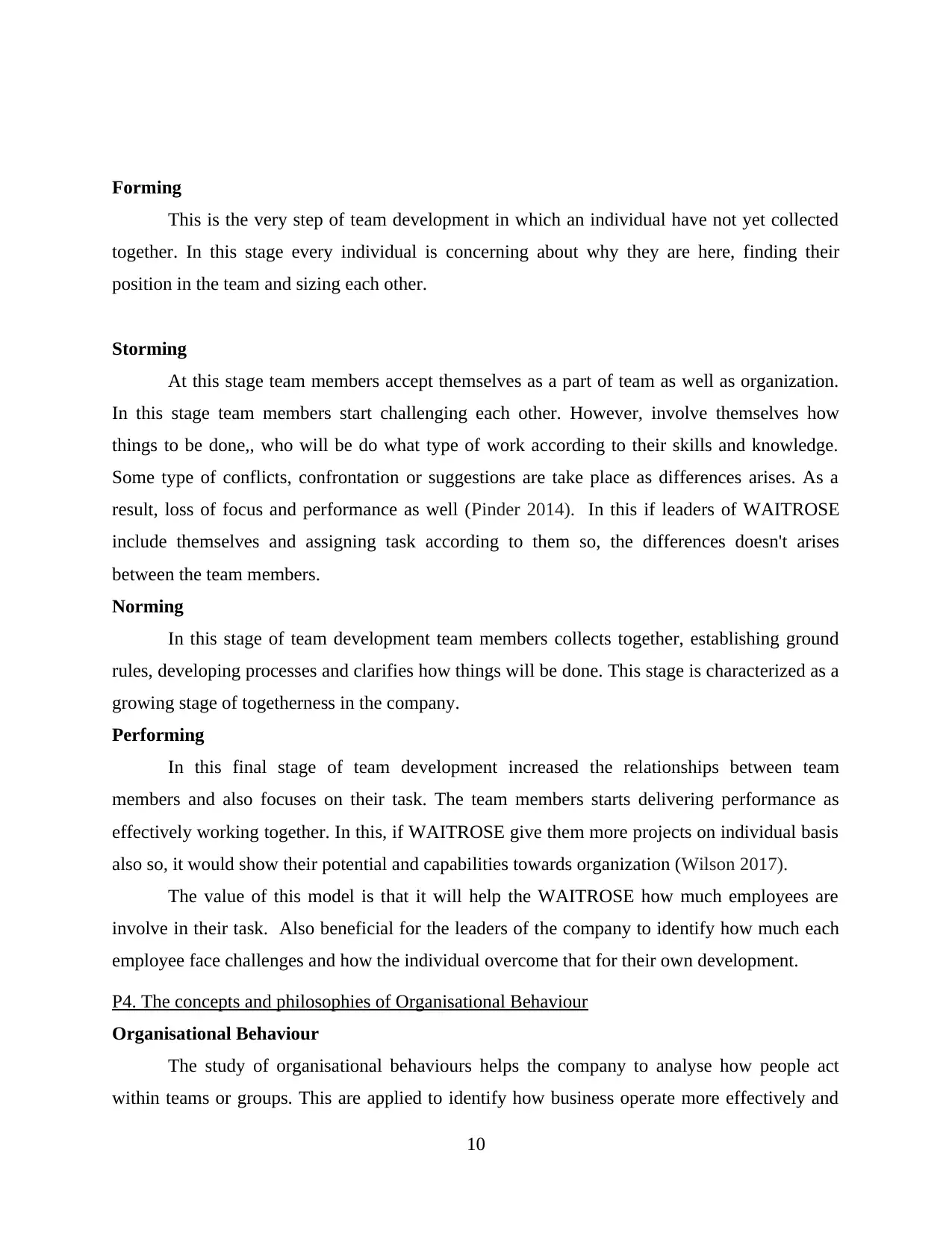
Forming
This is the very step of team development in which an individual have not yet collected
together. In this stage every individual is concerning about why they are here, finding their
position in the team and sizing each other.
Storming
At this stage team members accept themselves as a part of team as well as organization.
In this stage team members start challenging each other. However, involve themselves how
things to be done,, who will be do what type of work according to their skills and knowledge.
Some type of conflicts, confrontation or suggestions are take place as differences arises. As a
result, loss of focus and performance as well (Pinder 2014). In this if leaders of WAITROSE
include themselves and assigning task according to them so, the differences doesn't arises
between the team members.
Norming
In this stage of team development team members collects together, establishing ground
rules, developing processes and clarifies how things will be done. This stage is characterized as a
growing stage of togetherness in the company.
Performing
In this final stage of team development increased the relationships between team
members and also focuses on their task. The team members starts delivering performance as
effectively working together. In this, if WAITROSE give them more projects on individual basis
also so, it would show their potential and capabilities towards organization (Wilson 2017).
The value of this model is that it will help the WAITROSE how much employees are
involve in their task. Also beneficial for the leaders of the company to identify how much each
employee face challenges and how the individual overcome that for their own development.
P4. The concepts and philosophies of Organisational Behaviour
Organisational Behaviour
The study of organisational behaviours helps the company to analyse how people act
within teams or groups. This are applied to identify how business operate more effectively and
10
This is the very step of team development in which an individual have not yet collected
together. In this stage every individual is concerning about why they are here, finding their
position in the team and sizing each other.
Storming
At this stage team members accept themselves as a part of team as well as organization.
In this stage team members start challenging each other. However, involve themselves how
things to be done,, who will be do what type of work according to their skills and knowledge.
Some type of conflicts, confrontation or suggestions are take place as differences arises. As a
result, loss of focus and performance as well (Pinder 2014). In this if leaders of WAITROSE
include themselves and assigning task according to them so, the differences doesn't arises
between the team members.
Norming
In this stage of team development team members collects together, establishing ground
rules, developing processes and clarifies how things will be done. This stage is characterized as a
growing stage of togetherness in the company.
Performing
In this final stage of team development increased the relationships between team
members and also focuses on their task. The team members starts delivering performance as
effectively working together. In this, if WAITROSE give them more projects on individual basis
also so, it would show their potential and capabilities towards organization (Wilson 2017).
The value of this model is that it will help the WAITROSE how much employees are
involve in their task. Also beneficial for the leaders of the company to identify how much each
employee face challenges and how the individual overcome that for their own development.
P4. The concepts and philosophies of Organisational Behaviour
Organisational Behaviour
The study of organisational behaviours helps the company to analyse how people act
within teams or groups. This are applied to identify how business operate more effectively and
10
⊘ This is a preview!⊘
Do you want full access?
Subscribe today to unlock all pages.
Trusted by 1+ million students worldwide

1 out of 16


Related Documents


Your All-in-One AI-Powered Toolkit for Academic Success.
+13062052269
info@desklib.com
Available 24*7 on WhatsApp / Email
![[object Object]](/_next/static/media/star-bottom.7253800d.svg)
Unlock your academic potential
Copyright © 2020–2026 A2Z Services. All Rights Reserved. Developed and managed by ZUCOL.