MG414 Organisational Behaviour Report: Marks and Spencer Analysis
VerifiedAdded on 2023/01/04
|12
|2937
|57
Report
AI Summary
This report provides an in-depth analysis of the organizational behaviour of Marks and Spencer, a retail company. The report begins by introducing the concept of organizational behaviour and its relevance to the company. It then delves into the theoretical models of organizational culture, specifically focusing on Handy's cultural model and its application to Marks and Spencer, identifying power, task, role, and person cultures. The report further examines how the company's culture improves organizational effectiveness, with an emphasis on enhanced employee satisfaction, work efficiency, and communication. The role of culture in employee motivation is also evaluated, discussing how organizational culture influences employee engagement and goal achievement. Finally, the report assesses how the company can leverage its culture to enhance its overall success, providing a comprehensive overview of the interplay between culture and organizational performance.
Organisational Behaviour

Paraphrase This Document
Need a fresh take? Get an instant paraphrase of this document with our AI Paraphraser
Executive Summary
Analysis of individual's behaviour through the proper implementatin of theoritical
approach is done in this report. Effectiveness of these theories on employee performance is
also eveluated in the report with that effectiveness of organizational culture in employee
performance is analysed in this report.
Analysis of individual's behaviour through the proper implementatin of theoritical
approach is done in this report. Effectiveness of these theories on employee performance is
also eveluated in the report with that effectiveness of organizational culture in employee
performance is analysed in this report.
Table of Contents
INTRODUCTION.....................................................................................................................................4
MAIN BODY............................................................................................................................................4
Theoretical model for organisation culture.......................................................................................4
Culture improve organisation effectiveness......................................................................................6
Role of culture on employee motivation-..........................................................................................8
Utilization of work culture for goal achieving-...................................................................................9
CONCLUSION.........................................................................................................................................9
REFERENCES.........................................................................................................................................10
INTRODUCTION.....................................................................................................................................4
MAIN BODY............................................................................................................................................4
Theoretical model for organisation culture.......................................................................................4
Culture improve organisation effectiveness......................................................................................6
Role of culture on employee motivation-..........................................................................................8
Utilization of work culture for goal achieving-...................................................................................9
CONCLUSION.........................................................................................................................................9
REFERENCES.........................................................................................................................................10
⊘ This is a preview!⊘
Do you want full access?
Subscribe today to unlock all pages.

Trusted by 1+ million students worldwide
INTRODUCTION
Organisation behaviour is defined as the behaviour of the human being associated
with the organisation. This report is based on the case study of Marks and Spencer in respect
to its organisation behaviour practices. The organisation is associated with the retail sector.
Company is engaged selling high quality clothing, home products and food products.
Company initiated its business in the year 1884. Headquarter of the company is located in
London, United Kingdom. This project would emphasis over the organisation behaviour in
respect to the Marks and Spencer Company. Henceforth, report will emphasis over theoretical
model associated with the culture of organisation. How culture of company could improve
the effectiveness of the culture of organisational work place. Different theories associated
with the motivation of employee at work place would also define in this project. Role of
culture and employee motivation would discuss briefly in this project. Furthermore, this
project would discuss how culture of company can enhances the overall success of the
organisation.
MAIN BODY
Theoretical model for organisation culture
Culture is defined as the culture of the company. Handy cultural model would
specifically project how effective the culture of Marks and Spencer Company.
Handy cultural model
Organisation behaviour is defined as the behaviour of the human being associated
with the organisation. This report is based on the case study of Marks and Spencer in respect
to its organisation behaviour practices. The organisation is associated with the retail sector.
Company is engaged selling high quality clothing, home products and food products.
Company initiated its business in the year 1884. Headquarter of the company is located in
London, United Kingdom. This project would emphasis over the organisation behaviour in
respect to the Marks and Spencer Company. Henceforth, report will emphasis over theoretical
model associated with the culture of organisation. How culture of company could improve
the effectiveness of the culture of organisational work place. Different theories associated
with the motivation of employee at work place would also define in this project. Role of
culture and employee motivation would discuss briefly in this project. Furthermore, this
project would discuss how culture of company can enhances the overall success of the
organisation.
MAIN BODY
Theoretical model for organisation culture
Culture is defined as the culture of the company. Handy cultural model would
specifically project how effective the culture of Marks and Spencer Company.
Handy cultural model
Paraphrase This Document
Need a fresh take? Get an instant paraphrase of this document with our AI Paraphraser
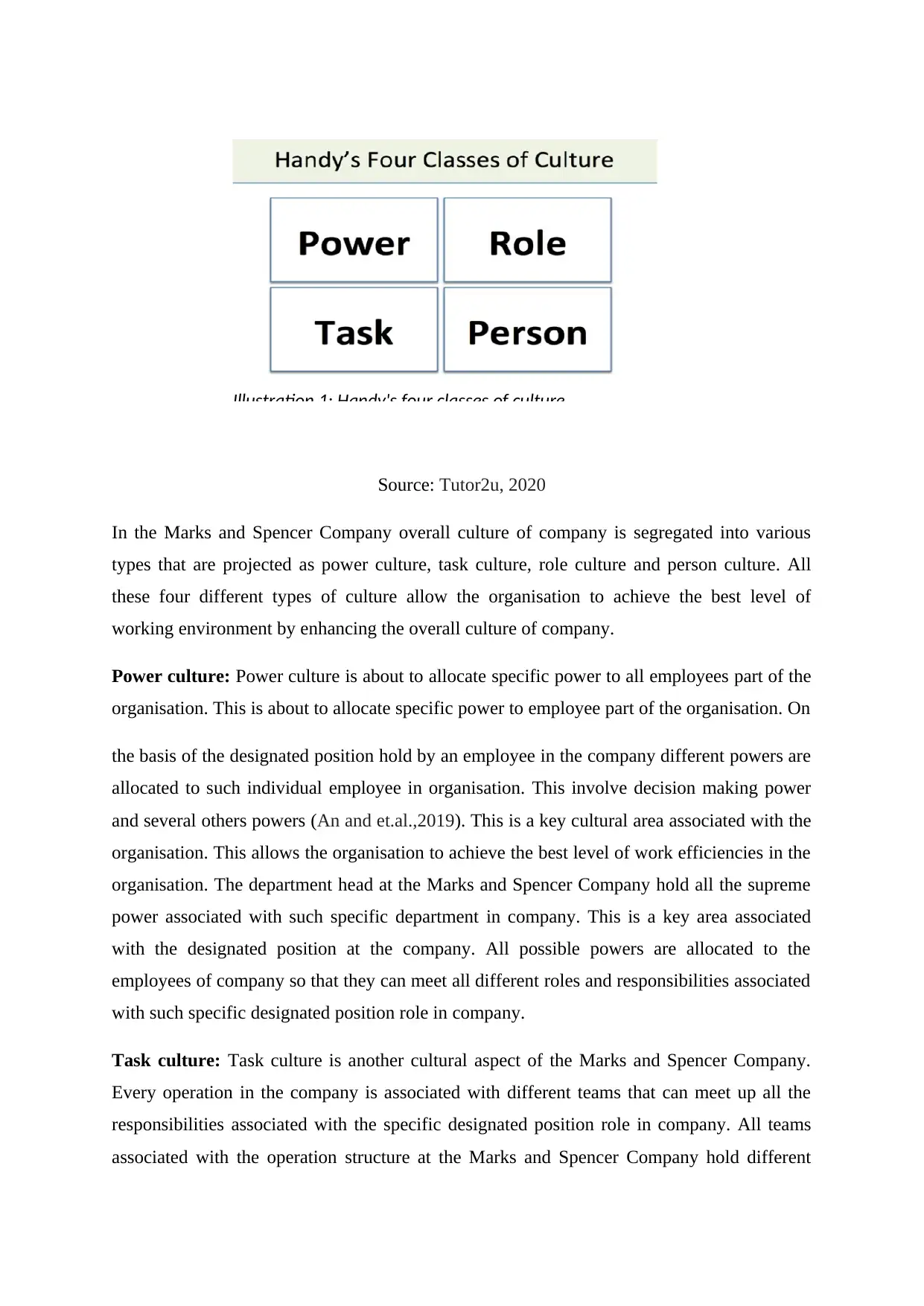
Source: Tutor2u, 2020
In the Marks and Spencer Company overall culture of company is segregated into various
types that are projected as power culture, task culture, role culture and person culture. All
these four different types of culture allow the organisation to achieve the best level of
working environment by enhancing the overall culture of company.
Power culture: Power culture is about to allocate specific power to all employees part of the
organisation. This is about to allocate specific power to employee part of the organisation. On
the basis of the designated position hold by an employee in the company different powers are
allocated to such individual employee in organisation. This involve decision making power
and several others powers (An and et.al.,2019). This is a key cultural area associated with the
organisation. This allows the organisation to achieve the best level of work efficiencies in the
organisation. The department head at the Marks and Spencer Company hold all the supreme
power associated with such specific department in company. This is a key area associated
with the designated position at the company. All possible powers are allocated to the
employees of company so that they can meet all different roles and responsibilities associated
with such specific designated position role in company.
Task culture: Task culture is another cultural aspect of the Marks and Spencer Company.
Every operation in the company is associated with different teams that can meet up all the
responsibilities associated with the specific designated position role in company. All teams
associated with the operation structure at the Marks and Spencer Company hold different
Illustration 1: Handy's four classes of culture
In the Marks and Spencer Company overall culture of company is segregated into various
types that are projected as power culture, task culture, role culture and person culture. All
these four different types of culture allow the organisation to achieve the best level of
working environment by enhancing the overall culture of company.
Power culture: Power culture is about to allocate specific power to all employees part of the
organisation. This is about to allocate specific power to employee part of the organisation. On
the basis of the designated position hold by an employee in the company different powers are
allocated to such individual employee in organisation. This involve decision making power
and several others powers (An and et.al.,2019). This is a key cultural area associated with the
organisation. This allows the organisation to achieve the best level of work efficiencies in the
organisation. The department head at the Marks and Spencer Company hold all the supreme
power associated with such specific department in company. This is a key area associated
with the designated position at the company. All possible powers are allocated to the
employees of company so that they can meet all different roles and responsibilities associated
with such specific designated position role in company.
Task culture: Task culture is another cultural aspect of the Marks and Spencer Company.
Every operation in the company is associated with different teams that can meet up all the
responsibilities associated with the specific designated position role in company. All teams
associated with the operation structure at the Marks and Spencer Company hold different
Illustration 1: Handy's four classes of culture
responsibilities that can match up with the different areas of the functional activity of
company (Sharma and Khatri, 2019). Each team try to cope up with different roles and
responsibilities associated with the organisation. These teams get all the power to take
important operational decision that can best support such organisation to achieve all different
operational objectives. Task culture is another key dimension associated with the organisation
culture of Marks and Spencer Company.
Role culture: Role culture is another crucial aspect associated with the Marks and Spencer
Company. In this aspect every human resource part of the organisation get a specific role in
the organisation structure of company on the basis of the skill and knowledge such individual
hold in organisation. All roles associated with the organisation hierarchy of company are
segregated into all the human resources part of the organisation. This is a key aspect of the
culture of the Marks and Spencer Company. Role culture is a crucial functional area of the
company (Broom, 2019). On the basis of the individual capacity and potential of employee
they get the specific role in the organisation. Role culture is a specific cultural aspect
associated with the marks and Spencer company that allow the company to manage all its
different areas of operations and functions in the best way possible. This cultural aspect of the
company could support the organisation in fulfilling the requirements associated with every
designated position hold by company.
Person culture: Person culture is another key cultural aspect associated with the Marks and
Spencer Company. This involves giving proper respect to every employee associated with the
organisation. This cultural aspect supports the company in achieving the best level of
employee satisfaction in the organisation. This cultural aspect of company allows and drives
the company to give proper respect and treatment to every employee part of the organisation.
Person culture is one of the key cultural aspects associated with the Marks and Spencer
Company which has supported the organisation to achieve the best level of working
environment at work places.
The above mentioned points project different elements associated with the culture of
the Marks and Spencer Company. Organisation culture is a critical aspect of the company.
Culture improve organisation effectiveness
Organisation culture is among the key area associated with the company. Following
are the points denote the improved effectiveness of the organisation due to the culture of
company (Mitonga-Monga, J. and Cilliers, F., 2016).
company (Sharma and Khatri, 2019). Each team try to cope up with different roles and
responsibilities associated with the organisation. These teams get all the power to take
important operational decision that can best support such organisation to achieve all different
operational objectives. Task culture is another key dimension associated with the organisation
culture of Marks and Spencer Company.
Role culture: Role culture is another crucial aspect associated with the Marks and Spencer
Company. In this aspect every human resource part of the organisation get a specific role in
the organisation structure of company on the basis of the skill and knowledge such individual
hold in organisation. All roles associated with the organisation hierarchy of company are
segregated into all the human resources part of the organisation. This is a key aspect of the
culture of the Marks and Spencer Company. Role culture is a crucial functional area of the
company (Broom, 2019). On the basis of the individual capacity and potential of employee
they get the specific role in the organisation. Role culture is a specific cultural aspect
associated with the marks and Spencer company that allow the company to manage all its
different areas of operations and functions in the best way possible. This cultural aspect of the
company could support the organisation in fulfilling the requirements associated with every
designated position hold by company.
Person culture: Person culture is another key cultural aspect associated with the Marks and
Spencer Company. This involves giving proper respect to every employee associated with the
organisation. This cultural aspect supports the company in achieving the best level of
employee satisfaction in the organisation. This cultural aspect of company allows and drives
the company to give proper respect and treatment to every employee part of the organisation.
Person culture is one of the key cultural aspects associated with the Marks and Spencer
Company which has supported the organisation to achieve the best level of working
environment at work places.
The above mentioned points project different elements associated with the culture of
the Marks and Spencer Company. Organisation culture is a critical aspect of the company.
Culture improve organisation effectiveness
Organisation culture is among the key area associated with the company. Following
are the points denote the improved effectiveness of the organisation due to the culture of
company (Mitonga-Monga, J. and Cilliers, F., 2016).
⊘ This is a preview!⊘
Do you want full access?
Subscribe today to unlock all pages.
Trusted by 1+ million students worldwide
Improve employee satisfaction: Organisation culture support the organisation to improve
the overall satisfaction of company’s employees. This is a key strength of organisation that
has guided the Marks and Spencer Company to enhance and boost the employee satisfaction
rate at organisation. Proper culture of organisation always supports the employees of
company to achieve the best level of work efficiencies possible at the organisation (Graddol,
2018). This played a significant role and contributed massively in context that it could
support the organisation and management for achieving the best level of employee
satisfaction rate at the organisation. Employee satisfaction further improve the employee
sustainability at work place as employee do not leave the organisation due to the attachment
and better treatment at work place even if the other organisation offer better salaries to the
employee.
Improve work efficiency: Organisation culture improves the overall work efficiency of the
organisation. This has created a better system at the Marks and Spencer Company which
could allowed the company to enhance and boost the overall work efficiencies of the
company. This is a key positive aspect associated with the organisation as it allow company
to achieve the best level of work efficiencies due to immense support of company’s employee
base.
Improve working culture: Organisation culture also put a huge impact over work culture of
the organisation. Effective organisation culture directly improved the communication
between organisation and employees. This play the critical role in company for the
organisation and management that they get to communicate more properly with the
employees of company in respect to working abilities and different other areas that contribute
in the overall development of the capabilities and skills of human resources associated with
the organisation.
Improve communication: Organisation culture play an important role in improving the
communication between management and employees part of the Marks and Spencer
Company (Khan, Kumar and Vytialingam, 2016). Employee get the proper support in the
Marks and Spence Company about communicating with the higher authorities and
management in the organisation about any issue they face or any problem they are associated
with against the working approaches. All these aspect improve the overall communication
between management and employees part of the Marks and Spencer Company.
the overall satisfaction of company’s employees. This is a key strength of organisation that
has guided the Marks and Spencer Company to enhance and boost the employee satisfaction
rate at organisation. Proper culture of organisation always supports the employees of
company to achieve the best level of work efficiencies possible at the organisation (Graddol,
2018). This played a significant role and contributed massively in context that it could
support the organisation and management for achieving the best level of employee
satisfaction rate at the organisation. Employee satisfaction further improve the employee
sustainability at work place as employee do not leave the organisation due to the attachment
and better treatment at work place even if the other organisation offer better salaries to the
employee.
Improve work efficiency: Organisation culture improves the overall work efficiency of the
organisation. This has created a better system at the Marks and Spencer Company which
could allowed the company to enhance and boost the overall work efficiencies of the
company. This is a key positive aspect associated with the organisation as it allow company
to achieve the best level of work efficiencies due to immense support of company’s employee
base.
Improve working culture: Organisation culture also put a huge impact over work culture of
the organisation. Effective organisation culture directly improved the communication
between organisation and employees. This play the critical role in company for the
organisation and management that they get to communicate more properly with the
employees of company in respect to working abilities and different other areas that contribute
in the overall development of the capabilities and skills of human resources associated with
the organisation.
Improve communication: Organisation culture play an important role in improving the
communication between management and employees part of the Marks and Spencer
Company (Khan, Kumar and Vytialingam, 2016). Employee get the proper support in the
Marks and Spence Company about communicating with the higher authorities and
management in the organisation about any issue they face or any problem they are associated
with against the working approaches. All these aspect improve the overall communication
between management and employees part of the Marks and Spencer Company.
Paraphrase This Document
Need a fresh take? Get an instant paraphrase of this document with our AI Paraphraser
The above mentioned points project different aspects associated with the effective
culture of organisation.
Role of culture on employee motivation-
Organizational culture is the way in which organizational activities happens with
organization like Marks and Spencer. Organizational culture makes a direct impct on
employee's motvation towards achieving their organizational objectives. It is important
because organization is the collection of employees which are gathered together for achieving
a common objective and in which individual employee is having its unique skill sets and
working capabilities (Yang, Manika and Athanasopoulou, 2020). Thus it becomes very
important for organization to develop a effective organizational structure in which employees
are given an opportunity to showcase their abilities such that Marks & Spencer is able to
achieve its orgaizational objectives. Impact of effective organizational culture is also directly
proportional to the hierarchy of power within organization because if employees are not
having a clear image of organizatioal working then they will not be able to analyse the
organizational requirement which will empower them to analyse their performance with the
required criteria. In addition to that employee will also be not able to report their issues
because there is not clear organizational structure is made available to them. Thus by
providing employees a clear organiztioal structure company will not only provide an ability
to employees to showcase their issues by also at the same time Marks & Spence can improve
organization's internal environment (Wilkins, Butt and Annabi, 2018). This happens because
employees are working on the ground zero and if any issue is analysed by them then they can
effectively discuss the issues with the higher authorities of the organization. This is also
called as proving feedbacks in which suggestions for improvement or issues are provided by
employees to their heads. This will not only improve company's performance on the ground
level but also at the same increase their engagement with the organizational activities but also
at the same motivate them to play their role organizational activities.
Orgazational work culture can also be developed in such a way that employee's
engagement with organization can be improved and for achieving this company has to
implement several organizational changes. But there are also other actions through which
employee's can be motivated for achieving their organizational targets, in which one of the
main part is through implementing organizational structure changes according to the
convience of employees. Then arises developing organizational structure and alloting
departments to employees as per their interest and skills sets. This is one of the widely used
method in organization like Marks & Spencer in which employees are transered to other
departments of their choice, through which company will increase their interest at their
respective fields. This can be achieved by taking internal recruitment in which employees can
showcase their skills and knowledge which is suitable for the specific position. Through this
activity company can recruit suitable employee from which the organization and at the same
time employee's engagement can also be increased because they are playing the role of their
interest. Due to which they are highly motivated for surpassing their limits by implementing
orgaizational changes as per their needs, this will not only enable them to customise their
work field as per their requirement but will also be more effective because they are
culture of organisation.
Role of culture on employee motivation-
Organizational culture is the way in which organizational activities happens with
organization like Marks and Spencer. Organizational culture makes a direct impct on
employee's motvation towards achieving their organizational objectives. It is important
because organization is the collection of employees which are gathered together for achieving
a common objective and in which individual employee is having its unique skill sets and
working capabilities (Yang, Manika and Athanasopoulou, 2020). Thus it becomes very
important for organization to develop a effective organizational structure in which employees
are given an opportunity to showcase their abilities such that Marks & Spencer is able to
achieve its orgaizational objectives. Impact of effective organizational culture is also directly
proportional to the hierarchy of power within organization because if employees are not
having a clear image of organizatioal working then they will not be able to analyse the
organizational requirement which will empower them to analyse their performance with the
required criteria. In addition to that employee will also be not able to report their issues
because there is not clear organizational structure is made available to them. Thus by
providing employees a clear organiztioal structure company will not only provide an ability
to employees to showcase their issues by also at the same time Marks & Spence can improve
organization's internal environment (Wilkins, Butt and Annabi, 2018). This happens because
employees are working on the ground zero and if any issue is analysed by them then they can
effectively discuss the issues with the higher authorities of the organization. This is also
called as proving feedbacks in which suggestions for improvement or issues are provided by
employees to their heads. This will not only improve company's performance on the ground
level but also at the same increase their engagement with the organizational activities but also
at the same motivate them to play their role organizational activities.
Orgazational work culture can also be developed in such a way that employee's
engagement with organization can be improved and for achieving this company has to
implement several organizational changes. But there are also other actions through which
employee's can be motivated for achieving their organizational targets, in which one of the
main part is through implementing organizational structure changes according to the
convience of employees. Then arises developing organizational structure and alloting
departments to employees as per their interest and skills sets. This is one of the widely used
method in organization like Marks & Spencer in which employees are transered to other
departments of their choice, through which company will increase their interest at their
respective fields. This can be achieved by taking internal recruitment in which employees can
showcase their skills and knowledge which is suitable for the specific position. Through this
activity company can recruit suitable employee from which the organization and at the same
time employee's engagement can also be increased because they are playing the role of their
interest. Due to which they are highly motivated for surpassing their limits by implementing
orgaizational changes as per their needs, this will not only enable them to customise their
work field as per their requirement but will also be more effective because they are
experienced regarding the ground level working. Through this ground level working analysis
and deeloping new organizational objectives employees at Marks & Spencer will enable
organization to achieve its organiztional objectives because its internal work culture is
customised through the employees (Naqshbandi, Singh and Ma, 2016). This will provide high
output at minimum expenditures and at the same it will also motivate other employees to
improve their working capabilities such that they are able to achieve organizational objecives.
Utilization of work culture for goal achieving-
Work culture is the collection of believes and behaviour which employees have
towards acchieving their objectives, this work culture is utilized by organizations for
developing their working strategy such that employees are highly motivated for mplementing
organizational changes. For achieving this company has to closely monitor the performance
of its employees and the same time evaluate the performance that, are they able to achieve
their organizational objectives. Through this analysis of employee's performance Marks &
Spencer will be able to develop a organizational strategy through which it can increase the
probaliltity of goals achieving which will enable it perform well in front of its customers.
This it is very important for organization like Mark & Spencer to continuously improvise its
working capabilities as per changing market trends because if they are not able provide
products as per current market trens then in that case customers may switch the brand to a
better option. Thu in order to maintain customer with the organization company has to
change the working the working as per changing market condition because of which it will be
able to maintainits customer count (Weber, Unterrainer and Höge, 2020). However this is not
as easy as it is said because in order to change organizational working Marks & Spencer has
to provide training to its employees by which their working and goal achieving capabilities
can be increased. Therefore it can be analysed that organizational expenditures are increasing
because the company has to invest capital in marketing for the new product and at the same
time it has to pay for trainning its employees. Thus if organization has to effeciently analyse
its work culture by which it can increase the probailtiy of goal achieving.
CONCLUSION
From the above analysis it can be concluded that individuals at organization may have
gathered for achieving a common objective but due to high work load and changing market
trend their work effeciency is reduced. Thus with the effective implementation of
mativational theories and effecient work culture development Marks & Spencer will be able
to achieve its organizational goals. Howver company must balance its organizational
expenditures in such a way that the implemented improvisation is long term and sustainable
in changing market condition by which it can increase the probability of goal achievement.
and deeloping new organizational objectives employees at Marks & Spencer will enable
organization to achieve its organiztional objectives because its internal work culture is
customised through the employees (Naqshbandi, Singh and Ma, 2016). This will provide high
output at minimum expenditures and at the same it will also motivate other employees to
improve their working capabilities such that they are able to achieve organizational objecives.
Utilization of work culture for goal achieving-
Work culture is the collection of believes and behaviour which employees have
towards acchieving their objectives, this work culture is utilized by organizations for
developing their working strategy such that employees are highly motivated for mplementing
organizational changes. For achieving this company has to closely monitor the performance
of its employees and the same time evaluate the performance that, are they able to achieve
their organizational objectives. Through this analysis of employee's performance Marks &
Spencer will be able to develop a organizational strategy through which it can increase the
probaliltity of goals achieving which will enable it perform well in front of its customers.
This it is very important for organization like Mark & Spencer to continuously improvise its
working capabilities as per changing market trends because if they are not able provide
products as per current market trens then in that case customers may switch the brand to a
better option. Thu in order to maintain customer with the organization company has to
change the working the working as per changing market condition because of which it will be
able to maintainits customer count (Weber, Unterrainer and Höge, 2020). However this is not
as easy as it is said because in order to change organizational working Marks & Spencer has
to provide training to its employees by which their working and goal achieving capabilities
can be increased. Therefore it can be analysed that organizational expenditures are increasing
because the company has to invest capital in marketing for the new product and at the same
time it has to pay for trainning its employees. Thus if organization has to effeciently analyse
its work culture by which it can increase the probailtiy of goal achieving.
CONCLUSION
From the above analysis it can be concluded that individuals at organization may have
gathered for achieving a common objective but due to high work load and changing market
trend their work effeciency is reduced. Thus with the effective implementation of
mativational theories and effecient work culture development Marks & Spencer will be able
to achieve its organizational goals. Howver company must balance its organizational
expenditures in such a way that the implemented improvisation is long term and sustainable
in changing market condition by which it can increase the probability of goal achievement.
⊘ This is a preview!⊘
Do you want full access?
Subscribe today to unlock all pages.
Trusted by 1+ million students worldwide

Paraphrase This Document
Need a fresh take? Get an instant paraphrase of this document with our AI Paraphraser
REFERENCES
Books and Journals
An, S. Q. and et.al.,2019. Social behaviour and making attachments: a report from the fifth
‘Young Microbiologists Symposium on Microbe Signalling, Organisation and
Pathogenesis’. Microbiology. 165(2). pp.138-145.
Broom, E., 2019. The functional organisation and role in visually guided behaviour of the
top-down projection from anterior cingulate cortex to primary visual
cortex (Doctoral dissertation, Cardiff University).
Graddol, D., 2018. Discourse specific pitch behaviour. In Intonation in discourse (pp. 221-
238). Routledge.
Khan, S. K., Kumar, K. R. and Vytialingam, L. K., 2016. A STUDY OF ORGANISATION
CITIZENSHIP BEHAVIOUR, JOB AUTONOMY AND ORGANISATIONAL
RESOURCES TOWARDS ORGANISATION COMMITMENT IN PRIVATE
SCHOOLS IN MALAYSIA. International Academic Research Journal of Social
Science. 2(1). pp.42-48.
Sharma, N. and Khatri, S.K., 2019. Does digitised internal communication develop
citizenship behaviour? Case study of an Indian government
organisation. International Journal of Public Sector Performance Management. 5(1).
pp.105-122.
Yang, L., Manika, D. and Athanasopoulou, A., 2020. Are they sinners or saints? A multi-
level investigation of hypocrisy in organisational and employee pro-environmental
behaviours. Journal of Business Research. 114. pp.336-347.
Wilkins, S., Butt, M.M. and Annabi, C.A., 2018. The influence of organisational
identification on employee attitudes and behaviours in multinational higher
education institutions. Journal of Higher Education Policy and Management. 40(1).
pp.48-66.
Naqshbandi, M.M., Singh, S.K.G. and Ma, P., 2016. The link between organisational
citizenship behaviours and open innovation: A case of Malaysian high-tech
sector. IIMB Management Review. 28(4). pp.200-211.
Weber, W.G., Unterrainer, C. and Höge, T., 2020. Psychological research on organisational
democracy: A meta‐analysis of individual, organisational, and societal
outcomes. Applied Psychology. 69(3). pp.1009-1071.
Mitonga-Monga, J. and Cilliers, F., 2016. Perceived ethical leadership: Its moderating
influence on employees’ organisational commitment and organisational citizenship
behaviours. Journal of Psychology in Africa. 26(1). pp.35-42.
Online Reference
Books and Journals
An, S. Q. and et.al.,2019. Social behaviour and making attachments: a report from the fifth
‘Young Microbiologists Symposium on Microbe Signalling, Organisation and
Pathogenesis’. Microbiology. 165(2). pp.138-145.
Broom, E., 2019. The functional organisation and role in visually guided behaviour of the
top-down projection from anterior cingulate cortex to primary visual
cortex (Doctoral dissertation, Cardiff University).
Graddol, D., 2018. Discourse specific pitch behaviour. In Intonation in discourse (pp. 221-
238). Routledge.
Khan, S. K., Kumar, K. R. and Vytialingam, L. K., 2016. A STUDY OF ORGANISATION
CITIZENSHIP BEHAVIOUR, JOB AUTONOMY AND ORGANISATIONAL
RESOURCES TOWARDS ORGANISATION COMMITMENT IN PRIVATE
SCHOOLS IN MALAYSIA. International Academic Research Journal of Social
Science. 2(1). pp.42-48.
Sharma, N. and Khatri, S.K., 2019. Does digitised internal communication develop
citizenship behaviour? Case study of an Indian government
organisation. International Journal of Public Sector Performance Management. 5(1).
pp.105-122.
Yang, L., Manika, D. and Athanasopoulou, A., 2020. Are they sinners or saints? A multi-
level investigation of hypocrisy in organisational and employee pro-environmental
behaviours. Journal of Business Research. 114. pp.336-347.
Wilkins, S., Butt, M.M. and Annabi, C.A., 2018. The influence of organisational
identification on employee attitudes and behaviours in multinational higher
education institutions. Journal of Higher Education Policy and Management. 40(1).
pp.48-66.
Naqshbandi, M.M., Singh, S.K.G. and Ma, P., 2016. The link between organisational
citizenship behaviours and open innovation: A case of Malaysian high-tech
sector. IIMB Management Review. 28(4). pp.200-211.
Weber, W.G., Unterrainer, C. and Höge, T., 2020. Psychological research on organisational
democracy: A meta‐analysis of individual, organisational, and societal
outcomes. Applied Psychology. 69(3). pp.1009-1071.
Mitonga-Monga, J. and Cilliers, F., 2016. Perceived ethical leadership: Its moderating
influence on employees’ organisational commitment and organisational citizenship
behaviours. Journal of Psychology in Africa. 26(1). pp.35-42.
Online Reference
Tutor2u, Handy's Model of Organizational Culture, 2020 [Online]. Avaiable through:
<https://www.tutor2u.net/business/reference/models-of-organisational-culture-
handy>
<https://www.tutor2u.net/business/reference/models-of-organisational-culture-
handy>
⊘ This is a preview!⊘
Do you want full access?
Subscribe today to unlock all pages.
Trusted by 1+ million students worldwide

1 out of 12


Related Documents


Your All-in-One AI-Powered Toolkit for Academic Success.
+13062052269
info@desklib.com
Available 24*7 on WhatsApp / Email
![[object Object]](/_next/static/media/star-bottom.7253800d.svg)
Unlock your academic potential
Copyright © 2020–2026 A2Z Services. All Rights Reserved. Developed and managed by ZUCOL.