Organisational Behaviour Report: 4com Plc, Leadership and Teams
VerifiedAdded on 2020/06/04
|20
|6895
|89
Report
AI Summary
This report examines organisational behaviour within the context of 4com Plc, an information and communication technology company. It delves into how organizational culture, politics, and power influence individual, team behaviour, and overall performance. The report analyzes various aspects of organisational behaviour, including the impact of leadership styles on employee performance, motivational theories (such as Maslow's hierarchy of needs and Herzberg's theory), and the factors that contribute to effective and ineffective teams. It explores the dimensions of culture, the impact of globalization and technology, and the application of network and system theories. The report also provides a critical analysis of how culture, politics, and power affect worker performance, emphasizing the importance of creating a healthy work environment. Furthermore, it discusses the role of motivation, including extrinsic and intrinsic motivation, and the application of leadership styles to enhance organizational effectiveness. The report concludes by evaluating the concepts and philosophies of organisational behaviour and their influence on behaviour within the organisational context.
Organisational Behaviour

Paraphrase This Document
Need a fresh take? Get an instant paraphrase of this document with our AI Paraphraser
Table of Contents
INTRODUCTION...........................................................................................................................1
TASK 1............................................................................................................................................1
P1. Organisation's culture, politics and power influence on individual, performance and team
behaviour................................................................................................................................1
M1. Critical analysis of the ways in which culture, politics and power of a firm can impact
individual, team behaviour and performance.........................................................................3
TASK 2............................................................................................................................................4
P2. Content and process theories of motivation and motivational techniques enables effective
achievement of targets............................................................................................................4
M2 Influence the behaviour of others through the effective application of motivational
theories...................................................................................................................................7
TASK 3 ..........................................................................................................................................9
P3 What makes a team effective different from ineffective teams........................................9
M3 Relevant team and group development theories..............................................................2
TASK 4............................................................................................................................................3
P4. Concepts and philosophies of organisational behaviour within the organisational context. 3
M4 Evaluation of the concepts and philosophies of OB inform and influence behaviour.....5
CONCLUSION................................................................................................................................6
REFERENCES................................................................................................................................6
INTRODUCTION...........................................................................................................................1
TASK 1............................................................................................................................................1
P1. Organisation's culture, politics and power influence on individual, performance and team
behaviour................................................................................................................................1
M1. Critical analysis of the ways in which culture, politics and power of a firm can impact
individual, team behaviour and performance.........................................................................3
TASK 2............................................................................................................................................4
P2. Content and process theories of motivation and motivational techniques enables effective
achievement of targets............................................................................................................4
M2 Influence the behaviour of others through the effective application of motivational
theories...................................................................................................................................7
TASK 3 ..........................................................................................................................................9
P3 What makes a team effective different from ineffective teams........................................9
M3 Relevant team and group development theories..............................................................2
TASK 4............................................................................................................................................3
P4. Concepts and philosophies of organisational behaviour within the organisational context. 3
M4 Evaluation of the concepts and philosophies of OB inform and influence behaviour.....5
CONCLUSION................................................................................................................................6
REFERENCES................................................................................................................................6
INTRODUCTION
It is referred as an attitude that individuals follow inside the firm. In other words, it can
be termed as the study of behaviour that is adopted by the person at workplace. People interact in
a group in different ways. Theories related to Organisational behaviour are used for human
resource purposes to enlarge the outcomes from individual team members (Agarwal and et. al.,
2012). There are several styles or approaches that is followed by different firms so as to boost
employees towards shared objectives of the enterprise. In order to understand the organisational
behaviour, this report highlights study related to medium sized organisation, 4com Plc. This
company deals in the business of information and communication technology. This report
highlights ways in which leaders and their leadership styles influence the performance of
employees. It also showcases different aspects related to working as a team as well as factors that
affect the overall performance of firm.
TASK 1
P1. Organisation's culture, politics and power influence on individual, performance and team
behaviour
There are several factors that affect the organisational behaviour. Some of these factors
are culture, politics and power that are present within organisation. In the present competitive
environment, these factors are affecting the targets and motives of firm (Alfes and et. al., 2013).
It is the fact that if top management takes decision that too comprises of very less number of
people, then it is possible that it must be based on rationalism which may influence the
performance of workers.
Politics present in the organisation is understood as fulfilment of goals set be individuals
without effecting in a specific way on the policies that exist as well as the regulations of 4com
plc. Relations with political parties help in enhancing the performance related to execution of
work in firm apart from its negative impacts. Furthermore, it will increase the situation of
conflict among the employees and their superiors. To construct decisions the employers needs to
understand the demands of employees and their interests (Ashby, 2013). Any harm to these
reduces the capability of the firm as well as its productivity may also gets attenuated. Internal
management politics that is revolving around the personal interest of individual leads to business
failure in the longer go.
1
It is referred as an attitude that individuals follow inside the firm. In other words, it can
be termed as the study of behaviour that is adopted by the person at workplace. People interact in
a group in different ways. Theories related to Organisational behaviour are used for human
resource purposes to enlarge the outcomes from individual team members (Agarwal and et. al.,
2012). There are several styles or approaches that is followed by different firms so as to boost
employees towards shared objectives of the enterprise. In order to understand the organisational
behaviour, this report highlights study related to medium sized organisation, 4com Plc. This
company deals in the business of information and communication technology. This report
highlights ways in which leaders and their leadership styles influence the performance of
employees. It also showcases different aspects related to working as a team as well as factors that
affect the overall performance of firm.
TASK 1
P1. Organisation's culture, politics and power influence on individual, performance and team
behaviour
There are several factors that affect the organisational behaviour. Some of these factors
are culture, politics and power that are present within organisation. In the present competitive
environment, these factors are affecting the targets and motives of firm (Alfes and et. al., 2013).
It is the fact that if top management takes decision that too comprises of very less number of
people, then it is possible that it must be based on rationalism which may influence the
performance of workers.
Politics present in the organisation is understood as fulfilment of goals set be individuals
without effecting in a specific way on the policies that exist as well as the regulations of 4com
plc. Relations with political parties help in enhancing the performance related to execution of
work in firm apart from its negative impacts. Furthermore, it will increase the situation of
conflict among the employees and their superiors. To construct decisions the employers needs to
understand the demands of employees and their interests (Ashby, 2013). Any harm to these
reduces the capability of the firm as well as its productivity may also gets attenuated. Internal
management politics that is revolving around the personal interest of individual leads to business
failure in the longer go.
1
⊘ This is a preview!⊘
Do you want full access?
Subscribe today to unlock all pages.

Trusted by 1+ million students worldwide
There is influence of culture, power and politics on behaviour of organisation. This
culture provide help to run each and every activities in efficient and effective manner in business.
Also power influence to work in better manner and provide assistance. Similarly, politics help to
resolve conflict and help for achievement of final goals. This can leads to success of organisation
by influencing each and every people of firm.
There are different types of culture which can be followed in 4com such as:
Power- It is the culture in which only few people have power to influence organisation.
The manager, CEO of 4com has power culture as they are superior person who take all decision
making.
Role- Each and every individual working in organisation know their roles and
responsibilities. The power is derived from person's position and follow hierarchical
bureaucracy. 4Com employees know their roles and duties to be performed for business and
achieve goal and objectives.
Task- In order to solve particular problem or project, task culture is formed. There are
many problems which arise in 4com to solve that skilled and knowledge team is formed.
Person- When people think themselves superior to business then person culture is
formed. They have people with similar training, expertise and background.
After analysing all type of culture, it can be concluded that 4com need to implement role
culture as each and every individual are aware of their roles and responsibilities.
Hofsted's Dimension of culture theory
It is framework for cross cultural communication. This theory explains effects of society
culture on value of members and related to behaviour with use of structure derived through
factor analysis. It is very important for 4com to apply this theory as it is large telecommunication
and people from different parts of world come to work. Thus, It is very important for business to
achieve goals and objectives which leads to success.
Globalisation
With the rise in globalisation, 4com can get maximum gain. As it helps in better economy
of business as well as country. The living standard of people rise with globalisation who demand
for high quality goods and services which provide success to organisation. The increase in sales
and profits leads to success of business.
Technology
2
culture provide help to run each and every activities in efficient and effective manner in business.
Also power influence to work in better manner and provide assistance. Similarly, politics help to
resolve conflict and help for achievement of final goals. This can leads to success of organisation
by influencing each and every people of firm.
There are different types of culture which can be followed in 4com such as:
Power- It is the culture in which only few people have power to influence organisation.
The manager, CEO of 4com has power culture as they are superior person who take all decision
making.
Role- Each and every individual working in organisation know their roles and
responsibilities. The power is derived from person's position and follow hierarchical
bureaucracy. 4Com employees know their roles and duties to be performed for business and
achieve goal and objectives.
Task- In order to solve particular problem or project, task culture is formed. There are
many problems which arise in 4com to solve that skilled and knowledge team is formed.
Person- When people think themselves superior to business then person culture is
formed. They have people with similar training, expertise and background.
After analysing all type of culture, it can be concluded that 4com need to implement role
culture as each and every individual are aware of their roles and responsibilities.
Hofsted's Dimension of culture theory
It is framework for cross cultural communication. This theory explains effects of society
culture on value of members and related to behaviour with use of structure derived through
factor analysis. It is very important for 4com to apply this theory as it is large telecommunication
and people from different parts of world come to work. Thus, It is very important for business to
achieve goals and objectives which leads to success.
Globalisation
With the rise in globalisation, 4com can get maximum gain. As it helps in better economy
of business as well as country. The living standard of people rise with globalisation who demand
for high quality goods and services which provide success to organisation. The increase in sales
and profits leads to success of business.
Technology
2
Paraphrase This Document
Need a fresh take? Get an instant paraphrase of this document with our AI Paraphraser
Technology is the most important aspect which plays vital role in success of business.
4Com can apply latest and update technology in their firm in order to run its activities and
operation effectively and efficiently. This leads to increase in productivity of employee as they
can use technology for performing work. Also labour cost can be reduced and increase
performance of staffs and worker.
Network and System Theories
These theories are very important for organisation as they helps in achieving goals and
objectives of firm. Here, network theory is defined as relationship with employees, consumer,
supplier and others so that everyone can work effectively and efficiently in proper system or
structure. This theories can be used by 4com for betterment running of their operations and
activities.
Organisational Psychology
Every organisation should work with some psychology for achievement of goals and
objectives. Here, 4ocm work with psychology of increasing productivity and improving quality
of work along with employees. This provide them guideline to work in better and effective
manner.
M1. Critical analysis of the ways in which culture, politics and power of a firm can impact
individual, team behaviour and performance.
In every organisation there are few factors that drives its overall performance. As per the
view point of Bird, K., Saalfeld and Wüst, (2010) Power, politics and organisational culture have
direct impact on the worker's performance and hence they are effecting organisation's
performance. The rules and regulations made within the firm has influences the team behaviour
thus it is important to consider all the aspects and nature of the organisation and must be
effective and efficient. It says that workers of the firm will significantly perform their activities
and attain their goals and targets in impressive and efficient way. On the contrary Dixit and
Vaish, 2013 believes that company must create appropriate and healthy environment within the
firm due to this all staffs of the firm will work as a proper unit as well as have mutual
understanding in a significant manner.
As per the view point of Venieris, Naoum and Vlismas (2015) segmentation of power is
is impacting both positively as well as negatively on 4 com. For instance, if power is provided to
few people then it creates demotivation in rest of team members. Additionally, those employers
3
4Com can apply latest and update technology in their firm in order to run its activities and
operation effectively and efficiently. This leads to increase in productivity of employee as they
can use technology for performing work. Also labour cost can be reduced and increase
performance of staffs and worker.
Network and System Theories
These theories are very important for organisation as they helps in achieving goals and
objectives of firm. Here, network theory is defined as relationship with employees, consumer,
supplier and others so that everyone can work effectively and efficiently in proper system or
structure. This theories can be used by 4com for betterment running of their operations and
activities.
Organisational Psychology
Every organisation should work with some psychology for achievement of goals and
objectives. Here, 4ocm work with psychology of increasing productivity and improving quality
of work along with employees. This provide them guideline to work in better and effective
manner.
M1. Critical analysis of the ways in which culture, politics and power of a firm can impact
individual, team behaviour and performance.
In every organisation there are few factors that drives its overall performance. As per the
view point of Bird, K., Saalfeld and Wüst, (2010) Power, politics and organisational culture have
direct impact on the worker's performance and hence they are effecting organisation's
performance. The rules and regulations made within the firm has influences the team behaviour
thus it is important to consider all the aspects and nature of the organisation and must be
effective and efficient. It says that workers of the firm will significantly perform their activities
and attain their goals and targets in impressive and efficient way. On the contrary Dixit and
Vaish, 2013 believes that company must create appropriate and healthy environment within the
firm due to this all staffs of the firm will work as a proper unit as well as have mutual
understanding in a significant manner.
As per the view point of Venieris, Naoum and Vlismas (2015) segmentation of power is
is impacting both positively as well as negatively on 4 com. For instance, if power is provided to
few people then it creates demotivation in rest of team members. Additionally, those employers
3
who receives extreme power can also use that for their personal benefits. Thus, it influences
negatively. On the other hand, distribution of power in right hands can also helps in organising
work of entire corporation effectively. At the same time, Tohidinia and Mosakhani (2010) stated
that relationship with political parties aid in upgrading the performance associated to execution
of work in company. Moreover, it would also increase the condition of conflict among the
workers and their superiors. As per the views of Suppiah, and Singh Sandhu (2011), individuals
are facing various problems as they came from variant cultural backgrounds and hence their
thinking is also different from one another in several way.
TASK 2
P2. Content and process theories of motivation and motivational techniques enables effective
achievement of targets
Any organisation can achieve their set goals as well as their objectives by imbibing
motivational inspirations inside the employees. It can be of two types namely monetary and non
monetary. In the current business environment it is essential for the firms to motivate its workers
as the increasing competition has enhanced the stress levels of the staff members and it is ever
increasing on every day. This may result in reduction of employee capabilities. There are few
theories that will be applied and can boost the inspirational levels of the workers employed in
4com Plc. Some of these theories are as follows:
Maslow's hierarchy of needs: It comprises of five levels: Physiological needs: It undertakes all the basic needs of the employee that is necessary
for the employee's survival. These are necessities for life and must be available with
every individual like food, water, shelter etc. Security and safety needs: These needs of the workers are linked with the well being of
an individual working in a firm. This might be complex needs but is essential for their
performance. They are seeking the protection from the firms while working at workplace.
These safety is related to financial aids, safety from accidents, protection from instability
etc. Social needs: It is related to the individual's belonging as well as the things that he or she
likes in the society. For example the needs of their family etc. Human performance can
4
negatively. On the other hand, distribution of power in right hands can also helps in organising
work of entire corporation effectively. At the same time, Tohidinia and Mosakhani (2010) stated
that relationship with political parties aid in upgrading the performance associated to execution
of work in company. Moreover, it would also increase the condition of conflict among the
workers and their superiors. As per the views of Suppiah, and Singh Sandhu (2011), individuals
are facing various problems as they came from variant cultural backgrounds and hence their
thinking is also different from one another in several way.
TASK 2
P2. Content and process theories of motivation and motivational techniques enables effective
achievement of targets
Any organisation can achieve their set goals as well as their objectives by imbibing
motivational inspirations inside the employees. It can be of two types namely monetary and non
monetary. In the current business environment it is essential for the firms to motivate its workers
as the increasing competition has enhanced the stress levels of the staff members and it is ever
increasing on every day. This may result in reduction of employee capabilities. There are few
theories that will be applied and can boost the inspirational levels of the workers employed in
4com Plc. Some of these theories are as follows:
Maslow's hierarchy of needs: It comprises of five levels: Physiological needs: It undertakes all the basic needs of the employee that is necessary
for the employee's survival. These are necessities for life and must be available with
every individual like food, water, shelter etc. Security and safety needs: These needs of the workers are linked with the well being of
an individual working in a firm. This might be complex needs but is essential for their
performance. They are seeking the protection from the firms while working at workplace.
These safety is related to financial aids, safety from accidents, protection from instability
etc. Social needs: It is related to the individual's belonging as well as the things that he or she
likes in the society. For example the needs of their family etc. Human performance can
4
⊘ This is a preview!⊘
Do you want full access?
Subscribe today to unlock all pages.
Trusted by 1+ million students worldwide
get affected by the emotional relationship he ov she has with firm as well as the work
they have been assigned within the firm Esteem needs: Every worker has some aspirations like he or she wants appreciation and
respect fro their seniors. Following this might increase the levels of motivation as well as
imbibe confidence in them that ultimately may lead to increase in the productivity
(Einarsen and et. al., 2011).
Self actualisation needs: While working for an organisation they want to achieve their
desires and attain everything what they desire from their life.
Herzberg's theory of motivation
Hygiene factor: It is associated with the wages that received by the employees as well as
the issues that are related to the security as it is part of the occupation. It assists in carte
ring motivational levels of individual.
Motivational level: It is important for the managers within the firm to increase the
motivational level of their employees as it will help them in achieving their assigned task
in a better way (Farndale, Hope-Hailey and Kelliher, 2011). Motivational theories
comprises of certain theories like expectancy, reinforcement, equity and setting of goals.
Extrinsic Motivation
Such motivation occurs when an individual are motivate towards good performance and
engage in various activity for earning reward in order to avoid punishment. 4Com can use such
motivation for their employees so that they can work for betterment of organisation and achieve
goals and objectives.
Intrinsic Motivation
This is the motivation in which behaviour of individual is personally rewarding
essentially working for own sake rather than desire for external reward. Here, individual like to
perform by themselves without it is said by manager of 4com.
Emotional Intelligence
This is the capability of people for recognising own emotions and discern among various
feeling. This helps employees of 4com to use emotional information and guiding behaviour and
thinking and managing emotions to adopt environments or goals.
Task vs Relationship Leadership
5
they have been assigned within the firm Esteem needs: Every worker has some aspirations like he or she wants appreciation and
respect fro their seniors. Following this might increase the levels of motivation as well as
imbibe confidence in them that ultimately may lead to increase in the productivity
(Einarsen and et. al., 2011).
Self actualisation needs: While working for an organisation they want to achieve their
desires and attain everything what they desire from their life.
Herzberg's theory of motivation
Hygiene factor: It is associated with the wages that received by the employees as well as
the issues that are related to the security as it is part of the occupation. It assists in carte
ring motivational levels of individual.
Motivational level: It is important for the managers within the firm to increase the
motivational level of their employees as it will help them in achieving their assigned task
in a better way (Farndale, Hope-Hailey and Kelliher, 2011). Motivational theories
comprises of certain theories like expectancy, reinforcement, equity and setting of goals.
Extrinsic Motivation
Such motivation occurs when an individual are motivate towards good performance and
engage in various activity for earning reward in order to avoid punishment. 4Com can use such
motivation for their employees so that they can work for betterment of organisation and achieve
goals and objectives.
Intrinsic Motivation
This is the motivation in which behaviour of individual is personally rewarding
essentially working for own sake rather than desire for external reward. Here, individual like to
perform by themselves without it is said by manager of 4com.
Emotional Intelligence
This is the capability of people for recognising own emotions and discern among various
feeling. This helps employees of 4com to use emotional information and guiding behaviour and
thinking and managing emotions to adopt environments or goals.
Task vs Relationship Leadership
5
Paraphrase This Document
Need a fresh take? Get an instant paraphrase of this document with our AI Paraphraser
Task leadership describes a leader which is motivated by accomplishing task and
focusing on their roles and task of employees. 4Com can use such leadership in firm in order to
divide work to each and every employees working in organisation. Similarly, relationship
leadership describes leaders who is motivated and concerned with their interaction with
individual. This can help people to achieve goal of firm. 4Com need to interact with their staff so
that they can work in better and effective manner.
Psychodynamic Approach
It includes all theories in psychology which see functioning of human that is based upon
forces and drives within specified unconscious and person and among various structure of
personality. It is influenced by unconscious motives, childhood experiences, determined and ego.
4com plc is making use of three completely different theories of motivation so as to
increase the effectiveness of workers. Using all these company can inculcate better relations with
their workers.
6
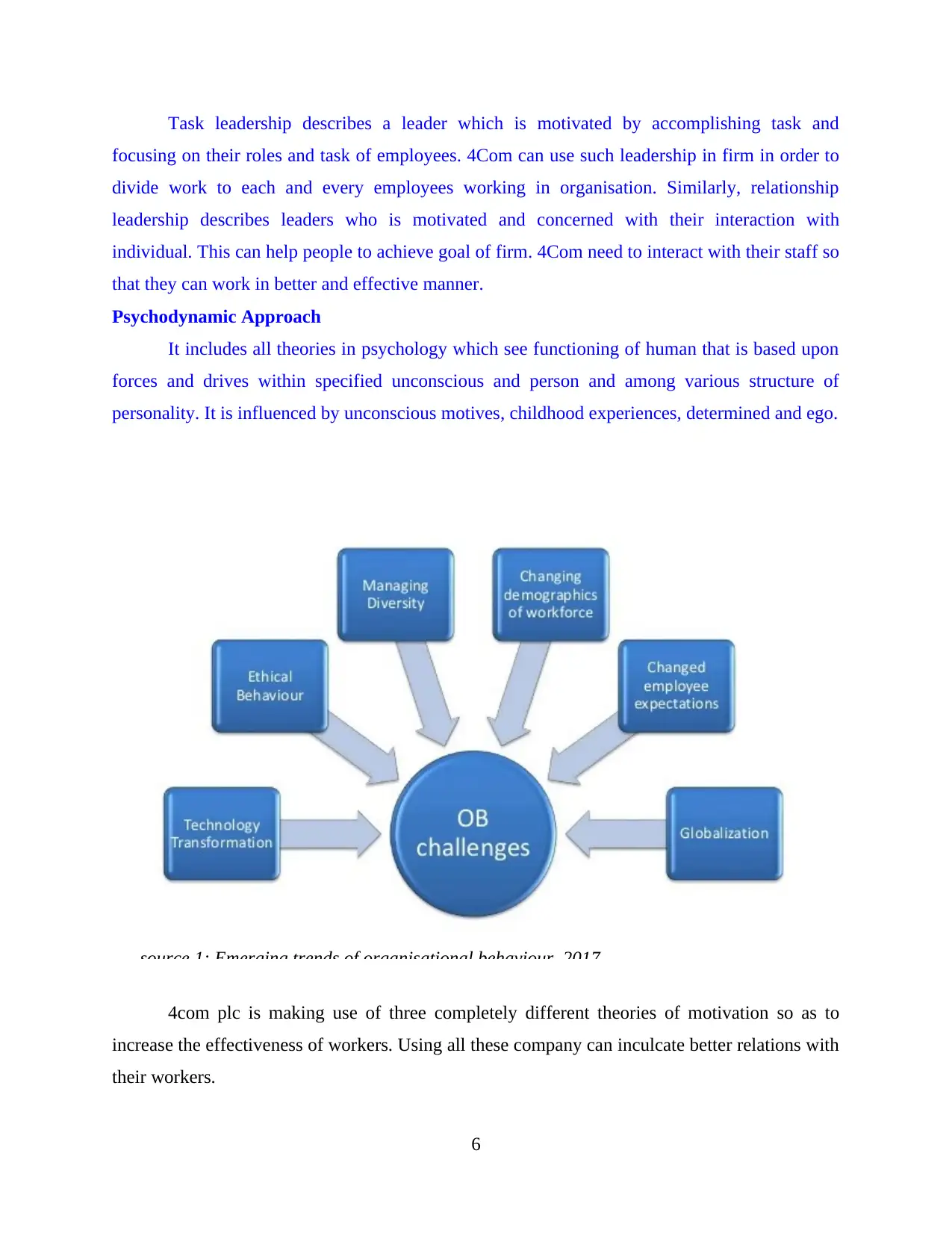
source 1: Emerging trends of organisational behaviour, 2017
focusing on their roles and task of employees. 4Com can use such leadership in firm in order to
divide work to each and every employees working in organisation. Similarly, relationship
leadership describes leaders who is motivated and concerned with their interaction with
individual. This can help people to achieve goal of firm. 4Com need to interact with their staff so
that they can work in better and effective manner.
Psychodynamic Approach
It includes all theories in psychology which see functioning of human that is based upon
forces and drives within specified unconscious and person and among various structure of
personality. It is influenced by unconscious motives, childhood experiences, determined and ego.
4com plc is making use of three completely different theories of motivation so as to
increase the effectiveness of workers. Using all these company can inculcate better relations with
their workers.
6
source 1: Emerging trends of organisational behaviour, 2017
If in case workers of the firm is unsatisfied with their task then managers can take use of
Herzberg's two factor theory in order to inspire them. As per this theory top officials can give
chance to their employees and hence they will increase their ability as well as knowledge.
Maslow's thoery can be used at the time when the workers are unsatisfied as they demand
more from their employers (Nutbeam, Harris and Wise, 2010). This may help in fulfilling the
basic needs and all other highlighted demands that is presented in the above part of this report.
Theory of expectancy can be utilised by the management in the case when workers can
make effective methodology so as to achieve best possible outcome. This can be done in the
manner that superiors are benefited from their workers.
Process theories:
This describes how work forces selects behavioural actions for meeting their choices or
needs. Following philosophies provides suggestion and insight on how individual really make
choices for working hard on the basis of existing rewards, preferences, expected work
outcomes.
Vrooms Expectancy theory:
This theory is developed by Victor. H. Vroom and is based on the assumption that people
behaviour outcomes from the preferences made by the them in context of alternative course of
action. 4com Plc manager adapt this theory for encouraging workers in workplace. Expectancy: This is the motivational process that ascertain specific course of action
which will lead get expected results. So, 4com Plc manager are managing that all
workers has efficiency so that they can do the task effectively to achieve desirable results. Valency: This considered as value of people on specific results or strengths of individuals
which are favoured for desirable rewards results. It is the process by which manager of
4com Plc analyses that workers get encouraged through incentives, bonus and so on all
these develop value for both company and people.
Instrumentality: Herein, workers has expectation to get promotion. For this, 4com Plc
manager assure that people give its best so that both firm as well as individuals objectives
can be achieved. So, this assists people to accomplish high growth path in its career.
Adam’s equity theory:
This was proposed by J.Stacy Adams. He stated that work forces do comparison of
reward potential for expanding their attempts level. It is based on assumptions that: People do
7
Herzberg's two factor theory in order to inspire them. As per this theory top officials can give
chance to their employees and hence they will increase their ability as well as knowledge.
Maslow's thoery can be used at the time when the workers are unsatisfied as they demand
more from their employers (Nutbeam, Harris and Wise, 2010). This may help in fulfilling the
basic needs and all other highlighted demands that is presented in the above part of this report.
Theory of expectancy can be utilised by the management in the case when workers can
make effective methodology so as to achieve best possible outcome. This can be done in the
manner that superiors are benefited from their workers.
Process theories:
This describes how work forces selects behavioural actions for meeting their choices or
needs. Following philosophies provides suggestion and insight on how individual really make
choices for working hard on the basis of existing rewards, preferences, expected work
outcomes.
Vrooms Expectancy theory:
This theory is developed by Victor. H. Vroom and is based on the assumption that people
behaviour outcomes from the preferences made by the them in context of alternative course of
action. 4com Plc manager adapt this theory for encouraging workers in workplace. Expectancy: This is the motivational process that ascertain specific course of action
which will lead get expected results. So, 4com Plc manager are managing that all
workers has efficiency so that they can do the task effectively to achieve desirable results. Valency: This considered as value of people on specific results or strengths of individuals
which are favoured for desirable rewards results. It is the process by which manager of
4com Plc analyses that workers get encouraged through incentives, bonus and so on all
these develop value for both company and people.
Instrumentality: Herein, workers has expectation to get promotion. For this, 4com Plc
manager assure that people give its best so that both firm as well as individuals objectives
can be achieved. So, this assists people to accomplish high growth path in its career.
Adam’s equity theory:
This was proposed by J.Stacy Adams. He stated that work forces do comparison of
reward potential for expanding their attempts level. It is based on assumptions that: People do
7
⊘ This is a preview!⊘
Do you want full access?
Subscribe today to unlock all pages.
Trusted by 1+ million students worldwide
contribution for that they desire definite rewards and for authorise exchange people compare
their contribution as well as rewards with another one and try to determine inequality. 4Com plc
adopt this theory to know about the motivational level between workers within workplace.
Herein, there are three kinds of exchange relations that are mentioned below: Overpaid Inequality: If people realize that their results are compared to its contribution,
in relation to another. Underpaid Inequality: in case people perceives that their rewards are not more than its
inputs as comparison to others.
Equity: Individual realise that their rewards in relation to its contribution are equal to
another one.
M2 Influence the behaviour of others through the effective application of motivational theories.
These motivational theories are very helpful in maintaining the higher inspirational levels
of the employees. If the motivational theories are applied by the senior managers then it may
help to influence the behaviour of others. These changing behaviours can be beneficial for the
company. As per the view point of Pentecost and Andrews, (2010) motivational theories have
greater impact on the behaviour of employees. It may lead to increase in the commitment of the
employees which includes tat the firm must allocate work to the employees as per their
capabilities, knowledge or skill. It helps them in working in effective manner. It also helps to
enhancing the employee satisfaction level which is very important for the firm. It ensures the
growth of the company. On the other hand Punjaisri and Wilson, (2011) states that motivational
theory improves the efficiency of the workers as they are working as per their ability and have
jest towards the organisation. It also increases the confidence of the employee as they are
performing better.
According to Wickramasinghe and Perera (2014), there are some application of
behavioural motivational theories that is mentioned below :
Process theories : This describes how work forces selects behavioural actions for meeting
their choices or needs. Following philosophies provides suggestion and insight on how
individual really make choices for working hard on the basis of existing rewards,
preferences, expected work outcomes.
Equity theory : This was proposed by J.Stacy Adams. He stated that work forces do
comparison of reward potential for expanding their attempts level. Equity emerges when
8
their contribution as well as rewards with another one and try to determine inequality. 4Com plc
adopt this theory to know about the motivational level between workers within workplace.
Herein, there are three kinds of exchange relations that are mentioned below: Overpaid Inequality: If people realize that their results are compared to its contribution,
in relation to another. Underpaid Inequality: in case people perceives that their rewards are not more than its
inputs as comparison to others.
Equity: Individual realise that their rewards in relation to its contribution are equal to
another one.
M2 Influence the behaviour of others through the effective application of motivational theories.
These motivational theories are very helpful in maintaining the higher inspirational levels
of the employees. If the motivational theories are applied by the senior managers then it may
help to influence the behaviour of others. These changing behaviours can be beneficial for the
company. As per the view point of Pentecost and Andrews, (2010) motivational theories have
greater impact on the behaviour of employees. It may lead to increase in the commitment of the
employees which includes tat the firm must allocate work to the employees as per their
capabilities, knowledge or skill. It helps them in working in effective manner. It also helps to
enhancing the employee satisfaction level which is very important for the firm. It ensures the
growth of the company. On the other hand Punjaisri and Wilson, (2011) states that motivational
theory improves the efficiency of the workers as they are working as per their ability and have
jest towards the organisation. It also increases the confidence of the employee as they are
performing better.
According to Wickramasinghe and Perera (2014), there are some application of
behavioural motivational theories that is mentioned below :
Process theories : This describes how work forces selects behavioural actions for meeting
their choices or needs. Following philosophies provides suggestion and insight on how
individual really make choices for working hard on the basis of existing rewards,
preferences, expected work outcomes.
Equity theory : This was proposed by J.Stacy Adams. He stated that work forces do
comparison of reward potential for expanding their attempts level. Equity emerges when
8
Paraphrase This Document
Need a fresh take? Get an instant paraphrase of this document with our AI Paraphraser
employees perceive such rewards by giving equal efforts. But inequalities rises when
their regards are low-level in relation to other individuals for sharing similar work load.
Reinforcement theory : Given by E. L. Thorndike that simply defines relation between
behaviour and its results. Positive reinforcement occurs when promotion or wages
increment is provided to workers as a reward for the optimistic behaviour. At the same
time punishment is also given in the form of suspension, docking pay, threats, etc. for
decreasing the possibility of behaviour continuing by executing negative outcomes.
Positive rewards inspires people while punishment demotivate the same.
TASK 3
P3 What makes a team effective different from ineffective teams
There are various kinds of things that makes a team effective as well as ineffective. They
are various characteristics of any team that makes them effective or ineffective. There are
various kinds of teams in an organisation it depends on the structure that they can follows so as
to make their team effective as well as efficient. Some of the criteria that makes the effective
team different from the ineffective team some of the them are as follows:
Team organisation: In effective team there are many kinds of roles that is assigned to the
different so that the task becomes easier as well as they can achieve it within the time set
by them. They have a leader or manager. This is lagged in the teams that are ineffective
that they do not distribute the work properly.
Assignment of work: This is one of the basic reason due to which any team becomes
effective i.e. they assign roles to team members as per their capability and skill. It helps
them to achieve everything on time as well as in effective manner.
Continuous discussions: Every team that is effective have continuous discussions on the
work progress. In these meetings or discussion they decide whether they have to follow
the decided path or not (Sandman and et. al., 2012). It lags in the teams that are
ineffective as they continue for the long time with the same objective and may result as a
failure. These discussion helps in the self evaluation which is important for becoming a
team that is effective.
Coordination: There is a proper coordination in the effective team as they understand
each others behaviour and nature. They understand the mindset of the other members.
9
their regards are low-level in relation to other individuals for sharing similar work load.
Reinforcement theory : Given by E. L. Thorndike that simply defines relation between
behaviour and its results. Positive reinforcement occurs when promotion or wages
increment is provided to workers as a reward for the optimistic behaviour. At the same
time punishment is also given in the form of suspension, docking pay, threats, etc. for
decreasing the possibility of behaviour continuing by executing negative outcomes.
Positive rewards inspires people while punishment demotivate the same.
TASK 3
P3 What makes a team effective different from ineffective teams
There are various kinds of things that makes a team effective as well as ineffective. They
are various characteristics of any team that makes them effective or ineffective. There are
various kinds of teams in an organisation it depends on the structure that they can follows so as
to make their team effective as well as efficient. Some of the criteria that makes the effective
team different from the ineffective team some of the them are as follows:
Team organisation: In effective team there are many kinds of roles that is assigned to the
different so that the task becomes easier as well as they can achieve it within the time set
by them. They have a leader or manager. This is lagged in the teams that are ineffective
that they do not distribute the work properly.
Assignment of work: This is one of the basic reason due to which any team becomes
effective i.e. they assign roles to team members as per their capability and skill. It helps
them to achieve everything on time as well as in effective manner.
Continuous discussions: Every team that is effective have continuous discussions on the
work progress. In these meetings or discussion they decide whether they have to follow
the decided path or not (Sandman and et. al., 2012). It lags in the teams that are
ineffective as they continue for the long time with the same objective and may result as a
failure. These discussion helps in the self evaluation which is important for becoming a
team that is effective.
Coordination: There is a proper coordination in the effective team as they understand
each others behaviour and nature. They understand the mindset of the other members.
9
Everyone's view is appreciated: In the teams that are effective, they listens to the view
point of every members. They generally conduct open discussion which is different from
the practice of ineffective teams where only few members are responsible for making
decisions.
Help each other in their bad time: In effective teams, members helps each other in their
times when their performance levels decreases. This is important as failing to do so can
lead to overall decrease in the work performance of the team and may lead to delay in the
project completion (Solomon, Russell-Bennett and Previte, 2012). In ineffective teams
every member concentrate on their own performance rather than understanding
themselves as team player.
Time scheduling: In effective teams there is a proper time scheduling that has been made
so that they complete the desired levels of task in the set time frame and may lead to
overall achieving of task in a proper way.
Conflict resolution: In the effective team the conflicts are resolved in a proper way. In
this process there understanding among themselves helps the most. If there is any opinion
disagreement they settle down by having discussions where as in the ineffective teams
they carry on their tasks with even conflict in them which results in failure.
There are different types of teams which are as follows:
Functional Team- It is permanent in nature which consists of people from same
department having various responsibilities. Here, manager is responsible for each and every
thing and everyone report to superior. Such team can be formed by 4com for better running of
business and activities and obstacles does not arise when transferring work from one to another.
Problem Solving Team- When problem arise in organisation in order to solve that team is
formed. Here, people with skilled and experienced participate for solving problems. There are
many problem arise in 4com which can be solved through such teams.
Project Team- It is group of employees who work together for sharing strategies and
goals. This team allows assignment of clear responsibilities, roles and duties for given project
and complete within time period.
Virtual team development and Networking
There are five stages of virtual team development and networking which are as follows:
10
point of every members. They generally conduct open discussion which is different from
the practice of ineffective teams where only few members are responsible for making
decisions.
Help each other in their bad time: In effective teams, members helps each other in their
times when their performance levels decreases. This is important as failing to do so can
lead to overall decrease in the work performance of the team and may lead to delay in the
project completion (Solomon, Russell-Bennett and Previte, 2012). In ineffective teams
every member concentrate on their own performance rather than understanding
themselves as team player.
Time scheduling: In effective teams there is a proper time scheduling that has been made
so that they complete the desired levels of task in the set time frame and may lead to
overall achieving of task in a proper way.
Conflict resolution: In the effective team the conflicts are resolved in a proper way. In
this process there understanding among themselves helps the most. If there is any opinion
disagreement they settle down by having discussions where as in the ineffective teams
they carry on their tasks with even conflict in them which results in failure.
There are different types of teams which are as follows:
Functional Team- It is permanent in nature which consists of people from same
department having various responsibilities. Here, manager is responsible for each and every
thing and everyone report to superior. Such team can be formed by 4com for better running of
business and activities and obstacles does not arise when transferring work from one to another.
Problem Solving Team- When problem arise in organisation in order to solve that team is
formed. Here, people with skilled and experienced participate for solving problems. There are
many problem arise in 4com which can be solved through such teams.
Project Team- It is group of employees who work together for sharing strategies and
goals. This team allows assignment of clear responsibilities, roles and duties for given project
and complete within time period.
Virtual team development and Networking
There are five stages of virtual team development and networking which are as follows:
10
⊘ This is a preview!⊘
Do you want full access?
Subscribe today to unlock all pages.
Trusted by 1+ million students worldwide

1 out of 20


Related Documents


Your All-in-One AI-Powered Toolkit for Academic Success.
+13062052269
info@desklib.com
Available 24*7 on WhatsApp / Email
![[object Object]](/_next/static/media/star-bottom.7253800d.svg)
Unlock your academic potential
Copyright © 2020–2025 A2Z Services. All Rights Reserved. Developed and managed by ZUCOL.