Organisational Behaviour Report: Motivation, Teams and Culture
VerifiedAdded on 2023/06/05
|14
|4299
|256
Report
AI Summary
This report delves into the intricacies of organisational behaviour, focusing on how individual and team performance are influenced by company culture, politics, and power dynamics. It evaluates various motivational theories, including Maslow's hierarchy, Herzberg's two-factor theory, and Skinner's reinforcement theory, and their application in achieving organisational goals. Furthermore, the report examines the factors that differentiate effective teams from ineffective ones, providing a comprehensive analysis of team dynamics and performance. The chosen organisation for this report is Marks and Spencer, a multinational retail brand, and the report applies these concepts to its operational context, examining how the company's culture and practices impact employee behaviour and overall business outcomes. The report also provides insights into leadership and management strategies within the organisation.
Organisational behaviour

Paraphrase This Document
Need a fresh take? Get an instant paraphrase of this document with our AI Paraphraser
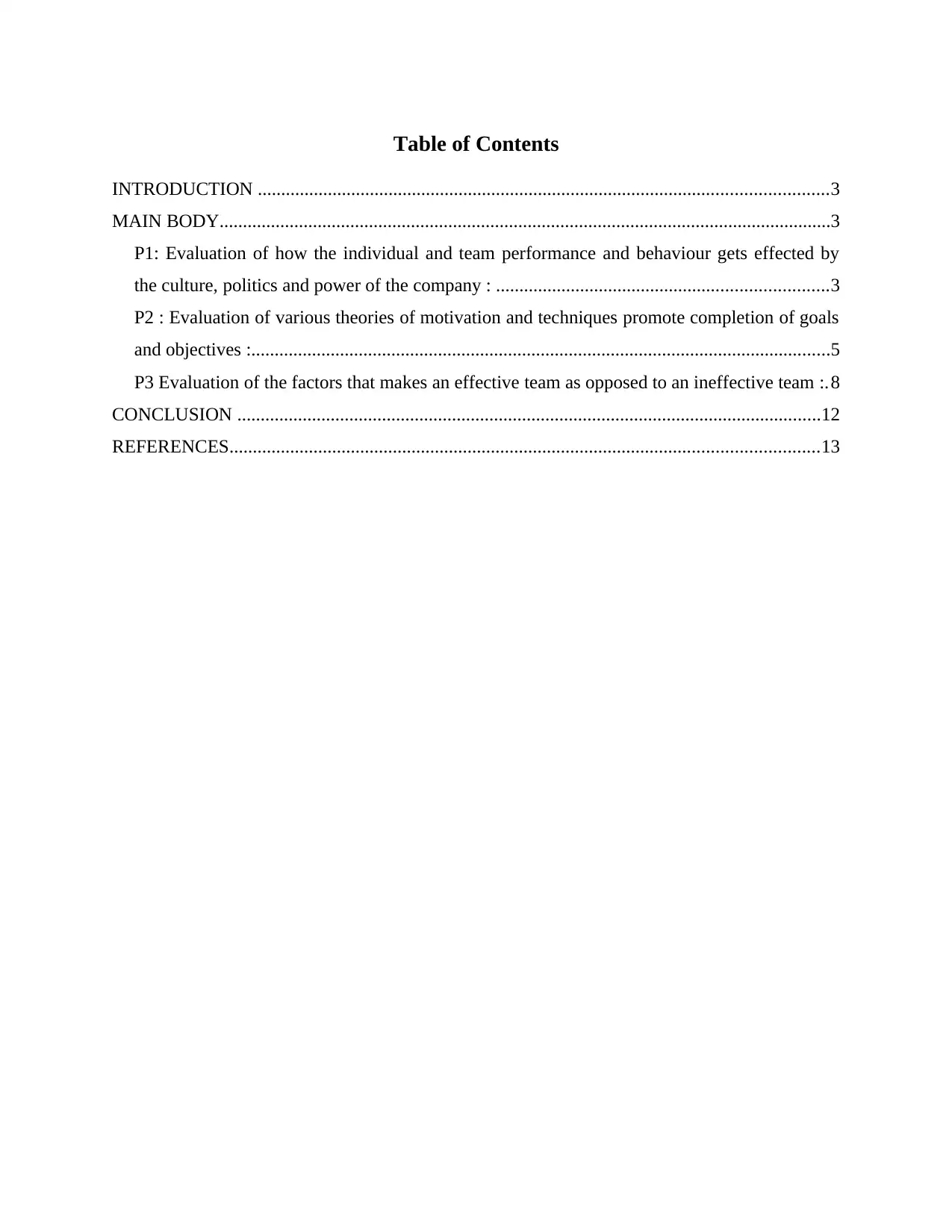
Table of Contents
INTRODUCTION ..........................................................................................................................3
MAIN BODY...................................................................................................................................3
P1: Evaluation of how the individual and team performance and behaviour gets effected by
the culture, politics and power of the company : .......................................................................3
P2 : Evaluation of various theories of motivation and techniques promote completion of goals
and objectives :............................................................................................................................5
P3 Evaluation of the factors that makes an effective team as opposed to an ineffective team :.8
CONCLUSION .............................................................................................................................12
REFERENCES..............................................................................................................................13
INTRODUCTION ..........................................................................................................................3
MAIN BODY...................................................................................................................................3
P1: Evaluation of how the individual and team performance and behaviour gets effected by
the culture, politics and power of the company : .......................................................................3
P2 : Evaluation of various theories of motivation and techniques promote completion of goals
and objectives :............................................................................................................................5
P3 Evaluation of the factors that makes an effective team as opposed to an ineffective team :.8
CONCLUSION .............................................................................................................................12
REFERENCES..............................................................................................................................13
INTRODUCTION
Organisational behaviour is basically the study of people's behaviour in the business
organisation. It analyses how people interact with each other within groups to make an attempt in
making business operations more effective. It includes various researches that are done with the
motive of enhancing job performance, satisfaction of job, innovating new ways and products,
building leadership and is a matter of concern for human resources of a company (Arslan and
Roudaki, 2018). The following report file is based on the topic – organisational behaviour. The
file has different headings that specialises and answer different parts of the topic. It starts with
the analysation of the reason of how the company's culture, politics and power influence team
and individual performance and their behaviour. Then there is the evaluation of the way in
which the content, techniques and motivational theories enable the achievement of goals and
objectives. Further it moves to explain what makes an effective team opposed to some
ineffective one. At last there is the application of certain concepts and philosophies of OB. The
chosen organisation for the report is Marks and Spencer which is multinational retailing brand
that deals in a large variety of product line. It is a UK based company headquartered in London,
United Kingdom.
MAIN BODY
P1: Evaluation of how the individual and team performance and behaviour gets effected by the
culture, politics and power of the company :
There is a strong impact of the behaviour of any individual or as a team at the work place.
There is difference in the behaviour of every individuals and it is human nature but it is
important that how much behaviour differs. Employees are an essential and valuable asset for a
business entity to get its operations done that are needed in the process of making final products
that are to be sold in the market (Masvaure and Buitendach, 2019). The behaviour of employees
gets effected through several factors such as – culture, power and politics. These aspects are
further explained in the following mentioning how they effect the behaviour of an individual :
Organisational culture :
The organisational culture is the mixture of values, practices, behaviour, beliefs and
experience that happen inside the premises of a office. The culture of a company have a huge
Organisational behaviour is basically the study of people's behaviour in the business
organisation. It analyses how people interact with each other within groups to make an attempt in
making business operations more effective. It includes various researches that are done with the
motive of enhancing job performance, satisfaction of job, innovating new ways and products,
building leadership and is a matter of concern for human resources of a company (Arslan and
Roudaki, 2018). The following report file is based on the topic – organisational behaviour. The
file has different headings that specialises and answer different parts of the topic. It starts with
the analysation of the reason of how the company's culture, politics and power influence team
and individual performance and their behaviour. Then there is the evaluation of the way in
which the content, techniques and motivational theories enable the achievement of goals and
objectives. Further it moves to explain what makes an effective team opposed to some
ineffective one. At last there is the application of certain concepts and philosophies of OB. The
chosen organisation for the report is Marks and Spencer which is multinational retailing brand
that deals in a large variety of product line. It is a UK based company headquartered in London,
United Kingdom.
MAIN BODY
P1: Evaluation of how the individual and team performance and behaviour gets effected by the
culture, politics and power of the company :
There is a strong impact of the behaviour of any individual or as a team at the work place.
There is difference in the behaviour of every individuals and it is human nature but it is
important that how much behaviour differs. Employees are an essential and valuable asset for a
business entity to get its operations done that are needed in the process of making final products
that are to be sold in the market (Masvaure and Buitendach, 2019). The behaviour of employees
gets effected through several factors such as – culture, power and politics. These aspects are
further explained in the following mentioning how they effect the behaviour of an individual :
Organisational culture :
The organisational culture is the mixture of values, practices, behaviour, beliefs and
experience that happen inside the premises of a office. The culture of a company have a huge
⊘ This is a preview!⊘
Do you want full access?
Subscribe today to unlock all pages.

Trusted by 1+ million students worldwide
influence as it builds an environment in which the people work and spend most of their times.
The adoption of a good culture depends on many different factors such as – beliefs of leader,
employees or customers, type of business and place where the enterprise is situated. A good
culture highly helps a company in various ways such as increasing the performance, creating a
healthy environment and achieving goodwill in the market. Companies use Hofstede's model in
understanding its culture. Marks and Spencer tries to keep a positive environment in the premises
and give its employees high standard experience. This makes the employees calm and better in
doing the work and in effective dealing with the customers (Bharthy and Sethi, 2020). The
positive organisational culture also improve healthy competition in the business that improve the
level of performance of the employees.
Politics :
Some type of politics or politics at some extend is practised everywhere. Politics in
relation to the business means when the labour or employees form a group in the enterprise and
use their number of majority in many different ways such as doing partial dividation of work,
targeting and giving tasks to other person and raise problems together so they can be solved by
the higher authorities more fast. The politics also effect the behaviour of an individual or team
that may be positive and negative. This happens mostly where the number of employees are
high. Marks and Spencer is a large scaled company that have its operations on a worldwide basis
(Srivastava and Pradhan, 2021). There are around 80000 employees that work with the
organisation in different company premise of different countries. The employees of similar
manufacturing unit or outlet may form groups and perform politics in the organisation. The
groups can also be prove to be good for the company as it enhances the helping behaviour and
directly enhances the productivity of the firm. To avoid negative politics Marks and Spencer try
to build connection with its workers and employees and try to hear and solve their demands.
Power :
Power is also one of the most important element that affect the behaviour of employees in
the organisation. The power in a business entity gets divided into various different level. Each of
the level have difference in their power of hands and the extend to which they can do something
and use their powers. These powers are divided differently so there are people that can handle
The adoption of a good culture depends on many different factors such as – beliefs of leader,
employees or customers, type of business and place where the enterprise is situated. A good
culture highly helps a company in various ways such as increasing the performance, creating a
healthy environment and achieving goodwill in the market. Companies use Hofstede's model in
understanding its culture. Marks and Spencer tries to keep a positive environment in the premises
and give its employees high standard experience. This makes the employees calm and better in
doing the work and in effective dealing with the customers (Bharthy and Sethi, 2020). The
positive organisational culture also improve healthy competition in the business that improve the
level of performance of the employees.
Politics :
Some type of politics or politics at some extend is practised everywhere. Politics in
relation to the business means when the labour or employees form a group in the enterprise and
use their number of majority in many different ways such as doing partial dividation of work,
targeting and giving tasks to other person and raise problems together so they can be solved by
the higher authorities more fast. The politics also effect the behaviour of an individual or team
that may be positive and negative. This happens mostly where the number of employees are
high. Marks and Spencer is a large scaled company that have its operations on a worldwide basis
(Srivastava and Pradhan, 2021). There are around 80000 employees that work with the
organisation in different company premise of different countries. The employees of similar
manufacturing unit or outlet may form groups and perform politics in the organisation. The
groups can also be prove to be good for the company as it enhances the helping behaviour and
directly enhances the productivity of the firm. To avoid negative politics Marks and Spencer try
to build connection with its workers and employees and try to hear and solve their demands.
Power :
Power is also one of the most important element that affect the behaviour of employees in
the organisation. The power in a business entity gets divided into various different level. Each of
the level have difference in their power of hands and the extend to which they can do something
and use their powers. These powers are divided differently so there are people that can handle
Paraphrase This Document
Need a fresh take? Get an instant paraphrase of this document with our AI Paraphraser
and record the work of other people, this keeps the work systematic and reduce chaos. People
gets jealous when some other people gets higher power from them and this happens commonly
in business companies. This can lead to confits and reduced performance of the employees. So
Marks and Spencer needs to consider this that only the capable ones gets promoted to the higher
authorities and they are good leaders and can efficiently manage their teams (Grobler and
Rensburg, 2019).
P2 : Evaluation of various theories of motivation and techniques promote completion of goals
and objectives :
Motivation is the process that builds the wants to do and achieve something. Basically it
is the process that makes people to work and do any task in their day to day life. Motivation
needs some results that are attractive to be achieved. Motivation is the very important feeling that
is important and play a vital role in influencing the performance level of the employees. It is a
vast topic that is being considered everywhere and especially in terms of business it is considered
as one of the most important aspect. Due to its high importance, there are various types of
theories that are given in the related matter, these are called theories of motivation or
motivational theories. The motivational theories that have been formed in the direction ot the
behaviour of development of human through focusing internal factors are known as content
theories (Carlucci, Mura and Schiuma, 2020). There are various types of content theories
developed by various researchers according to their belief such as – Maslow's need of
hierarchical theory, Herzberg's two factor theory, Porter and Lawler theory, ERG theory,
McClelland theory. There are also some other theories that are related to the psychological and
behavioural process to motivate the employees to behaviour in some particular specified manner
in order to achieve the goals and objectives of the company for example – Vroom's expectancy
theory, Locke's Setting and Adam's Equity theory. Some of these theories from both the types are
discussed in the following points :
Content theories
Maslow's need hierarchy Theory – This theory was given by renowned American
researcher Abraham Maslow in the year 1943. It is most commonly studied and used type
of motivational theory due to its high impracticability in the real world and easiness in
understanding. Firstly it was known as 'A theory of Human Motivation'. It is explained in
gets jealous when some other people gets higher power from them and this happens commonly
in business companies. This can lead to confits and reduced performance of the employees. So
Marks and Spencer needs to consider this that only the capable ones gets promoted to the higher
authorities and they are good leaders and can efficiently manage their teams (Grobler and
Rensburg, 2019).
P2 : Evaluation of various theories of motivation and techniques promote completion of goals
and objectives :
Motivation is the process that builds the wants to do and achieve something. Basically it
is the process that makes people to work and do any task in their day to day life. Motivation
needs some results that are attractive to be achieved. Motivation is the very important feeling that
is important and play a vital role in influencing the performance level of the employees. It is a
vast topic that is being considered everywhere and especially in terms of business it is considered
as one of the most important aspect. Due to its high importance, there are various types of
theories that are given in the related matter, these are called theories of motivation or
motivational theories. The motivational theories that have been formed in the direction ot the
behaviour of development of human through focusing internal factors are known as content
theories (Carlucci, Mura and Schiuma, 2020). There are various types of content theories
developed by various researchers according to their belief such as – Maslow's need of
hierarchical theory, Herzberg's two factor theory, Porter and Lawler theory, ERG theory,
McClelland theory. There are also some other theories that are related to the psychological and
behavioural process to motivate the employees to behaviour in some particular specified manner
in order to achieve the goals and objectives of the company for example – Vroom's expectancy
theory, Locke's Setting and Adam's Equity theory. Some of these theories from both the types are
discussed in the following points :
Content theories
Maslow's need hierarchy Theory – This theory was given by renowned American
researcher Abraham Maslow in the year 1943. It is most commonly studied and used type
of motivational theory due to its high impracticability in the real world and easiness in
understanding. Firstly it was known as 'A theory of Human Motivation'. It is explained in
a form of pyramid that includes five types of human needs that are mentioned according
to their level of importance. These needs are :
◦ Physiological needs – This is the need of cloth, food and shelter that are essential for
living a life. This is considered as the most important need of a human being
(Srinivas, 2020).
◦ Safety needs – This is the need of a human being to feel safe in the world and avoid
any safety related issue from people around or other creatures of the world. The
safety can be for self, health or money related things or properties. Marks and
Spencer provides several safety related services to its employees such as – health
insurance and home loans.
◦ Social needs – Then there comes the need to build relationships from other people.
The need of building relationships can be due to various reasons such as – avoiding
the feeling of loneliness, forming groups to achieve any task or for fulfilling sexual
arouses. For this, Marks and Spencer keeps a healthy working environment to let
employees talk to each, form teams to achieve tasks and it also organises games and
activities for the employees.
◦ Self esteem needs – At this level of motivation, a person wants to be respected from
other people in the society or at place of work. The status, achievements, dignity and
ego become important things in life. Marks and Spencer try that their employees
never feel disrespected from other people of the organisations, the higher authorities
or from the work (Karim, 2021).
◦ Self actualization need – The last need of the hierarchical pyramid is the need of self
actualization in which a person focusses on itself and try to realize the potential of
self, fulfilment of wants, seeking personal growth and to feel peak experiences that
he/she may desire. This is highest level of motivation according to Maslow
hierarchical theory. It is basically the desire to achieve everything that one wants and
can.
Herzberg's theory – The herzberg's motivation hygiene theory is also known as the two
factor theory in which Herzberg says that the job satisfaction and dissatisfaction exists on
different aspects and are interdependent. This theory is completely based on identifying
to their level of importance. These needs are :
◦ Physiological needs – This is the need of cloth, food and shelter that are essential for
living a life. This is considered as the most important need of a human being
(Srinivas, 2020).
◦ Safety needs – This is the need of a human being to feel safe in the world and avoid
any safety related issue from people around or other creatures of the world. The
safety can be for self, health or money related things or properties. Marks and
Spencer provides several safety related services to its employees such as – health
insurance and home loans.
◦ Social needs – Then there comes the need to build relationships from other people.
The need of building relationships can be due to various reasons such as – avoiding
the feeling of loneliness, forming groups to achieve any task or for fulfilling sexual
arouses. For this, Marks and Spencer keeps a healthy working environment to let
employees talk to each, form teams to achieve tasks and it also organises games and
activities for the employees.
◦ Self esteem needs – At this level of motivation, a person wants to be respected from
other people in the society or at place of work. The status, achievements, dignity and
ego become important things in life. Marks and Spencer try that their employees
never feel disrespected from other people of the organisations, the higher authorities
or from the work (Karim, 2021).
◦ Self actualization need – The last need of the hierarchical pyramid is the need of self
actualization in which a person focusses on itself and try to realize the potential of
self, fulfilment of wants, seeking personal growth and to feel peak experiences that
he/she may desire. This is highest level of motivation according to Maslow
hierarchical theory. It is basically the desire to achieve everything that one wants and
can.
Herzberg's theory – The herzberg's motivation hygiene theory is also known as the two
factor theory in which Herzberg says that the job satisfaction and dissatisfaction exists on
different aspects and are interdependent. This theory is completely based on identifying
⊘ This is a preview!⊘
Do you want full access?
Subscribe today to unlock all pages.
Trusted by 1+ million students worldwide
the factors, motivating the employees and increasing overall performance of the business
enterprise. The two factors of Herzberg theory are mentioned below :
◦ Hygiene factors (Dis-satisfiers) – These are the factors whose presence is essentail
but they do not provide any long term satisfaction to the employees. Thier presence
may not motivate the employees but they are essentials as their absence demotivates
the employees (Tsai, 2018). Some types of hygiene factors are – salary, working
environment, the physical place of work, relationship with other people in the firm,
polices, regulations and many other related elements.
◦ Motivators / motivating factors (Satisfiers) – These are essential factors that boost the
motivation of the employees in a business entity as they provide them job satisfaction.
A firm can use these factors to satisfy their employees and boost their morals that
directly effect the productivity levels. Some basic motivators are – Recognition, job
status, opportunities for growth, the work itself and responsibilities.
Process theories
Skinner's reinforcement Theory – This motivational theory was given by BF
Skinner and his several associates in the year around 1930. It states that the
behaviour of a person is the function of its consequences. It highlights the 'law of
effect' that says that the behaviour of a person that leads to positive results is
expected to be repeated but the behaviour that leads to negative consequences
should not be repeated. In terms of business, it is the behaviour of manager with
their employees effect their productivity highly. According to the theory, a
manager should praise the employees when they perform any good practices or
when they remove their negative / undesirable consequences through rewarding or
appreciating them and also to give required punishment to maintain the decorum
of the company (Berkovich and Bogler, 2021).
Vroom's Expectancy Theory – This motivational theory was given by Victor
Vroom together with Edward Lawler and Lyman Porter in 1983. This theory
explain that the relationships and behaviour at the work have a high impact on the
workings of a business enterprise as a whole. It in the several factors are
mentioned that influence the work, these are – skills, knowledge, personality and
experience. The performance of the workers will be maximised when they think
enterprise. The two factors of Herzberg theory are mentioned below :
◦ Hygiene factors (Dis-satisfiers) – These are the factors whose presence is essentail
but they do not provide any long term satisfaction to the employees. Thier presence
may not motivate the employees but they are essentials as their absence demotivates
the employees (Tsai, 2018). Some types of hygiene factors are – salary, working
environment, the physical place of work, relationship with other people in the firm,
polices, regulations and many other related elements.
◦ Motivators / motivating factors (Satisfiers) – These are essential factors that boost the
motivation of the employees in a business entity as they provide them job satisfaction.
A firm can use these factors to satisfy their employees and boost their morals that
directly effect the productivity levels. Some basic motivators are – Recognition, job
status, opportunities for growth, the work itself and responsibilities.
Process theories
Skinner's reinforcement Theory – This motivational theory was given by BF
Skinner and his several associates in the year around 1930. It states that the
behaviour of a person is the function of its consequences. It highlights the 'law of
effect' that says that the behaviour of a person that leads to positive results is
expected to be repeated but the behaviour that leads to negative consequences
should not be repeated. In terms of business, it is the behaviour of manager with
their employees effect their productivity highly. According to the theory, a
manager should praise the employees when they perform any good practices or
when they remove their negative / undesirable consequences through rewarding or
appreciating them and also to give required punishment to maintain the decorum
of the company (Berkovich and Bogler, 2021).
Vroom's Expectancy Theory – This motivational theory was given by Victor
Vroom together with Edward Lawler and Lyman Porter in 1983. This theory
explain that the relationships and behaviour at the work have a high impact on the
workings of a business enterprise as a whole. It in the several factors are
mentioned that influence the work, these are – skills, knowledge, personality and
experience. The performance of the workers will be maximised when they think
Paraphrase This Document
Need a fresh take? Get an instant paraphrase of this document with our AI Paraphraser
that there is a desirable rewards which they will receive when they complete the
work and there is a co-relation between the efforts and the performance. There are
some factors that were included in the theory these are :
◦ Valence – This says that a manager can highly motivate the employees when
he / she identify their needs and fulfil them. The manager can use rewards,
promotions and other similar aspects for this.
◦ Expectancy – Proper training the development programs should be provided
to the employees so they can understand their work clearly and do not waste
their time in facing problems and trying to fix them. They should be able to
identify them as the experts of their field (Onumo, Cullen and Awan, 2018).
◦ Instrumentality – This factor says that the manager should build targets for
each and every employee. The targets should be different and according to
their capability. They should not be too high that they can not achieve and not
too low that can achieve easily. If the targets are challenging they will put
their best efforts in the performance.
P3 Evaluation of the factors that makes an effective team as opposed to an ineffective team :
An effective team is the one that put all their efforts in the work and does their in a
specialised way. This type is of teams are expected and desired by a business entity in their
business as they will lead the company to the way of success. They work together as a team and
help each other. Whereas an ineffective team provides bad results it does work ineffectively, the
quality of the work is bad and the level of productivity is also low. When large and in power,
these teams lead the organisation to failures. The effective teams brings improvement in the level
of performance of the organisation which helps them in gaining competitive advantage over
other competing firms in the market (Alblooshi, Shamsuzzaman and Haridy, 2020). There are
various features of an effective team such as – strong communication, clarity in missions and
objectives, contribution in completion of the goals, holding the organisation together and many
more. A company tries to build effective teams in its organisation for which it uses various
methods. There are also some models that are used for building or converting teams effective.
One of these is explained below.
Tuckman model of team development :
work and there is a co-relation between the efforts and the performance. There are
some factors that were included in the theory these are :
◦ Valence – This says that a manager can highly motivate the employees when
he / she identify their needs and fulfil them. The manager can use rewards,
promotions and other similar aspects for this.
◦ Expectancy – Proper training the development programs should be provided
to the employees so they can understand their work clearly and do not waste
their time in facing problems and trying to fix them. They should be able to
identify them as the experts of their field (Onumo, Cullen and Awan, 2018).
◦ Instrumentality – This factor says that the manager should build targets for
each and every employee. The targets should be different and according to
their capability. They should not be too high that they can not achieve and not
too low that can achieve easily. If the targets are challenging they will put
their best efforts in the performance.
P3 Evaluation of the factors that makes an effective team as opposed to an ineffective team :
An effective team is the one that put all their efforts in the work and does their in a
specialised way. This type is of teams are expected and desired by a business entity in their
business as they will lead the company to the way of success. They work together as a team and
help each other. Whereas an ineffective team provides bad results it does work ineffectively, the
quality of the work is bad and the level of productivity is also low. When large and in power,
these teams lead the organisation to failures. The effective teams brings improvement in the level
of performance of the organisation which helps them in gaining competitive advantage over
other competing firms in the market (Alblooshi, Shamsuzzaman and Haridy, 2020). There are
various features of an effective team such as – strong communication, clarity in missions and
objectives, contribution in completion of the goals, holding the organisation together and many
more. A company tries to build effective teams in its organisation for which it uses various
methods. There are also some models that are used for building or converting teams effective.
One of these is explained below.
Tuckman model of team development :
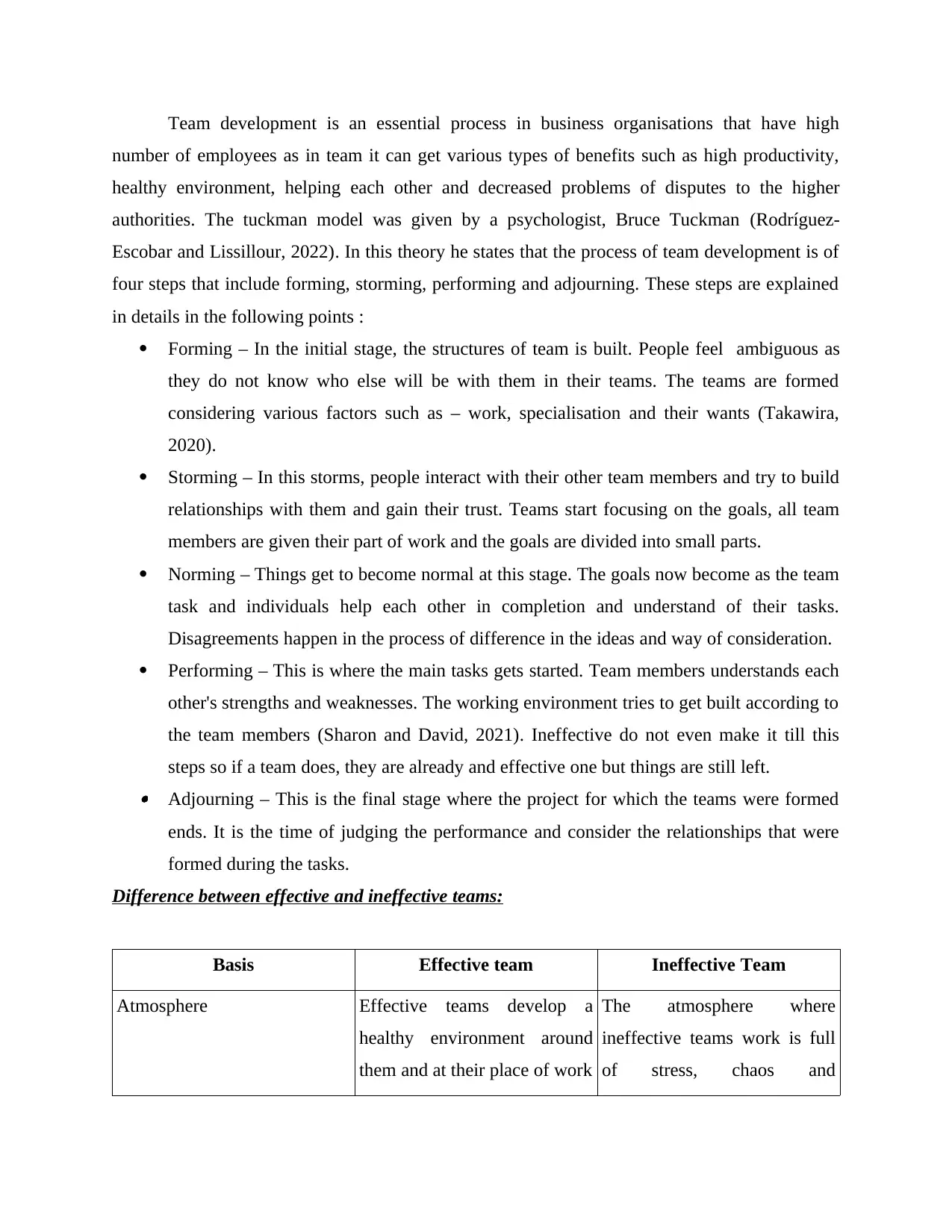
Team development is an essential process in business organisations that have high
number of employees as in team it can get various types of benefits such as high productivity,
healthy environment, helping each other and decreased problems of disputes to the higher
authorities. The tuckman model was given by a psychologist, Bruce Tuckman (Rodríguez-
Escobar and Lissillour, 2022). In this theory he states that the process of team development is of
four steps that include forming, storming, performing and adjourning. These steps are explained
in details in the following points :
Forming – In the initial stage, the structures of team is built. People feel ambiguous as
they do not know who else will be with them in their teams. The teams are formed
considering various factors such as – work, specialisation and their wants (Takawira,
2020).
Storming – In this storms, people interact with their other team members and try to build
relationships with them and gain their trust. Teams start focusing on the goals, all team
members are given their part of work and the goals are divided into small parts.
Norming – Things get to become normal at this stage. The goals now become as the team
task and individuals help each other in completion and understand of their tasks.
Disagreements happen in the process of difference in the ideas and way of consideration.
Performing – This is where the main tasks gets started. Team members understands each
other's strengths and weaknesses. The working environment tries to get built according to
the team members (Sharon and David, 2021). Ineffective do not even make it till this
steps so if a team does, they are already and effective one but things are still left. Adjourning – This is the final stage where the project for which the teams were formed
ends. It is the time of judging the performance and consider the relationships that were
formed during the tasks.
Difference between effective and ineffective teams:
Basis Effective team Ineffective Team
Atmosphere Effective teams develop a
healthy environment around
them and at their place of work
The atmosphere where
ineffective teams work is full
of stress, chaos and
number of employees as in team it can get various types of benefits such as high productivity,
healthy environment, helping each other and decreased problems of disputes to the higher
authorities. The tuckman model was given by a psychologist, Bruce Tuckman (Rodríguez-
Escobar and Lissillour, 2022). In this theory he states that the process of team development is of
four steps that include forming, storming, performing and adjourning. These steps are explained
in details in the following points :
Forming – In the initial stage, the structures of team is built. People feel ambiguous as
they do not know who else will be with them in their teams. The teams are formed
considering various factors such as – work, specialisation and their wants (Takawira,
2020).
Storming – In this storms, people interact with their other team members and try to build
relationships with them and gain their trust. Teams start focusing on the goals, all team
members are given their part of work and the goals are divided into small parts.
Norming – Things get to become normal at this stage. The goals now become as the team
task and individuals help each other in completion and understand of their tasks.
Disagreements happen in the process of difference in the ideas and way of consideration.
Performing – This is where the main tasks gets started. Team members understands each
other's strengths and weaknesses. The working environment tries to get built according to
the team members (Sharon and David, 2021). Ineffective do not even make it till this
steps so if a team does, they are already and effective one but things are still left. Adjourning – This is the final stage where the project for which the teams were formed
ends. It is the time of judging the performance and consider the relationships that were
formed during the tasks.
Difference between effective and ineffective teams:
Basis Effective team Ineffective Team
Atmosphere Effective teams develop a
healthy environment around
them and at their place of work
The atmosphere where
ineffective teams work is full
of stress, chaos and
⊘ This is a preview!⊘
Do you want full access?
Subscribe today to unlock all pages.
Trusted by 1+ million students worldwide
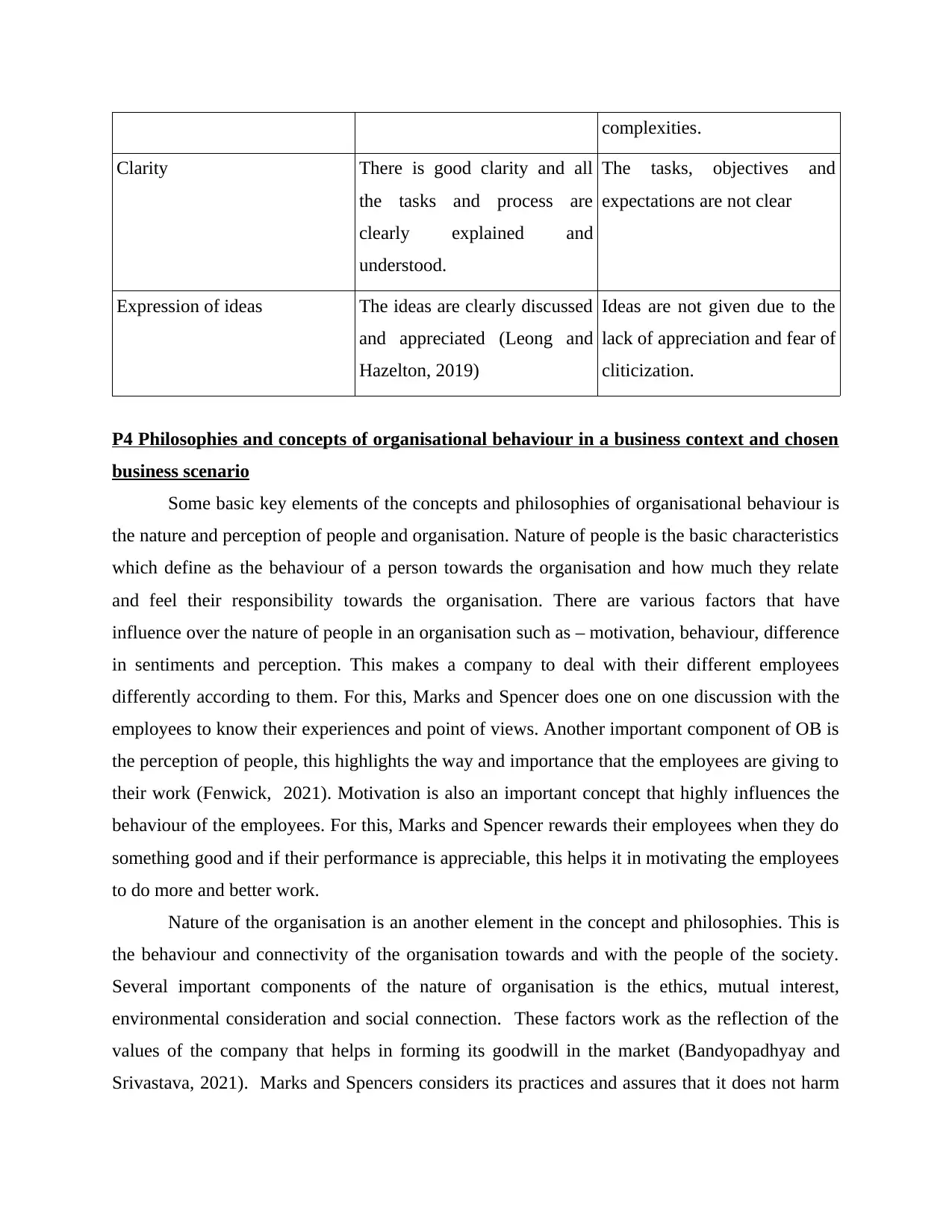
complexities.
Clarity There is good clarity and all
the tasks and process are
clearly explained and
understood.
The tasks, objectives and
expectations are not clear
Expression of ideas The ideas are clearly discussed
and appreciated (Leong and
Hazelton, 2019)
Ideas are not given due to the
lack of appreciation and fear of
cliticization.
P4 Philosophies and concepts of organisational behaviour in a business context and chosen
business scenario
Some basic key elements of the concepts and philosophies of organisational behaviour is
the nature and perception of people and organisation. Nature of people is the basic characteristics
which define as the behaviour of a person towards the organisation and how much they relate
and feel their responsibility towards the organisation. There are various factors that have
influence over the nature of people in an organisation such as – motivation, behaviour, difference
in sentiments and perception. This makes a company to deal with their different employees
differently according to them. For this, Marks and Spencer does one on one discussion with the
employees to know their experiences and point of views. Another important component of OB is
the perception of people, this highlights the way and importance that the employees are giving to
their work (Fenwick, 2021). Motivation is also an important concept that highly influences the
behaviour of the employees. For this, Marks and Spencer rewards their employees when they do
something good and if their performance is appreciable, this helps it in motivating the employees
to do more and better work.
Nature of the organisation is an another element in the concept and philosophies. This is
the behaviour and connectivity of the organisation towards and with the people of the society.
Several important components of the nature of organisation is the ethics, mutual interest,
environmental consideration and social connection. These factors work as the reflection of the
values of the company that helps in forming its goodwill in the market (Bandyopadhyay and
Srivastava, 2021). Marks and Spencers considers its practices and assures that it does not harm
Clarity There is good clarity and all
the tasks and process are
clearly explained and
understood.
The tasks, objectives and
expectations are not clear
Expression of ideas The ideas are clearly discussed
and appreciated (Leong and
Hazelton, 2019)
Ideas are not given due to the
lack of appreciation and fear of
cliticization.
P4 Philosophies and concepts of organisational behaviour in a business context and chosen
business scenario
Some basic key elements of the concepts and philosophies of organisational behaviour is
the nature and perception of people and organisation. Nature of people is the basic characteristics
which define as the behaviour of a person towards the organisation and how much they relate
and feel their responsibility towards the organisation. There are various factors that have
influence over the nature of people in an organisation such as – motivation, behaviour, difference
in sentiments and perception. This makes a company to deal with their different employees
differently according to them. For this, Marks and Spencer does one on one discussion with the
employees to know their experiences and point of views. Another important component of OB is
the perception of people, this highlights the way and importance that the employees are giving to
their work (Fenwick, 2021). Motivation is also an important concept that highly influences the
behaviour of the employees. For this, Marks and Spencer rewards their employees when they do
something good and if their performance is appreciable, this helps it in motivating the employees
to do more and better work.
Nature of the organisation is an another element in the concept and philosophies. This is
the behaviour and connectivity of the organisation towards and with the people of the society.
Several important components of the nature of organisation is the ethics, mutual interest,
environmental consideration and social connection. These factors work as the reflection of the
values of the company that helps in forming its goodwill in the market (Bandyopadhyay and
Srivastava, 2021). Marks and Spencers considers its practices and assures that it does not harm
Paraphrase This Document
Need a fresh take? Get an instant paraphrase of this document with our AI Paraphraser

the sentiments of the people of the society.
CONCLUSION
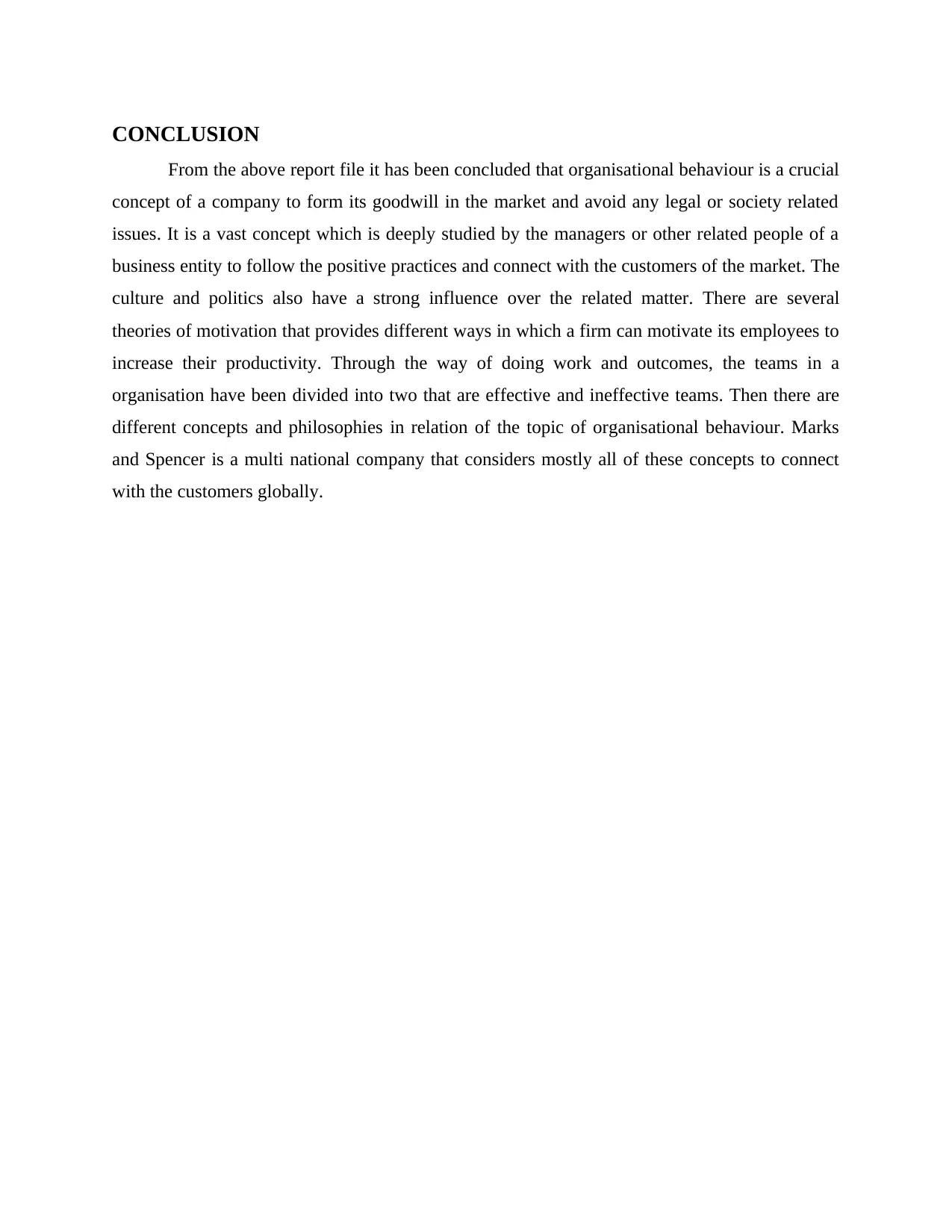
From the above report file it has been concluded that organisational behaviour is a crucial
concept of a company to form its goodwill in the market and avoid any legal or society related
issues. It is a vast concept which is deeply studied by the managers or other related people of a
business entity to follow the positive practices and connect with the customers of the market. The
culture and politics also have a strong influence over the related matter. There are several
theories of motivation that provides different ways in which a firm can motivate its employees to
increase their productivity. Through the way of doing work and outcomes, the teams in a
organisation have been divided into two that are effective and ineffective teams. Then there are
different concepts and philosophies in relation of the topic of organisational behaviour. Marks
and Spencer is a multi national company that considers mostly all of these concepts to connect
with the customers globally.
From the above report file it has been concluded that organisational behaviour is a crucial
concept of a company to form its goodwill in the market and avoid any legal or society related
issues. It is a vast concept which is deeply studied by the managers or other related people of a
business entity to follow the positive practices and connect with the customers of the market. The
culture and politics also have a strong influence over the related matter. There are several
theories of motivation that provides different ways in which a firm can motivate its employees to
increase their productivity. Through the way of doing work and outcomes, the teams in a
organisation have been divided into two that are effective and ineffective teams. Then there are
different concepts and philosophies in relation of the topic of organisational behaviour. Marks
and Spencer is a multi national company that considers mostly all of these concepts to connect
with the customers globally.
⊘ This is a preview!⊘
Do you want full access?
Subscribe today to unlock all pages.
Trusted by 1+ million students worldwide

1 out of 14


Related Documents


Your All-in-One AI-Powered Toolkit for Academic Success.
+13062052269
info@desklib.com
Available 24*7 on WhatsApp / Email
![[object Object]](/_next/static/media/star-bottom.7253800d.svg)
Unlock your academic potential
Copyright © 2020–2026 A2Z Services. All Rights Reserved. Developed and managed by ZUCOL.