Organisational Behaviour Report: Politics, Power, Culture at Tesco
VerifiedAdded on 2023/06/07
|15
|4687
|194
Report
AI Summary
This report provides an in-depth analysis of organisational behaviour, focusing on the case of Tesco. It begins by defining organisational behaviour and its importance in understanding human interactions within a firm. The report then explores the impact of politics, power, and culture on team and individual performance, referencing Handy's and Hofstede's cultural frameworks. It critically evaluates how these elements affect employee behaviour and performance, as well as the role of inspiration in driving organisational success. The second part of the report delves into motivational theories, including content theories like Maslow's Hierarchy of Needs, and process theories such as Vroom's Expectancy Theory. It critically analyses how these theories affect behaviour and enable the achievement of organisational targets. The report also examines how firms can apply behavioural motivational theories, models, and concepts to influence employee behaviour. Overall, this report offers a comprehensive examination of organisational behaviour within the context of Tesco, providing valuable insights into the factors that shape team dynamics and individual performance.
Organisational
Behaviour
Behaviour

Paraphrase This Document
Need a fresh take? Get an instant paraphrase of this document with our AI Paraphraser

Contents
INTRODUCTION...........................................................................................................................1
TASK 1............................................................................................................................................1
CONCLUSION ...............................................................................................................................1
REFERENCES................................................................................................................................1
INTRODUCTION...........................................................................................................................1
TASK 1............................................................................................................................................1
CONCLUSION ...............................................................................................................................1
REFERENCES................................................................................................................................1
INTRODUCTION
Organizational behaviour is a term, which refers to the valuation of the behaviour of
human. It evaluates how human being within a firm interact with each other. It set up the roles of
each and every one human being which has to be accomplished via human beings to the
attainment of targets or aims. Organisational behaviour assists in making peoples inspirit to
implement their work with more potential (Balwant 2018). It is regulated through discipline as
engineering, economics, experience, sociology and psychology of human beings. In the report,
the organisation that has been selected is Tesco which offer and sells diverse range of products as
clothes, furniture, software, financial services, and so on. TESCO is initiated in 1919
headquartered in London, England. In this report, influence of power, culture and politics on the
team work performance and behaviour of human beings are going to include. It also involves
how ineffective team differs from the effective team and group development theories for
assisting the impactful team process. Concept and philosophies of the organisational behaviour
within the firm to acknowledge businesses condition will also be discussing in this report work
(Bryant nd Merritt 2021).
MAIN BODY
TASK 1
P1 evaluate how politics, power and culture of a firm affects team or individual performance and
behaviour.
Firm is a set of institutions that contains different activities to bring about to revenue and
profits. It involves organizing, controlling and planning of teams as well as individuals as per to
their cultural and political behaviour. Firms concentrate on creating impactful teams who can get
planned targets and goals in provided time frame. Different elements affect the mind-set of
workers that can be managed through the TESCO managers. They maintain track on the
worker’s performance in TESCO and enhanced them by inspiring in needed way. Impact of
politics, power and culture on teams and individuals can be argued as follows:
Culture: This is a belief or social form that involves values, attitudes, goals and religious which
firms follow as per to their culture or atmosphere (Choong and Tan 2019). All firm have their
various environment which they include in their working atmosphere. Performance of worker
can be impacted through the work atmosphere. TESCO attempt to keep or maintain their
1
Organizational behaviour is a term, which refers to the valuation of the behaviour of
human. It evaluates how human being within a firm interact with each other. It set up the roles of
each and every one human being which has to be accomplished via human beings to the
attainment of targets or aims. Organisational behaviour assists in making peoples inspirit to
implement their work with more potential (Balwant 2018). It is regulated through discipline as
engineering, economics, experience, sociology and psychology of human beings. In the report,
the organisation that has been selected is Tesco which offer and sells diverse range of products as
clothes, furniture, software, financial services, and so on. TESCO is initiated in 1919
headquartered in London, England. In this report, influence of power, culture and politics on the
team work performance and behaviour of human beings are going to include. It also involves
how ineffective team differs from the effective team and group development theories for
assisting the impactful team process. Concept and philosophies of the organisational behaviour
within the firm to acknowledge businesses condition will also be discussing in this report work
(Bryant nd Merritt 2021).
MAIN BODY
TASK 1
P1 evaluate how politics, power and culture of a firm affects team or individual performance and
behaviour.
Firm is a set of institutions that contains different activities to bring about to revenue and
profits. It involves organizing, controlling and planning of teams as well as individuals as per to
their cultural and political behaviour. Firms concentrate on creating impactful teams who can get
planned targets and goals in provided time frame. Different elements affect the mind-set of
workers that can be managed through the TESCO managers. They maintain track on the
worker’s performance in TESCO and enhanced them by inspiring in needed way. Impact of
politics, power and culture on teams and individuals can be argued as follows:
Culture: This is a belief or social form that involves values, attitudes, goals and religious which
firms follow as per to their culture or atmosphere (Choong and Tan 2019). All firm have their
various environment which they include in their working atmosphere. Performance of worker
can be impacted through the work atmosphere. TESCO attempt to keep or maintain their
1
⊘ This is a preview!⊘
Do you want full access?
Subscribe today to unlock all pages.

Trusted by 1+ million students worldwide
environment which gives benefits to team as well as individuals. There are different kinds of
environment and its effects on behaviours of individual are given below:
Handy's Culture
This theory was given by Charles Handy. He was very popular philosopher and born in
1932. there are four kinds of culture as per the Charles handy has been already mentioned and
discussed below (Eissa and et.al 2019).
Power: power always lies in hands of owner and any other authorised person of the firm
in this culture. Any major decision can be only taken by the leader and other employees
of the firm follow him in order to follow the decision. The firm, TESCO follows this
culture as it leads to a better coordination among workers and efficient decision making.
This culture is very helpful for the company to make efficient decision for the betterment
and development of the firm.
Task culture: teams and groups are created to accomplish the given project effectively.
These teams and groups are consisting of diversified employees who are capable of
working and accomplishing the task to make organisational benefits. According to the
skills and talents employees contribute themselves to achieve organisational targets. A
team is build up to work collaboratively to achieve the goal of a common task. The
culture emphasises on outcomes of the organisational operations. This assist to influence
behaviour of workers positively to perform with their potential in field of expertise.
Person culture: workers in this environment concentrate on their targets rather than firm's
targets. Workers enjoy freedom and independence at the working site due to their
professional expertise and knowledge. Firm follow this culture that give ownership sense
to workers. The satisfaction feeling is potentially achieved in this kind of environment.
Role culture: This environment is highly comprising of procedures, rules, agreements and
obligations. Firms who accompany this kind of environment concentrate more on social
scale for appointment of responsibilities and authorities. This kind of environment
encourage worker's morale as they adopt challenges and do task voluntarily.
Hofstede's culture
This culture theory was evolved by Greet Hofstede. This theory mostly concentrates on
acknowledging the different environment across various countries. The effect of this
environment on the behaviour of employee are like follows:
2
environment and its effects on behaviours of individual are given below:
Handy's Culture
This theory was given by Charles Handy. He was very popular philosopher and born in
1932. there are four kinds of culture as per the Charles handy has been already mentioned and
discussed below (Eissa and et.al 2019).
Power: power always lies in hands of owner and any other authorised person of the firm
in this culture. Any major decision can be only taken by the leader and other employees
of the firm follow him in order to follow the decision. The firm, TESCO follows this
culture as it leads to a better coordination among workers and efficient decision making.
This culture is very helpful for the company to make efficient decision for the betterment
and development of the firm.
Task culture: teams and groups are created to accomplish the given project effectively.
These teams and groups are consisting of diversified employees who are capable of
working and accomplishing the task to make organisational benefits. According to the
skills and talents employees contribute themselves to achieve organisational targets. A
team is build up to work collaboratively to achieve the goal of a common task. The
culture emphasises on outcomes of the organisational operations. This assist to influence
behaviour of workers positively to perform with their potential in field of expertise.
Person culture: workers in this environment concentrate on their targets rather than firm's
targets. Workers enjoy freedom and independence at the working site due to their
professional expertise and knowledge. Firm follow this culture that give ownership sense
to workers. The satisfaction feeling is potentially achieved in this kind of environment.
Role culture: This environment is highly comprising of procedures, rules, agreements and
obligations. Firms who accompany this kind of environment concentrate more on social
scale for appointment of responsibilities and authorities. This kind of environment
encourage worker's morale as they adopt challenges and do task voluntarily.
Hofstede's culture
This culture theory was evolved by Greet Hofstede. This theory mostly concentrates on
acknowledging the different environment across various countries. The effect of this
environment on the behaviour of employee are like follows:
2
Paraphrase This Document
Need a fresh take? Get an instant paraphrase of this document with our AI Paraphraser
Power distance index: this tells the level of inequality and power tolerated in firm. High
distance of powers displays that environment adopts the differences like inequality and
power. This atmosphere provides more significance to ranks and authorities
Collectivism vs individualism: it mainly concentrates on the level which is contributing
between individual and society and dependence of one another. Collectivism tells that
workers concentrate mostly on group or collective aims rather than individual aims.
Whereas individualism tells that workers concentrate on their personal aims in
comparison to firm's aims (Lacroux 2021).
Uncertainty avoidance index: it refers to the anxiety and ambiguity tolerance. High level
of the uncertainties means the very less uncertainty and risk taking tolerance. Whereas
more tolerance of uncertainty and ambiguity are referred by low index.
Femininity vs Masculinity: This proportion concentrate on the authorities and roles split
between men and women. It commonly belongs to the sexual behaviour and equality in
the society. Human being by masculinity points out wealth building and assertive
whereas femininity points out nurturing and modest.
Restraint and Indulgence: This portion point out that society involves human being who
accomplish their requirement or not. Indulgence pertain to human being who enjoy their
live and freely live whereas restrain pertain to human being who conceal their
requirements and enjoys less in their life (Larijani and Saravi-Moghadam 2018).
Power
It is the trait that affects human beings to work in specific direction. All firms utilise
power to inspire human beings in similar or other method. TESCO have senior managers who
keeps some potential that assist in impactful performance of workers. This consequence in better
decision making and coordination procedure that results in fulfil of collective aims and as well as
individual aims.
Politics
It pertains to the activities that are irrational and can affects the people behaviour within
firms. All firms consist of human being who trails political behaviour to get aims. Sometime it
impacts negatively and decrease the creativity and productivity of workers. TESCO attempts to
continue positive work culture and decorum that inspires employees at workplace. To reduce the
3
distance of powers displays that environment adopts the differences like inequality and
power. This atmosphere provides more significance to ranks and authorities
Collectivism vs individualism: it mainly concentrates on the level which is contributing
between individual and society and dependence of one another. Collectivism tells that
workers concentrate mostly on group or collective aims rather than individual aims.
Whereas individualism tells that workers concentrate on their personal aims in
comparison to firm's aims (Lacroux 2021).
Uncertainty avoidance index: it refers to the anxiety and ambiguity tolerance. High level
of the uncertainties means the very less uncertainty and risk taking tolerance. Whereas
more tolerance of uncertainty and ambiguity are referred by low index.
Femininity vs Masculinity: This proportion concentrate on the authorities and roles split
between men and women. It commonly belongs to the sexual behaviour and equality in
the society. Human being by masculinity points out wealth building and assertive
whereas femininity points out nurturing and modest.
Restraint and Indulgence: This portion point out that society involves human being who
accomplish their requirement or not. Indulgence pertain to human being who enjoy their
live and freely live whereas restrain pertain to human being who conceal their
requirements and enjoys less in their life (Larijani and Saravi-Moghadam 2018).
Power
It is the trait that affects human beings to work in specific direction. All firms utilise
power to inspire human beings in similar or other method. TESCO have senior managers who
keeps some potential that assist in impactful performance of workers. This consequence in better
decision making and coordination procedure that results in fulfil of collective aims and as well as
individual aims.
Politics
It pertains to the activities that are irrational and can affects the people behaviour within
firms. All firms consist of human being who trails political behaviour to get aims. Sometime it
impacts negatively and decrease the creativity and productivity of workers. TESCO attempts to
continue positive work culture and decorum that inspires employees at workplace. To reduce the
3
politics' negative impacts in firm, TESCO trails hierarchical lawful structure which keeps
coordination among workers. This controls the unnecessary and irrelevant applications in firm.
M1 critically evaluates how the atmosphere, power and culture of a firm can affect team and
individual performance and behaviour.
All firms comprise of politics, power and culture as per to their environment and size.
These elements prepare workers to concentrate on the firm targets along with individual aims. It
enhances satisfaction and confidence level in firm and encourage team work (Lee and Park
2020). These elements enhance teams and individual’s performance. Sometime, some political,
power and cultural and policies as biased behaviour of administration can demotivate workers.
To continue the impacts of these elements firm, formulate different rules or regulations that
creates uniformity among the groups. Power should be utilised in balance to remove negativity
from the firm which enhance satisfaction of employees and assist in revenue production.
D1 critically analyse the relationship among politics, power, culture and inspiration that enables
organisation and team’s success.
All individual tend to achieve equal authorities and rights as per their experiences and
skills that make the potentiate in work. Culture of firm influences the worker’s behaviour in
negative or positive ways. To decrease the negative affects managers, execute different
inspiration plans that influence them to get goals. Politics, power and culture consists of the work
culture which can be positively made by the support of inspiration. They are directly associated
to each other and give affirmation to worker on their achievement. It is vital to encourage
workers to the completion of goals. Politics may decrease the impacts but management maintain
track on the needless activities. Inspirational activities can decrease the effect of political
strategies that can prove efficient to the firm (Mishra Ghosh and Sharma 2021).
TASK 2
P2 analyse how process and content theories of motivational techniques and motivation enable
potential achievement of targets
Motivation is a universal procedure which initiate, directs and affect human being to
work for planned aims. TESCO utilises different motivational elements to their workers.
Motivation has two types that can be narrated as:
4
coordination among workers. This controls the unnecessary and irrelevant applications in firm.
M1 critically evaluates how the atmosphere, power and culture of a firm can affect team and
individual performance and behaviour.
All firms comprise of politics, power and culture as per to their environment and size.
These elements prepare workers to concentrate on the firm targets along with individual aims. It
enhances satisfaction and confidence level in firm and encourage team work (Lee and Park
2020). These elements enhance teams and individual’s performance. Sometime, some political,
power and cultural and policies as biased behaviour of administration can demotivate workers.
To continue the impacts of these elements firm, formulate different rules or regulations that
creates uniformity among the groups. Power should be utilised in balance to remove negativity
from the firm which enhance satisfaction of employees and assist in revenue production.
D1 critically analyse the relationship among politics, power, culture and inspiration that enables
organisation and team’s success.
All individual tend to achieve equal authorities and rights as per their experiences and
skills that make the potentiate in work. Culture of firm influences the worker’s behaviour in
negative or positive ways. To decrease the negative affects managers, execute different
inspiration plans that influence them to get goals. Politics, power and culture consists of the work
culture which can be positively made by the support of inspiration. They are directly associated
to each other and give affirmation to worker on their achievement. It is vital to encourage
workers to the completion of goals. Politics may decrease the impacts but management maintain
track on the needless activities. Inspirational activities can decrease the effect of political
strategies that can prove efficient to the firm (Mishra Ghosh and Sharma 2021).
TASK 2
P2 analyse how process and content theories of motivational techniques and motivation enable
potential achievement of targets
Motivation is a universal procedure which initiate, directs and affect human being to
work for planned aims. TESCO utilises different motivational elements to their workers.
Motivation has two types that can be narrated as:
4
⊘ This is a preview!⊘
Do you want full access?
Subscribe today to unlock all pages.
Trusted by 1+ million students worldwide
Extrinsic motivation: in this, human beings get targets by the support of external
motivation. Some of the examples of extrinsic motivations are salaries, rewards, bonuses
and incentives.
Intrinsic motivation: This pertain to the task performed to the own satisfaction (Morales-
Sánchez and Pasama Morin and et.al 2020). In this workers do not want any external
inspirational elements because inspiration comes from within to fulfil the aims.
Theories of motivation
content theory
Maslow's Hierarchy:
This theory was given in 1943 by Abraham Maslow. It comprises of five levels of
Requirements. TESCO also fulfil the 5 levels of requirement of their workers which are as
follows:
Psychological requirements: This is the primary requirement from the hierarchy that
comprise of fundamental requirements. These requirements are the essential to life which
consists water, food, air, shelter and clothes. TESCO gives fundamental salaries to their
workers which accomplish their physiological requirements.
Security and safety: Next requirement comes to the security and safety that comprise of
job security and physical safety. Workers need safe atmosphere to work appropriately
because it is essential to their mental health. TESCO give job security to their worker by
providing them lawful hiring letter and different safety advantages as health insurance
that give stability to them (Nguyen and Malik 2020).
Love and social belonging requirements: people are social animal who require to interact
with each other to share their ideas and thoughts. If concentrate on managing social
relations among friends, colleagues and families. TESCO celebrate the success of their
Workers and give them promotions and rewards that assist in completion of esteem
requirement.
Self-actualisation needs: it is the last requirement from the hierarchy that is hard to please
because it varies from one human being to another human being. TESCO attempts to
fulfil this requirement by providing them more chances to the further development.
Process theory
Vroom expectancy theory
5
motivation. Some of the examples of extrinsic motivations are salaries, rewards, bonuses
and incentives.
Intrinsic motivation: This pertain to the task performed to the own satisfaction (Morales-
Sánchez and Pasama Morin and et.al 2020). In this workers do not want any external
inspirational elements because inspiration comes from within to fulfil the aims.
Theories of motivation
content theory
Maslow's Hierarchy:
This theory was given in 1943 by Abraham Maslow. It comprises of five levels of
Requirements. TESCO also fulfil the 5 levels of requirement of their workers which are as
follows:
Psychological requirements: This is the primary requirement from the hierarchy that
comprise of fundamental requirements. These requirements are the essential to life which
consists water, food, air, shelter and clothes. TESCO gives fundamental salaries to their
workers which accomplish their physiological requirements.
Security and safety: Next requirement comes to the security and safety that comprise of
job security and physical safety. Workers need safe atmosphere to work appropriately
because it is essential to their mental health. TESCO give job security to their worker by
providing them lawful hiring letter and different safety advantages as health insurance
that give stability to them (Nguyen and Malik 2020).
Love and social belonging requirements: people are social animal who require to interact
with each other to share their ideas and thoughts. If concentrate on managing social
relations among friends, colleagues and families. TESCO celebrate the success of their
Workers and give them promotions and rewards that assist in completion of esteem
requirement.
Self-actualisation needs: it is the last requirement from the hierarchy that is hard to please
because it varies from one human being to another human being. TESCO attempts to
fulfil this requirement by providing them more chances to the further development.
Process theory
Vroom expectancy theory
5
Paraphrase This Document
Need a fresh take? Get an instant paraphrase of this document with our AI Paraphraser
This theory pertains to the choosing of the best options from the substitutes to exaggerate
the pleasure at workplace. This believes, performance based on factors as abilities, experiences,
knowledge, skills and personalities. Variables of this theory is following:
Expectancy: firms should concentrate on the confidence level and expectation of the
worker because all workers have different expectations. TESCO give different
supervision, training sessions, and resources to their workers as per their need which
inspire them to get targets.
Instrumentality: it pertains to the worker’s mind-set whether they get incentives and
rewards against their performance. TESCO always make sure that they give advantages
which they have pledged to their workers. This assists in enhancement of their
performance (Rashid and Barron 2022).
Valence: this is the ultimate output which all individual value as per to their needs. Firms
should evaluate the requirements of their workers so that they provide rewards as per
that wish.
M2 critically analyse how to affects the behaviour of others by the potential application of
behavioural motivational theories, models and concepts.
Motivational theories assist firm to evaluate the needs that affect the worker’s
behaviours. Content theory reflects that all individual needs five level of motivation to get full
pleased and process theory reflects all single individuals required different motivational elements
to perform in fancy way. Motivation is crucial segment because it assists in enhancing capacities
of workers that directly enhance the revenue generation. TESCO always inspires their workers
by providing them increments, incentives, rewards and promotion (Safi 2021).
TASK 3
P3 Describe what makes a potential team as opposed to an ineffective team.
To get goals firms make groups or team to inception of operations. Various group of human
beings work together to common aims in a firm. TESCO also encourages team work because it
enhances coordination among various departments. Different complex issues can be solved by
the support of potential teams. Talented workers in team set up loyalty and trust each other
which increase the performance (Stewart and Manz 2019). Difference between ineffective team
and effective team are:
6
the pleasure at workplace. This believes, performance based on factors as abilities, experiences,
knowledge, skills and personalities. Variables of this theory is following:
Expectancy: firms should concentrate on the confidence level and expectation of the
worker because all workers have different expectations. TESCO give different
supervision, training sessions, and resources to their workers as per their need which
inspire them to get targets.
Instrumentality: it pertains to the worker’s mind-set whether they get incentives and
rewards against their performance. TESCO always make sure that they give advantages
which they have pledged to their workers. This assists in enhancement of their
performance (Rashid and Barron 2022).
Valence: this is the ultimate output which all individual value as per to their needs. Firms
should evaluate the requirements of their workers so that they provide rewards as per
that wish.
M2 critically analyse how to affects the behaviour of others by the potential application of
behavioural motivational theories, models and concepts.
Motivational theories assist firm to evaluate the needs that affect the worker’s
behaviours. Content theory reflects that all individual needs five level of motivation to get full
pleased and process theory reflects all single individuals required different motivational elements
to perform in fancy way. Motivation is crucial segment because it assists in enhancing capacities
of workers that directly enhance the revenue generation. TESCO always inspires their workers
by providing them increments, incentives, rewards and promotion (Safi 2021).
TASK 3
P3 Describe what makes a potential team as opposed to an ineffective team.
To get goals firms make groups or team to inception of operations. Various group of human
beings work together to common aims in a firm. TESCO also encourages team work because it
enhances coordination among various departments. Different complex issues can be solved by
the support of potential teams. Talented workers in team set up loyalty and trust each other
which increase the performance (Stewart and Manz 2019). Difference between ineffective team
and effective team are:
6
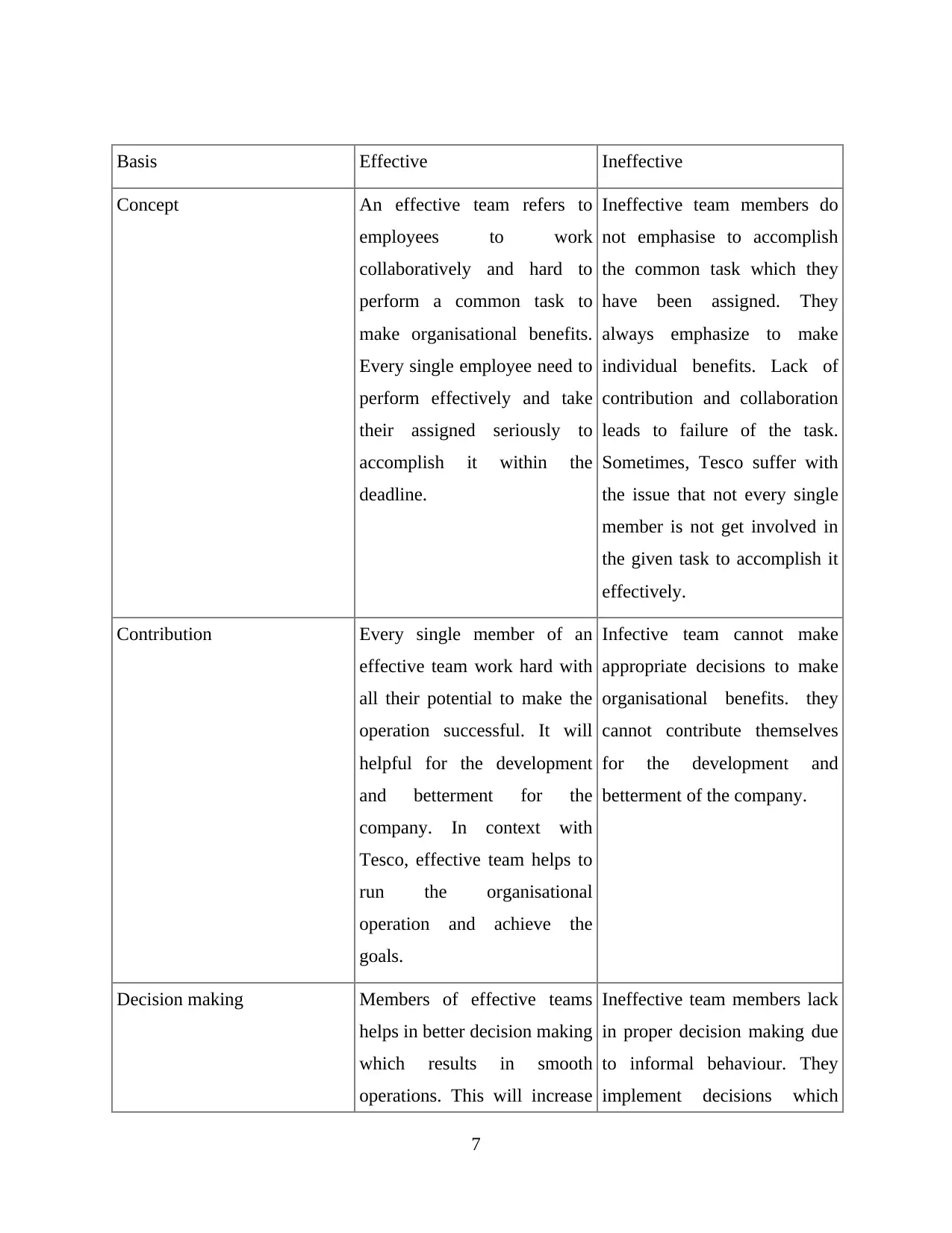
Basis Effective Ineffective
Concept An effective team refers to
employees to work
collaboratively and hard to
perform a common task to
make organisational benefits.
Every single employee need to
perform effectively and take
their assigned seriously to
accomplish it within the
deadline.
Ineffective team members do
not emphasise to accomplish
the common task which they
have been assigned. They
always emphasize to make
individual benefits. Lack of
contribution and collaboration
leads to failure of the task.
Sometimes, Tesco suffer with
the issue that not every single
member is not get involved in
the given task to accomplish it
effectively.
Contribution Every single member of an
effective team work hard with
all their potential to make the
operation successful. It will
helpful for the development
and betterment for the
company. In context with
Tesco, effective team helps to
run the organisational
operation and achieve the
goals.
Infective team cannot make
appropriate decisions to make
organisational benefits. they
cannot contribute themselves
for the development and
betterment of the company.
Decision making Members of effective teams
helps in better decision making
which results in smooth
operations. This will increase
Ineffective team members lack
in proper decision making due
to informal behaviour. They
implement decisions which
7
Concept An effective team refers to
employees to work
collaboratively and hard to
perform a common task to
make organisational benefits.
Every single employee need to
perform effectively and take
their assigned seriously to
accomplish it within the
deadline.
Ineffective team members do
not emphasise to accomplish
the common task which they
have been assigned. They
always emphasize to make
individual benefits. Lack of
contribution and collaboration
leads to failure of the task.
Sometimes, Tesco suffer with
the issue that not every single
member is not get involved in
the given task to accomplish it
effectively.
Contribution Every single member of an
effective team work hard with
all their potential to make the
operation successful. It will
helpful for the development
and betterment for the
company. In context with
Tesco, effective team helps to
run the organisational
operation and achieve the
goals.
Infective team cannot make
appropriate decisions to make
organisational benefits. they
cannot contribute themselves
for the development and
betterment of the company.
Decision making Members of effective teams
helps in better decision making
which results in smooth
operations. This will increase
Ineffective team members lack
in proper decision making due
to informal behaviour. They
implement decisions which
7
⊘ This is a preview!⊘
Do you want full access?
Subscribe today to unlock all pages.
Trusted by 1+ million students worldwide
the profit generation in
organisation.
only help in their own growth
and development.
M3 evaluate appropriate group and team development theories to assist the development of
cooperation within effective teams
Tuckman group stage development theory was launched in 1965 by Bruce Tuckman. This theory
consists phases which are necessary to the growth and development of the firm. TESCO also
execute this theory that assists in impactful working of the firm. This theory can be described as:
Forming: it is the initial stage that bind the structure and keep all the team members in a
group. This concentrate on allocating and assembling the workers need and task to
perform these task appropriately. Manager of TESCO makes plans which their workers
have to follow to get the goals.
Storming: in this level, combination of various ideas together evaluates to carry out task.
Between this phase workers of TESCO attempt to make relationship with one another.
Many influence elements can be seen like power, structural, leadership and political
problems (Tayal and Bamel et.al 2022).
Norming: this level involves settlement of disturbances and conflicts with one another to
get the targets. TESCO leaders includes other workers to the decision takings that results
in very impactful method of getting targets (Thompson and Ackroyd 2022).
Performing: in this level group members become motivated, more confident and
independent. They seem flexibility sense in decision making and take responsibilities
and authorities seriously to get goals by all the members of team in TESCO.
Adjourning: it is the ultimate level that includes the termination of members and project
are planning for leaving the group. It can outcome as restless behaviour. TESCO
concentrate on moving to further level that assist in keeping the positive condition.
Belbin Theory
It was launched in 1981 by Dr. Meredith Belbin. It concentrates on supporting in team
making and role were created to perform the achievement of whole team. TESCO also utilise
Belbin theory between the functions that can be described as follows:
The Monitor evaluator: Monitor evaluator creates strategies, decision, and process that
are based on the facts and reality. TESCO includes devoted workers who are very
8
organisation.
only help in their own growth
and development.
M3 evaluate appropriate group and team development theories to assist the development of
cooperation within effective teams
Tuckman group stage development theory was launched in 1965 by Bruce Tuckman. This theory
consists phases which are necessary to the growth and development of the firm. TESCO also
execute this theory that assists in impactful working of the firm. This theory can be described as:
Forming: it is the initial stage that bind the structure and keep all the team members in a
group. This concentrate on allocating and assembling the workers need and task to
perform these task appropriately. Manager of TESCO makes plans which their workers
have to follow to get the goals.
Storming: in this level, combination of various ideas together evaluates to carry out task.
Between this phase workers of TESCO attempt to make relationship with one another.
Many influence elements can be seen like power, structural, leadership and political
problems (Tayal and Bamel et.al 2022).
Norming: this level involves settlement of disturbances and conflicts with one another to
get the targets. TESCO leaders includes other workers to the decision takings that results
in very impactful method of getting targets (Thompson and Ackroyd 2022).
Performing: in this level group members become motivated, more confident and
independent. They seem flexibility sense in decision making and take responsibilities
and authorities seriously to get goals by all the members of team in TESCO.
Adjourning: it is the ultimate level that includes the termination of members and project
are planning for leaving the group. It can outcome as restless behaviour. TESCO
concentrate on moving to further level that assist in keeping the positive condition.
Belbin Theory
It was launched in 1981 by Dr. Meredith Belbin. It concentrates on supporting in team
making and role were created to perform the achievement of whole team. TESCO also utilise
Belbin theory between the functions that can be described as follows:
The Monitor evaluator: Monitor evaluator creates strategies, decision, and process that
are based on the facts and reality. TESCO includes devoted workers who are very
8
Paraphrase This Document
Need a fresh take? Get an instant paraphrase of this document with our AI Paraphraser
focused and committed in the upcoming years planning. These workers generally
achieve higher post because of their critical thinking and advanced skills (Khaola and
Rambe 2020).
The Specialist: This includes an expert person in the group who keeps some expertise
knowledge and skill in particular field. They assist other workers in TESCO when
anyone need any support in their area of expertise.
The plant: it involves worker who loves to work in separation with innovative ideas and
creative thoughts. TESCO have some of the workers who keeps creative approach as
they contribute in higher profit making.
The shaper: these are commonly gregarious workers of the firm who assist others also in
getting goals and targets. They are too devoted about their performance and motivate
other to carry out well.
The implementer: These kind of workers perform in a specific structure and manage
decorum in the firm. Some workers of TESCO are executers because they make positive
culture to all the worker working in the firm. They are the spine of TESCO because they
perform on plans.
The finisher or completer: this kind of workers are cool and work as per the quality
needed and accomplish the standard of excellence. TESCO have some of the workers
who minimize the errors and finished deadlines with standard performance.
The coordinate: These workers are specialist in interpersonal skills and communication.
In TESCO, managers assist other workers getting their own aims together with firms
aims.
The team worker: workers who keep relations in groups and make euphony are consider
as team employees. Some workers of TESCO are impactful in solving issue and conflicts
and assist others in making peaceful atmosphere.
The Resource investigator: These workers explain new opportunities and ideas to further
improvement. TESCO achieve advantages from these workers because they Make novel
firm contacts to them.
9
achieve higher post because of their critical thinking and advanced skills (Khaola and
Rambe 2020).
The Specialist: This includes an expert person in the group who keeps some expertise
knowledge and skill in particular field. They assist other workers in TESCO when
anyone need any support in their area of expertise.
The plant: it involves worker who loves to work in separation with innovative ideas and
creative thoughts. TESCO have some of the workers who keeps creative approach as
they contribute in higher profit making.
The shaper: these are commonly gregarious workers of the firm who assist others also in
getting goals and targets. They are too devoted about their performance and motivate
other to carry out well.
The implementer: These kind of workers perform in a specific structure and manage
decorum in the firm. Some workers of TESCO are executers because they make positive
culture to all the worker working in the firm. They are the spine of TESCO because they
perform on plans.
The finisher or completer: this kind of workers are cool and work as per the quality
needed and accomplish the standard of excellence. TESCO have some of the workers
who minimize the errors and finished deadlines with standard performance.
The coordinate: These workers are specialist in interpersonal skills and communication.
In TESCO, managers assist other workers getting their own aims together with firms
aims.
The team worker: workers who keep relations in groups and make euphony are consider
as team employees. Some workers of TESCO are impactful in solving issue and conflicts
and assist others in making peaceful atmosphere.
The Resource investigator: These workers explain new opportunities and ideas to further
improvement. TESCO achieve advantages from these workers because they Make novel
firm contacts to them.
9
TASK 4
P5 Philosophies and concept of organisational behaviour applied within a firm in reference to
given business status
Path goal theory: Robert house and Martin Evans have introduced this theory. It describes
reliability of a leader of a team to giver support, technology, information and many other
resources which assist team members to achieve a common goal. There are three steps
involved which have mentioned below: -
Employee characteristics: Team leaders of Tesco emphasise of their workers such as
experience, skills, control and ability to make them retain in the company for a long
period of time. The level of satisfaction gets enhanced at the organisation.
Environment and Task characteristics: this step mostly concentrate on the barriers that
hamper the functions in TESCO. To decrease the effect of the barriers, managers take
essential actions as making various path.
Leader behaviour style: leaders change their way as per the need of the culture. Leaders
of TESCO cast themselves that enhances the performance of the workers.
M4 analyse how philosophies and concepts of OB influence and inform behaviour in a provided
business condition:
Philosophies and concepts assist in increasing the performance and skills of the workers working
in the firm. It assists TESCO in getting their fixed aims in efficient and effective way. These
philosophies assist in acknowledging the worker’s behaviour and assist in better communication
and coordination. They can also affect the policies, culture, and powers of the firm which takes
part in vital role in firm (Yadav and Punia 2021). Improved firm atmosphere inspires workers
which keep them in firm to long period and reduce the worker revenue. Philosophies of firm's
behaviour assists in getting growth and achievement.
D2 Critically evaluate the significance of team development theories, philosophies and concepts
which affects behaviour in the organisation to enhance firm productivity and performance.
It plays a vital role in affecting the behaviour like it enhance the efficiency of the workers. It
analyses the barriers and negative aspects which decrease the revenue of firm. These theories
assist in good communication among the workers that enhances their abilities at organisation.
Development theories assist in making new innovation and ideas to the completion of works. It
10
P5 Philosophies and concept of organisational behaviour applied within a firm in reference to
given business status
Path goal theory: Robert house and Martin Evans have introduced this theory. It describes
reliability of a leader of a team to giver support, technology, information and many other
resources which assist team members to achieve a common goal. There are three steps
involved which have mentioned below: -
Employee characteristics: Team leaders of Tesco emphasise of their workers such as
experience, skills, control and ability to make them retain in the company for a long
period of time. The level of satisfaction gets enhanced at the organisation.
Environment and Task characteristics: this step mostly concentrate on the barriers that
hamper the functions in TESCO. To decrease the effect of the barriers, managers take
essential actions as making various path.
Leader behaviour style: leaders change their way as per the need of the culture. Leaders
of TESCO cast themselves that enhances the performance of the workers.
M4 analyse how philosophies and concepts of OB influence and inform behaviour in a provided
business condition:
Philosophies and concepts assist in increasing the performance and skills of the workers working
in the firm. It assists TESCO in getting their fixed aims in efficient and effective way. These
philosophies assist in acknowledging the worker’s behaviour and assist in better communication
and coordination. They can also affect the policies, culture, and powers of the firm which takes
part in vital role in firm (Yadav and Punia 2021). Improved firm atmosphere inspires workers
which keep them in firm to long period and reduce the worker revenue. Philosophies of firm's
behaviour assists in getting growth and achievement.
D2 Critically evaluate the significance of team development theories, philosophies and concepts
which affects behaviour in the organisation to enhance firm productivity and performance.
It plays a vital role in affecting the behaviour like it enhance the efficiency of the workers. It
analyses the barriers and negative aspects which decrease the revenue of firm. These theories
assist in good communication among the workers that enhances their abilities at organisation.
Development theories assist in making new innovation and ideas to the completion of works. It
10
⊘ This is a preview!⊘
Do you want full access?
Subscribe today to unlock all pages.
Trusted by 1+ million students worldwide

1 out of 15


Related Documents


Your All-in-One AI-Powered Toolkit for Academic Success.
+13062052269
info@desklib.com
Available 24*7 on WhatsApp / Email
![[object Object]](/_next/static/media/star-bottom.7253800d.svg)
Unlock your academic potential
Copyright © 2020–2026 A2Z Services. All Rights Reserved. Developed and managed by ZUCOL.