Organisational Behaviour Analysis: A Case Study of Unilever
VerifiedAdded on 2023/06/07
|15
|4651
|181
Report
AI Summary
This report provides a comprehensive analysis of organisational behaviour at Unilever, a British multinational consumer goods company. It examines the importance of organisational culture and motivation in the workplace, referencing Maslow's Hierarchy of Needs and Hertzberg's Two-Factor Theory. The report explores how these theories influence organisational behaviour and performance, offering recommendations for improvement, such as celebrating achievements, providing flexibility, and investing in training and development. Additionally, it delves into team dynamics, roles, and behaviour, utilising Tuckman's model, and reflects on the value of effective teamwork within the Unilever context. The organisation's focus on employee health, safety, and wellbeing is also highlighted, emphasizing Unilever's unique Wellbeing Framework. Desklib provides access to this and other solved assignments for students.
Organisation Behaviour

Paraphrase This Document
Need a fresh take? Get an instant paraphrase of this document with our AI Paraphraser
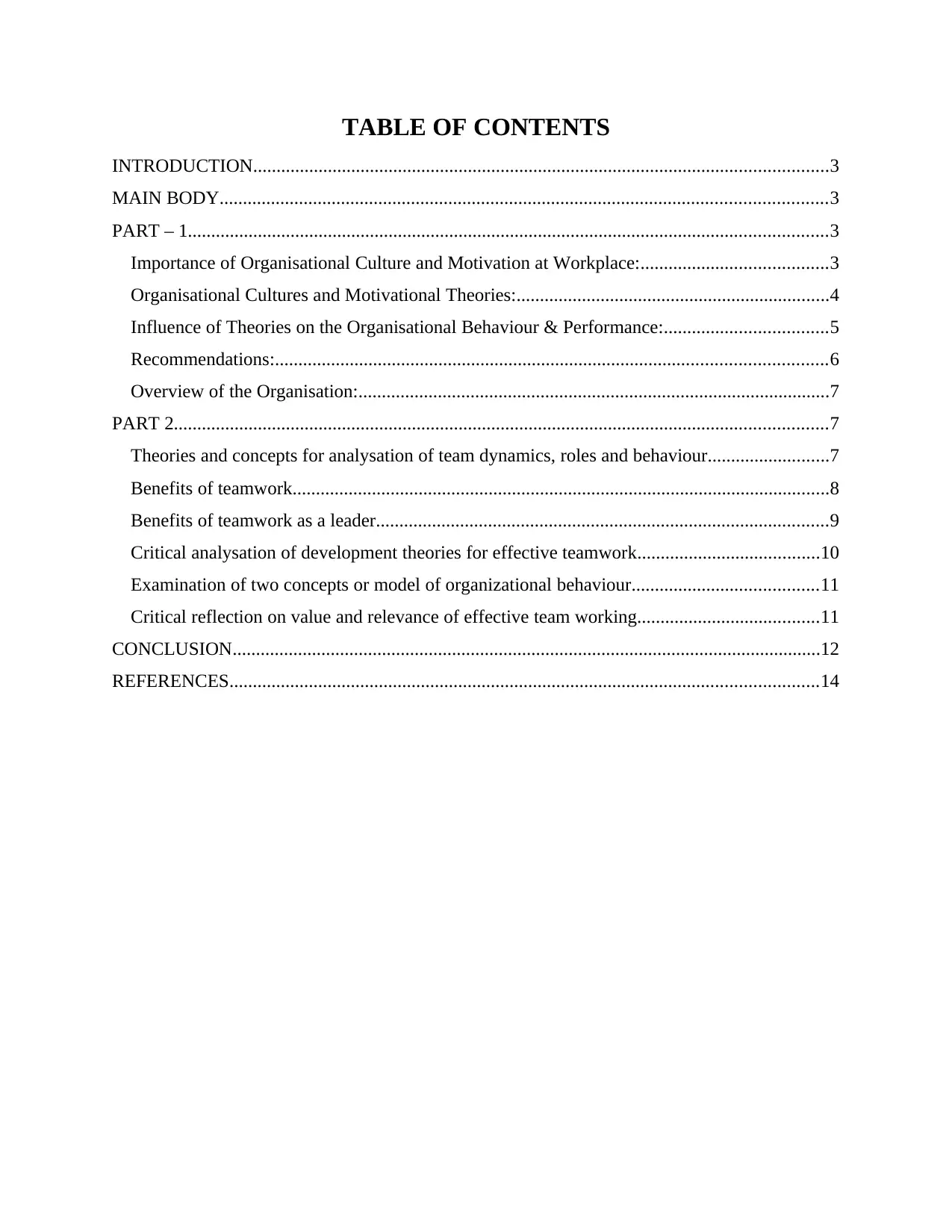
TABLE OF CONTENTS
INTRODUCTION...........................................................................................................................3
MAIN BODY..................................................................................................................................3
PART – 1.........................................................................................................................................3
Importance of Organisational Culture and Motivation at Workplace:........................................3
Organisational Cultures and Motivational Theories:...................................................................4
Influence of Theories on the Organisational Behaviour & Performance:...................................5
Recommendations:......................................................................................................................6
Overview of the Organisation:.....................................................................................................7
PART 2............................................................................................................................................7
Theories and concepts for analysation of team dynamics, roles and behaviour..........................7
Benefits of teamwork...................................................................................................................8
Benefits of teamwork as a leader.................................................................................................9
Critical analysation of development theories for effective teamwork.......................................10
Examination of two concepts or model of organizational behaviour........................................11
Critical reflection on value and relevance of effective team working.......................................11
CONCLUSION..............................................................................................................................12
REFERENCES..............................................................................................................................14
INTRODUCTION...........................................................................................................................3
MAIN BODY..................................................................................................................................3
PART – 1.........................................................................................................................................3
Importance of Organisational Culture and Motivation at Workplace:........................................3
Organisational Cultures and Motivational Theories:...................................................................4
Influence of Theories on the Organisational Behaviour & Performance:...................................5
Recommendations:......................................................................................................................6
Overview of the Organisation:.....................................................................................................7
PART 2............................................................................................................................................7
Theories and concepts for analysation of team dynamics, roles and behaviour..........................7
Benefits of teamwork...................................................................................................................8
Benefits of teamwork as a leader.................................................................................................9
Critical analysation of development theories for effective teamwork.......................................10
Examination of two concepts or model of organizational behaviour........................................11
Critical reflection on value and relevance of effective team working.......................................11
CONCLUSION..............................................................................................................................12
REFERENCES..............................................................................................................................14
INTRODUCTION
Organizational behaviour is the academic study of how the people interact within the
groups. This is the study that helps the business in making it better for the better and more
effective operations. In this project the selected organization is Unilever which is a British
multinational consumer goods company with headquarters in London. Unilever products include
food, condiments, ice cream, cleaning agents, beauty products and other personal care products.
This project is going to be analysing the influence of the culture, politics and power on the
behaviour of the other in an organizational context. This project will also be evaluating the ways
in which they can be motivated in order to be able to achieve the goals that have been made.
MAIN BODY
PART – 1
Importance of Organisational Culture and Motivation at Workplace:
The summation of an organisation’s values, objectives, mission and objectives which are
guiding the employees working in it is referred to as Organisational Culture. Organisational
culture in place means a well – structured system which will result in the gaining success which
it has aimed and targeted to achieve. Therefore, certain reasons of such importance of
organizational culture is as follows:
Organizational behaviour is the academic study of how the people interact within the
groups. This is the study that helps the business in making it better for the better and more
effective operations. In this project the selected organization is Unilever which is a British
multinational consumer goods company with headquarters in London. Unilever products include
food, condiments, ice cream, cleaning agents, beauty products and other personal care products.
This project is going to be analysing the influence of the culture, politics and power on the
behaviour of the other in an organizational context. This project will also be evaluating the ways
in which they can be motivated in order to be able to achieve the goals that have been made.
MAIN BODY
PART – 1
Importance of Organisational Culture and Motivation at Workplace:
The summation of an organisation’s values, objectives, mission and objectives which are
guiding the employees working in it is referred to as Organisational Culture. Organisational
culture in place means a well – structured system which will result in the gaining success which
it has aimed and targeted to achieve. Therefore, certain reasons of such importance of
organizational culture is as follows:
⊘ This is a preview!⊘
Do you want full access?
Subscribe today to unlock all pages.

Trusted by 1+ million students worldwide
Enhanced engagement of employee – The engagement of employees towards their duties
and responsibilities increases and becomes effective when the environment at the workplace
is organisationally cultured.
Increased productivity – The employees tend to be more productive and will be performing
well when they have access to required resources and tools which becomes possible through
effective organisational culture.
Strong brand – The reputation and public image of the organisation is represented by the
organisational culture in place.
Harmonized team culture – The decision making process is effectively guided and the
workflows are improved through the help of efficient organisational culture which will help
the teams to be more harmonized and overcome sense of ambiguity.
Another aspect to be addressed at the workplace is the sense of motivation among the
employees working which will be deciding the level of innovation, commitment and energy an
employee will be bringing in the organisation (Gautama So and et.al., 2018). So the importance
of such importance among the employees is explained as follows:
More innovation – Rewarding and benefiting the employees will allow them to be more
innovative and this will inculcate a feeling of being appreciated and supported by the
company and resultantly, they will be challenging themselves to work more efficiently.
Reduced absentees – Motivation among the employees will naturally lead to reduced
absenteeism among the employees. This will be possible through serious acknowledgement
of the teams and its members and managing their workload and wellbeing.
Lower staff turnover – Employees who will be motivated to work in the organisation will
not be leaving the organisation so early and resultantly, the employee turnover will be
reduced significantly.
Enhanced reputation – Strong internal brand image of the organisation is very essential
among the employees to keep them motivated and well – performing.
Organisational Cultures and Motivational Theories:
Now, it shall be noted that there are various theories which ascertains how the behaviour
of an individual is affected by such motivation in both the personal and professional spaces
(Erthal and Marques, 2018). This means that these theories are important to every aspect of
society but is crucially relevant in case of business and management as motivation will lead to
and responsibilities increases and becomes effective when the environment at the workplace
is organisationally cultured.
Increased productivity – The employees tend to be more productive and will be performing
well when they have access to required resources and tools which becomes possible through
effective organisational culture.
Strong brand – The reputation and public image of the organisation is represented by the
organisational culture in place.
Harmonized team culture – The decision making process is effectively guided and the
workflows are improved through the help of efficient organisational culture which will help
the teams to be more harmonized and overcome sense of ambiguity.
Another aspect to be addressed at the workplace is the sense of motivation among the
employees working which will be deciding the level of innovation, commitment and energy an
employee will be bringing in the organisation (Gautama So and et.al., 2018). So the importance
of such importance among the employees is explained as follows:
More innovation – Rewarding and benefiting the employees will allow them to be more
innovative and this will inculcate a feeling of being appreciated and supported by the
company and resultantly, they will be challenging themselves to work more efficiently.
Reduced absentees – Motivation among the employees will naturally lead to reduced
absenteeism among the employees. This will be possible through serious acknowledgement
of the teams and its members and managing their workload and wellbeing.
Lower staff turnover – Employees who will be motivated to work in the organisation will
not be leaving the organisation so early and resultantly, the employee turnover will be
reduced significantly.
Enhanced reputation – Strong internal brand image of the organisation is very essential
among the employees to keep them motivated and well – performing.
Organisational Cultures and Motivational Theories:
Now, it shall be noted that there are various theories which ascertains how the behaviour
of an individual is affected by such motivation in both the personal and professional spaces
(Erthal and Marques, 2018). This means that these theories are important to every aspect of
society but is crucially relevant in case of business and management as motivation will lead to
Paraphrase This Document
Need a fresh take? Get an instant paraphrase of this document with our AI Paraphraser
employees being more productive and profitable. Following are some of the theories which are
most relevant:
Maslow’s Theory of Hierarchical Needs – As per this theory a person stays motivated
when all his needs are fulfilled. It is assumed herein that an individual work for his
contribution and utilization of his skills rather than for money and security. Therefore, such
needs are arranged in a hierarchy which includes physiological needs, safety needs, social
needs, self – esteem needs and self – actualization needs.
Hertzberg’s two-factor Theory – As per this theory the needs are divided into two
categories i.e., hygiene factors and motivating factors. Degraded hygiene factors will reduce
the motivation but improving such factors will not essentially enhance the team motivation.
Thus, hygiene factors will involve working conditions, policies, rules, co-worker relations,
etc. while motivator factors will involve achievements, responsibility, personal growth,
recognition, etc.
Unilever Plc which has been selected for the purposes of this report mainly focusses on
their employees’ health, safety and high – quality work life balance. They believe that the
contribution from such employees is more when they are healthy, well and fulfilling the purpose
of their life (Szydło and Grześ-Bukłaho, 2020). For this, promotion of an optimistic environment
is being concentrated on for supporting the physical, social, emotional and mental wellbeing of
the employees. Therefore, this framework for wellbeing is at the core of the business which
involves being purposeful, mentally available, emotionally available and physically healthy.
Thus, it can be said that the organisation utilises the Maslow’s Theory of Hierarchical Needs.
Influence of Theories on the Organisational Behaviour & Performance:
These theories help the organisation to understand how a person is driven towards a
specific goal and objective of the business and management (Nguyen, 2019). The motivational
theories assist in enhancing the productivity of the employees as each employee is different and
will be motivated in a different way. This is where these theories of motivation come in play
which will help the organisation to understand what will make the employee work efficiently.
Thus, these theories will concentrate on various aspects of the organisation for improvement of
the motivation like reward which involves creation of a well framed reward scheme which will
motivate the employee and increase the productivity. Another aspect to be considered is trust of
the employees that they are satisfied that the employers consider the best interests of the
most relevant:
Maslow’s Theory of Hierarchical Needs – As per this theory a person stays motivated
when all his needs are fulfilled. It is assumed herein that an individual work for his
contribution and utilization of his skills rather than for money and security. Therefore, such
needs are arranged in a hierarchy which includes physiological needs, safety needs, social
needs, self – esteem needs and self – actualization needs.
Hertzberg’s two-factor Theory – As per this theory the needs are divided into two
categories i.e., hygiene factors and motivating factors. Degraded hygiene factors will reduce
the motivation but improving such factors will not essentially enhance the team motivation.
Thus, hygiene factors will involve working conditions, policies, rules, co-worker relations,
etc. while motivator factors will involve achievements, responsibility, personal growth,
recognition, etc.
Unilever Plc which has been selected for the purposes of this report mainly focusses on
their employees’ health, safety and high – quality work life balance. They believe that the
contribution from such employees is more when they are healthy, well and fulfilling the purpose
of their life (Szydło and Grześ-Bukłaho, 2020). For this, promotion of an optimistic environment
is being concentrated on for supporting the physical, social, emotional and mental wellbeing of
the employees. Therefore, this framework for wellbeing is at the core of the business which
involves being purposeful, mentally available, emotionally available and physically healthy.
Thus, it can be said that the organisation utilises the Maslow’s Theory of Hierarchical Needs.
Influence of Theories on the Organisational Behaviour & Performance:
These theories help the organisation to understand how a person is driven towards a
specific goal and objective of the business and management (Nguyen, 2019). The motivational
theories assist in enhancing the productivity of the employees as each employee is different and
will be motivated in a different way. This is where these theories of motivation come in play
which will help the organisation to understand what will make the employee work efficiently.
Thus, these theories will concentrate on various aspects of the organisation for improvement of
the motivation like reward which involves creation of a well framed reward scheme which will
motivate the employee and increase the productivity. Another aspect to be considered is trust of
the employees that they are satisfied that the employers consider the best interests of the
employees and in return, the employees do a job efficiently. This will create a positive
atmosphere for motivating the staff (Belrhiti and et.al., 2020). Recognizing the efforts of an
employees is very crucial as the employee who is recognized will be putting his whole hearted
efforts in the work.
Such motivation developed through the application of these motivational theories will be
essentially putting the human, financial and physical resources into action for accomplishment of
the goals and objectives of the organisation (Obeidat and et.al., 2018). So, this is done by
building the wellbeing of the employees which will allow them to work fluently and utilize the
resources available to the enterprise in the best possible manner and thus, improving the
performance of the business. This will also help in improvement of the efficiency level of the
employees by filling the gap between the ability of the employees and their willingness to use
their abilities which will improve the performance of the employees.
Recommendations:
For improving the performance of the staff, Unilever need to follow the following
recommendations which will help in meeting their goals and objectives:
Celebrating the achievements – It is important to acknowledge the achievements of the
employees and their significant results which helped organisation to move further towards
their missions. This is done by celebrating the employees’ achievements and results. Being
focussed on the wins of the team and congratulating them on their commitment towards the
high quality work. This will motivate them to remain consistent and perform even better.
Provide flexibility – Providing flexibility to the workers and employees in the working
schedules whenever necessary will be very much appreciated and highly valued by the
employees. This will develop a sense of trust among the employees and also help them in
enhancing their productivity.
Training and development – For the employees to perform their job with utmost efficiency,
it is very necessary to provide them with the requisite training which will help them in
understanding their roles and responsibilities in a better way (14 Strategies To Improve
Employee Performance, 2022.). Such training will also allow these employees to develop by
enhancing their skills, improving their intellect and increasing their knowledge in their field
of expertise and working.
atmosphere for motivating the staff (Belrhiti and et.al., 2020). Recognizing the efforts of an
employees is very crucial as the employee who is recognized will be putting his whole hearted
efforts in the work.
Such motivation developed through the application of these motivational theories will be
essentially putting the human, financial and physical resources into action for accomplishment of
the goals and objectives of the organisation (Obeidat and et.al., 2018). So, this is done by
building the wellbeing of the employees which will allow them to work fluently and utilize the
resources available to the enterprise in the best possible manner and thus, improving the
performance of the business. This will also help in improvement of the efficiency level of the
employees by filling the gap between the ability of the employees and their willingness to use
their abilities which will improve the performance of the employees.
Recommendations:
For improving the performance of the staff, Unilever need to follow the following
recommendations which will help in meeting their goals and objectives:
Celebrating the achievements – It is important to acknowledge the achievements of the
employees and their significant results which helped organisation to move further towards
their missions. This is done by celebrating the employees’ achievements and results. Being
focussed on the wins of the team and congratulating them on their commitment towards the
high quality work. This will motivate them to remain consistent and perform even better.
Provide flexibility – Providing flexibility to the workers and employees in the working
schedules whenever necessary will be very much appreciated and highly valued by the
employees. This will develop a sense of trust among the employees and also help them in
enhancing their productivity.
Training and development – For the employees to perform their job with utmost efficiency,
it is very necessary to provide them with the requisite training which will help them in
understanding their roles and responsibilities in a better way (14 Strategies To Improve
Employee Performance, 2022.). Such training will also allow these employees to develop by
enhancing their skills, improving their intellect and increasing their knowledge in their field
of expertise and working.
⊘ This is a preview!⊘
Do you want full access?
Subscribe today to unlock all pages.
Trusted by 1+ million students worldwide
Focussed towards the goal – When the organisation is focussed entirely towards the goals
set by them the employees will know where to concentrate their efforts (Alsabahi and et.al.,
2021). The employees will know clearly what is expected out of them and they will be able
to meet the expectations easily or even exceed the expectations.
Incentives – By offering the employees with the incentives and other rewards & benefits,
their performance can be effectively improved. Such incentives, rewards and benefits can be
offered when these employees perform highly and results in production of some high quality
results.
Overview of the Organisation:
Keeping the interests of employees in mind, Unilever majorly focusses on the health and
wellbeing of its employees. This includes the safety of the people working in this organisation.
Unilever believes that each and every employee and worker that work in it shall be free from the
risk of injuries and accidents. It has a unique Wellbeing Framework which focusses on health
and wellbeing of the employees by being:
Purposeful – This will involve identification of the aspects that significantly matters to them
and being connected to that in all its operations.
Mental – This will involve management of choices and reactions generated mentally towards
the pressures, adversities, challenges and distractions.
Emotional – This will involve feeling positivity and facing the challenges confidently.
Physical – This will involve approaching the challenges with zeal and energy by taking care
of the health, diet, energy, fitness and sleep levels.
Another priority of this organisation is the health and safety of the people working in it. It
is most crucial of the most salient issues of the human rights and the commitment towards the
safety and health of employees. The organisation also is very sensitive towards the mental health
of its employees. So, creation of such workplace which supports the mental Unilever focuses on
culture, leadership, prevention and support.
PART 2
Theories and concepts for analysation of team dynamics, roles and behaviour
Team dynamics are the behavioural and emotional forces which are the influence of the
team performance and direction. It is considered to be the nature of work, personalities inside the
set by them the employees will know where to concentrate their efforts (Alsabahi and et.al.,
2021). The employees will know clearly what is expected out of them and they will be able
to meet the expectations easily or even exceed the expectations.
Incentives – By offering the employees with the incentives and other rewards & benefits,
their performance can be effectively improved. Such incentives, rewards and benefits can be
offered when these employees perform highly and results in production of some high quality
results.
Overview of the Organisation:
Keeping the interests of employees in mind, Unilever majorly focusses on the health and
wellbeing of its employees. This includes the safety of the people working in this organisation.
Unilever believes that each and every employee and worker that work in it shall be free from the
risk of injuries and accidents. It has a unique Wellbeing Framework which focusses on health
and wellbeing of the employees by being:
Purposeful – This will involve identification of the aspects that significantly matters to them
and being connected to that in all its operations.
Mental – This will involve management of choices and reactions generated mentally towards
the pressures, adversities, challenges and distractions.
Emotional – This will involve feeling positivity and facing the challenges confidently.
Physical – This will involve approaching the challenges with zeal and energy by taking care
of the health, diet, energy, fitness and sleep levels.
Another priority of this organisation is the health and safety of the people working in it. It
is most crucial of the most salient issues of the human rights and the commitment towards the
safety and health of employees. The organisation also is very sensitive towards the mental health
of its employees. So, creation of such workplace which supports the mental Unilever focuses on
culture, leadership, prevention and support.
PART 2
Theories and concepts for analysation of team dynamics, roles and behaviour
Team dynamics are the behavioural and emotional forces which are the influence of the
team performance and direction. It is considered to be the nature of work, personalities inside the
Paraphrase This Document
Need a fresh take? Get an instant paraphrase of this document with our AI Paraphraser
team, working interactions with the other individuals in the setting that helps in the team work
(Gagné, 2018). This has been considered to be the part of the positive dynamics that is able to
exhibit the trust, work towards communal decisions and also holding each other accountable.
Understanding of the team dynamics are also a very important part of the growth that is very
important to be thrived upon the working environment. Tuckman model is the model that can
support the team dynamics as it has the five different stages. These stages are as follows,
Forming:
This is the stage at which the teams have in order to have high expectations that are eager
of com. This also influences the slight concern on the individual performance of the role and
style which fits into the other group members.
Storming:
At this stage the individuals start to plan their operating styles with a less restraint and
ability to mask their team role limitation. This includes the operational style of the differences
that are expected from them to learn and deal with a rise in the conflict (Tasselli, Kilduff and
Landis, 2018). IT is essential and is considered a more adverse factor towards the conflict for
struggle here.
Norming:
This stage is the one with self-expectations and other exams begin lining up with the
reality instead of the individual perception of reality. It is considered to be very essential for
respecting various styles and can be developed for controlling the shift to team from the leaders.
Performing:
From this stage the individuals start showing their strengths in team roles and offset each
other weakness with confidence. It is considered to be the collaboration of the integral aspect of
the team strengths.
Reforming:
This is the stage that may or may not arrive depending on whether the team is dissolved
or modified. It is the beginning of a new forming stage for the team (Gravina and et.al., 2018).
Benefits of teamwork
Following are the benefits of team work in an organization are as follows,
(Gagné, 2018). This has been considered to be the part of the positive dynamics that is able to
exhibit the trust, work towards communal decisions and also holding each other accountable.
Understanding of the team dynamics are also a very important part of the growth that is very
important to be thrived upon the working environment. Tuckman model is the model that can
support the team dynamics as it has the five different stages. These stages are as follows,
Forming:
This is the stage at which the teams have in order to have high expectations that are eager
of com. This also influences the slight concern on the individual performance of the role and
style which fits into the other group members.
Storming:
At this stage the individuals start to plan their operating styles with a less restraint and
ability to mask their team role limitation. This includes the operational style of the differences
that are expected from them to learn and deal with a rise in the conflict (Tasselli, Kilduff and
Landis, 2018). IT is essential and is considered a more adverse factor towards the conflict for
struggle here.
Norming:
This stage is the one with self-expectations and other exams begin lining up with the
reality instead of the individual perception of reality. It is considered to be very essential for
respecting various styles and can be developed for controlling the shift to team from the leaders.
Performing:
From this stage the individuals start showing their strengths in team roles and offset each
other weakness with confidence. It is considered to be the collaboration of the integral aspect of
the team strengths.
Reforming:
This is the stage that may or may not arrive depending on whether the team is dissolved
or modified. It is the beginning of a new forming stage for the team (Gravina and et.al., 2018).
Benefits of teamwork
Following are the benefits of team work in an organization are as follows,
Better Problem Solving:
Due to the collaboration of minds the team are considered to be more and more capable
of being able to develop a strong group. Better problem solving is very beneficial for the
business to be able to achieve the targets that are effective enough to be outperformed for the
best individuals.
Increased potential for innovation:
Working in a team allows the individuals to be creative in minds that is considered to be
the key factor that can be used effectively for better potential towards innovation. Hence, the
success that comes from surrounding others is through the success of breakthrough innovation
which involves the discomfort (Graham and et.al., 2020).
Happier team members:
Team work has been considered to be the reason due to which there is a happier team
member. This is due to the fact that the business would like to gain the success that is required
for the achievement of honest feedback, mutual respect and personal openness.
Personal growth:
The part of the team that is considered to be very effective and important that the
business that is able to gain the effectiveness that is required. It has been found that more people
are able to grow when they are able to work with collaboration with other factors.
Less burnout:
It has been found that the nearly most of the fulltime employee feel burnout as they have
been considered to be over used due to the lack of efficiency which is present in the organization.
However, the effective team work is able to help in decreasing these effects.
Increases Productivity:
It has been found that the increase in the teamwork is directly related to the increase in
the productivity of the employees that are working with collaboration. This is helpful for the
organization to be able to achieve the goals and objectives.
Benefits of teamwork as a leader
There are multiple benefits of being a leader and also a being good at teamwork. This is
considered to be the factor that invests many different products and services (Pan and et.al.,
2018). There are different benefits that a leader is able to gain from the development of team
Due to the collaboration of minds the team are considered to be more and more capable
of being able to develop a strong group. Better problem solving is very beneficial for the
business to be able to achieve the targets that are effective enough to be outperformed for the
best individuals.
Increased potential for innovation:
Working in a team allows the individuals to be creative in minds that is considered to be
the key factor that can be used effectively for better potential towards innovation. Hence, the
success that comes from surrounding others is through the success of breakthrough innovation
which involves the discomfort (Graham and et.al., 2020).
Happier team members:
Team work has been considered to be the reason due to which there is a happier team
member. This is due to the fact that the business would like to gain the success that is required
for the achievement of honest feedback, mutual respect and personal openness.
Personal growth:
The part of the team that is considered to be very effective and important that the
business that is able to gain the effectiveness that is required. It has been found that more people
are able to grow when they are able to work with collaboration with other factors.
Less burnout:
It has been found that the nearly most of the fulltime employee feel burnout as they have
been considered to be over used due to the lack of efficiency which is present in the organization.
However, the effective team work is able to help in decreasing these effects.
Increases Productivity:
It has been found that the increase in the teamwork is directly related to the increase in
the productivity of the employees that are working with collaboration. This is helpful for the
organization to be able to achieve the goals and objectives.
Benefits of teamwork as a leader
There are multiple benefits of being a leader and also a being good at teamwork. This is
considered to be the factor that invests many different products and services (Pan and et.al.,
2018). There are different benefits that a leader is able to gain from the development of team
⊘ This is a preview!⊘
Do you want full access?
Subscribe today to unlock all pages.
Trusted by 1+ million students worldwide
building practices. Following are the benefits that the leaders have from the development of the
teamwork,
Increases Employee Engagement:
As a leader it is very important for the business to be able to analyse the factors which
are needed for the employee engagement. This has been found to be the factor that influences the
millennials which is also considered to be the engagement that is essential for the leaders to pull
out the passion that is required for the team. This provides the organization with confidence,
accountability and healthier work culture.
Development of trust:
The teamwork a has been considered to be the factor that is able to help the employee act
as a lone wolf and not an impact for the other people responsibilities. These deadlines are
considered to be the factor that are able to operate at the maximum efficiency that is essential for
the trusting the day to day activities of the leadership practise.
Reduction of workplace clashes:
Due to the increase in the strengths the team is affected by the team members in between
added benefit for the minimization of conflicts. This is essential for the major clashes that aid
leaders to achieve the success in the organization.
Development of leadership skills:
Team work has been found to be the feature that is very effective for aiding the
organization in a way that it is able to sustain the long term growth. This can be found to be the
talent that the leadership position needs to focus on for investing or cultivating on leaders from
within.
Professionalism:
Teamwork has been considered to be the reason due to which the leaders are able to
introduce the level of professionalism that is required. This is also very important for the creation
of operational success that is very effective for the effective practices in the organization.
Critical analysation of development theories for effective teamwork
Theory of team roles is considered to be the factor which is essential for the effectiveness
of the team work. The Belbin’s role of team roles explains that the there are nine roles that every
team needs to have. These roles are considered to be the plant, resource investigator, shaper,
monitor evaluator, team worker, implementer, completer –finisher and specialist. Kim and et.al.,
teamwork,
Increases Employee Engagement:
As a leader it is very important for the business to be able to analyse the factors which
are needed for the employee engagement. This has been found to be the factor that influences the
millennials which is also considered to be the engagement that is essential for the leaders to pull
out the passion that is required for the team. This provides the organization with confidence,
accountability and healthier work culture.
Development of trust:
The teamwork a has been considered to be the factor that is able to help the employee act
as a lone wolf and not an impact for the other people responsibilities. These deadlines are
considered to be the factor that are able to operate at the maximum efficiency that is essential for
the trusting the day to day activities of the leadership practise.
Reduction of workplace clashes:
Due to the increase in the strengths the team is affected by the team members in between
added benefit for the minimization of conflicts. This is essential for the major clashes that aid
leaders to achieve the success in the organization.
Development of leadership skills:
Team work has been found to be the feature that is very effective for aiding the
organization in a way that it is able to sustain the long term growth. This can be found to be the
talent that the leadership position needs to focus on for investing or cultivating on leaders from
within.
Professionalism:
Teamwork has been considered to be the reason due to which the leaders are able to
introduce the level of professionalism that is required. This is also very important for the creation
of operational success that is very effective for the effective practices in the organization.
Critical analysation of development theories for effective teamwork
Theory of team roles is considered to be the factor which is essential for the effectiveness
of the team work. The Belbin’s role of team roles explains that the there are nine roles that every
team needs to have. These roles are considered to be the plant, resource investigator, shaper,
monitor evaluator, team worker, implementer, completer –finisher and specialist. Kim and et.al.,
Paraphrase This Document
Need a fresh take? Get an instant paraphrase of this document with our AI Paraphraser
(2019) explains that these roles explain how the different members of the team are considered to
be effective with a collaboration of different practices which are key to the success of the
business.
However, this theory is not as effective as the other organization as it would have a
negative effect on the ways in which the business can achieve the success. The Maslow hierarchy
of needs are considered to be the theory that explains the requirements of the team that is
essential for being able to start the safety of the security of health that is essential for respecting
others. This theory explains how there are certain needs that are essential for the organization to
be able to achieve the success in influencing the organization towards success in their operations.
Guo and et.al., (2020) explained how this theory has been found to be less effective as it is not
able to be successful for the management of the key practices.
Examination of two concepts or model of organizational behaviour
The organizational behaviour has different models that are related to the different types of
discipline like psychology, sociology, anthropology and etc. Following are the two concepts of
organizational behaviour model which is able to solve the problems which an organization has
been facing,
Custodial Model:
This is the root level of the model in which the economic resources of het managerial
orientations of money is considered. It is the factor in which the employee is able to allow the
orientation towards the security and benefit from the provided towards them. The focus of this
study is towards the dependency of the organization. This is also considered to be the
requirements that is able to be met by the security of the organization.
In this model the adaptation of the firms has the high resources that are suggested by the
dependency of the economic resources (Ristianti, Putrajaya and Fathurrochman, 2020). This is
also the approach that is directed towards the depended on the firm in comparison to that of the
manager and the boss. This is also the factor that provide the business with the required passion
that is key towards the satisfaction and is able to encourage the factor that at required.
Collegial Model:
This is the root level of the partnership within the management orientation in which the
teamwork is considered to be very important and essential for a responsible behaviour.
Discipline in the employee is said to require the self-actualization that is effective for the
be effective with a collaboration of different practices which are key to the success of the
business.
However, this theory is not as effective as the other organization as it would have a
negative effect on the ways in which the business can achieve the success. The Maslow hierarchy
of needs are considered to be the theory that explains the requirements of the team that is
essential for being able to start the safety of the security of health that is essential for respecting
others. This theory explains how there are certain needs that are essential for the organization to
be able to achieve the success in influencing the organization towards success in their operations.
Guo and et.al., (2020) explained how this theory has been found to be less effective as it is not
able to be successful for the management of the key practices.
Examination of two concepts or model of organizational behaviour
The organizational behaviour has different models that are related to the different types of
discipline like psychology, sociology, anthropology and etc. Following are the two concepts of
organizational behaviour model which is able to solve the problems which an organization has
been facing,
Custodial Model:
This is the root level of the model in which the economic resources of het managerial
orientations of money is considered. It is the factor in which the employee is able to allow the
orientation towards the security and benefit from the provided towards them. The focus of this
study is towards the dependency of the organization. This is also considered to be the
requirements that is able to be met by the security of the organization.
In this model the adaptation of the firms has the high resources that are suggested by the
dependency of the economic resources (Ristianti, Putrajaya and Fathurrochman, 2020). This is
also the approach that is directed towards the depended on the firm in comparison to that of the
manager and the boss. This is also the factor that provide the business with the required passion
that is key towards the satisfaction and is able to encourage the factor that at required.
Collegial Model:
This is the root level of the partnership within the management orientation in which the
teamwork is considered to be very important and essential for a responsible behaviour.
Discipline in the employee is said to require the self-actualization that is effective for the
performance of the moderate zeal (Gigol, 2020). This is also the extension of the supportive
model that is able to help the business approach what is adopted for the team work approach and
is essential for the model to be maintained for the working freely as an obligation to uphold the
quality standards for a better image of the company.
Critical reflection on value and relevance of effective team working
I have been able to develop my team work with the help of effective practices that were
related to group working. In this I was able to focus on how to provide the organization with the
critical aspects of the team building nature. I was also able to generate the success that is
essential for the motivating the people around be. For this I was making sure that business can
generate certain elements that are essential for learning the motivational factor and other
environmental group functions that are key towards the success of the organization.
I was able to be more effective with the team building practices because I was trying to
focus on being a perfectionist that I essential for the management of the practices and provided
the success in the programme that is related towards the development of confidence and also
other practices which allowed me to gain the success. Management of the success in an
organization is said to be provide the team with operational advantages that would help in the
development of same mentality that is required to achieve the success that is required.
CONCLUSION
From the above project it can be concluded that Unilever despite of being a large
organization has been able to successfully exemplify the organizational behaviour and its
influence towards the ways in which the organization works. In this project the analysation of
how the organizational culture, politics and power are able to influence the individual and team
behaviour has been explained. This project has been able to evaluate the content and process
theories of the motivation and motivational techniques that are able to enable effective
achievement of goals in an organizational context. In this project an explanation about what
makes an effective team with the support of theories and concepts has been made. This project
was effective in the application of concepts and philosophies of organizational behaviour within
an organizational context and given business situation.
model that is able to help the business approach what is adopted for the team work approach and
is essential for the model to be maintained for the working freely as an obligation to uphold the
quality standards for a better image of the company.
Critical reflection on value and relevance of effective team working
I have been able to develop my team work with the help of effective practices that were
related to group working. In this I was able to focus on how to provide the organization with the
critical aspects of the team building nature. I was also able to generate the success that is
essential for the motivating the people around be. For this I was making sure that business can
generate certain elements that are essential for learning the motivational factor and other
environmental group functions that are key towards the success of the organization.
I was able to be more effective with the team building practices because I was trying to
focus on being a perfectionist that I essential for the management of the practices and provided
the success in the programme that is related towards the development of confidence and also
other practices which allowed me to gain the success. Management of the success in an
organization is said to be provide the team with operational advantages that would help in the
development of same mentality that is required to achieve the success that is required.
CONCLUSION
From the above project it can be concluded that Unilever despite of being a large
organization has been able to successfully exemplify the organizational behaviour and its
influence towards the ways in which the organization works. In this project the analysation of
how the organizational culture, politics and power are able to influence the individual and team
behaviour has been explained. This project has been able to evaluate the content and process
theories of the motivation and motivational techniques that are able to enable effective
achievement of goals in an organizational context. In this project an explanation about what
makes an effective team with the support of theories and concepts has been made. This project
was effective in the application of concepts and philosophies of organizational behaviour within
an organizational context and given business situation.
⊘ This is a preview!⊘
Do you want full access?
Subscribe today to unlock all pages.
Trusted by 1+ million students worldwide

1 out of 15


Related Documents


Your All-in-One AI-Powered Toolkit for Academic Success.
+13062052269
info@desklib.com
Available 24*7 on WhatsApp / Email
![[object Object]](/_next/static/media/star-bottom.7253800d.svg)
Unlock your academic potential
Copyright © 2020–2026 A2Z Services. All Rights Reserved. Developed and managed by ZUCOL.