Organisational Behaviour Report: Virgin Mobile Case Study Analysis
VerifiedAdded on 2021/01/01
|18
|6030
|280
Report
AI Summary
This report delves into the realm of organisational behaviour, using Virgin Mobile as a case study to explore the impact of culture, power, and politics on employee behaviour and performance. It examines various cultural influences, including role, power, task, and person cultures, and their effects on teams and individuals. The report also analyzes the application of content and process theories of motivation, as well as techniques for fostering effective teams. Furthermore, it explores the concepts and philosophies of organisational behaviour within a company context, considering factors such as globalisation, digital technology, and the influence of politics on organizational structure and change. The report emphasizes the importance of ethical environments, power dynamics, and the role of structure in facilitating communication and achieving organizational objectives.

ORGANISATIONAL
BEHAVIOUR
BEHAVIOUR

Paraphrase This Document
Need a fresh take? Get an instant paraphrase of this document with our AI Paraphraser

Table of Contents
INTRODUCTION...........................................................................................................................1
TASK 1............................................................................................................................................1
P1 Ways in which culture, power and politics affect the behaviour and performance...............1
TASK 2............................................................................................................................................4
P2 Evaluation of content and process theories of motivation and motivational techniques.......4
TASK 3............................................................................................................................................7
P3 Process for making an effective team as an oppose to ineffective team................................7
TASK 4............................................................................................................................................8
P4 Concepts and philosophies of organisational behaviour within a company..........................8
CONCLUSION..............................................................................................................................10
REFERENCES..............................................................................................................................11
INTRODUCTION...........................................................................................................................1
TASK 1............................................................................................................................................1
P1 Ways in which culture, power and politics affect the behaviour and performance...............1
TASK 2............................................................................................................................................4
P2 Evaluation of content and process theories of motivation and motivational techniques.......4
TASK 3............................................................................................................................................7
P3 Process for making an effective team as an oppose to ineffective team................................7
TASK 4............................................................................................................................................8
P4 Concepts and philosophies of organisational behaviour within a company..........................8
CONCLUSION..............................................................................................................................10
REFERENCES..............................................................................................................................11

⊘ This is a preview!⊘
Do you want full access?
Subscribe today to unlock all pages.

Trusted by 1+ million students worldwide

INTRODUCTION
Organisational behaviour is considered as a study that is done in order to understand the
influence of group or individual's behaviour within an organisation (Bratianu, Jianu and
Vasilache, 2010). This assist company in knowing the ways or impact of work through which
they can improve their business operations. Virgin Mobile is taken in this assignment so as to
know organisational behaviour of their employees. Report will focus on organisation's culture,
power influence individual and team behaviour in a company. Implementation of content and
process theory of motivation for achieving the desired goals. Process that firm can implement
for making an effective team in order to attain their objectives is mentioned in this assignment.
Lastly, concepts and philosophies of organisational behaviour with in an organisation according
to a given situation is included in this report.
TASK 1
P1 Ways in which culture, power and politics affect the behaviour and performance
Influence of Culture
In an organisation, there are many people who are with different mindset and perform
their task for providing benefits to company. Every individual belongs to different culture and
they work for achieving a common goal. Culture, some what allows an organisation in
identifying the behaviour of persons according to the performance level. Therefore, Virgin
Mobile, is focussing on creating a healthy work place by establishing an ethical environment.
This is assisting them in implementing new strategies for having an effective growth in business.
Different types of culture is are explained below for a better understanding (Burrell and Morgan,
2017). Role Culture: In this, employer first evaluate the capabilities and analyse their skills
before giving or assigning any kind of task. This help them in implementing training
programmes by for improving performance of a person. Therefore, through this
employees get to know about the roles that are to be performed by them. , it can be said
that role is directly related to responsibilities.
Influence on Team: If the team will highly skilled than it will help them in performing the task
in a better manner. It will help them in assigning the roles and responsibilities in a better manner.
As a result maximum profits will be gained by the organisation.
1
Organisational behaviour is considered as a study that is done in order to understand the
influence of group or individual's behaviour within an organisation (Bratianu, Jianu and
Vasilache, 2010). This assist company in knowing the ways or impact of work through which
they can improve their business operations. Virgin Mobile is taken in this assignment so as to
know organisational behaviour of their employees. Report will focus on organisation's culture,
power influence individual and team behaviour in a company. Implementation of content and
process theory of motivation for achieving the desired goals. Process that firm can implement
for making an effective team in order to attain their objectives is mentioned in this assignment.
Lastly, concepts and philosophies of organisational behaviour with in an organisation according
to a given situation is included in this report.
TASK 1
P1 Ways in which culture, power and politics affect the behaviour and performance
Influence of Culture
In an organisation, there are many people who are with different mindset and perform
their task for providing benefits to company. Every individual belongs to different culture and
they work for achieving a common goal. Culture, some what allows an organisation in
identifying the behaviour of persons according to the performance level. Therefore, Virgin
Mobile, is focussing on creating a healthy work place by establishing an ethical environment.
This is assisting them in implementing new strategies for having an effective growth in business.
Different types of culture is are explained below for a better understanding (Burrell and Morgan,
2017). Role Culture: In this, employer first evaluate the capabilities and analyse their skills
before giving or assigning any kind of task. This help them in implementing training
programmes by for improving performance of a person. Therefore, through this
employees get to know about the roles that are to be performed by them. , it can be said
that role is directly related to responsibilities.
Influence on Team: If the team will highly skilled than it will help them in performing the task
in a better manner. It will help them in assigning the roles and responsibilities in a better manner.
As a result maximum profits will be gained by the organisation.
1
Paraphrase This Document
Need a fresh take? Get an instant paraphrase of this document with our AI Paraphraser

Influence on individual: If an employee is treated in an effective manner and roles that are
assigned are according to the capabilities than the person will keep his/her morale boosted. Power Culture: This privilege an individual by providing all sort of power and it assist
them in attaining set goals and objectives. Thus, it provides a flexible environment at
workplace. Henceforth, it helps an individual in making appropriate decision as per the
capabilities.
Influence on Team: If a team is given power than they can perform their work more efficiently
according to their choices and preferences. As a result it will help them in accomplishing their
task in timely manner.
Influence on individual: For a candidates it full power is given than he/she can may use this in a
positive or a negative way depends upon the nature and behaviour he/she acquires. It can raise
his/her personality or can bring them down. Task Culture: As per worker's capabilities superiors assign work so that it can be
accomplished in a speculated time frame and in a better manner as well. Therefore, this
kind of approach is applicable for performing specific task as per priority and objectives.
Influence on Team: It is mandatory that organisation maintains a proper environment at
workplace because it can influence the motive of performing their task in a positive or a negative
manner. If better environment is given than team can accomplish their work in an appropriate
manner and if not than vice-versa.
Influence on individual: In terms of individual, culture may affect the minds of a person. If
proper support is not given than an individual may feel alienated form the organisation.
Therefore, it is crucial that employees are given better environment where they share same
mutual understanding. Person Culture: They are considered as an essential element who work for organisation
in order to provide benefits. Therefore, company choose best candidates who can perform
for achieving the same. Thus, workers are given importance under this category (Chahal
and Mehta, 2010).
Influence on Team: There is a possibility that people belongs to different culture work in an
organisation so people can have different perspective for performing a task. If team shares better
understanding than all the issues can be eliminated and if it is not done than team can face its
adverse affect because of which accomplishing goals and targets can create problems.
2
assigned are according to the capabilities than the person will keep his/her morale boosted. Power Culture: This privilege an individual by providing all sort of power and it assist
them in attaining set goals and objectives. Thus, it provides a flexible environment at
workplace. Henceforth, it helps an individual in making appropriate decision as per the
capabilities.
Influence on Team: If a team is given power than they can perform their work more efficiently
according to their choices and preferences. As a result it will help them in accomplishing their
task in timely manner.
Influence on individual: For a candidates it full power is given than he/she can may use this in a
positive or a negative way depends upon the nature and behaviour he/she acquires. It can raise
his/her personality or can bring them down. Task Culture: As per worker's capabilities superiors assign work so that it can be
accomplished in a speculated time frame and in a better manner as well. Therefore, this
kind of approach is applicable for performing specific task as per priority and objectives.
Influence on Team: It is mandatory that organisation maintains a proper environment at
workplace because it can influence the motive of performing their task in a positive or a negative
manner. If better environment is given than team can accomplish their work in an appropriate
manner and if not than vice-versa.
Influence on individual: In terms of individual, culture may affect the minds of a person. If
proper support is not given than an individual may feel alienated form the organisation.
Therefore, it is crucial that employees are given better environment where they share same
mutual understanding. Person Culture: They are considered as an essential element who work for organisation
in order to provide benefits. Therefore, company choose best candidates who can perform
for achieving the same. Thus, workers are given importance under this category (Chahal
and Mehta, 2010).
Influence on Team: There is a possibility that people belongs to different culture work in an
organisation so people can have different perspective for performing a task. If team shares better
understanding than all the issues can be eliminated and if it is not done than team can face its
adverse affect because of which accomplishing goals and targets can create problems.
2

Influence on individual: Different perspective for completing the task can have affect the
mindset of a person. This can raise conflicts amongst individuals. So, it is necessary that
company conducts meeting on a regular basis in order to know problem and issues if any
individual is facing in a company.
Henceforth, Virgin Mobile is creating a better workforce where company assign task as
per the performance of an individual as a result it is helping them in attaining the goals and
objectives in an effective manner. It is helping them in having a positive culture within the
organisation.
Therefore, culture of power and politics are utilised by most of the companies for having
effective growth. By applying both the factors company can make appropriate decision through
which they can gain maximum benefits.
In context with Virgin Mobile, they are using Hofstede's dimension of culture in order to
maintain a balance between people of various culture. This theory helps a company in analysing
four concept of cultural values and cross cultural communication as well. Further it is explained
below so as to understand it in a better manner.
Cultural differences is a big issue in organisation like Virgin Mobile, so, they must have
give proper knowledge about people of different culture who are working in an organisation.
This will help company in maintaining a better understanding between employees. Further for
this, enterprise can conduct meetings and activities in which workers can actively participate as a
result it will help them in having better understanding of the individual's behaviour and nature as
well.
Uncertainty avoidance: This is defined as “society's tolerance for ambiguity” in this
people clench an activity that is what something unexpected and different from status quo. Thus,
it explains a level under which people feels uncomfortable (Chiboiwa, Chipunza and Samuel,
2011) (Creed, 2011).
Individualism v/s collectivism: Individualism explains that every person works according
to their own choices whereas in collectivism they interact with different groups or people.
Therefore, both the elements are important so as to achieve the set targets in given time frame.
Masculinity v/s Femininity: These are the role that are related to task which is given to
males and females respectively. Thus, it is based on biological characteristics and roles assigned
by society.
3
mindset of a person. This can raise conflicts amongst individuals. So, it is necessary that
company conducts meeting on a regular basis in order to know problem and issues if any
individual is facing in a company.
Henceforth, Virgin Mobile is creating a better workforce where company assign task as
per the performance of an individual as a result it is helping them in attaining the goals and
objectives in an effective manner. It is helping them in having a positive culture within the
organisation.
Therefore, culture of power and politics are utilised by most of the companies for having
effective growth. By applying both the factors company can make appropriate decision through
which they can gain maximum benefits.
In context with Virgin Mobile, they are using Hofstede's dimension of culture in order to
maintain a balance between people of various culture. This theory helps a company in analysing
four concept of cultural values and cross cultural communication as well. Further it is explained
below so as to understand it in a better manner.
Cultural differences is a big issue in organisation like Virgin Mobile, so, they must have
give proper knowledge about people of different culture who are working in an organisation.
This will help company in maintaining a better understanding between employees. Further for
this, enterprise can conduct meetings and activities in which workers can actively participate as a
result it will help them in having better understanding of the individual's behaviour and nature as
well.
Uncertainty avoidance: This is defined as “society's tolerance for ambiguity” in this
people clench an activity that is what something unexpected and different from status quo. Thus,
it explains a level under which people feels uncomfortable (Chiboiwa, Chipunza and Samuel,
2011) (Creed, 2011).
Individualism v/s collectivism: Individualism explains that every person works according
to their own choices whereas in collectivism they interact with different groups or people.
Therefore, both the elements are important so as to achieve the set targets in given time frame.
Masculinity v/s Femininity: These are the role that are related to task which is given to
males and females respectively. Thus, it is based on biological characteristics and roles assigned
by society.
3
⊘ This is a preview!⊘
Do you want full access?
Subscribe today to unlock all pages.
Trusted by 1+ million students worldwide

Power distance: Under this company try to distribute powers equally so that nobody is
entertained. This helps a person in performing the work according to the capabilities.
Rise of Globalisation and Digital technology: According to the current market situation,
in 21st century digital technology has helped most of the companies in gaining maximum benefits
(Da Veiga and Eloff, 2010). Now firms through different mediums can attract more and more
customers as a result it is increasing their sales and profitability. It is helping organisation in
doing proper import and export process and it is enabling them in transferring relevant
information with one another.
Globalisation has opened up and widen the space for companies for trading in different
countries for establishing themselves in a better manner. This has helped firm in shaping their
business operations. Technology is biggest revolution that has made the process of trading more
easier. Now firm can easily interact with one another for enhancing their business as a result
people of different culture are now working for a respective company in order to provide
maximum benefits.
Influence of politics
Political factor is considered as an important element that must be look after by company
as it will help them in running their business in an effectively. In context with Virgin Mobile,
they are using appropriate organisational politics for conveying their message in a better manner
as a result it is helping them in attaining goals and objectives in specific time frame. Therefore, it
depends on the nature of business which company has adopted for example: if they are achieving
targets on time than organisational behaviour will be positive but when people will start working
for their own interest than this will act as a negative???. Therefore, both elements are as
important and its influence can be seen in the productivity of an organisation.
Along with this, structure of organisational behaviour consist of implicit and explicit
policies under which company makes rules and regulations. This help them in allocating the role
and responsibilities that are required for accomplishing the task (del Mar Alonso-Almeida and
Rodríguez-Antón, 2011). Thus, structure that is followed help the organisation in transferring
information in systematic way i.e. step by step or level by level. For example: from authorities to
superiors than to managers than to leaders and so on. Structure of organisational behaviour
includes supervision, task allocation, mediums through which goals can be achieved. Therefore,
4
entertained. This helps a person in performing the work according to the capabilities.
Rise of Globalisation and Digital technology: According to the current market situation,
in 21st century digital technology has helped most of the companies in gaining maximum benefits
(Da Veiga and Eloff, 2010). Now firms through different mediums can attract more and more
customers as a result it is increasing their sales and profitability. It is helping organisation in
doing proper import and export process and it is enabling them in transferring relevant
information with one another.
Globalisation has opened up and widen the space for companies for trading in different
countries for establishing themselves in a better manner. This has helped firm in shaping their
business operations. Technology is biggest revolution that has made the process of trading more
easier. Now firm can easily interact with one another for enhancing their business as a result
people of different culture are now working for a respective company in order to provide
maximum benefits.
Influence of politics
Political factor is considered as an important element that must be look after by company
as it will help them in running their business in an effectively. In context with Virgin Mobile,
they are using appropriate organisational politics for conveying their message in a better manner
as a result it is helping them in attaining goals and objectives in specific time frame. Therefore, it
depends on the nature of business which company has adopted for example: if they are achieving
targets on time than organisational behaviour will be positive but when people will start working
for their own interest than this will act as a negative???. Therefore, both elements are as
important and its influence can be seen in the productivity of an organisation.
Along with this, structure of organisational behaviour consist of implicit and explicit
policies under which company makes rules and regulations. This help them in allocating the role
and responsibilities that are required for accomplishing the task (del Mar Alonso-Almeida and
Rodríguez-Antón, 2011). Thus, structure that is followed help the organisation in transferring
information in systematic way i.e. step by step or level by level. For example: from authorities to
superiors than to managers than to leaders and so on. Structure of organisational behaviour
includes supervision, task allocation, mediums through which goals can be achieved. Therefore,
4
Paraphrase This Document
Need a fresh take? Get an instant paraphrase of this document with our AI Paraphraser
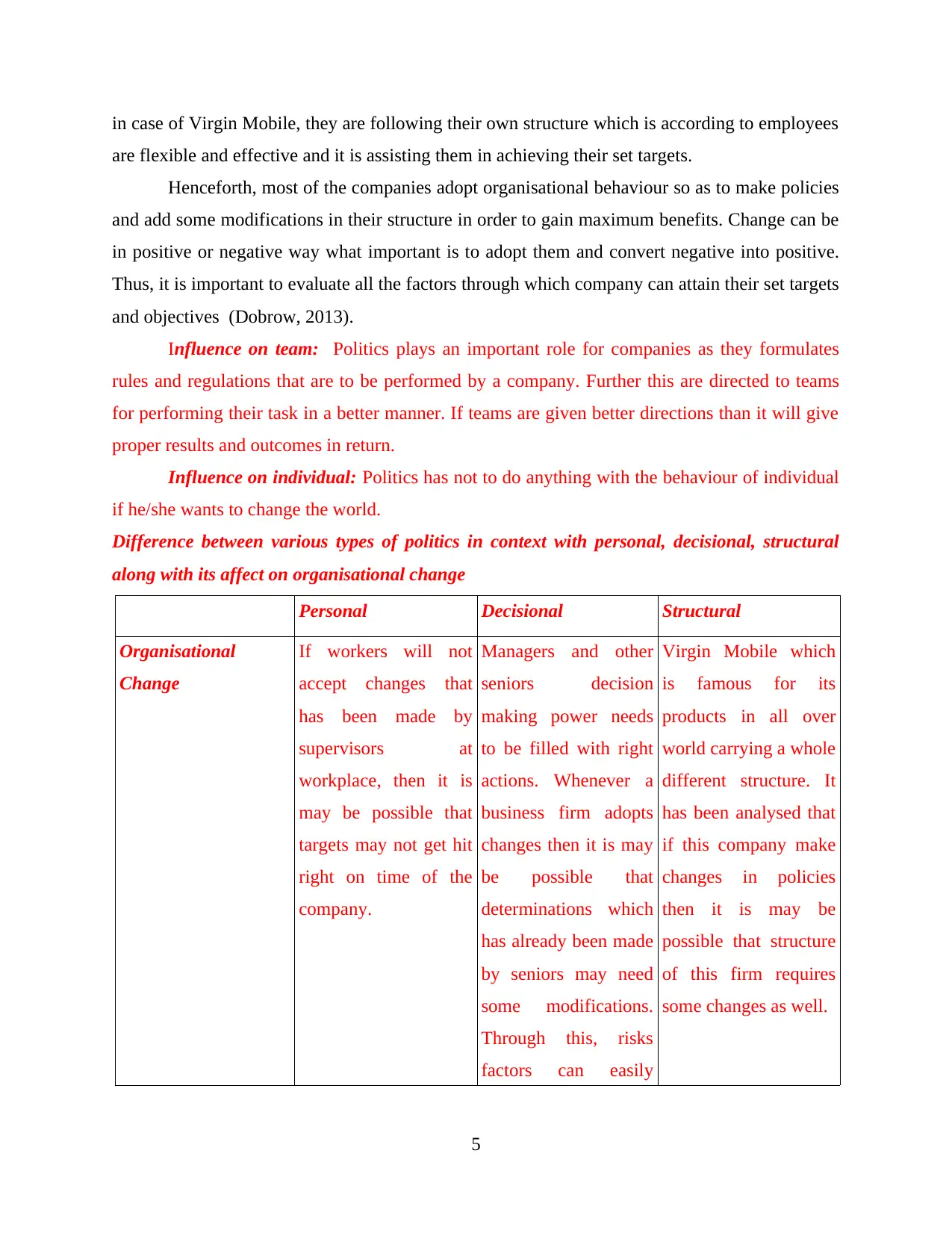
in case of Virgin Mobile, they are following their own structure which is according to employees
are flexible and effective and it is assisting them in achieving their set targets.
Henceforth, most of the companies adopt organisational behaviour so as to make policies
and add some modifications in their structure in order to gain maximum benefits. Change can be
in positive or negative way what important is to adopt them and convert negative into positive.
Thus, it is important to evaluate all the factors through which company can attain their set targets
and objectives (Dobrow, 2013).
Influence on team: Politics plays an important role for companies as they formulates
rules and regulations that are to be performed by a company. Further this are directed to teams
for performing their task in a better manner. If teams are given better directions than it will give
proper results and outcomes in return.
Influence on individual: Politics has not to do anything with the behaviour of individual
if he/she wants to change the world.
Difference between various types of politics in context with personal, decisional, structural
along with its affect on organisational change
Personal Decisional Structural
Organisational
Change
If workers will not
accept changes that
has been made by
supervisors at
workplace, then it is
may be possible that
targets may not get hit
right on time of the
company.
Managers and other
seniors decision
making power needs
to be filled with right
actions. Whenever a
business firm adopts
changes then it is may
be possible that
determinations which
has already been made
by seniors may need
some modifications.
Through this, risks
factors can easily
Virgin Mobile which
is famous for its
products in all over
world carrying a whole
different structure. It
has been analysed that
if this company make
changes in policies
then it is may be
possible that structure
of this firm requires
some changes as well.
5
are flexible and effective and it is assisting them in achieving their set targets.
Henceforth, most of the companies adopt organisational behaviour so as to make policies
and add some modifications in their structure in order to gain maximum benefits. Change can be
in positive or negative way what important is to adopt them and convert negative into positive.
Thus, it is important to evaluate all the factors through which company can attain their set targets
and objectives (Dobrow, 2013).
Influence on team: Politics plays an important role for companies as they formulates
rules and regulations that are to be performed by a company. Further this are directed to teams
for performing their task in a better manner. If teams are given better directions than it will give
proper results and outcomes in return.
Influence on individual: Politics has not to do anything with the behaviour of individual
if he/she wants to change the world.
Difference between various types of politics in context with personal, decisional, structural
along with its affect on organisational change
Personal Decisional Structural
Organisational
Change
If workers will not
accept changes that
has been made by
supervisors at
workplace, then it is
may be possible that
targets may not get hit
right on time of the
company.
Managers and other
seniors decision
making power needs
to be filled with right
actions. Whenever a
business firm adopts
changes then it is may
be possible that
determinations which
has already been made
by seniors may need
some modifications.
Through this, risks
factors can easily
Virgin Mobile which
is famous for its
products in all over
world carrying a whole
different structure. It
has been analysed that
if this company make
changes in policies
then it is may be
possible that structure
of this firm requires
some changes as well.
5

reduced to zero.
Influence of power
Power is essential for operating and managing the task effectively thus, it assist company
in performing the work in a systematic manner so that all the set targets and desired goals are
achieved. Basically, there are three aspects of power which are as per an individual, in a
relationship, used for making structure of a firm. Thus, all the three situations about how an
individual makes decisions by maintaining a healthy relation with the others. If it is not
maintained than it can have an adverse affect on company.
Henceforth, power is determined as relationship between two or more individual and both
affects the behaviour of each other. Thus, it is required that a company is headed by a person so
that he/she can manage entire operations. Although power assist the organisation in completing
the task in a proper way but if decision is not in favour of employees or an individual that it can
have an adverse effect and company's growth can go down (Hafenbrack, Kinias and Barsade,
2014). Basically, there are two types of power that are explained below:
Coercive power: Under this, whatever task is given to workers that have to perform by
the follower. It is considered as an improper use of power as employees can be against the same.
It creates threat over the minds of workers that if superiors have given some order than they have
to follow them at any cost.
Authority: Under this, all the roles and responsibilities that are given by superiors are
accepted by their subordinates as these are given under certain rules and norms that are
acceptable by employees.
Reward power: It helps an individual in increasing their ability with the help of
incentives that are provided to a person. This includes increment, salary, positive appraisals.
Legitimate power: This is considered as an positional power, that a person holds in a
company. Employees had to revert to their superiors like managers and superiors.
Expert power: Under this people who have knowledge are considered, they are valued
by organisation and call them for resolving any kind of problem company is facing.
6
Influence of power
Power is essential for operating and managing the task effectively thus, it assist company
in performing the work in a systematic manner so that all the set targets and desired goals are
achieved. Basically, there are three aspects of power which are as per an individual, in a
relationship, used for making structure of a firm. Thus, all the three situations about how an
individual makes decisions by maintaining a healthy relation with the others. If it is not
maintained than it can have an adverse affect on company.
Henceforth, power is determined as relationship between two or more individual and both
affects the behaviour of each other. Thus, it is required that a company is headed by a person so
that he/she can manage entire operations. Although power assist the organisation in completing
the task in a proper way but if decision is not in favour of employees or an individual that it can
have an adverse effect and company's growth can go down (Hafenbrack, Kinias and Barsade,
2014). Basically, there are two types of power that are explained below:
Coercive power: Under this, whatever task is given to workers that have to perform by
the follower. It is considered as an improper use of power as employees can be against the same.
It creates threat over the minds of workers that if superiors have given some order than they have
to follow them at any cost.
Authority: Under this, all the roles and responsibilities that are given by superiors are
accepted by their subordinates as these are given under certain rules and norms that are
acceptable by employees.
Reward power: It helps an individual in increasing their ability with the help of
incentives that are provided to a person. This includes increment, salary, positive appraisals.
Legitimate power: This is considered as an positional power, that a person holds in a
company. Employees had to revert to their superiors like managers and superiors.
Expert power: Under this people who have knowledge are considered, they are valued
by organisation and call them for resolving any kind of problem company is facing.
6
⊘ This is a preview!⊘
Do you want full access?
Subscribe today to unlock all pages.
Trusted by 1+ million students worldwide

Henceforth, from this, it has been evaluated that power is good if it is used for the
betterment of a company but excessive power can leads to generate chaos in entire process.
TASK 2
P2 Evaluation of content and process theories of motivation and motivational techniques
Management has develop strategies in order to established healthy working place with in
an organisation. Through this, firm are able to enhance employees satisfaction as well as loyalty
toward enterprise (Kim, Chang and Jae Ko, 2010). A part from this, there are several cultural
theories are available and administration has select best of one or many action of plan to help to
enhance working environment for their all staff member members. Some theories that adopt by
Virgin Mobile are explain as follows:
Intrinsic Motivation: This is done within the organisation, motivating employees by
giving internal rewards. For achieving this, an individual adopts different skills or change in
behaviour so that he/she can satisfy his/her own personal determination. Thus, it is applied by an
individual of its own in an organisation. Further in terms of Virgin Mobile they are using this
motivational technique for upgrading the skills and knowledge that are acquired by them.
Extrinsic Motivation: This is given to individuals which are external like grades, money,
appraisal and many more. It assist a person in motivating and encouraging them in attaining the
task in an effective manner (Knights and Willmott, 2016).
Content Theory: Content theory is a one best method to identify the reason behind
changing needs. In present market scenario, consumer needs have changes very fast due to
modification in working environment. This theory was introduce by Abraham Maslow and
David McClelleand. Through this explanation, enterprise are able to find out trend of
modification at work place resulted enhance employees satisfaction and increase performance.
Some important kinds of content theories are explain as follows:
Maslow's Need Hierarchy: It is a another need identification theory by which organisation are
able to analysis workers needs accordingly offer compensation, salary, bonus etc. to staff
members. In this model, Maslow's provide four kind of needs physical, safety & security, social,
self actualisation and self esteem and these are explained below.
7
betterment of a company but excessive power can leads to generate chaos in entire process.
TASK 2
P2 Evaluation of content and process theories of motivation and motivational techniques
Management has develop strategies in order to established healthy working place with in
an organisation. Through this, firm are able to enhance employees satisfaction as well as loyalty
toward enterprise (Kim, Chang and Jae Ko, 2010). A part from this, there are several cultural
theories are available and administration has select best of one or many action of plan to help to
enhance working environment for their all staff member members. Some theories that adopt by
Virgin Mobile are explain as follows:
Intrinsic Motivation: This is done within the organisation, motivating employees by
giving internal rewards. For achieving this, an individual adopts different skills or change in
behaviour so that he/she can satisfy his/her own personal determination. Thus, it is applied by an
individual of its own in an organisation. Further in terms of Virgin Mobile they are using this
motivational technique for upgrading the skills and knowledge that are acquired by them.
Extrinsic Motivation: This is given to individuals which are external like grades, money,
appraisal and many more. It assist a person in motivating and encouraging them in attaining the
task in an effective manner (Knights and Willmott, 2016).
Content Theory: Content theory is a one best method to identify the reason behind
changing needs. In present market scenario, consumer needs have changes very fast due to
modification in working environment. This theory was introduce by Abraham Maslow and
David McClelleand. Through this explanation, enterprise are able to find out trend of
modification at work place resulted enhance employees satisfaction and increase performance.
Some important kinds of content theories are explain as follows:
Maslow's Need Hierarchy: It is a another need identification theory by which organisation are
able to analysis workers needs accordingly offer compensation, salary, bonus etc. to staff
members. In this model, Maslow's provide four kind of needs physical, safety & security, social,
self actualisation and self esteem and these are explained below.
7
Paraphrase This Document
Need a fresh take? Get an instant paraphrase of this document with our AI Paraphraser

Psychological needs: This is considered as a basic need, individual needed some
requirement like food, cloths, house etc. with out full filling this need employees can not jump to
another, so that it is called primary need of Maslow's.
Safe and security: In this workers want to safe as well as secure their life, for this they
purchases insurance policies and many more. In third, each one individual wants social develop
like friends, family, relationship etc. through this, they are able to enjoy their life in long run
(LA, 2013).
Self actualisation: person needed more self centralized profitability like promotion,
transfers or any monitory as well as non monitory benefits thus help to increase their
satisfaction.
Self Esteem: It is related to prestige of person, they can not wants monitory benefits only
needed social image.
Herzberg's Motivation-hygiene Theory: Management of Virgin Mobile has implemented
motivational theories in order to increase their satisfaction and enhance performance as well as
productivity in long period of time effectively. Herzeberg's introduce two factor theory of
motivation. In this, they says, some hygiene factor are all ready available into work place so that
it is a management responsibilities to identify these motivational elements and enhance
individual motivation effectively (Llewellyn and Hindmarsh, 2010). But some time, they want
to develop policies and rule thus help to create these factors with in an organisation through this
they are capable to rise motivation appropriately.
Alderfer's ERG Theory: ERG has stand for Existence, Relatedness and growth. This
model was introduce by Layton Alderfer and they explain Maslow's hierarchy model in detail.
They are further divided it into three kinds growing, generating and connection needs.
Process Theory: This model explain how person has using their knowledge, skills,
capabilities etc. so they energise their behaviour effectively. In this covers various kind of factors
which are develop by an organisation in order to encourage and motivate all staff member
appropriately with in work place. Some model that used by Virgin Mobile are explain as follows:
Vroom's Expectancy theory: Vroom expectancy theory has explain individual has
perform according to their capabilities that task has depend on intensity of work and expectation
that directly related to performance. Through this, employees are able to achieve target in limited
period of time appropriately thus help to enhance performance in long period of time. It is a
8
requirement like food, cloths, house etc. with out full filling this need employees can not jump to
another, so that it is called primary need of Maslow's.
Safe and security: In this workers want to safe as well as secure their life, for this they
purchases insurance policies and many more. In third, each one individual wants social develop
like friends, family, relationship etc. through this, they are able to enjoy their life in long run
(LA, 2013).
Self actualisation: person needed more self centralized profitability like promotion,
transfers or any monitory as well as non monitory benefits thus help to increase their
satisfaction.
Self Esteem: It is related to prestige of person, they can not wants monitory benefits only
needed social image.
Herzberg's Motivation-hygiene Theory: Management of Virgin Mobile has implemented
motivational theories in order to increase their satisfaction and enhance performance as well as
productivity in long period of time effectively. Herzeberg's introduce two factor theory of
motivation. In this, they says, some hygiene factor are all ready available into work place so that
it is a management responsibilities to identify these motivational elements and enhance
individual motivation effectively (Llewellyn and Hindmarsh, 2010). But some time, they want
to develop policies and rule thus help to create these factors with in an organisation through this
they are capable to rise motivation appropriately.
Alderfer's ERG Theory: ERG has stand for Existence, Relatedness and growth. This
model was introduce by Layton Alderfer and they explain Maslow's hierarchy model in detail.
They are further divided it into three kinds growing, generating and connection needs.
Process Theory: This model explain how person has using their knowledge, skills,
capabilities etc. so they energise their behaviour effectively. In this covers various kind of factors
which are develop by an organisation in order to encourage and motivate all staff member
appropriately with in work place. Some model that used by Virgin Mobile are explain as follows:
Vroom's Expectancy theory: Vroom expectancy theory has explain individual has
perform according to their capabilities that task has depend on intensity of work and expectation
that directly related to performance. Through this, employees are able to achieve target in limited
period of time appropriately thus help to enhance performance in long period of time. It is a
8

person thinking about expected result of their performance that must be influenced elements like
skills, utilisation of resources, job role and many more.
Adam's Equity theory: According to this theory, person has compare their performance
with others individuals in order to identify gap between actual and desire performance
appropriately. It the others words, equity theory can be define as comparison between actual
efforts put by people to completing work appropriately and behalf of that according organisation
has distributed benefits among all staff members effectively (Misra and Puri, 2011).
Locke's theory: This theory was first published in the year 1968 in an article”Towards a
theory if Task Motivation and Incentives”. In this he has discussed about setting of set goals
through which can be achieved and further be used for motivating its employees and workers.
Both Locke's and Latham's gave five principles that includes clarity, challenge, commitment,
feedback and task complexity.
Structure by which Virgin Mobile has enhanced its level of motivation between all
staff members in order to achieve objectives:
Virgin Mobile has implemented various kind of motivational theories for their employees
with in an organisation. Through this activities, management are capable to increase self
confidence, moral, performance, productivity and many more.
TASK 3
P3 Process for making an effective team as an oppose to ineffective team
Belbin's Typology: In this kind of typology, company incorporates a particular language
in order to explain different types of roles within a team. Thus, the language that is adopted
provides a simplest way for communicating and explaining the task in an effective manner.
Although it has some sort of drawbacks but it is very effective and helpful for managing and
organising team so as to achieve the desired targets in speculated time frame (Nicholas,
Rowlands and Jamali, 2010).
For achieving the work in a given time frame it is essential that company have an
effective team. Therefore, it is essential that a leaders and managers monitor the performance of
individual on a regular basis so that they can assign the work according to the capabilities of a
person. Along with this, role of leaders are important as they motivate the entire team and squad
in such a manner so that goal can be accomplishes in a better manner. For this, leaders uses
9
skills, utilisation of resources, job role and many more.
Adam's Equity theory: According to this theory, person has compare their performance
with others individuals in order to identify gap between actual and desire performance
appropriately. It the others words, equity theory can be define as comparison between actual
efforts put by people to completing work appropriately and behalf of that according organisation
has distributed benefits among all staff members effectively (Misra and Puri, 2011).
Locke's theory: This theory was first published in the year 1968 in an article”Towards a
theory if Task Motivation and Incentives”. In this he has discussed about setting of set goals
through which can be achieved and further be used for motivating its employees and workers.
Both Locke's and Latham's gave five principles that includes clarity, challenge, commitment,
feedback and task complexity.
Structure by which Virgin Mobile has enhanced its level of motivation between all
staff members in order to achieve objectives:
Virgin Mobile has implemented various kind of motivational theories for their employees
with in an organisation. Through this activities, management are capable to increase self
confidence, moral, performance, productivity and many more.
TASK 3
P3 Process for making an effective team as an oppose to ineffective team
Belbin's Typology: In this kind of typology, company incorporates a particular language
in order to explain different types of roles within a team. Thus, the language that is adopted
provides a simplest way for communicating and explaining the task in an effective manner.
Although it has some sort of drawbacks but it is very effective and helpful for managing and
organising team so as to achieve the desired targets in speculated time frame (Nicholas,
Rowlands and Jamali, 2010).
For achieving the work in a given time frame it is essential that company have an
effective team. Therefore, it is essential that a leaders and managers monitor the performance of
individual on a regular basis so that they can assign the work according to the capabilities of a
person. Along with this, role of leaders are important as they motivate the entire team and squad
in such a manner so that goal can be accomplishes in a better manner. For this, leaders uses
9
⊘ This is a preview!⊘
Do you want full access?
Subscribe today to unlock all pages.
Trusted by 1+ million students worldwide

1 out of 18


Related Documents


Your All-in-One AI-Powered Toolkit for Academic Success.
+13062052269
info@desklib.com
Available 24*7 on WhatsApp / Email
![[object Object]](/_next/static/media/star-bottom.7253800d.svg)
Unlock your academic potential
Copyright © 2020–2026 A2Z Services. All Rights Reserved. Developed and managed by ZUCOL.