Analysing Change Management and Leadership in ASDA & Morrisons
VerifiedAdded on 2024/06/28
|15
|3976
|409
Report
AI Summary
This report investigates organisational change within ASDA and Morrisons, two leading UK supermarket chains. The first assignment focuses on the drivers and impacts of change, examining how it affects organisational strategy using PEST and SWOT analyses. It evaluates the effects of change on leadership, individuals, and team behavior, and assesses how the impact of change was minimised through appropriate models. The second assignment applies force field analysis to determine support and opposition to change, explains barriers to change and their influence on decision making, and evaluates the success of change implementation. The report also discusses the advantages and disadvantages of different leadership approaches to dealing with change, providing a comprehensive overview of change management strategies in a retail context. Desklib provides a platform for students to access similar past papers and solved assignments.
Investigating organisational
change
change

Paraphrase This Document
Need a fresh take? Get an instant paraphrase of this document with our AI Paraphraser
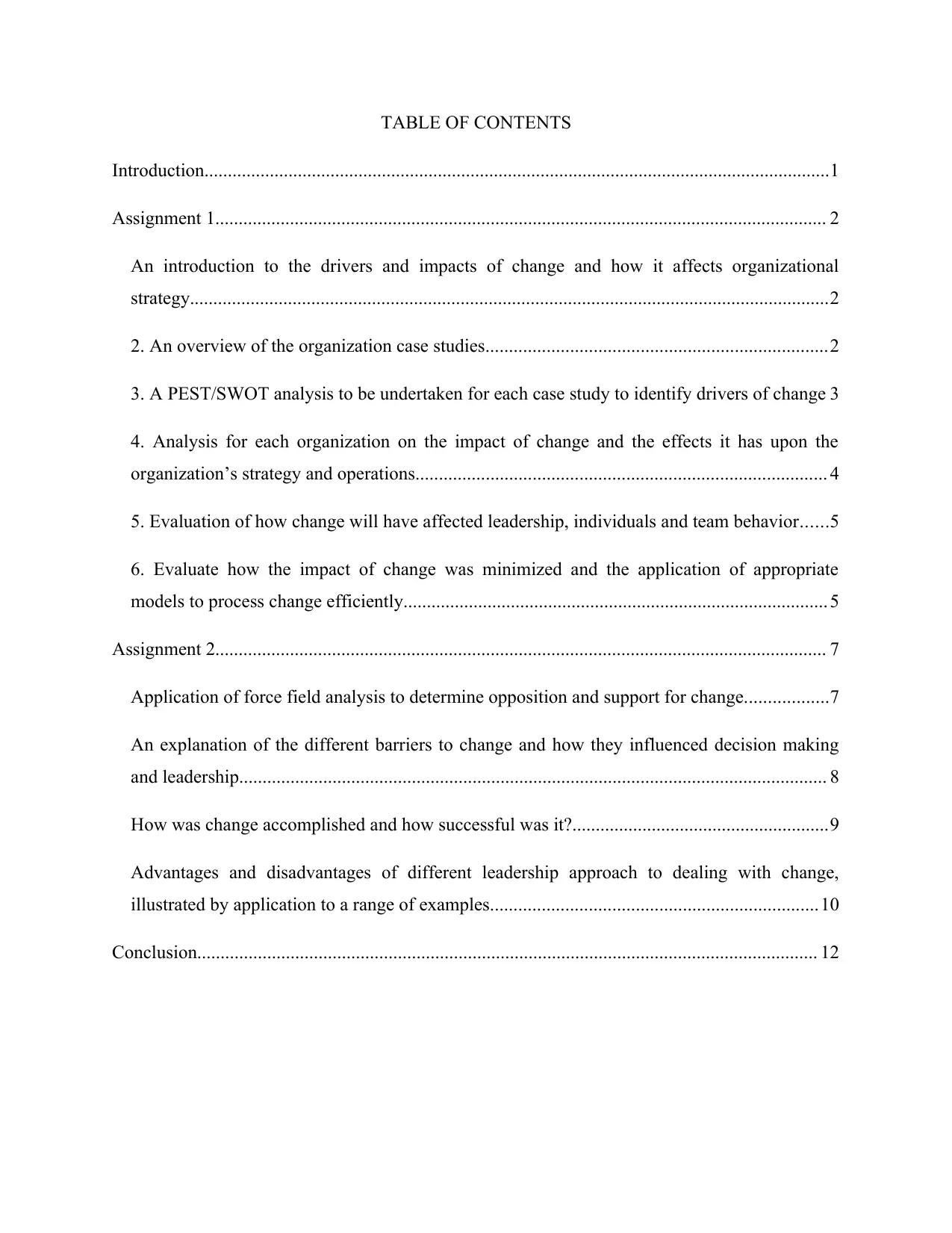
TABLE OF CONTENTS
Introduction......................................................................................................................................1
Assignment 1................................................................................................................................... 2
An introduction to the drivers and impacts of change and how it affects organizational
strategy.........................................................................................................................................2
2. An overview of the organization case studies.........................................................................2
3. A PEST/SWOT analysis to be undertaken for each case study to identify drivers of change 3
4. Analysis for each organization on the impact of change and the effects it has upon the
organization’s strategy and operations........................................................................................ 4
5. Evaluation of how change will have affected leadership, individuals and team behavior......5
6. Evaluate how the impact of change was minimized and the application of appropriate
models to process change efficiently........................................................................................... 5
Assignment 2................................................................................................................................... 7
Application of force field analysis to determine opposition and support for change..................7
An explanation of the different barriers to change and how they influenced decision making
and leadership.............................................................................................................................. 8
How was change accomplished and how successful was it?.......................................................9
Advantages and disadvantages of different leadership approach to dealing with change,
illustrated by application to a range of examples......................................................................10
Conclusion..................................................................................................................................... 12
Introduction......................................................................................................................................1
Assignment 1................................................................................................................................... 2
An introduction to the drivers and impacts of change and how it affects organizational
strategy.........................................................................................................................................2
2. An overview of the organization case studies.........................................................................2
3. A PEST/SWOT analysis to be undertaken for each case study to identify drivers of change 3
4. Analysis for each organization on the impact of change and the effects it has upon the
organization’s strategy and operations........................................................................................ 4
5. Evaluation of how change will have affected leadership, individuals and team behavior......5
6. Evaluate how the impact of change was minimized and the application of appropriate
models to process change efficiently........................................................................................... 5
Assignment 2................................................................................................................................... 7
Application of force field analysis to determine opposition and support for change..................7
An explanation of the different barriers to change and how they influenced decision making
and leadership.............................................................................................................................. 8
How was change accomplished and how successful was it?.......................................................9
Advantages and disadvantages of different leadership approach to dealing with change,
illustrated by application to a range of examples......................................................................10
Conclusion..................................................................................................................................... 12
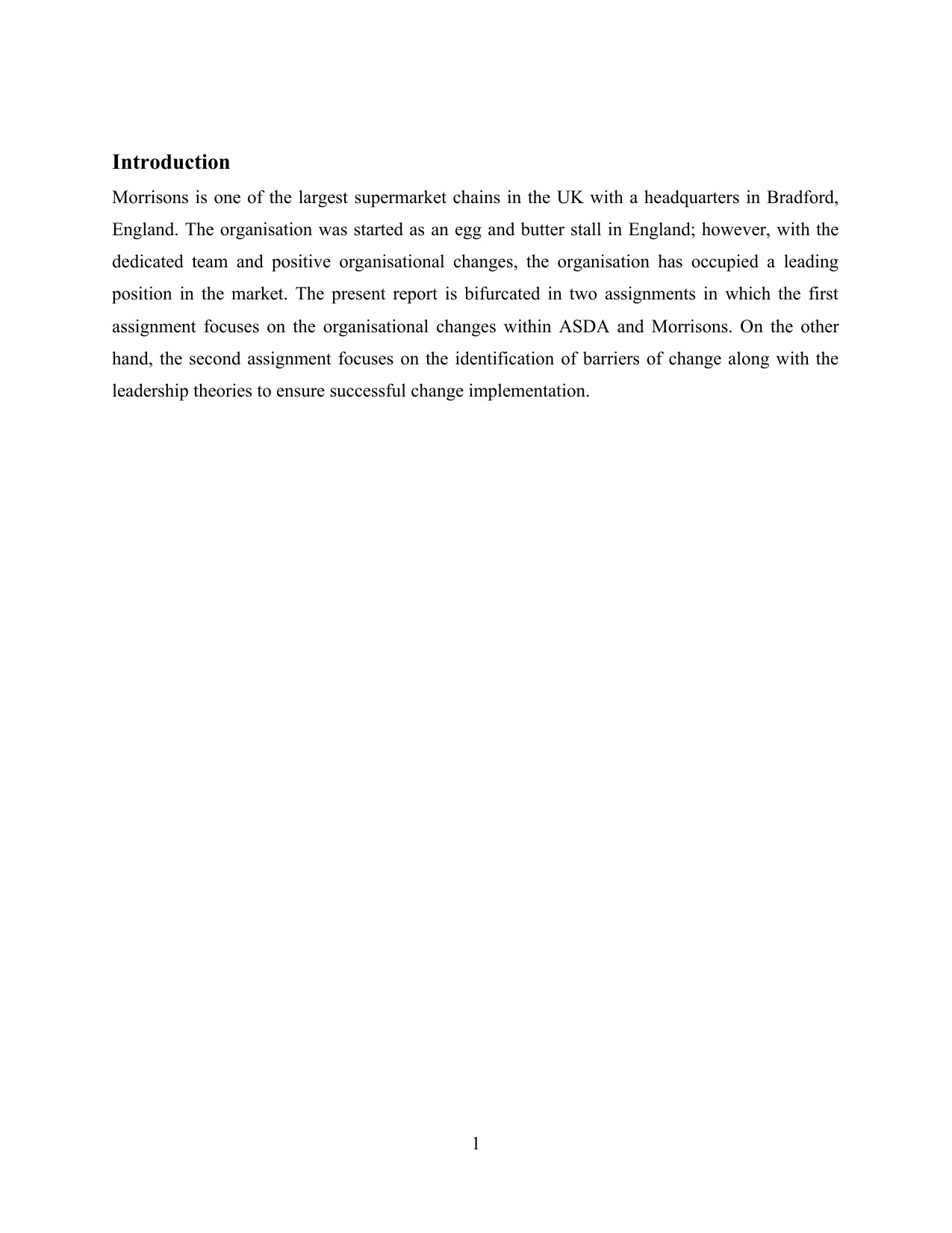
Introduction
Morrisons is one of the largest supermarket chains in the UK with a headquarters in Bradford,
England. The organisation was started as an egg and butter stall in England; however, with the
dedicated team and positive organisational changes, the organisation has occupied a leading
position in the market. The present report is bifurcated in two assignments in which the first
assignment focuses on the organisational changes within ASDA and Morrisons. On the other
hand, the second assignment focuses on the identification of barriers of change along with the
leadership theories to ensure successful change implementation.
1
Morrisons is one of the largest supermarket chains in the UK with a headquarters in Bradford,
England. The organisation was started as an egg and butter stall in England; however, with the
dedicated team and positive organisational changes, the organisation has occupied a leading
position in the market. The present report is bifurcated in two assignments in which the first
assignment focuses on the organisational changes within ASDA and Morrisons. On the other
hand, the second assignment focuses on the identification of barriers of change along with the
leadership theories to ensure successful change implementation.
1
⊘ This is a preview!⊘
Do you want full access?
Subscribe today to unlock all pages.

Trusted by 1+ million students worldwide
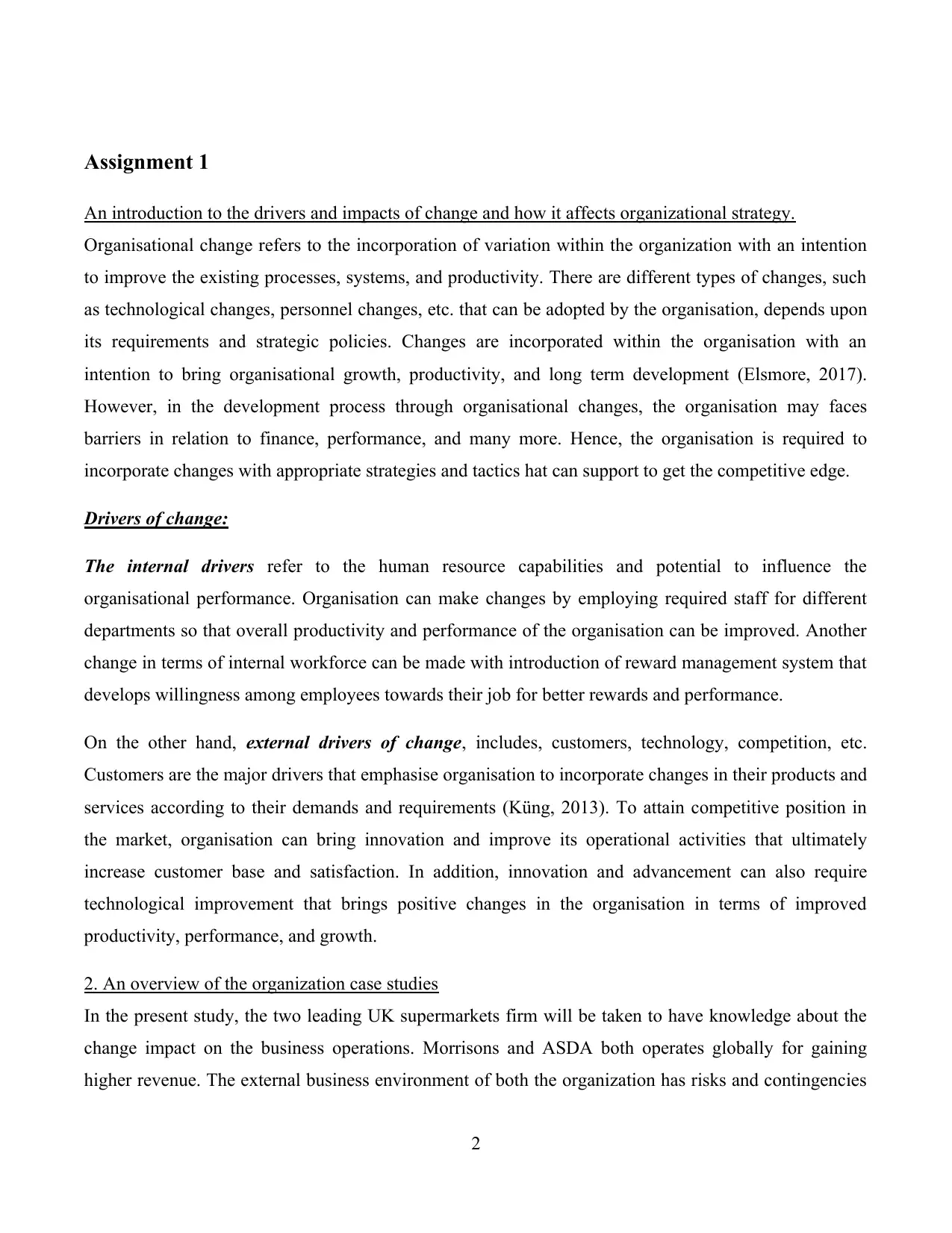
Assignment 1
An introduction to the drivers and impacts of change and how it affects organizational strategy.
Organisational change refers to the incorporation of variation within the organization with an intention
to improve the existing processes, systems, and productivity. There are different types of changes, such
as technological changes, personnel changes, etc. that can be adopted by the organisation, depends upon
its requirements and strategic policies. Changes are incorporated within the organisation with an
intention to bring organisational growth, productivity, and long term development (Elsmore, 2017).
However, in the development process through organisational changes, the organisation may faces
barriers in relation to finance, performance, and many more. Hence, the organisation is required to
incorporate changes with appropriate strategies and tactics hat can support to get the competitive edge.
Drivers of change:
The internal drivers refer to the human resource capabilities and potential to influence the
organisational performance. Organisation can make changes by employing required staff for different
departments so that overall productivity and performance of the organisation can be improved. Another
change in terms of internal workforce can be made with introduction of reward management system that
develops willingness among employees towards their job for better rewards and performance.
On the other hand, external drivers of change, includes, customers, technology, competition, etc.
Customers are the major drivers that emphasise organisation to incorporate changes in their products and
services according to their demands and requirements (Küng, 2013). To attain competitive position in
the market, organisation can bring innovation and improve its operational activities that ultimately
increase customer base and satisfaction. In addition, innovation and advancement can also require
technological improvement that brings positive changes in the organisation in terms of improved
productivity, performance, and growth.
2. An overview of the organization case studies
In the present study, the two leading UK supermarkets firm will be taken to have knowledge about the
change impact on the business operations. Morrisons and ASDA both operates globally for gaining
higher revenue. The external business environment of both the organization has risks and contingencies
2
An introduction to the drivers and impacts of change and how it affects organizational strategy.
Organisational change refers to the incorporation of variation within the organization with an intention
to improve the existing processes, systems, and productivity. There are different types of changes, such
as technological changes, personnel changes, etc. that can be adopted by the organisation, depends upon
its requirements and strategic policies. Changes are incorporated within the organisation with an
intention to bring organisational growth, productivity, and long term development (Elsmore, 2017).
However, in the development process through organisational changes, the organisation may faces
barriers in relation to finance, performance, and many more. Hence, the organisation is required to
incorporate changes with appropriate strategies and tactics hat can support to get the competitive edge.
Drivers of change:
The internal drivers refer to the human resource capabilities and potential to influence the
organisational performance. Organisation can make changes by employing required staff for different
departments so that overall productivity and performance of the organisation can be improved. Another
change in terms of internal workforce can be made with introduction of reward management system that
develops willingness among employees towards their job for better rewards and performance.
On the other hand, external drivers of change, includes, customers, technology, competition, etc.
Customers are the major drivers that emphasise organisation to incorporate changes in their products and
services according to their demands and requirements (Küng, 2013). To attain competitive position in
the market, organisation can bring innovation and improve its operational activities that ultimately
increase customer base and satisfaction. In addition, innovation and advancement can also require
technological improvement that brings positive changes in the organisation in terms of improved
productivity, performance, and growth.
2. An overview of the organization case studies
In the present study, the two leading UK supermarkets firm will be taken to have knowledge about the
change impact on the business operations. Morrisons and ASDA both operates globally for gaining
higher revenue. The external business environment of both the organization has risks and contingencies
2
Paraphrase This Document
Need a fresh take? Get an instant paraphrase of this document with our AI Paraphraser
and includes stiff competitive barrier that needs more planning and strong decision making strategies to
bring the change in the business and reduce the negative factors accordingly. Morrison’s wants to bring
the change in self check-ins and self check out system while ASDA needs to bring the change in HR
policies to retain the employee retention.
3. A PEST/SWOT analysis to be undertaken for each case study to identify drivers of change
PEST analysis for Morrisons
Political: The government laws and regulations also influence the change in the business. If government
brought strict regulations and laws the change needs arises. As the organization want to bring check-ins
and check out system, the laws related to security measures and health standards shall be overlook by
Morrisons to protect customers from any harm.
Economic: It is to be seen by the Morrisons brings positive impact on the country GDP as it will raise
the business income of the organization. The check-ins and check out system are costly and on this
concern, organization has to first consider the budget and raise the funds for this purpose. On this
context, the interest and inflation rate factor shall be considered (Aithal, 2017).
Social: For positive bring of change in the business of Morrisons, it is important that business involved
themselves in corporate social activities for common public and society. It is important to know to
organization that role of society is important in any business operation of business.
Technological: As the change entirely related to bringing the new technology to make automation for
the employees and to the customers that will benefit both the parties involved in transaction. Therefore,
technology adoption shall be secure and brings simplicity for customers (Aithal, 2017).
SWOT analysis for ASDA
Strength: As ASDA is the big MNC, it has large workforce of around 150, 000 employees over 500
outlets. Therefore, it is not possible to consider the need of each and every employee resulting into
turnover. But it can be overcome through using the strength of large workforce (Gürel and Tat, 2017).
Weakness: Its main weakness is that it has limited presence globally and due to this employee’s for their
self recognition switch the job. On this account, it can be seen that due to this weakness change is
needed.
3
bring the change in the business and reduce the negative factors accordingly. Morrison’s wants to bring
the change in self check-ins and self check out system while ASDA needs to bring the change in HR
policies to retain the employee retention.
3. A PEST/SWOT analysis to be undertaken for each case study to identify drivers of change
PEST analysis for Morrisons
Political: The government laws and regulations also influence the change in the business. If government
brought strict regulations and laws the change needs arises. As the organization want to bring check-ins
and check out system, the laws related to security measures and health standards shall be overlook by
Morrisons to protect customers from any harm.
Economic: It is to be seen by the Morrisons brings positive impact on the country GDP as it will raise
the business income of the organization. The check-ins and check out system are costly and on this
concern, organization has to first consider the budget and raise the funds for this purpose. On this
context, the interest and inflation rate factor shall be considered (Aithal, 2017).
Social: For positive bring of change in the business of Morrisons, it is important that business involved
themselves in corporate social activities for common public and society. It is important to know to
organization that role of society is important in any business operation of business.
Technological: As the change entirely related to bringing the new technology to make automation for
the employees and to the customers that will benefit both the parties involved in transaction. Therefore,
technology adoption shall be secure and brings simplicity for customers (Aithal, 2017).
SWOT analysis for ASDA
Strength: As ASDA is the big MNC, it has large workforce of around 150, 000 employees over 500
outlets. Therefore, it is not possible to consider the need of each and every employee resulting into
turnover. But it can be overcome through using the strength of large workforce (Gürel and Tat, 2017).
Weakness: Its main weakness is that it has limited presence globally and due to this employee’s for their
self recognition switch the job. On this account, it can be seen that due to this weakness change is
needed.
3
Opportunities: Opportunities such as expansion in newer segments can be effective to bring the change
of reducing the turnover as it supports in increasing the motivation and positive retention in business of
employees (Grant, 2016).
Threats: Low salary is the threat seen in ASDA and due to this employee retention does not take place.
The change will be positive only if the organization uses the strengths and opportunities to minimize
threat.
4. Analysis for each organization on the impact of change and the effects it has upon the organization’s
strategy and operations
For analysis the change impact, it is important that both the organizations adopt the change management
model that puts pressure on the organizations to take the management style and accordingly give
training to implement the change. The model called as Lewin’s change model can be explained in three
stages:-
Unfreeze: The employee faces generally the difficulty in taking the change and it is significant for the
top management to formulate the staff in such manner for taking the changes by both organizations in
ASDA and Morrisons. The use of training and communication should be done.
Change: At this stage, the change is carried out and it involves changes in implementing the important
areas. On this point, the various skills require effective leadership skills and decision making for
employees (Bartunek and Woodman, 2015). Morrison’s leaders need to give training to the employees
for check-ins and check out system.
Refreeze: This stage includes back on the stage at the place stabilization following change
implementation. ASDA employee to reduce the employee turnover can easily follow back the actual
routine and now being helpful with what they require to manage.
The changes mentioned will be positive impact on the business and on this concern technological
automation brings the work simple and easy. The customers will also remain satisfied with this new
technology. On the other side, ASDA will also lower down the employee turnover by bringing attractive
rewards and incentives. It will also improve team work and supports in providing the flexible working
practices so as to motivate the staffs (Cummings et.al. 2016). There will be important enhancement in
duties of the employee outcome in high performance.
4
of reducing the turnover as it supports in increasing the motivation and positive retention in business of
employees (Grant, 2016).
Threats: Low salary is the threat seen in ASDA and due to this employee retention does not take place.
The change will be positive only if the organization uses the strengths and opportunities to minimize
threat.
4. Analysis for each organization on the impact of change and the effects it has upon the organization’s
strategy and operations
For analysis the change impact, it is important that both the organizations adopt the change management
model that puts pressure on the organizations to take the management style and accordingly give
training to implement the change. The model called as Lewin’s change model can be explained in three
stages:-
Unfreeze: The employee faces generally the difficulty in taking the change and it is significant for the
top management to formulate the staff in such manner for taking the changes by both organizations in
ASDA and Morrisons. The use of training and communication should be done.
Change: At this stage, the change is carried out and it involves changes in implementing the important
areas. On this point, the various skills require effective leadership skills and decision making for
employees (Bartunek and Woodman, 2015). Morrison’s leaders need to give training to the employees
for check-ins and check out system.
Refreeze: This stage includes back on the stage at the place stabilization following change
implementation. ASDA employee to reduce the employee turnover can easily follow back the actual
routine and now being helpful with what they require to manage.
The changes mentioned will be positive impact on the business and on this concern technological
automation brings the work simple and easy. The customers will also remain satisfied with this new
technology. On the other side, ASDA will also lower down the employee turnover by bringing attractive
rewards and incentives. It will also improve team work and supports in providing the flexible working
practices so as to motivate the staffs (Cummings et.al. 2016). There will be important enhancement in
duties of the employee outcome in high performance.
4
⊘ This is a preview!⊘
Do you want full access?
Subscribe today to unlock all pages.
Trusted by 1+ million students worldwide
5. Evaluation of how change will have affected leadership, individuals and team behavior
In Morrisons, the change of bringing the new system to simplify the work of the employees in the
organization as their manual recording of bills will be eliminated. The individual employee will remain
positive as they explore the other areas of learning. The leaders will also see positive result in working
of the team that will ultimately meet the positive team behavior in the organization. On the other side,
ASDA employee turnover will be reduced as HR policies amended will bring positive impact on
leadership, individual and team behavior (Burke, 2017). The leaders will keep on motivating the
employees more and individual employee will show commitment towards the business. Positive HR
policies in ASDA will increase their competencies that supports in team working and collaboration to
bring any of the change in the business.
6. Evaluate how the impact of change was minimized and the application of appropriate models to
process change efficiently.
The change management model helps in serving the right learning for implementing the changes for
objectives meeting. On this concern, the use of Burke Litwin's change management model can be done
which is explained below:-
External environment: It includes factors in relation to competitors, suppliers etc that impacts the
performance of the business and working of firm. The manager needs important role in conducting the
market research to examine and bring improvements.
Leadership: The organization shall adopt useful leadership style so that business objectives can be met.
Mission and strategy: It helps in getting the customer and employee retention towards the business of
the organization.
Organization culture: The business culture supports in learning atmosphere so as to positive influence
on employee assessment (Bejinariu et.al. 2017).
Structure: The structure of the Morrison should be critical and shall include the entire important
department that can be categorized into sub department to bring the positive change at every level.
Individual values: The positive behavior and ethical values helps in positivity to formulate the change
in the business of Morrisons.
5
In Morrisons, the change of bringing the new system to simplify the work of the employees in the
organization as their manual recording of bills will be eliminated. The individual employee will remain
positive as they explore the other areas of learning. The leaders will also see positive result in working
of the team that will ultimately meet the positive team behavior in the organization. On the other side,
ASDA employee turnover will be reduced as HR policies amended will bring positive impact on
leadership, individual and team behavior (Burke, 2017). The leaders will keep on motivating the
employees more and individual employee will show commitment towards the business. Positive HR
policies in ASDA will increase their competencies that supports in team working and collaboration to
bring any of the change in the business.
6. Evaluate how the impact of change was minimized and the application of appropriate models to
process change efficiently.
The change management model helps in serving the right learning for implementing the changes for
objectives meeting. On this concern, the use of Burke Litwin's change management model can be done
which is explained below:-
External environment: It includes factors in relation to competitors, suppliers etc that impacts the
performance of the business and working of firm. The manager needs important role in conducting the
market research to examine and bring improvements.
Leadership: The organization shall adopt useful leadership style so that business objectives can be met.
Mission and strategy: It helps in getting the customer and employee retention towards the business of
the organization.
Organization culture: The business culture supports in learning atmosphere so as to positive influence
on employee assessment (Bejinariu et.al. 2017).
Structure: The structure of the Morrison should be critical and shall include the entire important
department that can be categorized into sub department to bring the positive change at every level.
Individual values: The positive behavior and ethical values helps in positivity to formulate the change
in the business of Morrisons.
5
Paraphrase This Document
Need a fresh take? Get an instant paraphrase of this document with our AI Paraphraser
Employee motivation: There are several tools and strategies that can be given to employees so that they
stay committed and perform highly (Stone, 2015). The high motivation encourages the employees to
achieve the targets as it will give successful positive satisfaction to the customers.
6
stay committed and perform highly (Stone, 2015). The high motivation encourages the employees to
achieve the targets as it will give successful positive satisfaction to the customers.
6
Assignment 2
Application of force field analysis to determine opposition and support for change.
The concept behind Force field analysis is that different circumstances can be maintained with
equilibrium between the resisting and driving forces. Hence, to incorporate changes within the
organisation successfully, the driving changes must be strengthened, and the resisting factors
must be weakened. The force field analysis is a strategic tool that supports the management of
Morrisons in introducing the technological changes in terms of the self-check ins and outs in its
different stores. The driving forces are those factors that support the leaders and managers in the
organisation in incorporating changes (Mitchell, 2013). For example, the enthusiastic working
environment and positive attitude of employees help the organisation in introducing new check-
ins and out facilities at different stores of Morrisons that ultimately facilitate in optimising the
operational and management cost of individual stores.
On the other hand, the restraining factors may include resistant employees, inoperative
processes, policies, and systems, negative behaviour, inefficient leaders, and insufficient skills
that act as a hindrance in making changes within Morrisons. Restraining factors are the obstacles
that discourage the implementation of new changes within Morrisons (Jones, 2013). For
example, if the technological changes at different Morrisons stores are incorporated by
inefficient leaders then there will be no employees engagement and no new working methods
will be developed that ultimately disturb the present organisational processes as well as
negatively impact the new change processes.
Possible Obstacles
Force field analysis is an important strategic instrument that helps the Morrisons in identifying
the change requirements to support the business objectives and organisational working
environment. This analysis is effective in determining the possible obstacles in implementing the
technological changes that support the management in making strategic decisions pertaining to
the elimination of obstacles (Hayes, 2018). Hence, to make positive changes for the sustainable
growth of Morrisons, it is essential to develop a team in which different members play different
roles in the change process. For example, to implement the technological changes within
7
Application of force field analysis to determine opposition and support for change.
The concept behind Force field analysis is that different circumstances can be maintained with
equilibrium between the resisting and driving forces. Hence, to incorporate changes within the
organisation successfully, the driving changes must be strengthened, and the resisting factors
must be weakened. The force field analysis is a strategic tool that supports the management of
Morrisons in introducing the technological changes in terms of the self-check ins and outs in its
different stores. The driving forces are those factors that support the leaders and managers in the
organisation in incorporating changes (Mitchell, 2013). For example, the enthusiastic working
environment and positive attitude of employees help the organisation in introducing new check-
ins and out facilities at different stores of Morrisons that ultimately facilitate in optimising the
operational and management cost of individual stores.
On the other hand, the restraining factors may include resistant employees, inoperative
processes, policies, and systems, negative behaviour, inefficient leaders, and insufficient skills
that act as a hindrance in making changes within Morrisons. Restraining factors are the obstacles
that discourage the implementation of new changes within Morrisons (Jones, 2013). For
example, if the technological changes at different Morrisons stores are incorporated by
inefficient leaders then there will be no employees engagement and no new working methods
will be developed that ultimately disturb the present organisational processes as well as
negatively impact the new change processes.
Possible Obstacles
Force field analysis is an important strategic instrument that helps the Morrisons in identifying
the change requirements to support the business objectives and organisational working
environment. This analysis is effective in determining the possible obstacles in implementing the
technological changes that support the management in making strategic decisions pertaining to
the elimination of obstacles (Hayes, 2018). Hence, to make positive changes for the sustainable
growth of Morrisons, it is essential to develop a team in which different members play different
roles in the change process. For example, to implement the technological changes within
7
⊘ This is a preview!⊘
Do you want full access?
Subscribe today to unlock all pages.
Trusted by 1+ million students worldwide
Morrisons, the team must include, senior managers, technical officers, internal stakeholders and
store managers.
An explanation of the different barriers to change and how they influenced decision making and
leadership.
The organisational change may not produce effective outcome due to various barriers caused due
to unorganised and unplanned processes within the organisational environment. Following are
different barriers that may hinder the successful implementation of Technological changes within
Morrisons:
Cultural diversities: Morrisons has employed more than 100,000 employees in its different
stores in the UK, and therefore, there is a blend of religions, beliefs, culture, castes, and values in
the organisational environment. Hence, there is a high probability that one employee does not
agree to others beliefs or values; hence, conflicts may arise among them (Lozano, 2013).
Therefore, the cultural diversities among the employees may negatively influence their working
performance and team-oriented spirit. This develops the barrier of resistance attitude among staff
towards any new changes within Morrisons.
Inefficient leaders: The commitment and dedication of leaders are essential in Morrisons to
incorporate check in and check out the system within the organisational stores. However, if
leaders do not take their responsibility seriously, then they will not be able to influence the
employees towards new changes within Morrisons positively (Alasadi, and Askary, 2014).
Hence, the success of technological changes may be doubtful for the Morrisons due to resisting
behaviour of staff.
Working culture: To incorporate new changes, require a positive and enthusiastic working
culture that nurtures the employees’ capability and boost the spirit of dedication and team
performance among them. However, the planning team at Morrisons in the technological
changes only focuses on the accomplishment of set targets and does not focus on the
development of a supportive working culture for the staff. Hence, even loyal and dedicated staffs
do not support the organisation in implementing changes.
8
store managers.
An explanation of the different barriers to change and how they influenced decision making and
leadership.
The organisational change may not produce effective outcome due to various barriers caused due
to unorganised and unplanned processes within the organisational environment. Following are
different barriers that may hinder the successful implementation of Technological changes within
Morrisons:
Cultural diversities: Morrisons has employed more than 100,000 employees in its different
stores in the UK, and therefore, there is a blend of religions, beliefs, culture, castes, and values in
the organisational environment. Hence, there is a high probability that one employee does not
agree to others beliefs or values; hence, conflicts may arise among them (Lozano, 2013).
Therefore, the cultural diversities among the employees may negatively influence their working
performance and team-oriented spirit. This develops the barrier of resistance attitude among staff
towards any new changes within Morrisons.
Inefficient leaders: The commitment and dedication of leaders are essential in Morrisons to
incorporate check in and check out the system within the organisational stores. However, if
leaders do not take their responsibility seriously, then they will not be able to influence the
employees towards new changes within Morrisons positively (Alasadi, and Askary, 2014).
Hence, the success of technological changes may be doubtful for the Morrisons due to resisting
behaviour of staff.
Working culture: To incorporate new changes, require a positive and enthusiastic working
culture that nurtures the employees’ capability and boost the spirit of dedication and team
performance among them. However, the planning team at Morrisons in the technological
changes only focuses on the accomplishment of set targets and does not focus on the
development of a supportive working culture for the staff. Hence, even loyal and dedicated staffs
do not support the organisation in implementing changes.
8
Paraphrase This Document
Need a fresh take? Get an instant paraphrase of this document with our AI Paraphraser
How was change accomplished and how successful was it?
The objective of technological changes in different stores of Morrisons is accomplished with the
help of the following phases:
Management of Morrisons has developed a sense of team spirit and willingness among
staff by developing a comfort level and engaging them in decisions making the process of
change.
In the next phase, a case for technological changes are established with the help of
customer satisfaction survey, customer feedback, and employee satisfaction survey, and
accordingly strategic plan is developed according to which all the activities will be
executed.
The next phase focuses on making communication strong at a different level in Morrisons
(Graetz et al., 2006). The proactive practices of management in communications leads to
minimisation of employees resistance and bind them with the organisation as they feel
that they are an integral part of the change process. The barriers to the change are
identified and discussed with the staff members by conducting periodical meetings and
seminars.
After determining the roles and responsibilities of different authorities and development
of change plan, a timeline is developed, and all the procedural steps are taken as per the
specified plan to implement changes. For example, the implementation of changes within
Morrisons required appropriate training to the employees to make them conversant with
new technological advancements at different stores.
The last phase of incorporating change is monitoring and control by the management of
Morrisons, which ensures that the actual outcome of the change is as per the target
standards set.
The above organisational procedure for technological advancement at Morrisons helps to achieve
the set objectives effectively and successfully (Crawford and Nahmias, 2010). It leads to
improvement in the customer services and satisfaction as the automatic services at the check-in
9
The objective of technological changes in different stores of Morrisons is accomplished with the
help of the following phases:
Management of Morrisons has developed a sense of team spirit and willingness among
staff by developing a comfort level and engaging them in decisions making the process of
change.
In the next phase, a case for technological changes are established with the help of
customer satisfaction survey, customer feedback, and employee satisfaction survey, and
accordingly strategic plan is developed according to which all the activities will be
executed.
The next phase focuses on making communication strong at a different level in Morrisons
(Graetz et al., 2006). The proactive practices of management in communications leads to
minimisation of employees resistance and bind them with the organisation as they feel
that they are an integral part of the change process. The barriers to the change are
identified and discussed with the staff members by conducting periodical meetings and
seminars.
After determining the roles and responsibilities of different authorities and development
of change plan, a timeline is developed, and all the procedural steps are taken as per the
specified plan to implement changes. For example, the implementation of changes within
Morrisons required appropriate training to the employees to make them conversant with
new technological advancements at different stores.
The last phase of incorporating change is monitoring and control by the management of
Morrisons, which ensures that the actual outcome of the change is as per the target
standards set.
The above organisational procedure for technological advancement at Morrisons helps to achieve
the set objectives effectively and successfully (Crawford and Nahmias, 2010). It leads to
improvement in the customer services and satisfaction as the automatic services at the check-in
9
and out points help them to save their precious time. In addition, the satisfaction of customers in
using new technology has lead to an increase in sales and Morrison's productivity.
Advantages and disadvantages of different leadership approach to dealing with change,
illustrated by application to a range of examples.
Trait Theory: This theory focuses on the improvement in the individual traits of leadership so
that the organisational goals can be effectively accomplished. For example, to incorporate
changes effectively within Morrisons, leaders are required to develop their intelligence,
competence, and be open to communicate and learning so that they can better motivate their
followers.
Advantages and disadvantages: The trait theory is beneficial for Morrisons in terms of
improving leadership qualities and efficiencies; however, this theory does not focus on the trait
improvement in the Morrisons staff (Yukl and Yukl, 2002).
Situational leadership theory: This theory specifies that different situations in the organisation
require leaders to adopt different leadership practices as the same practice cannot be applied in
all the situations. For example, for the accomplishment of short term goals, leaders must set
targets and deadlines for them and adopt task-oriented approach while dealing with the long term
goals and sustainable growth, leaders must adopt a relationship-oriented approach to improve
their capabilities.
Advantages and disadvantages: Situational leadership is beneficial in terms of recognising the
flexibility in the organisation and helps to develop a comfortable and healthy environment for the
employees. However, situational leadership focuses more on short term needs instead of long
term needs (Avolio et al., 2009).
10
using new technology has lead to an increase in sales and Morrison's productivity.
Advantages and disadvantages of different leadership approach to dealing with change,
illustrated by application to a range of examples.
Trait Theory: This theory focuses on the improvement in the individual traits of leadership so
that the organisational goals can be effectively accomplished. For example, to incorporate
changes effectively within Morrisons, leaders are required to develop their intelligence,
competence, and be open to communicate and learning so that they can better motivate their
followers.
Advantages and disadvantages: The trait theory is beneficial for Morrisons in terms of
improving leadership qualities and efficiencies; however, this theory does not focus on the trait
improvement in the Morrisons staff (Yukl and Yukl, 2002).
Situational leadership theory: This theory specifies that different situations in the organisation
require leaders to adopt different leadership practices as the same practice cannot be applied in
all the situations. For example, for the accomplishment of short term goals, leaders must set
targets and deadlines for them and adopt task-oriented approach while dealing with the long term
goals and sustainable growth, leaders must adopt a relationship-oriented approach to improve
their capabilities.
Advantages and disadvantages: Situational leadership is beneficial in terms of recognising the
flexibility in the organisation and helps to develop a comfortable and healthy environment for the
employees. However, situational leadership focuses more on short term needs instead of long
term needs (Avolio et al., 2009).
10
⊘ This is a preview!⊘
Do you want full access?
Subscribe today to unlock all pages.
Trusted by 1+ million students worldwide

1 out of 15


Related Documents


Your All-in-One AI-Powered Toolkit for Academic Success.
+13062052269
info@desklib.com
Available 24*7 on WhatsApp / Email
![[object Object]](/_next/static/media/star-bottom.7253800d.svg)
Unlock your academic potential
Copyright © 2020–2026 A2Z Services. All Rights Reserved. Developed and managed by ZUCOL.