Organisational Change Project Report: Land Rover's Analysis
VerifiedAdded on 2023/01/18
|13
|3844
|38
Report
AI Summary
This report presents an analysis of Land Rover's organizational change project, focusing on the importance of adapting to the modern business environment. The study begins with an introduction to Land Rover, a prominent British luxury car brand, and its global operations. It then delves into an internal and external analysis of the company, utilizing the SWOT framework to identify strengths, weaknesses, opportunities, and threats. The report highlights Land Rover's strong brand image and distribution network as strengths, while acknowledging counter-income maturation in rising markets and intense market competition as weaknesses and threats. Opportunities are identified in technological advancements and market expansion. The report reviews relevant literature on organizational change, including Kurt Lewin's Change Management Model and John Kotter's 8-Step Change Model. Finally, the report evaluates potential change strategies for Land Rover, emphasizing the need for adjustments in pricing, after-sales services, and the development of fuel-efficient vehicles to maintain a competitive edge in the automotive industry. The analysis underscores the significance of organizational change for Land Rover's future growth and success.
Organisational Change
Project
Project

Paraphrase This Document
Need a fresh take? Get an instant paraphrase of this document with our AI Paraphraser

⊘ This is a preview!⊘
Do you want full access?
Subscribe today to unlock all pages.

Trusted by 1+ million students worldwide
Introduction to the Organisation
The study aim to analysing the importance of organisational change that affects the
overall functioning of the firm. In today's modern business environment change is required as
change has direct influence over implementing business operations in effective manner. Land
Rover is a famous and well reputed British brand of four wheel drive cars which exclusively
provide premium and indulgence sport inferior transport. It is a large Auto-mobiles company
which operates at global level (Elsmore, 2017). The headquarter of the firm is in Whitley,
Coventry, United Kingdom, the company was found in the year of 1978 by the significant efforts
of British Leyland. The company was owned through the transnational car manufacturer Jaguar
Rover, that has been mainly attempted through the Tata Motors since the year of 2008. The
company mainly build Land Rovers in different countries like India, Brazil, Slovakia, China and
United Kingdom. The company is mainly concern over implementing changes that are arises,
thus adoption of suitable changes are required in the operations and products of the firm for the
purpose of achieving higher maturation and prosperity. This project comprise the study about
organisational change which is imperative in aiding the organisational operations in significant
direction to reaching at higher growth. In this internal and external analysis of the firm is being
executed to analyse the place where change is required within the work place (Harper, Randall
and Rouncefield, 2012). Therefore, suitable changes strategies are required to improve the
situation. In this appropriate recommendation has also been provided in respect to assisting the
business in right manner to gain profitability. In addition to this appropriate resources are
analysed to evaluation of identified suitable strategies at the end conclusion has been drawn in
which proper summary is being provided over the change which is significant for the growth and
success of the business.
Internal and External Analysis of the Organisation
SWOT analysis is conducting internal or external analysis of an organisation, thus it is a
plan of action which can be applied through Land Rover managers to conduct an effective
situational evaluation. Land Rover is one of the largest directional international luxury car
manufacturers that has begin its functions in the year of 1948 and is worked as the key market
leader in the UK. The ownership of the firm is in the hand of many owners likewise Leyland
Motor Corporation, Rover company, British Leyland and Ford motors, therefore, in the year of
1
The study aim to analysing the importance of organisational change that affects the
overall functioning of the firm. In today's modern business environment change is required as
change has direct influence over implementing business operations in effective manner. Land
Rover is a famous and well reputed British brand of four wheel drive cars which exclusively
provide premium and indulgence sport inferior transport. It is a large Auto-mobiles company
which operates at global level (Elsmore, 2017). The headquarter of the firm is in Whitley,
Coventry, United Kingdom, the company was found in the year of 1978 by the significant efforts
of British Leyland. The company was owned through the transnational car manufacturer Jaguar
Rover, that has been mainly attempted through the Tata Motors since the year of 2008. The
company mainly build Land Rovers in different countries like India, Brazil, Slovakia, China and
United Kingdom. The company is mainly concern over implementing changes that are arises,
thus adoption of suitable changes are required in the operations and products of the firm for the
purpose of achieving higher maturation and prosperity. This project comprise the study about
organisational change which is imperative in aiding the organisational operations in significant
direction to reaching at higher growth. In this internal and external analysis of the firm is being
executed to analyse the place where change is required within the work place (Harper, Randall
and Rouncefield, 2012). Therefore, suitable changes strategies are required to improve the
situation. In this appropriate recommendation has also been provided in respect to assisting the
business in right manner to gain profitability. In addition to this appropriate resources are
analysed to evaluation of identified suitable strategies at the end conclusion has been drawn in
which proper summary is being provided over the change which is significant for the growth and
success of the business.
Internal and External Analysis of the Organisation
SWOT analysis is conducting internal or external analysis of an organisation, thus it is a
plan of action which can be applied through Land Rover managers to conduct an effective
situational evaluation. Land Rover is one of the largest directional international luxury car
manufacturers that has begin its functions in the year of 1948 and is worked as the key market
leader in the UK. The ownership of the firm is in the hand of many owners likewise Leyland
Motor Corporation, Rover company, British Leyland and Ford motors, therefore, in the year of
1
Paraphrase This Document
Need a fresh take? Get an instant paraphrase of this document with our AI Paraphraser
2008 Tata Motors has been assisting its development at global level. SWOT Is the most
interactive aspects and needs appropriate collaboration within the segments in the business like
operations, marketing, finance, management information system, strategic planning etc. SWOT
is effective in analysing a companies intrinsic strategical aspects like strengths and weaknesses
and external strategic aspects like opportunities and threats (Waddell and et. al., 2019). The
detailed analysis of the SWOT is described as below:
Strengths of Land Rover- Internal Strategic Factor:
Strength of the firm is mainly determined as the key factor of internal analysis, therefore,
analysis of strength is effective in evaluating the core value of the business. Land Rover is
mainly considered as the key symbol in indulgence SUV's and transport medium has represented
huge strength and skilfulness around the globe in the large assortment of terrains and has won
various valuable honours and prises for its effective executions. The strength of the firm is
determined as below:
The biggest strength of Land Rover is the effective brand image, thus the strong brand of Jaguar
and Land Rover is substantiated through the parent company which is known as Tata Motors.
Therefore, the bushiness is being competitively moving ahead in right manner to provide
competition to its rivals.
In addition to this, the another strength of the firm is that, Land Rover has powerful base of
valuable providers of raw substantial which alter the business to address any supply chain
bottlenecks. The company is also having strong distribution network, passing through the years
the company is building an effective arrangement web which can attain relative quantity of its
significant commercial centre.
Weaknesses of Land Rover- Internal Strategic Factor:
Weaknesses are determined as the internal strategic factor which has direct impact over
the functioning of the firm. The key weakness of Land Rover is the counter income maturation
through the rising markets (Clegg and et. al., 2013). The premium segment auto-mobile
businesses are developing through the inherent significance of rising markets, therefore, Land
Rover has the destructive development rate in the emergent areas, thus the growth rate of Land
Rover is decreases in around 18% in the Asia Pacific region. Another weakness of the firm is the
higher available competition in the market, thus Land Rover has its major rivals are the Audi,
BMW and Mercedes Benz that create the commercial centre a fragmented market in the
2
interactive aspects and needs appropriate collaboration within the segments in the business like
operations, marketing, finance, management information system, strategic planning etc. SWOT
is effective in analysing a companies intrinsic strategical aspects like strengths and weaknesses
and external strategic aspects like opportunities and threats (Waddell and et. al., 2019). The
detailed analysis of the SWOT is described as below:
Strengths of Land Rover- Internal Strategic Factor:
Strength of the firm is mainly determined as the key factor of internal analysis, therefore,
analysis of strength is effective in evaluating the core value of the business. Land Rover is
mainly considered as the key symbol in indulgence SUV's and transport medium has represented
huge strength and skilfulness around the globe in the large assortment of terrains and has won
various valuable honours and prises for its effective executions. The strength of the firm is
determined as below:
The biggest strength of Land Rover is the effective brand image, thus the strong brand of Jaguar
and Land Rover is substantiated through the parent company which is known as Tata Motors.
Therefore, the bushiness is being competitively moving ahead in right manner to provide
competition to its rivals.
In addition to this, the another strength of the firm is that, Land Rover has powerful base of
valuable providers of raw substantial which alter the business to address any supply chain
bottlenecks. The company is also having strong distribution network, passing through the years
the company is building an effective arrangement web which can attain relative quantity of its
significant commercial centre.
Weaknesses of Land Rover- Internal Strategic Factor:
Weaknesses are determined as the internal strategic factor which has direct impact over
the functioning of the firm. The key weakness of Land Rover is the counter income maturation
through the rising markets (Clegg and et. al., 2013). The premium segment auto-mobile
businesses are developing through the inherent significance of rising markets, therefore, Land
Rover has the destructive development rate in the emergent areas, thus the growth rate of Land
Rover is decreases in around 18% in the Asia Pacific region. Another weakness of the firm is the
higher available competition in the market, thus Land Rover has its major rivals are the Audi,
BMW and Mercedes Benz that create the commercial centre a fragmented market in the
2
indulgence car area. Poor counter action on negative feedback and poor after sale services are the
key weakness of Land Rover, therefore, it is very much difficult for the customers to get services
of Land Rover in many countries other than UK, Which influence the intention of customers to
purchase Land Rover cars and this ca create risk for long term growth of firm.
Opportunities of Land Rover- External Strategic Factor:
Opportunities defined to those approach in the available situation which geographical
region the company on that it can gain benefit to develop its turning. The key opportunity of
Land Rover is the technology change around the globe that create value in developing the
necessity for self driven independent impulsive experience. Therefore, this develops opportunity
for Land Rover in providing luxury experience to their customers and this is beneficial for the
business in attaining potential progression and maturation. The another opportunities for Land
Rover is market expansion, thus entering markets such as BRIC and Asian nations may bring
development in the demand for luxury vehicles.
Threats of Land Rover- External Strategic Factor:
Threat is the factor of external analysis, thus it is recognised as the determinant which
restricts the growth of business. The key threat of Land Rover is the intense competition within
market. Therefore, the company has large players in the premium auto-mobile sector like BMW,
Audi, Mercedes Benz etc. and this has direct influence over the profitability and overall sales of
the firm (Bentley, 2017). Increasing fuel cost is the another threat for the auto-mobile business,
thus it makes it significantly essential aspect for the businesses to look at an alternative option
for saving fuel and decreasing cost.
For the execution of internal and external analysis of Land Rover, it has been determined
that, it is necessary for the firm to implement change in their pricing strategy for gaining
competitive advantage. Along with this, they have to implement changes within their after sales
services. As they have less service centre in various countries, so it is required for the firm to
introduce service centre to reduce the feedbacks from the customers regarding their after sales
services. Furthermore, due to high fuel cost, company also requires to develop innovation in
manufacturing energy efficiency cars that are effective in reducing the use of fuel.
Literature Review
According to the opinion analysis of Jenifer, 2018, The world has resist to change but yet
it is the only aspect which is effective in creating progress. Change is mainly represented either
3
key weakness of Land Rover, therefore, it is very much difficult for the customers to get services
of Land Rover in many countries other than UK, Which influence the intention of customers to
purchase Land Rover cars and this ca create risk for long term growth of firm.
Opportunities of Land Rover- External Strategic Factor:
Opportunities defined to those approach in the available situation which geographical
region the company on that it can gain benefit to develop its turning. The key opportunity of
Land Rover is the technology change around the globe that create value in developing the
necessity for self driven independent impulsive experience. Therefore, this develops opportunity
for Land Rover in providing luxury experience to their customers and this is beneficial for the
business in attaining potential progression and maturation. The another opportunities for Land
Rover is market expansion, thus entering markets such as BRIC and Asian nations may bring
development in the demand for luxury vehicles.
Threats of Land Rover- External Strategic Factor:
Threat is the factor of external analysis, thus it is recognised as the determinant which
restricts the growth of business. The key threat of Land Rover is the intense competition within
market. Therefore, the company has large players in the premium auto-mobile sector like BMW,
Audi, Mercedes Benz etc. and this has direct influence over the profitability and overall sales of
the firm (Bentley, 2017). Increasing fuel cost is the another threat for the auto-mobile business,
thus it makes it significantly essential aspect for the businesses to look at an alternative option
for saving fuel and decreasing cost.
For the execution of internal and external analysis of Land Rover, it has been determined
that, it is necessary for the firm to implement change in their pricing strategy for gaining
competitive advantage. Along with this, they have to implement changes within their after sales
services. As they have less service centre in various countries, so it is required for the firm to
introduce service centre to reduce the feedbacks from the customers regarding their after sales
services. Furthermore, due to high fuel cost, company also requires to develop innovation in
manufacturing energy efficiency cars that are effective in reducing the use of fuel.
Literature Review
According to the opinion analysis of Jenifer, 2018, The world has resist to change but yet
it is the only aspect which is effective in creating progress. Change is mainly represented either
3
⊘ This is a preview!⊘
Do you want full access?
Subscribe today to unlock all pages.
Trusted by 1+ million students worldwide
developing the effectiveness or even to adapt to exterior changes. Organisational change mainly
demands for a transformation in the behaviour of employees (Sinha, 2015). The implementation
of change can be analysed via the analysis of different theories of organisational change, that are
associated as under:
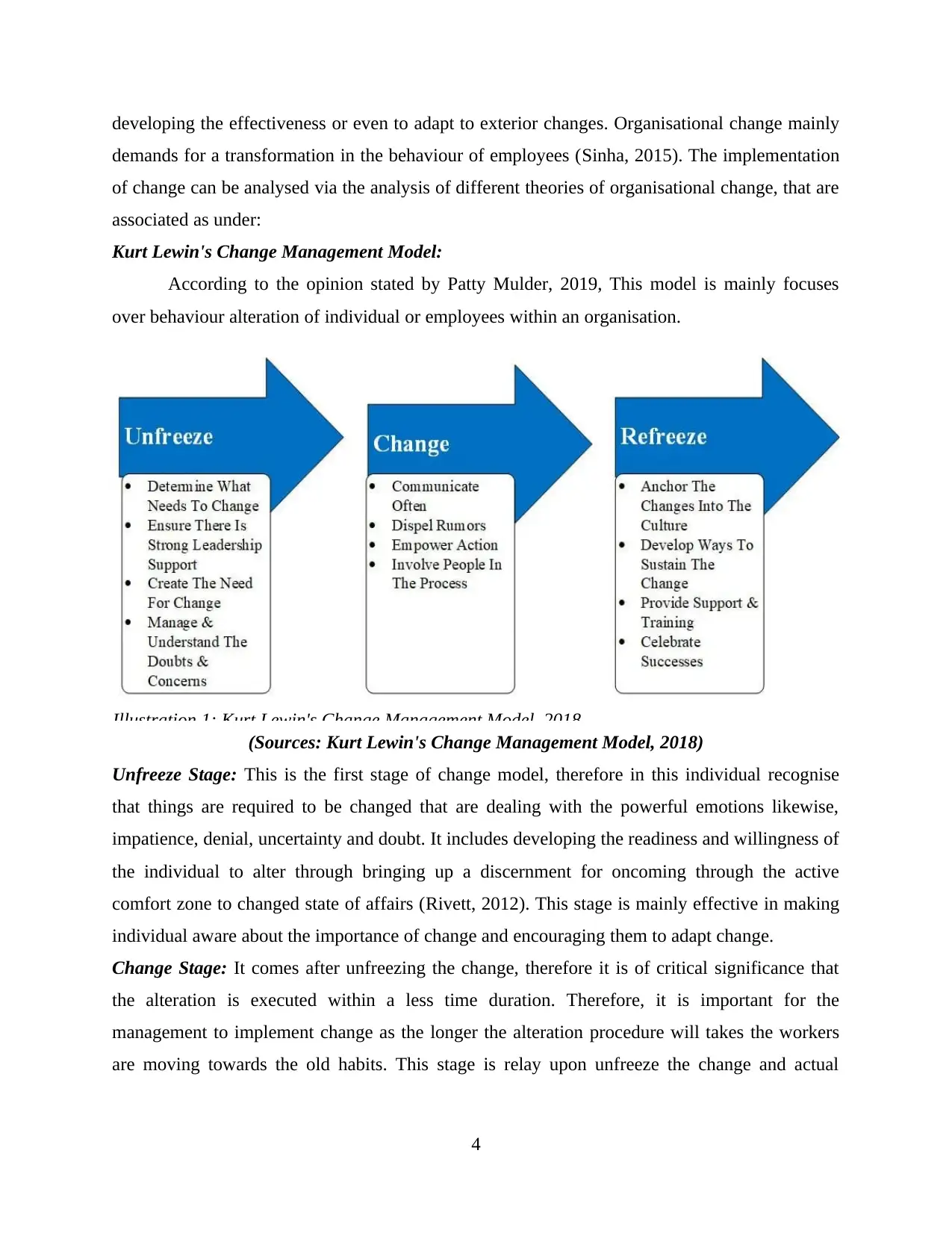
Kurt Lewin's Change Management Model:
According to the opinion stated by Patty Mulder, 2019, This model is mainly focuses
over behaviour alteration of individual or employees within an organisation.
(Sources: Kurt Lewin's Change Management Model, 2018)
Unfreeze Stage: This is the first stage of change model, therefore in this individual recognise
that things are required to be changed that are dealing with the powerful emotions likewise,
impatience, denial, uncertainty and doubt. It includes developing the readiness and willingness of
the individual to alter through bringing up a discernment for oncoming through the active
comfort zone to changed state of affairs (Rivett, 2012). This stage is mainly effective in making
individual aware about the importance of change and encouraging them to adapt change.
Change Stage: It comes after unfreezing the change, therefore it is of critical significance that
the alteration is executed within a less time duration. Therefore, it is important for the
management to implement change as the longer the alteration procedure will takes the workers
are moving towards the old habits. This stage is relay upon unfreeze the change and actual
4
Illustration 1: Kurt Lewin's Change Management Model, 2018.
demands for a transformation in the behaviour of employees (Sinha, 2015). The implementation
of change can be analysed via the analysis of different theories of organisational change, that are
associated as under:
Kurt Lewin's Change Management Model:
According to the opinion stated by Patty Mulder, 2019, This model is mainly focuses
over behaviour alteration of individual or employees within an organisation.
(Sources: Kurt Lewin's Change Management Model, 2018)
Unfreeze Stage: This is the first stage of change model, therefore in this individual recognise
that things are required to be changed that are dealing with the powerful emotions likewise,
impatience, denial, uncertainty and doubt. It includes developing the readiness and willingness of
the individual to alter through bringing up a discernment for oncoming through the active
comfort zone to changed state of affairs (Rivett, 2012). This stage is mainly effective in making
individual aware about the importance of change and encouraging them to adapt change.
Change Stage: It comes after unfreezing the change, therefore it is of critical significance that
the alteration is executed within a less time duration. Therefore, it is important for the
management to implement change as the longer the alteration procedure will takes the workers
are moving towards the old habits. This stage is relay upon unfreeze the change and actual
4
Illustration 1: Kurt Lewin's Change Management Model, 2018.
Paraphrase This Document
Need a fresh take? Get an instant paraphrase of this document with our AI Paraphraser
changes is executed. Therefore, this stage includes planning, appropriate abstraction and
motivating the participation of people for support the alteration.
Refreeze Stage: This stage is effective in refreeze the change (Thun and Hoenig, 2011). Refreeze
stage comes later the modification has been executed in the alteration segment, thus employees
are needs to revert to their old habits. In this stage, individual accepts or interior the fresh path of
employed and accept it as a part of life.
John Kotter's 8-Step Change Model
As per the opinion stated by Sherrl Hortzell, 2018, This model is effective in executing
organisational change. This model is encompasses over 8 staged which are described as under:
Establish a sense of urgency: This stage is effective in analysing the market and present
competitive realities. Therefore, it mainly helps others to see the requirement of change with the
support of opportunities.
Form a powerful coalition: In this management is requires to convince their employees about
the necessity of the change. This mainly takes help from the strong leadership style and proper
management skills to encourage others.
Create a Vision: In this a clear vision has been implemented to provide proper assistance to the
individual's to adopt changes (Baxter and Malak, 2013).
Communicating the Vision: After implementation of vision, management has requires to
communicate the vision within the organisation as to making people aware about the
determinates of success.
Empowering others to act on the vision: In this stage it is important for the business to
guarantee that the business procedure and constitution are in property and straight with the whole
business vision.
Planning for and creating short term wins: This stages is effective in providing direction to the
organisation to implementing short term targets instead of developing long term objectives,
therefore, it is easy for the businesses to attain short term objectives in effective manner.
Consolidating improvements and producing still more change: This stage is relay upon
attaining rapid growth through determining the success stories separately and developing
individual experience from them.
Institutionalising new approaches: In this stage development of effective connection can be
implemented among new behaviour and corporate success of business (Clegg and et. al., 2013).
5
motivating the participation of people for support the alteration.
Refreeze Stage: This stage is effective in refreeze the change (Thun and Hoenig, 2011). Refreeze
stage comes later the modification has been executed in the alteration segment, thus employees
are needs to revert to their old habits. In this stage, individual accepts or interior the fresh path of
employed and accept it as a part of life.
John Kotter's 8-Step Change Model
As per the opinion stated by Sherrl Hortzell, 2018, This model is effective in executing
organisational change. This model is encompasses over 8 staged which are described as under:
Establish a sense of urgency: This stage is effective in analysing the market and present
competitive realities. Therefore, it mainly helps others to see the requirement of change with the
support of opportunities.
Form a powerful coalition: In this management is requires to convince their employees about
the necessity of the change. This mainly takes help from the strong leadership style and proper
management skills to encourage others.
Create a Vision: In this a clear vision has been implemented to provide proper assistance to the
individual's to adopt changes (Baxter and Malak, 2013).
Communicating the Vision: After implementation of vision, management has requires to
communicate the vision within the organisation as to making people aware about the
determinates of success.
Empowering others to act on the vision: In this stage it is important for the business to
guarantee that the business procedure and constitution are in property and straight with the whole
business vision.
Planning for and creating short term wins: This stages is effective in providing direction to the
organisation to implementing short term targets instead of developing long term objectives,
therefore, it is easy for the businesses to attain short term objectives in effective manner.
Consolidating improvements and producing still more change: This stage is relay upon
attaining rapid growth through determining the success stories separately and developing
individual experience from them.
Institutionalising new approaches: In this stage development of effective connection can be
implemented among new behaviour and corporate success of business (Clegg and et. al., 2013).
5
Evaluation of possible change strategies required to improve the situation 500
In the today's automotive industry contest within commercial centre is advanced,
therefore, businesses are focuses over implementing change that are importance for the business
in attaining growth and success. In the organisational context, changes strategies are required to
improve the situations, therefore, Kurt Lewin's Change Management Model and John Kotter's 8-
Step Change Model are the effective model of organisational change.
Kurt Lewin's Change Management Model can be effectively executed by Land Rover in
executing changes within the operations of the firm, therefore, this model is effective in changing
the habits and behaviour of employees at work place. This model is based on three different
stages and first stage can provide benefit to Land Rover in creating awareness about the change
within the employees and unfreezing the old strategies on which the working of firm is based. In
the next stage, the management of Land Rover, can implement effective strategy, instance
company is based on high pricing strategy, so it is important for the firm to develop new strategy
related with effective pricing as to making organisational products affordable for the middle
class people (Serrano and et. al., 2014). Therefore, this stage can provide benefit to the firm in
executing the appropriate change strategy which is effective for the firm in attaining growth. At
the end stage, employees are assisted towards implementing new strategies and unfreeze the old
one. This is an efficacious model that create benefit for the business in executing change.
In addition to this, John Kotter's 8-Step Change Model, can also be effective for Land
Rover in benefiting them to adapt changes that are required on some situations, that are hamper
the performance and productivity of the firm. This model is based on 8 stages that are effective
for an organisation in implementing changes in more liable manner. This model is mainly
encompasses over the situations that are occurs instantly, therefore, in this urgency is created in
which requirement of implementing change is high, at the next stage it is important for the
businesses to developing trust among the employees regarding the importance of the change and
this model provide assistance via building vision which interconnected with the targets of the
business. At the next stage, management of Land Rover needs to concern over communicating
the vision among the employees as to guiding them towards attaining success. After
implementation of vision it is important for the businesses to remove issues and conflicts that
resists the change at work place. After that, business requires to categorised the long term
objectives within short operations in respect to effectively completion of work (Doyle and
6
In the today's automotive industry contest within commercial centre is advanced,
therefore, businesses are focuses over implementing change that are importance for the business
in attaining growth and success. In the organisational context, changes strategies are required to
improve the situations, therefore, Kurt Lewin's Change Management Model and John Kotter's 8-
Step Change Model are the effective model of organisational change.
Kurt Lewin's Change Management Model can be effectively executed by Land Rover in
executing changes within the operations of the firm, therefore, this model is effective in changing
the habits and behaviour of employees at work place. This model is based on three different
stages and first stage can provide benefit to Land Rover in creating awareness about the change
within the employees and unfreezing the old strategies on which the working of firm is based. In
the next stage, the management of Land Rover, can implement effective strategy, instance
company is based on high pricing strategy, so it is important for the firm to develop new strategy
related with effective pricing as to making organisational products affordable for the middle
class people (Serrano and et. al., 2014). Therefore, this stage can provide benefit to the firm in
executing the appropriate change strategy which is effective for the firm in attaining growth. At
the end stage, employees are assisted towards implementing new strategies and unfreeze the old
one. This is an efficacious model that create benefit for the business in executing change.
In addition to this, John Kotter's 8-Step Change Model, can also be effective for Land
Rover in benefiting them to adapt changes that are required on some situations, that are hamper
the performance and productivity of the firm. This model is based on 8 stages that are effective
for an organisation in implementing changes in more liable manner. This model is mainly
encompasses over the situations that are occurs instantly, therefore, in this urgency is created in
which requirement of implementing change is high, at the next stage it is important for the
businesses to developing trust among the employees regarding the importance of the change and
this model provide assistance via building vision which interconnected with the targets of the
business. At the next stage, management of Land Rover needs to concern over communicating
the vision among the employees as to guiding them towards attaining success. After
implementation of vision it is important for the businesses to remove issues and conflicts that
resists the change at work place. After that, business requires to categorised the long term
objectives within short operations in respect to effectively completion of work (Doyle and
6
⊘ This is a preview!⊘
Do you want full access?
Subscribe today to unlock all pages.
Trusted by 1+ million students worldwide
Bridgewater, 2012). At the end suitable relationship among employees behaviour and corporate
success is being executed.
From the above discussion it has been analysed that Kurt Lewin's Change Management
Model is the most suitable way for Land Rover which could be effective in implementing
changes that are essential for the business in achieving growth and success.
Recommendation
The present study is based on analysing the importance of implementing change that are
important for the business in achieving growth and success. From the detailed evaluation of the
project it has been recommended to Land Rover that, Kurt Lewin's Change Management Model,
is the best suitable approach of change, therefore, it is effective for the wider operations of Land
Rover. Therefore, Kurt Lewin's Change Management Model, is benefited for Land Rover in
terms of implementing changes in the organisational processes, thus Land Rover is a large
manufacturing unit of luxury cars and the company is operations all around the world. The
company has requirements to change their strategies, for instance: company is work on premium
pricing which is not affordable for each individual, so company should make changes in their
pricing policies with the support of Kurt Lewin's Change Management Model, therefore, this
model is effective in firstly unfreezing the premium pricing strategy and that change it into
effective pricing strategy and than refreeze it within the work place. It has also been
recommended to Land Rover, that company should also develop their services stores in multiple
region of areas where the demand of companies cars are higher, therefore, it will be effective for
the firm in attaining higher growth via providing effective after sales services to the customers.
From the analysis of the project, it has also been recommended to Land Rover, that, due to high
fuel cost company should also introduce vehicles which are based on energy or electricity,
therefore this is effectual in saving the cost of fuel and affordable by others.
Resources for implementing the suitable strategies
Land Rover is a large British auto-mobile company, which has its global operations and
the key motive of the firm is to attaining growth and success via fulfilling the desires of the
customers at market place. For better implementation of the strategies, company requires
multiple sources, which are associated as under:
7
success is being executed.
From the above discussion it has been analysed that Kurt Lewin's Change Management
Model is the most suitable way for Land Rover which could be effective in implementing
changes that are essential for the business in achieving growth and success.
Recommendation
The present study is based on analysing the importance of implementing change that are
important for the business in achieving growth and success. From the detailed evaluation of the
project it has been recommended to Land Rover that, Kurt Lewin's Change Management Model,
is the best suitable approach of change, therefore, it is effective for the wider operations of Land
Rover. Therefore, Kurt Lewin's Change Management Model, is benefited for Land Rover in
terms of implementing changes in the organisational processes, thus Land Rover is a large
manufacturing unit of luxury cars and the company is operations all around the world. The
company has requirements to change their strategies, for instance: company is work on premium
pricing which is not affordable for each individual, so company should make changes in their
pricing policies with the support of Kurt Lewin's Change Management Model, therefore, this
model is effective in firstly unfreezing the premium pricing strategy and that change it into
effective pricing strategy and than refreeze it within the work place. It has also been
recommended to Land Rover, that company should also develop their services stores in multiple
region of areas where the demand of companies cars are higher, therefore, it will be effective for
the firm in attaining higher growth via providing effective after sales services to the customers.
From the analysis of the project, it has also been recommended to Land Rover, that, due to high
fuel cost company should also introduce vehicles which are based on energy or electricity,
therefore this is effectual in saving the cost of fuel and affordable by others.
Resources for implementing the suitable strategies
Land Rover is a large British auto-mobile company, which has its global operations and
the key motive of the firm is to attaining growth and success via fulfilling the desires of the
customers at market place. For better implementation of the strategies, company requires
multiple sources, which are associated as under:
7
Paraphrase This Document
Need a fresh take? Get an instant paraphrase of this document with our AI Paraphraser
Technology: This is the major requirement for Land Rover as to bring advancement in their
operations, therefore, it is important for the firm or its management to analyse the requirement of
advance technology and adopt the change in the technologies for the purpose of attaining higher
growth and success at market place. Land Rover should implement technologies that are
effective in terms of developing energy, electricity and gas based vehicles (Radwan, 2018).
Human Resources: This is also another key consideration for Land Rover in the implementation
of new strategies, therefore, it is important for the management of Land Rover in hiring talented
workforces which are effectual in providing benefits to the firm in terms of implementing the
advancement in technology or accepts the change in effective manner. As a large business
organisation, Land Rover also needs to taking advice from the experts or higher authorities in
respect to taking appropriate decision in regards to the change which is essential for the business.
Physical Resources: It is also important for Land Rover to make proper arrangement of physical
resources which involves, machinery, raw material, efficient work forces, suitable manufacturing
units etc. Thus the availability of resources are essential for better execution of strategies in
effective manner. For instance: as per the recommendation provided to the Land Rover regards
energy efficient cars, company should make proper arrangement of machinery, car equipments
that are important to build cars that are based on energy.
Conclusion
From the detained analysis of the project it has been concluded that change is important
for each business to gain progress, therefore, it is important for the businesses to make changes
within their operations where changes are required, thus this is effective in developing
organisational performance at market place. The analysis of this particular project states that, in
the modern business environment, technology has increases at rapid basis, therefore, it is
essential for the businesses to implement changes and adopt advancement in their technologies
for betterment of organisational operations and functions.
8
operations, therefore, it is important for the firm or its management to analyse the requirement of
advance technology and adopt the change in the technologies for the purpose of attaining higher
growth and success at market place. Land Rover should implement technologies that are
effective in terms of developing energy, electricity and gas based vehicles (Radwan, 2018).
Human Resources: This is also another key consideration for Land Rover in the implementation
of new strategies, therefore, it is important for the management of Land Rover in hiring talented
workforces which are effectual in providing benefits to the firm in terms of implementing the
advancement in technology or accepts the change in effective manner. As a large business
organisation, Land Rover also needs to taking advice from the experts or higher authorities in
respect to taking appropriate decision in regards to the change which is essential for the business.
Physical Resources: It is also important for Land Rover to make proper arrangement of physical
resources which involves, machinery, raw material, efficient work forces, suitable manufacturing
units etc. Thus the availability of resources are essential for better execution of strategies in
effective manner. For instance: as per the recommendation provided to the Land Rover regards
energy efficient cars, company should make proper arrangement of machinery, car equipments
that are important to build cars that are based on energy.
Conclusion
From the detained analysis of the project it has been concluded that change is important
for each business to gain progress, therefore, it is important for the businesses to make changes
within their operations where changes are required, thus this is effective in developing
organisational performance at market place. The analysis of this particular project states that, in
the modern business environment, technology has increases at rapid basis, therefore, it is
essential for the businesses to implement changes and adopt advancement in their technologies
for betterment of organisational operations and functions.
8
References
Books and Journals
Baxter, B. and Malak, R., 2013, August. Increasing System Robustness Through a Utility-Based
Analysis. In ASME 2013 International Design Engineering Technical Conferences and
Computers and Information in Engineering Conference. American Society of
Mechanical Engineers Digital Collection.
Bentley, G., 2017. The automotive industry: change and challenge for the RDAs. In Regional
Development Agencies and Business Change (pp. 145-170). Routledge.
Clegg, B. and et. al., 2013. Governing inter-organisational R&D supplier collaborations: a study
at Jaguar Land Rover. Production Planning & Control. 24(8-9). pp.818-836.
Clegg, B. and et. al., 2013. Governing inter-organisational R&D supplier collaborations: a study
at Jaguar Land Rover. Production Planning & Control. 24(8-9). pp.818-836.
Doyle, P. and Bridgewater, S., 2012. Innovation in marketing. Routledge.
Elsmore, P., 2017. Organisational Culture: Organisational Change?: Organisational Change?.
Routledge.
Harper, R., Randall, D. and Rouncefield, M., 2012. Organisational change and retail finance: An
ethnographic perspective. Routledge.
Radwan, M., 2018. The impact of leadership on Employees’ Productivity in Jaguar Land Rover
Saudi Arabia service center.
Rivett, R., 2012. The Challenge of Technological Change in the Automotive Industry.
In Achieving Systems Safety (pp. 35-42). Springer, London.
Serrano, J. R. and et. al., 2014, June. Methodology to characterize heat transfer phenomena in
small automotive turbochargers: experiments and modelling based analysis. In ASME
Turbo Expo 2014: Turbine Technical Conference and Exposition. American Society of
Mechanical Engineers Digital Collection.
Sinha, M., 2015. Keeping up with Change-Building the Leaders of Tomorrow. NHRD Network
Journal. 8(3). pp.46-50.
Thun, J. H. and Hoenig, D., 2011. An empirical analysis of supply chain risk management in the
German automotive industry. International journal of production economics. 131(1).
pp.242-249.
Waddell, D. and et. al., 2019. Organisational change: Development and transformation.
Cengage AU.
Online
SWOT analysis of Range Rover. [Online]. Available through:
<https://www.marketing91.com/swot-analysis-of-range-rover/>.
SWOT analysis of Range Rover. [Online]. Available through:
<https://www.marketing91.com/swot-analysis-land-rover/>.
Lewin’s Change Model. [Online]. Available through:
<https://9mconsulting.com/newsletter/lewins-change-model/>.
Mulder, P., 2018. Lewin’s Change Model. [Online]. Available through:
<https://www.toolshero.com/change-management/lewin-change-model/>.
Jenifer, 2019. ACQUISITION OF JAGUAR AND LAND ROVER. [Online]. Available through:
<https://studybay.com/blog/acquisition-of-jaguar-and-land-rover/>.
9
Books and Journals
Baxter, B. and Malak, R., 2013, August. Increasing System Robustness Through a Utility-Based
Analysis. In ASME 2013 International Design Engineering Technical Conferences and
Computers and Information in Engineering Conference. American Society of
Mechanical Engineers Digital Collection.
Bentley, G., 2017. The automotive industry: change and challenge for the RDAs. In Regional
Development Agencies and Business Change (pp. 145-170). Routledge.
Clegg, B. and et. al., 2013. Governing inter-organisational R&D supplier collaborations: a study
at Jaguar Land Rover. Production Planning & Control. 24(8-9). pp.818-836.
Clegg, B. and et. al., 2013. Governing inter-organisational R&D supplier collaborations: a study
at Jaguar Land Rover. Production Planning & Control. 24(8-9). pp.818-836.
Doyle, P. and Bridgewater, S., 2012. Innovation in marketing. Routledge.
Elsmore, P., 2017. Organisational Culture: Organisational Change?: Organisational Change?.
Routledge.
Harper, R., Randall, D. and Rouncefield, M., 2012. Organisational change and retail finance: An
ethnographic perspective. Routledge.
Radwan, M., 2018. The impact of leadership on Employees’ Productivity in Jaguar Land Rover
Saudi Arabia service center.
Rivett, R., 2012. The Challenge of Technological Change in the Automotive Industry.
In Achieving Systems Safety (pp. 35-42). Springer, London.
Serrano, J. R. and et. al., 2014, June. Methodology to characterize heat transfer phenomena in
small automotive turbochargers: experiments and modelling based analysis. In ASME
Turbo Expo 2014: Turbine Technical Conference and Exposition. American Society of
Mechanical Engineers Digital Collection.
Sinha, M., 2015. Keeping up with Change-Building the Leaders of Tomorrow. NHRD Network
Journal. 8(3). pp.46-50.
Thun, J. H. and Hoenig, D., 2011. An empirical analysis of supply chain risk management in the
German automotive industry. International journal of production economics. 131(1).
pp.242-249.
Waddell, D. and et. al., 2019. Organisational change: Development and transformation.
Cengage AU.
Online
SWOT analysis of Range Rover. [Online]. Available through:
<https://www.marketing91.com/swot-analysis-of-range-rover/>.
SWOT analysis of Range Rover. [Online]. Available through:
<https://www.marketing91.com/swot-analysis-land-rover/>.
Lewin’s Change Model. [Online]. Available through:
<https://9mconsulting.com/newsletter/lewins-change-model/>.
Mulder, P., 2018. Lewin’s Change Model. [Online]. Available through:
<https://www.toolshero.com/change-management/lewin-change-model/>.
Jenifer, 2019. ACQUISITION OF JAGUAR AND LAND ROVER. [Online]. Available through:
<https://studybay.com/blog/acquisition-of-jaguar-and-land-rover/>.
9
⊘ This is a preview!⊘
Do you want full access?
Subscribe today to unlock all pages.
Trusted by 1+ million students worldwide

1 out of 13


Related Documents


Your All-in-One AI-Powered Toolkit for Academic Success.
+13062052269
info@desklib.com
Available 24*7 on WhatsApp / Email
![[object Object]](/_next/static/media/star-bottom.7253800d.svg)
Unlock your academic potential
Copyright © 2020–2026 A2Z Services. All Rights Reserved. Developed and managed by ZUCOL.