Report on Understanding and Leading Organisational Change
VerifiedAdded on 2023/01/04
|19
|5225
|51
Report
AI Summary
This report delves into the multifaceted realm of organizational change and leadership, focusing on the context of Ernst & Young. It commences by comparing different organizational structures, emphasizing the significance of structure in managing complexities and facilitating effective communication. The report then explores the effects of both internal and external drivers of change, such as PESTLE and SWOT analyses, on leadership, teams, and overall organizational dynamics. It further analyzes measures to mitigate the negative impacts of change on organizational behavior. The report also identifies various barriers to change and their influence on leadership decision-making, while also applying different leadership approaches to address change. The report concludes by highlighting key strategies for successful change management and the importance of adapting to evolving market conditions. The report also compares Ernst & Young with Deloitte, highlighting their differences in change management strategies.
Understanding and Leading
Change
Change

Paraphrase This Document
Need a fresh take? Get an instant paraphrase of this document with our AI Paraphraser
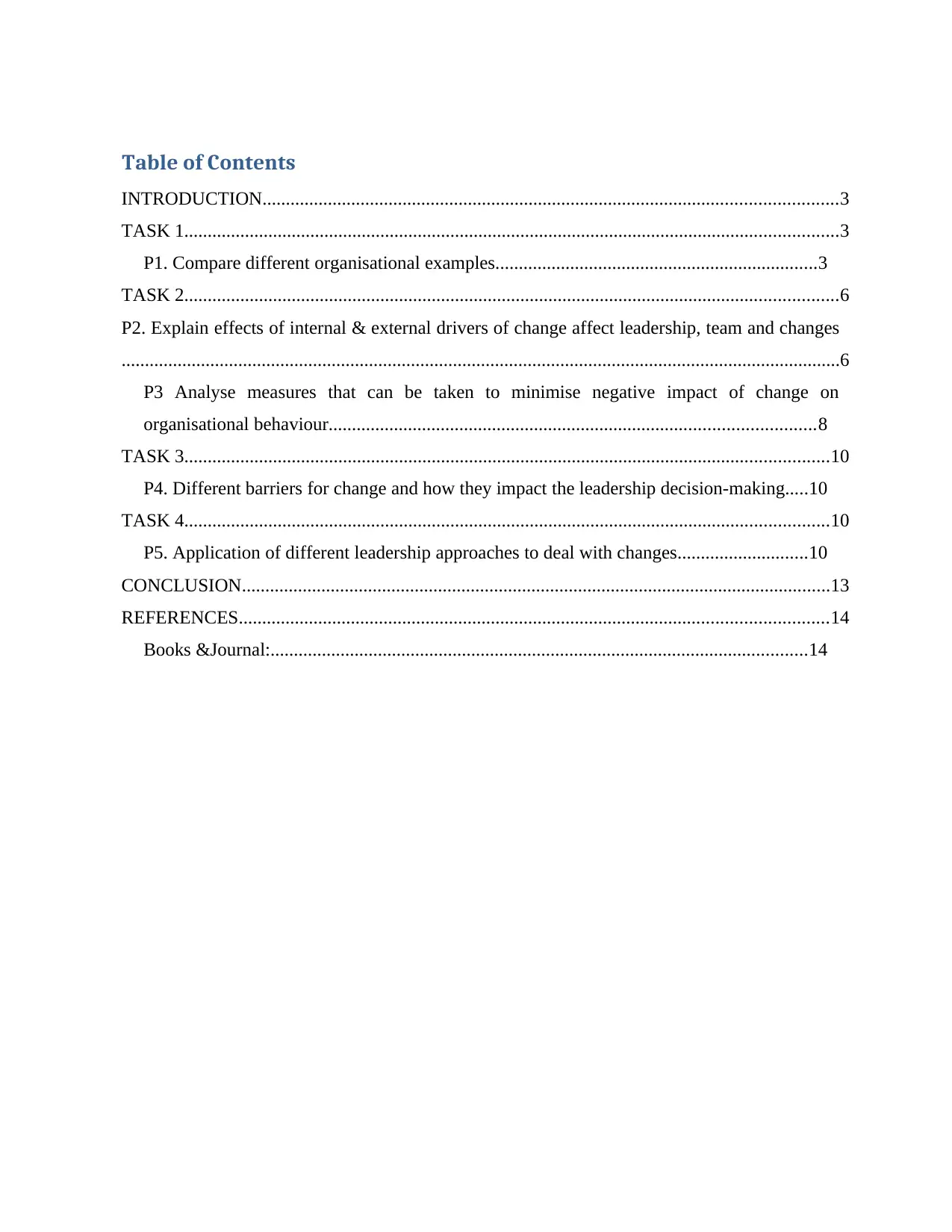
Table of Contents
INTRODUCTION...........................................................................................................................3
TASK 1............................................................................................................................................3
P1. Compare different organisational examples.....................................................................3
TASK 2............................................................................................................................................6
P2. Explain effects of internal & external drivers of change affect leadership, team and changes
..........................................................................................................................................................6
P3 Analyse measures that can be taken to minimise negative impact of change on
organisational behaviour........................................................................................................8
TASK 3..........................................................................................................................................10
P4. Different barriers for change and how they impact the leadership decision-making.....10
TASK 4..........................................................................................................................................10
P5. Application of different leadership approaches to deal with changes............................10
CONCLUSION..............................................................................................................................13
REFERENCES..............................................................................................................................14
Books &Journal:...................................................................................................................14
INTRODUCTION...........................................................................................................................3
TASK 1............................................................................................................................................3
P1. Compare different organisational examples.....................................................................3
TASK 2............................................................................................................................................6
P2. Explain effects of internal & external drivers of change affect leadership, team and changes
..........................................................................................................................................................6
P3 Analyse measures that can be taken to minimise negative impact of change on
organisational behaviour........................................................................................................8
TASK 3..........................................................................................................................................10
P4. Different barriers for change and how they impact the leadership decision-making.....10
TASK 4..........................................................................................................................................10
P5. Application of different leadership approaches to deal with changes............................10
CONCLUSION..............................................................................................................................13
REFERENCES..............................................................................................................................14
Books &Journal:...................................................................................................................14
INTRODUCTION
Organisational change is defined as inclusion of different modifications in the business
that is associated with processes in order to get positive implication over performance and
working abilities. Organisational change is playing significant role in the business working as
these are aligned with adaptation of market situation in such a manner that aims and objectives
of the business can be attained in early manner (Al Barwani, 2018). In the situation of
continuous failure need of organisational change may arise and in this manner business
standards can be enhanced and improved in prominent manner so that requisite opportunities
can be inhaled in significant manner. For attaining sustainability in opportunities, organisational
changes are adopted by the business. Different management theories are associated with
organisational change and these are assisting the business to accomplish aims and objectives
and to deal with arising complexities as well. This report is prepared for the major purpose to
recognise prominent aspects of organisational change in the background of Ernst & Young.
Ernst & Young is a global organisation of providing professional services to varied customers.
Ernst & Young is having their presence in more than 150 and they are managing 700 offices.
TASK 1
P1. Compare different organisational examples.
For developing an organisation its structure is having essential role as in controlling
diverseness and level of inequality. This provides separate identity to the business due to which
market prominence can be received in early stage. The businesses are having various
complexities that they are dealing with and to manage the same organisational structure plays
significant role. For removing challenges in effective manner, technology is the major part that
can be adopted so that to minimise impact of these complexities in business. In order to
improve business performance structure is imperative to be managed as while launching new
product and services in the market structure is helpful in managing launch process. Besides this
intrinsic communication is the other aspect which is necessary so that any prominent change
can be communicated in directive manner. Along with this an action plan is made which is
associated with strategies and aspects required to inhale change management. In order to deal
with organisational change these strategies are playing wide role so that to inculcate business
opportunities for overall succession (Al-Alawi, 2019).
The major objective of Ernst & Young is to introduce effective business processes so
that risk can be minimised to requisite extent. Business environment is the concept which
includes varied positive and negative impacts over the organisational succession. Within this
aspect manager is laced with major responsibility of dealing with customer demand and their
needs so that accordingly organisational offerings can be modified. Ernst & Young is a global
business organisation which is providing their services in varied areas of the globe so that to
satisfy needs of their customer in significant manner. Ernst & Young is totally emphasised over
recognising needs of their customer and meeting the same by providing them desired services.
Organisational change is defined as inclusion of different modifications in the business
that is associated with processes in order to get positive implication over performance and
working abilities. Organisational change is playing significant role in the business working as
these are aligned with adaptation of market situation in such a manner that aims and objectives
of the business can be attained in early manner (Al Barwani, 2018). In the situation of
continuous failure need of organisational change may arise and in this manner business
standards can be enhanced and improved in prominent manner so that requisite opportunities
can be inhaled in significant manner. For attaining sustainability in opportunities, organisational
changes are adopted by the business. Different management theories are associated with
organisational change and these are assisting the business to accomplish aims and objectives
and to deal with arising complexities as well. This report is prepared for the major purpose to
recognise prominent aspects of organisational change in the background of Ernst & Young.
Ernst & Young is a global organisation of providing professional services to varied customers.
Ernst & Young is having their presence in more than 150 and they are managing 700 offices.
TASK 1
P1. Compare different organisational examples.
For developing an organisation its structure is having essential role as in controlling
diverseness and level of inequality. This provides separate identity to the business due to which
market prominence can be received in early stage. The businesses are having various
complexities that they are dealing with and to manage the same organisational structure plays
significant role. For removing challenges in effective manner, technology is the major part that
can be adopted so that to minimise impact of these complexities in business. In order to
improve business performance structure is imperative to be managed as while launching new
product and services in the market structure is helpful in managing launch process. Besides this
intrinsic communication is the other aspect which is necessary so that any prominent change
can be communicated in directive manner. Along with this an action plan is made which is
associated with strategies and aspects required to inhale change management. In order to deal
with organisational change these strategies are playing wide role so that to inculcate business
opportunities for overall succession (Al-Alawi, 2019).
The major objective of Ernst & Young is to introduce effective business processes so
that risk can be minimised to requisite extent. Business environment is the concept which
includes varied positive and negative impacts over the organisational succession. Within this
aspect manager is laced with major responsibility of dealing with customer demand and their
needs so that accordingly organisational offerings can be modified. Ernst & Young is a global
business organisation which is providing their services in varied areas of the globe so that to
satisfy needs of their customer in significant manner. Ernst & Young is totally emphasised over
recognising needs of their customer and meeting the same by providing them desired services.
⊘ This is a preview!⊘
Do you want full access?
Subscribe today to unlock all pages.

Trusted by 1+ million students worldwide
In the current environment of high competition, the major issue is related with productivity and
sustainability so for accomplishing appropriate position in comparison to market rival
businesses are required to manage their business practices and align the same with market
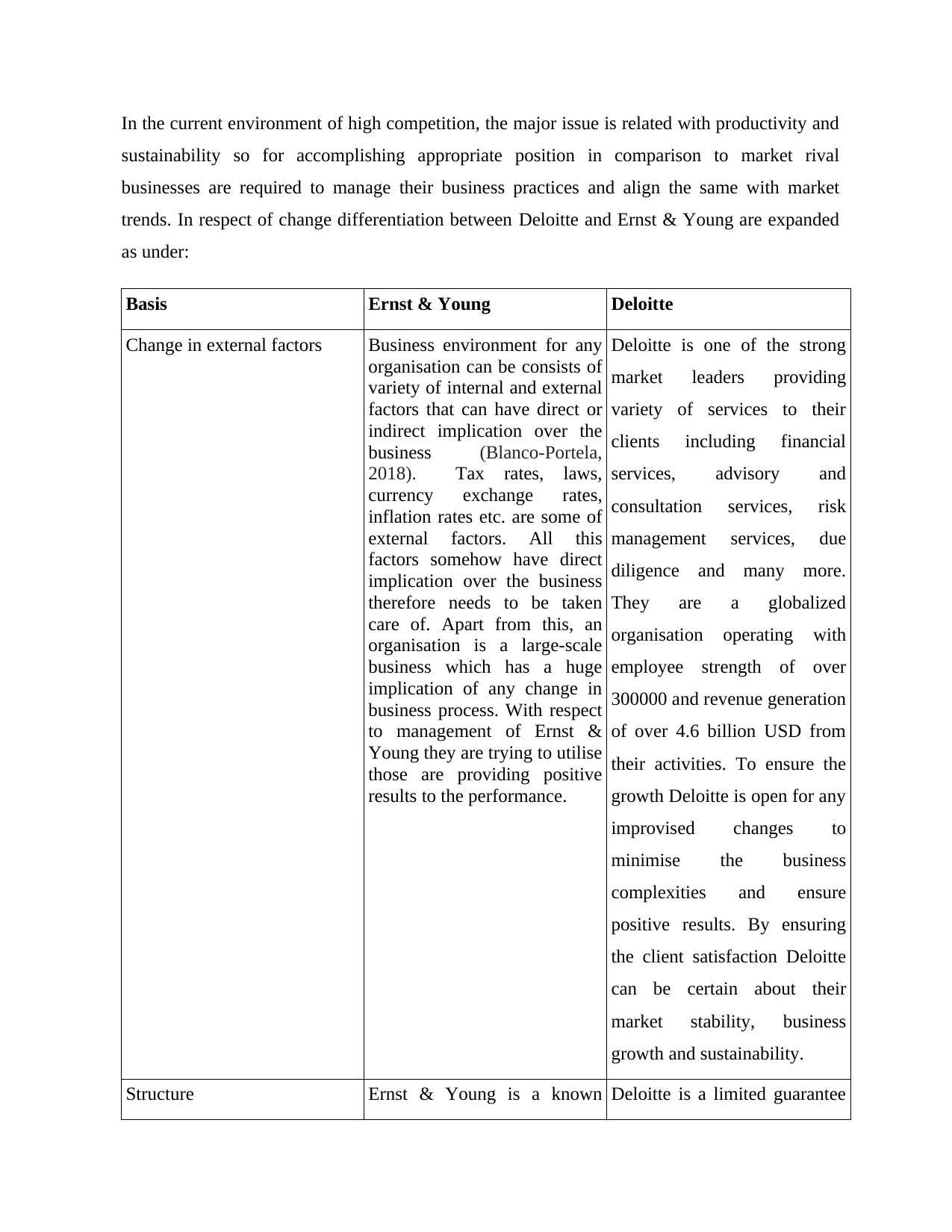
trends. In respect of change differentiation between Deloitte and Ernst & Young are expanded
as under:
Basis Ernst & Young Deloitte
Change in external factors Business environment for any
organisation can be consists of
variety of internal and external
factors that can have direct or
indirect implication over the
business (Blanco-Portela,
2018). Tax rates, laws,
currency exchange rates,
inflation rates etc. are some of
external factors. All this
factors somehow have direct
implication over the business
therefore needs to be taken
care of. Apart from this, an
organisation is a large-scale
business which has a huge
implication of any change in
business process. With respect
to management of Ernst &
Young they are trying to utilise
those are providing positive
results to the performance.
Deloitte is one of the strong
market leaders providing
variety of services to their
clients including financial
services, advisory and
consultation services, risk
management services, due
diligence and many more.
They are a globalized
organisation operating with
employee strength of over
300000 and revenue generation
of over 4.6 billion USD from
their activities. To ensure the
growth Deloitte is open for any
improvised changes to
minimise the business
complexities and ensure
positive results. By ensuring
the client satisfaction Deloitte
can be certain about their
market stability, business
growth and sustainability.
Structure Ernst & Young is a known Deloitte is a limited guarantee
sustainability so for accomplishing appropriate position in comparison to market rival
businesses are required to manage their business practices and align the same with market
trends. In respect of change differentiation between Deloitte and Ernst & Young are expanded
as under:
Basis Ernst & Young Deloitte
Change in external factors Business environment for any
organisation can be consists of
variety of internal and external
factors that can have direct or
indirect implication over the
business (Blanco-Portela,
2018). Tax rates, laws,
currency exchange rates,
inflation rates etc. are some of
external factors. All this
factors somehow have direct
implication over the business
therefore needs to be taken
care of. Apart from this, an
organisation is a large-scale
business which has a huge
implication of any change in
business process. With respect
to management of Ernst &
Young they are trying to utilise
those are providing positive
results to the performance.
Deloitte is one of the strong
market leaders providing
variety of services to their
clients including financial
services, advisory and
consultation services, risk
management services, due
diligence and many more.
They are a globalized
organisation operating with
employee strength of over
300000 and revenue generation
of over 4.6 billion USD from
their activities. To ensure the
growth Deloitte is open for any
improvised changes to
minimise the business
complexities and ensure
positive results. By ensuring
the client satisfaction Deloitte
can be certain about their
market stability, business
growth and sustainability.
Structure Ernst & Young is a known Deloitte is a limited guarantee
Paraphrase This Document
Need a fresh take? Get an instant paraphrase of this document with our AI Paraphraser
professional service provider
associated with various
financial services operation
across the world. If compared
to Deloitte, they function with
a smaller number of
employees comparatively so, it
might be difficult for them to
target and achieve the major
objectives and goals as
business.
and liability organisation by
structure which provides them
better opportunity to unleash
and secure new major
international markets. This
structure assists them in
carrying own their global
operations smoothly.
Strategy: Strategy can be defined as documented plans and steps that are framed by the
organisational leaders and are required to be followed by each resource of the organisation to
make a prominent progress towards organisation goals and objectives. This are set of steps and
procedures that need to be taken care in order to attain long term and short-term objective of the
business ((Chojnacka-Komorowska, 2019).
With this strategy and pathway, organisation will lead and direct business activities in
such a manner that the goals and visions of company will seem to be accomplishable. With
context of Ernst & Young, they too have their own set of clear visions and missions along with
planned strategy to attain the same. To ensure accomplishment of the business objectives, Ernst
& Young must make sure that they follow their strategy in the proper manner so that in case of
any change in factors it can be tracked and changed as required. PESTLE analysis tool would
be helpful and can be utilised to analyse market condition by Ernst & Young (Dawson, 2019).
Operations: This includes those types of strategies that are defined for changes which a
business is planning to be undertaking to lead effective system change within business
processes. To ensure effective strategies all the managers and supervisors are responsible to
conduct and build effective communication so that these well-planned strategies can be passed
to employees and various stakeholders of the organisation in the intended manner. It is the
responsibility of Managers to keep their employees motivated in such a way that it would lead
to effective & enhanced performance from them and the transition and change accept process is
done smoothly. Along with this proper and adequate trainings are also required for improving
associated with various
financial services operation
across the world. If compared
to Deloitte, they function with
a smaller number of
employees comparatively so, it
might be difficult for them to
target and achieve the major
objectives and goals as
business.
and liability organisation by
structure which provides them
better opportunity to unleash
and secure new major
international markets. This
structure assists them in
carrying own their global
operations smoothly.
Strategy: Strategy can be defined as documented plans and steps that are framed by the
organisational leaders and are required to be followed by each resource of the organisation to
make a prominent progress towards organisation goals and objectives. This are set of steps and
procedures that need to be taken care in order to attain long term and short-term objective of the
business ((Chojnacka-Komorowska, 2019).
With this strategy and pathway, organisation will lead and direct business activities in
such a manner that the goals and visions of company will seem to be accomplishable. With
context of Ernst & Young, they too have their own set of clear visions and missions along with
planned strategy to attain the same. To ensure accomplishment of the business objectives, Ernst
& Young must make sure that they follow their strategy in the proper manner so that in case of
any change in factors it can be tracked and changed as required. PESTLE analysis tool would
be helpful and can be utilised to analyse market condition by Ernst & Young (Dawson, 2019).
Operations: This includes those types of strategies that are defined for changes which a
business is planning to be undertaking to lead effective system change within business
processes. To ensure effective strategies all the managers and supervisors are responsible to
conduct and build effective communication so that these well-planned strategies can be passed
to employees and various stakeholders of the organisation in the intended manner. It is the
responsibility of Managers to keep their employees motivated in such a way that it would lead
to effective & enhanced performance from them and the transition and change accept process is
done smoothly. Along with this proper and adequate trainings are also required for improving
skills and intensifying their capabilities so that they can deal with their business responsibilities
in expected manner.
TASK 2
P2. Explain effects of internal & external drivers of change affect leadership, team and changes
In business sector, both external and internal environment has a deep impact on
leadership and team. It is necessary to focus on these factors so that decision making is being
done in proper. Business environment is defined as approach which includes external and
internal factors impacting upon overall organisational structure. In context of selected
organisation, they also use different frameworks to understand the business environment such
as SWOT analysis and Pest analysis. With the help of these two frameworks, it is easy to
examine the business environment. So, these two frameworks are further discussed below-
SWOT Analysis
It is a type of a framework which is used by enterprises to understand their internal
capabilities. It is important to uses analysis on the basis of which organisation is able to
exercise to strength weakness opportunities and threat (Dreyer, 2017).
Strength-
Main strength of Ernst and Young is that operates at global level and has large customer
base which depicts there strong market value.
Another strength of this company is that they have skilled and expertise employees who
are able to produce higher efficiency productivity at workplace (Gupta, 2016).
Weakness-
The biggest weakness of companies that many competitors of same field are
establishing their on research and development centres which is widely impacting upon
business operations.
Opportunities-
in expected manner.
TASK 2
P2. Explain effects of internal & external drivers of change affect leadership, team and changes
In business sector, both external and internal environment has a deep impact on
leadership and team. It is necessary to focus on these factors so that decision making is being
done in proper. Business environment is defined as approach which includes external and
internal factors impacting upon overall organisational structure. In context of selected
organisation, they also use different frameworks to understand the business environment such
as SWOT analysis and Pest analysis. With the help of these two frameworks, it is easy to
examine the business environment. So, these two frameworks are further discussed below-
SWOT Analysis
It is a type of a framework which is used by enterprises to understand their internal
capabilities. It is important to uses analysis on the basis of which organisation is able to
exercise to strength weakness opportunities and threat (Dreyer, 2017).
Strength-
Main strength of Ernst and Young is that operates at global level and has large customer
base which depicts there strong market value.
Another strength of this company is that they have skilled and expertise employees who
are able to produce higher efficiency productivity at workplace (Gupta, 2016).
Weakness-
The biggest weakness of companies that many competitors of same field are
establishing their on research and development centres which is widely impacting upon
business operations.
Opportunities-
⊘ This is a preview!⊘
Do you want full access?
Subscribe today to unlock all pages.
Trusted by 1+ million students worldwide
Ernst and Young also have opportunity of improving that client base in many following
countries through properly spending a huge amount on their infrastructure.
Threat-
Main threat to company is that due to this on-going covid-19 pandemic situation they
might lose their client place in many foreign countries and which can also impact upon their
goodwill ((Hussain, 2018).
PEST Analysis – External drivers
It is a type of a framework which is used by entity with purpose of analysing and
examining external factors affecting business operations and functions. It is a time consuming
framework because to carry out this proper market information and data is required which is
difficult in this flexible market. In context of chosen entity, it is seen that they also uses this
pest analysis which is described as follows-
Political factors
In this component of pest analysis it includes factors such as environmental or labour
law and many more. It is important to be aware about this factors their impact on business is
also examined. In relation of chosen enterprise, it is seen that due to changing policies with
Government makes it difficult for enterprise to operate their activities in effective manner.
Impact on team-This sector negatively impact on team members as because policy and
procedures are changeable and if they are not properly followed it can directly impact upon
their motivation level. Impact on leader- It also affects as because there are many subordinates
who resist for change and which can negatively impact the leadership style of a leader (Heinz,
2019).
Economic factors-
It is second component of framework in which it includes factors like tariff and non-
tariff, foreign trade policies, and many more. It is essential for entity to have an appropriate
market analysis so that economic factors are determined on the basis of which it is easier to
implement strategies. For example- in reference of given organisation, they also get affected by
this factor such as due to high interest rate it is positively impacting upon profitability and
international trade positively. In this changing market sector, it has become necessary to
conduct an external analysis so that the economic factors are properly examined. Impact on
team- This element also affect upon team as because when strategies are implemented to deal
countries through properly spending a huge amount on their infrastructure.
Threat-
Main threat to company is that due to this on-going covid-19 pandemic situation they
might lose their client place in many foreign countries and which can also impact upon their
goodwill ((Hussain, 2018).
PEST Analysis – External drivers
It is a type of a framework which is used by entity with purpose of analysing and
examining external factors affecting business operations and functions. It is a time consuming
framework because to carry out this proper market information and data is required which is
difficult in this flexible market. In context of chosen entity, it is seen that they also uses this
pest analysis which is described as follows-
Political factors
In this component of pest analysis it includes factors such as environmental or labour
law and many more. It is important to be aware about this factors their impact on business is
also examined. In relation of chosen enterprise, it is seen that due to changing policies with
Government makes it difficult for enterprise to operate their activities in effective manner.
Impact on team-This sector negatively impact on team members as because policy and
procedures are changeable and if they are not properly followed it can directly impact upon
their motivation level. Impact on leader- It also affects as because there are many subordinates
who resist for change and which can negatively impact the leadership style of a leader (Heinz,
2019).
Economic factors-
It is second component of framework in which it includes factors like tariff and non-
tariff, foreign trade policies, and many more. It is essential for entity to have an appropriate
market analysis so that economic factors are determined on the basis of which it is easier to
implement strategies. For example- in reference of given organisation, they also get affected by
this factor such as due to high interest rate it is positively impacting upon profitability and
international trade positively. In this changing market sector, it has become necessary to
conduct an external analysis so that the economic factors are properly examined. Impact on
team- This element also affect upon team as because when strategies are implemented to deal
Paraphrase This Document
Need a fresh take? Get an instant paraphrase of this document with our AI Paraphraser
with these economic changes new work pattern has to be followed by team which leads to
positive and negative impact.
Social factors-
It is also to be considered as important element of pest analysis as because it comprises
of attitude, behaviour, and perception of society, community or group of people. In business
organisations, it is necessary to focus on gender roles, online shopping and changing behaviour
as well as pattern of customers. Through properly analysing them will help in making correct
decision about marketing and other activities of corporation. Impact on team- This is also an
essential element which directly affects the team members of organisation because team has to
properly change there working pattern according to the changing behaviour and demand of
clients or customers. Impact on leader- Leaders mostly take decisions on the basis of attitude
behaviour and perceptions of their followers so social factors also impact at a wider scale (Lin,
2019).
Technological factors-
In this factor of pest analysis, it is also crucial element as because with rise use of
internet in market customer trends and behaviour is also shifting towards technology. Moreover
it has been also stated that technological factors affecting businesses for example artificial
intelligence software and hardware changes from time to time and which makes it difficult for
EY to use their internal management system in proper manner. Furthermore, due to frequent
change in technology it is becoming cost expensive for organisation to adopt latest technology
within their company (Realyvásquez-Vargas, 2018).
Effect on team- It also effect on team as because when new technology are adopted by
organisation team members have to learn about use of those technologies. Effect on leader-
Technological factor also affects the leader as leaders has to evolve their leadership style
employees also are able to adopt these new changes easily.
P3 Analyse measures that can be taken to minimise negative impact of change on organisational
behaviour.
Organisational behaviour is a wider and broader concept which is needed to be
understood so that changes affecting can be determined. In this flexible market, it is seen that
changes occur at frequent level and it is necessary to overcome with these changes so that
strategies are being used appropriately. In context of chosen organisation, they adopts different
types of measures to reduce the negative impact of change on organisation behaviour which are
explained below-
positive and negative impact.
Social factors-
It is also to be considered as important element of pest analysis as because it comprises
of attitude, behaviour, and perception of society, community or group of people. In business
organisations, it is necessary to focus on gender roles, online shopping and changing behaviour
as well as pattern of customers. Through properly analysing them will help in making correct
decision about marketing and other activities of corporation. Impact on team- This is also an
essential element which directly affects the team members of organisation because team has to
properly change there working pattern according to the changing behaviour and demand of
clients or customers. Impact on leader- Leaders mostly take decisions on the basis of attitude
behaviour and perceptions of their followers so social factors also impact at a wider scale (Lin,
2019).
Technological factors-
In this factor of pest analysis, it is also crucial element as because with rise use of
internet in market customer trends and behaviour is also shifting towards technology. Moreover
it has been also stated that technological factors affecting businesses for example artificial
intelligence software and hardware changes from time to time and which makes it difficult for
EY to use their internal management system in proper manner. Furthermore, due to frequent
change in technology it is becoming cost expensive for organisation to adopt latest technology
within their company (Realyvásquez-Vargas, 2018).
Effect on team- It also effect on team as because when new technology are adopted by
organisation team members have to learn about use of those technologies. Effect on leader-
Technological factor also affects the leader as leaders has to evolve their leadership style
employees also are able to adopt these new changes easily.
P3 Analyse measures that can be taken to minimise negative impact of change on organisational
behaviour.
Organisational behaviour is a wider and broader concept which is needed to be
understood so that changes affecting can be determined. In this flexible market, it is seen that
changes occur at frequent level and it is necessary to overcome with these changes so that
strategies are being used appropriately. In context of chosen organisation, they adopts different
types of measures to reduce the negative impact of change on organisation behaviour which are
explained below-
Realistic time scale- It is an important measure which is being adopted by EY as by
properly implementing realistic time scale why leaders as well as managers it is easier to
achieve set objectives and on the basis of which negative impacts can be reduced easily.
Appropriate leadership- It is being also considered as an important measure which is
used for minimising negative impact of change has by applying correct leadership style and
approach within organisational behaviour it is easier to make effective decisions which produce
better results ((Schleiff, 2020).
Another way through which it is easier to reduce negative impact of changes on
organisational behaviour is by properly using PDCA model in entity. It is an effective model
which is used for planning and monitoring changes that can impact upon enterprise activities
functions and operations at large scale. Change has impact on organisational behaviour because
decisions are taken by individual & if change occurs than process of decisions making also get
changes (Scholl, 2018). Businesses who are motivated to accept the risk within operation as
well as functions has ability to implement new change & innovation. Thus, PDCA model has
been used in which it includes measures that can minimise negative effect of change & is
discussed below
PDCA Cycle-
Plan- It is the first stage of this model in which planning is implemented and done as well as
new idea are generated for a specific purpose. Moreover, it is also seen that with effective and
proper planning it is easy to analyse the changes that can affect organisational and consumer
behaviour. In context of selected enterprise, by properly implementation of planning within
organisation objectives are achieved effectively. Do- In this second stage of model, idea which
is been generated at first aspect are being examined and analysed on the basis of which they are
further used. For example- in viewpoint of EY manager of company is responsible for adapting
the most appropriate idea such as targeting of clients throw different marketing strategies.
properly implementing realistic time scale why leaders as well as managers it is easier to
achieve set objectives and on the basis of which negative impacts can be reduced easily.
Appropriate leadership- It is being also considered as an important measure which is
used for minimising negative impact of change has by applying correct leadership style and
approach within organisational behaviour it is easier to make effective decisions which produce
better results ((Schleiff, 2020).
Another way through which it is easier to reduce negative impact of changes on
organisational behaviour is by properly using PDCA model in entity. It is an effective model
which is used for planning and monitoring changes that can impact upon enterprise activities
functions and operations at large scale. Change has impact on organisational behaviour because
decisions are taken by individual & if change occurs than process of decisions making also get
changes (Scholl, 2018). Businesses who are motivated to accept the risk within operation as
well as functions has ability to implement new change & innovation. Thus, PDCA model has
been used in which it includes measures that can minimise negative effect of change & is
discussed below
PDCA Cycle-
Plan- It is the first stage of this model in which planning is implemented and done as well as
new idea are generated for a specific purpose. Moreover, it is also seen that with effective and
proper planning it is easy to analyse the changes that can affect organisational and consumer
behaviour. In context of selected enterprise, by properly implementation of planning within
organisation objectives are achieved effectively. Do- In this second stage of model, idea which
is been generated at first aspect are being examined and analysed on the basis of which they are
further used. For example- in viewpoint of EY manager of company is responsible for adapting
the most appropriate idea such as targeting of clients throw different marketing strategies.
⊘ This is a preview!⊘
Do you want full access?
Subscribe today to unlock all pages.
Trusted by 1+ million students worldwide
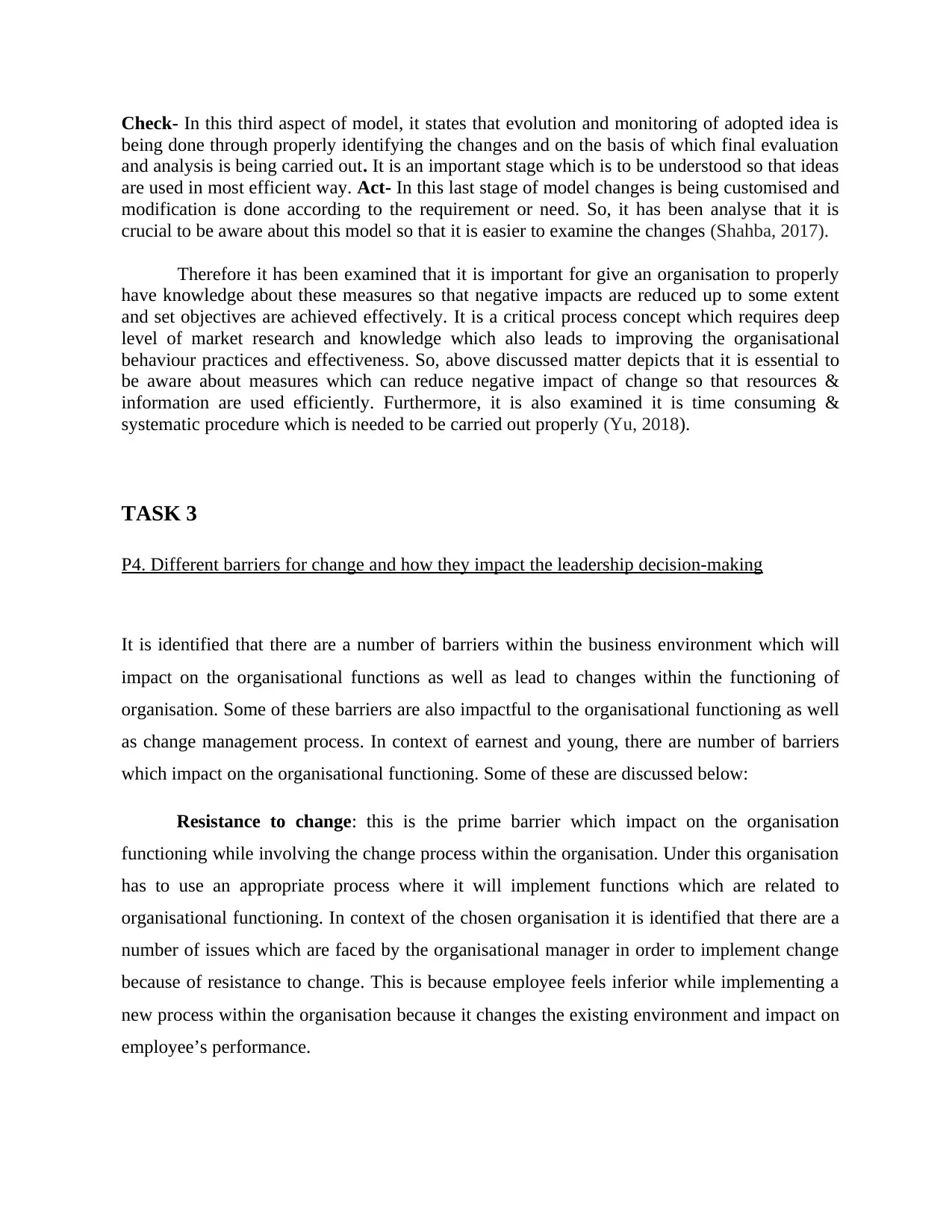
Check- In this third aspect of model, it states that evolution and monitoring of adopted idea is
being done through properly identifying the changes and on the basis of which final evaluation
and analysis is being carried out. It is an important stage which is to be understood so that ideas
are used in most efficient way. Act- In this last stage of model changes is being customised and
modification is done according to the requirement or need. So, it has been analyse that it is
crucial to be aware about this model so that it is easier to examine the changes (Shahba, 2017).
Therefore it has been examined that it is important for give an organisation to properly
have knowledge about these measures so that negative impacts are reduced up to some extent
and set objectives are achieved effectively. It is a critical process concept which requires deep
level of market research and knowledge which also leads to improving the organisational
behaviour practices and effectiveness. So, above discussed matter depicts that it is essential to
be aware about measures which can reduce negative impact of change so that resources &
information are used efficiently. Furthermore, it is also examined it is time consuming &
systematic procedure which is needed to be carried out properly (Yu, 2018).
TASK 3
P4. Different barriers for change and how they impact the leadership decision-making
It is identified that there are a number of barriers within the business environment which will
impact on the organisational functions as well as lead to changes within the functioning of
organisation. Some of these barriers are also impactful to the organisational functioning as well
as change management process. In context of earnest and young, there are number of barriers
which impact on the organisational functioning. Some of these are discussed below:
Resistance to change: this is the prime barrier which impact on the organisation
functioning while involving the change process within the organisation. Under this organisation
has to use an appropriate process where it will implement functions which are related to
organisational functioning. In context of the chosen organisation it is identified that there are a
number of issues which are faced by the organisational manager in order to implement change
because of resistance to change. This is because employee feels inferior while implementing a
new process within the organisation because it changes the existing environment and impact on
employee’s performance.
being done through properly identifying the changes and on the basis of which final evaluation
and analysis is being carried out. It is an important stage which is to be understood so that ideas
are used in most efficient way. Act- In this last stage of model changes is being customised and
modification is done according to the requirement or need. So, it has been analyse that it is
crucial to be aware about this model so that it is easier to examine the changes (Shahba, 2017).
Therefore it has been examined that it is important for give an organisation to properly
have knowledge about these measures so that negative impacts are reduced up to some extent
and set objectives are achieved effectively. It is a critical process concept which requires deep
level of market research and knowledge which also leads to improving the organisational
behaviour practices and effectiveness. So, above discussed matter depicts that it is essential to
be aware about measures which can reduce negative impact of change so that resources &
information are used efficiently. Furthermore, it is also examined it is time consuming &
systematic procedure which is needed to be carried out properly (Yu, 2018).
TASK 3
P4. Different barriers for change and how they impact the leadership decision-making
It is identified that there are a number of barriers within the business environment which will
impact on the organisational functions as well as lead to changes within the functioning of
organisation. Some of these barriers are also impactful to the organisational functioning as well
as change management process. In context of earnest and young, there are number of barriers
which impact on the organisational functioning. Some of these are discussed below:
Resistance to change: this is the prime barrier which impact on the organisation
functioning while involving the change process within the organisation. Under this organisation
has to use an appropriate process where it will implement functions which are related to
organisational functioning. In context of the chosen organisation it is identified that there are a
number of issues which are faced by the organisational manager in order to implement change
because of resistance to change. This is because employee feels inferior while implementing a
new process within the organisation because it changes the existing environment and impact on
employee’s performance.
Paraphrase This Document
Need a fresh take? Get an instant paraphrase of this document with our AI Paraphraser
Lack of proper communication: improper communication is also factor which act as
an barrier within the process of change. This is because it is related to the organisational
functioning where it impact on the functions of choose an organisation. in context to this it is
identified that lack of communication within the organisation will decrease the chances of
proper information flow within the firm which also leads to improper implementation of
different changes which are implemented within the organisation in the current times.
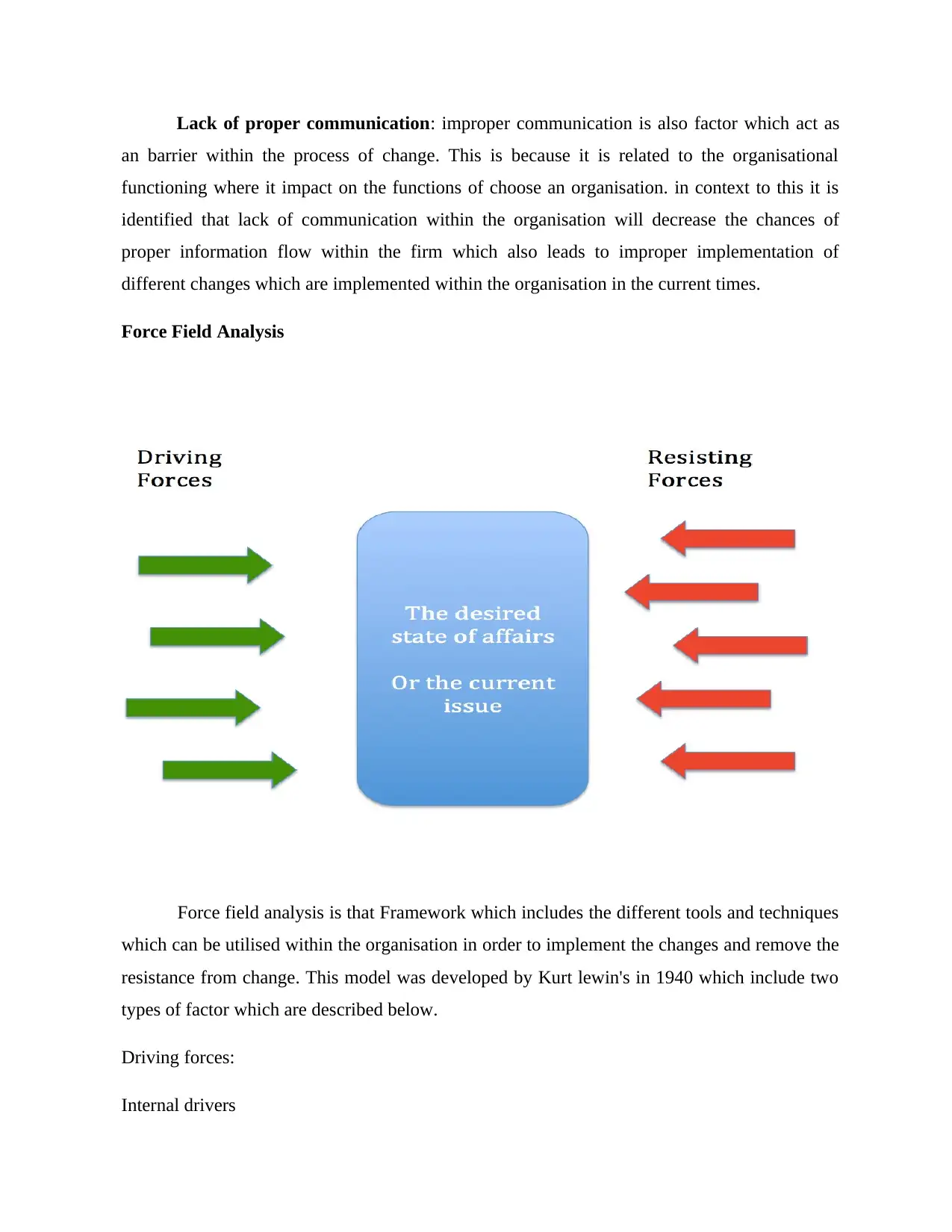
Force Field Analysis
Force field analysis is that Framework which includes the different tools and techniques
which can be utilised within the organisation in order to implement the changes and remove the
resistance from change. This model was developed by Kurt lewin's in 1940 which include two
types of factor which are described below.
Driving forces:
Internal drivers
an barrier within the process of change. This is because it is related to the organisational
functioning where it impact on the functions of choose an organisation. in context to this it is
identified that lack of communication within the organisation will decrease the chances of
proper information flow within the firm which also leads to improper implementation of
different changes which are implemented within the organisation in the current times.
Force Field Analysis
Force field analysis is that Framework which includes the different tools and techniques
which can be utilised within the organisation in order to implement the changes and remove the
resistance from change. This model was developed by Kurt lewin's in 1940 which include two
types of factor which are described below.
Driving forces:
Internal drivers
Performance: performance is the major internal factor which is related to
implementation of change process within the organisation as well as removing the barriers from
this process. Under this organisation has to ensure that there will be effective flow of functions
so that an updated performance level can be maintained. This will help in improving the
functions and achieving better results by increasing the competitive advantage.
Using old business asset: it is also factor which can be used in order to maintain the
change factor where organisation can easily use different machineries products according to the
requirements. This will help in improving the resistance as well as building better function so
that the chosen organisation can implement the process in a secured and systematic way. under
this performance is used as an internal driver organisation can identify the long-term impact on
and enterprises functioning as well as maintaining productivity level. This help in increasing
high performance standard as well as achieving appropriate productivity according to the
requirements.
Advanced technology: advanced technology is also factor which can be used by the
organisation in order to improve the resistance from change. Under this factor management can
use various social media platforms as well as continuous developing technologies which help in
improving the functioning as well as maintaining an appropriate system to change. Function
according to the requirements.
Customer flexible behaviour: is also factor which can be utilised by the organisation in
order to become a change management system for staff here organisation can use the flexible
and changeable be within the firm where management can use this system in order to
implement the productivity as well as improve production of different factors for staff under
this business can improve its functioning as well as maintain an appropriate decision making
process to implement the function and achieve better results.
Restraining forces-
These are those types of forces which makes it harder for company to implement change
with the sector.
Constant use of old techniques: this act as an effective remedy to remove the
resistance from change. This is because it help the employees in gaining the past experience by
implementation of change process within the organisation as well as removing the barriers from
this process. Under this organisation has to ensure that there will be effective flow of functions
so that an updated performance level can be maintained. This will help in improving the
functions and achieving better results by increasing the competitive advantage.
Using old business asset: it is also factor which can be used in order to maintain the
change factor where organisation can easily use different machineries products according to the
requirements. This will help in improving the resistance as well as building better function so
that the chosen organisation can implement the process in a secured and systematic way. under
this performance is used as an internal driver organisation can identify the long-term impact on
and enterprises functioning as well as maintaining productivity level. This help in increasing
high performance standard as well as achieving appropriate productivity according to the
requirements.
Advanced technology: advanced technology is also factor which can be used by the
organisation in order to improve the resistance from change. Under this factor management can
use various social media platforms as well as continuous developing technologies which help in
improving the functioning as well as maintaining an appropriate system to change. Function
according to the requirements.
Customer flexible behaviour: is also factor which can be utilised by the organisation in
order to become a change management system for staff here organisation can use the flexible
and changeable be within the firm where management can use this system in order to
implement the productivity as well as improve production of different factors for staff under
this business can improve its functioning as well as maintain an appropriate decision making
process to implement the function and achieve better results.
Restraining forces-
These are those types of forces which makes it harder for company to implement change
with the sector.
Constant use of old techniques: this act as an effective remedy to remove the
resistance from change. This is because it help the employees in gaining the past experience by
⊘ This is a preview!⊘
Do you want full access?
Subscribe today to unlock all pages.
Trusted by 1+ million students worldwide

1 out of 19


Related Documents


Your All-in-One AI-Powered Toolkit for Academic Success.
+13062052269
info@desklib.com
Available 24*7 on WhatsApp / Email
![[object Object]](/_next/static/media/star-bottom.7253800d.svg)
Unlock your academic potential
Copyright © 2020–2026 A2Z Services. All Rights Reserved. Developed and managed by ZUCOL.