Assessing Change Communication: Lakeland Wonders Report - MGT540
VerifiedAdded on 2023/06/08
|12
|3785
|245
Report
AI Summary
This report examines the communication strategies employed by Cheryl Hailstrom, the CEO of Lakeland Wonders, a toy manufacturing company, to implement organizational change. The report analyzes her approach, focusing on her role as a change agent and the effectiveness of her communication methods in driving change within the company. It critically evaluates her communication, considering the context of the company's history, culture, and the resistance encountered from employees and senior management. The analysis incorporates relevant scholarly literature on change management and communication to assess the strengths and weaknesses of Hailstrom's strategies. The report identifies gaps in her approach, such as a lack of understanding of the company culture and the need for a more participatory communication style. Finally, it provides recommendations for improving her communication and the overall change management process, suggesting strategies to address employee resistance, foster a shared vision, and ensure a smoother transition towards the desired organizational changes, including outsourcing manufacturing and modernizing business operations.
Running head: ROLE OF CHANGE COMMUNICATION IN ORGANISATIONAL CHANGE
ROLE OF CHANGE COMMUNICATION IN ORGANISATIONAL CHANGE
Name of the Student
Name of the University
Author Note
ROLE OF CHANGE COMMUNICATION IN ORGANISATIONAL CHANGE
Name of the Student
Name of the University
Author Note

Paraphrase This Document
Need a fresh take? Get an instant paraphrase of this document with our AI Paraphraser
1ROLE OF CHANGE COMMUNICATION IN ORGANISATIONAL CHANGE
Executive summary
The term organisational change or commonly known as OCM refers to the structure of
managing the new business processes and operations in order to develop better understanding
and growth with respect to returns and business. It also includes change in the pattern of
strategies, work environment and business outcomes. It is of utmost importance to deliver
effective communication to create an organisational change. The transformation of an
organisation from one step to another is not an easy journey, rather it depends on the effectual
application of the planning, of organizing, of motivating and controlling of the primary functions
that bring about a successful organisational change. The major aim of communication is to reach
out to the audience, create awareness, building of trust and educating the audience, influencing
perceptions, attitudes and their belief systems and most importantly prompting action to deliver
the desired result. This report will analyse and evaluate the communication change being
implemented by Cheryl Hailstrom to bring about an organisational change. This report will
critically, justify the change agents, the pieces of change communication implemented, their
effectiveness in creating a change and their possible outcomes. The report will also be looking
into the gaps and make recommendations for the same. Finally the report will conclude with the
evaluation of the case and understand the necessity of effective communication in creating a
change in an organisation.
Executive summary
The term organisational change or commonly known as OCM refers to the structure of
managing the new business processes and operations in order to develop better understanding
and growth with respect to returns and business. It also includes change in the pattern of
strategies, work environment and business outcomes. It is of utmost importance to deliver
effective communication to create an organisational change. The transformation of an
organisation from one step to another is not an easy journey, rather it depends on the effectual
application of the planning, of organizing, of motivating and controlling of the primary functions
that bring about a successful organisational change. The major aim of communication is to reach
out to the audience, create awareness, building of trust and educating the audience, influencing
perceptions, attitudes and their belief systems and most importantly prompting action to deliver
the desired result. This report will analyse and evaluate the communication change being
implemented by Cheryl Hailstrom to bring about an organisational change. This report will
critically, justify the change agents, the pieces of change communication implemented, their
effectiveness in creating a change and their possible outcomes. The report will also be looking
into the gaps and make recommendations for the same. Finally the report will conclude with the
evaluation of the case and understand the necessity of effective communication in creating a
change in an organisation.
2ROLE OF CHANGE COMMUNICATION IN ORGANISATIONAL CHANGE
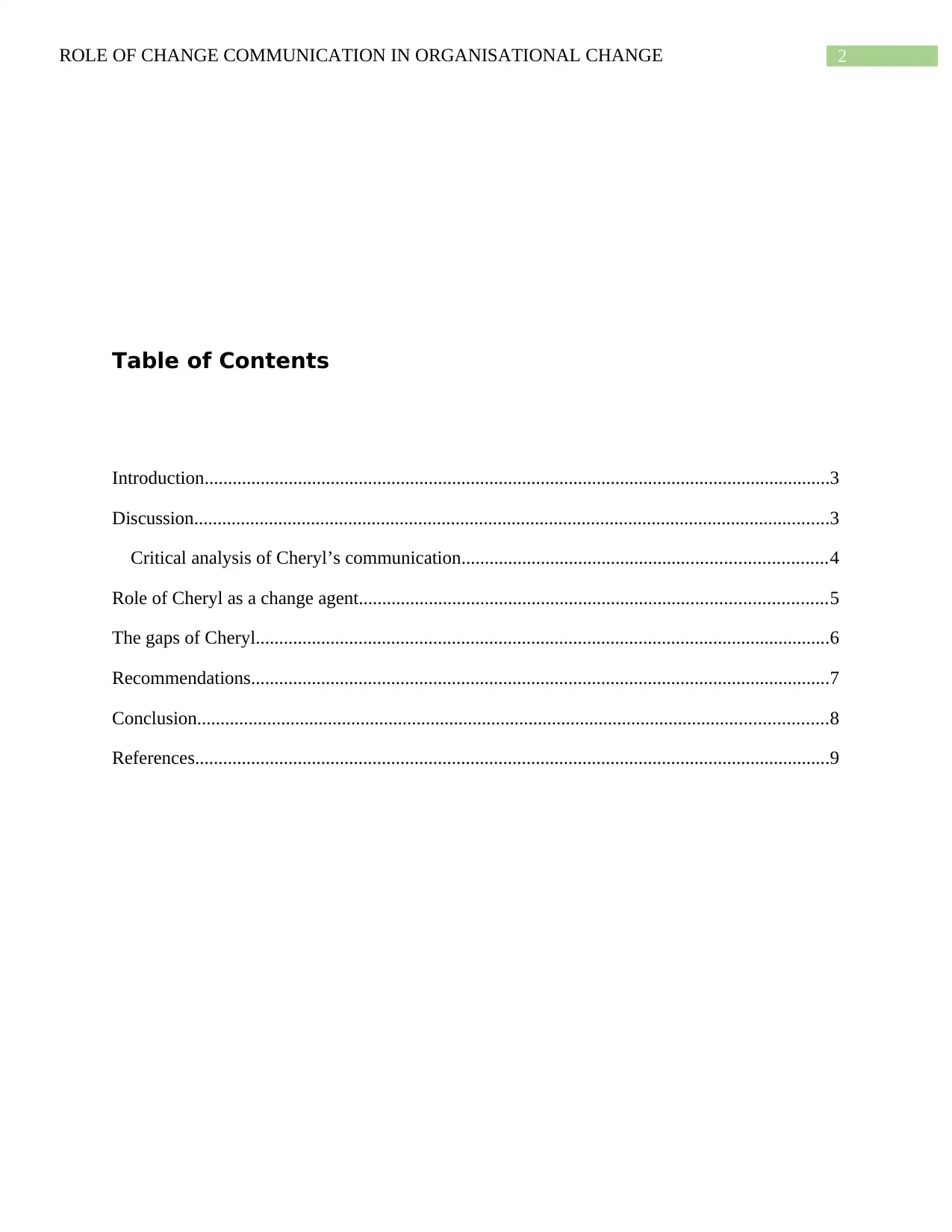
Table of Contents
Introduction......................................................................................................................................3
Discussion........................................................................................................................................3
Critical analysis of Cheryl’s communication..............................................................................4
Role of Cheryl as a change agent....................................................................................................5
The gaps of Cheryl...........................................................................................................................6
Recommendations............................................................................................................................7
Conclusion.......................................................................................................................................8
References........................................................................................................................................9
Table of Contents
Introduction......................................................................................................................................3
Discussion........................................................................................................................................3
Critical analysis of Cheryl’s communication..............................................................................4
Role of Cheryl as a change agent....................................................................................................5
The gaps of Cheryl...........................................................................................................................6
Recommendations............................................................................................................................7
Conclusion.......................................................................................................................................8
References........................................................................................................................................9
⊘ This is a preview!⊘
Do you want full access?
Subscribe today to unlock all pages.

Trusted by 1+ million students worldwide
3ROLE OF CHANGE COMMUNICATION IN ORGANISATIONAL CHANGE
Introduction
With the changing market structure and consumer demands, there has been an urging
need to revise the organisational structure and operational framework of the companies to cater
the market needs. The necessity of studying the change of an organisation and identifying the
agents of the change are therefore an important part of business operations in present times. To
keep up with the pace of technological advancement and changing criteria of production it has
become eminently necessary for the organisation to evolve with the time and therefore the
necessity for organisational change comes into being. The first step towards organisational
change starts with effective change in communication. Communication change refers to the
change in approach delivered through verbal and nonverbal communication and illustrates the
process of bringing about the change in series of actions delivered through communication. The
report will discuss in detail about the role of a change agent, and analyse the role Cheryl
Hailstorm as a change agent and the way she implements change communication to create
effective organisational change. The discussion will follow through several sections attending the
critical analysis of the case, the role of Cheryl Hailstorm, the identifying the pieces of change
communicated by her, and finally recommend solutions to modify the change communication as
suggested by Cheryl Hailstorm.
Discussion
The case opens up with the meeting scene (McNulty, 2018) of Cheryl Hailstrom with,
Mr. Mark Dawson, the senior vice president of operations. Cheryl Hailstrom has been the CEO
of Lakeland Wonders, a toy manufacturing company exclusively involved in making high
quality wooden toys. The company has been operating for over a period of 94 years and has been
successfully delivering quality products in time. Cheryl had joined the company when Walter
Swensen IV was retiring from office. Cheryl had always been an enthusiastic person and her role
in expanding the business of her former organisation, the ‘Kids&Company’ was commendable.
This led Walter Swensen to request her, to be the new CEO as his replacement. The incident is
post six months of Cheryl’s appointment and she feels that the company needs to make a
decisive change to grow its business and earn a competitive edge over the others by finalizing a
deal with Bull’s Eye store, which has agreed to partner with Lakeland Wonders for a deal.
Cheryl feels that this is the right opportunity to initiate the process of the organisational change,
Introduction
With the changing market structure and consumer demands, there has been an urging
need to revise the organisational structure and operational framework of the companies to cater
the market needs. The necessity of studying the change of an organisation and identifying the
agents of the change are therefore an important part of business operations in present times. To
keep up with the pace of technological advancement and changing criteria of production it has
become eminently necessary for the organisation to evolve with the time and therefore the
necessity for organisational change comes into being. The first step towards organisational
change starts with effective change in communication. Communication change refers to the
change in approach delivered through verbal and nonverbal communication and illustrates the
process of bringing about the change in series of actions delivered through communication. The
report will discuss in detail about the role of a change agent, and analyse the role Cheryl
Hailstorm as a change agent and the way she implements change communication to create
effective organisational change. The discussion will follow through several sections attending the
critical analysis of the case, the role of Cheryl Hailstorm, the identifying the pieces of change
communicated by her, and finally recommend solutions to modify the change communication as
suggested by Cheryl Hailstorm.
Discussion
The case opens up with the meeting scene (McNulty, 2018) of Cheryl Hailstrom with,
Mr. Mark Dawson, the senior vice president of operations. Cheryl Hailstrom has been the CEO
of Lakeland Wonders, a toy manufacturing company exclusively involved in making high
quality wooden toys. The company has been operating for over a period of 94 years and has been
successfully delivering quality products in time. Cheryl had joined the company when Walter
Swensen IV was retiring from office. Cheryl had always been an enthusiastic person and her role
in expanding the business of her former organisation, the ‘Kids&Company’ was commendable.
This led Walter Swensen to request her, to be the new CEO as his replacement. The incident is
post six months of Cheryl’s appointment and she feels that the company needs to make a
decisive change to grow its business and earn a competitive edge over the others by finalizing a
deal with Bull’s Eye store, which has agreed to partner with Lakeland Wonders for a deal.
Cheryl feels that this is the right opportunity to initiate the process of the organisational change,
Paraphrase This Document
Need a fresh take? Get an instant paraphrase of this document with our AI Paraphraser
4ROLE OF CHANGE COMMUNICATION IN ORGANISATIONAL CHANGE
and it is time for the company to outsource its manufacturing to over sea locations in order to
reduce the manufacturing costs. However, to bring this change she requires the whole team, to
start thinking in a different way and see the bigger picture behind bringing in the change. She
plans to do this individually by communicating with the senior vice president of operations. She
had planned a conference with the senior sales manager, the marketing head, and the vice
president of operations to communicate her concerns and to give the board a clear idea of her
plans through strategies of communication change. There had been several issues that she
identified with the functioning, and it was her observation there needs to be a change in the work
culture to bring about a change in the company. She refers to the empty office at 6.30 pm and
apprehends that these things needs to be reshaped in order to change the future of Lakeland
wonders. She decides to communicate these to her subordinates later during the conference.
Critical analysis of Cheryl’s communication
The way Cheryl communicates the process of change is more of a programmatic
approach where in the information to create a change passes down in through the top-bottom
approach. Given the way the company is dependent upon its trusted employees, the already
existent managers are of the opinion that a participatory approach should be implemented to get
a sense of the situation. Moreover given the nature of the situation Cheryl feels that the company
is way too inclined to its older ways and is not willing to mend its ways for sustaining the
competitive edge. However, it should be noted that, prior to the initiation of the change process,
the readying of the organisation is necessary as mentioned by Stuart M. Klein. General approach
to communication change is by the process of the programmatic approach, yet the ground
research and backdrop of the change should be well evaluated to bring about an effective
organisational change. This kind of approach allows lot more compliance and reduces employee
resistance by delivering the change process in the way that creates fair procedure and keeping the
stake holder’s perspective in mind and also conveys the vision of the implementers to the
employees in methodist way. Cheryl had been very energetic in delivering her communication
change and is always motivated to spread the vibe among her subordinates, which is definitely
the way change communication should be initiated. However, the impact that she expected is
missing due to the lack of her experience with the company. It is necessary for her to know her
subordinates more thoroughly and understand the company culture to bring about an
organisational change.
and it is time for the company to outsource its manufacturing to over sea locations in order to
reduce the manufacturing costs. However, to bring this change she requires the whole team, to
start thinking in a different way and see the bigger picture behind bringing in the change. She
plans to do this individually by communicating with the senior vice president of operations. She
had planned a conference with the senior sales manager, the marketing head, and the vice
president of operations to communicate her concerns and to give the board a clear idea of her
plans through strategies of communication change. There had been several issues that she
identified with the functioning, and it was her observation there needs to be a change in the work
culture to bring about a change in the company. She refers to the empty office at 6.30 pm and
apprehends that these things needs to be reshaped in order to change the future of Lakeland
wonders. She decides to communicate these to her subordinates later during the conference.
Critical analysis of Cheryl’s communication
The way Cheryl communicates the process of change is more of a programmatic
approach where in the information to create a change passes down in through the top-bottom
approach. Given the way the company is dependent upon its trusted employees, the already
existent managers are of the opinion that a participatory approach should be implemented to get
a sense of the situation. Moreover given the nature of the situation Cheryl feels that the company
is way too inclined to its older ways and is not willing to mend its ways for sustaining the
competitive edge. However, it should be noted that, prior to the initiation of the change process,
the readying of the organisation is necessary as mentioned by Stuart M. Klein. General approach
to communication change is by the process of the programmatic approach, yet the ground
research and backdrop of the change should be well evaluated to bring about an effective
organisational change. This kind of approach allows lot more compliance and reduces employee
resistance by delivering the change process in the way that creates fair procedure and keeping the
stake holder’s perspective in mind and also conveys the vision of the implementers to the
employees in methodist way. Cheryl had been very energetic in delivering her communication
change and is always motivated to spread the vibe among her subordinates, which is definitely
the way change communication should be initiated. However, the impact that she expected is
missing due to the lack of her experience with the company. It is necessary for her to know her
subordinates more thoroughly and understand the company culture to bring about an
organisational change.
5ROLE OF CHANGE COMMUNICATION IN ORGANISATIONAL CHANGE
The requirement of existing companies to transform into their modern format is mostly to
sustain the competitive edge in the market. Both the external and the internal factors influence
the need for an organisational change. For the case of Lakeland Wonders, Cheryl had observed
the internal factors, but have failed to understand the internal factors which have resulted in the
resistance to change among her colleagues. Moreover having a long trust value with the
employees, the board members and the operational manager’s count on this strategy as one of
their unique selling proposition. The inclination of the board of directors towards the existing
managers is also one of the hurdles that Cheryl will have to overcome in order to bring about the
change. The proposition given by Cheryl does not necessarily bring about a drastic change,
though it suggests that the initiation of the change must be done by upgrading their way of
business operations. She suggests that outsourcing their manufacturing would initially help them
to get an opportunity to increase their future possibilities of growing. She mentions that
outsourcing would allow Lakeland wonders to compete with the price and also enhance their
market outreach in terms of affordable range of toys. This necessarily does not mean that
production facilities in the United States would have to be shut down. Cheryl adequately
identifies the problems of the company, and proposes recommendations to create opportunities
for Lakeland Wonders to grow and evolve with time to achieve the desired outcome. But the
process in creating the change was adequately addressed eventually creating a resistance to
change by the other employees. The process of unfreezing, and effective change has to be done
in subsequent stages over a comfortable time frame. The way she planned to bring about the
change was pretty constructive. She had planned to change the way Lakeland wonders packaged
their products, and mentioned that better options should be tried out in designing the marketing
strategies. She recommended of Sampsen Design, a Chicago based firm to bring a change in the
way of packaging their new products with different approaches. She effectively brought about a
change in her approach, by implementing the participatory approach among her subordinates and
hence, making them feel important towards the company.
Role of Cheryl as a change agent
The role of a change agent is like that of a catalyst who assists in creating a
transformation. Each and every organisation, regardless of their stature, requires at least one
change agent. A change agent is any individual who has the expertise and capacity to fortify,
The requirement of existing companies to transform into their modern format is mostly to
sustain the competitive edge in the market. Both the external and the internal factors influence
the need for an organisational change. For the case of Lakeland Wonders, Cheryl had observed
the internal factors, but have failed to understand the internal factors which have resulted in the
resistance to change among her colleagues. Moreover having a long trust value with the
employees, the board members and the operational manager’s count on this strategy as one of
their unique selling proposition. The inclination of the board of directors towards the existing
managers is also one of the hurdles that Cheryl will have to overcome in order to bring about the
change. The proposition given by Cheryl does not necessarily bring about a drastic change,
though it suggests that the initiation of the change must be done by upgrading their way of
business operations. She suggests that outsourcing their manufacturing would initially help them
to get an opportunity to increase their future possibilities of growing. She mentions that
outsourcing would allow Lakeland wonders to compete with the price and also enhance their
market outreach in terms of affordable range of toys. This necessarily does not mean that
production facilities in the United States would have to be shut down. Cheryl adequately
identifies the problems of the company, and proposes recommendations to create opportunities
for Lakeland Wonders to grow and evolve with time to achieve the desired outcome. But the
process in creating the change was adequately addressed eventually creating a resistance to
change by the other employees. The process of unfreezing, and effective change has to be done
in subsequent stages over a comfortable time frame. The way she planned to bring about the
change was pretty constructive. She had planned to change the way Lakeland wonders packaged
their products, and mentioned that better options should be tried out in designing the marketing
strategies. She recommended of Sampsen Design, a Chicago based firm to bring a change in the
way of packaging their new products with different approaches. She effectively brought about a
change in her approach, by implementing the participatory approach among her subordinates and
hence, making them feel important towards the company.
Role of Cheryl as a change agent
The role of a change agent is like that of a catalyst who assists in creating a
transformation. Each and every organisation, regardless of their stature, requires at least one
change agent. A change agent is any individual who has the expertise and capacity to fortify,
⊘ This is a preview!⊘
Do you want full access?
Subscribe today to unlock all pages.
Trusted by 1+ million students worldwide
6ROLE OF CHANGE COMMUNICATION IN ORGANISATIONAL CHANGE
encourage, and organize the change in an organisational structure. Change operators might be
either external or internal(Matos, Simoes, & Esposito, 2014). The achievement of any change
agent, depends intensely on the quality and usefulness of the connection between the change
agents and the key leaders in the association. Cheryl Hailstrom, have been the change agent in
the case of Lakeland Wonders (Matos, Simoes & Esposito, 2014).
The typical change agent is either a person from the external environment alien to the
company’s culture, or generally the agent is from the company who looks deeply into the structure
and operations of the firm and recommend changes with alignment to the company’s culture. These
are generally organisation development type change agents, and Cheryl is one of them. Though she
had been in the company for almost six months, she has yet to know a lot about the organisation.
Since Cheryl has been working with Lakeland Wonders, even before joining the company, since
there was a tie up between her former company and Lakeland Wonders, she had known the company
closely. The change agents concentrate on internal procedures, for example, intergroup relations,
correspondence, and basic leadership. Their mediation procedure is generally called a cultural change
approach, since they modify the change process based on the culture of the concerned organisation.
Cheryl has tried to be an organisation development type of a change agent for Lakeland Wonders.
She had initiated dialogue with the probable clients and has brought in a lucrative offer that allows
longer commitment and scope of growth. She had not just initiated discussions with clients, at same
time, she had been calculating ways to mend the old ways of Lakeland Wonders and propagate new
work culture and ethics.
The gaps of Cheryl
Though Cheryl has tried her best to create an environment of change there had been no
positive outcome of it. Her subordinates and seniors are willing to listen to her new ways, but
only a little could have been achieved. The major reasons could be found if a brief analysis of the
why, when and how of Cheryl’s decision led to the current scenario.
Firstly, before even thinking of an organisational change, there should be a clear
understanding and objective as to why the transformation is required. The Transformation of
Lakelands Wonders is necessary to keep wit the changing pace, but that does not justify that only
due to cost effectiveness, should a manufacturing unit be opened up in overseas. There needs to
be the bigger picture than just the deal of the Bull’s Eye deal.
encourage, and organize the change in an organisational structure. Change operators might be
either external or internal(Matos, Simoes, & Esposito, 2014). The achievement of any change
agent, depends intensely on the quality and usefulness of the connection between the change
agents and the key leaders in the association. Cheryl Hailstrom, have been the change agent in
the case of Lakeland Wonders (Matos, Simoes & Esposito, 2014).
The typical change agent is either a person from the external environment alien to the
company’s culture, or generally the agent is from the company who looks deeply into the structure
and operations of the firm and recommend changes with alignment to the company’s culture. These
are generally organisation development type change agents, and Cheryl is one of them. Though she
had been in the company for almost six months, she has yet to know a lot about the organisation.
Since Cheryl has been working with Lakeland Wonders, even before joining the company, since
there was a tie up between her former company and Lakeland Wonders, she had known the company
closely. The change agents concentrate on internal procedures, for example, intergroup relations,
correspondence, and basic leadership. Their mediation procedure is generally called a cultural change
approach, since they modify the change process based on the culture of the concerned organisation.
Cheryl has tried to be an organisation development type of a change agent for Lakeland Wonders.
She had initiated dialogue with the probable clients and has brought in a lucrative offer that allows
longer commitment and scope of growth. She had not just initiated discussions with clients, at same
time, she had been calculating ways to mend the old ways of Lakeland Wonders and propagate new
work culture and ethics.
The gaps of Cheryl
Though Cheryl has tried her best to create an environment of change there had been no
positive outcome of it. Her subordinates and seniors are willing to listen to her new ways, but
only a little could have been achieved. The major reasons could be found if a brief analysis of the
why, when and how of Cheryl’s decision led to the current scenario.
Firstly, before even thinking of an organisational change, there should be a clear
understanding and objective as to why the transformation is required. The Transformation of
Lakelands Wonders is necessary to keep wit the changing pace, but that does not justify that only
due to cost effectiveness, should a manufacturing unit be opened up in overseas. There needs to
be the bigger picture than just the deal of the Bull’s Eye deal.
Paraphrase This Document
Need a fresh take? Get an instant paraphrase of this document with our AI Paraphraser
7ROLE OF CHANGE COMMUNICATION IN ORGANISATIONAL CHANGE
Now comes the When part of the question which refers to the credibility of the change
with respect to the situation of the company. The case tells us that the bond with the labor union
with company is going to expire in less than a year, and that any change of policy might slow
down the rate of production, which will hamper growth. This scenario of when the change is
required is also not been adequately observed by Cheryl (Jansson, 2013).
Finally the most important question before starting a change communication is how to
implement it. A proper adequate change process plan, is developed on the basis of the several
stages Change communication. The unfreezing, or readying the company is required, that takes a
considerable, time scale to start the change. Cheryl has directly initiated the change
communication without even weighing the viability or readiness of the organisation. Thus
resistance to her change is obvious as well (Langley et al., 2013).
Recommendations
Recommendations can be done once the gaps of a workflow has been understood. Similarly the
following recommendations deem fit as per the case which would lessen the effort of Cheryl
Hailstrom in bringing out the organisational change successfully (Grant, 2014). There are several
steps for making a change process. These steps will help identify the recommendations that
Cheryl should make to bring about an effective change.
Identify why the company needs a transformation and connect emotionally with their
employees to understand the company better.
Initiate a phase of readying for the company to start the Change process. This would
include better communication with the employees and the concerned to managers. Like
she could personally visit the manufacturing units and have an effective communication
with the base level employees.
The processes of unfreezing should be done carefully keeping in mind the effective
management after the change process.
Effective management should be carefully done since the company is making a
transformation. Ease of operations and other various processes must be ensured. Once
these issues are sorted out, the company might go for re freezing of the new policies and
incorporate these within company culture to see the successful transformation (Jacobs,
Witteloostuijn & Christe-Zeyse, 2013).
Now comes the When part of the question which refers to the credibility of the change
with respect to the situation of the company. The case tells us that the bond with the labor union
with company is going to expire in less than a year, and that any change of policy might slow
down the rate of production, which will hamper growth. This scenario of when the change is
required is also not been adequately observed by Cheryl (Jansson, 2013).
Finally the most important question before starting a change communication is how to
implement it. A proper adequate change process plan, is developed on the basis of the several
stages Change communication. The unfreezing, or readying the company is required, that takes a
considerable, time scale to start the change. Cheryl has directly initiated the change
communication without even weighing the viability or readiness of the organisation. Thus
resistance to her change is obvious as well (Langley et al., 2013).
Recommendations
Recommendations can be done once the gaps of a workflow has been understood. Similarly the
following recommendations deem fit as per the case which would lessen the effort of Cheryl
Hailstrom in bringing out the organisational change successfully (Grant, 2014). There are several
steps for making a change process. These steps will help identify the recommendations that
Cheryl should make to bring about an effective change.
Identify why the company needs a transformation and connect emotionally with their
employees to understand the company better.
Initiate a phase of readying for the company to start the Change process. This would
include better communication with the employees and the concerned to managers. Like
she could personally visit the manufacturing units and have an effective communication
with the base level employees.
The processes of unfreezing should be done carefully keeping in mind the effective
management after the change process.
Effective management should be carefully done since the company is making a
transformation. Ease of operations and other various processes must be ensured. Once
these issues are sorted out, the company might go for re freezing of the new policies and
incorporate these within company culture to see the successful transformation (Jacobs,
Witteloostuijn & Christe-Zeyse, 2013).
8ROLE OF CHANGE COMMUNICATION IN ORGANISATIONAL CHANGE
Conclusion
It is only by effective communication and proper planning that a transformation can be brought.
Organisational change is not an easy process and requires huge effort from both ends to make it a
success. The managers and change agents have to effective communicate the idea of the change
and thereby lead by example to create an impact to transform an organisation. As for the case
study here, the effective communication and enthusiasm by Cheryl is not just enough to deliver
the change she hopes to see. It has to be spread by her like an epidemic to bring about a
revolutionary change in the century old company. One of the major reasons that should not be
overlooked is the effective management of the change. The resistance to change is also one of
the major concerns and Cheryl Hailstrom needs to pay special attention to understand the reasons
behind the resistance. As long as she cannot connect with the employees and their managers, it
will be difficult to unfreeze the situation causing confusion among the employees. The effective
management post an organisational change should be handled with adequate communicative
skills by addressing the concerns of the employees and taking adequate care to train and develop
the workforce to maintain the new environment in a way that motivates the people working in
the organisation to strive for excellence and generate profitable returns to sustain the
organisational change.
Conclusion
It is only by effective communication and proper planning that a transformation can be brought.
Organisational change is not an easy process and requires huge effort from both ends to make it a
success. The managers and change agents have to effective communicate the idea of the change
and thereby lead by example to create an impact to transform an organisation. As for the case
study here, the effective communication and enthusiasm by Cheryl is not just enough to deliver
the change she hopes to see. It has to be spread by her like an epidemic to bring about a
revolutionary change in the century old company. One of the major reasons that should not be
overlooked is the effective management of the change. The resistance to change is also one of
the major concerns and Cheryl Hailstrom needs to pay special attention to understand the reasons
behind the resistance. As long as she cannot connect with the employees and their managers, it
will be difficult to unfreeze the situation causing confusion among the employees. The effective
management post an organisational change should be handled with adequate communicative
skills by addressing the concerns of the employees and taking adequate care to train and develop
the workforce to maintain the new environment in a way that motivates the people working in
the organisation to strive for excellence and generate profitable returns to sustain the
organisational change.
⊘ This is a preview!⊘
Do you want full access?
Subscribe today to unlock all pages.
Trusted by 1+ million students worldwide
9ROLE OF CHANGE COMMUNICATION IN ORGANISATIONAL CHANGE
References
Fassinger, R., & Morrow, S. L. (2013). Toward Best Practices in Quantitative, Qualitative, and
Mixed-Method Research: A Social Justice Perspective. Journal for Social Action in
Counseling & Psychology, 5(2).
Garcia, D., & Gluesing, J. C. (2013). Qualitative research methods in international organizational
change research. Journal of Organizational Change Management, 26(2), 423-444.
Gobble, M. M. (2013). Creating change. Research-technology management, 56(5), 62-66.
Grant, A. M. (2014). The efficacy of executive coaching in times of organisational
change. Journal of Change Management, 14(2), 258-280.
Hornstein, H. A. (2015). The integration of project management and organizational change
management is now a necessity. International Journal of Project Management, 33(2),
291-298.
Hornstein, H. A. (2015). The integration of project management and organizational change
management is now a necessity. International Journal of Project Management, 33(2),
291-298.
Ivanaj, S., Ivanaj, V., McIntyre, J., Da Costa, N. G., & Lozano, R. (2015). Multinational
Enterprises' strategic dynamics and climate change: drivers, barriers and impacts of
necessary organisational change. Journal of Cleaner Production, 30, 1e4.
Jacobs, G., van Witteloostuijn, A., & Christe-Zeyse, J. (2013). A theoretical framework of
organizational change. Journal of Organizational Change Management, 26(5), 772-792.
Jansson, N. (2013). Organizational change as practice: A critical analysis. Journal of
Organizational Change Management, 26(6), 1003-1019.
Kuipers, B. S., Higgs, M., Kickert, W., Tummers, L., Grandia, J., & Van der Voet, J. (2014). The
management of change in public organizations: A literature review. Public
administration, 92(1), 1-20.
References
Fassinger, R., & Morrow, S. L. (2013). Toward Best Practices in Quantitative, Qualitative, and
Mixed-Method Research: A Social Justice Perspective. Journal for Social Action in
Counseling & Psychology, 5(2).
Garcia, D., & Gluesing, J. C. (2013). Qualitative research methods in international organizational
change research. Journal of Organizational Change Management, 26(2), 423-444.
Gobble, M. M. (2013). Creating change. Research-technology management, 56(5), 62-66.
Grant, A. M. (2014). The efficacy of executive coaching in times of organisational
change. Journal of Change Management, 14(2), 258-280.
Hornstein, H. A. (2015). The integration of project management and organizational change
management is now a necessity. International Journal of Project Management, 33(2),
291-298.
Hornstein, H. A. (2015). The integration of project management and organizational change
management is now a necessity. International Journal of Project Management, 33(2),
291-298.
Ivanaj, S., Ivanaj, V., McIntyre, J., Da Costa, N. G., & Lozano, R. (2015). Multinational
Enterprises' strategic dynamics and climate change: drivers, barriers and impacts of
necessary organisational change. Journal of Cleaner Production, 30, 1e4.
Jacobs, G., van Witteloostuijn, A., & Christe-Zeyse, J. (2013). A theoretical framework of
organizational change. Journal of Organizational Change Management, 26(5), 772-792.
Jansson, N. (2013). Organizational change as practice: A critical analysis. Journal of
Organizational Change Management, 26(6), 1003-1019.
Kuipers, B. S., Higgs, M., Kickert, W., Tummers, L., Grandia, J., & Van der Voet, J. (2014). The
management of change in public organizations: A literature review. Public
administration, 92(1), 1-20.
Paraphrase This Document
Need a fresh take? Get an instant paraphrase of this document with our AI Paraphraser
10ROLE OF CHANGE COMMUNICATION IN ORGANISATIONAL CHANGE
Langley, A. N. N., Smallman, C., Tsoukas, H., & Van de Ven, A. H. (2013). Process studies of
change in organization and management: Unveiling temporality, activity, and
flow. Academy of management journal, 56(1), 1-13.
Long, C. S., Wan Ismail, W. K., & Amin, S. M. (2013). The role of change agent as mediator in
the relationship between HR competencies and organizational performance. The
International Journal of Human Resource Management, 24(10), 2019-2033.
Lutz Allen, S., Smith, J. E., & Da Silva, N. (2013). Leadership style in relation to organizational
change and organizational creativity: Perceptions from nonprofit organizational
members. Nonprofit Management and Leadership, 24(1), 23-42.
Matos Marques Simoes, P., & Esposito, M. (2014). Improving change management: How
communication nature influences resistance to change. Journal of Management
Development, 33(4), 324-341.
McNulty, E. (2018). Welcome Aboard (But Don’t Change a Thing). [online] Harvard Business
Review. Available at: https://hbr.org/2002/10/welcome-aboard-but-dont-change-a-thing
[Accessed 14 Sep. 2018].
Michie, M. (2014). Introduction. In Working Cross-culturally(pp. 1-12). SensePublishers,
Rotterdam.
Morin, A. J., Meyer, J. P., Bélanger, É., Boudrias, J. S., Gagné, M., & Parker, P. D. (2016).
Longitudinal associations between employees’ beliefs about the quality of the change
management process, affective commitment to change and psychological
empowerment. Human Relations, 69(3), 839-867.
Ocasio, W., Laamanen, T., & Vaara, E. (2018). Communication and attention dynamics: An
attention‐based view of strategic change. Strategic Management Journal, 39(1), 155-167.
Pinos, V., Twigg, N. W., Parayitam, S., & Olson, B. J. (2013). Leadership in the 21st century:
The effect of emotional intelligence. Electronic Business, 12(1).
Singhal, A., & Brown, W. J. (2018). The entertainment-education communication strategy: Past
struggles, present status, future agenda. Jurnal Komunikasi, Malaysian Journal of
Communication, 12.
Langley, A. N. N., Smallman, C., Tsoukas, H., & Van de Ven, A. H. (2013). Process studies of
change in organization and management: Unveiling temporality, activity, and
flow. Academy of management journal, 56(1), 1-13.
Long, C. S., Wan Ismail, W. K., & Amin, S. M. (2013). The role of change agent as mediator in
the relationship between HR competencies and organizational performance. The
International Journal of Human Resource Management, 24(10), 2019-2033.
Lutz Allen, S., Smith, J. E., & Da Silva, N. (2013). Leadership style in relation to organizational
change and organizational creativity: Perceptions from nonprofit organizational
members. Nonprofit Management and Leadership, 24(1), 23-42.
Matos Marques Simoes, P., & Esposito, M. (2014). Improving change management: How
communication nature influences resistance to change. Journal of Management
Development, 33(4), 324-341.
McNulty, E. (2018). Welcome Aboard (But Don’t Change a Thing). [online] Harvard Business
Review. Available at: https://hbr.org/2002/10/welcome-aboard-but-dont-change-a-thing
[Accessed 14 Sep. 2018].
Michie, M. (2014). Introduction. In Working Cross-culturally(pp. 1-12). SensePublishers,
Rotterdam.
Morin, A. J., Meyer, J. P., Bélanger, É., Boudrias, J. S., Gagné, M., & Parker, P. D. (2016).
Longitudinal associations between employees’ beliefs about the quality of the change
management process, affective commitment to change and psychological
empowerment. Human Relations, 69(3), 839-867.
Ocasio, W., Laamanen, T., & Vaara, E. (2018). Communication and attention dynamics: An
attention‐based view of strategic change. Strategic Management Journal, 39(1), 155-167.
Pinos, V., Twigg, N. W., Parayitam, S., & Olson, B. J. (2013). Leadership in the 21st century:
The effect of emotional intelligence. Electronic Business, 12(1).
Singhal, A., & Brown, W. J. (2018). The entertainment-education communication strategy: Past
struggles, present status, future agenda. Jurnal Komunikasi, Malaysian Journal of
Communication, 12.
11ROLE OF CHANGE COMMUNICATION IN ORGANISATIONAL CHANGE
Sonenshein, S. (2016). How corporations overcome issue illegitimacy and issue equivocality to
address social welfare: The role of the social change agent. Academy of Management
Review, 41(2), 349-366.
Sonenshein, S. (2016). How corporations overcome issue illegitimacy and issue equivocality to
address social welfare: The role of the social change agent. Academy of Management
Review, 41(2), 349-366.
⊘ This is a preview!⊘
Do you want full access?
Subscribe today to unlock all pages.
Trusted by 1+ million students worldwide

1 out of 12


Related Documents


Your All-in-One AI-Powered Toolkit for Academic Success.
+13062052269
info@desklib.com
Available 24*7 on WhatsApp / Email
![[object Object]](/_next/static/media/star-bottom.7253800d.svg)
Unlock your academic potential
Copyright © 2020–2026 A2Z Services. All Rights Reserved. Developed and managed by ZUCOL.