Effective and Ineffective Organisational Communication Strategies
VerifiedAdded on 2022/10/14
|11
|2675
|14
Essay
AI Summary
This essay examines organisational communication through a comparative analysis of two companies: Boost Juices and Commonwealth Bank (CBA). The study investigates the impact of effective and ineffective communication strategies on organisational success, employee engagement, and overall workplace culture. The author highlights how open communication, as exemplified by Boost Juices, fosters employee motivation and contributes to business growth. Conversely, the essay explores the detrimental effects of poor communication, as seen in CBA's scandals and leadership failures. Drawing on communication models and theories, such as the social exchange theory, the essay emphasizes the crucial role of leaders in establishing transparent communication channels and fostering a culture where employees feel valued and heard. The analysis covers the sender, medium, message, receiver, context and feedback, providing a comprehensive understanding of communication dynamics within organisations and the consequences of their implementation or absence.
Running head: ORGANISATIONAL COMMUNICATION
ORGANISATIONAL COMMUNICATION
Name of Student
Name of the University
Author Note
ORGANISATIONAL COMMUNICATION
Name of Student
Name of the University
Author Note

Paraphrase This Document
Need a fresh take? Get an instant paraphrase of this document with our AI Paraphraser
1ORGANISATIONAL COMMUNICATION
Effective Organisational communication refers to improving the employee morale,
engaging the employees and satisfaction of the employees and therefore leading to
Organisational success. Through effective communication Organisations can make sure that the
employees have understood all the terms and conditions of the Organisation and this drive
Organisational commitment of the employees (Wood 2015). Leaders have a very important role
to play in developing an Organisational culture and environment where there can be open
communication. The Organisations chosen for the purpose of this study are: Boost juices
company Australia Common wealth. The main aim of the study is to discuss about examples of
appropriate communication and inappropriate communication in the Organisation had the impact
of the same on the Organisation (Chmielecki 2015). The paper will therefore discuss about the
application of the communication model in Organisation and it will also discuss about
Organisations where there is proper communication and also Organisation where there is lack of
proper communication.
The Boost Juices Company is an Australian retail outlet that is specialised in providing
healthy juices and smoothie’s to its customers (boostjuice 2019). It was found by Janine Allis
who had identified to need for healthy fast-food in Australia and therefore decided to open the
Organisation to meet this need of the Organisation. The leader believes in open communication
and therefore has been successful in creating a culture of open communication where people can
discuss about their problems freely and the employees are motivated to give suggestions to
feedback to Janine for all her decisions. Open communication and a dynamic work culture is one
of the reasons for the fast growth of the company in Australia (Raina and Roebuck 2016). Janine
Allis had experience of working in different places before opening the company and therefore
she understood how employees feel when they are commented upon their clothes and that is why
Effective Organisational communication refers to improving the employee morale,
engaging the employees and satisfaction of the employees and therefore leading to
Organisational success. Through effective communication Organisations can make sure that the
employees have understood all the terms and conditions of the Organisation and this drive
Organisational commitment of the employees (Wood 2015). Leaders have a very important role
to play in developing an Organisational culture and environment where there can be open
communication. The Organisations chosen for the purpose of this study are: Boost juices
company Australia Common wealth. The main aim of the study is to discuss about examples of
appropriate communication and inappropriate communication in the Organisation had the impact
of the same on the Organisation (Chmielecki 2015). The paper will therefore discuss about the
application of the communication model in Organisation and it will also discuss about
Organisations where there is proper communication and also Organisation where there is lack of
proper communication.
The Boost Juices Company is an Australian retail outlet that is specialised in providing
healthy juices and smoothie’s to its customers (boostjuice 2019). It was found by Janine Allis
who had identified to need for healthy fast-food in Australia and therefore decided to open the
Organisation to meet this need of the Organisation. The leader believes in open communication
and therefore has been successful in creating a culture of open communication where people can
discuss about their problems freely and the employees are motivated to give suggestions to
feedback to Janine for all her decisions. Open communication and a dynamic work culture is one
of the reasons for the fast growth of the company in Australia (Raina and Roebuck 2016). Janine
Allis had experience of working in different places before opening the company and therefore
she understood how employees feel when they are commented upon their clothes and that is why
2ORGANISATIONAL COMMUNICATION
she has created a culture where the employees can wear whatever they want and she has also
understood the importance of open communication when she was working and therefore she has
the culture of the same in her Organisation (Piłat 2016). She allows her employees to discuss on
different family matters or any other problems they are being faced with because she believes
that only a motivated team can help in achieving the objectives of the Organisation. She carries
out regular meetings with her staff in order to get suggestions from them about some major
Organisational decision because she believes that it is the people of the Organisation who can
help in making the Organisation successful more than any other factors.
She also believes that employees should be respected and therefore they should feel that
they are being heard and so she discusses about all the issues with the Organisation before
finalising any decisions (Burgoon and Buller 2015). Janine Allis has been able to expand her
business to different countries and it now operating across different countries through franchising
business. She successfully implemented her franchising strategy for entering international market
because of lack of any resistance from her employees in the Organisation. When she first decided
to expand her operations beyond Australia to other countries she shared the idea with her
employees and communicated effectively with them. She called everyone for a meeting and
framed the message that how expanding the operations of the company can help them in
becoming successful and more profitable. Therefore she asked for their suggestions on this
decision of expanding operations through the franchising model.
The employees of the Organisation took this idea as an opportunity for earning more
profits and due to their culture of open communication they gave feedbacks about what they
thought about the same. There were not so much of interferences because she discussed these
issues in the conference room where all the weekly meetings took place. Therefore the
she has created a culture where the employees can wear whatever they want and she has also
understood the importance of open communication when she was working and therefore she has
the culture of the same in her Organisation (Piłat 2016). She allows her employees to discuss on
different family matters or any other problems they are being faced with because she believes
that only a motivated team can help in achieving the objectives of the Organisation. She carries
out regular meetings with her staff in order to get suggestions from them about some major
Organisational decision because she believes that it is the people of the Organisation who can
help in making the Organisation successful more than any other factors.
She also believes that employees should be respected and therefore they should feel that
they are being heard and so she discusses about all the issues with the Organisation before
finalising any decisions (Burgoon and Buller 2015). Janine Allis has been able to expand her
business to different countries and it now operating across different countries through franchising
business. She successfully implemented her franchising strategy for entering international market
because of lack of any resistance from her employees in the Organisation. When she first decided
to expand her operations beyond Australia to other countries she shared the idea with her
employees and communicated effectively with them. She called everyone for a meeting and
framed the message that how expanding the operations of the company can help them in
becoming successful and more profitable. Therefore she asked for their suggestions on this
decision of expanding operations through the franchising model.
The employees of the Organisation took this idea as an opportunity for earning more
profits and due to their culture of open communication they gave feedbacks about what they
thought about the same. There were not so much of interferences because she discussed these
issues in the conference room where all the weekly meetings took place. Therefore the
⊘ This is a preview!⊘
Do you want full access?
Subscribe today to unlock all pages.

Trusted by 1+ million students worldwide
3ORGANISATIONAL COMMUNICATION
communication between the leaders and the employees was free from any interference. There
were no cultural issues because she already has a diverse team therefore they are open to
accepting new people with different cultures (Verčič and Vokić 2017). The message about
expansion was sent directly by leader therefore it was consistent with the management and the
leader. Therefore through effective communication with her employees, Janine was able to
expand her business in very less period of time and also because of lack of any resistance from
the employees. The communication in this case was complete because there was not any form of
resistance and so the company could easily carry out their expansion strategy and is now
operating across many countries.
Figure 1: The communication model
Source: (Barnlund 2017)
communication between the leaders and the employees was free from any interference. There
were no cultural issues because she already has a diverse team therefore they are open to
accepting new people with different cultures (Verčič and Vokić 2017). The message about
expansion was sent directly by leader therefore it was consistent with the management and the
leader. Therefore through effective communication with her employees, Janine was able to
expand her business in very less period of time and also because of lack of any resistance from
the employees. The communication in this case was complete because there was not any form of
resistance and so the company could easily carry out their expansion strategy and is now
operating across many countries.
Figure 1: The communication model
Source: (Barnlund 2017)
Paraphrase This Document
Need a fresh take? Get an instant paraphrase of this document with our AI Paraphraser
4ORGANISATIONAL COMMUNICATION
From the above diagram, it can be understood that the Communication model consists of
six main elements- the sender, the medium, the message created by the sender, the receiver, the
context and the feedback (DeVito 2019).
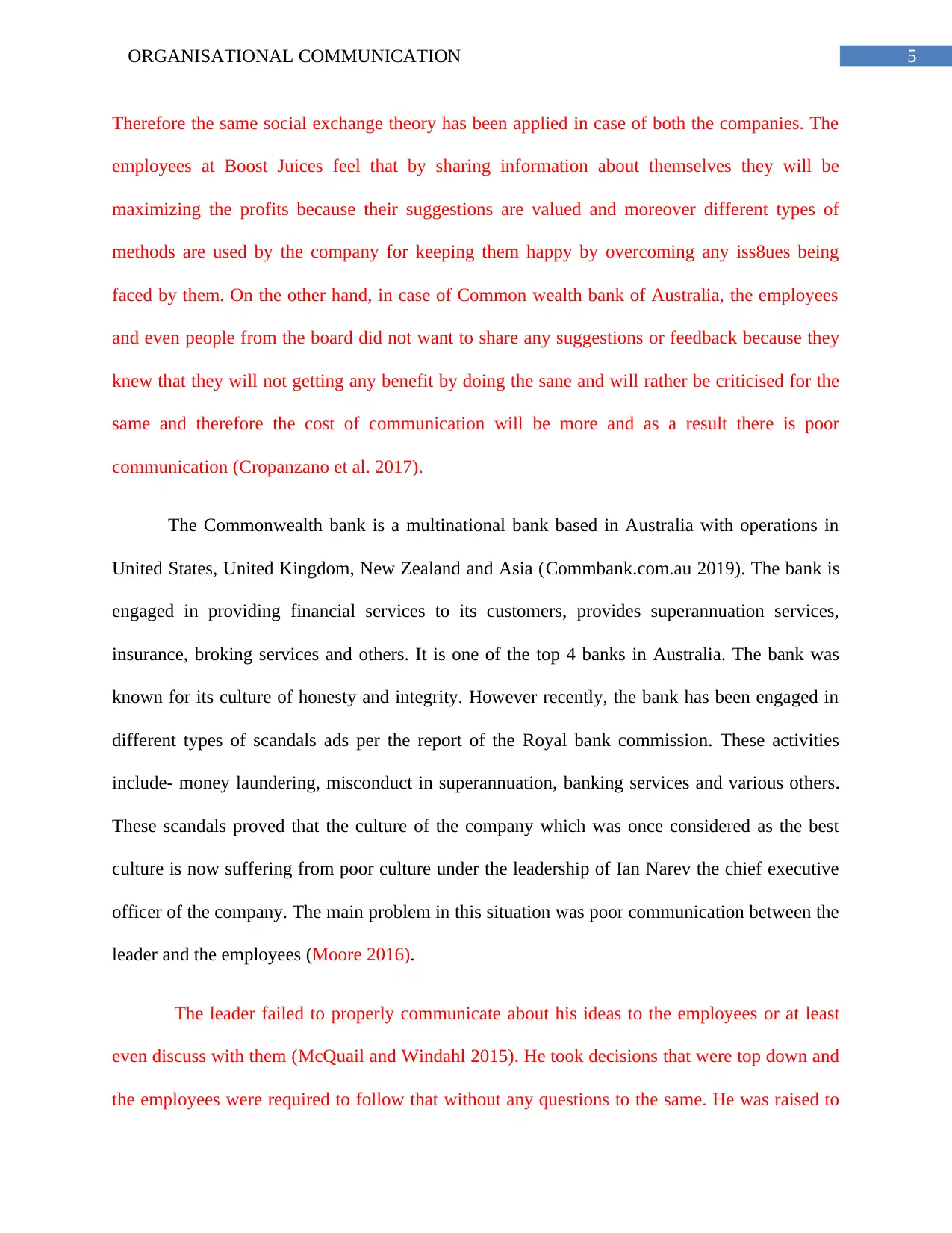
The social communication theory also needs to be understood in order to understand the
process of interpersonal communication. According to this theory, there are some specific
situations in which an individual reveals information to others. This theory explains when, where
and why people share such information regarding themselves to others. The theory is based on
the assumption that good interpersonal communication and relationship is dependent upon the
satisfaction of both the parties’ interest. Therefore as a result of social exchange, there can be
growth, development of relationship and even dissolution of relationship because the people
measure the rewards and the costs of sharing information with others and entering into an
interaction with others. Therefore through such social communication people aim at reducing the
cost and maximizing the benefits of communication and relationship.
Figure 2: Social exchange theory of interpersonal communication
Source: (Slack, Corlett and Morris 2015)
From the above diagram, it can be understood that the Communication model consists of
six main elements- the sender, the medium, the message created by the sender, the receiver, the
context and the feedback (DeVito 2019).
The social communication theory also needs to be understood in order to understand the
process of interpersonal communication. According to this theory, there are some specific
situations in which an individual reveals information to others. This theory explains when, where
and why people share such information regarding themselves to others. The theory is based on
the assumption that good interpersonal communication and relationship is dependent upon the
satisfaction of both the parties’ interest. Therefore as a result of social exchange, there can be
growth, development of relationship and even dissolution of relationship because the people
measure the rewards and the costs of sharing information with others and entering into an
interaction with others. Therefore through such social communication people aim at reducing the
cost and maximizing the benefits of communication and relationship.
Figure 2: Social exchange theory of interpersonal communication
Source: (Slack, Corlett and Morris 2015)
5ORGANISATIONAL COMMUNICATION
Therefore the same social exchange theory has been applied in case of both the companies. The
employees at Boost Juices feel that by sharing information about themselves they will be
maximizing the profits because their suggestions are valued and moreover different types of
methods are used by the company for keeping them happy by overcoming any iss8ues being
faced by them. On the other hand, in case of Common wealth bank of Australia, the employees
and even people from the board did not want to share any suggestions or feedback because they
knew that they will not getting any benefit by doing the sane and will rather be criticised for the
same and therefore the cost of communication will be more and as a result there is poor
communication (Cropanzano et al. 2017).
The Commonwealth bank is a multinational bank based in Australia with operations in
United States, United Kingdom, New Zealand and Asia (Commbank.com.au 2019). The bank is
engaged in providing financial services to its customers, provides superannuation services,
insurance, broking services and others. It is one of the top 4 banks in Australia. The bank was
known for its culture of honesty and integrity. However recently, the bank has been engaged in
different types of scandals ads per the report of the Royal bank commission. These activities
include- money laundering, misconduct in superannuation, banking services and various others.
These scandals proved that the culture of the company which was once considered as the best
culture is now suffering from poor culture under the leadership of Ian Narev the chief executive
officer of the company. The main problem in this situation was poor communication between the
leader and the employees (Moore 2016).
The leader failed to properly communicate about his ideas to the employees or at least
even discuss with them (McQuail and Windahl 2015). He took decisions that were top down and
the employees were required to follow that without any questions to the same. He was raised to
Therefore the same social exchange theory has been applied in case of both the companies. The
employees at Boost Juices feel that by sharing information about themselves they will be
maximizing the profits because their suggestions are valued and moreover different types of
methods are used by the company for keeping them happy by overcoming any iss8ues being
faced by them. On the other hand, in case of Common wealth bank of Australia, the employees
and even people from the board did not want to share any suggestions or feedback because they
knew that they will not getting any benefit by doing the sane and will rather be criticised for the
same and therefore the cost of communication will be more and as a result there is poor
communication (Cropanzano et al. 2017).
The Commonwealth bank is a multinational bank based in Australia with operations in
United States, United Kingdom, New Zealand and Asia (Commbank.com.au 2019). The bank is
engaged in providing financial services to its customers, provides superannuation services,
insurance, broking services and others. It is one of the top 4 banks in Australia. The bank was
known for its culture of honesty and integrity. However recently, the bank has been engaged in
different types of scandals ads per the report of the Royal bank commission. These activities
include- money laundering, misconduct in superannuation, banking services and various others.
These scandals proved that the culture of the company which was once considered as the best
culture is now suffering from poor culture under the leadership of Ian Narev the chief executive
officer of the company. The main problem in this situation was poor communication between the
leader and the employees (Moore 2016).
The leader failed to properly communicate about his ideas to the employees or at least
even discuss with them (McQuail and Windahl 2015). He took decisions that were top down and
the employees were required to follow that without any questions to the same. He was raised to
⊘ This is a preview!⊘
Do you want full access?
Subscribe today to unlock all pages.
Trusted by 1+ million students worldwide
6ORGANISATIONAL COMMUNICATION
his position very fast because of his leadership skills however he lacked one major skill that is
proper communication skill which not only led the company to different scandals of financial
planning and other issues but also destroyed the relationship between the leader and his
immediate subordinates and also all the other employees because most of the people were
unaware of his ideas and decisions and had no idea about the scandal at all (Shonubi et al. 2016).
In fact the lack of communication on part of the leader also created a culture of only top down
decision making and this made Catherine Livingstone stand up against her because she was not a
part of the scandal that took place was not even discussed or informed about the sane. If the then
CEO, Ian Narev had had listened to his subordinates his image as well as that of the company
would not have been hurt the way it was and as a result of the same the public lost their trust on
the company and the activities of the CEO also led the government and other external authorities
such as Royal commission to step in and to investigate into matters and it was only then when it
was find out that under the leadership of Ian Narev the culture of the company had become poor
(Scott and Davis 2015). There were scandals, there were conflicts within the company, and there
was loss of public trust and other types of losses all because of poor communication between the
leaders and the employees or the subordinates of the Organisation. Catherine Livingston stood up
against Ian Narev and the board because there was a sense of complacency in the Organisation
due to the then CEO. She was even asked to temper her sense of justice by Ian Narev when she
stood up against faulty products of the company and harmful commissions. She was never
consulted before taking the decision though she was a part of the board. She even felt that the
bank had misplaced confidence on them, where the meetings conducted were very brief, did not
ask for any reports, and was only concerned about getting acceptance from the management
(Richards et al. 2019). In the case of this company, the message or the decision of the CEO about
his position very fast because of his leadership skills however he lacked one major skill that is
proper communication skill which not only led the company to different scandals of financial
planning and other issues but also destroyed the relationship between the leader and his
immediate subordinates and also all the other employees because most of the people were
unaware of his ideas and decisions and had no idea about the scandal at all (Shonubi et al. 2016).
In fact the lack of communication on part of the leader also created a culture of only top down
decision making and this made Catherine Livingstone stand up against her because she was not a
part of the scandal that took place was not even discussed or informed about the sane. If the then
CEO, Ian Narev had had listened to his subordinates his image as well as that of the company
would not have been hurt the way it was and as a result of the same the public lost their trust on
the company and the activities of the CEO also led the government and other external authorities
such as Royal commission to step in and to investigate into matters and it was only then when it
was find out that under the leadership of Ian Narev the culture of the company had become poor
(Scott and Davis 2015). There were scandals, there were conflicts within the company, and there
was loss of public trust and other types of losses all because of poor communication between the
leaders and the employees or the subordinates of the Organisation. Catherine Livingston stood up
against Ian Narev and the board because there was a sense of complacency in the Organisation
due to the then CEO. She was even asked to temper her sense of justice by Ian Narev when she
stood up against faulty products of the company and harmful commissions. She was never
consulted before taking the decision though she was a part of the board. She even felt that the
bank had misplaced confidence on them, where the meetings conducted were very brief, did not
ask for any reports, and was only concerned about getting acceptance from the management
(Richards et al. 2019). In the case of this company, the message or the decision of the CEO about
Paraphrase This Document
Need a fresh take? Get an instant paraphrase of this document with our AI Paraphraser
7ORGANISATIONAL COMMUNICATION
faulty financial planning was never communicated to the employees, the major interference in
this case was the autocratic leadership style of the leader due to which he did not feel the
importance to consult the board members of the employees and get any suggestions from them
regarding the same. Had he communicated properly with the board and the employees he could
have made changes to the financial planning and that would have saved his image and also the
image of the bank (Sadia et al. 2016).
Therefore from the above discussion it can be understood that open communication plays
a very important role in determining the success of the Organisation. Through effective
communication the employees can understand their roles and responsibilities appropriately and
also provide suggestions and feedback to the top management regarding various Organisational
issues. Without proper communication in the Organisation sometimes the leaders take wrong
decision because they do not understand what impact their decision will have on the
Organisation as a whole because they do not communicate with their employees. Further there
can be misunderstanding between the management and the employees; there can also be different
issues such as lack of clarity of roles and responsibilities and demotivation of the employees
because they feel that they are not being heard and various other issues. Most of the successful
Organisation has open communication and proper communication such that employees can be
motivated and others. The companies chosen for the purpose of this study are Common wealth
bank and the Boost Juices Company.
faulty financial planning was never communicated to the employees, the major interference in
this case was the autocratic leadership style of the leader due to which he did not feel the
importance to consult the board members of the employees and get any suggestions from them
regarding the same. Had he communicated properly with the board and the employees he could
have made changes to the financial planning and that would have saved his image and also the
image of the bank (Sadia et al. 2016).
Therefore from the above discussion it can be understood that open communication plays
a very important role in determining the success of the Organisation. Through effective
communication the employees can understand their roles and responsibilities appropriately and
also provide suggestions and feedback to the top management regarding various Organisational
issues. Without proper communication in the Organisation sometimes the leaders take wrong
decision because they do not understand what impact their decision will have on the
Organisation as a whole because they do not communicate with their employees. Further there
can be misunderstanding between the management and the employees; there can also be different
issues such as lack of clarity of roles and responsibilities and demotivation of the employees
because they feel that they are not being heard and various other issues. Most of the successful
Organisation has open communication and proper communication such that employees can be
motivated and others. The companies chosen for the purpose of this study are Common wealth
bank and the Boost Juices Company.
8ORGANISATIONAL COMMUNICATION
References
Barnlund, D.C., 2017. A transactional model of communication. In Communication theory (pp.
47-57). Routledge.
boostjuice (2019). [online] boostjuice. Available at: https://www.boostjuice.com.au/ [Accessed
23 Sep. 2019].
Burgoon, J.K. and Buller, D.B., 2015. Interpersonal deception theory. The International
Encyclopedia of Interpersonal Communication, pp.1-6.
Chmielecki, M., 2015. Factors influencing effectiveness of internal communication. Journal of
Management and Business Administration. Central Europe, 23(2), pp.24-38.
Commbank.com.au (2019). Personal banking including accounts, credit cards and home loans -
CommBank. [online] Commbank.com.au. Available at: https://www.commbank.com.au/
[Accessed 23 Sep. 2019].
Cropanzano, R., Anthony, E.L., Daniels, S.R. and Hall, A.V., 2017. Social exchange theory: A
critical review with theoretical remedies. Academy of Management Annals, 11(1), pp.479-516.
DeVito, J.A., 2019. The interpersonal communication book. Instructor, 1, p.18.
McQuail, D. and Windahl, S., 2015. Communication models for the study of mass
communications. Routledge.
Moore, J., 2016. Where is the critical empirical interpersonal communication research? A
roadmap for future inquiry into discourse and power. Communication Theory, 27(1), pp.1-20.
References
Barnlund, D.C., 2017. A transactional model of communication. In Communication theory (pp.
47-57). Routledge.
boostjuice (2019). [online] boostjuice. Available at: https://www.boostjuice.com.au/ [Accessed
23 Sep. 2019].
Burgoon, J.K. and Buller, D.B., 2015. Interpersonal deception theory. The International
Encyclopedia of Interpersonal Communication, pp.1-6.
Chmielecki, M., 2015. Factors influencing effectiveness of internal communication. Journal of
Management and Business Administration. Central Europe, 23(2), pp.24-38.
Commbank.com.au (2019). Personal banking including accounts, credit cards and home loans -
CommBank. [online] Commbank.com.au. Available at: https://www.commbank.com.au/
[Accessed 23 Sep. 2019].
Cropanzano, R., Anthony, E.L., Daniels, S.R. and Hall, A.V., 2017. Social exchange theory: A
critical review with theoretical remedies. Academy of Management Annals, 11(1), pp.479-516.
DeVito, J.A., 2019. The interpersonal communication book. Instructor, 1, p.18.
McQuail, D. and Windahl, S., 2015. Communication models for the study of mass
communications. Routledge.
Moore, J., 2016. Where is the critical empirical interpersonal communication research? A
roadmap for future inquiry into discourse and power. Communication Theory, 27(1), pp.1-20.
⊘ This is a preview!⊘
Do you want full access?
Subscribe today to unlock all pages.
Trusted by 1+ million students worldwide
9ORGANISATIONAL COMMUNICATION
Piłat, M., 2016. How Organisational culture influences building a learning Organisation.
In Forum Scientiae Oeconomia (Vol. 4, No. 1, pp. 83-92).
Raina, R. and Roebuck, D.B., 2016. Exploring cultural influence on managerial communication
in relationship to job satisfaction, Organisational commitment, and the employees’ propensity to
leave in the insurance sector of India. International Journal of Business Communication, 53(1),
pp.97-130.
Richards, G., Yeoh, W., Chong, A.Y.L. and Popovič, A., 2019. Business intelligence
effectiveness and corporate performance management: an empirical analysis. Journal of
Computer Information Systems, 59(2), pp.188-196.
Sadia, A., Salleh, B.M., Kadir, Z.A. and Sanif, S., 2016. The relationship between organizational
communication and employees productivity with new dimensions of effective communication
flow. Journal of Business and Social Review in Emerging Economies, 2(2), pp.93-100.
Scott, W.R. and Davis, G.F., 2015. Organisations and organizing: Rational, natural and open
systems perspectives. Routledge.
Shonubi, O.A., Abdullah, N., Hashim, R. and Ab Hamid, N., 2016. Psychological influence of
organizational communication on employee job satisfaction and organizational commitment: a
review. Journal of Human Capital Development (JHCD), 9(1), pp.85-94.
Slack, R.E., Corlett, S. and Morris, R., 2015. Exploring employee engagement with (corporate)
social responsibility: A social exchange perspective on organisational participation. Journal of
Business Ethics, 127(3), pp.537-548.
Piłat, M., 2016. How Organisational culture influences building a learning Organisation.
In Forum Scientiae Oeconomia (Vol. 4, No. 1, pp. 83-92).
Raina, R. and Roebuck, D.B., 2016. Exploring cultural influence on managerial communication
in relationship to job satisfaction, Organisational commitment, and the employees’ propensity to
leave in the insurance sector of India. International Journal of Business Communication, 53(1),
pp.97-130.
Richards, G., Yeoh, W., Chong, A.Y.L. and Popovič, A., 2019. Business intelligence
effectiveness and corporate performance management: an empirical analysis. Journal of
Computer Information Systems, 59(2), pp.188-196.
Sadia, A., Salleh, B.M., Kadir, Z.A. and Sanif, S., 2016. The relationship between organizational
communication and employees productivity with new dimensions of effective communication
flow. Journal of Business and Social Review in Emerging Economies, 2(2), pp.93-100.
Scott, W.R. and Davis, G.F., 2015. Organisations and organizing: Rational, natural and open
systems perspectives. Routledge.
Shonubi, O.A., Abdullah, N., Hashim, R. and Ab Hamid, N., 2016. Psychological influence of
organizational communication on employee job satisfaction and organizational commitment: a
review. Journal of Human Capital Development (JHCD), 9(1), pp.85-94.
Slack, R.E., Corlett, S. and Morris, R., 2015. Exploring employee engagement with (corporate)
social responsibility: A social exchange perspective on organisational participation. Journal of
Business Ethics, 127(3), pp.537-548.
Paraphrase This Document
Need a fresh take? Get an instant paraphrase of this document with our AI Paraphraser
10ORGANISATIONAL COMMUNICATION
Verčič, A.T. and Vokić, N.P., 2017. Engaging employees through internal
communication. Public Relations Review, 43(5), pp.885-893.
Wood, J.T., 2015. Interpersonal communication: Everyday encounters. Nelson Education.
Verčič, A.T. and Vokić, N.P., 2017. Engaging employees through internal
communication. Public Relations Review, 43(5), pp.885-893.
Wood, J.T., 2015. Interpersonal communication: Everyday encounters. Nelson Education.

1 out of 11


Related Documents


Your All-in-One AI-Powered Toolkit for Academic Success.
+13062052269
info@desklib.com
Available 24*7 on WhatsApp / Email
![[object Object]](/_next/static/media/star-bottom.7253800d.svg)
Unlock your academic potential
Copyright © 2020–2026 A2Z Services. All Rights Reserved. Developed and managed by ZUCOL.