Investigation into Culture and Innovation at Corinthia London Hotel
VerifiedAdded on 2023/01/06
|10
|2050
|78
Project
AI Summary
This research project investigates the influence of organisational culture on innovation management, using Corinthia London as a case study. The project begins with an introduction outlining the research background, aim, objectives, questions, scope, and rationale. It then presents a literature review exploring the concepts of organisational culture and innovation management, the role of culture in the workplace, and the relationship between the two. The methodology section details the research philosophy, approach, strategy, choice, data collection methods (primary and secondary), sampling techniques, and ethical considerations. The study employs a deductive approach and a survey strategy to collect quantitative data from 40 respondents. The findings aim to identify how organisational culture impacts innovation within the hotel, providing insights into how businesses can foster a culture that supports innovation. The research concludes with a discussion of the findings, limitations, and suggestions for future research, along with a comprehensive list of references.
Research Project 7
(An investigation into the organisational culture and its
influence on innovation management. A case of study
Corinthia London)
(An investigation into the organisational culture and its
influence on innovation management. A case of study
Corinthia London)

Paraphrase This Document
Need a fresh take? Get an instant paraphrase of this document with our AI Paraphraser
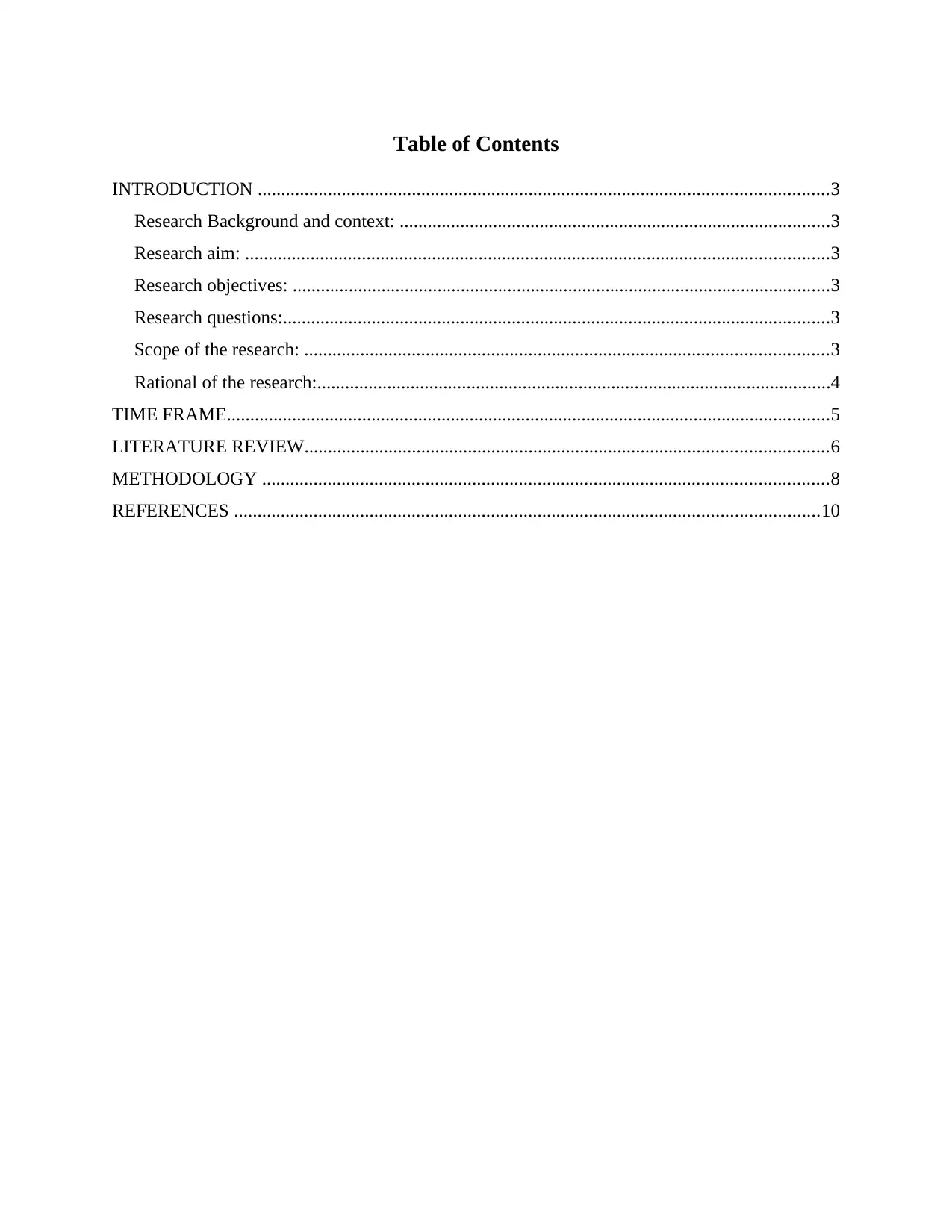
Table of Contents
INTRODUCTION ..........................................................................................................................3
Research Background and context: ............................................................................................3
Research aim: .............................................................................................................................3
Research objectives: ...................................................................................................................3
Research questions:.....................................................................................................................3
Scope of the research: ................................................................................................................3
Rational of the research:..............................................................................................................4
TIME FRAME.................................................................................................................................5
LITERATURE REVIEW................................................................................................................6
METHODOLOGY .........................................................................................................................8
REFERENCES .............................................................................................................................10
INTRODUCTION ..........................................................................................................................3
Research Background and context: ............................................................................................3
Research aim: .............................................................................................................................3
Research objectives: ...................................................................................................................3
Research questions:.....................................................................................................................3
Scope of the research: ................................................................................................................3
Rational of the research:..............................................................................................................4
TIME FRAME.................................................................................................................................5
LITERATURE REVIEW................................................................................................................6
METHODOLOGY .........................................................................................................................8
REFERENCES .............................................................................................................................10
INTRODUCTION
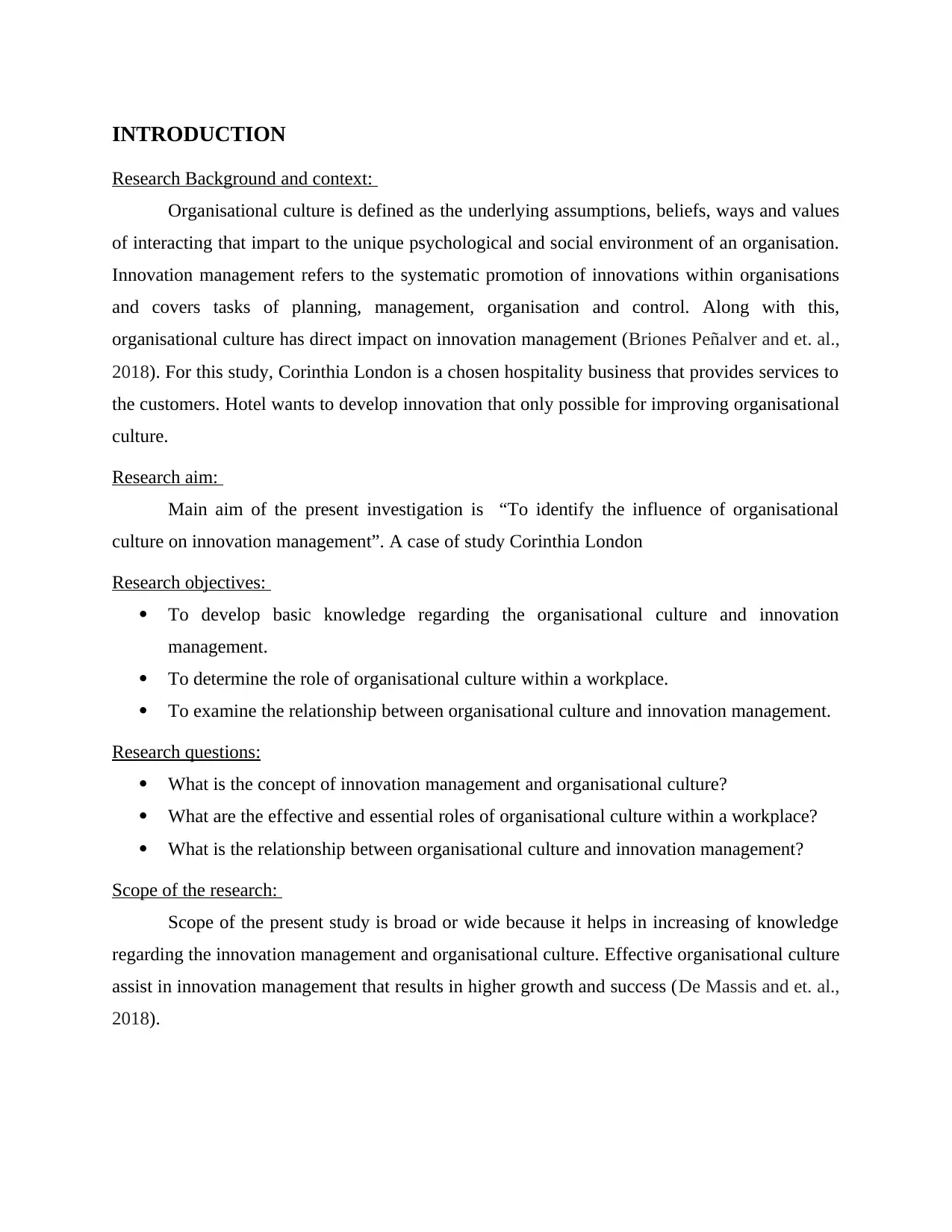
Research Background and context:
Organisational culture is defined as the underlying assumptions, beliefs, ways and values
of interacting that impart to the unique psychological and social environment of an organisation.
Innovation management refers to the systematic promotion of innovations within organisations
and covers tasks of planning, management, organisation and control. Along with this,
organisational culture has direct impact on innovation management (Briones Peñalver and et. al.,
2018). For this study, Corinthia London is a chosen hospitality business that provides services to
the customers. Hotel wants to develop innovation that only possible for improving organisational
culture.
Research aim:
Main aim of the present investigation is “To identify the influence of organisational
culture on innovation management”. A case of study Corinthia London
Research objectives:
To develop basic knowledge regarding the organisational culture and innovation
management.
To determine the role of organisational culture within a workplace.
To examine the relationship between organisational culture and innovation management.
Research questions:
What is the concept of innovation management and organisational culture?
What are the effective and essential roles of organisational culture within a workplace?
What is the relationship between organisational culture and innovation management?
Scope of the research:
Scope of the present study is broad or wide because it helps in increasing of knowledge
regarding the innovation management and organisational culture. Effective organisational culture
assist in innovation management that results in higher growth and success (De Massis and et. al.,
2018).
Research Background and context:
Organisational culture is defined as the underlying assumptions, beliefs, ways and values
of interacting that impart to the unique psychological and social environment of an organisation.
Innovation management refers to the systematic promotion of innovations within organisations
and covers tasks of planning, management, organisation and control. Along with this,
organisational culture has direct impact on innovation management (Briones Peñalver and et. al.,
2018). For this study, Corinthia London is a chosen hospitality business that provides services to
the customers. Hotel wants to develop innovation that only possible for improving organisational
culture.
Research aim:
Main aim of the present investigation is “To identify the influence of organisational
culture on innovation management”. A case of study Corinthia London
Research objectives:
To develop basic knowledge regarding the organisational culture and innovation
management.
To determine the role of organisational culture within a workplace.
To examine the relationship between organisational culture and innovation management.
Research questions:
What is the concept of innovation management and organisational culture?
What are the effective and essential roles of organisational culture within a workplace?
What is the relationship between organisational culture and innovation management?
Scope of the research:
Scope of the present study is broad or wide because it helps in increasing of knowledge
regarding the innovation management and organisational culture. Effective organisational culture
assist in innovation management that results in higher growth and success (De Massis and et. al.,
2018).
⊘ This is a preview!⊘
Do you want full access?
Subscribe today to unlock all pages.

Trusted by 1+ million students worldwide
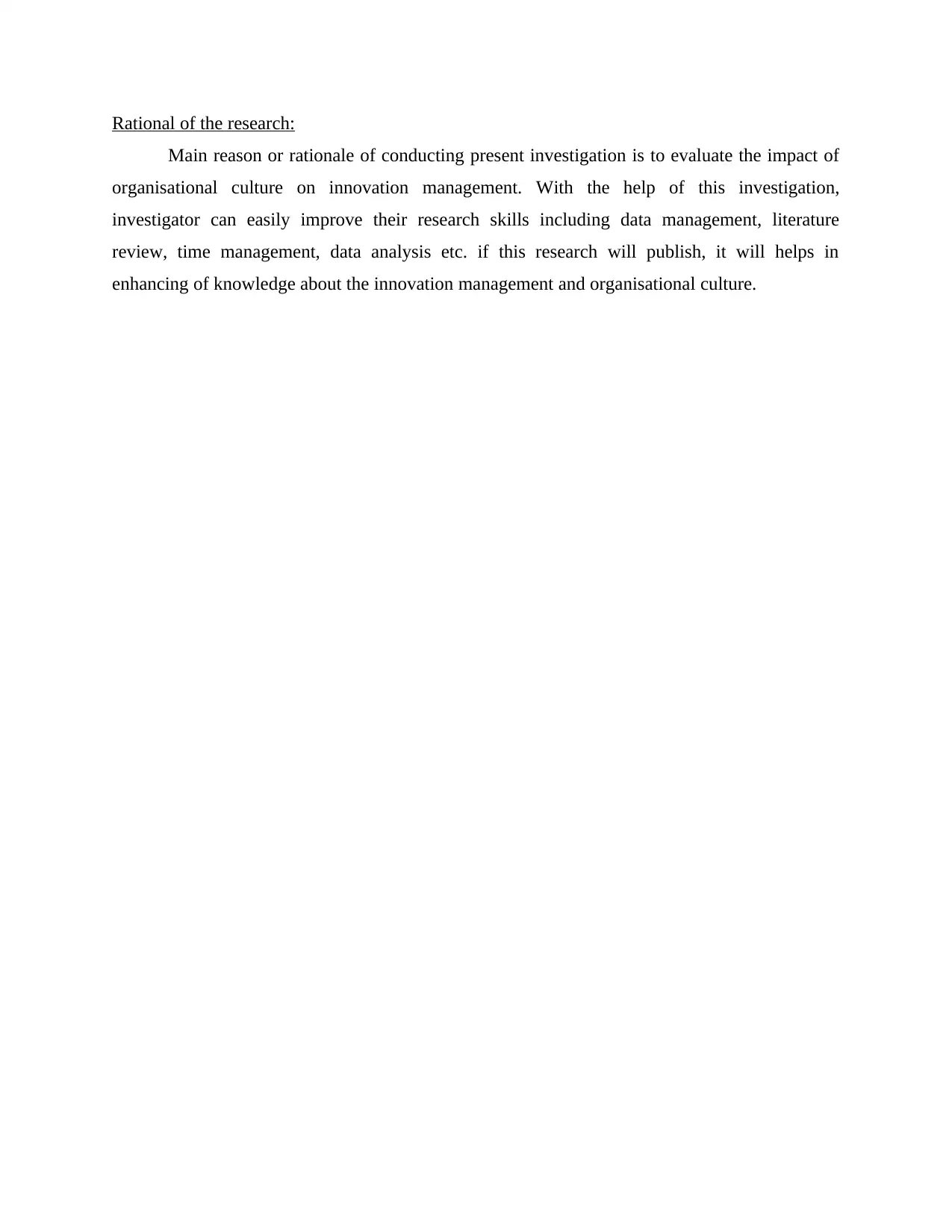
Rational of the research:
Main reason or rationale of conducting present investigation is to evaluate the impact of
organisational culture on innovation management. With the help of this investigation,
investigator can easily improve their research skills including data management, literature
review, time management, data analysis etc. if this research will publish, it will helps in
enhancing of knowledge about the innovation management and organisational culture.
Main reason or rationale of conducting present investigation is to evaluate the impact of
organisational culture on innovation management. With the help of this investigation,
investigator can easily improve their research skills including data management, literature
review, time management, data analysis etc. if this research will publish, it will helps in
enhancing of knowledge about the innovation management and organisational culture.
Paraphrase This Document
Need a fresh take? Get an instant paraphrase of this document with our AI Paraphraser
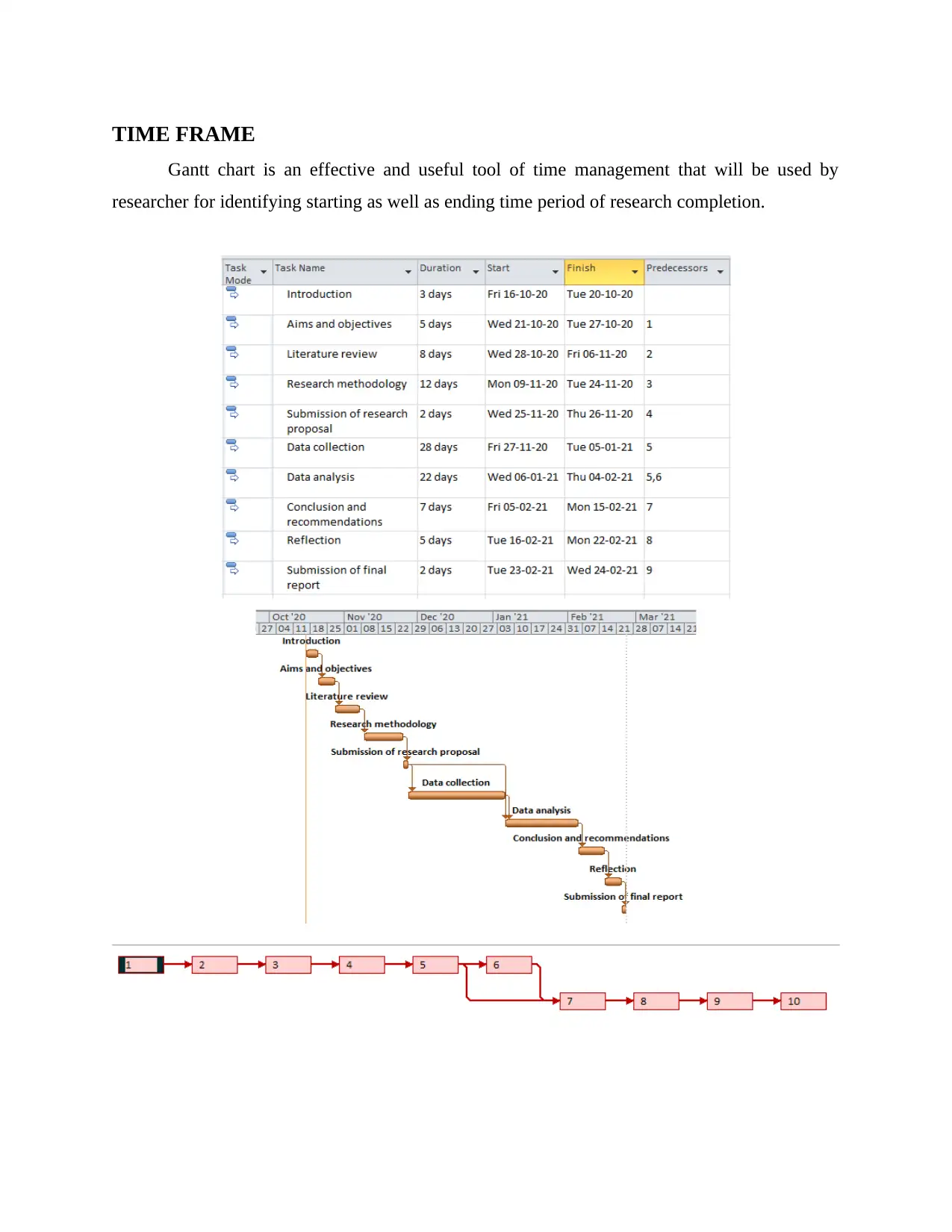
TIME FRAME
Gantt chart is an effective and useful tool of time management that will be used by
researcher for identifying starting as well as ending time period of research completion.
Gantt chart is an effective and useful tool of time management that will be used by
researcher for identifying starting as well as ending time period of research completion.
LITERATURE REVIEW
This is the procedure of secondary data collection that was gathered from various sources
including books, articles, magazines etc. This sources will be essential for researcher in
attainment of research aim and objectives through research questions. This will be explained as
below:
Basic knowledge regarding the organisational culture and innovation management
As per the view of Wong (2020), Organisational civilization is the compilation of
principles, prospect and activities that lead and notify the activities of all teammates. A great
customs demonstrates optimistic personality that guide to developed execution, while a
dysfunctional organisation customs brings out virtues that can delay even the most winning
ventures. Organisational traditions influence all factors of the business of a company from
promptness and attitude to agreement conditions and workers advantages. When place of work
ethnicity brings into line with its manpower, they are more probable to experience more comfy,
maintained and appreciated. Enterprise that priorities ethnicity can also weather complex
situation and modifies in the business atmosphere and come out stronger.
According to Nieminen (2018), Innovation administration as a term is also a source of
much deliberate. Some dispute that the very description of modernization signifies that it cannot
be administrated, whereas others are fleshy supporters in constructing schemes and activities for
the aim of making more creation. It indicates to dealing and managing of all the actions required
to establish something new within the firm which in exercise states things such as coming up
with thoughts, budding, prioritising and executing them as well as placing them in to business
activities like launching new products and introducing new interior processes.
The role of organisational culture within a workplace
According to Moseley C., (2020), Organisational culture plays an essential and crucial
role within the workplace in different manners. Some ventures that urbanized an immense
corporate culture, they maximise their kindness and got a good place in the marketplace Within
an establishment, culture unites employees through offering a sense of identity with the firm. It
helps ventures to differentiate themselves from one another and often creates commitment,
superseding personal interests. Culture also set organisational norms, rules and benchmarks.
Thereby, culture assists workforce to function in a company by teaching them how to behave.
This is the procedure of secondary data collection that was gathered from various sources
including books, articles, magazines etc. This sources will be essential for researcher in
attainment of research aim and objectives through research questions. This will be explained as
below:
Basic knowledge regarding the organisational culture and innovation management
As per the view of Wong (2020), Organisational civilization is the compilation of
principles, prospect and activities that lead and notify the activities of all teammates. A great
customs demonstrates optimistic personality that guide to developed execution, while a
dysfunctional organisation customs brings out virtues that can delay even the most winning
ventures. Organisational traditions influence all factors of the business of a company from
promptness and attitude to agreement conditions and workers advantages. When place of work
ethnicity brings into line with its manpower, they are more probable to experience more comfy,
maintained and appreciated. Enterprise that priorities ethnicity can also weather complex
situation and modifies in the business atmosphere and come out stronger.
According to Nieminen (2018), Innovation administration as a term is also a source of
much deliberate. Some dispute that the very description of modernization signifies that it cannot
be administrated, whereas others are fleshy supporters in constructing schemes and activities for
the aim of making more creation. It indicates to dealing and managing of all the actions required
to establish something new within the firm which in exercise states things such as coming up
with thoughts, budding, prioritising and executing them as well as placing them in to business
activities like launching new products and introducing new interior processes.
The role of organisational culture within a workplace
According to Moseley C., (2020), Organisational culture plays an essential and crucial
role within the workplace in different manners. Some ventures that urbanized an immense
corporate culture, they maximise their kindness and got a good place in the marketplace Within
an establishment, culture unites employees through offering a sense of identity with the firm. It
helps ventures to differentiate themselves from one another and often creates commitment,
superseding personal interests. Culture also set organisational norms, rules and benchmarks.
Thereby, culture assists workforce to function in a company by teaching them how to behave.
⊘ This is a preview!⊘
Do you want full access?
Subscribe today to unlock all pages.
Trusted by 1+ million students worldwide
Along with this, culture also plays an important role by assisting manpower in making sense of
their behaviours through offering justification for demeanour.
The relationship among organisational culture and innovation management
As per the view of Gold W., (2020), Organisational culture is included to be one of the
key factors in both developing and inhibiting innovation. Organisational culture indirectly
impacts performance by organisations innovation. In particular, the adhocracy culture has a
positive indirect impact on execution by organisation modernism whereas the hierarchy culture
has a unenthusiastic roundabout impact on execution by establishment creation. The relationship
between organisational culture and innovation is that when innovation takes place then culture
plays an effective role in it. Innovation includes of altering firms’ organisational figure, activities
and procedures in a form that is new to the company and outcomes in leveraging the enterprise’s
technical information support and its execution in forms of modernism, efficiency and rivalry. In
now these days globe that alters rapidly, they condemnation companies for their endurance on
ongoing development, utilise of superior technologies and responded to modifications in
ecological aspects. One of the potential aspects impacting the modernization of staff, the
organisational ethnicity as it is a switch that can simply make easy revolutionizes and new
instructions in a constant establishment.
their behaviours through offering justification for demeanour.
The relationship among organisational culture and innovation management
As per the view of Gold W., (2020), Organisational culture is included to be one of the
key factors in both developing and inhibiting innovation. Organisational culture indirectly
impacts performance by organisations innovation. In particular, the adhocracy culture has a
positive indirect impact on execution by organisation modernism whereas the hierarchy culture
has a unenthusiastic roundabout impact on execution by establishment creation. The relationship
between organisational culture and innovation is that when innovation takes place then culture
plays an effective role in it. Innovation includes of altering firms’ organisational figure, activities
and procedures in a form that is new to the company and outcomes in leveraging the enterprise’s
technical information support and its execution in forms of modernism, efficiency and rivalry. In
now these days globe that alters rapidly, they condemnation companies for their endurance on
ongoing development, utilise of superior technologies and responded to modifications in
ecological aspects. One of the potential aspects impacting the modernization of staff, the
organisational ethnicity as it is a switch that can simply make easy revolutionizes and new
instructions in a constant establishment.
Paraphrase This Document
Need a fresh take? Get an instant paraphrase of this document with our AI Paraphraser
METHODOLOGY
It is an important part of research which defines the activities requires to undertake while
carrying our research work. It consists of different methodologies which are used to make
research more effective. Here are such methodologies that researcher should consider and choose
appropriate one according to the suitability of research topic:
Research philosophy: It consists of two philosophies such as positivism and
interpretivisim. To carry out present research work in more effective manner, positivism
philosophy is best to adopt as it requires minimum time for collecting quantitative information
which is difficult to interpret (Frishammar and et. al., 2019).
Research approach: It contains two parts such as inductive and deductive approach
which are important to examine in order to analyse their merits and demerits of using under
research. In the present study, deductive approach is more suitable to adopt as it drives
researcher to clearly analysing the quantitative data within less time period which allows
researcher to focus on other important research work.
Research strategy: It consists of different strategies for gathering data related with the
topic of research i.e. An investigation into the organisational culture and its influence on
innovation management. It includes action research, analysis of case study, carrying out survey
etc. All these are suitable to gather data related with identification of organisational culture on
innovation management. In the present study, survey strategy is adopted as it assists researcher to
collect responses from large number of people in more accurate and reliable way.
Research choice: It consists of two choices among which researcher should adopt one
according to the availability of resources. It includes qualitative and quantitative. In the present
study, quantitative research is suitable to conduct as it allows researcher to gather data that
reflects in numerical terms within less time period (Kraśnicka, Głód and Wronka-Pośpiech,
2018).
Data collection: It consists of different methods having own benefits and drawbacks of
adopting. It includes primary and secondary method of data collection. Primary method contains
accurate and reliable data as compared with secondary method but consumes more time and
funds. In the present study of research work, both primary and secondary method are adopted in
which questionnaire is used to collect primary data whwereas articles, books etc. are used to
collect secondary data.
It is an important part of research which defines the activities requires to undertake while
carrying our research work. It consists of different methodologies which are used to make
research more effective. Here are such methodologies that researcher should consider and choose
appropriate one according to the suitability of research topic:
Research philosophy: It consists of two philosophies such as positivism and
interpretivisim. To carry out present research work in more effective manner, positivism
philosophy is best to adopt as it requires minimum time for collecting quantitative information
which is difficult to interpret (Frishammar and et. al., 2019).
Research approach: It contains two parts such as inductive and deductive approach
which are important to examine in order to analyse their merits and demerits of using under
research. In the present study, deductive approach is more suitable to adopt as it drives
researcher to clearly analysing the quantitative data within less time period which allows
researcher to focus on other important research work.
Research strategy: It consists of different strategies for gathering data related with the
topic of research i.e. An investigation into the organisational culture and its influence on
innovation management. It includes action research, analysis of case study, carrying out survey
etc. All these are suitable to gather data related with identification of organisational culture on
innovation management. In the present study, survey strategy is adopted as it assists researcher to
collect responses from large number of people in more accurate and reliable way.
Research choice: It consists of two choices among which researcher should adopt one
according to the availability of resources. It includes qualitative and quantitative. In the present
study, quantitative research is suitable to conduct as it allows researcher to gather data that
reflects in numerical terms within less time period (Kraśnicka, Głód and Wronka-Pośpiech,
2018).
Data collection: It consists of different methods having own benefits and drawbacks of
adopting. It includes primary and secondary method of data collection. Primary method contains
accurate and reliable data as compared with secondary method but consumes more time and
funds. In the present study of research work, both primary and secondary method are adopted in
which questionnaire is used to collect primary data whwereas articles, books etc. are used to
collect secondary data.
Sampling: It is the number of people whose views and opinions related with the topic of
research are undertaken. It includes customers, employees, suppliers etc. It comprises of two
methods such as probability and non-probability. In the present study of research work,
probability technique is used as it makes easy for researcher to select large number of
respondents within less time period. 40 respondents are undertake as sample size in the present
research.
Research ethics: It is an essential part of research which is required to consider by the
researcher to make research work more effective. For this, researcher should work ethically
without affecting interest of any respondent (Tian and et. al., 2018). It consists of different
principles such as respect of person, getting consent, maintaining confidentiality etc. In the
present research, researcher conducts research ethically by ensuring respondents that their
personal information should not be disclosed in public if providing accurate and reliable data.
research are undertaken. It includes customers, employees, suppliers etc. It comprises of two
methods such as probability and non-probability. In the present study of research work,
probability technique is used as it makes easy for researcher to select large number of
respondents within less time period. 40 respondents are undertake as sample size in the present
research.
Research ethics: It is an essential part of research which is required to consider by the
researcher to make research work more effective. For this, researcher should work ethically
without affecting interest of any respondent (Tian and et. al., 2018). It consists of different
principles such as respect of person, getting consent, maintaining confidentiality etc. In the
present research, researcher conducts research ethically by ensuring respondents that their
personal information should not be disclosed in public if providing accurate and reliable data.
⊘ This is a preview!⊘
Do you want full access?
Subscribe today to unlock all pages.
Trusted by 1+ million students worldwide
REFERENCES
Books and journals
Briones Peñalver, A. J. and et. al., 2018. Analysis of corporate social responsibility in Spanish
agribusiness and its influence on innovation and performance. Corporate Social
Responsibility and Environmental Management. 25(2). pp.182-193.
De Massis, A. and et. al., 2018. Innovation with Limited Resources: Management Lessons from
the G erman M ittelstand. Journal of Product Innovation Management. 35(1). pp.125-
146.
Frishammar, J. and et. al., 2019. Opportunities and challenges in the new innovation landscape:
Implications for innovation auditing and innovation management. European
Management Journal. 37(2). pp.151-164.
Kraśnicka, T., Głód, W. and Wronka-Pośpiech, M., 2018. Management innovation, pro-
innovation organisational culture and enterprise performance: testing the mediation
effect. Review of Managerial Science. 12(3). pp.737-769.
Tian, M. and et. al., 2018. How does culture influence innovation? A systematic literature
review. Management Decision.
Online
Wong K., 2020. Organizational Culture: Definition, Importance, and Development. [Online].
Available Through: < https://www.achievers.com/blog/organizational-culture-
definition/#:~:text=Organizational%20culture%20is%20the%20collection,your
%20company%20what%20it%20is.>.
Nieminen J., 2019. Innovation Management. [Online]. Available Through: <
https://www.viima.com/blog/innovation-management>.
Organizational Culture: Definition, Characteristics, Roles, Types. 2020. [Online]. Available
Through: < https://www.iedunote.com/organizational-culture>.
Relationship between Organizational Culture and Innovation with the Mediation of Job
Enrichment in the Fars Governor's Staff. 2020. [Online]. Available Through: <
https://www.questia.com/library/journal/1P3-4055683971/relationship-between-
organizational-culture-and-innovation>.
Gold W. 2020. THE RELATIONSHIPS BETWEEN ORGANISATIONAL CULTURE AND
MANAGEMENT INNOVATION IN POLISH ENTERPRISES. [Online]. Available
Through: <
https://www.researchgate.net/publication/281784932_THE_RELATIONSHIPS_BETW
EEN_ORGANISATIONAL_CULTURE_AND_MANAGEMENT_INNOVATION_IN
_POLISH_ENTERPRISES>.
Books and journals
Briones Peñalver, A. J. and et. al., 2018. Analysis of corporate social responsibility in Spanish
agribusiness and its influence on innovation and performance. Corporate Social
Responsibility and Environmental Management. 25(2). pp.182-193.
De Massis, A. and et. al., 2018. Innovation with Limited Resources: Management Lessons from
the G erman M ittelstand. Journal of Product Innovation Management. 35(1). pp.125-
146.
Frishammar, J. and et. al., 2019. Opportunities and challenges in the new innovation landscape:
Implications for innovation auditing and innovation management. European
Management Journal. 37(2). pp.151-164.
Kraśnicka, T., Głód, W. and Wronka-Pośpiech, M., 2018. Management innovation, pro-
innovation organisational culture and enterprise performance: testing the mediation
effect. Review of Managerial Science. 12(3). pp.737-769.
Tian, M. and et. al., 2018. How does culture influence innovation? A systematic literature
review. Management Decision.
Online
Wong K., 2020. Organizational Culture: Definition, Importance, and Development. [Online].
Available Through: < https://www.achievers.com/blog/organizational-culture-
definition/#:~:text=Organizational%20culture%20is%20the%20collection,your
%20company%20what%20it%20is.>.
Nieminen J., 2019. Innovation Management. [Online]. Available Through: <
https://www.viima.com/blog/innovation-management>.
Organizational Culture: Definition, Characteristics, Roles, Types. 2020. [Online]. Available
Through: < https://www.iedunote.com/organizational-culture>.
Relationship between Organizational Culture and Innovation with the Mediation of Job
Enrichment in the Fars Governor's Staff. 2020. [Online]. Available Through: <
https://www.questia.com/library/journal/1P3-4055683971/relationship-between-
organizational-culture-and-innovation>.
Gold W. 2020. THE RELATIONSHIPS BETWEEN ORGANISATIONAL CULTURE AND
MANAGEMENT INNOVATION IN POLISH ENTERPRISES. [Online]. Available
Through: <
https://www.researchgate.net/publication/281784932_THE_RELATIONSHIPS_BETW
EEN_ORGANISATIONAL_CULTURE_AND_MANAGEMENT_INNOVATION_IN
_POLISH_ENTERPRISES>.

1 out of 10


Related Documents


Your All-in-One AI-Powered Toolkit for Academic Success.
+13062052269
info@desklib.com
Available 24*7 on WhatsApp / Email
![[object Object]](/_next/static/media/star-bottom.7253800d.svg)
Unlock your academic potential
Copyright © 2020–2026 A2Z Services. All Rights Reserved. Developed and managed by ZUCOL.