A David & Co Limited: Organisational Behaviour Report Analysis
VerifiedAdded on 2020/10/22
|17
|4499
|62
Report
AI Summary
This report provides a comprehensive analysis of organisational behaviour, focusing on the impact of culture, politics, and power on individual and team performance within the context of A David & Co Limited, a food and beverage company. The report examines how organisational culture, including clan, adhocracy, market, and hierarchy cultures, influences employee interaction, motivation, and overall productivity. It explores the effects of organisational politics, both positive and negative, on employee performance and the work environment. The report also delves into the various types of power, such as coercive, connection, and reward power, and their influence on teams and individuals. Furthermore, the report evaluates content theories (Maslow's Need Hierarchy, Herzberg's Motivation-Hygiene theory, McClelland's Needs Theory, Alderfer's ERG theory) and process theories (Vroom's expectancy, Adam's equity theory, Goals setting theory, Reinforcement theory) of motivation, providing insights into how these theories can be applied to enhance employee motivation and achieve organisational goals. The report also contrasts effective and ineffective teams, highlighting the characteristics that contribute to team success and organisational productivity.
Organisational
Behaviour
Behaviour

Paraphrase This Document
Need a fresh take? Get an instant paraphrase of this document with our AI Paraphraser
Table of Contents
.........................................................................................................................................................3
INTRODUCTION ..........................................................................................................................3
TASK 1 ...........................................................................................................................................4
P1 How an organisation’s culture, politics and power influence individual and team ..............4
P2 Evaluate how content and process theories of motivation in the context of organisation.....1
Content Theories:.............................................................................................................................1
Process Theory:................................................................................................................................2
P3 Effective team opposed to an ineffective team .....................................................................3
P4 Apply concepts of organisational behaviour to the context of organisation..........................6
CONCLUSION ...............................................................................................................................8
.........................................................................................................................................................8
....................................................................................................................................................8
.........................................................................................................................................................3
INTRODUCTION ..........................................................................................................................3
TASK 1 ...........................................................................................................................................4
P1 How an organisation’s culture, politics and power influence individual and team ..............4
P2 Evaluate how content and process theories of motivation in the context of organisation.....1
Content Theories:.............................................................................................................................1
Process Theory:................................................................................................................................2
P3 Effective team opposed to an ineffective team .....................................................................3
P4 Apply concepts of organisational behaviour to the context of organisation..........................6
CONCLUSION ...............................................................................................................................8
.........................................................................................................................................................8
....................................................................................................................................................8

⊘ This is a preview!⊘
Do you want full access?
Subscribe today to unlock all pages.

Trusted by 1+ million students worldwide
INTRODUCTION
Organisation behaviour is the study in which individual and group are analysed on in the
context of the behaviour. It studies about the overall aspect of the human behaviour that helps
improving the performance the specific person. It is very important to study the overall
behaviour of employees working in the organisation as it helps in understanding that why the
particular type of behaviour is observed in individual. So it always help in studying the complex
nature of a person as well it also identifies that what are the main causes of such type of
behaviour (Ashkanasy and Humphrey, 2011). A David & Co Limited is an industry related to
food and beverages sector industry. The company offers the range of products like dairy, bakery
and frozen products, company also offers the fresh fruits, vegetable and various herbs. The report
will include influence of culture, politics and power and different things to improve the
efficiency of the organisation.
TASK 1
P1 How an organisation’s culture, politics and power influence individual and team
The organisation culture is all about various ideas believes and assumption that helps in
contributing the over all social and economical environment of an organisation. The performance
and productivity and performance are also get affected by the various culture in the organisation .
The organisation culture is overall based upon the nature of the person as well as in its beliefs
and customs value. The organisation culture helps in understanding the different roles and traits
of the individual employee. The overall culture in an organisation decides how the employees
will interact to their workplace. The healthy culture always helps in motivating as well as
satisfying the employees (Ates and Bititci, 2011).
The effective culture always tries to make the unity towards the work for employee which
belongs from the different background. The culture of the work always helps in promoting the
effective and health relationship between the employee and the organisation. By only having the
efficient culture in an organisation the best outcome of the individual can be achieved. There are
various types of culture in an organisation which are as follows.
Clan culture- This the basic or the most classical form of the culture which has the
healthy working and friendly environment. All the leaders and the mentors are like the father
figure to the different working employee. The overall culture is joined together by the loyalty
Organisation behaviour is the study in which individual and group are analysed on in the
context of the behaviour. It studies about the overall aspect of the human behaviour that helps
improving the performance the specific person. It is very important to study the overall
behaviour of employees working in the organisation as it helps in understanding that why the
particular type of behaviour is observed in individual. So it always help in studying the complex
nature of a person as well it also identifies that what are the main causes of such type of
behaviour (Ashkanasy and Humphrey, 2011). A David & Co Limited is an industry related to
food and beverages sector industry. The company offers the range of products like dairy, bakery
and frozen products, company also offers the fresh fruits, vegetable and various herbs. The report
will include influence of culture, politics and power and different things to improve the
efficiency of the organisation.
TASK 1
P1 How an organisation’s culture, politics and power influence individual and team
The organisation culture is all about various ideas believes and assumption that helps in
contributing the over all social and economical environment of an organisation. The performance
and productivity and performance are also get affected by the various culture in the organisation .
The organisation culture is overall based upon the nature of the person as well as in its beliefs
and customs value. The organisation culture helps in understanding the different roles and traits
of the individual employee. The overall culture in an organisation decides how the employees
will interact to their workplace. The healthy culture always helps in motivating as well as
satisfying the employees (Ates and Bititci, 2011).
The effective culture always tries to make the unity towards the work for employee which
belongs from the different background. The culture of the work always helps in promoting the
effective and health relationship between the employee and the organisation. By only having the
efficient culture in an organisation the best outcome of the individual can be achieved. There are
various types of culture in an organisation which are as follows.
Clan culture- This the basic or the most classical form of the culture which has the
healthy working and friendly environment. All the leaders and the mentors are like the father
figure to the different working employee. The overall culture is joined together by the loyalty
Paraphrase This Document
Need a fresh take? Get an instant paraphrase of this document with our AI Paraphraser
and process of tradition. This culture follows the long term development of the human resource
process. In this type of culture the leader are mentor and team builder. This culture improves the
effective building of team as well as the open communication channel in an organisation.
Androcracy culture- The overall culture which have a very creative and dynamic
environment to work. In short it follows the entrepreneurial spirit which means in this type of
culture in an organisation. The leader acts as the innovator and risk taking person in an
organisation. The long term goal of this type of culture is to grow and to create some new type of
resources. This type of culture promotes the freedom in the working environment. The leader in
this type of culture are the innovators and entrepreneur. This type of culture helps in creating the
new standards and in the continuous environment in an organisation (Avey, Palanski and
Walumbwa, 2011).
Market culture- This culture follows the result based working process this culture
believes in getting things done and finishing the work as soon as possible. The overall reputation
and the success are most important in this type of culture. They give the long tern focus on
reaching the goal. They measures the preference of client and then tries to improve the
productivity.
Hierarchy culture-This is the most formal type of culture which is well structured and
organised. The overall structure of the organisation will decide various procedures of doing
work. This type of culture gives focus on running smoothly for the longer period of time .The
leaders in these type of organisation are the organiser and coordinator of task. This type of
culture is much more effective that any other type of organisational culture.
Politics- It is the process of making a decision which applies to the various member of an
organisation. while in an organisation the good politics helps in improving the performance of
the organisation and bad politics reduces the performance of an employee. Bad politics refers to
the illogical behaviour of an employee in an working environment. There are various effects of
politics which are as follows
Decreases the overall productivity- The politics decreases the overall output of he
individual performer in an organisation. It also have been observed that specific persona who
plays the politics always pays less attention to their work. As the result obtained after politics is
that employees fail to achieve the target that has been employed to them.
process. In this type of culture the leader are mentor and team builder. This culture improves the
effective building of team as well as the open communication channel in an organisation.
Androcracy culture- The overall culture which have a very creative and dynamic
environment to work. In short it follows the entrepreneurial spirit which means in this type of
culture in an organisation. The leader acts as the innovator and risk taking person in an
organisation. The long term goal of this type of culture is to grow and to create some new type of
resources. This type of culture promotes the freedom in the working environment. The leader in
this type of culture are the innovators and entrepreneur. This type of culture helps in creating the
new standards and in the continuous environment in an organisation (Avey, Palanski and
Walumbwa, 2011).
Market culture- This culture follows the result based working process this culture
believes in getting things done and finishing the work as soon as possible. The overall reputation
and the success are most important in this type of culture. They give the long tern focus on
reaching the goal. They measures the preference of client and then tries to improve the
productivity.
Hierarchy culture-This is the most formal type of culture which is well structured and
organised. The overall structure of the organisation will decide various procedures of doing
work. This type of culture gives focus on running smoothly for the longer period of time .The
leaders in these type of organisation are the organiser and coordinator of task. This type of
culture is much more effective that any other type of organisational culture.
Politics- It is the process of making a decision which applies to the various member of an
organisation. while in an organisation the good politics helps in improving the performance of
the organisation and bad politics reduces the performance of an employee. Bad politics refers to
the illogical behaviour of an employee in an working environment. There are various effects of
politics which are as follows
Decreases the overall productivity- The politics decreases the overall output of he
individual performer in an organisation. It also have been observed that specific persona who
plays the politics always pays less attention to their work. As the result obtained after politics is
that employees fail to achieve the target that has been employed to them.
Spoils the overall environment-The politics lead to the negative environment in an
organisation. This spoils the overall working area of the environment as well as the relationship
between the various workers working in an organisation.
Demotivation of employees – Due to the politics a non performer of the task could also
be considered as good performer and the biggest reason behind this is politics. The employee
playing the politics always destroys the opportunity and image of other person working in an
organisation.
Power -It is an ability to get control over the person. Every person and an individual has
a power and it depends on then how do they use it in a proper and effective way. There are
several types of power which influences the team and the performance of the individual and
these are as follows.
Coercive power- The type of power in which the person is able to punish the workers
there employee are not following the order that are been given to to them. But this type of power
cannot be used on the basis on the regular basis as fear and dysfunctionality in the work can
appear at time of the result (Boje, Burnes and Hassard, 2011). This type of power is only used on
the workers when there is no satisfactory result is coming out of the given work.
Connection power- By listening and knowing the people carefully the person can be
influenced and the a connection is developed between the sender and the receiver. By increasing
and maintaining the connection networking can be improved which helps in developing the
potential.
Reward power- The ability to give the reward to an effective performer is considered as
the reward power. when rewards are given by the strategic process then it also influences the
other employees to work hard.
organisation. This spoils the overall working area of the environment as well as the relationship
between the various workers working in an organisation.
Demotivation of employees – Due to the politics a non performer of the task could also
be considered as good performer and the biggest reason behind this is politics. The employee
playing the politics always destroys the opportunity and image of other person working in an
organisation.
Power -It is an ability to get control over the person. Every person and an individual has
a power and it depends on then how do they use it in a proper and effective way. There are
several types of power which influences the team and the performance of the individual and
these are as follows.
Coercive power- The type of power in which the person is able to punish the workers
there employee are not following the order that are been given to to them. But this type of power
cannot be used on the basis on the regular basis as fear and dysfunctionality in the work can
appear at time of the result (Boje, Burnes and Hassard, 2011). This type of power is only used on
the workers when there is no satisfactory result is coming out of the given work.
Connection power- By listening and knowing the people carefully the person can be
influenced and the a connection is developed between the sender and the receiver. By increasing
and maintaining the connection networking can be improved which helps in developing the
potential.
Reward power- The ability to give the reward to an effective performer is considered as
the reward power. when rewards are given by the strategic process then it also influences the
other employees to work hard.
⊘ This is a preview!⊘
Do you want full access?
Subscribe today to unlock all pages.
Trusted by 1+ million students worldwide
P2 Evaluate how content and process theories of motivation in the context of organisation
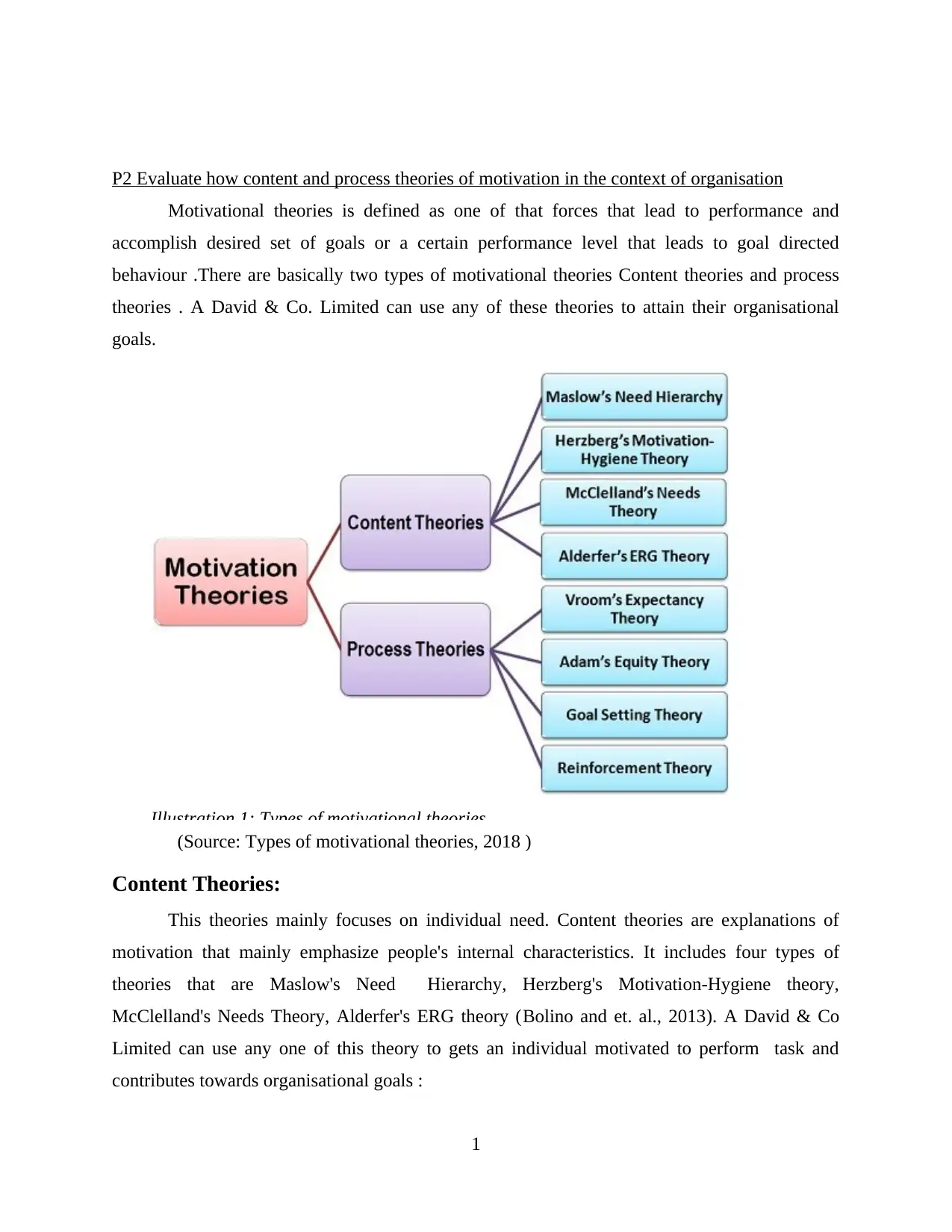
Motivational theories is defined as one of that forces that lead to performance and
accomplish desired set of goals or a certain performance level that leads to goal directed
behaviour .There are basically two types of motivational theories Content theories and process
theories . A David & Co. Limited can use any of these theories to attain their organisational
goals.
(Source: Types of motivational theories, 2018 )
Content Theories:
This theories mainly focuses on individual need. Content theories are explanations of
motivation that mainly emphasize people's internal characteristics. It includes four types of
theories that are Maslow's Need Hierarchy, Herzberg's Motivation-Hygiene theory,
McClelland's Needs Theory, Alderfer's ERG theory (Bolino and et. al., 2013). A David & Co
Limited can use any one of this theory to gets an individual motivated to perform task and
contributes towards organisational goals :
1
Illustration 1: Types of motivational theories
Motivational theories is defined as one of that forces that lead to performance and
accomplish desired set of goals or a certain performance level that leads to goal directed
behaviour .There are basically two types of motivational theories Content theories and process
theories . A David & Co. Limited can use any of these theories to attain their organisational
goals.
(Source: Types of motivational theories, 2018 )
Content Theories:
This theories mainly focuses on individual need. Content theories are explanations of
motivation that mainly emphasize people's internal characteristics. It includes four types of
theories that are Maslow's Need Hierarchy, Herzberg's Motivation-Hygiene theory,
McClelland's Needs Theory, Alderfer's ERG theory (Bolino and et. al., 2013). A David & Co
Limited can use any one of this theory to gets an individual motivated to perform task and
contributes towards organisational goals :
1
Illustration 1: Types of motivational theories
Paraphrase This Document
Need a fresh take? Get an instant paraphrase of this document with our AI Paraphraser
Maslow's Need Hierarchy:
This theory is given by Abraham Maslow. This theory is based on simple premise i.e A
theory of human motivation are some of needs present that are basic to all human beings,If
these need are satisfied in an organisation job performance will increase . There are basically five
needs of Maslow's Hierarchy that starts from bottom to top and that are Physiological, Safety,
Social, Esteem and self-Actualisation.
Physiological needs: This is most basic need as it is foundation of Maslow's hierarchy
which mainly includes needs that are related to one's survival need for
food,water,breathing, sleep and other biological needs are required in this theory.
Safety needs: It is concerned with free from the threat of pain,Security of body, danger
security of family safety of health and property, personal security, financial security
safety against accidents,illness and their adverse impacts (Carpenter, Berry and Houston,
2014). This need is one of the basic and evolutionary needs.
Social needs: It is the third level of Maslow's hierarchy . This need refers to attachments
of friendship, family love and bond desire for interpersonal attachments as a human
motivation. Social needs mainly includes such things as love,acceptance and belonging in
it. This stage is very important part of psychological development because relationship
with others can mostly reduce emotional concern such as depression and anxiety.
Esteem needs: It relates to desire to be respected, respect of others and respect by others
to feel important and be appreciated.
Self- actualisation: At last to highest level of the hierarchy, need of Self-actualisation
defines desire to acquire new skills, take new challenges and attainment of goals . By
fulfilling these needs A David & Co. Limited can satisfy the different needs of each
employee , organisation and ensure a highly motivated workforce.
Process Theory:
This theory of motivation is mainly focuses on the psychological process which affects
motivation with regard to the expectations, goals. Process theory mainly includes four types of
theory that are Vroom's expectancy, Adam's equity theory, Goals setting theory, Reinforcement
2
This theory is given by Abraham Maslow. This theory is based on simple premise i.e A
theory of human motivation are some of needs present that are basic to all human beings,If
these need are satisfied in an organisation job performance will increase . There are basically five
needs of Maslow's Hierarchy that starts from bottom to top and that are Physiological, Safety,
Social, Esteem and self-Actualisation.
Physiological needs: This is most basic need as it is foundation of Maslow's hierarchy
which mainly includes needs that are related to one's survival need for
food,water,breathing, sleep and other biological needs are required in this theory.
Safety needs: It is concerned with free from the threat of pain,Security of body, danger
security of family safety of health and property, personal security, financial security
safety against accidents,illness and their adverse impacts (Carpenter, Berry and Houston,
2014). This need is one of the basic and evolutionary needs.
Social needs: It is the third level of Maslow's hierarchy . This need refers to attachments
of friendship, family love and bond desire for interpersonal attachments as a human
motivation. Social needs mainly includes such things as love,acceptance and belonging in
it. This stage is very important part of psychological development because relationship
with others can mostly reduce emotional concern such as depression and anxiety.
Esteem needs: It relates to desire to be respected, respect of others and respect by others
to feel important and be appreciated.
Self- actualisation: At last to highest level of the hierarchy, need of Self-actualisation
defines desire to acquire new skills, take new challenges and attainment of goals . By
fulfilling these needs A David & Co. Limited can satisfy the different needs of each
employee , organisation and ensure a highly motivated workforce.
Process Theory:
This theory of motivation is mainly focuses on the psychological process which affects
motivation with regard to the expectations, goals. Process theory mainly includes four types of
theory that are Vroom's expectancy, Adam's equity theory, Goals setting theory, Reinforcement
2
theory (West and Lyubovnikova, 2013). A David & Co Limited can use any one of these to
achieve their organisational targets.
Goals setting theory:
It is a technique used to raise incentives for employees to complete work quickly and
effectively. Goal setting leads not only to better organisational performance by increasing
motivation and efforts but also through increasing and improving the feedback qualities. A David
& Co. Limited can set task-related specific goals to increase performance and improve major
source of motivation for employees basically this motivation theory signifies that specific and
difficult goals,with self-generated feedback can lead to higher performance . Goal setting
involves the development of action plan that is designed to guide and motivate an individual or a
group to work towards desired goals (Choi, 2011).
By using these theories organisation can increase their labour turnover and fulfil the
needs of their desired set of goals in an very effective and efficient manner. A David & Co.
Limited by using these technique can plays a critical role in employee production and
productivity and enhance quality and speed of their work.
P3 Effective team opposed to an ineffective team
Team:
Team refers to group of individuals who works together to deliver a particular products
and services for achieving a common objective. Teams plays a crucial role in overall success of
business entity. For Instance- Teams of A David & Co. bring uniformity in organisation and
increase healthy competitive environment.
Characteristics of teams are:-
There is clear understanding among employees toward their objectives
It helps in generating mutual co-operation among staff members It makes employees to communicate pro actively in an organisation
Effective Team:
Effective team refers to team who helps a organisation to increase it's productivity and
employees motivation (Wagner and et. al., 2012). In this report teams of chosen organisation A
David & Co. not only share information but also share responsibilities of their work to increase
efficiency in a organisation.
3
achieve their organisational targets.
Goals setting theory:
It is a technique used to raise incentives for employees to complete work quickly and
effectively. Goal setting leads not only to better organisational performance by increasing
motivation and efforts but also through increasing and improving the feedback qualities. A David
& Co. Limited can set task-related specific goals to increase performance and improve major
source of motivation for employees basically this motivation theory signifies that specific and
difficult goals,with self-generated feedback can lead to higher performance . Goal setting
involves the development of action plan that is designed to guide and motivate an individual or a
group to work towards desired goals (Choi, 2011).
By using these theories organisation can increase their labour turnover and fulfil the
needs of their desired set of goals in an very effective and efficient manner. A David & Co.
Limited by using these technique can plays a critical role in employee production and
productivity and enhance quality and speed of their work.
P3 Effective team opposed to an ineffective team
Team:
Team refers to group of individuals who works together to deliver a particular products
and services for achieving a common objective. Teams plays a crucial role in overall success of
business entity. For Instance- Teams of A David & Co. bring uniformity in organisation and
increase healthy competitive environment.
Characteristics of teams are:-
There is clear understanding among employees toward their objectives
It helps in generating mutual co-operation among staff members It makes employees to communicate pro actively in an organisation
Effective Team:
Effective team refers to team who helps a organisation to increase it's productivity and
employees motivation (Wagner and et. al., 2012). In this report teams of chosen organisation A
David & Co. not only share information but also share responsibilities of their work to increase
efficiency in a organisation.
3
⊘ This is a preview!⊘
Do you want full access?
Subscribe today to unlock all pages.
Trusted by 1+ million students worldwide
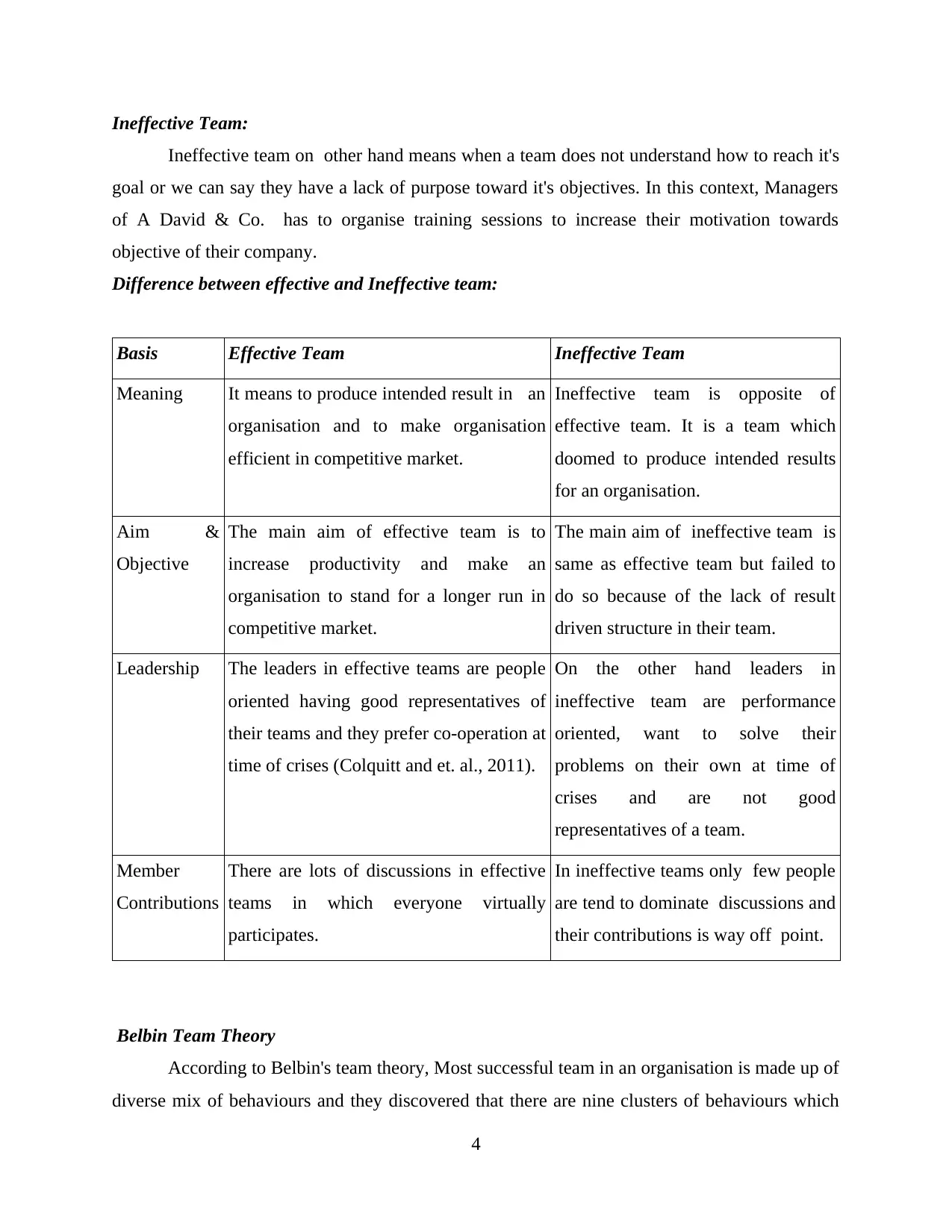
Ineffective Team:
Ineffective team on other hand means when a team does not understand how to reach it's
goal or we can say they have a lack of purpose toward it's objectives. In this context, Managers
of A David & Co. has to organise training sessions to increase their motivation towards
objective of their company.
Difference between effective and Ineffective team:
Basis Effective Team Ineffective Team
Meaning It means to produce intended result in an
organisation and to make organisation
efficient in competitive market.
Ineffective team is opposite of
effective team. It is a team which
doomed to produce intended results
for an organisation.
Aim &
Objective
The main aim of effective team is to
increase productivity and make an
organisation to stand for a longer run in
competitive market.
The main aim of ineffective team is
same as effective team but failed to
do so because of the lack of result
driven structure in their team.
Leadership The leaders in effective teams are people
oriented having good representatives of
their teams and they prefer co-operation at
time of crises (Colquitt and et. al., 2011).
On the other hand leaders in
ineffective team are performance
oriented, want to solve their
problems on their own at time of
crises and are not good
representatives of a team.
Member
Contributions
There are lots of discussions in effective
teams in which everyone virtually
participates.
In ineffective teams only few people
are tend to dominate discussions and
their contributions is way off point.
Belbin Team Theory
According to Belbin's team theory, Most successful team in an organisation is made up of
diverse mix of behaviours and they discovered that there are nine clusters of behaviours which
4
Ineffective team on other hand means when a team does not understand how to reach it's
goal or we can say they have a lack of purpose toward it's objectives. In this context, Managers
of A David & Co. has to organise training sessions to increase their motivation towards
objective of their company.
Difference between effective and Ineffective team:
Basis Effective Team Ineffective Team
Meaning It means to produce intended result in an
organisation and to make organisation
efficient in competitive market.
Ineffective team is opposite of
effective team. It is a team which
doomed to produce intended results
for an organisation.
Aim &
Objective
The main aim of effective team is to
increase productivity and make an
organisation to stand for a longer run in
competitive market.
The main aim of ineffective team is
same as effective team but failed to
do so because of the lack of result
driven structure in their team.
Leadership The leaders in effective teams are people
oriented having good representatives of
their teams and they prefer co-operation at
time of crises (Colquitt and et. al., 2011).
On the other hand leaders in
ineffective team are performance
oriented, want to solve their
problems on their own at time of
crises and are not good
representatives of a team.
Member
Contributions
There are lots of discussions in effective
teams in which everyone virtually
participates.
In ineffective teams only few people
are tend to dominate discussions and
their contributions is way off point.
Belbin Team Theory
According to Belbin's team theory, Most successful team in an organisation is made up of
diverse mix of behaviours and they discovered that there are nine clusters of behaviours which
4
Paraphrase This Document
Need a fresh take? Get an instant paraphrase of this document with our AI Paraphraser
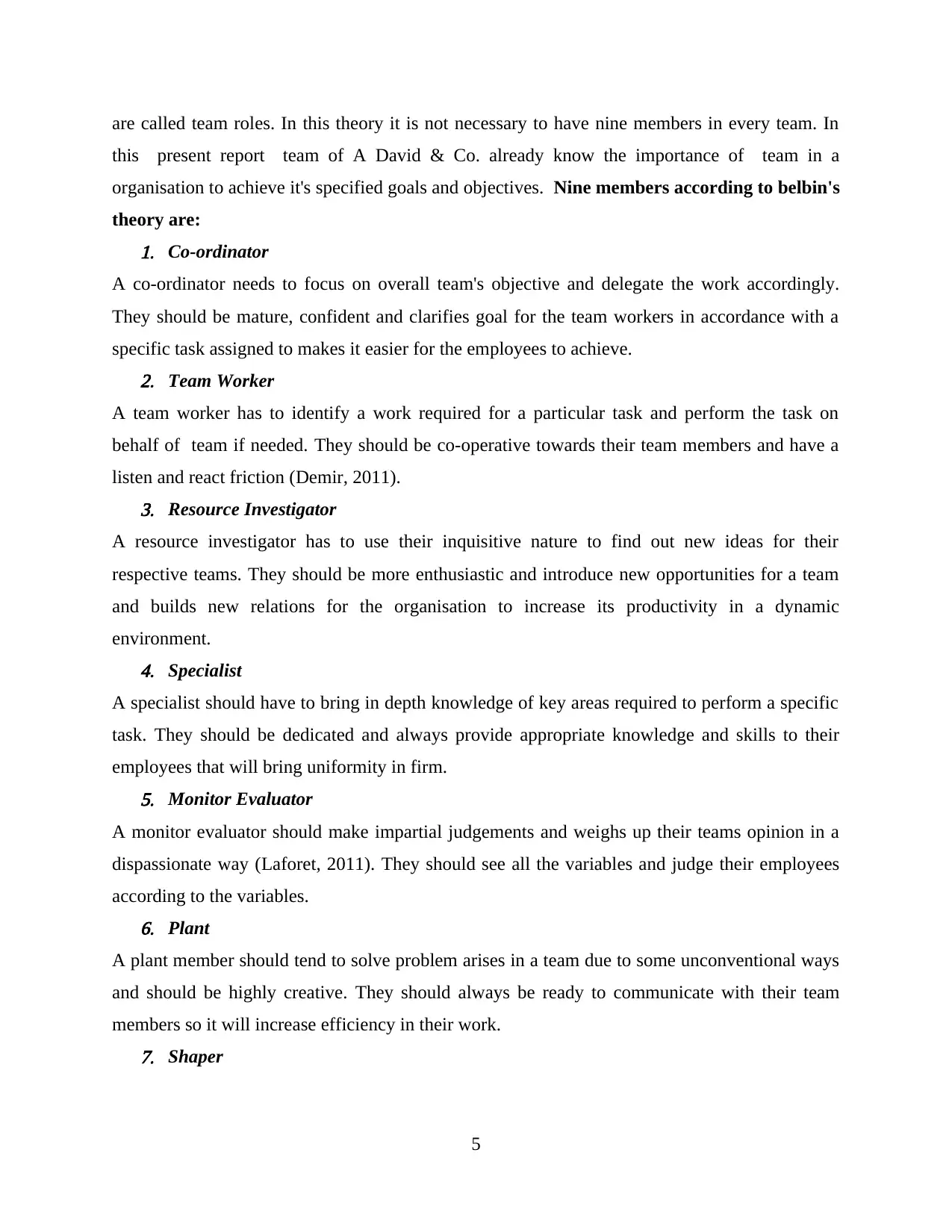
are called team roles. In this theory it is not necessary to have nine members in every team. In
this present report team of A David & Co. already know the importance of team in a
organisation to achieve it's specified goals and objectives. Nine members according to belbin's
theory are:1. Co-ordinator
A co-ordinator needs to focus on overall team's objective and delegate the work accordingly.
They should be mature, confident and clarifies goal for the team workers in accordance with a
specific task assigned to makes it easier for the employees to achieve.2. Team Worker
A team worker has to identify a work required for a particular task and perform the task on
behalf of team if needed. They should be co-operative towards their team members and have a
listen and react friction (Demir, 2011).3. Resource Investigator
A resource investigator has to use their inquisitive nature to find out new ideas for their
respective teams. They should be more enthusiastic and introduce new opportunities for a team
and builds new relations for the organisation to increase its productivity in a dynamic
environment.4. Specialist
A specialist should have to bring in depth knowledge of key areas required to perform a specific
task. They should be dedicated and always provide appropriate knowledge and skills to their
employees that will bring uniformity in firm.5. Monitor Evaluator
A monitor evaluator should make impartial judgements and weighs up their teams opinion in a
dispassionate way (Laforet, 2011). They should see all the variables and judge their employees
according to the variables.6. Plant
A plant member should tend to solve problem arises in a team due to some unconventional ways
and should be highly creative. They should always be ready to communicate with their team
members so it will increase efficiency in their work.7. Shaper
5
this present report team of A David & Co. already know the importance of team in a
organisation to achieve it's specified goals and objectives. Nine members according to belbin's
theory are:1. Co-ordinator
A co-ordinator needs to focus on overall team's objective and delegate the work accordingly.
They should be mature, confident and clarifies goal for the team workers in accordance with a
specific task assigned to makes it easier for the employees to achieve.2. Team Worker
A team worker has to identify a work required for a particular task and perform the task on
behalf of team if needed. They should be co-operative towards their team members and have a
listen and react friction (Demir, 2011).3. Resource Investigator
A resource investigator has to use their inquisitive nature to find out new ideas for their
respective teams. They should be more enthusiastic and introduce new opportunities for a team
and builds new relations for the organisation to increase its productivity in a dynamic
environment.4. Specialist
A specialist should have to bring in depth knowledge of key areas required to perform a specific
task. They should be dedicated and always provide appropriate knowledge and skills to their
employees that will bring uniformity in firm.5. Monitor Evaluator
A monitor evaluator should make impartial judgements and weighs up their teams opinion in a
dispassionate way (Laforet, 2011). They should see all the variables and judge their employees
according to the variables.6. Plant
A plant member should tend to solve problem arises in a team due to some unconventional ways
and should be highly creative. They should always be ready to communicate with their team
members so it will increase efficiency in their work.7. Shaper
5
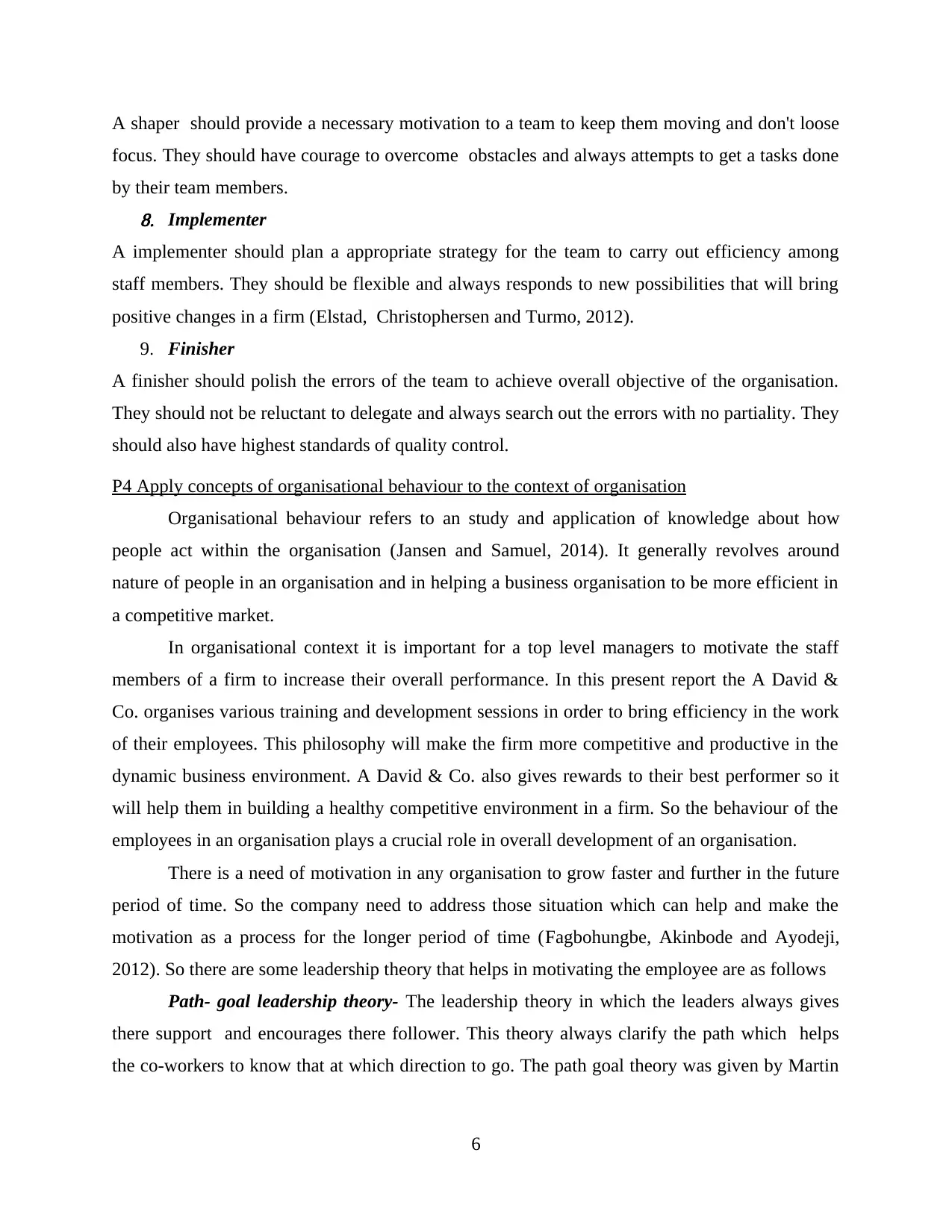
A shaper should provide a necessary motivation to a team to keep them moving and don't loose
focus. They should have courage to overcome obstacles and always attempts to get a tasks done
by their team members.8. Implementer
A implementer should plan a appropriate strategy for the team to carry out efficiency among
staff members. They should be flexible and always responds to new possibilities that will bring
positive changes in a firm (Elstad, Christophersen and Turmo, 2012).
9. Finisher
A finisher should polish the errors of the team to achieve overall objective of the organisation.
They should not be reluctant to delegate and always search out the errors with no partiality. They
should also have highest standards of quality control.
P4 Apply concepts of organisational behaviour to the context of organisation
Organisational behaviour refers to an study and application of knowledge about how
people act within the organisation (Jansen and Samuel, 2014). It generally revolves around
nature of people in an organisation and in helping a business organisation to be more efficient in
a competitive market.
In organisational context it is important for a top level managers to motivate the staff
members of a firm to increase their overall performance. In this present report the A David &
Co. organises various training and development sessions in order to bring efficiency in the work
of their employees. This philosophy will make the firm more competitive and productive in the
dynamic business environment. A David & Co. also gives rewards to their best performer so it
will help them in building a healthy competitive environment in a firm. So the behaviour of the
employees in an organisation plays a crucial role in overall development of an organisation.
There is a need of motivation in any organisation to grow faster and further in the future
period of time. So the company need to address those situation which can help and make the
motivation as a process for the longer period of time (Fagbohungbe, Akinbode and Ayodeji,
2012). So there are some leadership theory that helps in motivating the employee are as follows
Path- goal leadership theory- The leadership theory in which the leaders always gives
there support and encourages there follower. This theory always clarify the path which helps
the co-workers to know that at which direction to go. The path goal theory was given by Martin
6
focus. They should have courage to overcome obstacles and always attempts to get a tasks done
by their team members.8. Implementer
A implementer should plan a appropriate strategy for the team to carry out efficiency among
staff members. They should be flexible and always responds to new possibilities that will bring
positive changes in a firm (Elstad, Christophersen and Turmo, 2012).
9. Finisher
A finisher should polish the errors of the team to achieve overall objective of the organisation.
They should not be reluctant to delegate and always search out the errors with no partiality. They
should also have highest standards of quality control.
P4 Apply concepts of organisational behaviour to the context of organisation
Organisational behaviour refers to an study and application of knowledge about how
people act within the organisation (Jansen and Samuel, 2014). It generally revolves around
nature of people in an organisation and in helping a business organisation to be more efficient in
a competitive market.
In organisational context it is important for a top level managers to motivate the staff
members of a firm to increase their overall performance. In this present report the A David &
Co. organises various training and development sessions in order to bring efficiency in the work
of their employees. This philosophy will make the firm more competitive and productive in the
dynamic business environment. A David & Co. also gives rewards to their best performer so it
will help them in building a healthy competitive environment in a firm. So the behaviour of the
employees in an organisation plays a crucial role in overall development of an organisation.
There is a need of motivation in any organisation to grow faster and further in the future
period of time. So the company need to address those situation which can help and make the
motivation as a process for the longer period of time (Fagbohungbe, Akinbode and Ayodeji,
2012). So there are some leadership theory that helps in motivating the employee are as follows
Path- goal leadership theory- The leadership theory in which the leaders always gives
there support and encourages there follower. This theory always clarify the path which helps
the co-workers to know that at which direction to go. The path goal theory was given by Martin
6
⊘ This is a preview!⊘
Do you want full access?
Subscribe today to unlock all pages.
Trusted by 1+ million students worldwide

1 out of 17


Related Documents


Your All-in-One AI-Powered Toolkit for Academic Success.
+13062052269
info@desklib.com
Available 24*7 on WhatsApp / Email
![[object Object]](/_next/static/media/star-bottom.7253800d.svg)
Unlock your academic potential
Copyright © 2020–2026 A2Z Services. All Rights Reserved. Developed and managed by ZUCOL.