Unit 12: Organisational Culture and Workforce Motivation
VerifiedAdded on 2023/01/05
|14
|4359
|68
Report
AI Summary
This report examines the influence of organizational culture, politics, and power on individual and team behavior and performance, using Tesla as a case study. It explores various aspects, including Handy's and Hofstede's cultural dimensions, positive and negative organizational politics, and different types of power, such as reward, coercive, legitimate, expert, and referent power, and their effects. The report further investigates content and process theories of motivation, including intrinsic and extrinsic motivation, and their role in achieving company goals. The analysis provides insights into how these elements interact to shape employee behavior and contribute to the overall success of an organization, offering recommendations for creating a positive and productive work environment within Tesla.
Organisational Cultures and
Workforce Motivation
Workforce Motivation

Paraphrase This Document
Need a fresh take? Get an instant paraphrase of this document with our AI Paraphraser
Table of Contents
INTRODUCTION ..........................................................................................................................3
TASK 1............................................................................................................................................3
P1 Organisation culture, politics and power influence performance of team and individual 3
M1 Critically analyse how the culture, politics and power of an organisation can influence
individual and team behaviour and performance...................................................................8
TASK 2............................................................................................................................................8
P2 Content and process theories of motivation enable achievement of company’s goals.....8
M2 Critically evaluate how to influence the behaviour of others through the effective
application of behavioural motivational theories, concepts and models..............................11
D1 Critically evaluate the relationship between culture, politics, power and motivation that
enables teams and organisations to succeed providing justified recommendations.............12
CONCLUSION..............................................................................................................................12
References......................................................................................................................................13
Books and Journals:..............................................................................................................13
INTRODUCTION ..........................................................................................................................3
TASK 1............................................................................................................................................3
P1 Organisation culture, politics and power influence performance of team and individual 3
M1 Critically analyse how the culture, politics and power of an organisation can influence
individual and team behaviour and performance...................................................................8
TASK 2............................................................................................................................................8
P2 Content and process theories of motivation enable achievement of company’s goals.....8
M2 Critically evaluate how to influence the behaviour of others through the effective
application of behavioural motivational theories, concepts and models..............................11
D1 Critically evaluate the relationship between culture, politics, power and motivation that
enables teams and organisations to succeed providing justified recommendations.............12
CONCLUSION..............................................................................................................................12
References......................................................................................................................................13
Books and Journals:..............................................................................................................13
INTRODUCTION
Organisational behaviour is a wide concept of business environment, which emphasize
on every aspect of business activity, human resource management and all the factors that
influence on growth of an organisation. TESLA is undertaken for this report, it is the American
company that deals in the automotive sector (Al Issa, 2019). It was founded in July 1, 2003 at
Palo Alto, California. This report covers the organisational culture that influence the individual
and team behaviour. It also covers the motivational theories that help to achieve the objectives of
organisation.
TASK 1
P1 Organisation culture, politics and power influence performance of team and individual
An organisation is a set of various internal and external forces which bind an organisation
with some norms and conditions, includes its cultural, political factors and powers of authority. It
is very essential to analyse all the factors for the managers and workforce of TESLA to know the
actual performance of human resource and try to find weak areas to be work on. All these factors
are discussed below:
Culture:
Culture of an organisation can be understood by analysing its expectations, beliefs and
norms under which all the workforce sets its targets by making work strategies, how and when
work has to be done, this will differentiate working potential of every individual for further
improvement.
Tesla's organisational culture is quite different from others, there main focus is on
creation of competitive human resources so that they get best resources that develop innovative
products. Their culture ideally empowers their labour force so that they get brand position in the
automotive sector. They focus on innovation through the employees so that they stand first in the
energy generation power. Their customer services are different from another because they serve
after the sale services so that they sustain the business in the market.
Types of culture and its influence on employee’s behaviour
Handy's culture:
Power culture:
Organisational behaviour is a wide concept of business environment, which emphasize
on every aspect of business activity, human resource management and all the factors that
influence on growth of an organisation. TESLA is undertaken for this report, it is the American
company that deals in the automotive sector (Al Issa, 2019). It was founded in July 1, 2003 at
Palo Alto, California. This report covers the organisational culture that influence the individual
and team behaviour. It also covers the motivational theories that help to achieve the objectives of
organisation.
TASK 1
P1 Organisation culture, politics and power influence performance of team and individual
An organisation is a set of various internal and external forces which bind an organisation
with some norms and conditions, includes its cultural, political factors and powers of authority. It
is very essential to analyse all the factors for the managers and workforce of TESLA to know the
actual performance of human resource and try to find weak areas to be work on. All these factors
are discussed below:
Culture:
Culture of an organisation can be understood by analysing its expectations, beliefs and
norms under which all the workforce sets its targets by making work strategies, how and when
work has to be done, this will differentiate working potential of every individual for further
improvement.
Tesla's organisational culture is quite different from others, there main focus is on
creation of competitive human resources so that they get best resources that develop innovative
products. Their culture ideally empowers their labour force so that they get brand position in the
automotive sector. They focus on innovation through the employees so that they stand first in the
energy generation power. Their customer services are different from another because they serve
after the sale services so that they sustain the business in the market.
Types of culture and its influence on employee’s behaviour
Handy's culture:
Power culture:
⊘ This is a preview!⊘
Do you want full access?
Subscribe today to unlock all pages.

Trusted by 1+ million students worldwide
Power culture is an internal environment of an organisation which sets and distribute
powers or authorities to perform tasks (Bhagwan, 2018). The managers of TESLA should
distribute these powers to the skilled and experienced individuals who can guide well, motivate
others and make them work to achieve organisational goals. Task culture:
In this type of culture, departments are formed, each department indulge in several tasks
for which teams are to be made and put every individual according to their knowledge and skills
into them, tasks are going to perform as per the targets of each department. Role culture:
In this type of culture, roles and responsibilities are well distributed in order to maintain
proper functioning of tasks by following some rules and regulations (Brough, Chataway, and
Biggs, 2016). Lower management are depend on the decision of top management it creates delay
in decision making.
Person culture:
Person cultures involves a motivation strategy in order to achieve high job role or post, an
individual work for its development and desire to make more contribution as compare to others.
as one can say, in greed to achieve extra benefits and powers in favour of an organisation.
Tesla's has problem solving culture for that they are eligible to solve the critical problems
and make the situation better. Power culture is good in Tesla's but it not be too much because it
can create the rigidity in the performance of the employees. Task culture is good because Tesla is
the large organisation so creating task and assign a team is beneficial for the completion of task.
Role culture has only a single negative point that affects the Tesla's performance, it creates
delays in decision. For motivating employee’s person culture is good for Tesla because it tries to
feel that person are important for the organisation.
Hofstede’s dimensions of culture
Hofstede’s contribute six dimensions in respect to differ one culture from other. These
dimensions are as follow:
Power Distance Index: This dimension indicates the fact that not every individual is equal
in terms of skills and knowledge and in that case more qualified individual is entitled to
get powers. So that high power distance reflects hierarchy of delegation in authority
powers or authorities to perform tasks (Bhagwan, 2018). The managers of TESLA should
distribute these powers to the skilled and experienced individuals who can guide well, motivate
others and make them work to achieve organisational goals. Task culture:
In this type of culture, departments are formed, each department indulge in several tasks
for which teams are to be made and put every individual according to their knowledge and skills
into them, tasks are going to perform as per the targets of each department. Role culture:
In this type of culture, roles and responsibilities are well distributed in order to maintain
proper functioning of tasks by following some rules and regulations (Brough, Chataway, and
Biggs, 2016). Lower management are depend on the decision of top management it creates delay
in decision making.
Person culture:
Person cultures involves a motivation strategy in order to achieve high job role or post, an
individual work for its development and desire to make more contribution as compare to others.
as one can say, in greed to achieve extra benefits and powers in favour of an organisation.
Tesla's has problem solving culture for that they are eligible to solve the critical problems
and make the situation better. Power culture is good in Tesla's but it not be too much because it
can create the rigidity in the performance of the employees. Task culture is good because Tesla is
the large organisation so creating task and assign a team is beneficial for the completion of task.
Role culture has only a single negative point that affects the Tesla's performance, it creates
delays in decision. For motivating employee’s person culture is good for Tesla because it tries to
feel that person are important for the organisation.
Hofstede’s dimensions of culture
Hofstede’s contribute six dimensions in respect to differ one culture from other. These
dimensions are as follow:
Power Distance Index: This dimension indicates the fact that not every individual is equal
in terms of skills and knowledge and in that case more qualified individual is entitled to
get powers. So that high power distance reflects hierarchy of delegation in authority
Paraphrase This Document
Need a fresh take? Get an instant paraphrase of this document with our AI Paraphraser
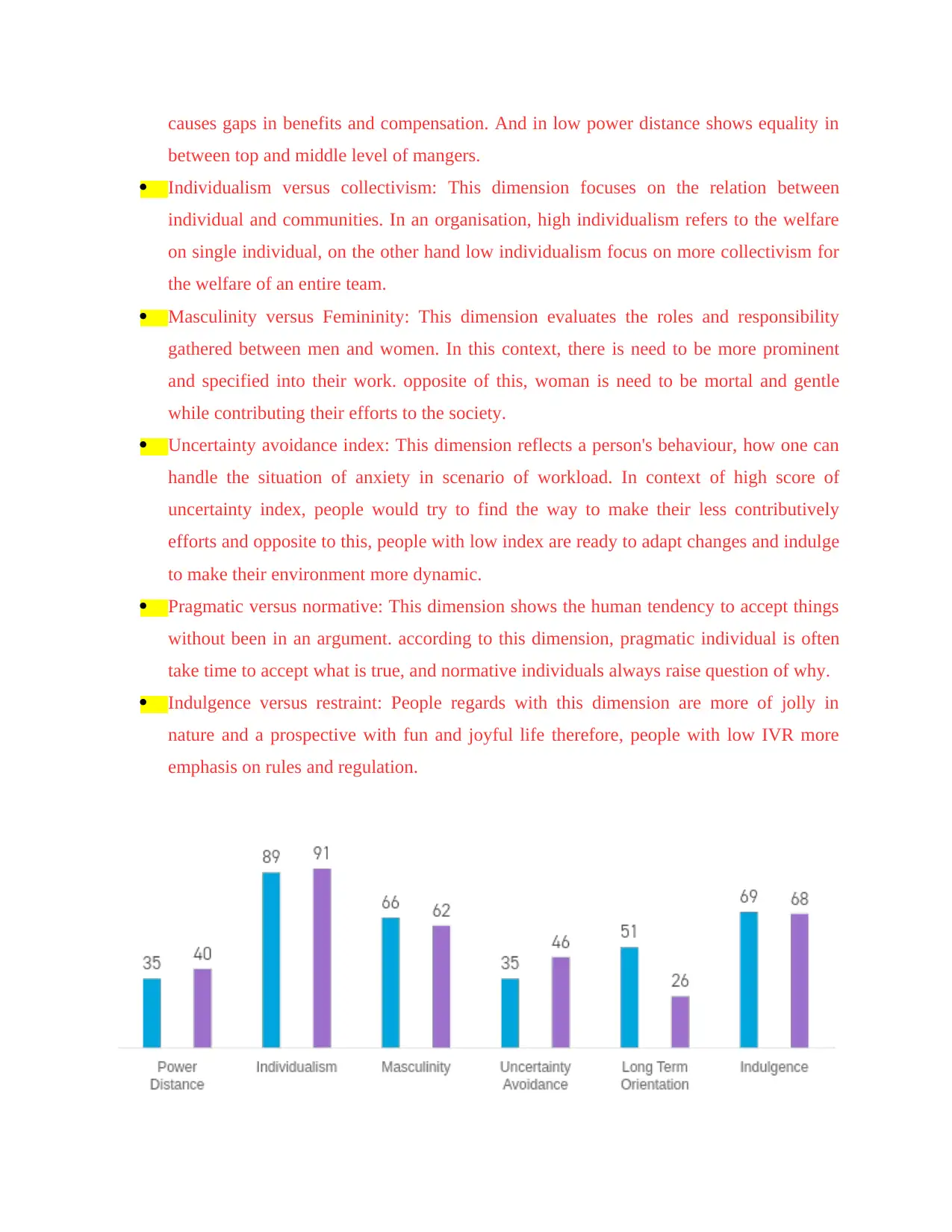
causes gaps in benefits and compensation. And in low power distance shows equality in
between top and middle level of mangers.
Individualism versus collectivism: This dimension focuses on the relation between
individual and communities. In an organisation, high individualism refers to the welfare
on single individual, on the other hand low individualism focus on more collectivism for
the welfare of an entire team.
Masculinity versus Femininity: This dimension evaluates the roles and responsibility
gathered between men and women. In this context, there is need to be more prominent
and specified into their work. opposite of this, woman is need to be mortal and gentle
while contributing their efforts to the society.
Uncertainty avoidance index: This dimension reflects a person's behaviour, how one can
handle the situation of anxiety in scenario of workload. In context of high score of
uncertainty index, people would try to find the way to make their less contributively
efforts and opposite to this, people with low index are ready to adapt changes and indulge
to make their environment more dynamic.
Pragmatic versus normative: This dimension shows the human tendency to accept things
without been in an argument. according to this dimension, pragmatic individual is often
take time to accept what is true, and normative individuals always raise question of why.
Indulgence versus restraint: People regards with this dimension are more of jolly in
nature and a prospective with fun and joyful life therefore, people with low IVR more
emphasis on rules and regulation.
between top and middle level of mangers.
Individualism versus collectivism: This dimension focuses on the relation between
individual and communities. In an organisation, high individualism refers to the welfare
on single individual, on the other hand low individualism focus on more collectivism for
the welfare of an entire team.
Masculinity versus Femininity: This dimension evaluates the roles and responsibility
gathered between men and women. In this context, there is need to be more prominent
and specified into their work. opposite of this, woman is need to be mortal and gentle
while contributing their efforts to the society.
Uncertainty avoidance index: This dimension reflects a person's behaviour, how one can
handle the situation of anxiety in scenario of workload. In context of high score of
uncertainty index, people would try to find the way to make their less contributively
efforts and opposite to this, people with low index are ready to adapt changes and indulge
to make their environment more dynamic.
Pragmatic versus normative: This dimension shows the human tendency to accept things
without been in an argument. according to this dimension, pragmatic individual is often
take time to accept what is true, and normative individuals always raise question of why.
Indulgence versus restraint: People regards with this dimension are more of jolly in
nature and a prospective with fun and joyful life therefore, people with low IVR more
emphasis on rules and regulation.
Politics: In an organisation, politics amongst employees could create a negative
environment by indulging in making their self-strategies in respect of attempting changes in
benefits, compensation, powers and authority.
Positive/negative organisational politics:
Positive organisational politics in such a way that it creates awareness in the organisation
through informal conversations, if people doing wrong then they should be ready for the result.
Negative organisational politics in such a way that if person doing too much politics then it
creates discrimination in the company's environment.
The impact of politics on team and individual performance
Organisational politics give negative as well as positive impact on the behaviour of the
organisation. Politics influence the individual performance it may be boost or decline them. If the
politics is too much then it creates negativity that decrease the performance or maybe they cease
from the job.
How Tesla can create a positive environment?
Tesla can minimize the politics through fair decisions in the organisation so that
employees didn't suffer from the discriminations and any hesitations that give negative effect.
Power: Power is a ability to perform one's duty in favour of organisational benefit in
terms of full utilisation of managerial resource, how to make them work by giving proper
guidance and ability to manage employee’s performance (Cropley and Cropley, 2017).
Types of power: Reward power: This power indulges a manager to offer rewards to employees for their
better performance appraisal, in order to boost their level to work hard by increment in
salary or bonus and compensate them by providing leaves or grants (Dajani and
Mohamad, 2017). Coercive power: This power makes a manager to make a move towards any miss
happening at the workplace with an employee, in the form of fire threat, crush or
collisions or any major injury while working.
environment by indulging in making their self-strategies in respect of attempting changes in
benefits, compensation, powers and authority.
Positive/negative organisational politics:
Positive organisational politics in such a way that it creates awareness in the organisation
through informal conversations, if people doing wrong then they should be ready for the result.
Negative organisational politics in such a way that if person doing too much politics then it
creates discrimination in the company's environment.
The impact of politics on team and individual performance
Organisational politics give negative as well as positive impact on the behaviour of the
organisation. Politics influence the individual performance it may be boost or decline them. If the
politics is too much then it creates negativity that decrease the performance or maybe they cease
from the job.
How Tesla can create a positive environment?
Tesla can minimize the politics through fair decisions in the organisation so that
employees didn't suffer from the discriminations and any hesitations that give negative effect.
Power: Power is a ability to perform one's duty in favour of organisational benefit in
terms of full utilisation of managerial resource, how to make them work by giving proper
guidance and ability to manage employee’s performance (Cropley and Cropley, 2017).
Types of power: Reward power: This power indulges a manager to offer rewards to employees for their
better performance appraisal, in order to boost their level to work hard by increment in
salary or bonus and compensate them by providing leaves or grants (Dajani and
Mohamad, 2017). Coercive power: This power makes a manager to make a move towards any miss
happening at the workplace with an employee, in the form of fire threat, crush or
collisions or any major injury while working.
⊘ This is a preview!⊘
Do you want full access?
Subscribe today to unlock all pages.
Trusted by 1+ million students worldwide
Legitimate power: This power creates a centralised working environment for the
employees as one is well aware about each one's authority to ask questions and division
of work through which clear communications standards will be set. Expert Power: It is the power that needs high skills and knowledge, it is a vast concept. It
is useful for solving the issues and problems of the companies.
Referent Power: It is the result of perceiving someone's worthiness and attractiveness. It
comes from the person's point of view; it is very complicated power. Because if someone
perceived others wrongly then it gives a very wrong impact and create the problems.
Explain the positive and negative impact of each type of power on performance
Every power has negative and positive impact that are well explained below:
Reward power has more positive impacts on performance that it motivates the employees
towards the organisational goal. But at the same time it gives negative mean in a way that
if the company provides unnecessary rewards then it gets in losses.
More use of coercive power creates threatening in the environment of business so it is
necessary to overcome with that.
Legitimate power is only good till the time when the owner didn't get offended in the
organisation.
Expert power is very technical in nature so proper knowledge is very important to
handling this power.
Referent power one of the complicated it is only useful when the person rightly perceives
the other person in the organisation.
M1 Critically analyse how the culture, politics and power of an organisation can influence
individual and team behaviour and performance.
From the above discussion TESLA is big company that have many employees that's why
it is necessary to understand the organisational culture and how it influence. Its culture
empowers its employees to search for the ideal solutions and encourages them to innovate to
support continuous improvement which makes its business unique and different from others
Using of which power is totally depends on the situation. The important part of the human's
behaviour is politics it effects negatively and positively. Tesla used many powers that have
positive and negative effects on individual and team behaviour. Tesla should use appropriate
proportion of powers so that they overcome with the negative impacts.
employees as one is well aware about each one's authority to ask questions and division
of work through which clear communications standards will be set. Expert Power: It is the power that needs high skills and knowledge, it is a vast concept. It
is useful for solving the issues and problems of the companies.
Referent Power: It is the result of perceiving someone's worthiness and attractiveness. It
comes from the person's point of view; it is very complicated power. Because if someone
perceived others wrongly then it gives a very wrong impact and create the problems.
Explain the positive and negative impact of each type of power on performance
Every power has negative and positive impact that are well explained below:
Reward power has more positive impacts on performance that it motivates the employees
towards the organisational goal. But at the same time it gives negative mean in a way that
if the company provides unnecessary rewards then it gets in losses.
More use of coercive power creates threatening in the environment of business so it is
necessary to overcome with that.
Legitimate power is only good till the time when the owner didn't get offended in the
organisation.
Expert power is very technical in nature so proper knowledge is very important to
handling this power.
Referent power one of the complicated it is only useful when the person rightly perceives
the other person in the organisation.
M1 Critically analyse how the culture, politics and power of an organisation can influence
individual and team behaviour and performance.
From the above discussion TESLA is big company that have many employees that's why
it is necessary to understand the organisational culture and how it influence. Its culture
empowers its employees to search for the ideal solutions and encourages them to innovate to
support continuous improvement which makes its business unique and different from others
Using of which power is totally depends on the situation. The important part of the human's
behaviour is politics it effects negatively and positively. Tesla used many powers that have
positive and negative effects on individual and team behaviour. Tesla should use appropriate
proportion of powers so that they overcome with the negative impacts.
Paraphrase This Document
Need a fresh take? Get an instant paraphrase of this document with our AI Paraphraser
System theory: It is the theory that defines the understanding of changing behaviour of
social system so that it gives help to the policy makers. It is the study of society that affected by
external and internal factors so that proper analyses can made and taking proper course of action.
This system theory should be applied in Tesla for proper study of society and taking proper
course of action
Network Theory: The Network theory refers to identifying the person that are in
between in the buyer-seller relationship. It is the identification of mediators that involve in the
trade of goods and services because more than two members are involved in the trading process.
If this Network theory is applied in Tesla then it will help the organisation to remove mediator
and reducing cost of product and increase profits and revenues of the organisation.
TASK 2
P2 Content and process theories of motivation enable achievement of company’s goals
Motivation is an ongoing process in an organisation and for well management criteria. To
better understand this concept there are various theories that are discussed below:
Intrinsic motivation: This concept of motivation states the nature of an individual in
order to satisfy their needs and desire to perform their work (Hitka, Kozubíková, and Potkány,
2018). In respect of Tesla, the organization provide better wages and salary to their employees
which satisfy their basic needs and motivate them to work hard and this will help the
organization to achieve their goals with motivated and loyal staff.
Extrinsic motivation: This concept states the needs of an individual of expecting
something in return in form of rewards or benefit for their work done. These motivation theories
are very helpful to the Tesla's work performance because it motivates the employees towards
attainment of the organisational goals. It can be done through external as well as internal
rewards. They provide certain rewards to their employees either in terms of money or in
appraisal and motivate them to do better in future.
For example- In relation of chosen firm, they uses both these kind of motivation
depending on type of situations which is faced by employees and employers. It is necessary to
focus on such type of motivation so that appropriate kind of decisions are made regarding
increasing of productivity and profitability at higher scale.
social system so that it gives help to the policy makers. It is the study of society that affected by
external and internal factors so that proper analyses can made and taking proper course of action.
This system theory should be applied in Tesla for proper study of society and taking proper
course of action
Network Theory: The Network theory refers to identifying the person that are in
between in the buyer-seller relationship. It is the identification of mediators that involve in the
trade of goods and services because more than two members are involved in the trading process.
If this Network theory is applied in Tesla then it will help the organisation to remove mediator
and reducing cost of product and increase profits and revenues of the organisation.
TASK 2
P2 Content and process theories of motivation enable achievement of company’s goals
Motivation is an ongoing process in an organisation and for well management criteria. To
better understand this concept there are various theories that are discussed below:
Intrinsic motivation: This concept of motivation states the nature of an individual in
order to satisfy their needs and desire to perform their work (Hitka, Kozubíková, and Potkány,
2018). In respect of Tesla, the organization provide better wages and salary to their employees
which satisfy their basic needs and motivate them to work hard and this will help the
organization to achieve their goals with motivated and loyal staff.
Extrinsic motivation: This concept states the needs of an individual of expecting
something in return in form of rewards or benefit for their work done. These motivation theories
are very helpful to the Tesla's work performance because it motivates the employees towards
attainment of the organisational goals. It can be done through external as well as internal
rewards. They provide certain rewards to their employees either in terms of money or in
appraisal and motivate them to do better in future.
For example- In relation of chosen firm, they uses both these kind of motivation
depending on type of situations which is faced by employees and employers. It is necessary to
focus on such type of motivation so that appropriate kind of decisions are made regarding
increasing of productivity and profitability at higher scale.
Motivational theories
Maslow's hierarchy theories of motivation states the level of motivation a person is desire
to attain in their life at some extent, as every individual want something more after achieving the
basic needs (Isfahani, Teimouri and Abzari, 2019). All these theories are thoroughly discussed
below: Physiological needs: This theory includes a basic need of a human being such as food,
shelter, clothing. For this, it is an important aspect to lookout for TESLA's managers as if
they provide enough salary or compensation to their employee for fulfilling these basic
requirements. If basic requirements of employees of Tesla are fulfilled then they will do
the work with more dedication and effort. Safety needs: The managers of TESLA ensures fulfilment of safety needs of their
employees in the way of promotional activities or in health related issues. They provide
their employees benefits like pension fund, sickness fund, etc Belongingness and love needs: The mangers of TESLA must ensure their internal
environment, by creating group activity which let them make interactive working
relations and help the employees to develop friendship between each other and establish
contact between them to let them feel belonged to the organisation. Esteem needs: In this theory, an individual is more concerned about their respect and
independence in terms of power and responsibilities (Kotera, Adhikari and Van Gordon,
2018). In relation with TESLA, the managers should ensure these esteem needs of their
employees by encouraging them for their performance also a code of respect should be
follow in the organisation.
Need of self-actualisation: It is the last level of this theory, which creates a huge desire
to attain luxurious lifestyle and a never ending want for it. In relation with TESLA due to
its wide expansion and high profitable ration in last few years, an employee contributing
its best efforts must get desired opportunities to fulfil their expectancies.
By analysing all the above theories, it helps in motivation and encouragement of
employee’s morale at TESLA, this way the company can reach the height of its success for long
term. If employees are reaching their full potential level, then it boosts productivity that helps to
achieve the target.
Two Factor Theory
Maslow's hierarchy theories of motivation states the level of motivation a person is desire
to attain in their life at some extent, as every individual want something more after achieving the
basic needs (Isfahani, Teimouri and Abzari, 2019). All these theories are thoroughly discussed
below: Physiological needs: This theory includes a basic need of a human being such as food,
shelter, clothing. For this, it is an important aspect to lookout for TESLA's managers as if
they provide enough salary or compensation to their employee for fulfilling these basic
requirements. If basic requirements of employees of Tesla are fulfilled then they will do
the work with more dedication and effort. Safety needs: The managers of TESLA ensures fulfilment of safety needs of their
employees in the way of promotional activities or in health related issues. They provide
their employees benefits like pension fund, sickness fund, etc Belongingness and love needs: The mangers of TESLA must ensure their internal
environment, by creating group activity which let them make interactive working
relations and help the employees to develop friendship between each other and establish
contact between them to let them feel belonged to the organisation. Esteem needs: In this theory, an individual is more concerned about their respect and
independence in terms of power and responsibilities (Kotera, Adhikari and Van Gordon,
2018). In relation with TESLA, the managers should ensure these esteem needs of their
employees by encouraging them for their performance also a code of respect should be
follow in the organisation.
Need of self-actualisation: It is the last level of this theory, which creates a huge desire
to attain luxurious lifestyle and a never ending want for it. In relation with TESLA due to
its wide expansion and high profitable ration in last few years, an employee contributing
its best efforts must get desired opportunities to fulfil their expectancies.
By analysing all the above theories, it helps in motivation and encouragement of
employee’s morale at TESLA, this way the company can reach the height of its success for long
term. If employees are reaching their full potential level, then it boosts productivity that helps to
achieve the target.
Two Factor Theory
⊘ This is a preview!⊘
Do you want full access?
Subscribe today to unlock all pages.
Trusted by 1+ million students worldwide
It focuses on motivating the employees towards the organisational objectives. It focuses
on two factors that are motivating factors and hygiene factors. Poor hygiene declines the
performance and vice-versa. Tesla used this one for improving hygiene by regular cleaning and
providing a sanitized environment to their employees and motivate the employees so that they
achieve the organisational goals.
Process theory of motivation:
Vroom expectancy theory of motivation: This theory puts emphasize on an individual’s
choice of pleasure and pride to work. With help of this theory, it is easy for entity to adopt
competitive benefits as by examining of individual goals & objectives in proper manner.
Further, it has been too analysed that process theory states that how and why behaviour is being
triggered of individual.
Vroom uses some factors to better understand this theory stated below:
Expectancy: It is an inner motivation of an individual’s expectancy by its own presence
of mind, full of attaining organisational profit by making proper utility of available resource
merge with skills and knowledge (Rahardja, Moein and Lutfiani, 2018). Tesla as a vast company
with so much of man power take care of their employees needs so that internally they can be
stress free and complete their task ina motivated manner.
Instrumentality: An organisation should be transparent and well stabilize in terms of
good relations between decision makers and decision takers, that helps in efficient working in
employee’s performance and will result in desired output. If talked about Tesla, its all
department of functions are interrelated with each other and helps in best decision making.
Valence: Valence is the desired expectation for which the efforts to be put on,
expectation can be valued in terms of money or additional offers. Tesla takes care of their
employees expectation and provide them rewards for their better work in accordance to their
desires and expectation.
All these theories of vroom are certainly specified for individual’s self-motivation
assistance with available resources. Managerial Departments of TESLA's must ensure the
expected needs of workforce in respect to gain better output.
Latham and Locke Theory
on two factors that are motivating factors and hygiene factors. Poor hygiene declines the
performance and vice-versa. Tesla used this one for improving hygiene by regular cleaning and
providing a sanitized environment to their employees and motivate the employees so that they
achieve the organisational goals.
Process theory of motivation:
Vroom expectancy theory of motivation: This theory puts emphasize on an individual’s
choice of pleasure and pride to work. With help of this theory, it is easy for entity to adopt
competitive benefits as by examining of individual goals & objectives in proper manner.
Further, it has been too analysed that process theory states that how and why behaviour is being
triggered of individual.
Vroom uses some factors to better understand this theory stated below:
Expectancy: It is an inner motivation of an individual’s expectancy by its own presence
of mind, full of attaining organisational profit by making proper utility of available resource
merge with skills and knowledge (Rahardja, Moein and Lutfiani, 2018). Tesla as a vast company
with so much of man power take care of their employees needs so that internally they can be
stress free and complete their task ina motivated manner.
Instrumentality: An organisation should be transparent and well stabilize in terms of
good relations between decision makers and decision takers, that helps in efficient working in
employee’s performance and will result in desired output. If talked about Tesla, its all
department of functions are interrelated with each other and helps in best decision making.
Valence: Valence is the desired expectation for which the efforts to be put on,
expectation can be valued in terms of money or additional offers. Tesla takes care of their
employees expectation and provide them rewards for their better work in accordance to their
desires and expectation.
All these theories of vroom are certainly specified for individual’s self-motivation
assistance with available resources. Managerial Departments of TESLA's must ensure the
expected needs of workforce in respect to gain better output.
Latham and Locke Theory
Paraphrase This Document
Need a fresh take? Get an instant paraphrase of this document with our AI Paraphraser
It is the theory that set goals to the organisation according to their business. It gives the
right directions so that employees are clear about roles and responsibilities. This theory is given
by Latham and Locke.
From above discussed theory, it has been examined it is essential to focus on such
theory of motivation because it assists in development & growth of individual. While
considering of this theories, it is easy to achieve objectives within proper manner. It is
responsibility of manager to use theories of motivation with proper considerations.
Implication of motivation theory on leadership and management within organisation
The mangers of TESLA's must go through with these theories and apply them in their
organisational behaviour. it’s not only beneficiary to lower level also for leaders, it helps them to
lead and guide efficiently in result with high performance (Rayner, and Morgan, 2018).
Emotional intelligence: An individual must have control on their emotional handling's in
an organisation and capabilities to stand strong while leading others also, should have maintain
an understanding between self and others emotions. Tesla appoint or promote the candidates as
managers with a desired level of experience only and they know how to tackle employee's
emotional handling.
Importance of soft skills for managers and teams: In an organisation, inner skills of an
individual also plays roles for business growth. Managers of TESLA's must be polite, generous
and smooth in behaviour.
Soft and hard skills both are important for the Tesla's performance. Soft skills help to
motivate the employees towards the goals and it pushes to accomplish it. And hard skills are
helpful for following the rules and responsibilities in the company. It helps the company that
their employees know the consequences if not follow them.
Leadership as well as management are important part of enterprise without which it is
not possible to achieve business goals. It is duty of manager to make assure that everything is
being done by using of models & theories. Furthermore, it has been stated that it is critically
crucial to scan business environment so that it is easier to understand the market situations
properly.
right directions so that employees are clear about roles and responsibilities. This theory is given
by Latham and Locke.
From above discussed theory, it has been examined it is essential to focus on such
theory of motivation because it assists in development & growth of individual. While
considering of this theories, it is easy to achieve objectives within proper manner. It is
responsibility of manager to use theories of motivation with proper considerations.
Implication of motivation theory on leadership and management within organisation
The mangers of TESLA's must go through with these theories and apply them in their
organisational behaviour. it’s not only beneficiary to lower level also for leaders, it helps them to
lead and guide efficiently in result with high performance (Rayner, and Morgan, 2018).
Emotional intelligence: An individual must have control on their emotional handling's in
an organisation and capabilities to stand strong while leading others also, should have maintain
an understanding between self and others emotions. Tesla appoint or promote the candidates as
managers with a desired level of experience only and they know how to tackle employee's
emotional handling.
Importance of soft skills for managers and teams: In an organisation, inner skills of an
individual also plays roles for business growth. Managers of TESLA's must be polite, generous
and smooth in behaviour.
Soft and hard skills both are important for the Tesla's performance. Soft skills help to
motivate the employees towards the goals and it pushes to accomplish it. And hard skills are
helpful for following the rules and responsibilities in the company. It helps the company that
their employees know the consequences if not follow them.
Leadership as well as management are important part of enterprise without which it is
not possible to achieve business goals. It is duty of manager to make assure that everything is
being done by using of models & theories. Furthermore, it has been stated that it is critically
crucial to scan business environment so that it is easier to understand the market situations
properly.
M2 Critically evaluate how to influence the behaviour of others through the effective application
of behavioural motivational theories, concepts and models.
Motivational theories directly affect the behaviour of the employees of TESLA. It gives
motivation towards organisational goals. With the help of motivational theories organisation can
integrate the individual goals with organisational goals. Motivational theories like maslow's
theory, two factor motivation theory, vroom theory, etc. provide various ways by which tesla can
improve its market value just by applying these motivational theories. Maslow theory talks about
how the needs of employees can be satisfied in a hierarchy from basics to self actualistion. On
the other hand two factor talks about motivation of employees through hygiene and vroom talks
about internal motivation of employees. If these motivation theories are applied on the
employees then they will be stress free as much as possible and do their work with all their
hearts.
D1 Critically evaluate the relationship between culture, politics, power and motivation that
enables teams and organisations to succeed providing justified recommendations.
According to the above discussions, it is analysed that TESLA need proper identification
of factors that influence individual behaviour. And theories of motivation should be adopted by
the TESLA so that they can achieve their targets and goals (Willar, Trigunarsyah and Coffey,
2016). It is recommended to Tesla that it should also take carte of their lower level managers that
how they are treating their employees under them as those employees must be motivated at the
top to achieve organisational goals because they are responsible for the production or service
provided to the customer. If lower level mangers are using these theories to motivate their
employees then well and good if not then they should be provided proper training for how to
motivate employees under them to achieve the organisational objectives.
CONCLUSION
It is concluded from the above discussions that companies should be identify and analyse
the situations that affect the individual and organisational behaviour. Power, politics and culture
directly or indirectly affects the working environment of the organisation. It can be positive or
negative depends on the situations. Motivation theories are the key elements that helps to
motivate towards organisational objectives. So, TESLA need to apply motivational theories that
helps to attain objectives.
of behavioural motivational theories, concepts and models.
Motivational theories directly affect the behaviour of the employees of TESLA. It gives
motivation towards organisational goals. With the help of motivational theories organisation can
integrate the individual goals with organisational goals. Motivational theories like maslow's
theory, two factor motivation theory, vroom theory, etc. provide various ways by which tesla can
improve its market value just by applying these motivational theories. Maslow theory talks about
how the needs of employees can be satisfied in a hierarchy from basics to self actualistion. On
the other hand two factor talks about motivation of employees through hygiene and vroom talks
about internal motivation of employees. If these motivation theories are applied on the
employees then they will be stress free as much as possible and do their work with all their
hearts.
D1 Critically evaluate the relationship between culture, politics, power and motivation that
enables teams and organisations to succeed providing justified recommendations.
According to the above discussions, it is analysed that TESLA need proper identification
of factors that influence individual behaviour. And theories of motivation should be adopted by
the TESLA so that they can achieve their targets and goals (Willar, Trigunarsyah and Coffey,
2016). It is recommended to Tesla that it should also take carte of their lower level managers that
how they are treating their employees under them as those employees must be motivated at the
top to achieve organisational goals because they are responsible for the production or service
provided to the customer. If lower level mangers are using these theories to motivate their
employees then well and good if not then they should be provided proper training for how to
motivate employees under them to achieve the organisational objectives.
CONCLUSION
It is concluded from the above discussions that companies should be identify and analyse
the situations that affect the individual and organisational behaviour. Power, politics and culture
directly or indirectly affects the working environment of the organisation. It can be positive or
negative depends on the situations. Motivation theories are the key elements that helps to
motivate towards organisational objectives. So, TESLA need to apply motivational theories that
helps to attain objectives.
⊘ This is a preview!⊘
Do you want full access?
Subscribe today to unlock all pages.
Trusted by 1+ million students worldwide

1 out of 14


Related Documents


Your All-in-One AI-Powered Toolkit for Academic Success.
+13062052269
info@desklib.com
Available 24*7 on WhatsApp / Email
![[object Object]](/_next/static/media/star-bottom.7253800d.svg)
Unlock your academic potential
Copyright © 2020–2026 A2Z Services. All Rights Reserved. Developed and managed by ZUCOL.