Detailed Analysis of NHS: Organisational Health Management Case Study
VerifiedAdded on 2020/09/03
|12
|3142
|89
Case Study
AI Summary
This case study examines the organisational health management of the National Health Service (NHS). It provides an overview of the NHS, discussing its establishment, functions, and financial aspects. The analysis covers key areas such as organisational performance management, stakeholder communication, risk management strategies, quality management and improvement, financial performance, customer and client perspectives, and people perspectives. The study highlights the importance of effective performance management in achieving organisational goals, managing resources, and improving employee morale. It explores risk management processes, quality improvement initiatives, and the impact of financial performance on the organisation's overall health. The case study also addresses implementation issues and provides recommendations for improvement, offering valuable insights into the challenges and opportunities within the NHS.
Managing Organisational
Health Case Study
Health Case Study

Paraphrase This Document
Need a fresh take? Get an instant paraphrase of this document with our AI Paraphraser
TABLE OF CONTENTS
INTRODUCTION...........................................................................................................................1
Overview of the firm..............................................................................................................1
Analysis of Existing Organisational Performance Management System...............................4
Communicating performance to stakeholders........................................................................4
Risk Management...................................................................................................................5
Quality management and Improvement.................................................................................6
Financial Performance ...........................................................................................................6
Customer and client perspective.............................................................................................7
People perspectives................................................................................................................7
Implementation issues............................................................................................................7
RECOMMENDATIONS TO IMPROVEMENT............................................................................7
REFERENCES ...............................................................................................................................9
INTRODUCTION...........................................................................................................................1
Overview of the firm..............................................................................................................1
Analysis of Existing Organisational Performance Management System...............................4
Communicating performance to stakeholders........................................................................4
Risk Management...................................................................................................................5
Quality management and Improvement.................................................................................6
Financial Performance ...........................................................................................................6
Customer and client perspective.............................................................................................7
People perspectives................................................................................................................7
Implementation issues............................................................................................................7
RECOMMENDATIONS TO IMPROVEMENT............................................................................7
REFERENCES ...............................................................................................................................9

⊘ This is a preview!⊘
Do you want full access?
Subscribe today to unlock all pages.

Trusted by 1+ million students worldwide
INTRODUCTION
Organisational performance management can be considered as the process of effectively
managing organisational resources for attaining the desired goals and objectives in a well-
planned and systematic manner. This concept of management is commonly applied by each
small as well as large business enterprise for the development of employees and workers.
Performance management plays a vast role within an organisation for providing feedbacks,
documentation and accountability for performance outcome (Ates and et. al., 2013). It helps in
providing significant direction to employees to contribute their potential efforts in attaining
organisational goals and objectives. NHS is the chosen company for this particular project. Firm
deals in providing high quality products and services to the people who are financially weak and
not able to take proper treatment. This report involves the study about organisational
performance management and execution measurement, communicating the performance of
stakeholders, various risk management strategies which are adopted by firm as to managing risk
and conflict at work place.
Overview of the firm
In this modern era, the basic purpose of each business organisation is to provide high
quality products and services to their significant buyers for satisfying their needs and wants.
NHS is the most popular organisation which is established in the year of 1948 as one of major
social reforms in United Kingdom (Bourne and et. al., 2013). The company mainly provides free
comprehensive services to the local residents in United Kingdom. Each of the UK's health
service system operates its all business functions independently and it is politically accountable
to the relevant government. The Wales government, Scottish government, Northern Ireland
Executive and UK Government are responsible for England's National Health Services. The four
service organisations work together and employ approximate 1.6 million people with a collective
budget of £136.7 Billion. The major objective of firm is to provide high quality and fast services
to their significant customers for satisfying their needs and wants. Quality management and
improvement tools, management of financial performance within an organisation, the perspective
of customers and clients towards the firm and different kinds of issues which are faced by
business organisation are discussed as well. OPM performs an effective role in developing
organisational performance through managing organisational resources in a systematic manner.
1
Organisational performance management can be considered as the process of effectively
managing organisational resources for attaining the desired goals and objectives in a well-
planned and systematic manner. This concept of management is commonly applied by each
small as well as large business enterprise for the development of employees and workers.
Performance management plays a vast role within an organisation for providing feedbacks,
documentation and accountability for performance outcome (Ates and et. al., 2013). It helps in
providing significant direction to employees to contribute their potential efforts in attaining
organisational goals and objectives. NHS is the chosen company for this particular project. Firm
deals in providing high quality products and services to the people who are financially weak and
not able to take proper treatment. This report involves the study about organisational
performance management and execution measurement, communicating the performance of
stakeholders, various risk management strategies which are adopted by firm as to managing risk
and conflict at work place.
Overview of the firm
In this modern era, the basic purpose of each business organisation is to provide high
quality products and services to their significant buyers for satisfying their needs and wants.
NHS is the most popular organisation which is established in the year of 1948 as one of major
social reforms in United Kingdom (Bourne and et. al., 2013). The company mainly provides free
comprehensive services to the local residents in United Kingdom. Each of the UK's health
service system operates its all business functions independently and it is politically accountable
to the relevant government. The Wales government, Scottish government, Northern Ireland
Executive and UK Government are responsible for England's National Health Services. The four
service organisations work together and employ approximate 1.6 million people with a collective
budget of £136.7 Billion. The major objective of firm is to provide high quality and fast services
to their significant customers for satisfying their needs and wants. Quality management and
improvement tools, management of financial performance within an organisation, the perspective
of customers and clients towards the firm and different kinds of issues which are faced by
business organisation are discussed as well. OPM performs an effective role in developing
organisational performance through managing organisational resources in a systematic manner.
1
Paraphrase This Document
Need a fresh take? Get an instant paraphrase of this document with our AI Paraphraser
National Health Services is a combined name which is widely used by each of the four public
health services such as National Health Services in England, NHS Scotland, NHS Wales and
Health and Social care in Northern Ireland in the country of United Kingdom.
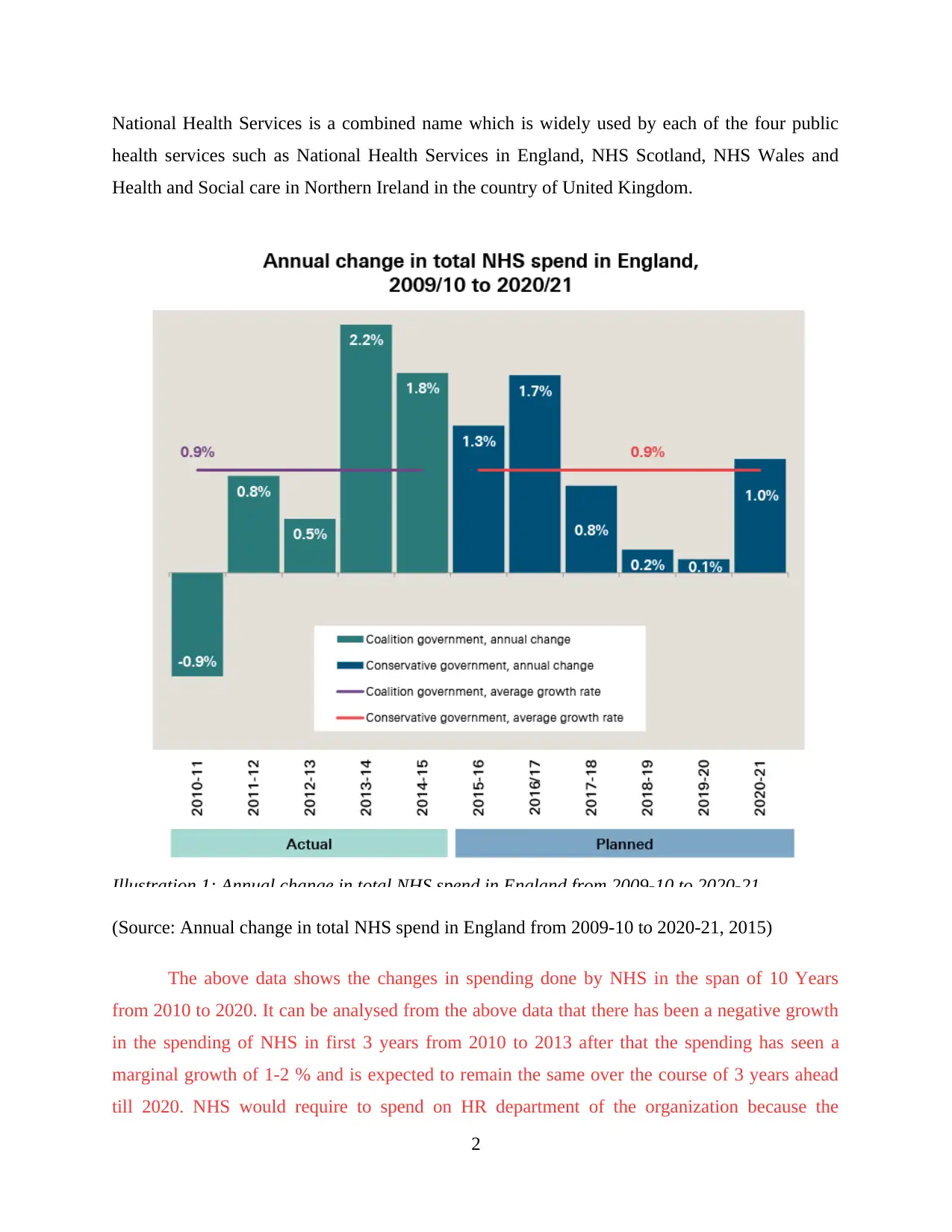
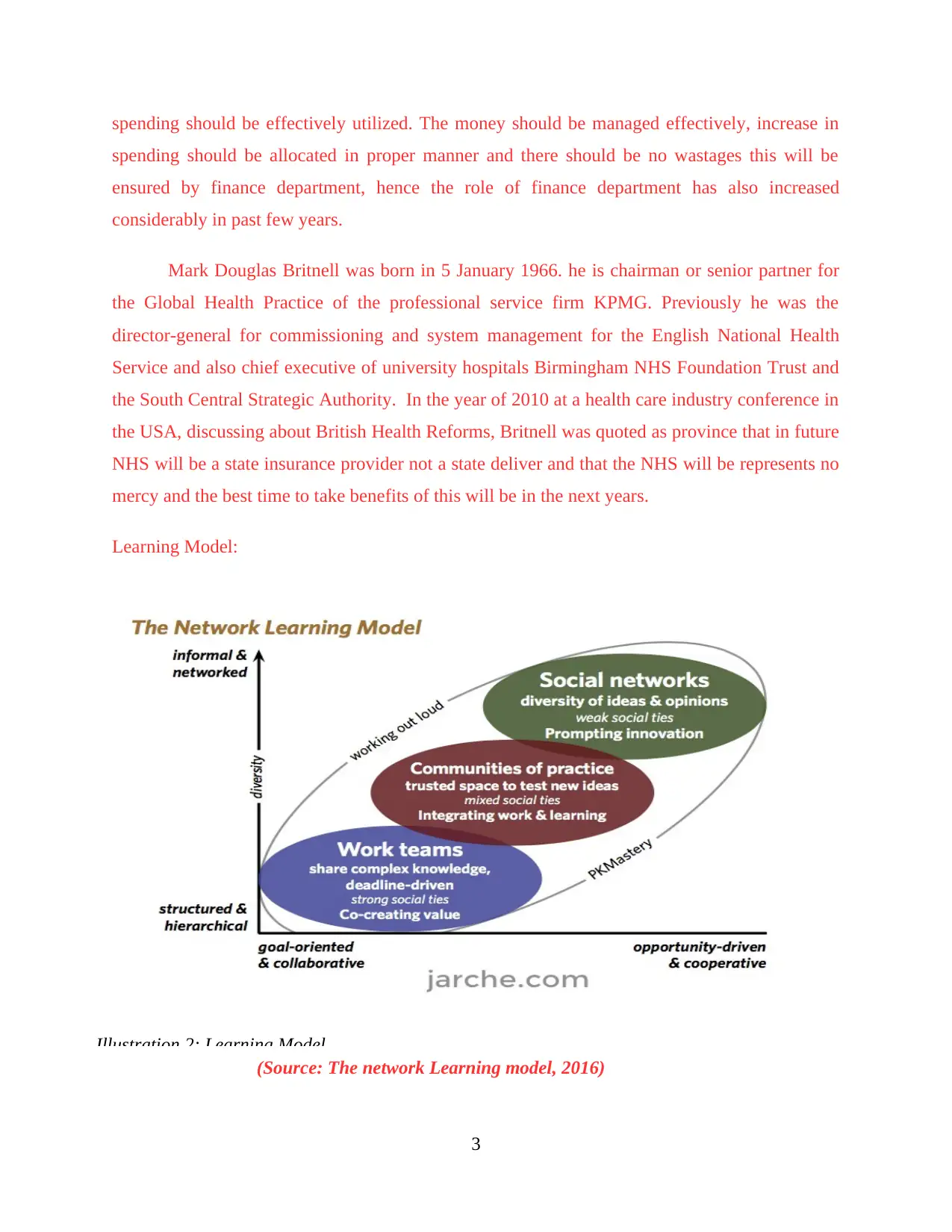
Illustration 1: Annual change in total NHS spend in England from 2009-10 to 2020-21
(Source: Annual change in total NHS spend in England from 2009-10 to 2020-21, 2015)
The above data shows the changes in spending done by NHS in the span of 10 Years
from 2010 to 2020. It can be analysed from the above data that there has been a negative growth
in the spending of NHS in first 3 years from 2010 to 2013 after that the spending has seen a
marginal growth of 1-2 % and is expected to remain the same over the course of 3 years ahead
till 2020. NHS would require to spend on HR department of the organization because the
2
health services such as National Health Services in England, NHS Scotland, NHS Wales and
Health and Social care in Northern Ireland in the country of United Kingdom.
Illustration 1: Annual change in total NHS spend in England from 2009-10 to 2020-21
(Source: Annual change in total NHS spend in England from 2009-10 to 2020-21, 2015)
The above data shows the changes in spending done by NHS in the span of 10 Years
from 2010 to 2020. It can be analysed from the above data that there has been a negative growth
in the spending of NHS in first 3 years from 2010 to 2013 after that the spending has seen a
marginal growth of 1-2 % and is expected to remain the same over the course of 3 years ahead
till 2020. NHS would require to spend on HR department of the organization because the
2
spending should be effectively utilized. The money should be managed effectively, increase in
spending should be allocated in proper manner and there should be no wastages this will be
ensured by finance department, hence the role of finance department has also increased
considerably in past few years.
Mark Douglas Britnell was born in 5 January 1966. he is chairman or senior partner for
the Global Health Practice of the professional service firm KPMG. Previously he was the
director-general for commissioning and system management for the English National Health
Service and also chief executive of university hospitals Birmingham NHS Foundation Trust and
the South Central Strategic Authority. In the year of 2010 at a health care industry conference in
the USA, discussing about British Health Reforms, Britnell was quoted as province that in future
NHS will be a state insurance provider not a state deliver and that the NHS will be represents no
mercy and the best time to take benefits of this will be in the next years.
Learning Model:
(Source: The network Learning model, 2016)
3
Illustration 2: Learning Model
spending should be allocated in proper manner and there should be no wastages this will be
ensured by finance department, hence the role of finance department has also increased
considerably in past few years.
Mark Douglas Britnell was born in 5 January 1966. he is chairman or senior partner for
the Global Health Practice of the professional service firm KPMG. Previously he was the
director-general for commissioning and system management for the English National Health
Service and also chief executive of university hospitals Birmingham NHS Foundation Trust and
the South Central Strategic Authority. In the year of 2010 at a health care industry conference in
the USA, discussing about British Health Reforms, Britnell was quoted as province that in future
NHS will be a state insurance provider not a state deliver and that the NHS will be represents no
mercy and the best time to take benefits of this will be in the next years.
Learning Model:
(Source: The network Learning model, 2016)
3
Illustration 2: Learning Model
⊘ This is a preview!⊘
Do you want full access?
Subscribe today to unlock all pages.
Trusted by 1+ million students worldwide
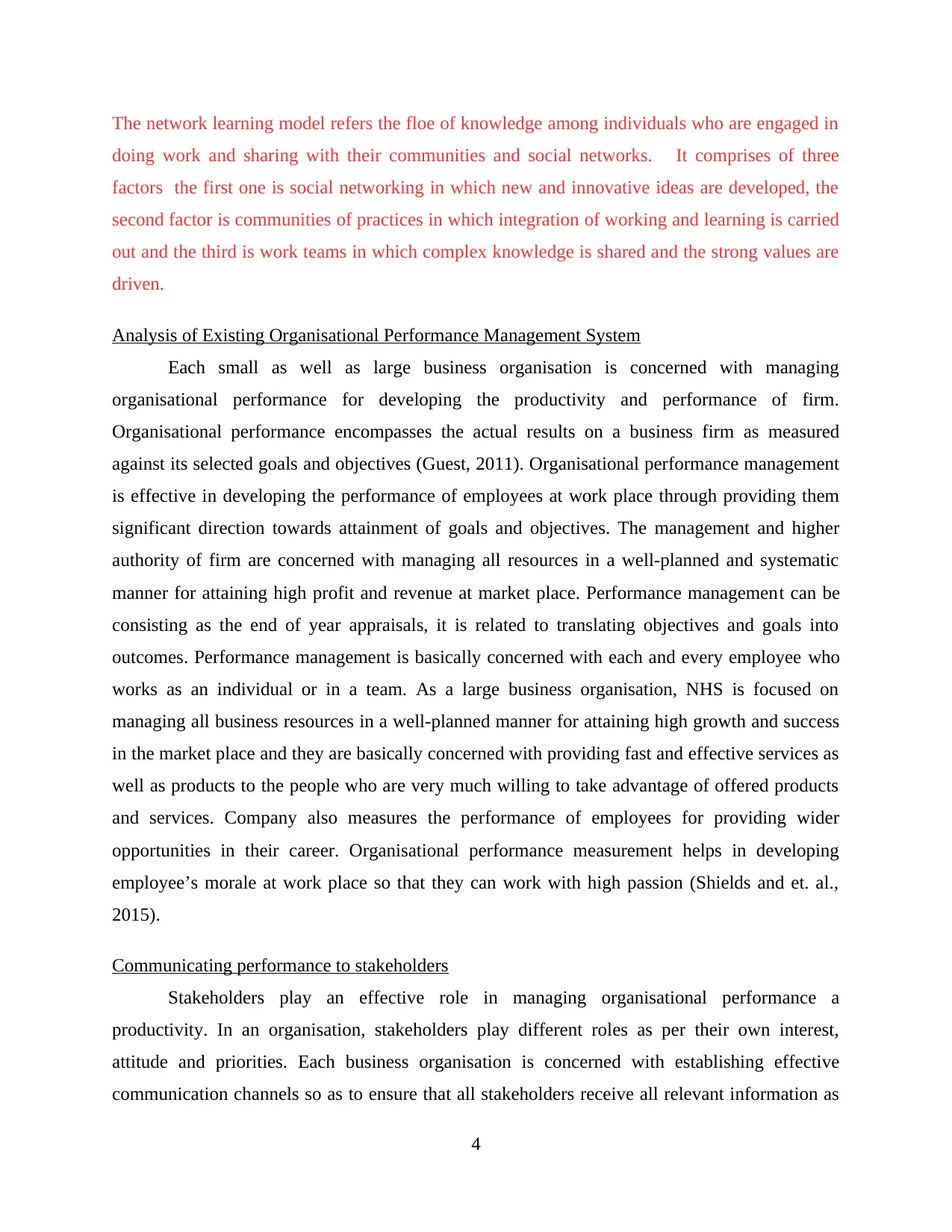
The network learning model refers the floe of knowledge among individuals who are engaged in
doing work and sharing with their communities and social networks. It comprises of three
factors the first one is social networking in which new and innovative ideas are developed, the
second factor is communities of practices in which integration of working and learning is carried
out and the third is work teams in which complex knowledge is shared and the strong values are
driven.
Analysis of Existing Organisational Performance Management System
Each small as well as large business organisation is concerned with managing
organisational performance for developing the productivity and performance of firm.
Organisational performance encompasses the actual results on a business firm as measured
against its selected goals and objectives (Guest, 2011). Organisational performance management
is effective in developing the performance of employees at work place through providing them
significant direction towards attainment of goals and objectives. The management and higher
authority of firm are concerned with managing all resources in a well-planned and systematic
manner for attaining high profit and revenue at market place. Performance management can be
consisting as the end of year appraisals, it is related to translating objectives and goals into
outcomes. Performance management is basically concerned with each and every employee who
works as an individual or in a team. As a large business organisation, NHS is focused on
managing all business resources in a well-planned manner for attaining high growth and success
in the market place and they are basically concerned with providing fast and effective services as
well as products to the people who are very much willing to take advantage of offered products
and services. Company also measures the performance of employees for providing wider
opportunities in their career. Organisational performance measurement helps in developing
employee’s morale at work place so that they can work with high passion (Shields and et. al.,
2015).
Communicating performance to stakeholders
Stakeholders play an effective role in managing organisational performance a
productivity. In an organisation, stakeholders play different roles as per their own interest,
attitude and priorities. Each business organisation is concerned with establishing effective
communication channels so as to ensure that all stakeholders receive all relevant information as
4
doing work and sharing with their communities and social networks. It comprises of three
factors the first one is social networking in which new and innovative ideas are developed, the
second factor is communities of practices in which integration of working and learning is carried
out and the third is work teams in which complex knowledge is shared and the strong values are
driven.
Analysis of Existing Organisational Performance Management System
Each small as well as large business organisation is concerned with managing
organisational performance for developing the productivity and performance of firm.
Organisational performance encompasses the actual results on a business firm as measured
against its selected goals and objectives (Guest, 2011). Organisational performance management
is effective in developing the performance of employees at work place through providing them
significant direction towards attainment of goals and objectives. The management and higher
authority of firm are concerned with managing all resources in a well-planned and systematic
manner for attaining high profit and revenue at market place. Performance management can be
consisting as the end of year appraisals, it is related to translating objectives and goals into
outcomes. Performance management is basically concerned with each and every employee who
works as an individual or in a team. As a large business organisation, NHS is focused on
managing all business resources in a well-planned manner for attaining high growth and success
in the market place and they are basically concerned with providing fast and effective services as
well as products to the people who are very much willing to take advantage of offered products
and services. Company also measures the performance of employees for providing wider
opportunities in their career. Organisational performance measurement helps in developing
employee’s morale at work place so that they can work with high passion (Shields and et. al.,
2015).
Communicating performance to stakeholders
Stakeholders play an effective role in managing organisational performance a
productivity. In an organisation, stakeholders play different roles as per their own interest,
attitude and priorities. Each business organisation is concerned with establishing effective
communication channels so as to ensure that all stakeholders receive all relevant information as
4
Paraphrase This Document
Need a fresh take? Get an instant paraphrase of this document with our AI Paraphraser
per their needs and build positive or effective attitude towards the firm or its various projects. It
is required for a health care sector to implement an effective communication channel to transect
all data and information in an effective and efficient manner (Johnson, 2016). Stakeholders are
having a huge amount of share in profit and revenue and for this, they perform various activities
as per their skills and knowledge at workplace. In service sector, stakeholders play a vast role in
providing significant capital fund for serving beneficial and appropriate services to the needy
people without charging any kind of cost. Being the world’s largest service provider
organisation, NHS is concerned with providing free health care facility to people who are facing
various kinds of health issues and not able to take significant treatment due to lack of money.
Risk Management
Risk and conflicts are unwanted in nature they can arise on any time or in any situation.
Each business organisations are concern on managing risk as to attaining high position at market
place (Lee, 2017). Organisational performance management plays significant role in managing
risk at work place through implement all business operations at right manner. Risk management
can be considered as an effective process of identifying the risk and their influence on firm or its
operations. A good risk management system helps in minimizing the factor of risk within an
organisation and needs to be represented as an integral to efficient management practices. A risk
management process can be implemented to any type of situation where an unexpected or
undesired result could be important and where various opportunities are determined. Risk
management process involved various elements which are associate as below: Identifying the risk: It is essential for each business firm to determine the risk and its
impact on organisation. It is the major responsibility of firm or its higher authority to
identifying the actors by which risk are associated and has a direct influence on
organisational performance. Analyse the risk: In this stage organisation needs to analyse the risk as to remove them in
effective and efficient manner. The analysis needs to consider the range of significant
consequences and how situations are arises. Evaluate risk: In this stage the higher authority of firm are concern on comparing
estimated level of risk with the pre-determined criteria. If the risk level is low than risk
may occur into an acceptable category and treatment may not be essential.
5
is required for a health care sector to implement an effective communication channel to transect
all data and information in an effective and efficient manner (Johnson, 2016). Stakeholders are
having a huge amount of share in profit and revenue and for this, they perform various activities
as per their skills and knowledge at workplace. In service sector, stakeholders play a vast role in
providing significant capital fund for serving beneficial and appropriate services to the needy
people without charging any kind of cost. Being the world’s largest service provider
organisation, NHS is concerned with providing free health care facility to people who are facing
various kinds of health issues and not able to take significant treatment due to lack of money.
Risk Management
Risk and conflicts are unwanted in nature they can arise on any time or in any situation.
Each business organisations are concern on managing risk as to attaining high position at market
place (Lee, 2017). Organisational performance management plays significant role in managing
risk at work place through implement all business operations at right manner. Risk management
can be considered as an effective process of identifying the risk and their influence on firm or its
operations. A good risk management system helps in minimizing the factor of risk within an
organisation and needs to be represented as an integral to efficient management practices. A risk
management process can be implemented to any type of situation where an unexpected or
undesired result could be important and where various opportunities are determined. Risk
management process involved various elements which are associate as below: Identifying the risk: It is essential for each business firm to determine the risk and its
impact on organisation. It is the major responsibility of firm or its higher authority to
identifying the actors by which risk are associated and has a direct influence on
organisational performance. Analyse the risk: In this stage organisation needs to analyse the risk as to remove them in
effective and efficient manner. The analysis needs to consider the range of significant
consequences and how situations are arises. Evaluate risk: In this stage the higher authority of firm are concern on comparing
estimated level of risk with the pre-determined criteria. If the risk level is low than risk
may occur into an acceptable category and treatment may not be essential.
5
Treat risk: In this the treatment of risk needs to be done as per the priority and an
effective management plan needs to include consideration of funding (López-Nicolás and
Meroño-Cerdán, 2011). Monitor and Review: Control and monitor the performance of the firms risk management
system and adopt changed that has a huge positive influence on organisational
performance.
Communicate and consult: In this stage organisation or its management department are
focused on communicating with internal as well as external stakeholders as efficient at
the each step of the process of risk management and concerning the process as a whole.
Quality management and Improvement
In a health care sector employees are more concern on providing high quality products
and services as to satisfying the needs and wants of people (Mir and Pinnington, 2014). NHS is
widely concern on providing high quality facilities to their significant patients as to improving
their mental as well as physical condition. Effective Quality management leads the firm towards
improving effectiveness of treatments and enhance customer’s satisfaction with the offered
products and services of firm. NHS is concern on taking feedbacks from customers as it is
effective in analysing the issues and conflicts which are arises at the time of serving the products
and services of firm (Rasula, Vuksic and Stemberger, 2012).
Financial Performance
This also plays a vast role in developing organisational performance and productivity at
market area. Effective organisational performance management system helps in developing
firm’s financial performance. It is a measure of how the organisation can utilized its available
resources so as to generate huge revenues. The company can identify its actual financial
performance through preparing financial statement such as profit and loss a/c, balance sheet etc.
Therefore in order to survive in competitive environment for longer duration the company need
to achieve good financial position in market (Truss and et. al., 2013).
6
effective management plan needs to include consideration of funding (López-Nicolás and
Meroño-Cerdán, 2011). Monitor and Review: Control and monitor the performance of the firms risk management
system and adopt changed that has a huge positive influence on organisational
performance.
Communicate and consult: In this stage organisation or its management department are
focused on communicating with internal as well as external stakeholders as efficient at
the each step of the process of risk management and concerning the process as a whole.
Quality management and Improvement
In a health care sector employees are more concern on providing high quality products
and services as to satisfying the needs and wants of people (Mir and Pinnington, 2014). NHS is
widely concern on providing high quality facilities to their significant patients as to improving
their mental as well as physical condition. Effective Quality management leads the firm towards
improving effectiveness of treatments and enhance customer’s satisfaction with the offered
products and services of firm. NHS is concern on taking feedbacks from customers as it is
effective in analysing the issues and conflicts which are arises at the time of serving the products
and services of firm (Rasula, Vuksic and Stemberger, 2012).
Financial Performance
This also plays a vast role in developing organisational performance and productivity at
market area. Effective organisational performance management system helps in developing
firm’s financial performance. It is a measure of how the organisation can utilized its available
resources so as to generate huge revenues. The company can identify its actual financial
performance through preparing financial statement such as profit and loss a/c, balance sheet etc.
Therefore in order to survive in competitive environment for longer duration the company need
to achieve good financial position in market (Truss and et. al., 2013).
6
⊘ This is a preview!⊘
Do you want full access?
Subscribe today to unlock all pages.
Trusted by 1+ million students worldwide
Customer and client perspective
It is a viewpoint of customers and clients towards the quality of products and services
they purchased from the company. Thus, it is important for company to evaluate their perception
in order to identify their needs and demands and fulfil them on time and generate huge profits.
People perspectives
It refers to the perception of people and their behaviours and interest towards the products
and services which can also affect and influence the decision making process of an organisation.
Implementation issues
There are some barriers or problems which restricts the company in implementing tools
and techniques in an effective and efficient manner is known as implementation issues. For
example If an organisation do not have skilled and efficient workers then chances of
implementing new techniques in an effective manner will be low (Zhu, Sarkis and Lai, 2012).
Some of the other issues are:
Failure in identifying the needs of users.
Failure in identifying total cost
RECOMMENDATIONS TO IMPROVEMENT
NHS is industries which is concerned with health care sector. It implement various
strategies which aids to enhance performance of organisation. It should do assessment in order
increase profitability of organisation. There are various issues which reduce performance of
organisation. There are some recommendation in order to improve the performance of
organisation which are describe below:
Performance improvement: At certain stage of company's evolution,NHS can improve
its various processes of organisation. In order to optimize the different inventories which
are used in operation processes. The manufacturing operation can replaced with new
technology to existing technology. NHS should apply different strategies to improve the
performance of organisation. Organisation should appoint panel of team members who
can analyses the performance of employee working in the organisation. Team assesses
the different key factors and issues which impact the performance of organisation. Use of
7
It is a viewpoint of customers and clients towards the quality of products and services
they purchased from the company. Thus, it is important for company to evaluate their perception
in order to identify their needs and demands and fulfil them on time and generate huge profits.
People perspectives
It refers to the perception of people and their behaviours and interest towards the products
and services which can also affect and influence the decision making process of an organisation.
Implementation issues
There are some barriers or problems which restricts the company in implementing tools
and techniques in an effective and efficient manner is known as implementation issues. For
example If an organisation do not have skilled and efficient workers then chances of
implementing new techniques in an effective manner will be low (Zhu, Sarkis and Lai, 2012).
Some of the other issues are:
Failure in identifying the needs of users.
Failure in identifying total cost
RECOMMENDATIONS TO IMPROVEMENT
NHS is industries which is concerned with health care sector. It implement various
strategies which aids to enhance performance of organisation. It should do assessment in order
increase profitability of organisation. There are various issues which reduce performance of
organisation. There are some recommendation in order to improve the performance of
organisation which are describe below:
Performance improvement: At certain stage of company's evolution,NHS can improve
its various processes of organisation. In order to optimize the different inventories which
are used in operation processes. The manufacturing operation can replaced with new
technology to existing technology. NHS should apply different strategies to improve the
performance of organisation. Organisation should appoint panel of team members who
can analyses the performance of employee working in the organisation. Team assesses
the different key factors and issues which impact the performance of organisation. Use of
7
Paraphrase This Document
Need a fresh take? Get an instant paraphrase of this document with our AI Paraphraser
advance technology and new methods can upgrade the system of organisation. It also
enhance the skills and knowledge of employee working in the organisation.
Revenue Enhancement: Growth of revenue is most important element of any
organisation. NHS should implement various strategies like enhance the availability of
medicine so that it can purchase by large number of customers. Organisation should
provide better facilities to other organisation which aids to enhance profitability of
company. Organisation implement new processes which are not being implemented by
other organisation. That new method should be provided by NHS. It also help to
maximise profits of organisation. Organisation of training session leads to develop skills
and knowledge of employee.
Process improvement: This is recommended to NHS to improve the various process of
organisation in order to attain effectiveness in work procedure of various processes.
Implementation of new technology within organisation leads to improve processes of
different operation. The task can easily accomplished by employee working in
organisation within stipulated time frame.
Manufacturing optimization: In order to sustain position in marketplace organisation
should fulfil its unique needs. Organisation should provide abundant amount resources
from different location in stipulated time frame which aids in performing different
activities in organisation. The management should apply different strategies like six
sigma knowledge of lean which aids to improve performance of organisation. It aids to
enhance the efficiency of employee to perform their task in effective manner.
Supply chain management: In present scenario, organisation apply different views of
experts in order to expand supply chain management. NHS should implement various
strategies to provide better facilities to patients and employee of organisation.
Organisation should implement different means of transport which provides medicines
and other valuable things which are concerned on to caring of patient. Organisation
should apply effective system in order to provide better supply of medicine and other
tools within stipulated time frame. It can help to cure various patient very quickly.
Organisation should allocate different resources which provide medicines and apparatus
at very relevant price which help to provide better service to patients which come
different places. It aids in achieving goals and objectives of organisation.
8
enhance the skills and knowledge of employee working in the organisation.
Revenue Enhancement: Growth of revenue is most important element of any
organisation. NHS should implement various strategies like enhance the availability of
medicine so that it can purchase by large number of customers. Organisation should
provide better facilities to other organisation which aids to enhance profitability of
company. Organisation implement new processes which are not being implemented by
other organisation. That new method should be provided by NHS. It also help to
maximise profits of organisation. Organisation of training session leads to develop skills
and knowledge of employee.
Process improvement: This is recommended to NHS to improve the various process of
organisation in order to attain effectiveness in work procedure of various processes.
Implementation of new technology within organisation leads to improve processes of
different operation. The task can easily accomplished by employee working in
organisation within stipulated time frame.
Manufacturing optimization: In order to sustain position in marketplace organisation
should fulfil its unique needs. Organisation should provide abundant amount resources
from different location in stipulated time frame which aids in performing different
activities in organisation. The management should apply different strategies like six
sigma knowledge of lean which aids to improve performance of organisation. It aids to
enhance the efficiency of employee to perform their task in effective manner.
Supply chain management: In present scenario, organisation apply different views of
experts in order to expand supply chain management. NHS should implement various
strategies to provide better facilities to patients and employee of organisation.
Organisation should implement different means of transport which provides medicines
and other valuable things which are concerned on to caring of patient. Organisation
should apply effective system in order to provide better supply of medicine and other
tools within stipulated time frame. It can help to cure various patient very quickly.
Organisation should allocate different resources which provide medicines and apparatus
at very relevant price which help to provide better service to patients which come
different places. It aids in achieving goals and objectives of organisation.
8
REFERENCES
Books and Journals
Ates, A., and et. al., 2013. The development of SME managerial practice for effective
performance management. Journal of Small Business and Enterprise Development. 20(1).
pp.28-54.
Bourne, M., and et. al., 2013. Generating organisational performance: The contributing effects
of performance measurement and human resource management practices. International
Journal of Operations & Production Management. 33(11/12). pp.1599-1622.
Guest, D. E., 2011. Human resource management and performance: still searching for some
answers. Human resource management journal. 21(1). pp.3-13.
Johnson, G., 2016. Exploring strategy: text and cases. Pearson Education.
Lee, G., 2017. Leadership coaching: From personal insight to organisational performance.
Kogan Page Publishers.
López-Nicolás, C. and Meroño-Cerdán, Á. L., 2011. Strategic knowledge management,
innovation and performance. International journal of information management. 31(6).
pp.502-509.
Mir, F. A. and Pinnington, A. H., 2014. Exploring the value of project management: linking
project management performance and project success. International journal of project
management. 32(2). pp.202-217.
Rasula, J., Vuksic, V. B. and Stemberger, M. I., 2012. The impact of knowledge management on
organisational performance. Economic and Business Review for Central and South-
Eastern Europe. 14(2). p.147.
Shields, J., and et. al., 2015. Managing Employee Performance & Reward: Concepts, Practices,
Strategies. Cambridge University Press.
Truss, C., and et. al., 2013. Employee engagement, organisational performance and individual
well-being: exploring the evidence, developing the theory.
Zhu, Q., Sarkis, J. and Lai, K. H., 2012. Examining the effects of green supply chain
management practices and their mediations on performance improvements. International
journal of production research. 50(5). pp.1377-1394.
Online
Roberts , S., 2018. How Should Companies Communicate Well With Their Stakeholders?
. [Online]. Available through: <http://smallbusiness.chron.com/should-companies-communicate-
well-stakeholders-15237.html>
9
Books and Journals
Ates, A., and et. al., 2013. The development of SME managerial practice for effective
performance management. Journal of Small Business and Enterprise Development. 20(1).
pp.28-54.
Bourne, M., and et. al., 2013. Generating organisational performance: The contributing effects
of performance measurement and human resource management practices. International
Journal of Operations & Production Management. 33(11/12). pp.1599-1622.
Guest, D. E., 2011. Human resource management and performance: still searching for some
answers. Human resource management journal. 21(1). pp.3-13.
Johnson, G., 2016. Exploring strategy: text and cases. Pearson Education.
Lee, G., 2017. Leadership coaching: From personal insight to organisational performance.
Kogan Page Publishers.
López-Nicolás, C. and Meroño-Cerdán, Á. L., 2011. Strategic knowledge management,
innovation and performance. International journal of information management. 31(6).
pp.502-509.
Mir, F. A. and Pinnington, A. H., 2014. Exploring the value of project management: linking
project management performance and project success. International journal of project
management. 32(2). pp.202-217.
Rasula, J., Vuksic, V. B. and Stemberger, M. I., 2012. The impact of knowledge management on
organisational performance. Economic and Business Review for Central and South-
Eastern Europe. 14(2). p.147.
Shields, J., and et. al., 2015. Managing Employee Performance & Reward: Concepts, Practices,
Strategies. Cambridge University Press.
Truss, C., and et. al., 2013. Employee engagement, organisational performance and individual
well-being: exploring the evidence, developing the theory.
Zhu, Q., Sarkis, J. and Lai, K. H., 2012. Examining the effects of green supply chain
management practices and their mediations on performance improvements. International
journal of production research. 50(5). pp.1377-1394.
Online
Roberts , S., 2018. How Should Companies Communicate Well With Their Stakeholders?
. [Online]. Available through: <http://smallbusiness.chron.com/should-companies-communicate-
well-stakeholders-15237.html>
9
⊘ This is a preview!⊘
Do you want full access?
Subscribe today to unlock all pages.
Trusted by 1+ million students worldwide

1 out of 12


Related Documents


Your All-in-One AI-Powered Toolkit for Academic Success.
+13062052269
info@desklib.com
Available 24*7 on WhatsApp / Email
![[object Object]](/_next/static/media/star-bottom.7253800d.svg)
Unlock your academic potential
Copyright © 2020–2026 A2Z Services. All Rights Reserved. Developed and managed by ZUCOL.