Organisations and Behaviour Report: Leadership Styles and Motivation
VerifiedAdded on 2020/06/05
|17
|5731
|29
Report
AI Summary
This report examines organisational behaviour, focusing on the influence of company culture and structure on employee performance. It compares the structures and cultures of CAPCO and Standard Chartered, highlighting the impact of factors such as hierarchical levels, communication, and leadership styles. The report analyzes different leadership styles, including autocratic, democratic, transformational, and laissez-faire approaches, and their effectiveness within organisations. It also delves into organisational theory and its underpinning of management practices, exploring the impact of motivation theories on employee behaviour and productivity. Furthermore, the report investigates the nature of groups, teamwork dynamics, and the effects of technology on team functioning, providing a comprehensive overview of key elements in organisational behaviour.
ORGANSIATIONS AND
BEHAVIOUR
BEHAVIOUR

Paraphrase This Document
Need a fresh take? Get an instant paraphrase of this document with our AI Paraphraser
Table of Contents
INTRODUCTION...........................................................................................................................3
TASK 1............................................................................................................................................4
1.1 Compare and contrast different companies culture and structure.........................................4
1.2 Relationship among organisation's structure and culture can impact on performance.........5
1.3 Factors influences individual behaviour...............................................................................6
TASK 2............................................................................................................................................7
2.1 Compare effectiveness of different leadership styles ..........................................................7
2.2 Organisational theory underpins the practice........................................................................8
2.3 Different approaches to management....................................................................................8
TASK 3............................................................................................................................................9
3.1 Impact that different leadership styles on motivation...........................................................9
3.2 Comparing two motivation theories used in company........................................................10
3.3 Evaluating need of motivation theory for manager.............................................................13
TASK 4 .........................................................................................................................................14
4.1 Nature of groups and group behaviour................................................................................14
4.2 Factors that promote inhibit the development of teamwork...............................................14
4.3 Impact of technology on team functioning.........................................................................15
CONCLUSION..............................................................................................................................16
REFERENCES..............................................................................................................................16
.......................................................................................................................................................18
INTRODUCTION...........................................................................................................................3
TASK 1............................................................................................................................................4
1.1 Compare and contrast different companies culture and structure.........................................4
1.2 Relationship among organisation's structure and culture can impact on performance.........5
1.3 Factors influences individual behaviour...............................................................................6
TASK 2............................................................................................................................................7
2.1 Compare effectiveness of different leadership styles ..........................................................7
2.2 Organisational theory underpins the practice........................................................................8
2.3 Different approaches to management....................................................................................8
TASK 3............................................................................................................................................9
3.1 Impact that different leadership styles on motivation...........................................................9
3.2 Comparing two motivation theories used in company........................................................10
3.3 Evaluating need of motivation theory for manager.............................................................13
TASK 4 .........................................................................................................................................14
4.1 Nature of groups and group behaviour................................................................................14
4.2 Factors that promote inhibit the development of teamwork...............................................14
4.3 Impact of technology on team functioning.........................................................................15
CONCLUSION..............................................................................................................................16
REFERENCES..............................................................................................................................16
.......................................................................................................................................................18
INTRODUCTION
In an organisation, human behaviour is very important. It is the study of behaviour of
people in a company. The behaviour is directly concerned with the production of organisation.
CAPCO is a global business and technology consultancy and it is specialized in financial
services sectors like banking insurance, finance, technology etc. It offers consultancy services to
financial industries. In this report, mentioned about the comparison between two organisational
structure and relationship among the companies structure. Sometimes, the culture of a company
impact on the performance of business (Jabari and Soleimannezhad, 2014). There are many
factors which influence the behaviour of an individual at workplace. This company uses the
different types of effective leadership styles. The company uses different types of approaches to
management in workplace. In this report also mentioned that the managers use motivational
theories to motivate employees in an organisation. In workplace of company, there are many
factors that my promote the development of teamwork.
TASK 1
1.1 Compare and contrast different companies culture and structure
The culture and structure of every organisations is from each other. Culture consists
system of norms, values and beliefs which indicates behaviour of people in a company. The
organisational structure means rules and regulations which is designed for different department
at every level. Sometimes, it is affected by size, complexities in tasks, culture, external and
internal environment. There are two companies CAPCO and Standard Chartered and their
structure is different. Standard chartered is a financial service provider company. This financial
institution operates in institutional banking, corporate, treasury services etc. Mainly
organisational structure are of three types:
Tall hierarchical Structure- Basically this structure is used by big organisations. It
consists of several levels of hierarchy. In this, there are many managers and the role of
every manager is different, they have proper control over activities and employees. In
this, top management does not include employees in decision making process and take all
decisions it self (Gupta and Upadhyay, 2012). The communication level between
employees and top management is very poor. They do not motivate employees towards
work.
In an organisation, human behaviour is very important. It is the study of behaviour of
people in a company. The behaviour is directly concerned with the production of organisation.
CAPCO is a global business and technology consultancy and it is specialized in financial
services sectors like banking insurance, finance, technology etc. It offers consultancy services to
financial industries. In this report, mentioned about the comparison between two organisational
structure and relationship among the companies structure. Sometimes, the culture of a company
impact on the performance of business (Jabari and Soleimannezhad, 2014). There are many
factors which influence the behaviour of an individual at workplace. This company uses the
different types of effective leadership styles. The company uses different types of approaches to
management in workplace. In this report also mentioned that the managers use motivational
theories to motivate employees in an organisation. In workplace of company, there are many
factors that my promote the development of teamwork.
TASK 1
1.1 Compare and contrast different companies culture and structure
The culture and structure of every organisations is from each other. Culture consists
system of norms, values and beliefs which indicates behaviour of people in a company. The
organisational structure means rules and regulations which is designed for different department
at every level. Sometimes, it is affected by size, complexities in tasks, culture, external and
internal environment. There are two companies CAPCO and Standard Chartered and their
structure is different. Standard chartered is a financial service provider company. This financial
institution operates in institutional banking, corporate, treasury services etc. Mainly
organisational structure are of three types:
Tall hierarchical Structure- Basically this structure is used by big organisations. It
consists of several levels of hierarchy. In this, there are many managers and the role of
every manager is different, they have proper control over activities and employees. In
this, top management does not include employees in decision making process and take all
decisions it self (Gupta and Upadhyay, 2012). The communication level between
employees and top management is very poor. They do not motivate employees towards
work.
⊘ This is a preview!⊘
Do you want full access?
Subscribe today to unlock all pages.

Trusted by 1+ million students worldwide
Flat organisational structure- This structure is used by small and medium size
organisations. So, managers easily concentrate on employees. In this, communication is
good and proper among top management and employees. Managers motivated and proper
advice to employees, so that they can perform better and take better decisions.
Matrix organisational structure- It is a combination of two and more than two
organisational structures (Baumgarten and Mulvenna, 2010). Company commonly used
this with large projects and uncertain environment where there is a need arise for
economies. In this, all employees have to report to product manager as well as functional
manger.
Organisational culture- It is a set of values, norms, customs and beliefs. It means the way in
which an organisation treat its employees, conduct business. The culture is defined in to two
parts:
Collaborative culture- In this, company sees satisfaction level of consumers. Employees
work under this culture, they have the freedom to do work and also make positive
decisions which affects positively on productivity and growth of company. In this culture,
managers are trusting, motivating, liberal etc. They motivate and inspire employees to do
work in a proper manner. From this, the productivity of company will be enhances.
Controlled culture- In this culture, mangers have proper control over their employees.
They create the hierarchical reporting structure and they power is on the hands of top
management. This culture makes employees un- empowered to take any decisions. It
affects on working performance of employees.
CAPCO works on flat structure and it works in dynamic and innovative culture. In this
structure, the communication is good among managers and employees (Sinha and et.al., 2017).
Top management of this company work with their employees. On the other hand STANDARD
CHARTERED works in Tall organisational structure, in this all decisions are taken by top
management and communication between employees and managers is not good or satisfactory.
1.2 Relationship among organisation's structure and culture can impact on performance
When structure and culture of organisation is good or proper then the performance of
business will be good. To improve the performance level of employees, it is necessary to
motivate them and from this the productivity and profitability of company will be increases. To
improve the performance of business, then managers have to motivate employees, to solve their
organisations. So, managers easily concentrate on employees. In this, communication is
good and proper among top management and employees. Managers motivated and proper
advice to employees, so that they can perform better and take better decisions.
Matrix organisational structure- It is a combination of two and more than two
organisational structures (Baumgarten and Mulvenna, 2010). Company commonly used
this with large projects and uncertain environment where there is a need arise for
economies. In this, all employees have to report to product manager as well as functional
manger.
Organisational culture- It is a set of values, norms, customs and beliefs. It means the way in
which an organisation treat its employees, conduct business. The culture is defined in to two
parts:
Collaborative culture- In this, company sees satisfaction level of consumers. Employees
work under this culture, they have the freedom to do work and also make positive
decisions which affects positively on productivity and growth of company. In this culture,
managers are trusting, motivating, liberal etc. They motivate and inspire employees to do
work in a proper manner. From this, the productivity of company will be enhances.
Controlled culture- In this culture, mangers have proper control over their employees.
They create the hierarchical reporting structure and they power is on the hands of top
management. This culture makes employees un- empowered to take any decisions. It
affects on working performance of employees.
CAPCO works on flat structure and it works in dynamic and innovative culture. In this
structure, the communication is good among managers and employees (Sinha and et.al., 2017).
Top management of this company work with their employees. On the other hand STANDARD
CHARTERED works in Tall organisational structure, in this all decisions are taken by top
management and communication between employees and managers is not good or satisfactory.
1.2 Relationship among organisation's structure and culture can impact on performance
When structure and culture of organisation is good or proper then the performance of
business will be good. To improve the performance level of employees, it is necessary to
motivate them and from this the productivity and profitability of company will be increases. To
improve the performance of business, then managers have to motivate employees, to solve their
Paraphrase This Document
Need a fresh take? Get an instant paraphrase of this document with our AI Paraphraser
problems in an effective manner and provide training related to new technologies and
machineries. From all this, the confidence and working level of employees will be increased and
improve the performance of employees (Kurian and Naik, 2014). If managers do not motivate
employees and do not interact with them, then in this case they will get demotivated and it
affects on company's productivity.
An organisational structure and culture tends to alteration the determination of employees
negatively and positively. This is all depend on culture and structure of a business firm. If
company uses satisfactory and well organised hierarchical structure then its impact will be
positive and if in case it uses hard management styles for employees, then its impact will be
negative. CAPCO uses flat hierarchical structure with wide span of control and collaborative
culture that is related with culture and believes in employees engagement. It results in motivate
them and increases an efficiency and effectiveness of business. It helps in improving the
performance of employees. It STANDARD CHARTERED works in tall structure and control
culture. In this managers are not motivate employees and do not proper interact with them. They
have proper control over employees. It impacts on business performance.
1.3 Factors influences individual behaviour
There are several factors which affects on individual behaviour at workplace. These
factors consist organisational structure, aims, culture, punishment system, values etc. If the
structure of company is not good and employees do not feel good, and top management do not
support their employees then in this case, the behaviour of employees will be affected. If
company uses well hierarchical structure, give support, motivation and proper guidance to them,
then the work performance of employees will be enhances (Mihaela and Bratianu, 2012).
Fredrick Herzberg gives two factor theory that defines behaviour of individual at work.
Hygiene factors- When employees do not create maximum satisfaction then it can
demotivate them. There are some hygiene factors like for instance working conditions, salary
issues, relationship among employees and managers, policies of company etc. In a company if
working environment is not good or positive and the relationship of employees and managers or
leaders is not good or healthy then in this case employees will be demotivated and they do not
work properly.
machineries. From all this, the confidence and working level of employees will be increased and
improve the performance of employees (Kurian and Naik, 2014). If managers do not motivate
employees and do not interact with them, then in this case they will get demotivated and it
affects on company's productivity.
An organisational structure and culture tends to alteration the determination of employees
negatively and positively. This is all depend on culture and structure of a business firm. If
company uses satisfactory and well organised hierarchical structure then its impact will be
positive and if in case it uses hard management styles for employees, then its impact will be
negative. CAPCO uses flat hierarchical structure with wide span of control and collaborative
culture that is related with culture and believes in employees engagement. It results in motivate
them and increases an efficiency and effectiveness of business. It helps in improving the
performance of employees. It STANDARD CHARTERED works in tall structure and control
culture. In this managers are not motivate employees and do not proper interact with them. They
have proper control over employees. It impacts on business performance.
1.3 Factors influences individual behaviour
There are several factors which affects on individual behaviour at workplace. These
factors consist organisational structure, aims, culture, punishment system, values etc. If the
structure of company is not good and employees do not feel good, and top management do not
support their employees then in this case, the behaviour of employees will be affected. If
company uses well hierarchical structure, give support, motivation and proper guidance to them,
then the work performance of employees will be enhances (Mihaela and Bratianu, 2012).
Fredrick Herzberg gives two factor theory that defines behaviour of individual at work.
Hygiene factors- When employees do not create maximum satisfaction then it can
demotivate them. There are some hygiene factors like for instance working conditions, salary
issues, relationship among employees and managers, policies of company etc. In a company if
working environment is not good or positive and the relationship of employees and managers or
leaders is not good or healthy then in this case employees will be demotivated and they do not
work properly.
Motivational factors- These factors motivate employees and do not create dissatisfaction.
The manager provides them appreciation and recognition towards their work and communicate
well with their employees. So, relationship between workers and leaders will be strong.
CAPCO uses motivate factors and motivate their employees and also work with them
while STANDARD CHARTERED uses Hygiene factors and do not interact and motivate them.
So these are the factors which influence person behaviour positively and negatively at
workplace.
TASK 2
2.1 Compare effectiveness of different leadership styles
Leadership is play an important role to develop business in the effective manner by which
helps to achieve organisational goals and objectives. It aids to increase productivity as well as
improve working performance of employees (Ryan and Francis, 2012). CAPCO and
STANDARD CHARTERED are financial companies in UK. There is available various types of
leadership styles, which manage and control all over works as well as given effective guidance. Autocratic Leadership: This leadership style assist to manage all works which owner of
the an organisation able to take corrective action. Follow this style by both companies
where all decisions and actions made by either owner also other executive on behalf of
him. This leadership form using by more companies to improve working performance as
well as productivity of firm. It is existed from very beginning time in organisations that is
regulated by management practises. Democratic Leadership: This type leading styles refers to define in which decision
making responsibilities are distributed between he/ she authorities, by which they can
able to take corrective and effective decision to develop business in appropriate way. Its
positively impacting on companies productivity by which create better communication
across whole organisation, which all employees are easy to communicate with employers
and customers. Transformational leadership: This leading style helps to express all employees get more
satisfaction to achieve goals and targets by using their own ideas and methods (Thurman,
Kidman and Taylor, 2014). It is mainly committed to improve team works, setting
The manager provides them appreciation and recognition towards their work and communicate
well with their employees. So, relationship between workers and leaders will be strong.
CAPCO uses motivate factors and motivate their employees and also work with them
while STANDARD CHARTERED uses Hygiene factors and do not interact and motivate them.
So these are the factors which influence person behaviour positively and negatively at
workplace.
TASK 2
2.1 Compare effectiveness of different leadership styles
Leadership is play an important role to develop business in the effective manner by which
helps to achieve organisational goals and objectives. It aids to increase productivity as well as
improve working performance of employees (Ryan and Francis, 2012). CAPCO and
STANDARD CHARTERED are financial companies in UK. There is available various types of
leadership styles, which manage and control all over works as well as given effective guidance. Autocratic Leadership: This leadership style assist to manage all works which owner of
the an organisation able to take corrective action. Follow this style by both companies
where all decisions and actions made by either owner also other executive on behalf of
him. This leadership form using by more companies to improve working performance as
well as productivity of firm. It is existed from very beginning time in organisations that is
regulated by management practises. Democratic Leadership: This type leading styles refers to define in which decision
making responsibilities are distributed between he/ she authorities, by which they can
able to take corrective and effective decision to develop business in appropriate way. Its
positively impacting on companies productivity by which create better communication
across whole organisation, which all employees are easy to communicate with employers
and customers. Transformational leadership: This leading style helps to express all employees get more
satisfaction to achieve goals and targets by using their own ideas and methods (Thurman,
Kidman and Taylor, 2014). It is mainly committed to improve team works, setting
⊘ This is a preview!⊘
Do you want full access?
Subscribe today to unlock all pages.
Trusted by 1+ million students worldwide
individual goals by which they can complete their task and amend working performance
as well. Laissez- faire leadership style- In this, employees choose their way of working. This
leadership is based on trust. They set their deadline of work. The managers give their
responsibilities to them to complete work in their own way and to make decisions. This
leadership is very effective but in case if employees are not skilled and trained then it
affects on working environment.
Relationship oriented leadership- This leadership is people oriented. In this top
management gives proper support to their employees. The main aim of this leadership is
to provide highly satisfaction and benefits to people and work for their welfare.
CAPCO company uses democratic leadership style and laissez- faire leadership style.
Managers involve their employees in decision making process and give freedom to do work ion
their own ways. From this, they will motivated and enhances their working performance. On the
other hand STANDARD CHARTERED company uses autocratic leadership style and do not
involve them in decision making process and have proper control over them (Laouer, 2011).
They do not provide proper training to them about new technologies and machineries.
2.2 Organisational theory underpins the practice
An organisation uses its theory in some areas of business. Employees try to follow
organisational theory to make their job and their life better. The management theory can
underpins personal values of employees that may not agree to follow the rules an regulations of a
company but they carried out their jobs in an effective and proper manner. This theory mainly
focus on the working environment of company and it also affects on the working capability. The
main objective of an organisation is to achieve its goals with in a measurable period of time. This
theory helps the business to understand about the modern and advanced technology, diversity,
knowledge, development, capacity, positive approach etc. It helps in adopting and using the new
and advanced technology which helps in finding new and simplest ways of completing work.
CAPCO company uses this human oriented approach (Krawchenko, 2014). It helps
managers to deal properly and effectively with their employees in a company. From this, the
employees will be motivated , participative and work for achieving the goals of company. This
approach helps in achieving the target. Through this theory the communication among top
as well. Laissez- faire leadership style- In this, employees choose their way of working. This
leadership is based on trust. They set their deadline of work. The managers give their
responsibilities to them to complete work in their own way and to make decisions. This
leadership is very effective but in case if employees are not skilled and trained then it
affects on working environment.
Relationship oriented leadership- This leadership is people oriented. In this top
management gives proper support to their employees. The main aim of this leadership is
to provide highly satisfaction and benefits to people and work for their welfare.
CAPCO company uses democratic leadership style and laissez- faire leadership style.
Managers involve their employees in decision making process and give freedom to do work ion
their own ways. From this, they will motivated and enhances their working performance. On the
other hand STANDARD CHARTERED company uses autocratic leadership style and do not
involve them in decision making process and have proper control over them (Laouer, 2011).
They do not provide proper training to them about new technologies and machineries.
2.2 Organisational theory underpins the practice
An organisation uses its theory in some areas of business. Employees try to follow
organisational theory to make their job and their life better. The management theory can
underpins personal values of employees that may not agree to follow the rules an regulations of a
company but they carried out their jobs in an effective and proper manner. This theory mainly
focus on the working environment of company and it also affects on the working capability. The
main objective of an organisation is to achieve its goals with in a measurable period of time. This
theory helps the business to understand about the modern and advanced technology, diversity,
knowledge, development, capacity, positive approach etc. It helps in adopting and using the new
and advanced technology which helps in finding new and simplest ways of completing work.
CAPCO company uses this human oriented approach (Krawchenko, 2014). It helps
managers to deal properly and effectively with their employees in a company. From this, the
employees will be motivated , participative and work for achieving the goals of company. This
approach helps in achieving the target. Through this theory the communication among top
Paraphrase This Document
Need a fresh take? Get an instant paraphrase of this document with our AI Paraphraser
management and workers will be good and healthy. So, for increases the productivity of
company, it is necessary to adopt this theory.
2.3 Different approaches to management
There are some approaches which are used by managers in an organisation:
Bureaucratic approach- This approach promotes the development and training
programmes of improve the skills of managers (Alisch and Freytag-Leyer, 2011). The main
benefit of this approach is that the company focuses only the work and performance of managers
and providing them positive environment for training and development.
Group behaviour approach- This approach states the importance of persons behaviour
and their attitude. In this approach, see the behaviour of employees in a group.
Interpersonal approach- This approach is mainly focus on interpersonal behaviour of
workers, human relationship, motivation etc. The main limitation of this approach is that it does
not involve planning and organising. It believes in creating the new conditions for their
employees.
Human relation approach- In this, managers deal with their employees effectively
because employees are motivated and participative. This is more effective approach because it
focuses on employees performance and motivate them.
System approach- It deals company either as open system or either as close system. This
approach is a problem solving approach. It encourages individuals to deal with problem and find
out the appropriate solution of that problem.
Contingency approach- This approach is mainly known as situational approach. It
suggests the suitable style of management that is dependent on t context of use of situation
(Tung, Baird and Schoch, 2011). The contingency manager gives attention to typical situation
and make effort to communicate properly.
CAPCO company uses both approaches behaviour and human relation approach.
According of Chief Executive Officer of CAPCO, the goal is not achieved through only
individuals by through teams. This company only believes in team work and and group
behaviour approaches that meets big success.
company, it is necessary to adopt this theory.
2.3 Different approaches to management
There are some approaches which are used by managers in an organisation:
Bureaucratic approach- This approach promotes the development and training
programmes of improve the skills of managers (Alisch and Freytag-Leyer, 2011). The main
benefit of this approach is that the company focuses only the work and performance of managers
and providing them positive environment for training and development.
Group behaviour approach- This approach states the importance of persons behaviour
and their attitude. In this approach, see the behaviour of employees in a group.
Interpersonal approach- This approach is mainly focus on interpersonal behaviour of
workers, human relationship, motivation etc. The main limitation of this approach is that it does
not involve planning and organising. It believes in creating the new conditions for their
employees.
Human relation approach- In this, managers deal with their employees effectively
because employees are motivated and participative. This is more effective approach because it
focuses on employees performance and motivate them.
System approach- It deals company either as open system or either as close system. This
approach is a problem solving approach. It encourages individuals to deal with problem and find
out the appropriate solution of that problem.
Contingency approach- This approach is mainly known as situational approach. It
suggests the suitable style of management that is dependent on t context of use of situation
(Tung, Baird and Schoch, 2011). The contingency manager gives attention to typical situation
and make effort to communicate properly.
CAPCO company uses both approaches behaviour and human relation approach.
According of Chief Executive Officer of CAPCO, the goal is not achieved through only
individuals by through teams. This company only believes in team work and and group
behaviour approaches that meets big success.
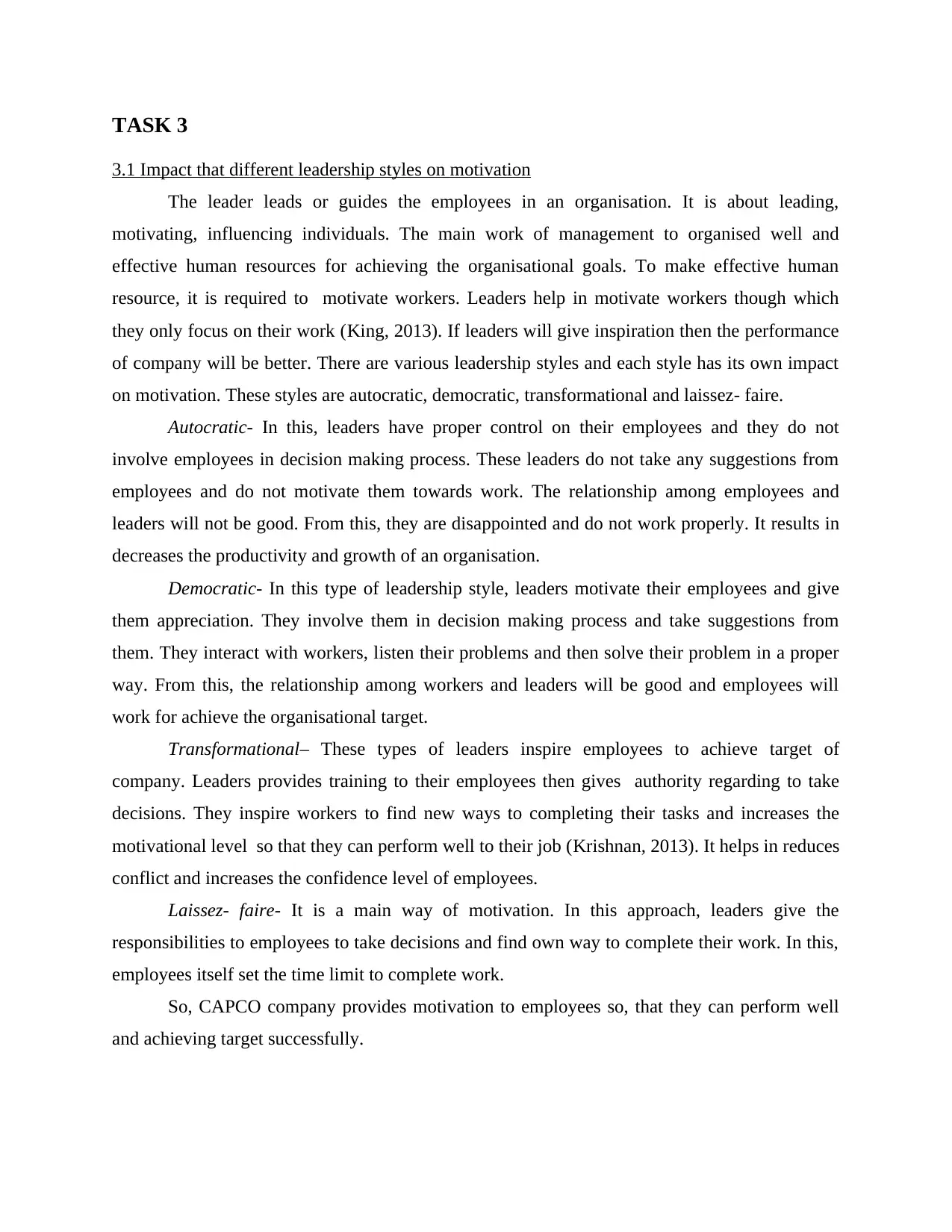
TASK 3
3.1 Impact that different leadership styles on motivation
The leader leads or guides the employees in an organisation. It is about leading,
motivating, influencing individuals. The main work of management to organised well and
effective human resources for achieving the organisational goals. To make effective human
resource, it is required to motivate workers. Leaders help in motivate workers though which
they only focus on their work (King, 2013). If leaders will give inspiration then the performance
of company will be better. There are various leadership styles and each style has its own impact
on motivation. These styles are autocratic, democratic, transformational and laissez- faire.
Autocratic- In this, leaders have proper control on their employees and they do not
involve employees in decision making process. These leaders do not take any suggestions from
employees and do not motivate them towards work. The relationship among employees and
leaders will not be good. From this, they are disappointed and do not work properly. It results in
decreases the productivity and growth of an organisation.
Democratic- In this type of leadership style, leaders motivate their employees and give
them appreciation. They involve them in decision making process and take suggestions from
them. They interact with workers, listen their problems and then solve their problem in a proper
way. From this, the relationship among workers and leaders will be good and employees will
work for achieve the organisational target.
Transformational– These types of leaders inspire employees to achieve target of
company. Leaders provides training to their employees then gives authority regarding to take
decisions. They inspire workers to find new ways to completing their tasks and increases the
motivational level so that they can perform well to their job (Krishnan, 2013). It helps in reduces
conflict and increases the confidence level of employees.
Laissez- faire- It is a main way of motivation. In this approach, leaders give the
responsibilities to employees to take decisions and find own way to complete their work. In this,
employees itself set the time limit to complete work.
So, CAPCO company provides motivation to employees so, that they can perform well
and achieving target successfully.
3.1 Impact that different leadership styles on motivation
The leader leads or guides the employees in an organisation. It is about leading,
motivating, influencing individuals. The main work of management to organised well and
effective human resources for achieving the organisational goals. To make effective human
resource, it is required to motivate workers. Leaders help in motivate workers though which
they only focus on their work (King, 2013). If leaders will give inspiration then the performance
of company will be better. There are various leadership styles and each style has its own impact
on motivation. These styles are autocratic, democratic, transformational and laissez- faire.
Autocratic- In this, leaders have proper control on their employees and they do not
involve employees in decision making process. These leaders do not take any suggestions from
employees and do not motivate them towards work. The relationship among employees and
leaders will not be good. From this, they are disappointed and do not work properly. It results in
decreases the productivity and growth of an organisation.
Democratic- In this type of leadership style, leaders motivate their employees and give
them appreciation. They involve them in decision making process and take suggestions from
them. They interact with workers, listen their problems and then solve their problem in a proper
way. From this, the relationship among workers and leaders will be good and employees will
work for achieve the organisational target.
Transformational– These types of leaders inspire employees to achieve target of
company. Leaders provides training to their employees then gives authority regarding to take
decisions. They inspire workers to find new ways to completing their tasks and increases the
motivational level so that they can perform well to their job (Krishnan, 2013). It helps in reduces
conflict and increases the confidence level of employees.
Laissez- faire- It is a main way of motivation. In this approach, leaders give the
responsibilities to employees to take decisions and find own way to complete their work. In this,
employees itself set the time limit to complete work.
So, CAPCO company provides motivation to employees so, that they can perform well
and achieving target successfully.
⊘ This is a preview!⊘
Do you want full access?
Subscribe today to unlock all pages.
Trusted by 1+ million students worldwide
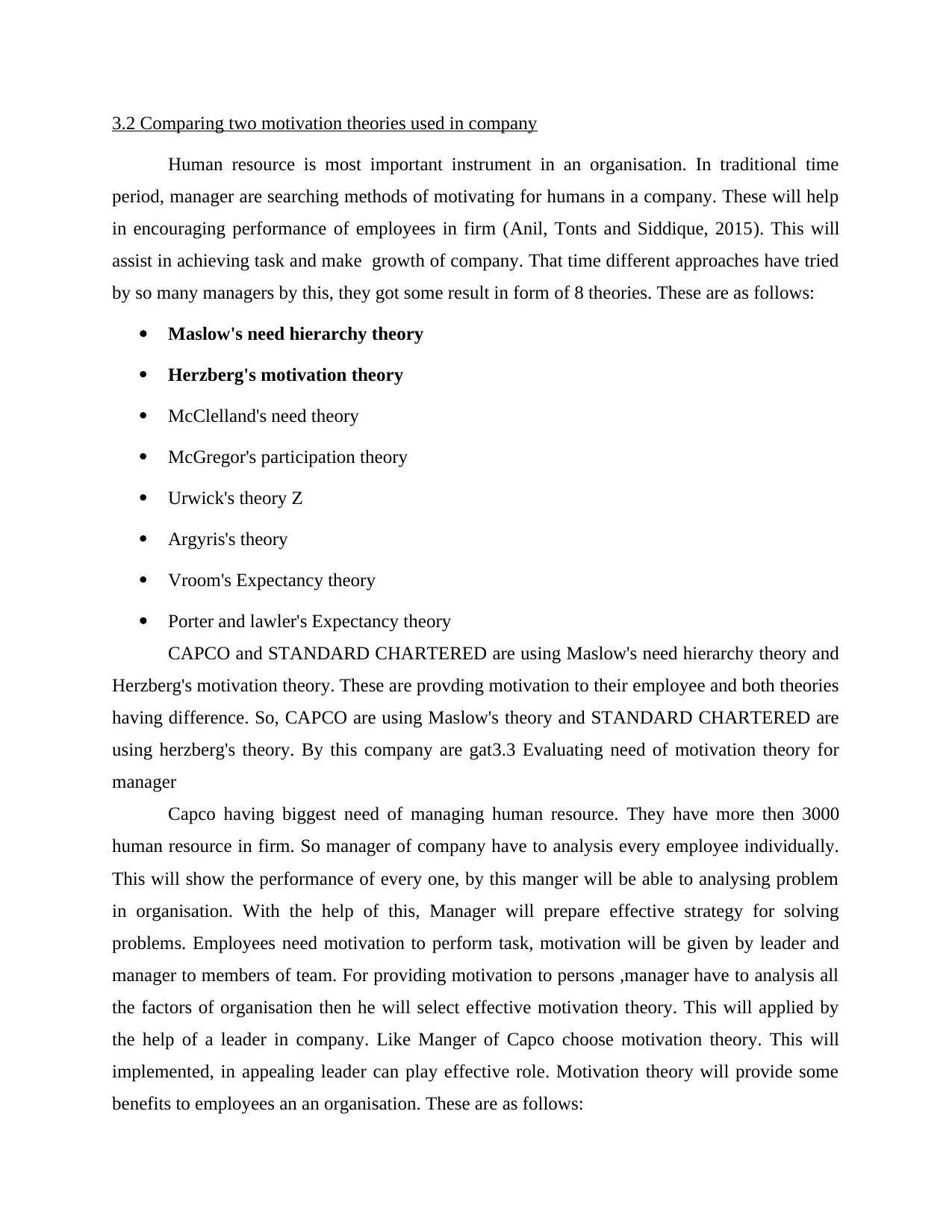
3.2 Comparing two motivation theories used in company
Human resource is most important instrument in an organisation. In traditional time
period, manager are searching methods of motivating for humans in a company. These will help
in encouraging performance of employees in firm (Anil, Tonts and Siddique, 2015). This will
assist in achieving task and make growth of company. That time different approaches have tried
by so many managers by this, they got some result in form of 8 theories. These are as follows:
Maslow's need hierarchy theory
Herzberg's motivation theory
McClelland's need theory
McGregor's participation theory
Urwick's theory Z
Argyris's theory
Vroom's Expectancy theory
Porter and lawler's Expectancy theory
CAPCO and STANDARD CHARTERED are using Maslow's need hierarchy theory and
Herzberg's motivation theory. These are provding motivation to their employee and both theories
having difference. So, CAPCO are using Maslow's theory and STANDARD CHARTERED are
using herzberg's theory. By this company are gat3.3 Evaluating need of motivation theory for
manager
Capco having biggest need of managing human resource. They have more then 3000
human resource in firm. So manager of company have to analysis every employee individually.
This will show the performance of every one, by this manger will be able to analysing problem
in organisation. With the help of this, Manager will prepare effective strategy for solving
problems. Employees need motivation to perform task, motivation will be given by leader and
manager to members of team. For providing motivation to persons ,manager have to analysis all
the factors of organisation then he will select effective motivation theory. This will applied by
the help of a leader in company. Like Manger of Capco choose motivation theory. This will
implemented, in appealing leader can play effective role. Motivation theory will provide some
benefits to employees an an organisation. These are as follows:
Human resource is most important instrument in an organisation. In traditional time
period, manager are searching methods of motivating for humans in a company. These will help
in encouraging performance of employees in firm (Anil, Tonts and Siddique, 2015). This will
assist in achieving task and make growth of company. That time different approaches have tried
by so many managers by this, they got some result in form of 8 theories. These are as follows:
Maslow's need hierarchy theory
Herzberg's motivation theory
McClelland's need theory
McGregor's participation theory
Urwick's theory Z
Argyris's theory
Vroom's Expectancy theory
Porter and lawler's Expectancy theory
CAPCO and STANDARD CHARTERED are using Maslow's need hierarchy theory and
Herzberg's motivation theory. These are provding motivation to their employee and both theories
having difference. So, CAPCO are using Maslow's theory and STANDARD CHARTERED are
using herzberg's theory. By this company are gat3.3 Evaluating need of motivation theory for
manager
Capco having biggest need of managing human resource. They have more then 3000
human resource in firm. So manager of company have to analysis every employee individually.
This will show the performance of every one, by this manger will be able to analysing problem
in organisation. With the help of this, Manager will prepare effective strategy for solving
problems. Employees need motivation to perform task, motivation will be given by leader and
manager to members of team. For providing motivation to persons ,manager have to analysis all
the factors of organisation then he will select effective motivation theory. This will applied by
the help of a leader in company. Like Manger of Capco choose motivation theory. This will
implemented, in appealing leader can play effective role. Motivation theory will provide some
benefits to employees an an organisation. These are as follows:
Paraphrase This Document
Need a fresh take? Get an instant paraphrase of this document with our AI Paraphraser
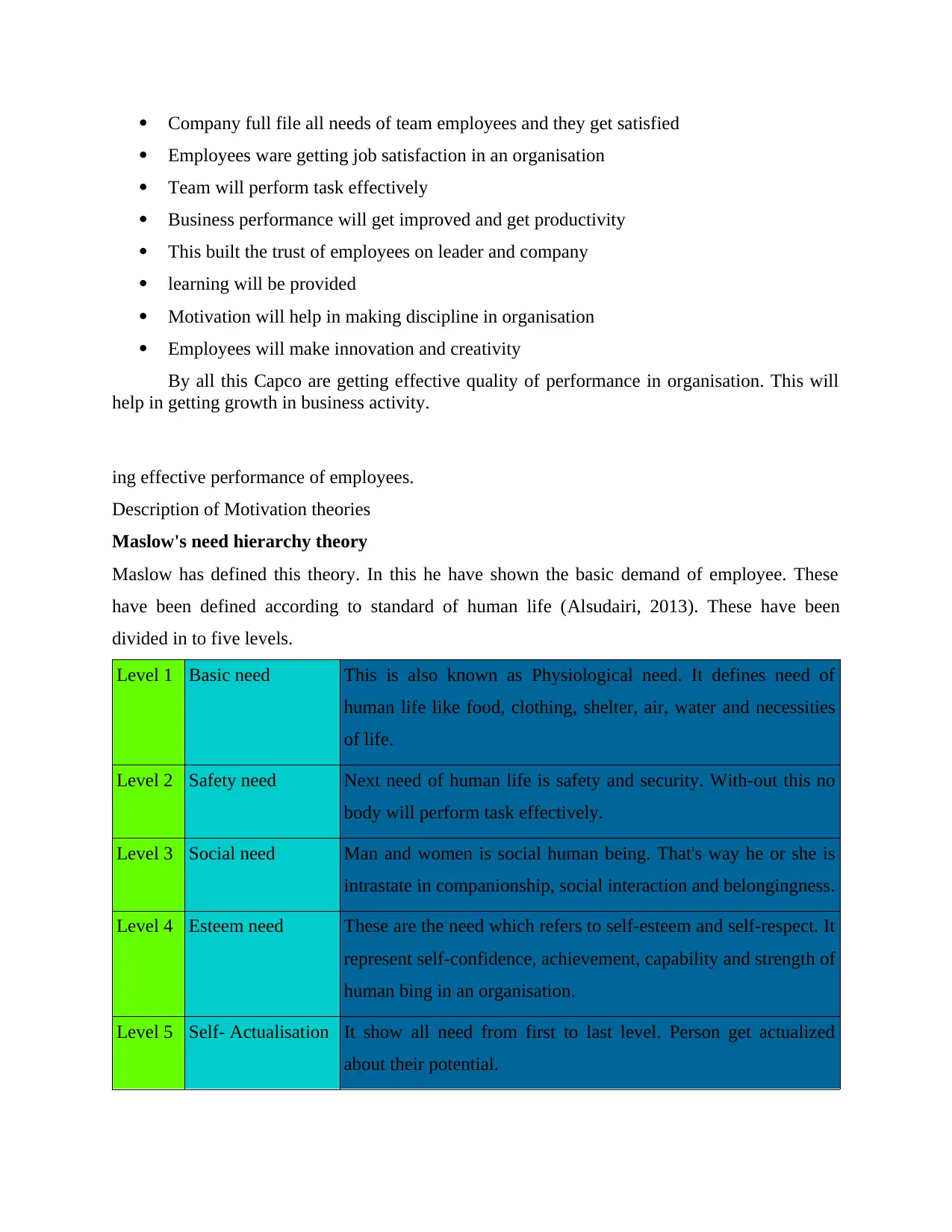
Company full file all needs of team employees and they get satisfied
Employees ware getting job satisfaction in an organisation
Team will perform task effectively
Business performance will get improved and get productivity
This built the trust of employees on leader and company
learning will be provided
Motivation will help in making discipline in organisation
Employees will make innovation and creativity
By all this Capco are getting effective quality of performance in organisation. This will
help in getting growth in business activity.
ing effective performance of employees.
Description of Motivation theories
Maslow's need hierarchy theory
Maslow has defined this theory. In this he have shown the basic demand of employee. These
have been defined according to standard of human life (Alsudairi, 2013). These have been
divided in to five levels.
Level 1 Basic need This is also known as Physiological need. It defines need of
human life like food, clothing, shelter, air, water and necessities
of life.
Level 2 Safety need Next need of human life is safety and security. With-out this no
body will perform task effectively.
Level 3 Social need Man and women is social human being. That's way he or she is
intrastate in companionship, social interaction and belongingness.
Level 4 Esteem need These are the need which refers to self-esteem and self-respect. It
represent self-confidence, achievement, capability and strength of
human bing in an organisation.
Level 5 Self- Actualisation It show all need from first to last level. Person get actualized
about their potential.
Employees ware getting job satisfaction in an organisation
Team will perform task effectively
Business performance will get improved and get productivity
This built the trust of employees on leader and company
learning will be provided
Motivation will help in making discipline in organisation
Employees will make innovation and creativity
By all this Capco are getting effective quality of performance in organisation. This will
help in getting growth in business activity.
ing effective performance of employees.
Description of Motivation theories
Maslow's need hierarchy theory
Maslow has defined this theory. In this he have shown the basic demand of employee. These
have been defined according to standard of human life (Alsudairi, 2013). These have been
divided in to five levels.
Level 1 Basic need This is also known as Physiological need. It defines need of
human life like food, clothing, shelter, air, water and necessities
of life.
Level 2 Safety need Next need of human life is safety and security. With-out this no
body will perform task effectively.
Level 3 Social need Man and women is social human being. That's way he or she is
intrastate in companionship, social interaction and belongingness.
Level 4 Esteem need These are the need which refers to self-esteem and self-respect. It
represent self-confidence, achievement, capability and strength of
human bing in an organisation.
Level 5 Self- Actualisation It show all need from first to last level. Person get actualized
about their potential.
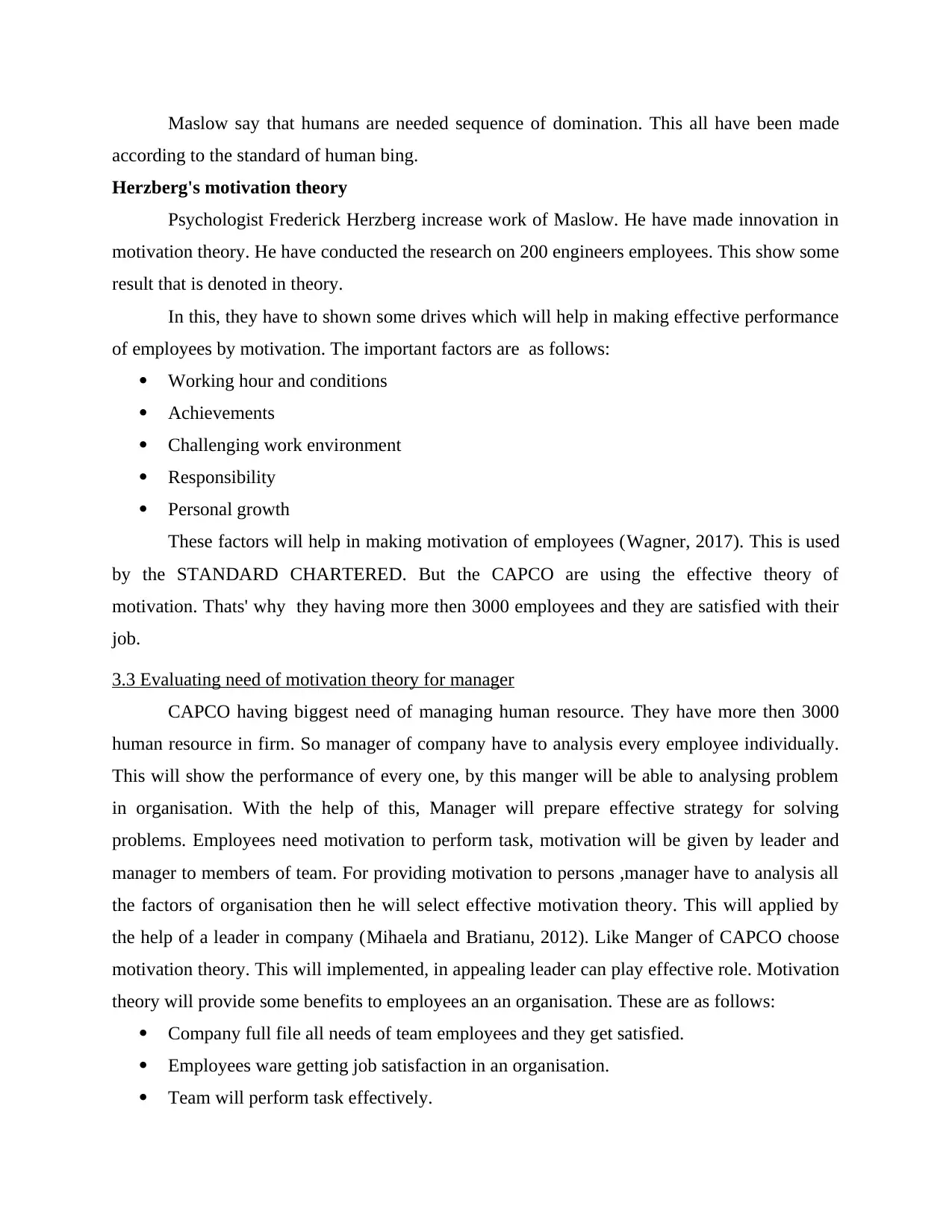
Maslow say that humans are needed sequence of domination. This all have been made
according to the standard of human bing.
Herzberg's motivation theory
Psychologist Frederick Herzberg increase work of Maslow. He have made innovation in
motivation theory. He have conducted the research on 200 engineers employees. This show some
result that is denoted in theory.
In this, they have to shown some drives which will help in making effective performance
of employees by motivation. The important factors are as follows:
Working hour and conditions
Achievements
Challenging work environment
Responsibility
Personal growth
These factors will help in making motivation of employees (Wagner, 2017). This is used
by the STANDARD CHARTERED. But the CAPCO are using the effective theory of
motivation. Thats' why they having more then 3000 employees and they are satisfied with their
job.
3.3 Evaluating need of motivation theory for manager
CAPCO having biggest need of managing human resource. They have more then 3000
human resource in firm. So manager of company have to analysis every employee individually.
This will show the performance of every one, by this manger will be able to analysing problem
in organisation. With the help of this, Manager will prepare effective strategy for solving
problems. Employees need motivation to perform task, motivation will be given by leader and
manager to members of team. For providing motivation to persons ,manager have to analysis all
the factors of organisation then he will select effective motivation theory. This will applied by
the help of a leader in company (Mihaela and Bratianu, 2012). Like Manger of CAPCO choose
motivation theory. This will implemented, in appealing leader can play effective role. Motivation
theory will provide some benefits to employees an an organisation. These are as follows:
Company full file all needs of team employees and they get satisfied.
Employees ware getting job satisfaction in an organisation.
Team will perform task effectively.
according to the standard of human bing.
Herzberg's motivation theory
Psychologist Frederick Herzberg increase work of Maslow. He have made innovation in
motivation theory. He have conducted the research on 200 engineers employees. This show some
result that is denoted in theory.
In this, they have to shown some drives which will help in making effective performance
of employees by motivation. The important factors are as follows:
Working hour and conditions
Achievements
Challenging work environment
Responsibility
Personal growth
These factors will help in making motivation of employees (Wagner, 2017). This is used
by the STANDARD CHARTERED. But the CAPCO are using the effective theory of
motivation. Thats' why they having more then 3000 employees and they are satisfied with their
job.
3.3 Evaluating need of motivation theory for manager
CAPCO having biggest need of managing human resource. They have more then 3000
human resource in firm. So manager of company have to analysis every employee individually.
This will show the performance of every one, by this manger will be able to analysing problem
in organisation. With the help of this, Manager will prepare effective strategy for solving
problems. Employees need motivation to perform task, motivation will be given by leader and
manager to members of team. For providing motivation to persons ,manager have to analysis all
the factors of organisation then he will select effective motivation theory. This will applied by
the help of a leader in company (Mihaela and Bratianu, 2012). Like Manger of CAPCO choose
motivation theory. This will implemented, in appealing leader can play effective role. Motivation
theory will provide some benefits to employees an an organisation. These are as follows:
Company full file all needs of team employees and they get satisfied.
Employees ware getting job satisfaction in an organisation.
Team will perform task effectively.
⊘ This is a preview!⊘
Do you want full access?
Subscribe today to unlock all pages.
Trusted by 1+ million students worldwide

1 out of 17


Related Documents


Your All-in-One AI-Powered Toolkit for Academic Success.
+13062052269
info@desklib.com
Available 24*7 on WhatsApp / Email
![[object Object]](/_next/static/media/star-bottom.7253800d.svg)
Unlock your academic potential
Copyright © 2020–2026 A2Z Services. All Rights Reserved. Developed and managed by ZUCOL.