Essay on Leadership: Transformational Leadership in Organisations

Verified

Added on  2023/01/19

|6
|1615
|68
Essay
AI Summary
This essay examines the multifaceted aspects of leadership, beginning with a concise definition emphasizing the ability to inspire others to dream, learn, do, and become more. It breaks down this statement to analyze key components of effective leadership, including envisioning the future, fostering continuous learning, promoting action and productivity, and encouraging personal and professional growth. The essay then pivots to discuss transformational leadership, its characteristics, and its impact on organisations. Transformational leadership is defined by the reciprocal support between leaders and followers, aiming for a shared vision and high standards. The essay highlights the four key influences of transformational leadership: charisma, inspirational motivation, individualised consideration, and intellectual stimulation. These elements are discussed in detail, demonstrating how leaders use them to create an environment where individuals are motivated to excel and contribute to the organisation's success. The essay references several sources to support its arguments, providing a comprehensive overview of the subject.

Document Page
ORGANISATIONAL PSYCHOLOGY
1 | P a g e
tabler-icon-diamond-filled.svg

Paraphrase This Document

Need a fresh take? Get an instant paraphrase of this document with our AI Paraphraser
Document Page
"If your actions inspire others to dream more, learn more, do more and become more, you are
a leader."
In fewer than twenty words, he clarified the spirit of leadership. One can divide this simple
statement and have an understanding of each component to have a glimpse if varied aspects of
leadership. “Inspire others to dream more…”
Dreaming defines leaders’ envisaging stuffs that might remain, that don't presently occur —
whether it stands to describe an innovative product or service, a newfangled functional unit, a
fresh solution on the road to explain a problematic, situation, a healthier procedure, or an
improved and sturdier establishment, communal set or nation (Adair, 2010). Visualizing events
and their outcomes in this framework is the vigorous and focused use of mind's eye, our
originality and our instinct or perception Every so often, great frontrunners are termed
"visionaries" since they remain contented in discovering the unidentified facts, thoughtful and
distinguishing ideologies whatever may be conceivable, somewhat than being comfortable with
the current situation. Innovation as well as target remains a leader's pursuit (Marquis & Huston,
2011).
"...Inspire others to learn more…"
Learning stands as the unique patterns of assurances of an inquisitive mind, the dynamic search
for different information and talents. Learning necessitates a readiness to move further than
acquainted standards of understanding as well as being competent to give or take, “I don't
distinguish all there remains to be familiar with. I need somewhat to learn." Leaders stand as
persistent learners, as well as their illustration of individual and specialized development can
“motivate and energize” others to perform the equivalent pattern of working procedures.
Learning more correspondingly defines the leadership eminence of devising an exposed mind,
unpretentiously accept as true that others' perspectives and concepts have significant values,
pursuing input and authentic opinion (Oliver, 2010).
"...Inspire others to do more…"
Leaders are active and industrious and generally undertake a countless deal. They ensure systems
for establishing and scheduling, and identify in what way to work competently with others
2 | P a g e
Document Page
through a well-organized plus operative technique. They recognize how to represent, which
remains another characteristic of efficiency. They also realize further for the reason that they fix
high principles for themselves, as well as are not gratified with averageness. Yet again, example
stands as the preeminent trainer, and their inclination to put the efforts firmly remain diligent,
and persistence serves as a great model designed for others, who consecutively need to make a
better involvement, to continue as an extent of making things to materialize (Conger & Riggio,
2012).
“..Inspire others to become more…”
“Becoming more” remains a term that defines the perception of development and spreading out.
Leaders are persistently intensifying their capability to mature in their range and penetration of
talents. It might comprise fetching a more operative public presenter, a more accomplished
audience member, or a healthier manager for consultation, just to refer to a few patterns. Over
stretch of time as well as through the excitement of understanding, the leader turns out to remain
more of the dependable self and articulates more of the indispensible talents along with
personality. It is simply identical to the development of acorn which remains a seed, and
"becomes more" by budding to an “oak tree” (Hughes & Beatty, 2011).
The functioning term in whole of these principles specifies as "inspire." This remains the spirit of
accurate leadership. Even though leaders recurrently do need great power and "regulation" over
certain possessions, their true influence comes as of being stimulating. Persons support as well as
"follow" leaders for the reason that they admire and appreciate them, since they are creditable of
trustworthiness and respect. There is a pooled confusion that leaders "encourage" and
“energize” their personnel, but the fact is that front-runners can simply trigger and promote the
aspiration in people to dream, study, and sort out and develop more (Marquis & Huston, 2011).
This stands as the transformation of headship and guidance — in a specified framework, to
afford the required constituents and situation wherein people are persistently motivated to remain
their best.
Davis (2011) outlined that transformational trend serve the method of pursuing shared purposes
done with the collective assortment of heads as well as group’s resolution with the ground rules
headed for the fulfillment of the imagined transformation. Transformational mechanism may
3 | P a g e
Document Page
be assumed once “leaders and followers support reciprocally to improve them in the direction of
accomplishing a cultured position of standards as well as interest” On the other hand, Marquis &
Huston (2011) demarcated transformational headship by way of an incomparable factors of
categorization that transfigures the groups to turnaround beyond their egocentricity by altering
their self-confidence, values, welfares, and integrities, stimulating and energizing them to
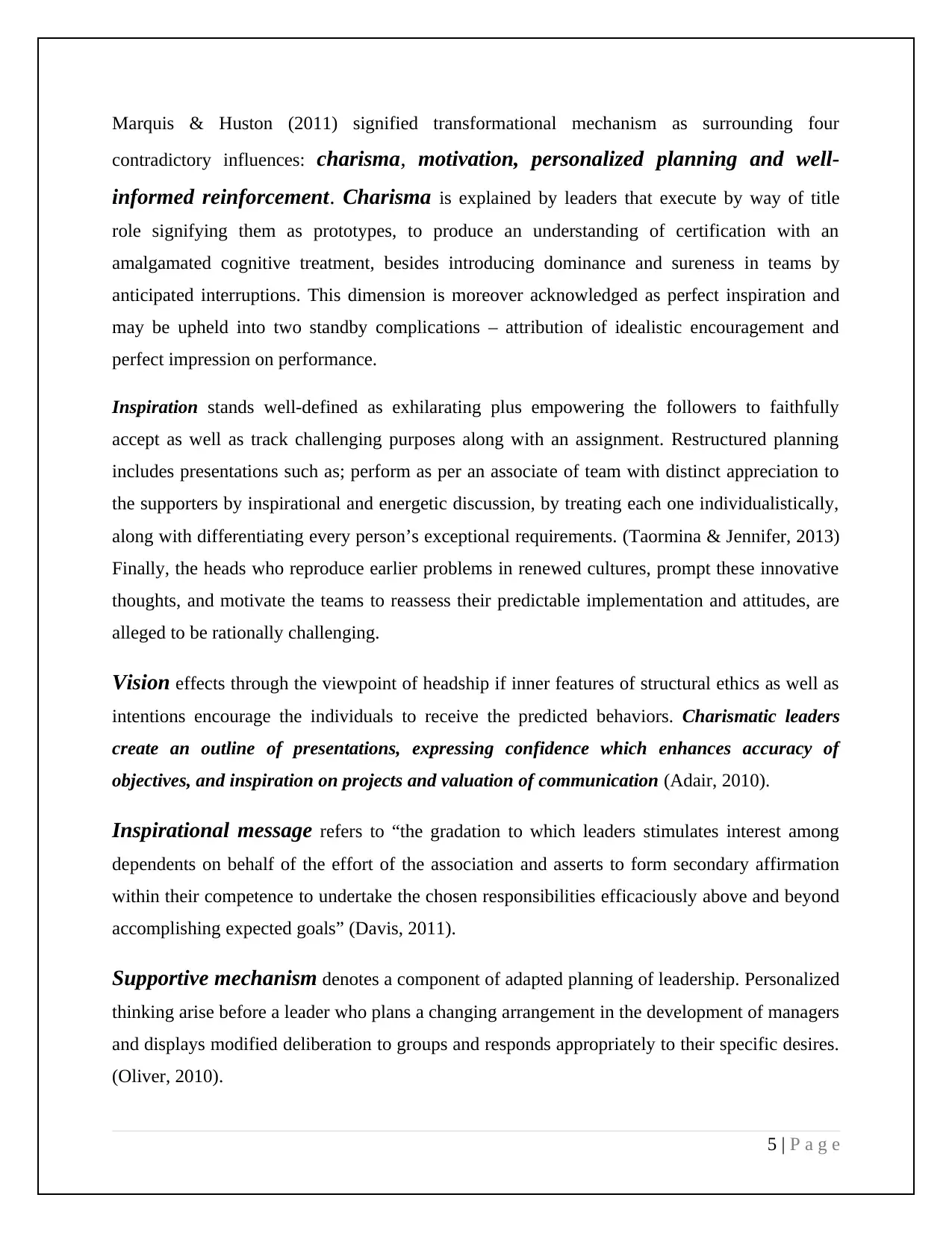
perform better than principally anticipated. Azaralli (2013) highlighted that transformational
supremacy “emerges when powerful leaders expand as well as upraise the wellbeing of their
teams, despite the fact that they create awareness and acknowledgment of the promises and
responsibility of the association, besides at the period they influence their personnel to lookout
more than their specific “self-importance meant for the value of the group”.
(Source: Azaralli, 2013)
4 | P a g e
tabler-icon-diamond-filled.svg

Paraphrase This Document

Need a fresh take? Get an instant paraphrase of this document with our AI Paraphraser
Document Page
Marquis & Huston (2011) signified transformational mechanism as surrounding four
contradictory influences: charisma, motivation, personalized planning and well-
informed reinforcement. Charisma is explained by leaders that execute by way of title
role signifying them as prototypes, to produce an understanding of certification with an
amalgamated cognitive treatment, besides introducing dominance and sureness in teams by
anticipated interruptions. This dimension is moreover acknowledged as perfect inspiration and
may be upheld into two standby complications – attribution of idealistic encouragement and
perfect impression on performance.
Inspiration stands well-defined as exhilarating plus empowering the followers to faithfully
accept as well as track challenging purposes along with an assignment. Restructured planning
includes presentations such as; perform as per an associate of team with distinct appreciation to
the supporters by inspirational and energetic discussion, by treating each one individualistically,
along with differentiating every person’s exceptional requirements. (Taormina & Jennifer, 2013)
Finally, the heads who reproduce earlier problems in renewed cultures, prompt these innovative
thoughts, and motivate the teams to reassess their predictable implementation and attitudes, are
alleged to be rationally challenging.
Vision effects through the viewpoint of headship if inner features of structural ethics as well as
intentions encourage the individuals to receive the predicted behaviors. Charismatic leaders
create an outline of presentations, expressing confidence which enhances accuracy of
objectives, and inspiration on projects and valuation of communication (Adair, 2010).
Inspirational message refers to “the gradation to which leaders stimulates interest among
dependents on behalf of the effort of the association and asserts to form secondary affirmation
within their competence to undertake the chosen responsibilities efficaciously above and beyond
accomplishing expected goals” (Davis, 2011).
Supportive mechanism denotes a component of adapted planning of leadership. Personalized
thinking arise before a leader who plans a changing arrangement in the development of managers
and displays modified deliberation to groups and responds appropriately to their specific desires.
(Oliver, 2010).
5 | P a g e
Document Page
References
Adair, J. (2010) Strategic Leadership: How to Think and Plan Strategically and Provide
Direction. 5th ed. London: Kogan Page.
Azaralli, N. (2013). “Effects of transformational leadership on empowerment and team
effectiveness”. Leadership & Org Development J, 24(6), pp.335-344.
Conger, J. A. & Riggio, R. E. (2012) The Practice of Leadership: Developing the Next
Generation of Leaders, 2nd ed. Oxford: Butterworth Heinemann.
Davis, A. (2011) Leadership, Teamwork and Trust. 3rd ed. New York: Harper Collins.
Hughes, R. L. & Beatty, K. M. (2011) Becoming a Strategic Leader: Your Role in Your
Organization's Enduring Success, 2nd ed. San Francisco: Jossey-Bass
Marquis, B. L. & Huston, C. J. (2011) Leadership Roles and Management Functions in Nursing:
Theory and Application, 6th ed. London: Elsevier.
Oliver, R. (2010). “A Cognitive Model of the Antecedents and Consequences of Satisfaction
Decisions”. Journal of Marketing Research, 17(4), p.460.
Taormina, R J., & Jennifer, H. (2013) 'Maslow And The Motivation Hierarchy: Measuring
Satisfaction Of The Needs'. The American Journal of Psychology 126(2), pp. 155-177.
6 | P a g e
chevron_up_icon
1 out of 6
circle_padding
hide_on_mobile
zoom_out_icon
[object Object]