Organization Behaviour: Personality, Motivation, and Theories
VerifiedAdded on 2021/11/18
|13
|3702
|31
Essay
AI Summary
This essay provides a comprehensive overview of organization behaviour, focusing on the interplay of personality and individual differences within a workplace context. It begins by defining organization behaviour as a scientific approach to understanding the interactions of people, teams, and groups, and highlights the importance of recognizing diverse behaviours and personalities in a multi-cultural environment. The essay delves into the concepts and theories related to personality and individual differences, including psychological theories like extraversion and introversion, and personality theories like Type A and Type B. It then explores the Five-Factor Model, examining the impact of openness, conscientiousness, extraversion, agreeableness, and neuroticism on organizational dynamics. Furthermore, the essay examines employee motivation, discussing the impact of personality on motivation and presenting key theories like McGregor's Theory X and Theory Y, and Herzberg's Two-factor theory. The analysis includes the integrated relationship between organization and human behaviour and the importance of understanding individual differences for effective management and strategic goal achievement. The essay also provides a critical analysis of how personality and individual differences affect employee motivation and offers a deep understanding of the complex relationship between personality traits, individual differences, and employee motivation within an organizational setting.

11/13/2018
Running Head: ORGANIZATION BEHAVIOUR 0
Management of Organization Behavior
Running Head: ORGANIZATION BEHAVIOUR 0
Management of Organization Behavior

Paraphrase This Document
Need a fresh take? Get an instant paraphrase of this document with our AI Paraphraser
ORGANIZATION BEHAVIOUR 1
Table of Contents
Overview....................................................................................................................................2
Personality and Individual difference........................................................................................2
Concepts and Theories...............................................................................................................3
Models........................................................................................................................................4
Relationship of ‘personality and individual differences’ with organizational behaviour..........6
Employee Motivation.................................................................................................................6
Impact of ‘personality and individual differences’ on employee motivation............................7
Motivation Theories...................................................................................................................8
McGregor’s Theory X and Theory Y.....................................................................................8
Herzberg ‘Two-factor’ theory................................................................................................9
Table of Contents
Overview....................................................................................................................................2
Personality and Individual difference........................................................................................2
Concepts and Theories...............................................................................................................3
Models........................................................................................................................................4
Relationship of ‘personality and individual differences’ with organizational behaviour..........6
Employee Motivation.................................................................................................................6
Impact of ‘personality and individual differences’ on employee motivation............................7
Motivation Theories...................................................................................................................8
McGregor’s Theory X and Theory Y.....................................................................................8
Herzberg ‘Two-factor’ theory................................................................................................9
ORGANIZATION BEHAVIOUR 2
Overview
Organization behaviour is a scientific approach compound of various theories related to the
interaction of people, teams and groups (Youssef and Luthans, 2007). These theories are
applied to human resource so that to raise the final output and productivity. In this
assignment, I have chosen the topic – “Personality and individual differences” and integrate
with the various theories of the organization behaviour so as to gain various insights. In the
completion of this assignment, I also research through various academics journals and other
secondary resources relevant to the topic. In a multi-cultural environment of an organization,
the management recognizes various types of behaviour having different personality and
approach in the achievement of objectives and goals (Bakker and Schaufeli, 2008). For
managing these individuals, this approach will help the organization to achieve their vision in
an effective way and work towards the future growth of the business enterprise.
Personality and Individual difference
Organization behaviour states the interaction of human behaviour with the organization itself.
It is also a study of the individuals employed there for a particular job role. For a
management, it is first important to learn about the various aspects and functions of the
organization than before focusing on the individual. Contemporary organization behaviour
also includes various fundamental characteristics that accept a set of concepts to explore the
domain (Collings and Mellahi, 2009).
Human behaviour is different and every person has different characteristics from one another.
Due to this, the organization and management also face challenges in making the managers,
task and subordinate equivalent. In addition, the personality traits of individuals also relate to
the job satisfaction of the employee. For example, introvert kind of people can easily fit with
any job in any circumstances where as the extrovert people may raise their hand as if they did
not like the nature of the work or task.
Laland, Kendal and Brown (2007) also argued that organization performance and personality
theory belong to a broad domain. Each of the aspects has their own scientific research and
models. The interaction of the personality and organization also differs as per the attrition
cycle. If the organization hierarchy is unstructured, every individual personality will be less
Overview
Organization behaviour is a scientific approach compound of various theories related to the
interaction of people, teams and groups (Youssef and Luthans, 2007). These theories are
applied to human resource so that to raise the final output and productivity. In this
assignment, I have chosen the topic – “Personality and individual differences” and integrate
with the various theories of the organization behaviour so as to gain various insights. In the
completion of this assignment, I also research through various academics journals and other
secondary resources relevant to the topic. In a multi-cultural environment of an organization,
the management recognizes various types of behaviour having different personality and
approach in the achievement of objectives and goals (Bakker and Schaufeli, 2008). For
managing these individuals, this approach will help the organization to achieve their vision in
an effective way and work towards the future growth of the business enterprise.
Personality and Individual difference
Organization behaviour states the interaction of human behaviour with the organization itself.
It is also a study of the individuals employed there for a particular job role. For a
management, it is first important to learn about the various aspects and functions of the
organization than before focusing on the individual. Contemporary organization behaviour
also includes various fundamental characteristics that accept a set of concepts to explore the
domain (Collings and Mellahi, 2009).
Human behaviour is different and every person has different characteristics from one another.
Due to this, the organization and management also face challenges in making the managers,
task and subordinate equivalent. In addition, the personality traits of individuals also relate to
the job satisfaction of the employee. For example, introvert kind of people can easily fit with
any job in any circumstances where as the extrovert people may raise their hand as if they did
not like the nature of the work or task.
Laland, Kendal and Brown (2007) also argued that organization performance and personality
theory belong to a broad domain. Each of the aspects has their own scientific research and
models. The interaction of the personality and organization also differs as per the attrition
cycle. If the organization hierarchy is unstructured, every individual personality will be less
⊘ This is a preview!⊘
Do you want full access?
Subscribe today to unlock all pages.

Trusted by 1+ million students worldwide
ORGANIZATION BEHAVIOUR 3
dominant as per their position. However, if it structured, even on the weak position individual
will have more dominancy. The social and genetic aspects of an individual possess an
important component of the character.
The capability of an individual personality also influences the effective organization
behaviour. It is defined as the full-composed efforts and behaviour of an individual towards
the achievement of any specific goal or objectives. The manger of an organization needs to
acquire various branch of knowledge related to the psychological, emotional and cognitive
aspects so as to understand the organization behaviour widely (Luhr, West and Venkatesh,
2007). One of the significant responsibility of manager is to employ structured behaviour and
culture in an organization by exploring the individuals’ personality differences.
Concepts and Theories
There are various theories in respect to personality and individual difference. These theories
place a significant role in judging the individual differences and character of an individual.
This all comes under the branch of psychology which aims to define that how people are
individually different due to the psychological forces and personality traits. In a business
enterprise, Personality can also be defined as the pattern of behaviour; thoughts and attitudes
exhibited over time and have a significance influence over human nature and perceptions
(Zhao, Seibert and Lumpkin, 2010).
One can distinguish personality type of an individual with the help of various traits of their
character. In respect with this, psychological theory also contributes to classifying different
kinds of individuals based on psychological aspects. This theory states that there are two
types of people in society, which possess different types of traits. These two types of
psychological characteristics are extraversion and introversion. Those individuals who are
extroverts like to meet new people and want to be more social with others. On the other hand,
introvert people do their task alone and did not like much interaction. Type A and Type B
personality theory were also introduced by Meyer Friedman which contrasts on two
personality types of an individual (Matzler et al, 2008).
These two aspects of personality theory are also called the two patterns of the individual
difference and personality. The individuals who belong to Type A personality are always
confidence towards their goals and thus do work with full potential. They are also high-risk
takers. Type B personality categorised the individuals on the basis of different trait. The
dominant as per their position. However, if it structured, even on the weak position individual
will have more dominancy. The social and genetic aspects of an individual possess an
important component of the character.
The capability of an individual personality also influences the effective organization
behaviour. It is defined as the full-composed efforts and behaviour of an individual towards
the achievement of any specific goal or objectives. The manger of an organization needs to
acquire various branch of knowledge related to the psychological, emotional and cognitive
aspects so as to understand the organization behaviour widely (Luhr, West and Venkatesh,
2007). One of the significant responsibility of manager is to employ structured behaviour and
culture in an organization by exploring the individuals’ personality differences.
Concepts and Theories
There are various theories in respect to personality and individual difference. These theories
place a significant role in judging the individual differences and character of an individual.
This all comes under the branch of psychology which aims to define that how people are
individually different due to the psychological forces and personality traits. In a business
enterprise, Personality can also be defined as the pattern of behaviour; thoughts and attitudes
exhibited over time and have a significance influence over human nature and perceptions
(Zhao, Seibert and Lumpkin, 2010).
One can distinguish personality type of an individual with the help of various traits of their
character. In respect with this, psychological theory also contributes to classifying different
kinds of individuals based on psychological aspects. This theory states that there are two
types of people in society, which possess different types of traits. These two types of
psychological characteristics are extraversion and introversion. Those individuals who are
extroverts like to meet new people and want to be more social with others. On the other hand,
introvert people do their task alone and did not like much interaction. Type A and Type B
personality theory were also introduced by Meyer Friedman which contrasts on two
personality types of an individual (Matzler et al, 2008).
These two aspects of personality theory are also called the two patterns of the individual
difference and personality. The individuals who belong to Type A personality are always
confidence towards their goals and thus do work with full potential. They are also high-risk
takers. Type B personality categorised the individuals on the basis of different trait. The
Paraphrase This Document
Need a fresh take? Get an instant paraphrase of this document with our AI Paraphraser
ORGANIZATION BEHAVIOUR 4
people belong to Type B personality are more relaxed, low-risk taker and also less
competitive. According to this theory, some of the individuals also categorised in both
personality types, as they possess the traits of both aspects.
In addition, one of the significant theory i.e. Myers-Briggs can also help in ascertaining the
different character of the person. With help of this model, the manager can use the different
factors of the models to enlighten several types of character of a person. They can also test
the type of personality with the help of this model.
Models
One of the psychological and significant models of personality i.e. Five Factor model is also
important in perspective of an individual behaviour. With the help of this model, the
management can understand the five unique factors of the personality, which is different in
every individual. These factors can also help in exploring the future leaders of an
organization by analysing various compelling elements. Five-factor model was formed based
on a hypothesis that fundamental traits of human personality have become encoded in
language overtime (Kendler and Myers, 2010). A group of personality psychologists argued
that five-factor model represented the most successful outcome of these efforts.
Every business enterprise needs to consider these five elements while creating environment
and culture for the organization. The management with the help of this model can foresee the
future in respective with the popular trait model of human personality. This model also plays
a significant role in revitalizing the discipline of personality psychology. The five aspects of
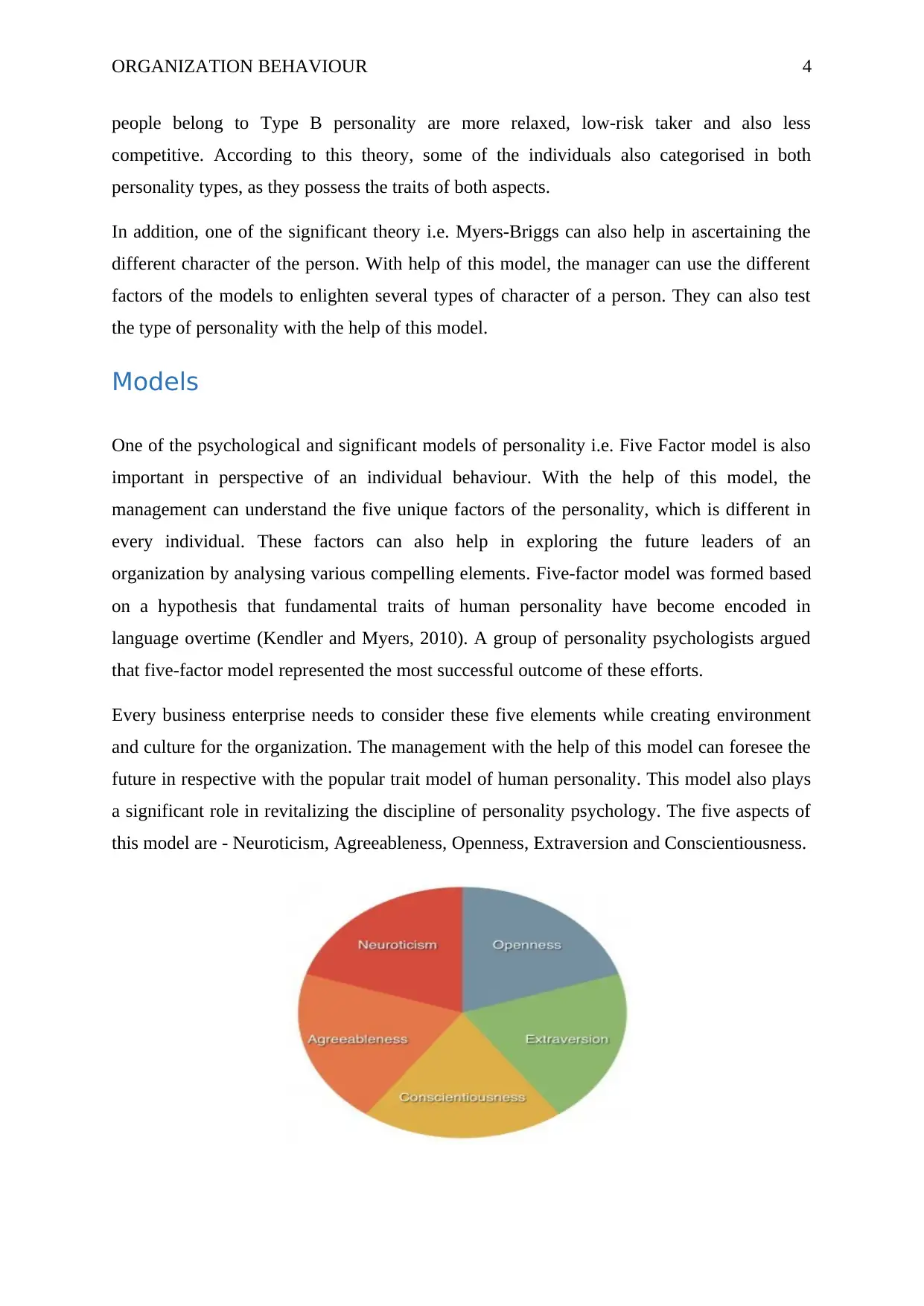
this model are - Neuroticism, Agreeableness, Openness, Extraversion and Conscientiousness.
people belong to Type B personality are more relaxed, low-risk taker and also less
competitive. According to this theory, some of the individuals also categorised in both
personality types, as they possess the traits of both aspects.
In addition, one of the significant theory i.e. Myers-Briggs can also help in ascertaining the
different character of the person. With help of this model, the manager can use the different
factors of the models to enlighten several types of character of a person. They can also test
the type of personality with the help of this model.
Models
One of the psychological and significant models of personality i.e. Five Factor model is also
important in perspective of an individual behaviour. With the help of this model, the
management can understand the five unique factors of the personality, which is different in
every individual. These factors can also help in exploring the future leaders of an
organization by analysing various compelling elements. Five-factor model was formed based
on a hypothesis that fundamental traits of human personality have become encoded in
language overtime (Kendler and Myers, 2010). A group of personality psychologists argued
that five-factor model represented the most successful outcome of these efforts.
Every business enterprise needs to consider these five elements while creating environment
and culture for the organization. The management with the help of this model can foresee the
future in respective with the popular trait model of human personality. This model also plays
a significant role in revitalizing the discipline of personality psychology. The five aspects of
this model are - Neuroticism, Agreeableness, Openness, Extraversion and Conscientiousness.
ORGANIZATION BEHAVIOUR 5
Source: (Griffin, 2007)
Openness – The individuals who possess this category are curious to explore and
learn new things, and tend to hold unconventional beliefs. These individuals are
having a broad range of interest who appreciate art and enjoy new things (Crede,
Harms, Niehorster and Gaye-Valentine, 2012). In an organization, this aspect of
personality can be found in the leaders who manage many team and groups.
Conscientiousness – Those whose traits come under this category are self-disciplined
and behave in a planned manner. They are prompt and reliable. These individuals also
take the necessary responsibilities on themselves (Crede, Harms, Niehorster and
Gaye-Valentine, 2012).
Extraversion – The extroverts’ people possesses high amount of energy and they are
also enthusiastic towards their work. Moreover, these people also show their
dominancy in their respective field (Crede, Harms, Niehorster and Gaye-Valentine,
2012). They are just not socially active but also like to interact with other people in
their peers.
Agreeableness – In this personality trait, the kindness and warmth of an individual are
measured. If the individual is more agreeableness, it can be said that he will also be
trustful, compassionate and helpful. Both extraversion and agreeableness help the
leader and manger to build a cohesive team in the organization (Crede, Harms,
Niehorster and Gaye-Valentine, 2012). In addition, the nature of the people is also
positive towards the work under this category.
Neuroticism – The other name of this trait is emotional stability. The individuals
come under this category are having a tendency to experience anxiety, anger and
depression (Crede, Harms, Niehorster and Gaye-Valentine, 2012).
Therefore, it is ascertained that the leader needs to be of extrovert personality so as to guide
their subordinates and employees effectively. It can also be said that a leader must have the
extraversion and conscientiousness traits to mould the behaviour of the employees in the right
direction.
Source: (Griffin, 2007)
Openness – The individuals who possess this category are curious to explore and
learn new things, and tend to hold unconventional beliefs. These individuals are
having a broad range of interest who appreciate art and enjoy new things (Crede,
Harms, Niehorster and Gaye-Valentine, 2012). In an organization, this aspect of
personality can be found in the leaders who manage many team and groups.
Conscientiousness – Those whose traits come under this category are self-disciplined
and behave in a planned manner. They are prompt and reliable. These individuals also
take the necessary responsibilities on themselves (Crede, Harms, Niehorster and
Gaye-Valentine, 2012).
Extraversion – The extroverts’ people possesses high amount of energy and they are
also enthusiastic towards their work. Moreover, these people also show their
dominancy in their respective field (Crede, Harms, Niehorster and Gaye-Valentine,
2012). They are just not socially active but also like to interact with other people in
their peers.
Agreeableness – In this personality trait, the kindness and warmth of an individual are
measured. If the individual is more agreeableness, it can be said that he will also be
trustful, compassionate and helpful. Both extraversion and agreeableness help the
leader and manger to build a cohesive team in the organization (Crede, Harms,
Niehorster and Gaye-Valentine, 2012). In addition, the nature of the people is also
positive towards the work under this category.
Neuroticism – The other name of this trait is emotional stability. The individuals
come under this category are having a tendency to experience anxiety, anger and
depression (Crede, Harms, Niehorster and Gaye-Valentine, 2012).
Therefore, it is ascertained that the leader needs to be of extrovert personality so as to guide
their subordinates and employees effectively. It can also be said that a leader must have the
extraversion and conscientiousness traits to mould the behaviour of the employees in the right
direction.
⊘ This is a preview!⊘
Do you want full access?
Subscribe today to unlock all pages.
Trusted by 1+ million students worldwide
ORGANIZATION BEHAVIOUR 6
Relationship of ‘personality and individual differences’
with organizational behaviour
De Jong and Den Hartog (2007) also stated that there is an integrated relation between
organization behaviour and human behaviour. For gaining knowledge about the various
aspects of organization behaviour, it is important to first analyse human behaviour, which is
also a complex phenomenon. This creates a challenge for the organization to align employees
and tasks in an economic manner so as to achieve the strategic goals. It is also important for
the manager to give due important to the internal and external stimulus in relation to the
unconscious mind of the human being.
There are various theories relating to the managing of groups in respect to the organization
behaviour. They are also relevant in the decision making of the employees. For example, to
increase the productivity with the output, Taylor has proposed the theory of scientific
management. Moreover, Henry Fayol, who developed various general theories of business
administration also proposed certain principles of management required to use by the
managers to make the operation accomplish effectively (Rahman, 2012).
In addition, some modern theories of behaviour are also stated by the McGregor in respect to
assumptions like – Theory X and Theory Y.
Employee Motivation
Employee motivation refers to factors or groups of factors that direct employee behaviour
towards the accomplishment of work, tasks and goals. The major two factors are extrinsic
factors and intrinsic factors. In any organization, Managing of employee motivation always
creates a challenge for the manager. Their changing needs and requirements require managers
to change various policies and rules in respect to individual behaviour.
In the present scenario, there are several different methods of motivation of employees strive
on the encouragement as almost all companies work in the global business environment
(Dewett, 2007). For increasing the longevity of employees with the company, many
businesses are exploring to flexibility in the job designing and the respective reward systems.
Relationship of ‘personality and individual differences’
with organizational behaviour
De Jong and Den Hartog (2007) also stated that there is an integrated relation between
organization behaviour and human behaviour. For gaining knowledge about the various
aspects of organization behaviour, it is important to first analyse human behaviour, which is
also a complex phenomenon. This creates a challenge for the organization to align employees
and tasks in an economic manner so as to achieve the strategic goals. It is also important for
the manager to give due important to the internal and external stimulus in relation to the
unconscious mind of the human being.
There are various theories relating to the managing of groups in respect to the organization
behaviour. They are also relevant in the decision making of the employees. For example, to
increase the productivity with the output, Taylor has proposed the theory of scientific
management. Moreover, Henry Fayol, who developed various general theories of business
administration also proposed certain principles of management required to use by the
managers to make the operation accomplish effectively (Rahman, 2012).
In addition, some modern theories of behaviour are also stated by the McGregor in respect to
assumptions like – Theory X and Theory Y.
Employee Motivation
Employee motivation refers to factors or groups of factors that direct employee behaviour
towards the accomplishment of work, tasks and goals. The major two factors are extrinsic
factors and intrinsic factors. In any organization, Managing of employee motivation always
creates a challenge for the manager. Their changing needs and requirements require managers
to change various policies and rules in respect to individual behaviour.
In the present scenario, there are several different methods of motivation of employees strive
on the encouragement as almost all companies work in the global business environment
(Dewett, 2007). For increasing the longevity of employees with the company, many
businesses are exploring to flexibility in the job designing and the respective reward systems.
Paraphrase This Document
Need a fresh take? Get an instant paraphrase of this document with our AI Paraphraser
ORGANIZATION BEHAVIOUR 7
In the motivation aspect of any business, Dysvik and Kuvaas, (2010), state various factors
and these can help the organization in improving their overall productivity. These factors are
mention below –
Manager needs to develop enthusiasm in the employees so that they can give priority
to the organization goals and objectives rather than specific goals.
Every employee of the organization needs for a constant recognition as this will help
in the evolvement of positivity in the mind.
Every employee of the organization should be treated equally and full dignity.
The management of the organization also needs to ensure that there should be a
constant communication need to take place for resolving various clarifications.
The actions and behaviour of leaders should also be undertaken so as to empower the
workers positively.
Impact of ‘personality and individual differences’ on
employee motivation
Many researchers agree on the existence of individual differences in motivational preference
or traits. Moreover, different types of personality also define the level of personality. The
performance and competence of the employees also create a vital role in perspectives of
motivation. In addition, the managers need to mould the employee behaviour by motivation
him in the direction of vision of the firm. Some of the barriers also come during the
motivation course of an employee such as situations constraint, personality differences, etc.
To achieve extraordinary level of motivation, one needs to involve with the intensity,
direction and duration of the behaviour. Gong, Law, Chang and Xin (2009) also states that
some of the managers treat their employees as the most valuable resources of the firm but
some of them just use them for the objective of profit maximisation.
Personal behaviour and individual differences play an important role in motivating the
employees of the business enterprise. The effectiveness of the manager can be evaluated on
their roles and functions i.e. attainment of objectives, integrations, decision-making and
group maintenance. Every individual has different self-concept, which is due to the individual
differences. It is the responsibility of leader to integrate all aspects towards moulding the
behaviour of employees and motive them to achieve the business objectives.
In the motivation aspect of any business, Dysvik and Kuvaas, (2010), state various factors
and these can help the organization in improving their overall productivity. These factors are
mention below –
Manager needs to develop enthusiasm in the employees so that they can give priority
to the organization goals and objectives rather than specific goals.
Every employee of the organization needs for a constant recognition as this will help
in the evolvement of positivity in the mind.
Every employee of the organization should be treated equally and full dignity.
The management of the organization also needs to ensure that there should be a
constant communication need to take place for resolving various clarifications.
The actions and behaviour of leaders should also be undertaken so as to empower the
workers positively.
Impact of ‘personality and individual differences’ on
employee motivation
Many researchers agree on the existence of individual differences in motivational preference
or traits. Moreover, different types of personality also define the level of personality. The
performance and competence of the employees also create a vital role in perspectives of
motivation. In addition, the managers need to mould the employee behaviour by motivation
him in the direction of vision of the firm. Some of the barriers also come during the
motivation course of an employee such as situations constraint, personality differences, etc.
To achieve extraordinary level of motivation, one needs to involve with the intensity,
direction and duration of the behaviour. Gong, Law, Chang and Xin (2009) also states that
some of the managers treat their employees as the most valuable resources of the firm but
some of them just use them for the objective of profit maximisation.
Personal behaviour and individual differences play an important role in motivating the
employees of the business enterprise. The effectiveness of the manager can be evaluated on
their roles and functions i.e. attainment of objectives, integrations, decision-making and
group maintenance. Every individual has different self-concept, which is due to the individual
differences. It is the responsibility of leader to integrate all aspects towards moulding the
behaviour of employees and motive them to achieve the business objectives.
ORGANIZATION BEHAVIOUR 8
Motivation Theories
Various theories explain the aspects of motivation and human behaviour in an organization.
This gives the employees a glimpse about the personality and individual differences. Some of
the theories are - Vroom Expectancy theory, Herzberg’s two-factor theory and Hertzberg
theory.
McGregor’s Theory X and Theory Y
This theory suggests two aspects of human behaviour and motivation at work or it can also be
said that organization gets two different views of individuals – one positive (theory Y) and
one negative (theory X). This also forms various assumptions according to the nature of the
individuals. As per the theory X assumptions, an average employee of individual is not
interested in work and always tries to escape whenever possible. On the other hand, theory Y
assumption states that employees do their job in a natural and relax manner (Wong, Gardiner,
Lang and Coulon, 2008).
Managers play an important role in guiding individuals, as they need proper security and
constant communication. As per theory X, the average number of people dislikes the work or
sometimes they do the work unwillingly as due to the threat of the punishment in the
organization. On the other hand, all those individuals who belong to theory Y category are
active towards any task. They also put reasonable and active query towards the management
and thus get many rewards from the management of the organization.
This theory is also related to the psychological factor of doing job and gives various
assumptions related to any psychological factor of doing job. With the help of this theory, the
organization can also give respective recognition to the individual.
Herzberg ‘Two-factor’ theory
Motivation Theories
Various theories explain the aspects of motivation and human behaviour in an organization.
This gives the employees a glimpse about the personality and individual differences. Some of
the theories are - Vroom Expectancy theory, Herzberg’s two-factor theory and Hertzberg
theory.
McGregor’s Theory X and Theory Y
This theory suggests two aspects of human behaviour and motivation at work or it can also be
said that organization gets two different views of individuals – one positive (theory Y) and
one negative (theory X). This also forms various assumptions according to the nature of the
individuals. As per the theory X assumptions, an average employee of individual is not
interested in work and always tries to escape whenever possible. On the other hand, theory Y
assumption states that employees do their job in a natural and relax manner (Wong, Gardiner,
Lang and Coulon, 2008).
Managers play an important role in guiding individuals, as they need proper security and
constant communication. As per theory X, the average number of people dislikes the work or
sometimes they do the work unwillingly as due to the threat of the punishment in the
organization. On the other hand, all those individuals who belong to theory Y category are
active towards any task. They also put reasonable and active query towards the management
and thus get many rewards from the management of the organization.
This theory is also related to the psychological factor of doing job and gives various
assumptions related to any psychological factor of doing job. With the help of this theory, the
organization can also give respective recognition to the individual.
Herzberg ‘Two-factor’ theory
⊘ This is a preview!⊘
Do you want full access?
Subscribe today to unlock all pages.
Trusted by 1+ million students worldwide
ORGANIZATION BEHAVIOUR 9
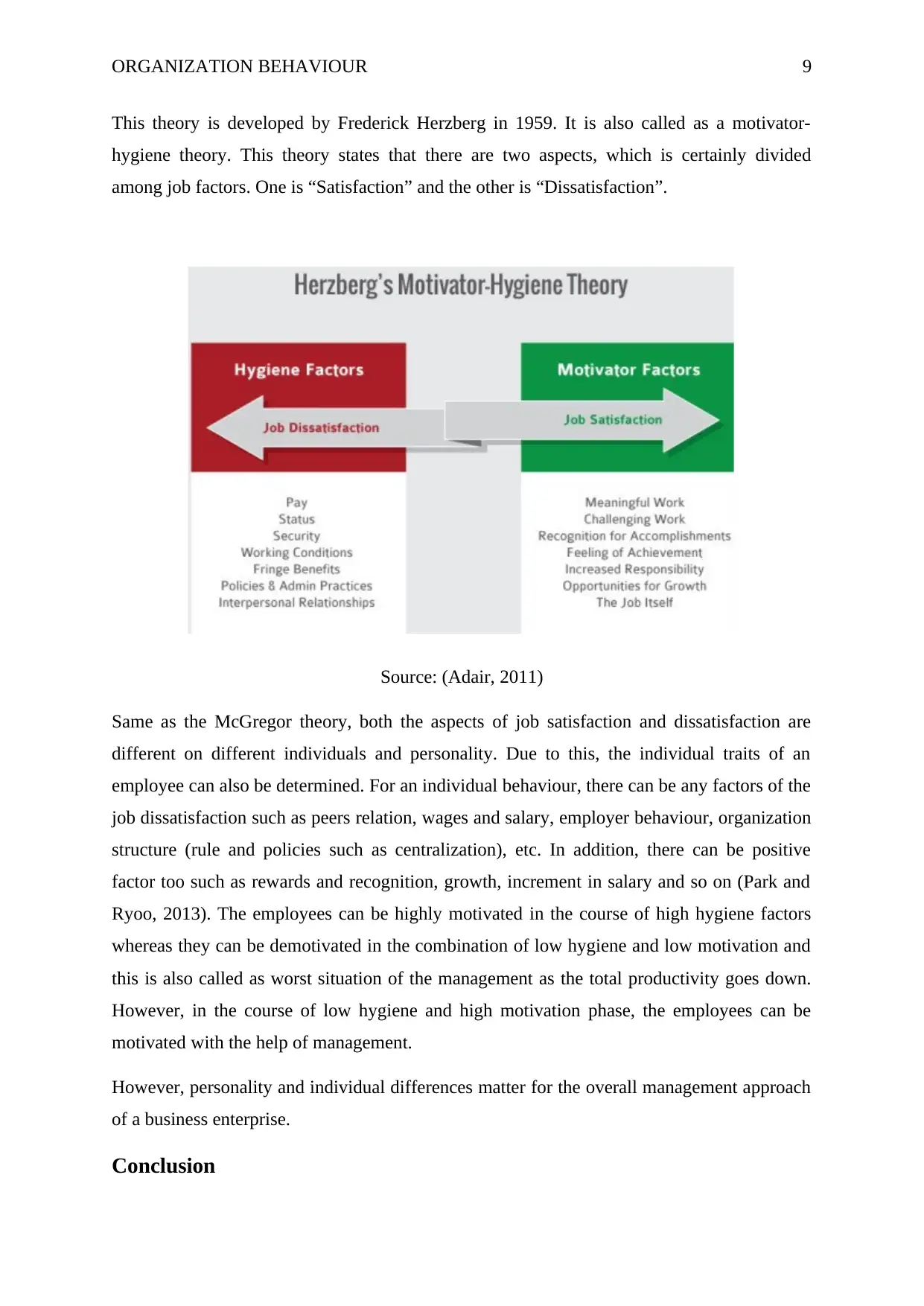
This theory is developed by Frederick Herzberg in 1959. It is also called as a motivator-
hygiene theory. This theory states that there are two aspects, which is certainly divided
among job factors. One is “Satisfaction” and the other is “Dissatisfaction”.
Source: (Adair, 2011)
Same as the McGregor theory, both the aspects of job satisfaction and dissatisfaction are
different on different individuals and personality. Due to this, the individual traits of an
employee can also be determined. For an individual behaviour, there can be any factors of the
job dissatisfaction such as peers relation, wages and salary, employer behaviour, organization
structure (rule and policies such as centralization), etc. In addition, there can be positive
factor too such as rewards and recognition, growth, increment in salary and so on (Park and
Ryoo, 2013). The employees can be highly motivated in the course of high hygiene factors
whereas they can be demotivated in the combination of low hygiene and low motivation and
this is also called as worst situation of the management as the total productivity goes down.
However, in the course of low hygiene and high motivation phase, the employees can be
motivated with the help of management.
However, personality and individual differences matter for the overall management approach
of a business enterprise.
Conclusion
This theory is developed by Frederick Herzberg in 1959. It is also called as a motivator-
hygiene theory. This theory states that there are two aspects, which is certainly divided
among job factors. One is “Satisfaction” and the other is “Dissatisfaction”.
Source: (Adair, 2011)
Same as the McGregor theory, both the aspects of job satisfaction and dissatisfaction are
different on different individuals and personality. Due to this, the individual traits of an
employee can also be determined. For an individual behaviour, there can be any factors of the
job dissatisfaction such as peers relation, wages and salary, employer behaviour, organization
structure (rule and policies such as centralization), etc. In addition, there can be positive
factor too such as rewards and recognition, growth, increment in salary and so on (Park and
Ryoo, 2013). The employees can be highly motivated in the course of high hygiene factors
whereas they can be demotivated in the combination of low hygiene and low motivation and
this is also called as worst situation of the management as the total productivity goes down.
However, in the course of low hygiene and high motivation phase, the employees can be
motivated with the help of management.
However, personality and individual differences matter for the overall management approach
of a business enterprise.
Conclusion
Paraphrase This Document
Need a fresh take? Get an instant paraphrase of this document with our AI Paraphraser
ORGANIZATION BEHAVIOUR 10
Enduring motivation in employees is very important for the organization to raise productivity
and influence the behaviour of the individual. However, the level of motivation can differ
according individual to individual. This is why a skilled manager is required in the
organization to decrease the individual differences and guide individual behaviour in the
direction of organizational vision and mission. They need to value the most important
resource i.e. employees to take down the respective work.
Enduring motivation in employees is very important for the organization to raise productivity
and influence the behaviour of the individual. However, the level of motivation can differ
according individual to individual. This is why a skilled manager is required in the
organization to decrease the individual differences and guide individual behaviour in the
direction of organizational vision and mission. They need to value the most important
resource i.e. employees to take down the respective work.
ORGANIZATION BEHAVIOUR 11
References
Adair, J. (2011) John Adair's 100 Greatest Ideas for Effective Leadership. United Kingdom:
John Wiley & Sons.
Bakker, A.B. and Schaufeli, W.B. (2008) Positive organizational behavior: Engaged
employees in flourishing organizations. Journal of Organizational Behavior: The
International Journal of Industrial, Occupational and Organizational Psychology and
Behavior, 29(2), pp.147-154.
Collings, D.G. and Mellahi, K. (2009) Strategic talent management: A review and research
agenda. Human resource management review, 19(4), pp.304-313.
Crede, M., Harms, P., Niehorster, S. and Gaye-Valentine, A. (2012) An evaluation of the
consequences of using short measures of the Big Five personality traits. Journal of
personality and social psychology, 102(4), p.874.
De Jong, J.P. and Den Hartog, D.N. (2007) How leaders influence employees' innovative
behaviour. European Journal of innovation management, 10(1), pp.41-64.
Dewett, T. (2007) Linking intrinsic motivation, risk taking, and employee creativity in an
R&D environment. R&D Management, 37(3), pp.197-208.
Dysvik, A. and Kuvaas, B. (2010) Exploring the relative and combined influence of mastery-
approach goals and work intrinsic motivation on employee turnover intention. Personnel
review, 39(5), pp.622-638.
Gong, Y., Law, K.S., Chang, S. and Xin, K.R. (2009) Human resources management and
firm performance: The differential role of managerial affective and continuance
commitment. Journal of Applied Psychology, 94(1), p.263.
Griffin, R. (2007) Fundamentals of Management. 5th ed. U.S.A: Cengage Learning.
Kendler, K.S. and Myers, J. (2010) The genetic and environmental relationship between
major depression and the five-factor model of personality. Psychological medicine, 40(5),
pp.801-806.
Laland, K.N., Kendal, J.R. and Brown, G.R. (2007) The niche construction perspective:
Implications for evolution and human behaviour. Journal of Evolutionary Psychology, 5(1),
pp.51-66.
References
Adair, J. (2011) John Adair's 100 Greatest Ideas for Effective Leadership. United Kingdom:
John Wiley & Sons.
Bakker, A.B. and Schaufeli, W.B. (2008) Positive organizational behavior: Engaged
employees in flourishing organizations. Journal of Organizational Behavior: The
International Journal of Industrial, Occupational and Organizational Psychology and
Behavior, 29(2), pp.147-154.
Collings, D.G. and Mellahi, K. (2009) Strategic talent management: A review and research
agenda. Human resource management review, 19(4), pp.304-313.
Crede, M., Harms, P., Niehorster, S. and Gaye-Valentine, A. (2012) An evaluation of the
consequences of using short measures of the Big Five personality traits. Journal of
personality and social psychology, 102(4), p.874.
De Jong, J.P. and Den Hartog, D.N. (2007) How leaders influence employees' innovative
behaviour. European Journal of innovation management, 10(1), pp.41-64.
Dewett, T. (2007) Linking intrinsic motivation, risk taking, and employee creativity in an
R&D environment. R&D Management, 37(3), pp.197-208.
Dysvik, A. and Kuvaas, B. (2010) Exploring the relative and combined influence of mastery-
approach goals and work intrinsic motivation on employee turnover intention. Personnel
review, 39(5), pp.622-638.
Gong, Y., Law, K.S., Chang, S. and Xin, K.R. (2009) Human resources management and
firm performance: The differential role of managerial affective and continuance
commitment. Journal of Applied Psychology, 94(1), p.263.
Griffin, R. (2007) Fundamentals of Management. 5th ed. U.S.A: Cengage Learning.
Kendler, K.S. and Myers, J. (2010) The genetic and environmental relationship between
major depression and the five-factor model of personality. Psychological medicine, 40(5),
pp.801-806.
Laland, K.N., Kendal, J.R. and Brown, G.R. (2007) The niche construction perspective:
Implications for evolution and human behaviour. Journal of Evolutionary Psychology, 5(1),
pp.51-66.
⊘ This is a preview!⊘
Do you want full access?
Subscribe today to unlock all pages.
Trusted by 1+ million students worldwide

1 out of 13


Related Documents


Your All-in-One AI-Powered Toolkit for Academic Success.
+13062052269
info@desklib.com
Available 24*7 on WhatsApp / Email
![[object Object]](/_next/static/media/star-bottom.7253800d.svg)
Unlock your academic potential
Copyright © 2020–2026 A2Z Services. All Rights Reserved. Developed and managed by ZUCOL.