Organization Behaviour: Motivation Techniques and Productivity

Verified

Added on  2020/03/28

|8
|2107
|36
Essay
AI Summary
This essay critically analyzes the impact of motivation techniques employed by managers to enhance worker productivity, providing an application of these techniques within an organizational context. The essay begins by establishing the significance of motivation in fostering employee efficiency and its subsequent effects on organizational productivity. It explores various factors that influence employee efficiency, including both intra-business and extra-business factors, such as organizational structure, management methods, and technology. The essay also examines the role of performance management systems and specific techniques like job enrichment and value analysis in boosting business growth and development. Furthermore, it delves into factors that can hinder employee efficiency, such as unfavorable working environments and low motivation, emphasizing the importance of addressing these issues. The essay then discusses the significance of motivation, including the use of motivation techniques like Hertzberg’s Two-Factor Theory and Maslow’s Hierarchy of Needs to improve employee satisfaction and reduce turnover. Finally, the essay concludes by summarizing the key findings and highlighting the importance of motivation techniques for managers to enhance employee effectiveness and retention.
Document Page
Running Head: ORGANIZATION BEHAVIOUR
Organization Behaviour
tabler-icon-diamond-filled.svg

Paraphrase This Document

Need a fresh take? Get an instant paraphrase of this document with our AI Paraphraser
Document Page
2
ORGANIZATION BEHAVIOUR
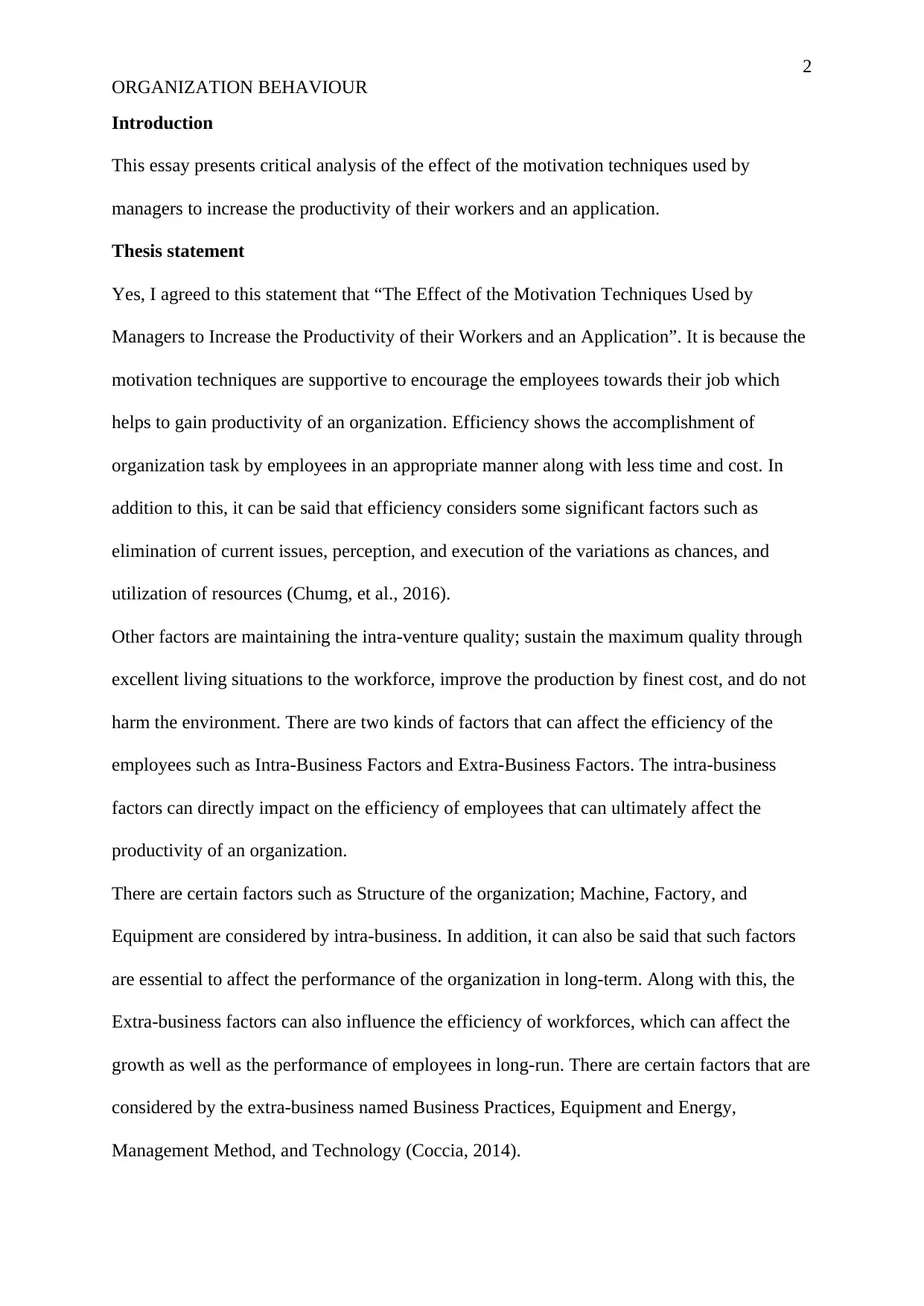
Introduction
This essay presents critical analysis of the effect of the motivation techniques used by
managers to increase the productivity of their workers and an application.
Thesis statement
Yes, I agreed to this statement that “The Effect of the Motivation Techniques Used by
Managers to Increase the Productivity of their Workers and an Application”. It is because the
motivation techniques are supportive to encourage the employees towards their job which
helps to gain productivity of an organization. Efficiency shows the accomplishment of
organization task by employees in an appropriate manner along with less time and cost. In
addition to this, it can be said that efficiency considers some significant factors such as
elimination of current issues, perception, and execution of the variations as chances, and
utilization of resources (Chumg, et al., 2016).
Other factors are maintaining the intra-venture quality; sustain the maximum quality through
excellent living situations to the workforce, improve the production by finest cost, and do not
harm the environment. There are two kinds of factors that can affect the efficiency of the
employees such as Intra-Business Factors and Extra-Business Factors. The intra-business
factors can directly impact on the efficiency of employees that can ultimately affect the
productivity of an organization.
There are certain factors such as Structure of the organization; Machine, Factory, and
Equipment are considered by intra-business. In addition, it can also be said that such factors
are essential to affect the performance of the organization in long-term. Along with this, the
Extra-business factors can also influence the efficiency of workforces, which can affect the
growth as well as the performance of employees in long-run. There are certain factors that are
considered by the extra-business named Business Practices, Equipment and Energy,
Management Method, and Technology (Coccia, 2014).
Document Page
3
ORGANIZATION BEHAVIOUR
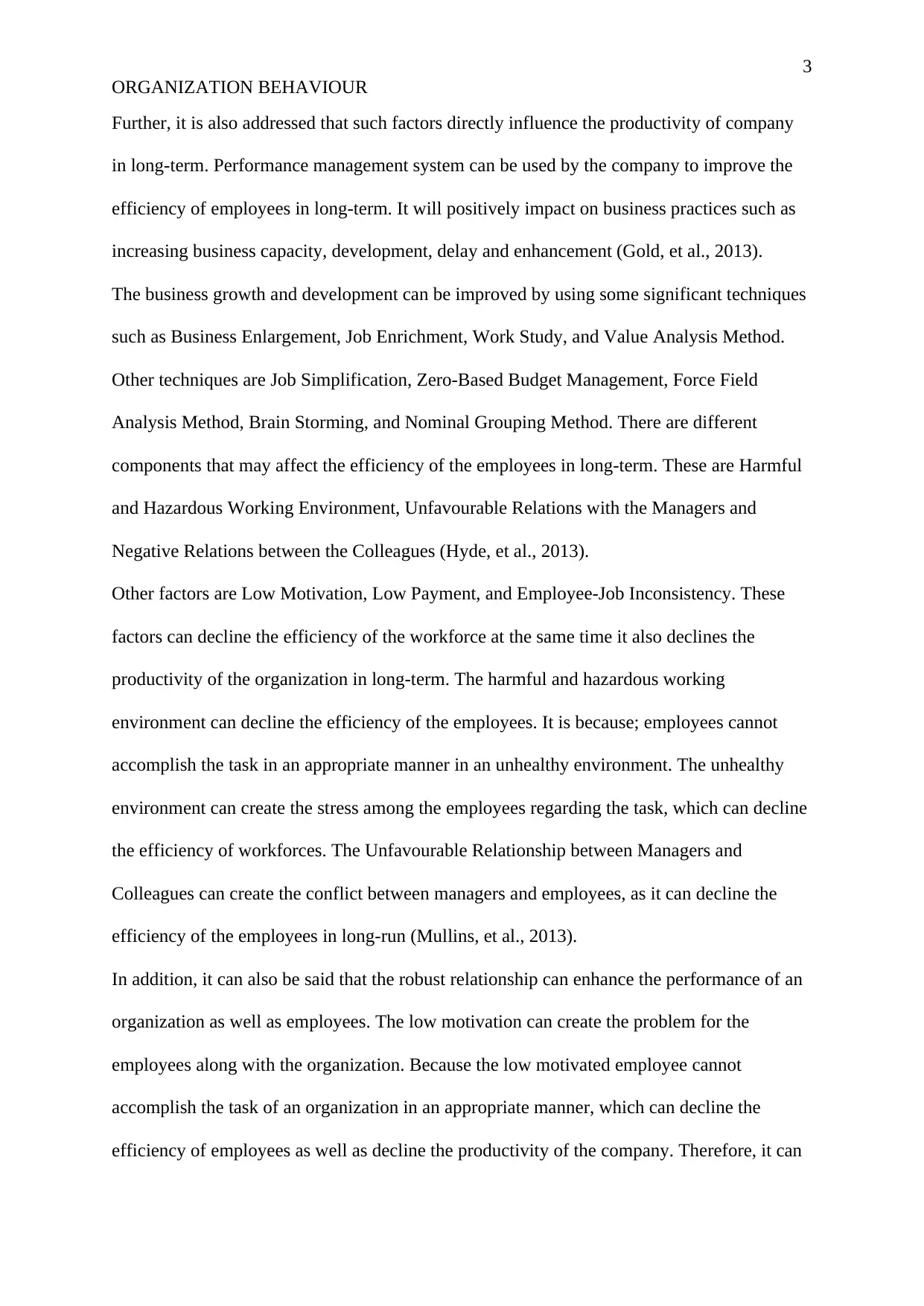
Further, it is also addressed that such factors directly influence the productivity of company
in long-term. Performance management system can be used by the company to improve the
efficiency of employees in long-term. It will positively impact on business practices such as
increasing business capacity, development, delay and enhancement (Gold, et al., 2013).
The business growth and development can be improved by using some significant techniques
such as Business Enlargement, Job Enrichment, Work Study, and Value Analysis Method.
Other techniques are Job Simplification, Zero-Based Budget Management, Force Field
Analysis Method, Brain Storming, and Nominal Grouping Method. There are different
components that may affect the efficiency of the employees in long-term. These are Harmful
and Hazardous Working Environment, Unfavourable Relations with the Managers and
Negative Relations between the Colleagues (Hyde, et al., 2013).
Other factors are Low Motivation, Low Payment, and Employee-Job Inconsistency. These
factors can decline the efficiency of the workforce at the same time it also declines the
productivity of the organization in long-term. The harmful and hazardous working
environment can decline the efficiency of the employees. It is because; employees cannot
accomplish the task in an appropriate manner in an unhealthy environment. The unhealthy
environment can create the stress among the employees regarding the task, which can decline
the efficiency of workforces. The Unfavourable Relationship between Managers and
Colleagues can create the conflict between managers and employees, as it can decline the
efficiency of the employees in long-run (Mullins, et al., 2013).
In addition, it can also be said that the robust relationship can enhance the performance of an
organization as well as employees. The low motivation can create the problem for the
employees along with the organization. Because the low motivated employee cannot
accomplish the task of an organization in an appropriate manner, which can decline the
efficiency of employees as well as decline the productivity of the company. Therefore, it can
Document Page
4
ORGANIZATION BEHAVIOUR
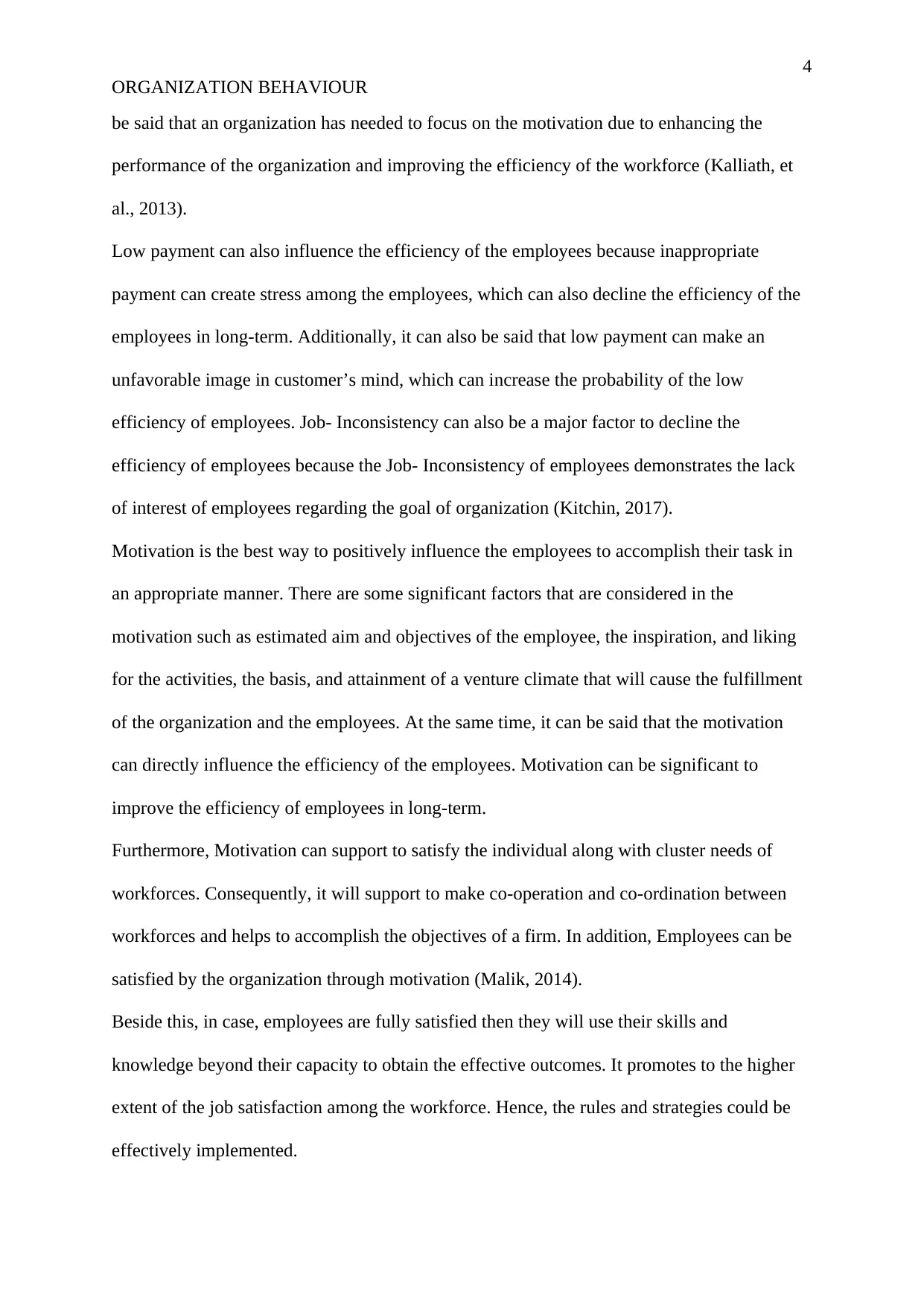
be said that an organization has needed to focus on the motivation due to enhancing the
performance of the organization and improving the efficiency of the workforce (Kalliath, et
al., 2013).
Low payment can also influence the efficiency of the employees because inappropriate
payment can create stress among the employees, which can also decline the efficiency of the
employees in long-term. Additionally, it can also be said that low payment can make an
unfavorable image in customer’s mind, which can increase the probability of the low
efficiency of employees. Job- Inconsistency can also be a major factor to decline the
efficiency of employees because the Job- Inconsistency of employees demonstrates the lack
of interest of employees regarding the goal of organization (Kitchin, 2017).
Motivation is the best way to positively influence the employees to accomplish their task in
an appropriate manner. There are some significant factors that are considered in the
motivation such as estimated aim and objectives of the employee, the inspiration, and liking
for the activities, the basis, and attainment of a venture climate that will cause the fulfillment
of the organization and the employees. At the same time, it can be said that the motivation
can directly influence the efficiency of the employees. Motivation can be significant to
improve the efficiency of employees in long-term.
Furthermore, Motivation can support to satisfy the individual along with cluster needs of
workforces. Consequently, it will support to make co-operation and co-ordination between
workforces and helps to accomplish the objectives of a firm. In addition, Employees can be
satisfied by the organization through motivation (Malik, 2014).
Beside this, in case, employees are fully satisfied then they will use their skills and
knowledge beyond their capacity to obtain the effective outcomes. It promotes to the higher
extent of the job satisfaction among the workforce. Hence, the rules and strategies could be
effectively implemented.
tabler-icon-diamond-filled.svg

Paraphrase This Document

Need a fresh take? Get an instant paraphrase of this document with our AI Paraphraser
Document Page
5
ORGANIZATION BEHAVIOUR
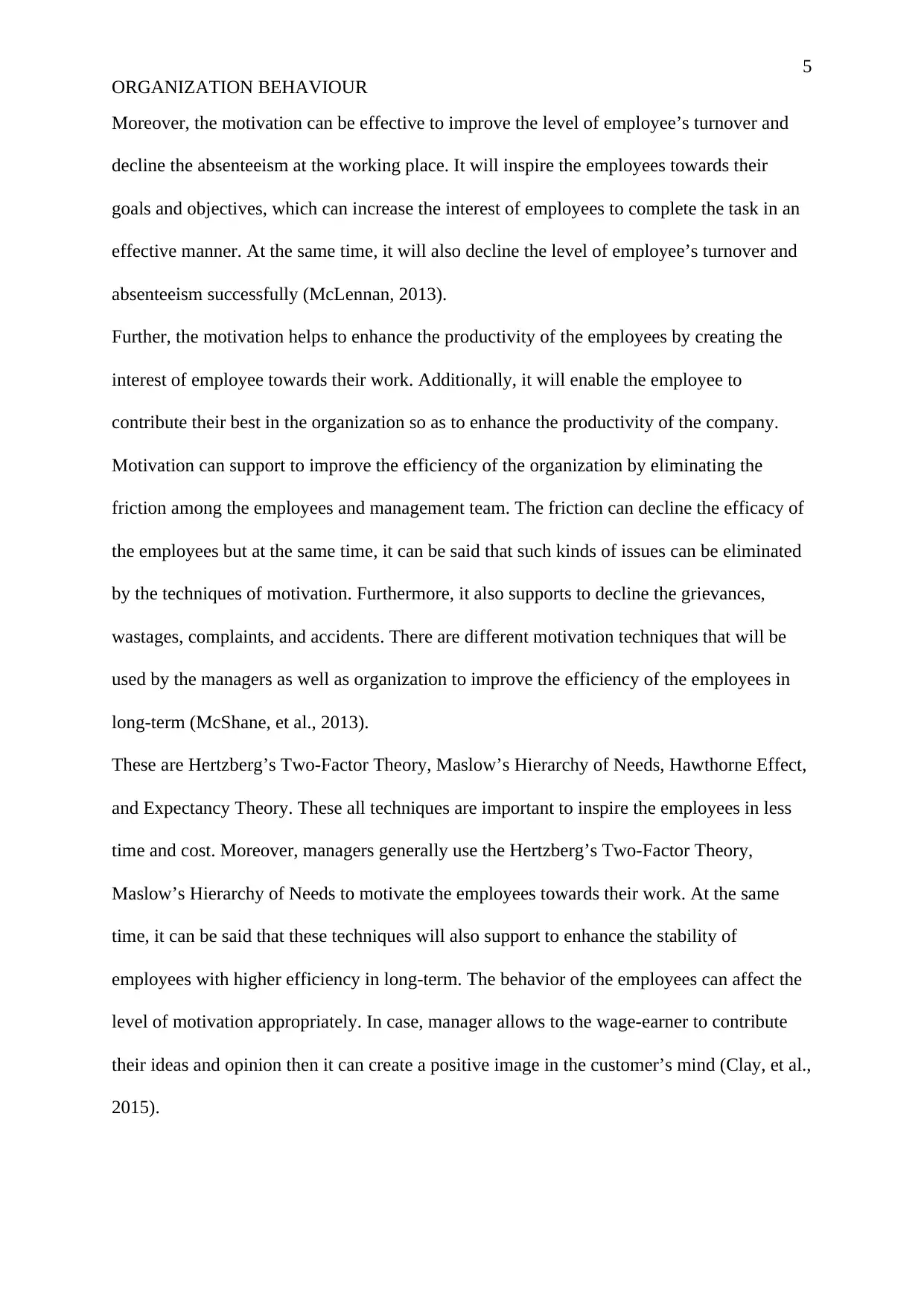
Moreover, the motivation can be effective to improve the level of employee’s turnover and
decline the absenteeism at the working place. It will inspire the employees towards their
goals and objectives, which can increase the interest of employees to complete the task in an
effective manner. At the same time, it will also decline the level of employee’s turnover and
absenteeism successfully (McLennan, 2013).
Further, the motivation helps to enhance the productivity of the employees by creating the
interest of employee towards their work. Additionally, it will enable the employee to
contribute their best in the organization so as to enhance the productivity of the company.
Motivation can support to improve the efficiency of the organization by eliminating the
friction among the employees and management team. The friction can decline the efficacy of
the employees but at the same time, it can be said that such kinds of issues can be eliminated
by the techniques of motivation. Furthermore, it also supports to decline the grievances,
wastages, complaints, and accidents. There are different motivation techniques that will be
used by the managers as well as organization to improve the efficiency of the employees in
long-term (McShane, et al., 2013).
These are Hertzberg’s Two-Factor Theory, Maslow’s Hierarchy of Needs, Hawthorne Effect,
and Expectancy Theory. These all techniques are important to inspire the employees in less
time and cost. Moreover, managers generally use the Hertzberg’s Two-Factor Theory,
Maslow’s Hierarchy of Needs to motivate the employees towards their work. At the same
time, it can be said that these techniques will also support to enhance the stability of
employees with higher efficiency in long-term. The behavior of the employees can affect the
level of motivation appropriately. In case, manager allows to the wage-earner to contribute
their ideas and opinion then it can create a positive image in the customer’s mind (Clay, et al.,
2015).
Document Page
6
ORGANIZATION BEHAVIOUR
At the same time, it can also be said that the positive image can be supportive to make a
robust relationship with employees along with enhancing the efficacy of employees in long-
term. In addition, the positive behavior of executive can increase the morale of employees
that will be supportive to improve the professional as well as personal life of the employees.
The appropriate behavior of the employees improves the communication skills of the
employees as well as attitude at the working place (Wood, et al., 2016).
The communication and attitude is a major factor that will impact on the performance of the
employees. Therefore, it can be said that a manager can improve the communication and
attitude skills of the employees by an ethical code of conduct to the employees. It will also
supportive to increase the efficiency of employees along with productivity of organization in
long-term.
Conclusion
From the above discussion, it can be concluded that employee efficiency can be effective to
accomplish the task of an organization in less time and cost with appropriate manner.
Additionally, it can also be summarized that the motivation technique is important for
managers to enhance the efficacy of employees and retain them in long-term. Finally, it can
be evaluated that Maslow’s Hierarchy of Needs and Hertzberg’s Two-Factor Theory is
generally used by the managers to inspire the employee towards their work.
Document Page
7
ORGANIZATION BEHAVIOUR
References
Chumg, H. F., Seaton, J., Cooke, L., and Ding, W. Y. (2016) Factors affecting employees'
knowledge-sharing behavior in the virtual organization from the perspectives of well-being
and organizational behavior, Computers in Human Behavior, 64, pp. 432-448.
Clay-Williams, R., and Braithwaite, J. (2015) Reframing implementation as an organizational
behavior problem: Inside a teamwork improvement intervention, Journal of health
organization and management, 29(6), pp. 670-683.
Coccia, M. (2014) Structure and organizational behavior of public research institutions under
unstable growth of human resources, International Journal of Services Technology and
Management, 20(4-6), pp. 251-266.
Gold, J., Holden, R., Iles, P., Stewart, J., and Beardwell, J. (2013) Human resource
development: Theory and practice. UK: Palgrave Macmillan.
Hyde, P., Harris, C., and Boaden, R. (2013) Pro-social organizational behavior of health care
workers, The International Journal of Human Resource Management, 24(16), pp. 3115-3130.
j Mullins, L., and Christy, G. (2013) Management and Organisational Behaviour. UK:
Pearson Education.
Kalliath, T., Brough, P., O'DRISCOLL, M., Manimala, M., SIU, O. L., and Parker, S.
(2013) Organisational behavior: a psychological perspective for the Asia Pacific. Australia:
McGraw-Hill.
Kitchin, D. (2017) An introduction to organizational behavior for managers and engineers: A
group and multicultural approach. UK: Routledge.
Malik, M. R. (2014) IMPACT OF POSITIVE ORGANISATIONAL BEHAVIOUR ON
LEADERSHIP AND HUMAN RESOURCE MANAGEMENT, International Journal of
Organizational Behaviour and Management Perspectives, 3(1), P. 70.
McLennan, R. (2013) Cases in organizational behavior. UK: Routledge.
tabler-icon-diamond-filled.svg

Paraphrase This Document

Need a fresh take? Get an instant paraphrase of this document with our AI Paraphraser
Document Page
8
ORGANIZATION BEHAVIOUR
McShane, S. L., Olekalns, M., and Travaglione, A. (2013) Organisational behavior:
Emerging knowledge, global insights. Australia: McGraw Hill.
Wood, J. M., Zeffane, R. M., Fromholtz, M., Wiesner, R., Morrison, R., Factor, A., and
Osborn, R. N. (2016) Organisational behavior: Core concepts and applications. USA: John
Wiley and Sons Australia, Ltd.
chevron_up_icon
1 out of 8
circle_padding
hide_on_mobile
zoom_out_icon
[object Object]