Report: Organizational Behavior Analysis of CAPCO PLASTIC and Samsung
VerifiedAdded on 2020/02/05
|21
|5146
|216
Report
AI Summary
This report provides a comprehensive analysis of organizational behavior, focusing on the relationship between organizational structure and culture, leadership styles, and employee motivation. It examines the structures and cultures of CAPCO PLASTIC and Samsung Total Petrochemical, comparing their approaches to management and employee engagement. The report discusses various leadership styles, including autocratic, participative, laissez-faire, and transactional approaches, and their effects on employee performance and innovation. It also explores the impact of organizational theories on management practices, employee behavior, and the overall environment of the workplace. The report further delves into factors influencing individual behavior, such as attitude, gender, background, qualities, and experience. It emphasizes the importance of a positive work environment, employee training, and the role of technology in teamwork. Overall, the report highlights how effective leadership, a supportive organizational culture, and strategic management practices contribute to enhanced employee performance and organizational success. This detailed analysis provides a valuable resource for students seeking to understand the complexities of organizational behavior and management strategies.
Table of Contents
INTRODUCTION...........................................................................................................................................2
TASK 1..........................................................................................................................................................3
1.1 ...........................................................................................................................................................3
1.2 ...........................................................................................................................................................5
1.3 .......................................................................................................................................................7
TASK 2..........................................................................................................................................................8
2.1 .......................................................................................................................................................8
2.2............................................................................................................................................................9
2.3 .....................................................................................................................................................11
TASK 3........................................................................................................................................................12
3.1 .....................................................................................................................................................12
3.2 .....................................................................................................................................................14
3.3 .....................................................................................................................................................16
TASK 4........................................................................................................................................................18
4.1......................................................................................................................................................18
4.2 .....................................................................................................................................................20
4.3 .....................................................................................................................................................21
CONCLUSION.............................................................................................................................................22
REFERENCES..............................................................................................................................................23
1
INTRODUCTION...........................................................................................................................................2
TASK 1..........................................................................................................................................................3
1.1 ...........................................................................................................................................................3
1.2 ...........................................................................................................................................................5
1.3 .......................................................................................................................................................7
TASK 2..........................................................................................................................................................8
2.1 .......................................................................................................................................................8
2.2............................................................................................................................................................9
2.3 .....................................................................................................................................................11
TASK 3........................................................................................................................................................12
3.1 .....................................................................................................................................................12
3.2 .....................................................................................................................................................14
3.3 .....................................................................................................................................................16
TASK 4........................................................................................................................................................18
4.1......................................................................................................................................................18
4.2 .....................................................................................................................................................20
4.3 .....................................................................................................................................................21
CONCLUSION.............................................................................................................................................22
REFERENCES..............................................................................................................................................23
1

Paraphrase This Document
Need a fresh take? Get an instant paraphrase of this document with our AI Paraphraser
INTRODUCTION
The objective of this task is to understand the individual and group behavior at work.
Various leadership and motivational theories have been discussed. In the present report,
interrelationship between organizational culture and structure is discussed. Impact of culture on
the efficiency and the performance of the employees within the organization have also been
highlighted. The various characteristic of individual behavior have been listed. In the second task
the significance of various leadership style have also been listed. These strategies of management
and practices have been listed. In the third task we discuss various motivational theories and their
application. The significance of motivation on the performance of the employees has been
discussed in detail. In the last task the introduction of group work and team work have been
mentioned. Effective teamwork helps in the management of the work effectively in a short span
of time. The influence of technology in the management of the team and the other task in the
company has been discussed in detail.
TASK 1
In this task, discussion is carried out on the relationship between structure and culture of
company. We have done a deep research on the structure and culture of CAPCO PLASTIC.
CAPCO PLASTIC is a company who manufactures CAPCO lactam and raw material of nylon.
1.1
The two companies being compared in this task are CAPCO PLASTIC and the
SAMSUNG TOTAL PETROCHEMICAL. All the strategies within the company and the culture
existing within the workplace have to be considered before answering this task.
The framework within the organization highlights the structure of the organization. The
chronology of the company from the top to the bottom level constitutes the structure of the
organization. There are different job profiles and the different levels of mangers within the
company. CAPCO PLASTIC has a tall organizational structure where there are many levels of
the managers and the employees (Cpaco plastic, 2012). The hierarchy of the organization
consists of many levels. There are many functional departments within the company looking
after different jobs such as administration, legal and regulatory service, finances and human
resources. Each department has their own director. The culture of the organization covers the
2
The objective of this task is to understand the individual and group behavior at work.
Various leadership and motivational theories have been discussed. In the present report,
interrelationship between organizational culture and structure is discussed. Impact of culture on
the efficiency and the performance of the employees within the organization have also been
highlighted. The various characteristic of individual behavior have been listed. In the second task
the significance of various leadership style have also been listed. These strategies of management
and practices have been listed. In the third task we discuss various motivational theories and their
application. The significance of motivation on the performance of the employees has been
discussed in detail. In the last task the introduction of group work and team work have been
mentioned. Effective teamwork helps in the management of the work effectively in a short span
of time. The influence of technology in the management of the team and the other task in the
company has been discussed in detail.
TASK 1
In this task, discussion is carried out on the relationship between structure and culture of
company. We have done a deep research on the structure and culture of CAPCO PLASTIC.
CAPCO PLASTIC is a company who manufactures CAPCO lactam and raw material of nylon.
1.1
The two companies being compared in this task are CAPCO PLASTIC and the
SAMSUNG TOTAL PETROCHEMICAL. All the strategies within the company and the culture
existing within the workplace have to be considered before answering this task.
The framework within the organization highlights the structure of the organization. The
chronology of the company from the top to the bottom level constitutes the structure of the
organization. There are different job profiles and the different levels of mangers within the
company. CAPCO PLASTIC has a tall organizational structure where there are many levels of
the managers and the employees (Cpaco plastic, 2012). The hierarchy of the organization
consists of many levels. There are many functional departments within the company looking
after different jobs such as administration, legal and regulatory service, finances and human
resources. Each department has their own director. The culture of the organization covers the
2
different principles and the values followed at the organization. The culture of CAPCO
PLASTIC is very friendly. Employees can wear whatever they feel like, there are flexible work
timings and everyone behaves in a friendly manner. Organizational culture affects the
performance of employee of Capco. The culture of every organization is unique and different. As
the employees of CAPCO PLASTIC determine their own time of working they work with
increased efficiency. In turn the performance of the company increases.
Different types of structure of an organization are given below:
Functional organization
In this the grouping of the organization and the job profiles I according to the purpose and the
role they play. It is well suited for the startups.
Divisional organizational structure
This type is most suited for the large organizational structure. This inhibits too much
communication between the employees and work for a specific area.
Matrix organizational structure
It is the combination of both the structure, i.e., functional and divisional. It is best suited for
multinational companies.
Characteristic of the organizational culture are as follows:
People
This is a characteristic of the company that pays a great attention on its employees and how the
decisions will affect the employees.
Teamwork
The company forms team to let its employees have positive relationship with each other. It also
increases the efficiency of work.
Rule
It happens in the company which has stability as one of its objectives. It is mandatory for the
employees to follow all the rules.
3
PLASTIC is very friendly. Employees can wear whatever they feel like, there are flexible work
timings and everyone behaves in a friendly manner. Organizational culture affects the
performance of employee of Capco. The culture of every organization is unique and different. As
the employees of CAPCO PLASTIC determine their own time of working they work with
increased efficiency. In turn the performance of the company increases.
Different types of structure of an organization are given below:
Functional organization
In this the grouping of the organization and the job profiles I according to the purpose and the
role they play. It is well suited for the startups.
Divisional organizational structure
This type is most suited for the large organizational structure. This inhibits too much
communication between the employees and work for a specific area.
Matrix organizational structure
It is the combination of both the structure, i.e., functional and divisional. It is best suited for
multinational companies.
Characteristic of the organizational culture are as follows:
People
This is a characteristic of the company that pays a great attention on its employees and how the
decisions will affect the employees.
Teamwork
The company forms team to let its employees have positive relationship with each other. It also
increases the efficiency of work.
Rule
It happens in the company which has stability as one of its objectives. It is mandatory for the
employees to follow all the rules.
3
⊘ This is a preview!⊘
Do you want full access?
Subscribe today to unlock all pages.

Trusted by 1+ million students worldwide
Power
It is followed in the organization which has autocratic leadership styles. All the powers are
vested in the hands of the leader.
The structure of Samsung Total Petrochemical is flat. There are very few managerial posts
available in the company. According to organizational structure, every employee should be
involved in the company’s decision. The culture of the company is very formal type. Employee
is expected to follow a proper dress code and wear decent clothes to the workplace. The hours of
coming and going from the office are also fixed by the mangers. The culture of the company
brings punctuality in the lives of the employees. (Biance, 2016)
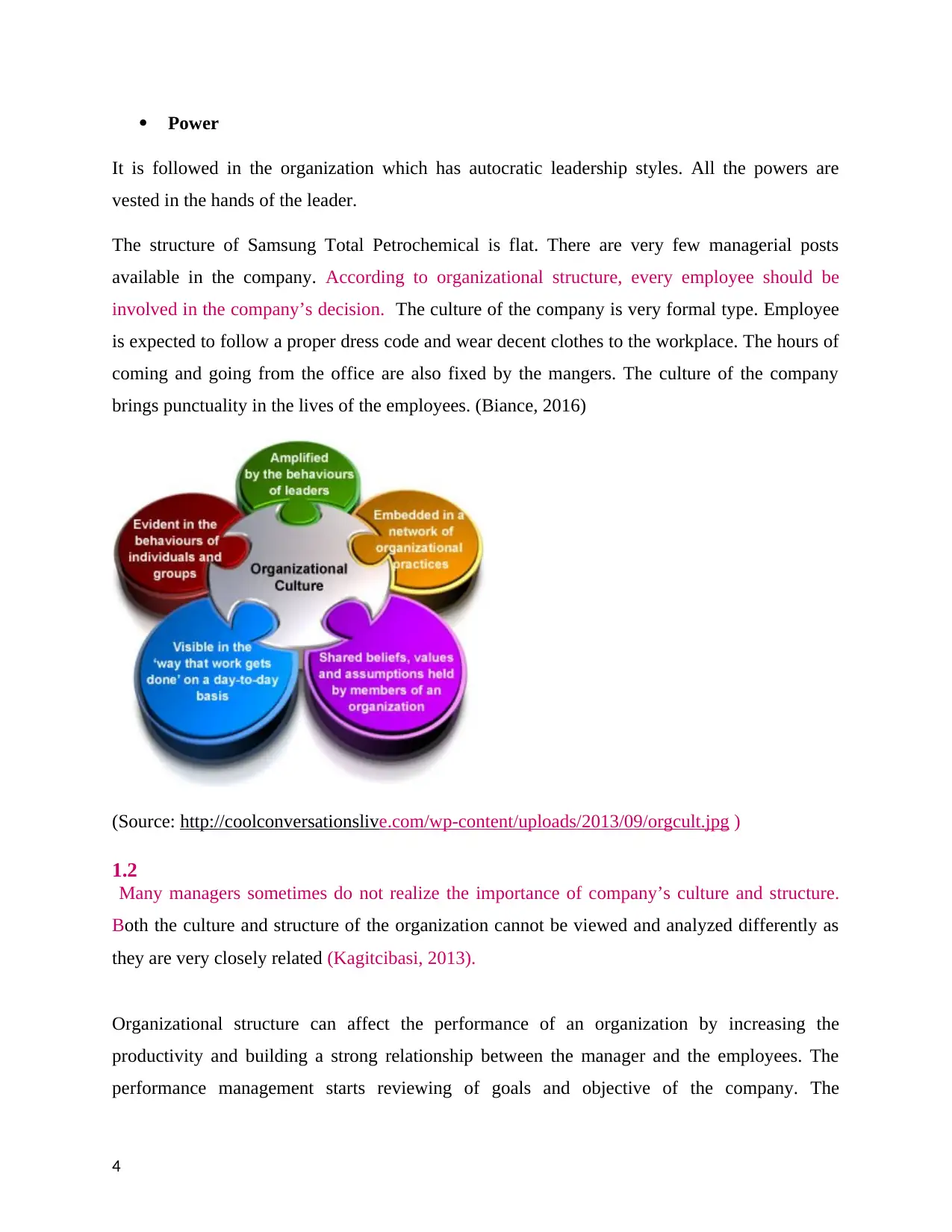
(Source: http://coolconversationslive.com/wp-content/uploads/2013/09/orgcult.jpg )
1.2
Many managers sometimes do not realize the importance of company’s culture and structure.
Both the culture and structure of the organization cannot be viewed and analyzed differently as
they are very closely related (Kagitcibasi, 2013).
Organizational structure can affect the performance of an organization by increasing the
productivity and building a strong relationship between the manager and the employees. The
performance management starts reviewing of goals and objective of the company. The
4
It is followed in the organization which has autocratic leadership styles. All the powers are
vested in the hands of the leader.
The structure of Samsung Total Petrochemical is flat. There are very few managerial posts
available in the company. According to organizational structure, every employee should be
involved in the company’s decision. The culture of the company is very formal type. Employee
is expected to follow a proper dress code and wear decent clothes to the workplace. The hours of
coming and going from the office are also fixed by the mangers. The culture of the company
brings punctuality in the lives of the employees. (Biance, 2016)
(Source: http://coolconversationslive.com/wp-content/uploads/2013/09/orgcult.jpg )
1.2
Many managers sometimes do not realize the importance of company’s culture and structure.
Both the culture and structure of the organization cannot be viewed and analyzed differently as
they are very closely related (Kagitcibasi, 2013).
Organizational structure can affect the performance of an organization by increasing the
productivity and building a strong relationship between the manager and the employees. The
performance management starts reviewing of goals and objective of the company. The
4
Paraphrase This Document
Need a fresh take? Get an instant paraphrase of this document with our AI Paraphraser
performance of the organization depends on the purpose of the organization. At CAPCO
PLASTIC the goals are set by the top management then its execution by the lower level
employees (Cpaco plastic, 2012).
Culture of the organization also affects the performance of the employees. Culture determines
the leadership style and hence the motivation of the employees is affected by it. If an
organization adopts “talk when needed” strategies then the employees will lack understanding
and coordination (Kark and Van Dijk, 2007).
The culture existing within CAPCO PLASTIC tells us about the working of different employees
within the workplace and the set of values and standard within the organization. The
infrastructure and the hierarchical positions of the employees within the company determine its
structure. The commitment and efficiency of the employee is determined by its structure and
culture.
Training helps in improving performance of employees. Training of the employees is determined
by its culture. The culture of CAPCO PLASTIC also determines the customer and employee
satisfaction at the company. The standard belief of the workplace also determines the values the
employees have. The culture and the structure of the company can affect the attitude of the
employees towards problem solving and handling their job. There should be a healthy and
positive atmosphere within the workplace to retain the employees in the company. The structure
if the company should be as such the employee should have a healthy competition among them
but there should be no possibility of rising by unfair means. All the employees should be
involved in the process of decision making as this will promote creativity and innovation within
the workplace. All these factors when coupled together also increase the performance of the
employees and the company. (Davoren, 2016)
1.3
There are some factors which affect the behavior of employee in the organization. Some of them
are listed below:
Attitude
5
PLASTIC the goals are set by the top management then its execution by the lower level
employees (Cpaco plastic, 2012).
Culture of the organization also affects the performance of the employees. Culture determines
the leadership style and hence the motivation of the employees is affected by it. If an
organization adopts “talk when needed” strategies then the employees will lack understanding
and coordination (Kark and Van Dijk, 2007).
The culture existing within CAPCO PLASTIC tells us about the working of different employees
within the workplace and the set of values and standard within the organization. The
infrastructure and the hierarchical positions of the employees within the company determine its
structure. The commitment and efficiency of the employee is determined by its structure and
culture.
Training helps in improving performance of employees. Training of the employees is determined
by its culture. The culture of CAPCO PLASTIC also determines the customer and employee
satisfaction at the company. The standard belief of the workplace also determines the values the
employees have. The culture and the structure of the company can affect the attitude of the
employees towards problem solving and handling their job. There should be a healthy and
positive atmosphere within the workplace to retain the employees in the company. The structure
if the company should be as such the employee should have a healthy competition among them
but there should be no possibility of rising by unfair means. All the employees should be
involved in the process of decision making as this will promote creativity and innovation within
the workplace. All these factors when coupled together also increase the performance of the
employees and the company. (Davoren, 2016)
1.3
There are some factors which affect the behavior of employee in the organization. Some of them
are listed below:
Attitude
5
Attitude is determined by the reaction of people towards a particular situation. CAPCO
PLASTIC needs people with varied attitude such as diplomats, extrovert, introverts and many
others. Attitude affect the working style of the people and their commitment.
Sex
At CAPCO PLASTIC both men and women are considered to be fit for all the managerial jobs.
Both man and women are given equal pay for their equal work. There is no discrimination based
on the basis of gender in the workplace. Women are generally more focused towards their work
as compared to men. Women are better at multitasking than men.
Previous background
Background refers to the place where the people belong to. It also covers their racial background
and the culture. It is made sure at CAPCO PLASTIC that there is no discrimination based on
basis of race and religion of the employee. Previous background also affects the quality of work
delivered by the employees. Indians are generally more hard working.
Qualities
Qualities and skills present in the employee on the individual basis are considered before hiring
the employee. The employees are given training in the company so that they can brush up their
skills. Some of the skills are present in the individual by birth. CAPCO PLASTIC focuses on
polishing such skills.
Experience
Experience refers to perception and insight an individual gains by working for many years.
Experience makes the employees mature and handle the problems in a good way. The perception
of the employees on various matters may also differ in accordance with their interpretation. More
experienced employees have better problem solving skills (Einarsen, Aasland and Skogstad,
2007).
6
PLASTIC needs people with varied attitude such as diplomats, extrovert, introverts and many
others. Attitude affect the working style of the people and their commitment.
Sex
At CAPCO PLASTIC both men and women are considered to be fit for all the managerial jobs.
Both man and women are given equal pay for their equal work. There is no discrimination based
on the basis of gender in the workplace. Women are generally more focused towards their work
as compared to men. Women are better at multitasking than men.
Previous background
Background refers to the place where the people belong to. It also covers their racial background
and the culture. It is made sure at CAPCO PLASTIC that there is no discrimination based on
basis of race and religion of the employee. Previous background also affects the quality of work
delivered by the employees. Indians are generally more hard working.
Qualities
Qualities and skills present in the employee on the individual basis are considered before hiring
the employee. The employees are given training in the company so that they can brush up their
skills. Some of the skills are present in the individual by birth. CAPCO PLASTIC focuses on
polishing such skills.
Experience
Experience refers to perception and insight an individual gains by working for many years.
Experience makes the employees mature and handle the problems in a good way. The perception
of the employees on various matters may also differ in accordance with their interpretation. More
experienced employees have better problem solving skills (Einarsen, Aasland and Skogstad,
2007).
6
⊘ This is a preview!⊘
Do you want full access?
Subscribe today to unlock all pages.
Trusted by 1+ million students worldwide
TASK 2
2.1
There are different types of leadership which may affect performance and effectiveness of
employees within an organization. The two type of leadership style that may be followed by
CAPCO PLASTIC and Samsung Total Petrochemical are discussed below:
Autocratic style
Samsung Total Petrochemical follows autocratic leadership style in the workplace. The leaders
and the employees are separate from each other. The employees are expected to follow the
instruction of the managers. Leader takes decision by its own without involving its team
member. The employees do not have a say in the process of decision making. They are not
consulted when the important decisions of the company are taken. The leaders help the
employees in performing their jobs and take reviews and feedbacks from them. Autocratic style
of leadership does not include innovation and creativity within the company. The leaders do not
keep a personal touch with the employees so the employee does not have a feeling of belongings
to the company. They do not get valued and their ideas are not taken. The employees can lose
motivation and their performance may decline. (MindTools, 2016)
Participative style
This type of leadership is also called democratic as the consent of all the employees are before
coming to a decision. The leadership style of CAPCO PLASTIC is participative and it is very
effective in managing the employees. Employee are involved in decision making process and due
to this they feel part of the organization The employees are allowed to choose their way of
working and may seek assistance from the mangers whenever required. The employee remains
motivated in their work and bring in new ideas to the company. This leadership maintains
healthy environment within the workplace where everybody motivates each other. (Pirraglia,
2016)
Laissez-Faire style
7
2.1
There are different types of leadership which may affect performance and effectiveness of
employees within an organization. The two type of leadership style that may be followed by
CAPCO PLASTIC and Samsung Total Petrochemical are discussed below:
Autocratic style
Samsung Total Petrochemical follows autocratic leadership style in the workplace. The leaders
and the employees are separate from each other. The employees are expected to follow the
instruction of the managers. Leader takes decision by its own without involving its team
member. The employees do not have a say in the process of decision making. They are not
consulted when the important decisions of the company are taken. The leaders help the
employees in performing their jobs and take reviews and feedbacks from them. Autocratic style
of leadership does not include innovation and creativity within the company. The leaders do not
keep a personal touch with the employees so the employee does not have a feeling of belongings
to the company. They do not get valued and their ideas are not taken. The employees can lose
motivation and their performance may decline. (MindTools, 2016)
Participative style
This type of leadership is also called democratic as the consent of all the employees are before
coming to a decision. The leadership style of CAPCO PLASTIC is participative and it is very
effective in managing the employees. Employee are involved in decision making process and due
to this they feel part of the organization The employees are allowed to choose their way of
working and may seek assistance from the mangers whenever required. The employee remains
motivated in their work and bring in new ideas to the company. This leadership maintains
healthy environment within the workplace where everybody motivates each other. (Pirraglia,
2016)
Laissez-Faire style
7
Paraphrase This Document
Need a fresh take? Get an instant paraphrase of this document with our AI Paraphraser
In this type of leadership there is a direct monitoring and supervision of the employees. Highly
skilled and experiences employees need less supervision whereas the new comers needs a lot of
supervision.
Transactional style
This type of leadership style involves giving and taking. The employees submit the work and the
leader gives the feedback in form of reward or punishment.
2.2
There are different ideas that enable the mangers to efficiently manage the workforce within an
organization are referred to as organizational theory. These theories also help the managers
decide the practices of the company. It helps the managers to effectively manage the work of the
organization while keeping the objective of the company in mind.
Organizational theories play an essential role in determining the structure and culture of a
company. The theory followed by an organization heavily affects the management practices of
an organization. The leadership style, motivation and the environment of the workplace is
affected by the theory it follows. It is the duty of the managers to properly inculcate a particular
organizational theory in the workplace. The managers have to be trained on a regular basis to
keep them updated. Various types of organizational theories are given below:
Scientific theory
This theory states that there is elation between all the departments of an organization and a
change in one department may affect the other. It tells us about the scientific strategy of handling
the employees. It also states that an organization is always in a dynamic state so it needs to be
constantly updated with the trends in the market. This theory has made the proceedings of an
organization more scientific and organized. It provides scientific and strategic solutions to all the
problems.
Human Relation theory
This theory mainly focuses on the motivation of the employee and increasing their efficiency
through various practices. There should be healthy relations between the managers and the
employees and the employee must try to understand the managers personally.The managers
8
skilled and experiences employees need less supervision whereas the new comers needs a lot of
supervision.
Transactional style
This type of leadership style involves giving and taking. The employees submit the work and the
leader gives the feedback in form of reward or punishment.
2.2
There are different ideas that enable the mangers to efficiently manage the workforce within an
organization are referred to as organizational theory. These theories also help the managers
decide the practices of the company. It helps the managers to effectively manage the work of the
organization while keeping the objective of the company in mind.
Organizational theories play an essential role in determining the structure and culture of a
company. The theory followed by an organization heavily affects the management practices of
an organization. The leadership style, motivation and the environment of the workplace is
affected by the theory it follows. It is the duty of the managers to properly inculcate a particular
organizational theory in the workplace. The managers have to be trained on a regular basis to
keep them updated. Various types of organizational theories are given below:
Scientific theory
This theory states that there is elation between all the departments of an organization and a
change in one department may affect the other. It tells us about the scientific strategy of handling
the employees. It also states that an organization is always in a dynamic state so it needs to be
constantly updated with the trends in the market. This theory has made the proceedings of an
organization more scientific and organized. It provides scientific and strategic solutions to all the
problems.
Human Relation theory
This theory mainly focuses on the motivation of the employee and increasing their efficiency
through various practices. There should be healthy relations between the managers and the
employees and the employee must try to understand the managers personally.The managers
8
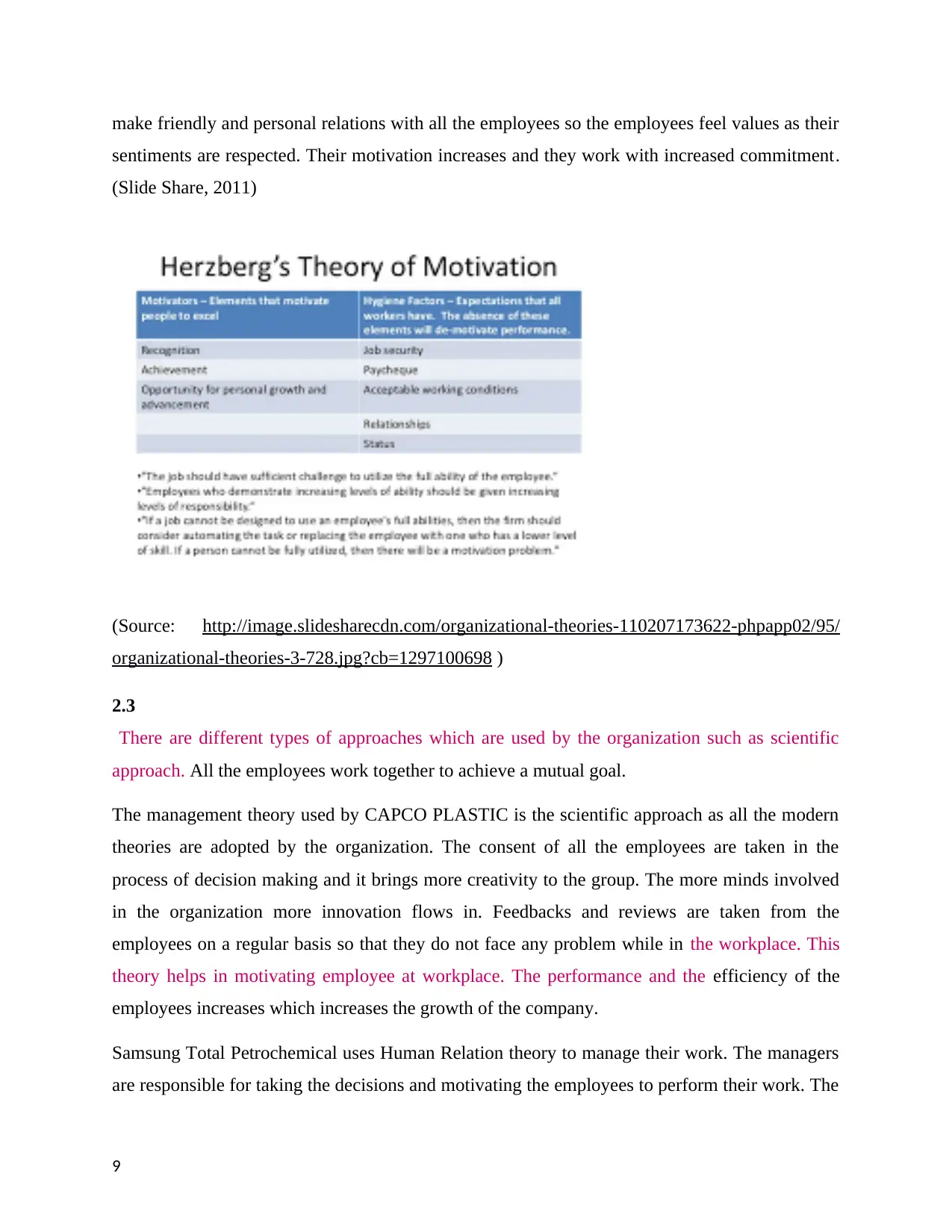
make friendly and personal relations with all the employees so the employees feel values as their
sentiments are respected. Their motivation increases and they work with increased commitment.
(Slide Share, 2011)
(Source: http://image.slidesharecdn.com/organizational-theories-110207173622-phpapp02/95/
organizational-theories-3-728.jpg?cb=1297100698 )
2.3
There are different types of approaches which are used by the organization such as scientific
approach. All the employees work together to achieve a mutual goal.
The management theory used by CAPCO PLASTIC is the scientific approach as all the modern
theories are adopted by the organization. The consent of all the employees are taken in the
process of decision making and it brings more creativity to the group. The more minds involved
in the organization more innovation flows in. Feedbacks and reviews are taken from the
employees on a regular basis so that they do not face any problem while in the workplace. This
theory helps in motivating employee at workplace. The performance and the efficiency of the
employees increases which increases the growth of the company.
Samsung Total Petrochemical uses Human Relation theory to manage their work. The managers
are responsible for taking the decisions and motivating the employees to perform their work. The
9
sentiments are respected. Their motivation increases and they work with increased commitment.
(Slide Share, 2011)
(Source: http://image.slidesharecdn.com/organizational-theories-110207173622-phpapp02/95/
organizational-theories-3-728.jpg?cb=1297100698 )
2.3
There are different types of approaches which are used by the organization such as scientific
approach. All the employees work together to achieve a mutual goal.
The management theory used by CAPCO PLASTIC is the scientific approach as all the modern
theories are adopted by the organization. The consent of all the employees are taken in the
process of decision making and it brings more creativity to the group. The more minds involved
in the organization more innovation flows in. Feedbacks and reviews are taken from the
employees on a regular basis so that they do not face any problem while in the workplace. This
theory helps in motivating employee at workplace. The performance and the efficiency of the
employees increases which increases the growth of the company.
Samsung Total Petrochemical uses Human Relation theory to manage their work. The managers
are responsible for taking the decisions and motivating the employees to perform their work. The
9
⊘ This is a preview!⊘
Do you want full access?
Subscribe today to unlock all pages.
Trusted by 1+ million students worldwide
task are assigned to the employees and they are expected to them deliver them on time. This
theory develops healthy relations between the employees and managers and this motivates them
to work with increased efficiency. The managers motivate the employees (Borman and
Motowidlo, 2014).
TASK 3
3.1
Leadership style has great impact on the organization and employee. A good leader knows how
to manage the employees and keep them dedicated towards their work. Managers give the
employees feedback about their work and help them perform better in their assigned task. An
efficient manager gives appraisal and rewards to the employee for their good work. The different
type of leadership style within an organization is given below:
Democracy
The consent of all the employees’ is taken before arising to a final decision. The employees give
in their best in the company as their ideas are respected. The leader takes the majority decision in
the end. Employee ideas are important for the company because it helps in making right decision
This type of leadership motivates the employees by giving them freedom and involving them.
Bureaucracy
This is a very strict form of leadership where all the work has to be done with great precision.
The huge projects involving lot of money where leaders cannot afford a small mistake follow
this type of leadership.
Autocracy
This type of leadership involves the managers giving instructions and the managers following it.
The managers have the total power of decision making and the employees follow their
instruction. This is inefficient form of leadership as the employee may start losing interest.
Work based
This form is adopted with an important job has to be done or a task has to be completed on an
urgent basis. This may get autocratic at some points as great deal of care has to be taken.
10
theory develops healthy relations between the employees and managers and this motivates them
to work with increased efficiency. The managers motivate the employees (Borman and
Motowidlo, 2014).
TASK 3
3.1
Leadership style has great impact on the organization and employee. A good leader knows how
to manage the employees and keep them dedicated towards their work. Managers give the
employees feedback about their work and help them perform better in their assigned task. An
efficient manager gives appraisal and rewards to the employee for their good work. The different
type of leadership style within an organization is given below:
Democracy
The consent of all the employees’ is taken before arising to a final decision. The employees give
in their best in the company as their ideas are respected. The leader takes the majority decision in
the end. Employee ideas are important for the company because it helps in making right decision
This type of leadership motivates the employees by giving them freedom and involving them.
Bureaucracy
This is a very strict form of leadership where all the work has to be done with great precision.
The huge projects involving lot of money where leaders cannot afford a small mistake follow
this type of leadership.
Autocracy
This type of leadership involves the managers giving instructions and the managers following it.
The managers have the total power of decision making and the employees follow their
instruction. This is inefficient form of leadership as the employee may start losing interest.
Work based
This form is adopted with an important job has to be done or a task has to be completed on an
urgent basis. This may get autocratic at some points as great deal of care has to be taken.
10
Paraphrase This Document
Need a fresh take? Get an instant paraphrase of this document with our AI Paraphraser
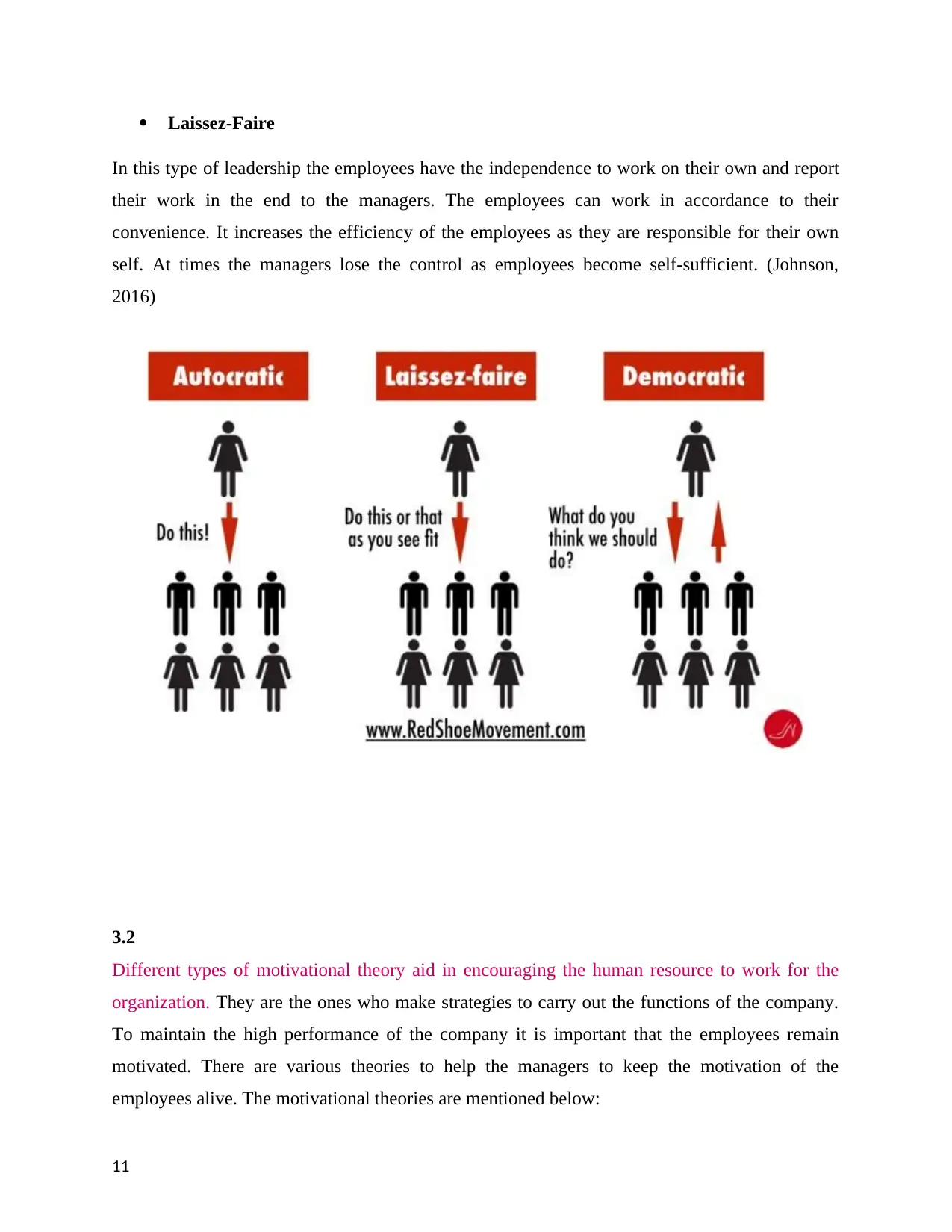
Laissez-Faire
In this type of leadership the employees have the independence to work on their own and report
their work in the end to the managers. The employees can work in accordance to their
convenience. It increases the efficiency of the employees as they are responsible for their own
self. At times the managers lose the control as employees become self-sufficient. (Johnson,
2016)
3.2
Different types of motivational theory aid in encouraging the human resource to work for the
organization. They are the ones who make strategies to carry out the functions of the company.
To maintain the high performance of the company it is important that the employees remain
motivated. There are various theories to help the managers to keep the motivation of the
employees alive. The motivational theories are mentioned below:
11
In this type of leadership the employees have the independence to work on their own and report
their work in the end to the managers. The employees can work in accordance to their
convenience. It increases the efficiency of the employees as they are responsible for their own
self. At times the managers lose the control as employees become self-sufficient. (Johnson,
2016)
3.2
Different types of motivational theory aid in encouraging the human resource to work for the
organization. They are the ones who make strategies to carry out the functions of the company.
To maintain the high performance of the company it is important that the employees remain
motivated. There are various theories to help the managers to keep the motivation of the
employees alive. The motivational theories are mentioned below:
11
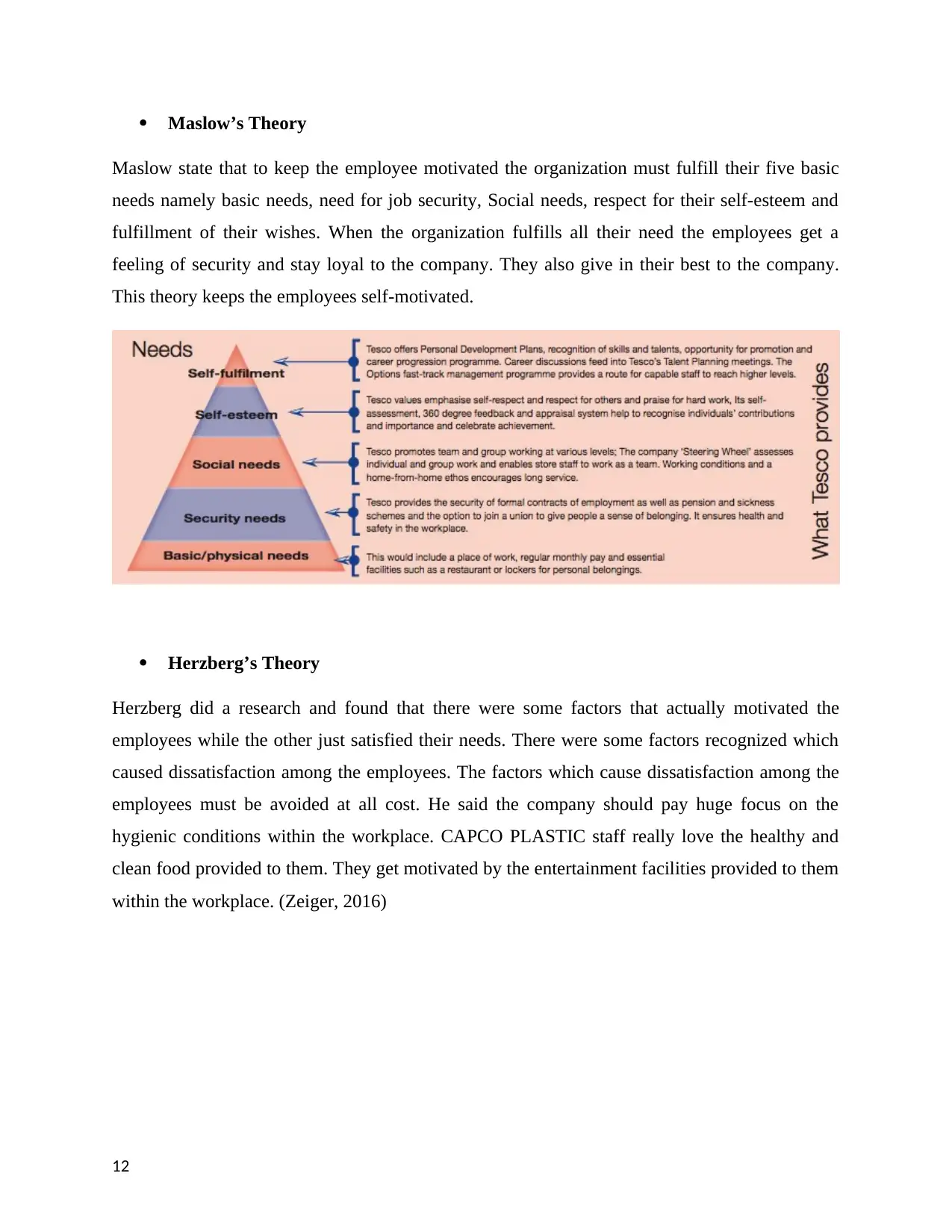
Maslow’s Theory
Maslow state that to keep the employee motivated the organization must fulfill their five basic
needs namely basic needs, need for job security, Social needs, respect for their self-esteem and
fulfillment of their wishes. When the organization fulfills all their need the employees get a
feeling of security and stay loyal to the company. They also give in their best to the company.
This theory keeps the employees self-motivated.
Herzberg’s Theory
Herzberg did a research and found that there were some factors that actually motivated the
employees while the other just satisfied their needs. There were some factors recognized which
caused dissatisfaction among the employees. The factors which cause dissatisfaction among the
employees must be avoided at all cost. He said the company should pay huge focus on the
hygienic conditions within the workplace. CAPCO PLASTIC staff really love the healthy and
clean food provided to them. They get motivated by the entertainment facilities provided to them
within the workplace. (Zeiger, 2016)
12
Maslow state that to keep the employee motivated the organization must fulfill their five basic
needs namely basic needs, need for job security, Social needs, respect for their self-esteem and
fulfillment of their wishes. When the organization fulfills all their need the employees get a
feeling of security and stay loyal to the company. They also give in their best to the company.
This theory keeps the employees self-motivated.
Herzberg’s Theory
Herzberg did a research and found that there were some factors that actually motivated the
employees while the other just satisfied their needs. There were some factors recognized which
caused dissatisfaction among the employees. The factors which cause dissatisfaction among the
employees must be avoided at all cost. He said the company should pay huge focus on the
hygienic conditions within the workplace. CAPCO PLASTIC staff really love the healthy and
clean food provided to them. They get motivated by the entertainment facilities provided to them
within the workplace. (Zeiger, 2016)
12
⊘ This is a preview!⊘
Do you want full access?
Subscribe today to unlock all pages.
Trusted by 1+ million students worldwide

1 out of 21


Related Documents


Your All-in-One AI-Powered Toolkit for Academic Success.
+13062052269
info@desklib.com
Available 24*7 on WhatsApp / Email
![[object Object]](/_next/static/media/star-bottom.7253800d.svg)
Unlock your academic potential
Copyright © 2020–2026 A2Z Services. All Rights Reserved. Developed and managed by ZUCOL.