Organizational Behavior: Socialization and Challenges

Verified

Added on  2022/08/14

|4
|750
|18
Homework Assignment
AI Summary
This assignment delves into the complexities of organizational behavior, examining the most significant challenges faced by employees and businesses in the 21st century, with a particular focus on workforce diversity. The student argues that globalization has amplified diversity, affecting organizational culture, team dynamics, and individual employee adaptation. Drawing on personal experiences, the assignment highlights how diversity influences organizational culture and team conflict. The assignment also explores the concept of socialization, emphasizing its role in internalizing organizational norms and ideologies, and its benefits for both the organization and new employees. The student provides a personal example illustrating how socialization facilitated their adaptation to the organizational culture, fostering self-development and team orientation. The assignment references key literature on organizational behavior and socialization to support the arguments presented.
Document Page
Running head: ORGANIZATIONAL BEHAVIOR
ORGANIZATIONAL BEHAVIOR
Name of the Student:
Name of the University:
Author Note:
tabler-icon-diamond-filled.svg

Paraphrase This Document

Need a fresh take? Get an instant paraphrase of this document with our AI Paraphraser
Document Page
1ORGANIZATIONAL BEHAVIOR
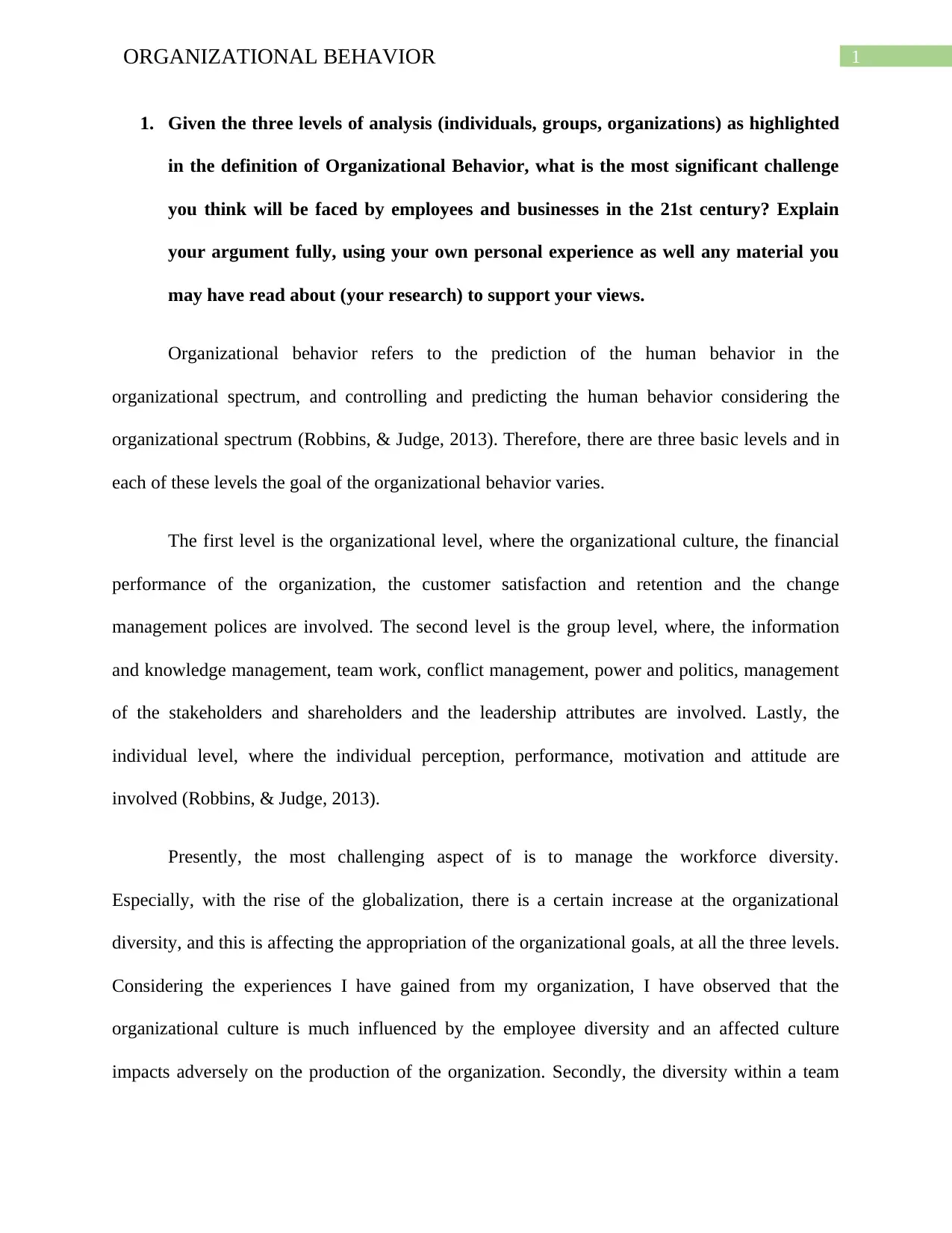
1. Given the three levels of analysis (individuals, groups, organizations) as highlighted
in the definition of Organizational Behavior, what is the most significant challenge
you think will be faced by employees and businesses in the 21st century? Explain
your argument fully, using your own personal experience as well any material you
may have read about (your research) to support your views.
Organizational behavior refers to the prediction of the human behavior in the
organizational spectrum, and controlling and predicting the human behavior considering the
organizational spectrum (Robbins, & Judge, 2013). Therefore, there are three basic levels and in
each of these levels the goal of the organizational behavior varies.
The first level is the organizational level, where the organizational culture, the financial
performance of the organization, the customer satisfaction and retention and the change
management polices are involved. The second level is the group level, where, the information
and knowledge management, team work, conflict management, power and politics, management
of the stakeholders and shareholders and the leadership attributes are involved. Lastly, the
individual level, where the individual perception, performance, motivation and attitude are
involved (Robbins, & Judge, 2013).
Presently, the most challenging aspect of is to manage the workforce diversity.
Especially, with the rise of the globalization, there is a certain increase at the organizational
diversity, and this is affecting the appropriation of the organizational goals, at all the three levels.
Considering the experiences I have gained from my organization, I have observed that the
organizational culture is much influenced by the employee diversity and an affected culture
impacts adversely on the production of the organization. Secondly, the diversity within a team
Document Page
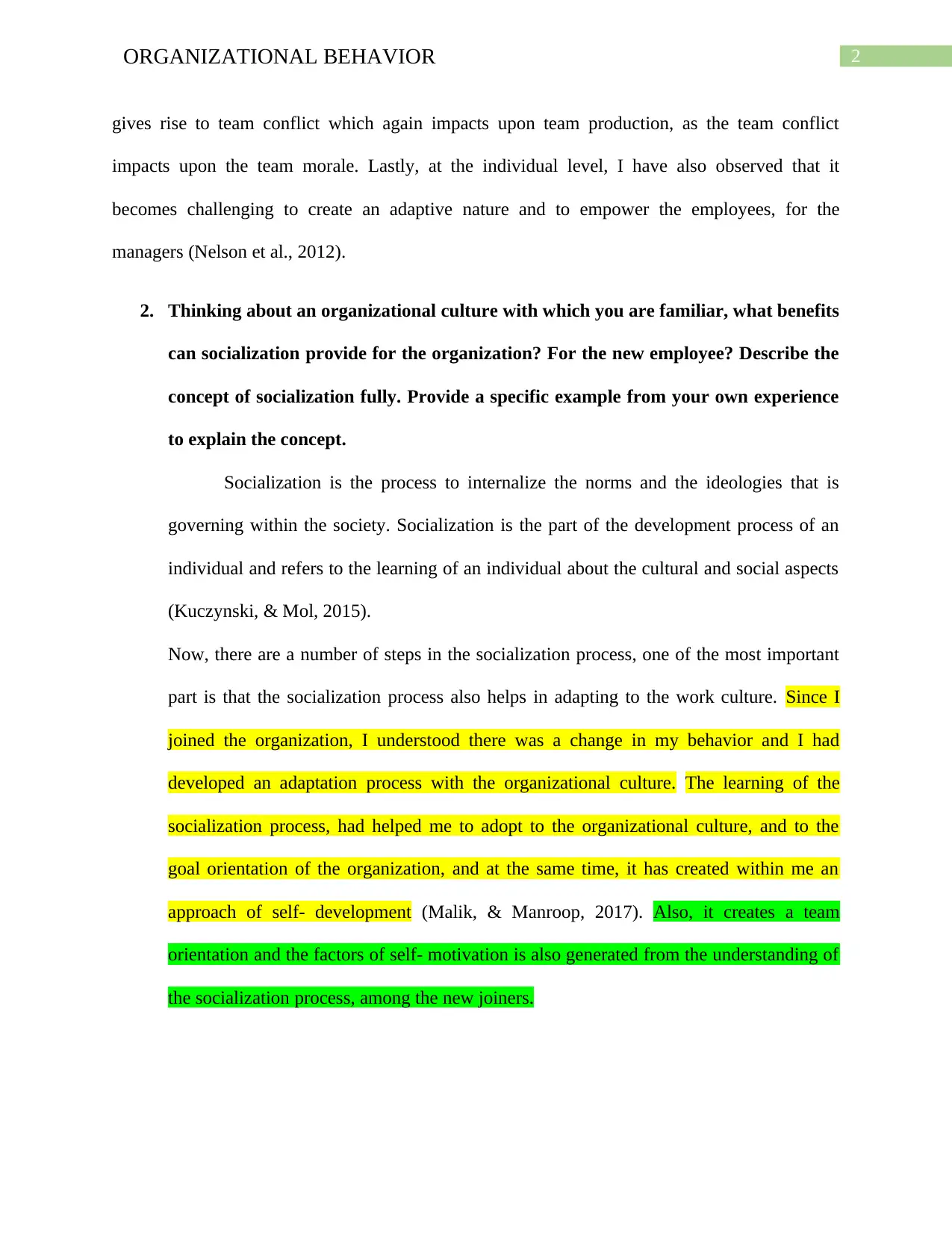
2ORGANIZATIONAL BEHAVIOR
gives rise to team conflict which again impacts upon team production, as the team conflict
impacts upon the team morale. Lastly, at the individual level, I have also observed that it
becomes challenging to create an adaptive nature and to empower the employees, for the
managers (Nelson et al., 2012).
2. Thinking about an organizational culture with which you are familiar, what benefits
can socialization provide for the organization? For the new employee? Describe the
concept of socialization fully. Provide a specific example from your own experience
to explain the concept.
Socialization is the process to internalize the norms and the ideologies that is
governing within the society. Socialization is the part of the development process of an
individual and refers to the learning of an individual about the cultural and social aspects
(Kuczynski, & Mol, 2015).
Now, there are a number of steps in the socialization process, one of the most important
part is that the socialization process also helps in adapting to the work culture. Since I
joined the organization, I understood there was a change in my behavior and I had
developed an adaptation process with the organizational culture. The learning of the
socialization process, had helped me to adopt to the organizational culture, and to the
goal orientation of the organization, and at the same time, it has created within me an
approach of self- development (Malik, & Manroop, 2017). Also, it creates a team
orientation and the factors of self- motivation is also generated from the understanding of
the socialization process, among the new joiners.
Document Page
3ORGANIZATIONAL BEHAVIOR
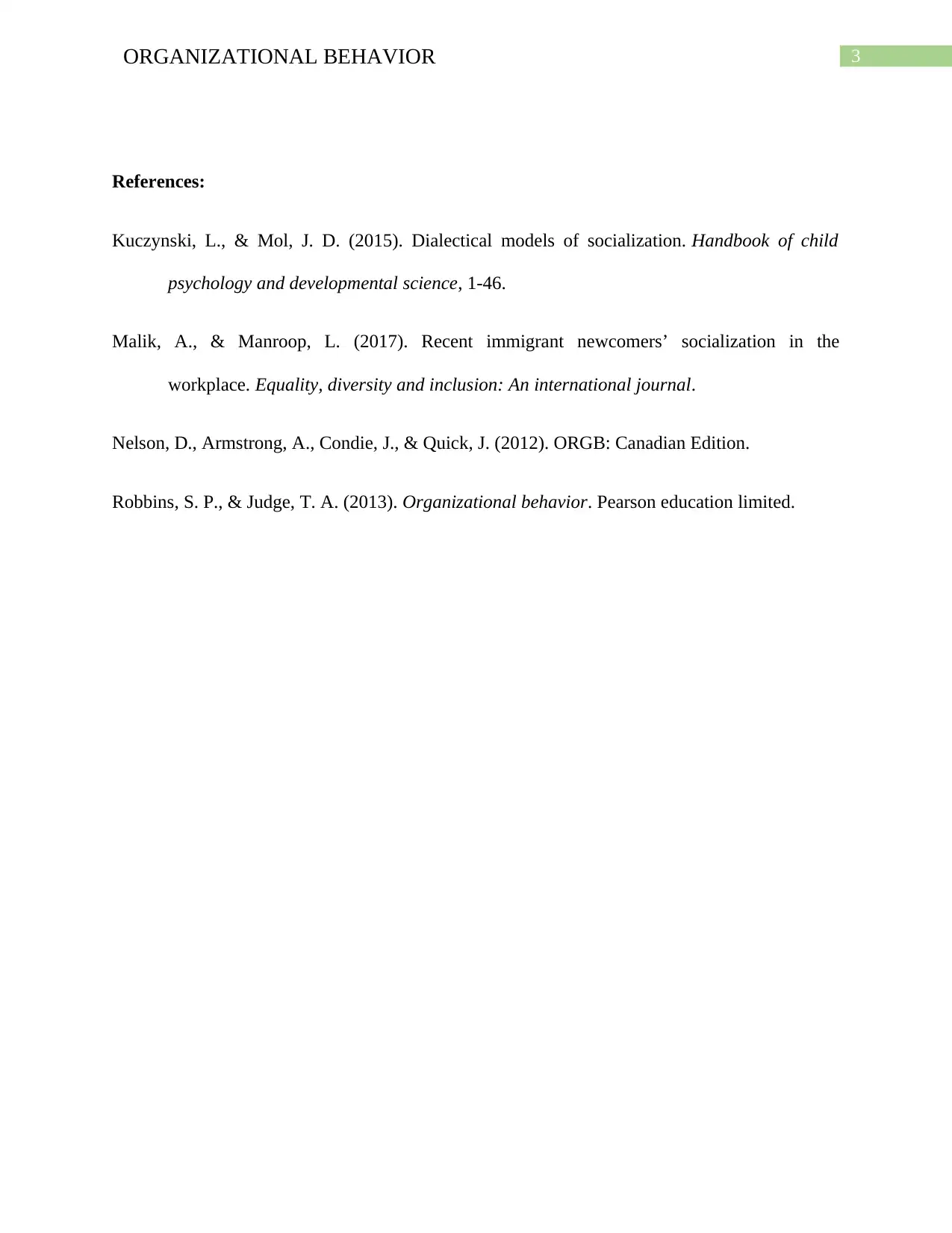
References:
Kuczynski, L., & Mol, J. D. (2015). Dialectical models of socialization. Handbook of child
psychology and developmental science, 1-46.
Malik, A., & Manroop, L. (2017). Recent immigrant newcomers’ socialization in the
workplace. Equality, diversity and inclusion: An international journal.
Nelson, D., Armstrong, A., Condie, J., & Quick, J. (2012). ORGB: Canadian Edition.
Robbins, S. P., & Judge, T. A. (2013). Organizational behavior. Pearson education limited.
chevron_up_icon
1 out of 4
circle_padding
hide_on_mobile
zoom_out_icon
[object Object]