An In-depth Report on Organizational Behavior and Leadership
VerifiedAdded on  2020/04/01
|7
|1388
|77
Report
AI Summary
This report delves into various aspects of organizational behavior, leadership, and teamwork. It begins by addressing delegation strategies, emphasizing the importance of prioritizing projects based on their financial impact and maintaining oversight through employee engagement and advisor roles for executives. The report then examines the elements of effective teamwork, highlighting the significance of employee engagement and favorable working conditions. It outlines steps for team leaders, including understanding team members' capabilities, assigning responsibilities, and fostering trust. The report also explores motivation in top UK organizations, emphasizing high-trust cultures, external recognition, social missions, and employee engagement through surveys. Additionally, it analyzes the film 'Bad Moms,' discussing its strengths and weaknesses in portraying motherhood and leadership. Finally, it compares trait and behavior leadership theories, suggesting a combined approach for selecting and developing effective leaders, incorporating both traits and behavioral skills.

Organization behavior
Insert name
Insert institution
Date
Insert name
Insert institution
Date
Paraphrase This Document
Need a fresh take? Get an instant paraphrase of this document with our AI Paraphraser

ORGANIZATION BEHAVIOR 2
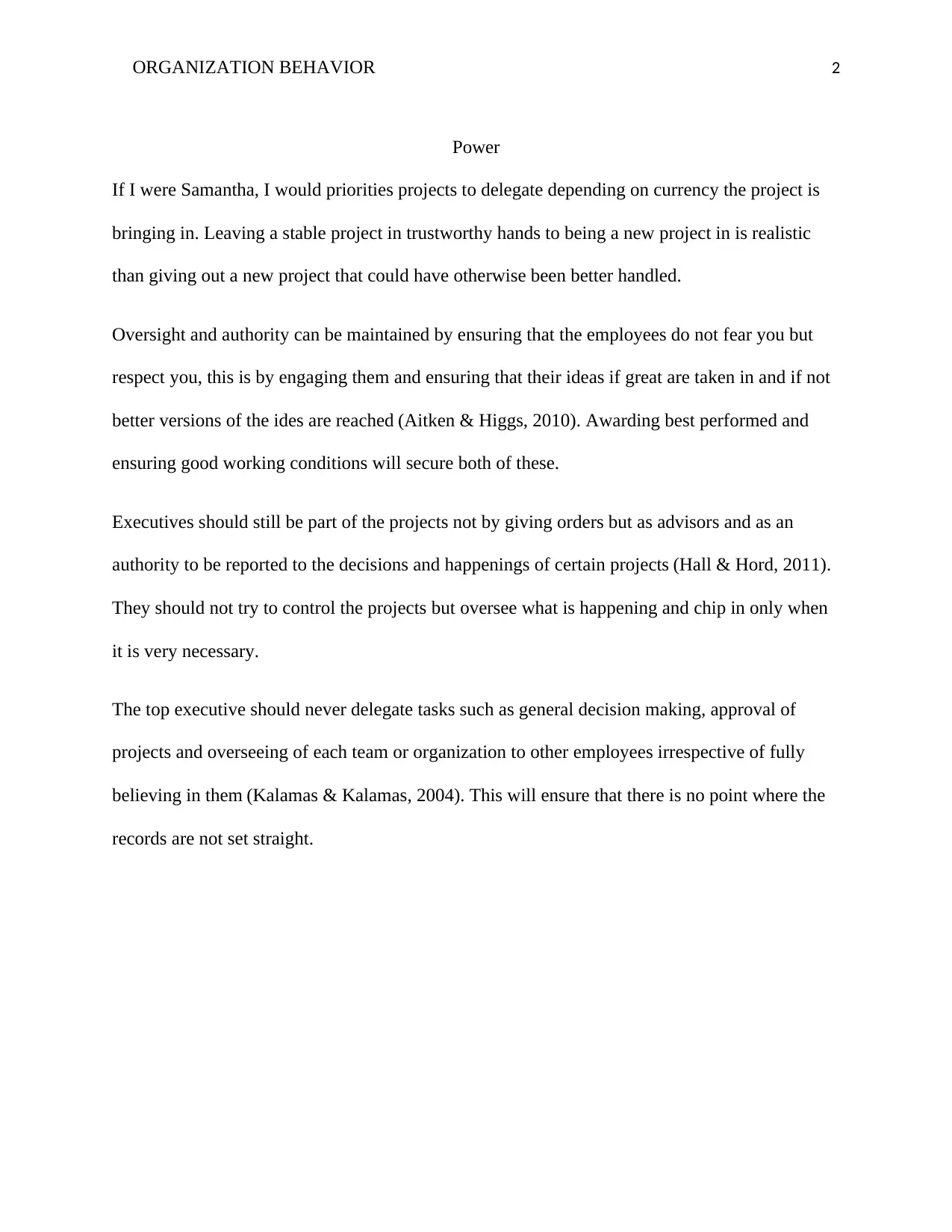
Power
If I were Samantha, I would priorities projects to delegate depending on currency the project is
bringing in. Leaving a stable project in trustworthy hands to being a new project in is realistic
than giving out a new project that could have otherwise been better handled.
Oversight and authority can be maintained by ensuring that the employees do not fear you but
respect you, this is by engaging them and ensuring that their ideas if great are taken in and if not
better versions of the ides are reached (Aitken & Higgs, 2010). Awarding best performed and
ensuring good working conditions will secure both of these.
Executives should still be part of the projects not by giving orders but as advisors and as an
authority to be reported to the decisions and happenings of certain projects (Hall & Hord, 2011).
They should not try to control the projects but oversee what is happening and chip in only when
it is very necessary.
The top executive should never delegate tasks such as general decision making, approval of
projects and overseeing of each team or organization to other employees irrespective of fully
believing in them (Kalamas & Kalamas, 2004). This will ensure that there is no point where the
records are not set straight.
Power
If I were Samantha, I would priorities projects to delegate depending on currency the project is
bringing in. Leaving a stable project in trustworthy hands to being a new project in is realistic
than giving out a new project that could have otherwise been better handled.
Oversight and authority can be maintained by ensuring that the employees do not fear you but
respect you, this is by engaging them and ensuring that their ideas if great are taken in and if not
better versions of the ides are reached (Aitken & Higgs, 2010). Awarding best performed and
ensuring good working conditions will secure both of these.
Executives should still be part of the projects not by giving orders but as advisors and as an
authority to be reported to the decisions and happenings of certain projects (Hall & Hord, 2011).
They should not try to control the projects but oversee what is happening and chip in only when
it is very necessary.
The top executive should never delegate tasks such as general decision making, approval of
projects and overseeing of each team or organization to other employees irrespective of fully
believing in them (Kalamas & Kalamas, 2004). This will ensure that there is no point where the
records are not set straight.

ORGANIZATION BEHAVIOR 3
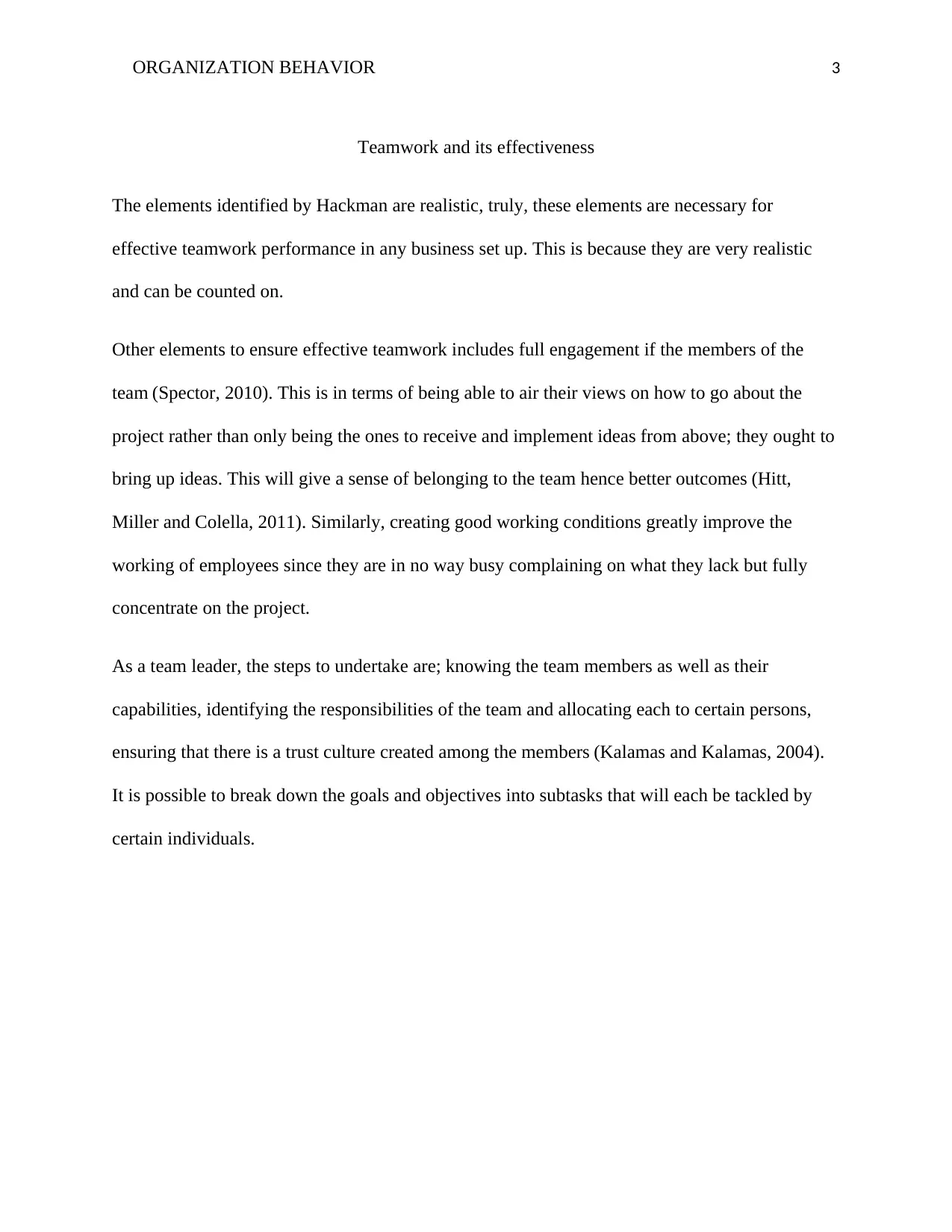
Teamwork and its effectiveness
The elements identified by Hackman are realistic, truly, these elements are necessary for
effective teamwork performance in any business set up. This is because they are very realistic
and can be counted on.
Other elements to ensure effective teamwork includes full engagement if the members of the
team (Spector, 2010). This is in terms of being able to air their views on how to go about the
project rather than only being the ones to receive and implement ideas from above; they ought to
bring up ideas. This will give a sense of belonging to the team hence better outcomes (Hitt,
Miller and Colella, 2011). Similarly, creating good working conditions greatly improve the
working of employees since they are in no way busy complaining on what they lack but fully
concentrate on the project.
As a team leader, the steps to undertake are; knowing the team members as well as their
capabilities, identifying the responsibilities of the team and allocating each to certain persons,
ensuring that there is a trust culture created among the members (Kalamas and Kalamas, 2004).
It is possible to break down the goals and objectives into subtasks that will each be tackled by
certain individuals.
Teamwork and its effectiveness
The elements identified by Hackman are realistic, truly, these elements are necessary for
effective teamwork performance in any business set up. This is because they are very realistic
and can be counted on.
Other elements to ensure effective teamwork includes full engagement if the members of the
team (Spector, 2010). This is in terms of being able to air their views on how to go about the
project rather than only being the ones to receive and implement ideas from above; they ought to
bring up ideas. This will give a sense of belonging to the team hence better outcomes (Hitt,
Miller and Colella, 2011). Similarly, creating good working conditions greatly improve the
working of employees since they are in no way busy complaining on what they lack but fully
concentrate on the project.
As a team leader, the steps to undertake are; knowing the team members as well as their
capabilities, identifying the responsibilities of the team and allocating each to certain persons,
ensuring that there is a trust culture created among the members (Kalamas and Kalamas, 2004).
It is possible to break down the goals and objectives into subtasks that will each be tackled by
certain individuals.
⊘ This is a preview!⊘
Do you want full access?
Subscribe today to unlock all pages.

Trusted by 1+ million students worldwide

ORGANIZATION BEHAVIOR 4
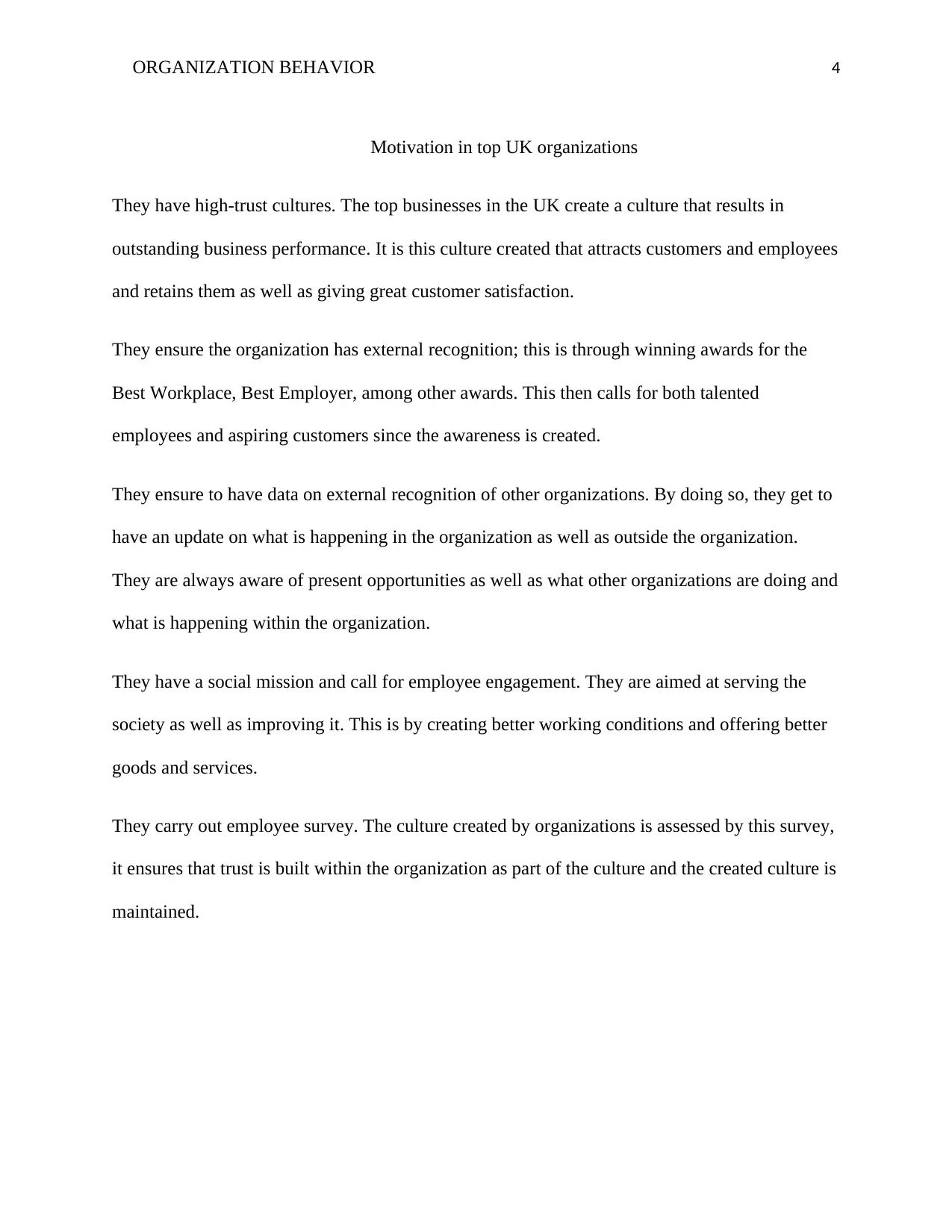
Motivation in top UK organizations
They have high-trust cultures. The top businesses in the UK create a culture that results in
outstanding business performance. It is this culture created that attracts customers and employees
and retains them as well as giving great customer satisfaction.
They ensure the organization has external recognition; this is through winning awards for the
Best Workplace, Best Employer, among other awards. This then calls for both talented
employees and aspiring customers since the awareness is created.
They ensure to have data on external recognition of other organizations. By doing so, they get to
have an update on what is happening in the organization as well as outside the organization.
They are always aware of present opportunities as well as what other organizations are doing and
what is happening within the organization.
They have a social mission and call for employee engagement. They are aimed at serving the
society as well as improving it. This is by creating better working conditions and offering better
goods and services.
They carry out employee survey. The culture created by organizations is assessed by this survey,
it ensures that trust is built within the organization as part of the culture and the created culture is
maintained.
Motivation in top UK organizations
They have high-trust cultures. The top businesses in the UK create a culture that results in
outstanding business performance. It is this culture created that attracts customers and employees
and retains them as well as giving great customer satisfaction.
They ensure the organization has external recognition; this is through winning awards for the
Best Workplace, Best Employer, among other awards. This then calls for both talented
employees and aspiring customers since the awareness is created.
They ensure to have data on external recognition of other organizations. By doing so, they get to
have an update on what is happening in the organization as well as outside the organization.
They are always aware of present opportunities as well as what other organizations are doing and
what is happening within the organization.
They have a social mission and call for employee engagement. They are aimed at serving the
society as well as improving it. This is by creating better working conditions and offering better
goods and services.
They carry out employee survey. The culture created by organizations is assessed by this survey,
it ensures that trust is built within the organization as part of the culture and the created culture is
maintained.
Paraphrase This Document
Need a fresh take? Get an instant paraphrase of this document with our AI Paraphraser

ORGANIZATION BEHAVIOR 5
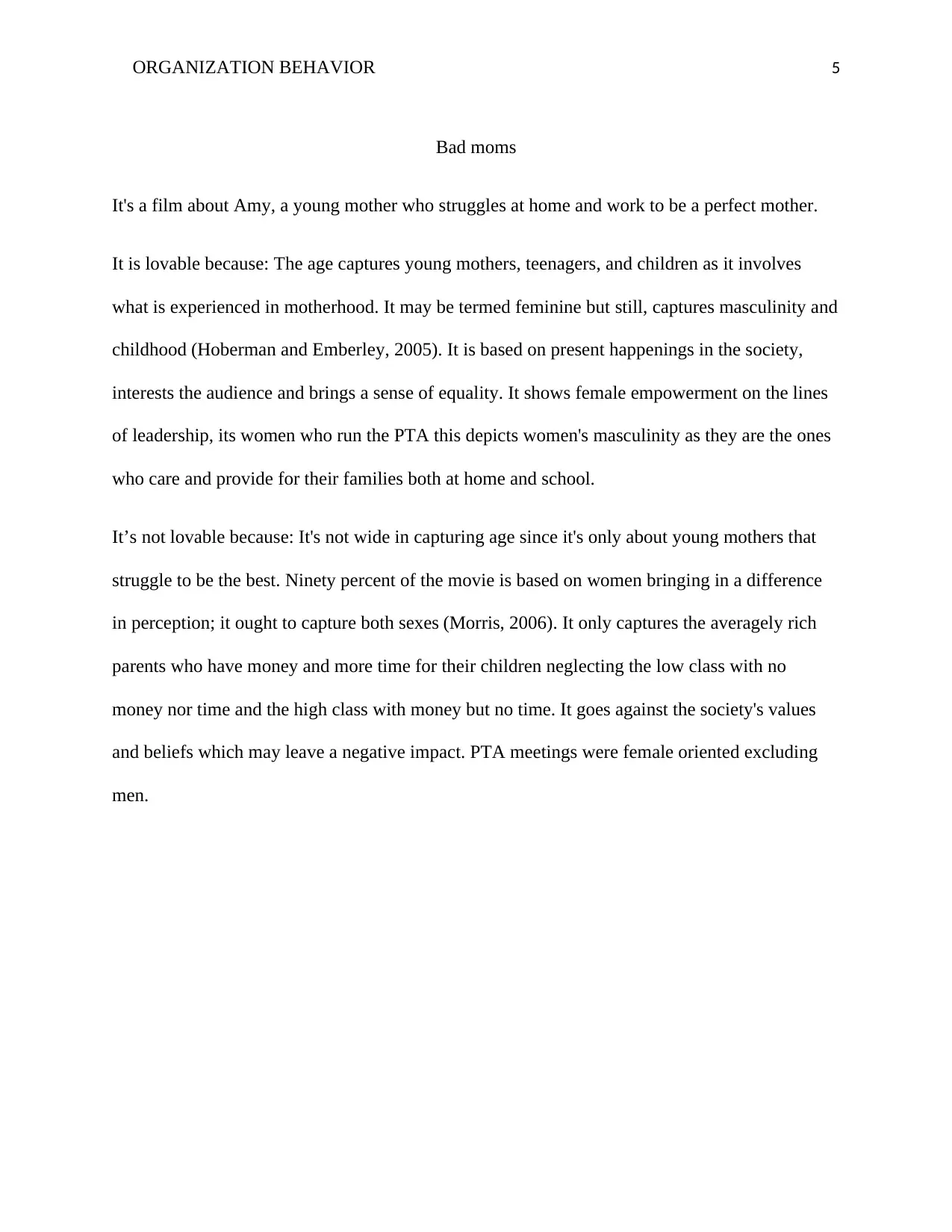
Bad moms
It's a film about Amy, a young mother who struggles at home and work to be a perfect mother.
It is lovable because: The age captures young mothers, teenagers, and children as it involves
what is experienced in motherhood. It may be termed feminine but still, captures masculinity and
childhood (Hoberman and Emberley, 2005). It is based on present happenings in the society,
interests the audience and brings a sense of equality. It shows female empowerment on the lines
of leadership, its women who run the PTA this depicts women's masculinity as they are the ones
who care and provide for their families both at home and school.
It’s not lovable because: It's not wide in capturing age since it's only about young mothers that
struggle to be the best. Ninety percent of the movie is based on women bringing in a difference
in perception; it ought to capture both sexes (Morris, 2006). It only captures the averagely rich
parents who have money and more time for their children neglecting the low class with no
money nor time and the high class with money but no time. It goes against the society's values
and beliefs which may leave a negative impact. PTA meetings were female oriented excluding
men.
Bad moms
It's a film about Amy, a young mother who struggles at home and work to be a perfect mother.
It is lovable because: The age captures young mothers, teenagers, and children as it involves
what is experienced in motherhood. It may be termed feminine but still, captures masculinity and
childhood (Hoberman and Emberley, 2005). It is based on present happenings in the society,
interests the audience and brings a sense of equality. It shows female empowerment on the lines
of leadership, its women who run the PTA this depicts women's masculinity as they are the ones
who care and provide for their families both at home and school.
It’s not lovable because: It's not wide in capturing age since it's only about young mothers that
struggle to be the best. Ninety percent of the movie is based on women bringing in a difference
in perception; it ought to capture both sexes (Morris, 2006). It only captures the averagely rich
parents who have money and more time for their children neglecting the low class with no
money nor time and the high class with money but no time. It goes against the society's values
and beliefs which may leave a negative impact. PTA meetings were female oriented excluding
men.

ORGANIZATION BEHAVIOR 6
Leadership
Trait leadership theory suggests that there are certain characteristics that are associated with
leadership. It is this trait set aside that determine effective leadership (Martin et al., 2017). On the
other hand, behavior leadership theory has it that it is how one relates to others and carries
himself or herself around others that determines effective leadership.
These theories are not valid because stating that traits are all that is required for good leadership
excludes so much. It is hard to find specific traits that are flexible enough to fit all possible
circumstances (Burns, 2012). Similarly, depending on behavior alone does not capture good
leadership because simply relating well to the subjects and gaining respect as well as creating the
best working atmosphere is not all that is required of a good leader, there is much more to it.
An organization can select and develop a good leader by using the theories to pick out the best
and instill in them the positive ideas that they would expect (Finkelstein, Hambrick and
Cannella, 2009). For instance, selection will be an individual with required traits, skills, and
flexibility depending on situations. Developing them will then include improving on how they
handle their subjects, for instance, the idea of the style theory of leadership to improve the
working atmosphere.
Leadership
Trait leadership theory suggests that there are certain characteristics that are associated with
leadership. It is this trait set aside that determine effective leadership (Martin et al., 2017). On the
other hand, behavior leadership theory has it that it is how one relates to others and carries
himself or herself around others that determines effective leadership.
These theories are not valid because stating that traits are all that is required for good leadership
excludes so much. It is hard to find specific traits that are flexible enough to fit all possible
circumstances (Burns, 2012). Similarly, depending on behavior alone does not capture good
leadership because simply relating well to the subjects and gaining respect as well as creating the
best working atmosphere is not all that is required of a good leader, there is much more to it.
An organization can select and develop a good leader by using the theories to pick out the best
and instill in them the positive ideas that they would expect (Finkelstein, Hambrick and
Cannella, 2009). For instance, selection will be an individual with required traits, skills, and
flexibility depending on situations. Developing them will then include improving on how they
handle their subjects, for instance, the idea of the style theory of leadership to improve the
working atmosphere.
⊘ This is a preview!⊘
Do you want full access?
Subscribe today to unlock all pages.

Trusted by 1+ million students worldwide

ORGANIZATION BEHAVIOR 7
References
Aitken, P. and Higgs, M. (2010). Developing change leaders. Oxford: Butterworth-Heinemann.
Hall, G. and Hord, S. (2011). Implementing change. Boston: Pearson.
Hitt, M., Miller, C., and Colella, A. (2011). Organizational Behavior. Hoboken, NJ: Wiley.
Kalamas, D. and Kalamas, J. (2004). Developing employee capital. Amherst, Mass.: HRD Press.
Burns, J. (2012). Leadership. New York, NY: Open Road Integrated Media.
Finkelstein, S., Hambrick, D. and Cannella, A. (2009). Strategic leadership. Oxford [u.a.]:
Oxford Univ. Press.
Hoberman, M. and Emberley, M. (2005). Very short Mother Goose tales to read together. New
York: Little, Brown.
Martin, B., Breunig, M., Wagstaff, M. and Goldenberg, M. (2017). Outdoor leadership.
Champaign, IL: Human Kinetics.
Morris, M. (2006). The lost mother. New York: Penguin Books.
References
Aitken, P. and Higgs, M. (2010). Developing change leaders. Oxford: Butterworth-Heinemann.
Hall, G. and Hord, S. (2011). Implementing change. Boston: Pearson.
Hitt, M., Miller, C., and Colella, A. (2011). Organizational Behavior. Hoboken, NJ: Wiley.
Kalamas, D. and Kalamas, J. (2004). Developing employee capital. Amherst, Mass.: HRD Press.
Burns, J. (2012). Leadership. New York, NY: Open Road Integrated Media.
Finkelstein, S., Hambrick, D. and Cannella, A. (2009). Strategic leadership. Oxford [u.a.]:
Oxford Univ. Press.
Hoberman, M. and Emberley, M. (2005). Very short Mother Goose tales to read together. New
York: Little, Brown.
Martin, B., Breunig, M., Wagstaff, M. and Goldenberg, M. (2017). Outdoor leadership.
Champaign, IL: Human Kinetics.
Morris, M. (2006). The lost mother. New York: Penguin Books.
1 out of 7
Related Documents
Your All-in-One AI-Powered Toolkit for Academic Success.
 +13062052269
info@desklib.com
Available 24*7 on WhatsApp / Email
Unlock your academic potential
Copyright © 2020–2026 A2Z Services. All Rights Reserved. Developed and managed by ZUCOL.