MNG82210 Assignment: Attitude at Work and Rational Decision Model
VerifiedAdded on 2023/04/11
|12
|2200
|328
Report
AI Summary
This report delves into two critical aspects of organizational behavior: the importance of a positive attitude in the workplace and the utility of the rational decision-making model. It explores the responsibility for fostering a good attitude, examining the roles of both employees and employers in creating a positive work environment. The report further analyzes the rational decision-making model, highlighting its limitations such as reliance on potentially inadequate information, time constraints, and the need for expertise, while also suggesting alternative decision-making models like the Ladder of Inference, Paired Comparison Analysis, and Vroom-Yetton-Jago model. The analysis is supported by citations from peer-reviewed academic journal articles, providing a comprehensive overview of these concepts within the context of organizational management.

ORGANIZATION BEHAVIOR
Name
Institution
Course
Tutor
City/State
Date
Name
Institution
Course
Tutor
City/State
Date

Paraphrase This Document
Need a fresh take? Get an instant paraphrase of this document with our AI Paraphraser
a) A good attitude at work whose responsibility is it
Introduction
Everyone is familiar with the strain in vitality level when one knows they are going into a
meeting with a nay-sayer who critiques all the ideas raised. We are likewise conversant with how
our attitudes can be boosted when the workplace cheerleader approaches with a beam and a
platter of donuts on a hectic Friday. While these might appear like no-brainers on the measure of
negative-to-positive vitalities in a workplace, deep down, an attitude has a substantial effect on a
workplace, comprising output levels and optimism. Losing a customer, flubbing a demonstration
or even having an annoying journey can put a usually gentle and even-keeled individual in an
undesirable mood. A bad attitude, nevertheless, is characteristically a state of mind, and it has the
perspective to pervade a workplace and pull everybody down with it. If one is an employee, they
might be able to steer unblemished of this character sort or brace themselves for obligatory
exchanges.
A good attitude at work is the employees’ responsibility
Introduction
For the maximum output in any business, employees ought to maintain a good attitude at all
times.
Employees should observe respect in the workplace
Introduction
Everyone is familiar with the strain in vitality level when one knows they are going into a
meeting with a nay-sayer who critiques all the ideas raised. We are likewise conversant with how
our attitudes can be boosted when the workplace cheerleader approaches with a beam and a
platter of donuts on a hectic Friday. While these might appear like no-brainers on the measure of
negative-to-positive vitalities in a workplace, deep down, an attitude has a substantial effect on a
workplace, comprising output levels and optimism. Losing a customer, flubbing a demonstration
or even having an annoying journey can put a usually gentle and even-keeled individual in an
undesirable mood. A bad attitude, nevertheless, is characteristically a state of mind, and it has the
perspective to pervade a workplace and pull everybody down with it. If one is an employee, they
might be able to steer unblemished of this character sort or brace themselves for obligatory
exchanges.
A good attitude at work is the employees’ responsibility
Introduction
For the maximum output in any business, employees ought to maintain a good attitude at all
times.
Employees should observe respect in the workplace
Employees ought to observe specific values and matters to uphold a positive attitude. Respect in
the workplace does not only encompass to the manner employees interrelate with the
administration. Individuals who have dignity do not do employers' biding no matter what; they
reason for themselves and give substitute thoughts occasionally, but courteously. Employees
must also have a respectful attitude when interrelating with customers and clients as well as
colleagues. Those with this type of attitude are willing to accord other persons respectfully and
professionally, even if they differ with the other individual's opinion of assessment.
Employees should be enthusiastic
Enthusiasm in employees around life in common emits positive energy that rubs off on
everybody around them. Such employees plunge into all ventures with curiosity, enthusiastically
acquires new abilities and thoughts and swiftly relates them to their work. Certain individuals are
innate with positive energy, but it might likewise be established. Businesses require employees
who are not merely devoted to the objectives and creativities that impact the bottom line,
nevertheless who similarly are dedicated to their specific ranks. Employees display a loyal
attitude by presenting a readiness to do anything it takes to accomplish the responsibilities of
their positions and through the growth of new concepts to make the business even healthier.
When steadfast characters work collectively as a team headed for company objectives,
everybody profits.
Inventive attitude is necessary for employees.
Employees with an inventive attitude do not feel wary away from experimenting with something
different or discovering a changed technique to do things. Businesses require employees who can
the workplace does not only encompass to the manner employees interrelate with the
administration. Individuals who have dignity do not do employers' biding no matter what; they
reason for themselves and give substitute thoughts occasionally, but courteously. Employees
must also have a respectful attitude when interrelating with customers and clients as well as
colleagues. Those with this type of attitude are willing to accord other persons respectfully and
professionally, even if they differ with the other individual's opinion of assessment.
Employees should be enthusiastic
Enthusiasm in employees around life in common emits positive energy that rubs off on
everybody around them. Such employees plunge into all ventures with curiosity, enthusiastically
acquires new abilities and thoughts and swiftly relates them to their work. Certain individuals are
innate with positive energy, but it might likewise be established. Businesses require employees
who are not merely devoted to the objectives and creativities that impact the bottom line,
nevertheless who similarly are dedicated to their specific ranks. Employees display a loyal
attitude by presenting a readiness to do anything it takes to accomplish the responsibilities of
their positions and through the growth of new concepts to make the business even healthier.
When steadfast characters work collectively as a team headed for company objectives,
everybody profits.
Inventive attitude is necessary for employees.
Employees with an inventive attitude do not feel wary away from experimenting with something
different or discovering a changed technique to do things. Businesses require employees who can
⊘ This is a preview!⊘
Do you want full access?
Subscribe today to unlock all pages.

Trusted by 1+ million students worldwide
think outside of the box and invent novel means to undertake general responsibilities and tactic
objectives. Employees with this kind of attitude discern their thoughts may not work out to be
the dominant mode to do something, but then that the greatest disappointment is not at least
giving novel concepts a try. It is significant to have a helpful attitude at work, whether that
means helping customers and clients with their requests or assisting colleagues in achieving
general company objectives. The more accommodating attitude employees have, the more
individuals desire to be nearby them at work and the more enthusiastic they are to work with
those employees on essential assignments and creativities.
Alternate Options
Employers can equally partake in maintaining a good attitude at work in several ways.
Employers should efficiently run the workplace and employees
Employers, on the other hand also have a responsibility to guarantee positive attitudes in
the workplace. When employees are content and involved, positions and efficiency are
more likely to be positive. Employers need to have the means to manage the negative
attitudes and nurture the positive ones. By efficiently running the workplace and
employees, employers can positively form attitudes and even advance their company’s
performance. Would it not be wonderful if one’s employees were completely content
individuals, grinning through every workday? Dejectedly that cannot be since an
individual’s attitudes are reduced and boosted by all types of aspects beyond their control.
The employer must handle these influences in the workplace, to stop negative attitudes
from arising.
objectives. Employees with this kind of attitude discern their thoughts may not work out to be
the dominant mode to do something, but then that the greatest disappointment is not at least
giving novel concepts a try. It is significant to have a helpful attitude at work, whether that
means helping customers and clients with their requests or assisting colleagues in achieving
general company objectives. The more accommodating attitude employees have, the more
individuals desire to be nearby them at work and the more enthusiastic they are to work with
those employees on essential assignments and creativities.
Alternate Options
Employers can equally partake in maintaining a good attitude at work in several ways.
Employers should efficiently run the workplace and employees
Employers, on the other hand also have a responsibility to guarantee positive attitudes in
the workplace. When employees are content and involved, positions and efficiency are
more likely to be positive. Employers need to have the means to manage the negative
attitudes and nurture the positive ones. By efficiently running the workplace and
employees, employers can positively form attitudes and even advance their company’s
performance. Would it not be wonderful if one’s employees were completely content
individuals, grinning through every workday? Dejectedly that cannot be since an
individual’s attitudes are reduced and boosted by all types of aspects beyond their control.
The employer must handle these influences in the workplace, to stop negative attitudes
from arising.
Paraphrase This Document
Need a fresh take? Get an instant paraphrase of this document with our AI Paraphraser
Employers should positively engage employees in the workplace
Engagement is a word encompassing employee fulfillment, obligation, and inspiration.
Methods that employers can use to positively engross employees embrace; providing sturdy
headship, line supervisors who inspire and enable, heeding to the employee opinion all
through the business, having organizational honor, i.e., the company living up to its
specified principles.
Employers should uphold the psychological contract
Additionally, employers should also enforce the psychological contract which is a
conceptualization of the correlation concerning employer and employee and what they
presume of each other. The psychological contract is ‘broken’ when employees feel that
their employer has performed dishonorably or fails to keep promises. This can negatively
influence commitment and job fulfillment, resulting in negative workplace attitudes. Rather
than hold one’s fire for negativity to arise, one can use various methods to form employee
attitudes in their work positively.
Heeding to employees’ concerns should be considered by employers
Employers should always address employees’ concerns. Once administration heeds to
employee concerns and deeds upon them, negativity is less probable to aggravate.
Employers should give employees prospects to express concerns, both officially and
casually, and take them earnestly. Certain individuals are naturally disposed to cynicism
and irritability, but one cannot let their attitude to bring others down. An employer can
offset negativity by; toadying employees for their accomplishments, concentrating on ways
Engagement is a word encompassing employee fulfillment, obligation, and inspiration.
Methods that employers can use to positively engross employees embrace; providing sturdy
headship, line supervisors who inspire and enable, heeding to the employee opinion all
through the business, having organizational honor, i.e., the company living up to its
specified principles.
Employers should uphold the psychological contract
Additionally, employers should also enforce the psychological contract which is a
conceptualization of the correlation concerning employer and employee and what they
presume of each other. The psychological contract is ‘broken’ when employees feel that
their employer has performed dishonorably or fails to keep promises. This can negatively
influence commitment and job fulfillment, resulting in negative workplace attitudes. Rather
than hold one’s fire for negativity to arise, one can use various methods to form employee
attitudes in their work positively.
Heeding to employees’ concerns should be considered by employers
Employers should always address employees’ concerns. Once administration heeds to
employee concerns and deeds upon them, negativity is less probable to aggravate.
Employers should give employees prospects to express concerns, both officially and
casually, and take them earnestly. Certain individuals are naturally disposed to cynicism
and irritability, but one cannot let their attitude to bring others down. An employer can
offset negativity by; toadying employees for their accomplishments, concentrating on ways
out instead of difficulties, and by getting employees to think of elucidations to their
grievances.
Conclusion
Workplace attitudes have an influence on each individual in the organization, from the
workers to the customers and even the business proprietor. Attitudes assist in developing
the predominant workplace atmosphere that regulates employee drive, efficiency and team
building capacities.
b) The rational decision-making model is not useful
Introduction
To guarantee the decision reached is the best, it should be logical. That is to say; the decision has
to be founded on realistic statistics, pieces of evidence and motives. Thus, rational decision
making can be defined merely as; a logical procedure of outlining problems, assessing decision
options and choosing the preeminent options decisions obtainable. Rational decision making
aims to select the dominant solution which will exploit the benefits and reduce whichever
outlays.
Its’ evidence is sometimes inadequate
Occasionally, the evidence is unsatisfactory. This issue may cause the problems in assessing the
concern even outlining the problem. This condition generally occurs in uncertain situations when
coming up with decisions. In such a case the decision maker does not have any info which may
assist in making the decision.
grievances.
Conclusion
Workplace attitudes have an influence on each individual in the organization, from the
workers to the customers and even the business proprietor. Attitudes assist in developing
the predominant workplace atmosphere that regulates employee drive, efficiency and team
building capacities.
b) The rational decision-making model is not useful
Introduction
To guarantee the decision reached is the best, it should be logical. That is to say; the decision has
to be founded on realistic statistics, pieces of evidence and motives. Thus, rational decision
making can be defined merely as; a logical procedure of outlining problems, assessing decision
options and choosing the preeminent options decisions obtainable. Rational decision making
aims to select the dominant solution which will exploit the benefits and reduce whichever
outlays.
Its’ evidence is sometimes inadequate
Occasionally, the evidence is unsatisfactory. This issue may cause the problems in assessing the
concern even outlining the problem. This condition generally occurs in uncertain situations when
coming up with decisions. In such a case the decision maker does not have any info which may
assist in making the decision.
⊘ This is a preview!⊘
Do you want full access?
Subscribe today to unlock all pages.
Trusted by 1+ million students worldwide
As a consequence, Etzioni (2016) denotes that one cannot assess the options and has to use
his/her familiarity to make a decision. For instance, a business wants to present new merchandise
to a new market. The company cannot envisage how the consumers would react to the new
merchandise since there is no other statistics which can be used to project. The absence of
previous tendencies or info around such new commodities or prospects causes rational decision
makers to go for additional safe and conservative alternatives. So the director of the business
cannot assess and forecast the outcomes of each option.
It is a slow decision-making process
Another drawback of rational decision making will occur when there are time restrictions.
It needs careful contemplation and consideration of statistics; this takes time, making this scheme
inappropriate for quick-decisions. In the current era of quick-paced changes, seizing the
opportunity promptly plays an essential role in success, and the rational model does not live up
to this role. This model of decision-making needs a lot of info in the assessment stage, to acquire
the info, typically it requires a long time of reflection, gathering, and examination. In today’s
quick paced business setting time is vital when determining business policies, the shortcomings
of rational decision making in time-controlled circumstances are apparent. Furthermore, deferral
in establishing and executing a decision may affect in the weakening of the apparent advantage
of such an option, for the benefits may ensue only when taken at that while. As such, these
exemplary finds use typically in making long-standing and strategy decisions rather than
temporary or floor level functioning decisions.
It is very involving as it requires finances and assets
Besides, apart from time, there are several other aspects which can influence decision-makers to
make the best decisions, such as finances and assets/means. Accurate info is very significant for
his/her familiarity to make a decision. For instance, a business wants to present new merchandise
to a new market. The company cannot envisage how the consumers would react to the new
merchandise since there is no other statistics which can be used to project. The absence of
previous tendencies or info around such new commodities or prospects causes rational decision
makers to go for additional safe and conservative alternatives. So the director of the business
cannot assess and forecast the outcomes of each option.
It is a slow decision-making process
Another drawback of rational decision making will occur when there are time restrictions.
It needs careful contemplation and consideration of statistics; this takes time, making this scheme
inappropriate for quick-decisions. In the current era of quick-paced changes, seizing the
opportunity promptly plays an essential role in success, and the rational model does not live up
to this role. This model of decision-making needs a lot of info in the assessment stage, to acquire
the info, typically it requires a long time of reflection, gathering, and examination. In today’s
quick paced business setting time is vital when determining business policies, the shortcomings
of rational decision making in time-controlled circumstances are apparent. Furthermore, deferral
in establishing and executing a decision may affect in the weakening of the apparent advantage
of such an option, for the benefits may ensue only when taken at that while. As such, these
exemplary finds use typically in making long-standing and strategy decisions rather than
temporary or floor level functioning decisions.
It is very involving as it requires finances and assets
Besides, apart from time, there are several other aspects which can influence decision-makers to
make the best decisions, such as finances and assets/means. Accurate info is very significant for
Paraphrase This Document
Need a fresh take? Get an instant paraphrase of this document with our AI Paraphraser
rational decision making. Nevertheless, Simon (2013) denotes that at times the information
gathered for making decisions can be deduced inaccurately. What is worse, several of the
decision makers might make decisions founded on comparable difficulties happened before or
their individual experience when handling previous problems. In this circumstance, the choice is
based on the info, but the info is fundamentally unsuitable or even incorrect.
It requires expertise to make decisions
Schwartz, Ben-Haim, and Dacso (2011) point out that when talking of incorrect statistics
analysis, decision makers are similarly an essential aspect in making decisions. Inexpert decision
makers in the method of rational decision making are moreover one of its restrictions. Decision
makers do not have extensive familiarity with all the details about the difficulties. Sound
decision-making is immersed in reaction, and blunders on the side of cautiousness. Many a time,
the business makes it big when directors or front-runners follow their natural predispositions to
take a chance and grab a prospect. They cannot forecast upcoming happenings with absolute
precision. Consequently, it is not at all times probable to select the best solution.
Alternative Options
Due to the limitations of the rational decision-making model, businesses should adopt other
models to facilitate their decision-making processes.
The Ladder Inference
The notion upholding the Ladder of Inference is to assist decision-makers to evade making poor
decisions founded on their previous experiences, prejudices, or other aspects. Decision-makers
ought to be targeting to set on the side as much subjective sway as probable in order to make
decisions that are purely in the superlative importance of the business as a whole.
gathered for making decisions can be deduced inaccurately. What is worse, several of the
decision makers might make decisions founded on comparable difficulties happened before or
their individual experience when handling previous problems. In this circumstance, the choice is
based on the info, but the info is fundamentally unsuitable or even incorrect.
It requires expertise to make decisions
Schwartz, Ben-Haim, and Dacso (2011) point out that when talking of incorrect statistics
analysis, decision makers are similarly an essential aspect in making decisions. Inexpert decision
makers in the method of rational decision making are moreover one of its restrictions. Decision
makers do not have extensive familiarity with all the details about the difficulties. Sound
decision-making is immersed in reaction, and blunders on the side of cautiousness. Many a time,
the business makes it big when directors or front-runners follow their natural predispositions to
take a chance and grab a prospect. They cannot forecast upcoming happenings with absolute
precision. Consequently, it is not at all times probable to select the best solution.
Alternative Options
Due to the limitations of the rational decision-making model, businesses should adopt other
models to facilitate their decision-making processes.
The Ladder Inference
The notion upholding the Ladder of Inference is to assist decision-makers to evade making poor
decisions founded on their previous experiences, prejudices, or other aspects. Decision-makers
ought to be targeting to set on the side as much subjective sway as probable in order to make
decisions that are purely in the superlative importance of the business as a whole.
Paired Comparison Analysis
The course of adopting this model implicates first forming a table which will lay out all the
numerous options available. Each choice at hand with respect to the decision that requires to be
made must be enumerated in the table, both crosswise the top and down the side. The table will
let decision-makers relate choices straight alongside one another. This is where the ‘paired
analysis’ comes into the representation. Decision makers are then going to relate one choice
alongside another, and decide a winner.
Vroom-Yetton-Jago
At the core of the Vroom-Yetton-Jago Decision Model is the point that not all resolutions are
formed equally. Certain decisions are exceedingly significant and will need contribution from
numerous individuals, whereas other decisions could be made fast as they would not have long-
term impacts on the business as a whole. With the help of this model, decision-makers can
customize their methodology to decision-making centered on the circumstance at hand.
Conclusion
Decision-making is a key element in businesses, therefore its course should be deliberated on
critically before selecting an exemplary or model to use.
The course of adopting this model implicates first forming a table which will lay out all the
numerous options available. Each choice at hand with respect to the decision that requires to be
made must be enumerated in the table, both crosswise the top and down the side. The table will
let decision-makers relate choices straight alongside one another. This is where the ‘paired
analysis’ comes into the representation. Decision makers are then going to relate one choice
alongside another, and decide a winner.
Vroom-Yetton-Jago
At the core of the Vroom-Yetton-Jago Decision Model is the point that not all resolutions are
formed equally. Certain decisions are exceedingly significant and will need contribution from
numerous individuals, whereas other decisions could be made fast as they would not have long-
term impacts on the business as a whole. With the help of this model, decision-makers can
customize their methodology to decision-making centered on the circumstance at hand.
Conclusion
Decision-making is a key element in businesses, therefore its course should be deliberated on
critically before selecting an exemplary or model to use.
⊘ This is a preview!⊘
Do you want full access?
Subscribe today to unlock all pages.
Trusted by 1+ million students worldwide
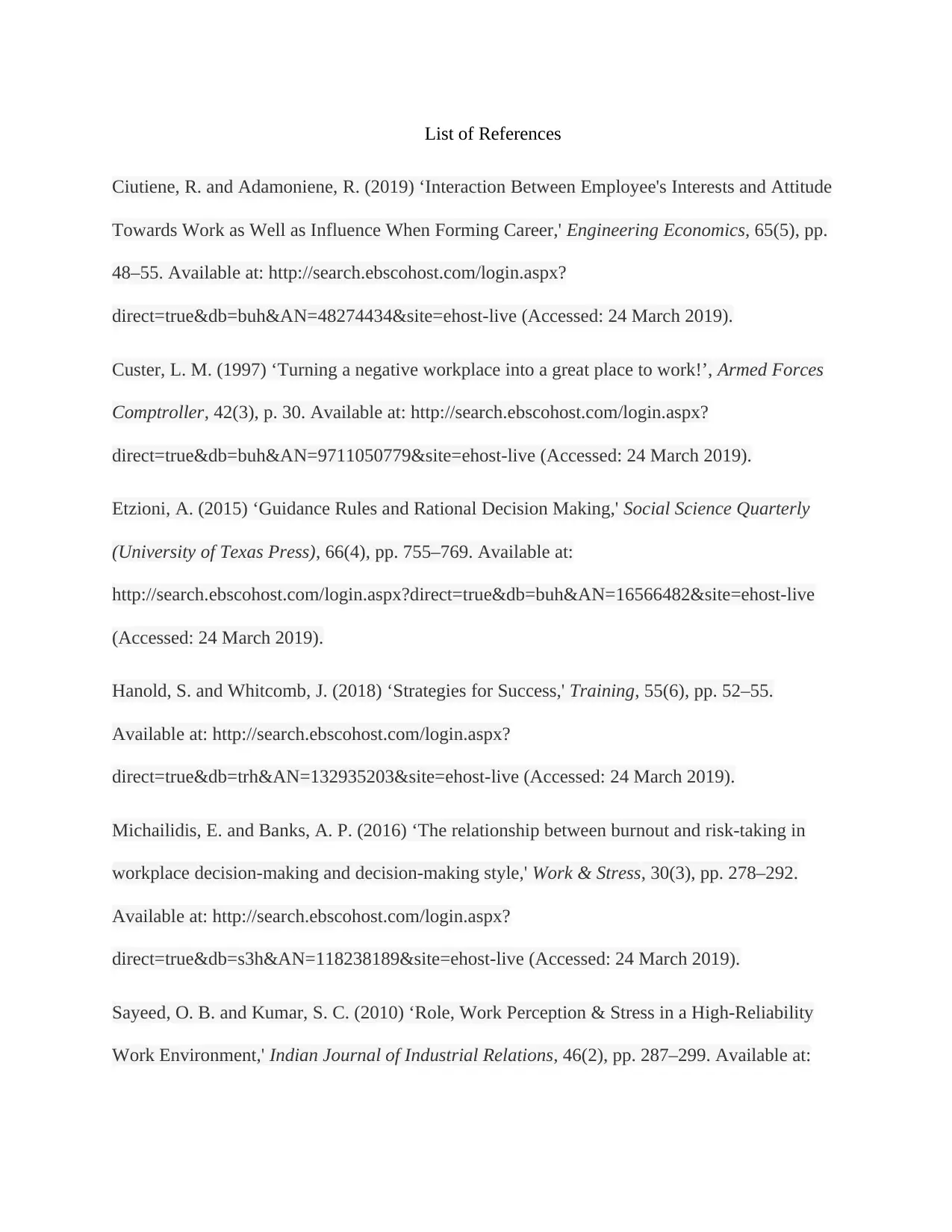
List of References
Ciutiene, R. and Adamoniene, R. (2019) ‘Interaction Between Employee's Interests and Attitude
Towards Work as Well as Influence When Forming Career,' Engineering Economics, 65(5), pp.
48–55. Available at: http://search.ebscohost.com/login.aspx?
direct=true&db=buh&AN=48274434&site=ehost-live (Accessed: 24 March 2019).
Custer, L. M. (1997) ‘Turning a negative workplace into a great place to work!’, Armed Forces
Comptroller, 42(3), p. 30. Available at: http://search.ebscohost.com/login.aspx?
direct=true&db=buh&AN=9711050779&site=ehost-live (Accessed: 24 March 2019).
Etzioni, A. (2015) ‘Guidance Rules and Rational Decision Making,' Social Science Quarterly
(University of Texas Press), 66(4), pp. 755–769. Available at:
http://search.ebscohost.com/login.aspx?direct=true&db=buh&AN=16566482&site=ehost-live
(Accessed: 24 March 2019).
Hanold, S. and Whitcomb, J. (2018) ‘Strategies for Success,' Training, 55(6), pp. 52–55.
Available at: http://search.ebscohost.com/login.aspx?
direct=true&db=trh&AN=132935203&site=ehost-live (Accessed: 24 March 2019).
Michailidis, E. and Banks, A. P. (2016) ‘The relationship between burnout and risk-taking in
workplace decision-making and decision-making style,' Work & Stress, 30(3), pp. 278–292.
Available at: http://search.ebscohost.com/login.aspx?
direct=true&db=s3h&AN=118238189&site=ehost-live (Accessed: 24 March 2019).
Sayeed, O. B. and Kumar, S. C. (2010) ‘Role, Work Perception & Stress in a High-Reliability
Work Environment,' Indian Journal of Industrial Relations, 46(2), pp. 287–299. Available at:
Ciutiene, R. and Adamoniene, R. (2019) ‘Interaction Between Employee's Interests and Attitude
Towards Work as Well as Influence When Forming Career,' Engineering Economics, 65(5), pp.
48–55. Available at: http://search.ebscohost.com/login.aspx?
direct=true&db=buh&AN=48274434&site=ehost-live (Accessed: 24 March 2019).
Custer, L. M. (1997) ‘Turning a negative workplace into a great place to work!’, Armed Forces
Comptroller, 42(3), p. 30. Available at: http://search.ebscohost.com/login.aspx?
direct=true&db=buh&AN=9711050779&site=ehost-live (Accessed: 24 March 2019).
Etzioni, A. (2015) ‘Guidance Rules and Rational Decision Making,' Social Science Quarterly
(University of Texas Press), 66(4), pp. 755–769. Available at:
http://search.ebscohost.com/login.aspx?direct=true&db=buh&AN=16566482&site=ehost-live
(Accessed: 24 March 2019).
Hanold, S. and Whitcomb, J. (2018) ‘Strategies for Success,' Training, 55(6), pp. 52–55.
Available at: http://search.ebscohost.com/login.aspx?
direct=true&db=trh&AN=132935203&site=ehost-live (Accessed: 24 March 2019).
Michailidis, E. and Banks, A. P. (2016) ‘The relationship between burnout and risk-taking in
workplace decision-making and decision-making style,' Work & Stress, 30(3), pp. 278–292.
Available at: http://search.ebscohost.com/login.aspx?
direct=true&db=s3h&AN=118238189&site=ehost-live (Accessed: 24 March 2019).
Sayeed, O. B. and Kumar, S. C. (2010) ‘Role, Work Perception & Stress in a High-Reliability
Work Environment,' Indian Journal of Industrial Relations, 46(2), pp. 287–299. Available at:
Paraphrase This Document
Need a fresh take? Get an instant paraphrase of this document with our AI Paraphraser
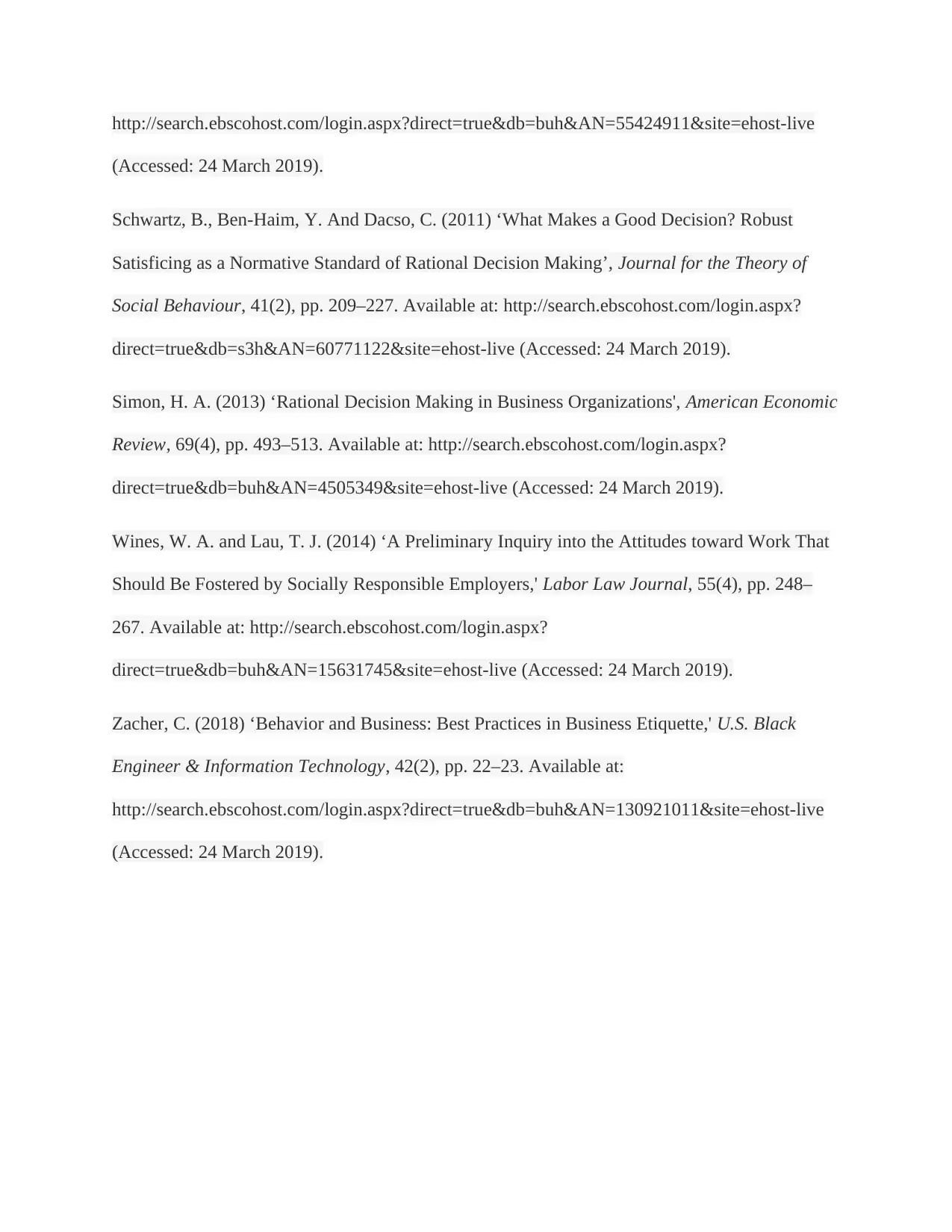
http://search.ebscohost.com/login.aspx?direct=true&db=buh&AN=55424911&site=ehost-live
(Accessed: 24 March 2019).
Schwartz, B., Ben-Haim, Y. And Dacso, C. (2011) ‘What Makes a Good Decision? Robust
Satisficing as a Normative Standard of Rational Decision Making’, Journal for the Theory of
Social Behaviour, 41(2), pp. 209–227. Available at: http://search.ebscohost.com/login.aspx?
direct=true&db=s3h&AN=60771122&site=ehost-live (Accessed: 24 March 2019).
Simon, H. A. (2013) ‘Rational Decision Making in Business Organizations', American Economic
Review, 69(4), pp. 493–513. Available at: http://search.ebscohost.com/login.aspx?
direct=true&db=buh&AN=4505349&site=ehost-live (Accessed: 24 March 2019).
Wines, W. A. and Lau, T. J. (2014) ‘A Preliminary Inquiry into the Attitudes toward Work That
Should Be Fostered by Socially Responsible Employers,' Labor Law Journal, 55(4), pp. 248–
267. Available at: http://search.ebscohost.com/login.aspx?
direct=true&db=buh&AN=15631745&site=ehost-live (Accessed: 24 March 2019).
Zacher, C. (2018) ‘Behavior and Business: Best Practices in Business Etiquette,' U.S. Black
Engineer & Information Technology, 42(2), pp. 22–23. Available at:
http://search.ebscohost.com/login.aspx?direct=true&db=buh&AN=130921011&site=ehost-live
(Accessed: 24 March 2019).
(Accessed: 24 March 2019).
Schwartz, B., Ben-Haim, Y. And Dacso, C. (2011) ‘What Makes a Good Decision? Robust
Satisficing as a Normative Standard of Rational Decision Making’, Journal for the Theory of
Social Behaviour, 41(2), pp. 209–227. Available at: http://search.ebscohost.com/login.aspx?
direct=true&db=s3h&AN=60771122&site=ehost-live (Accessed: 24 March 2019).
Simon, H. A. (2013) ‘Rational Decision Making in Business Organizations', American Economic
Review, 69(4), pp. 493–513. Available at: http://search.ebscohost.com/login.aspx?
direct=true&db=buh&AN=4505349&site=ehost-live (Accessed: 24 March 2019).
Wines, W. A. and Lau, T. J. (2014) ‘A Preliminary Inquiry into the Attitudes toward Work That
Should Be Fostered by Socially Responsible Employers,' Labor Law Journal, 55(4), pp. 248–
267. Available at: http://search.ebscohost.com/login.aspx?
direct=true&db=buh&AN=15631745&site=ehost-live (Accessed: 24 March 2019).
Zacher, C. (2018) ‘Behavior and Business: Best Practices in Business Etiquette,' U.S. Black
Engineer & Information Technology, 42(2), pp. 22–23. Available at:
http://search.ebscohost.com/login.aspx?direct=true&db=buh&AN=130921011&site=ehost-live
(Accessed: 24 March 2019).

⊘ This is a preview!⊘
Do you want full access?
Subscribe today to unlock all pages.
Trusted by 1+ million students worldwide

1 out of 12


Related Documents


Your All-in-One AI-Powered Toolkit for Academic Success.
+13062052269
info@desklib.com
Available 24*7 on WhatsApp / Email
![[object Object]](/_next/static/media/star-bottom.7253800d.svg)
Unlock your academic potential
Copyright © 2020–2026 A2Z Services. All Rights Reserved. Developed and managed by ZUCOL.