Organizational Behavior Report: Leadership, Personality, and Ethics
VerifiedAdded on 2019/11/26
|13
|3045
|428
Report
AI Summary
This report delves into the realm of organizational behavior, exploring the multifaceted aspects of leadership, personality theories, and ethical considerations within a professional context. It begins by defining ethical leadership and its significance in fostering a positive work environment and promoting the common good. The report then examines the social responsibilities of leaders, emphasizing their role in cultivating ethical conduct and building strong relationships within organizations. It also provides an overview of personality theories, including nomothetic and idiographic approaches, and their relevance in understanding individual differences and organizational dynamics. Additionally, the report discusses McGregor's Theory X and Theory Y, illustrating different leadership styles and their impact on employee motivation and engagement. The report also includes examples of leadership styles and theories and provides suggestions for improvement. This report is an insightful resource for students studying organizational behavior and leadership, providing valuable insights into the complexities of managing and leading within organizations.
Running head: ORGANIZATIONAL BEHAVIOR
Organizational Behavior
Name of the Student
Name of the University
Author Note
Organizational Behavior
Name of the Student
Name of the University
Author Note

Paraphrase This Document
Need a fresh take? Get an instant paraphrase of this document with our AI Paraphraser
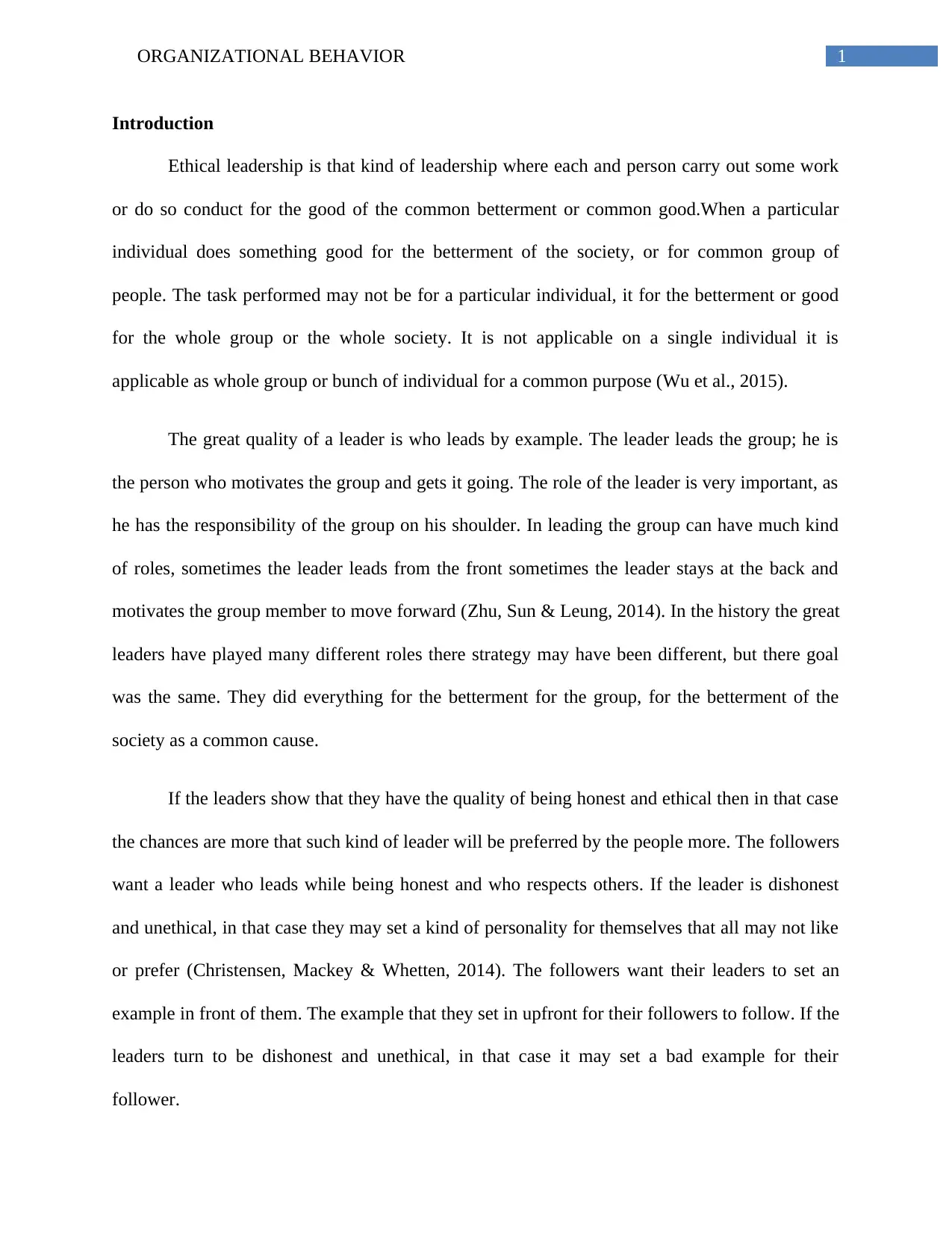
1ORGANIZATIONAL BEHAVIOR
Introduction
Ethical leadership is that kind of leadership where each and person carry out some work
or do so conduct for the good of the common betterment or common good.When a particular
individual does something good for the betterment of the society, or for common group of
people. The task performed may not be for a particular individual, it for the betterment or good
for the whole group or the whole society. It is not applicable on a single individual it is
applicable as whole group or bunch of individual for a common purpose (Wu et al., 2015).
The great quality of a leader is who leads by example. The leader leads the group; he is
the person who motivates the group and gets it going. The role of the leader is very important, as
he has the responsibility of the group on his shoulder. In leading the group can have much kind
of roles, sometimes the leader leads from the front sometimes the leader stays at the back and
motivates the group member to move forward (Zhu, Sun & Leung, 2014). In the history the great
leaders have played many different roles there strategy may have been different, but there goal
was the same. They did everything for the betterment for the group, for the betterment of the
society as a common cause.
If the leaders show that they have the quality of being honest and ethical then in that case
the chances are more that such kind of leader will be preferred by the people more. The followers
want a leader who leads while being honest and who respects others. If the leader is dishonest
and unethical, in that case they may set a kind of personality for themselves that all may not like
or prefer (Christensen, Mackey & Whetten, 2014). The followers want their leaders to set an
example in front of them. The example that they set in upfront for their followers to follow. If the
leaders turn to be dishonest and unethical, in that case it may set a bad example for their
follower.
Introduction
Ethical leadership is that kind of leadership where each and person carry out some work
or do so conduct for the good of the common betterment or common good.When a particular
individual does something good for the betterment of the society, or for common group of
people. The task performed may not be for a particular individual, it for the betterment or good
for the whole group or the whole society. It is not applicable on a single individual it is
applicable as whole group or bunch of individual for a common purpose (Wu et al., 2015).
The great quality of a leader is who leads by example. The leader leads the group; he is
the person who motivates the group and gets it going. The role of the leader is very important, as
he has the responsibility of the group on his shoulder. In leading the group can have much kind
of roles, sometimes the leader leads from the front sometimes the leader stays at the back and
motivates the group member to move forward (Zhu, Sun & Leung, 2014). In the history the great
leaders have played many different roles there strategy may have been different, but there goal
was the same. They did everything for the betterment for the group, for the betterment of the
society as a common cause.
If the leaders show that they have the quality of being honest and ethical then in that case
the chances are more that such kind of leader will be preferred by the people more. The followers
want a leader who leads while being honest and who respects others. If the leader is dishonest
and unethical, in that case they may set a kind of personality for themselves that all may not like
or prefer (Christensen, Mackey & Whetten, 2014). The followers want their leaders to set an
example in front of them. The example that they set in upfront for their followers to follow. If the
leaders turn to be dishonest and unethical, in that case it may set a bad example for their
follower.
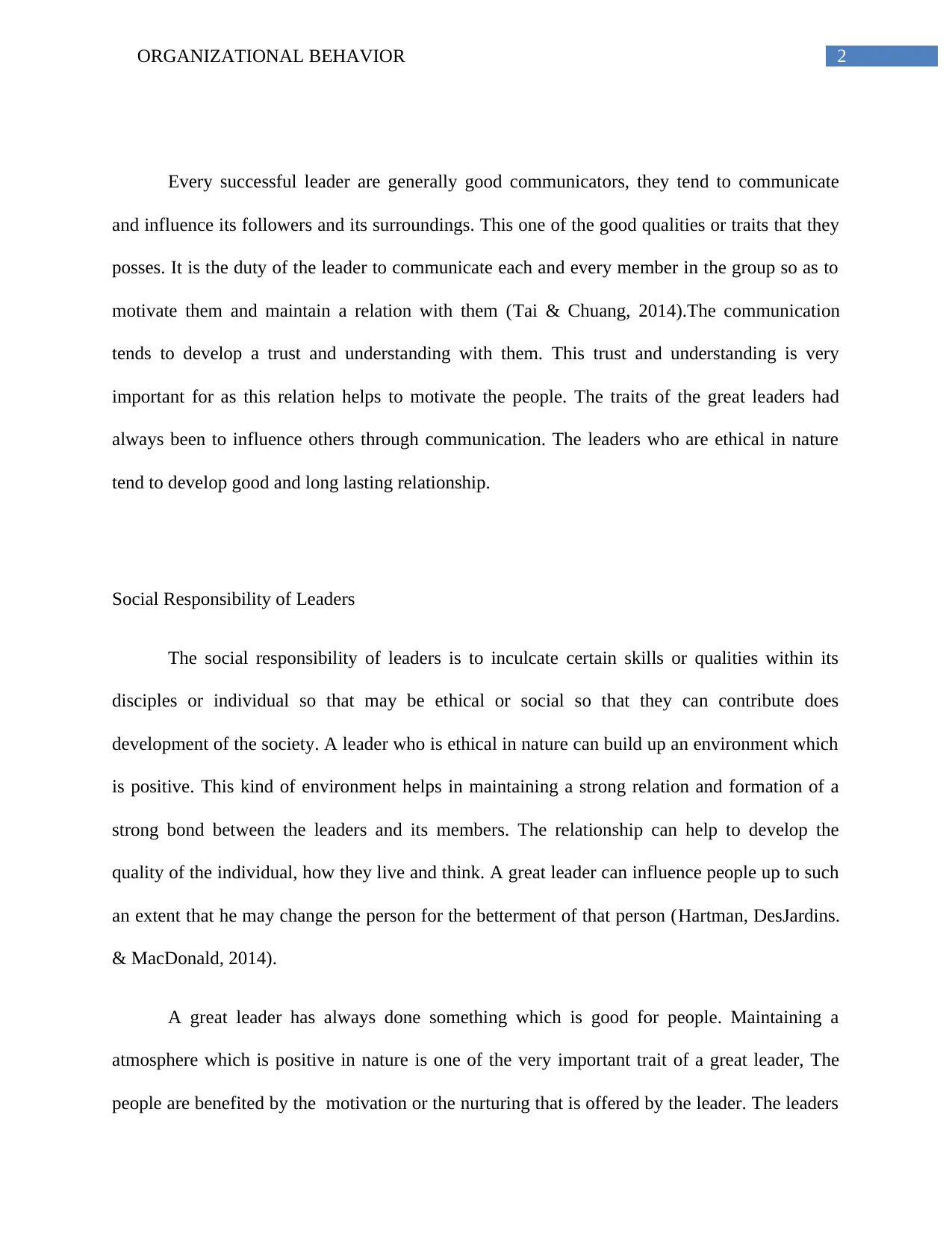
2ORGANIZATIONAL BEHAVIOR
Every successful leader are generally good communicators, they tend to communicate
and influence its followers and its surroundings. This one of the good qualities or traits that they
posses. It is the duty of the leader to communicate each and every member in the group so as to
motivate them and maintain a relation with them (Tai & Chuang, 2014).The communication
tends to develop a trust and understanding with them. This trust and understanding is very
important for as this relation helps to motivate the people. The traits of the great leaders had
always been to influence others through communication. The leaders who are ethical in nature
tend to develop good and long lasting relationship.
Social Responsibility of Leaders
The social responsibility of leaders is to inculcate certain skills or qualities within its
disciples or individual so that may be ethical or social so that they can contribute does
development of the society. A leader who is ethical in nature can build up an environment which
is positive. This kind of environment helps in maintaining a strong relation and formation of a
strong bond between the leaders and its members. The relationship can help to develop the
quality of the individual, how they live and think. A great leader can influence people up to such
an extent that he may change the person for the betterment of that person (Hartman, DesJardins.
& MacDonald, 2014).
A great leader has always done something which is good for people. Maintaining a
atmosphere which is positive in nature is one of the very important trait of a great leader, The
people are benefited by the motivation or the nurturing that is offered by the leader. The leaders
Every successful leader are generally good communicators, they tend to communicate
and influence its followers and its surroundings. This one of the good qualities or traits that they
posses. It is the duty of the leader to communicate each and every member in the group so as to
motivate them and maintain a relation with them (Tai & Chuang, 2014).The communication
tends to develop a trust and understanding with them. This trust and understanding is very
important for as this relation helps to motivate the people. The traits of the great leaders had
always been to influence others through communication. The leaders who are ethical in nature
tend to develop good and long lasting relationship.
Social Responsibility of Leaders
The social responsibility of leaders is to inculcate certain skills or qualities within its
disciples or individual so that may be ethical or social so that they can contribute does
development of the society. A leader who is ethical in nature can build up an environment which
is positive. This kind of environment helps in maintaining a strong relation and formation of a
strong bond between the leaders and its members. The relationship can help to develop the
quality of the individual, how they live and think. A great leader can influence people up to such
an extent that he may change the person for the betterment of that person (Hartman, DesJardins.
& MacDonald, 2014).
A great leader has always done something which is good for people. Maintaining a
atmosphere which is positive in nature is one of the very important trait of a great leader, The
people are benefited by the motivation or the nurturing that is offered by the leader. The leaders
⊘ This is a preview!⊘
Do you want full access?
Subscribe today to unlock all pages.

Trusted by 1+ million students worldwide
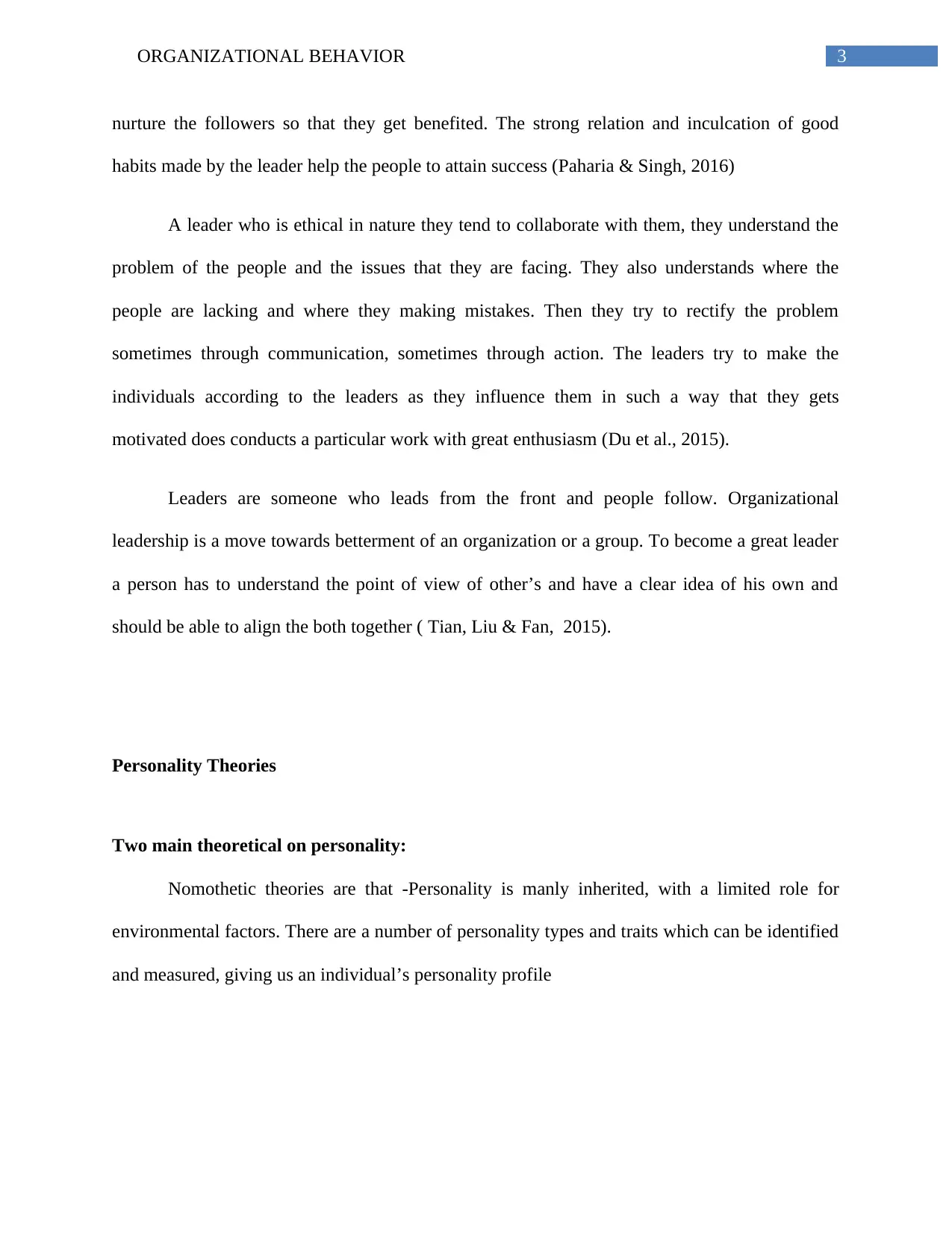
3ORGANIZATIONAL BEHAVIOR
nurture the followers so that they get benefited. The strong relation and inculcation of good
habits made by the leader help the people to attain success (Paharia & Singh, 2016)
A leader who is ethical in nature they tend to collaborate with them, they understand the
problem of the people and the issues that they are facing. They also understands where the
people are lacking and where they making mistakes. Then they try to rectify the problem
sometimes through communication, sometimes through action. The leaders try to make the
individuals according to the leaders as they influence them in such a way that they gets
motivated does conducts a particular work with great enthusiasm (Du et al., 2015).
Leaders are someone who leads from the front and people follow. Organizational
leadership is a move towards betterment of an organization or a group. To become a great leader
a person has to understand the point of view of other’s and have a clear idea of his own and
should be able to align the both together ( Tian, Liu & Fan, 2015).
Personality Theories
Two main theoretical on personality:
Nomothetic theories are that -Personality is manly inherited, with a limited role for
environmental factors. There are a number of personality types and traits which can be identified
and measured, giving us an individual’s personality profile
nurture the followers so that they get benefited. The strong relation and inculcation of good
habits made by the leader help the people to attain success (Paharia & Singh, 2016)
A leader who is ethical in nature they tend to collaborate with them, they understand the
problem of the people and the issues that they are facing. They also understands where the
people are lacking and where they making mistakes. Then they try to rectify the problem
sometimes through communication, sometimes through action. The leaders try to make the
individuals according to the leaders as they influence them in such a way that they gets
motivated does conducts a particular work with great enthusiasm (Du et al., 2015).
Leaders are someone who leads from the front and people follow. Organizational
leadership is a move towards betterment of an organization or a group. To become a great leader
a person has to understand the point of view of other’s and have a clear idea of his own and
should be able to align the both together ( Tian, Liu & Fan, 2015).
Personality Theories
Two main theoretical on personality:
Nomothetic theories are that -Personality is manly inherited, with a limited role for
environmental factors. There are a number of personality types and traits which can be identified
and measured, giving us an individual’s personality profile
Paraphrase This Document
Need a fresh take? Get an instant paraphrase of this document with our AI Paraphraser
4ORGANIZATIONAL BEHAVIOR
Idiographic theories are that –Personality develops with the development of the concept of self
in the individual. Personality cannot be divorced from the individual's cultural and social context.
Personality is in a constant state of change and development
Types of Personality
Eysenck - concluded that personality could be measured along two continua -
Introversion and extroversion and
Emotional stability
These theories gave four possible outcomes:
Introverted and unstable
Introverted and stable
Extroverted and stable
Extroverted and unstable
Nomothetic Theories- Understanding personality nomothetic theories Cattell identified two types
of personality trait:
Surface traits - Behaviors which tend to cluster consistently over a range of people
Source traits - The personal characteristics which appear to influence our behavioral
responses.
Ideographic Theories
Understanding personality-ideographic approach
Idiographic theories are that –Personality develops with the development of the concept of self
in the individual. Personality cannot be divorced from the individual's cultural and social context.
Personality is in a constant state of change and development
Types of Personality
Eysenck - concluded that personality could be measured along two continua -
Introversion and extroversion and
Emotional stability
These theories gave four possible outcomes:
Introverted and unstable
Introverted and stable
Extroverted and stable
Extroverted and unstable
Nomothetic Theories- Understanding personality nomothetic theories Cattell identified two types
of personality trait:
Surface traits - Behaviors which tend to cluster consistently over a range of people
Source traits - The personal characteristics which appear to influence our behavioral
responses.
Ideographic Theories
Understanding personality-ideographic approach
5ORGANIZATIONAL BEHAVIOR
See personality as the development of the concept of self in each individual
Carl Rogers stressed the need for growth and self actualisation of the individual over a
lifetime, taking place in the context of our relationships with others
Myers-Briggs suggested individuals differ according to a number of cognitive factors -
thinking, feeling, sensation and intuition
Focuses on how we construct meaning from our experiences
Seen as an active sense-making process so that no two individuals will share exactly the
same ‘reality’, e.g. the use of the term ‘father’ will triggers different experiences and
meanings in people
Kelly argued that personality is learned and situational
Repertory grid technique enables subjective view of people and events to be discussed
until a set of ‘constructs’ emerges
Comparison of Nomothetic and Ideographic
Nomothetic approaches assume there is a pool of characteristics which make up
personality
This pool is stable over time
Each individual possess these characteristics to differing degrees
These can be relied on to produce a personality profile in order to predict behaviour and
find the right job
Idiographic approaches see personality as dynamic and changeable
Personality cannot be separated from the social context of the individual
Need to understand the individual’s need for psychological growth
See personality as the development of the concept of self in each individual
Carl Rogers stressed the need for growth and self actualisation of the individual over a
lifetime, taking place in the context of our relationships with others
Myers-Briggs suggested individuals differ according to a number of cognitive factors -
thinking, feeling, sensation and intuition
Focuses on how we construct meaning from our experiences
Seen as an active sense-making process so that no two individuals will share exactly the
same ‘reality’, e.g. the use of the term ‘father’ will triggers different experiences and
meanings in people
Kelly argued that personality is learned and situational
Repertory grid technique enables subjective view of people and events to be discussed
until a set of ‘constructs’ emerges
Comparison of Nomothetic and Ideographic
Nomothetic approaches assume there is a pool of characteristics which make up
personality
This pool is stable over time
Each individual possess these characteristics to differing degrees
These can be relied on to produce a personality profile in order to predict behaviour and
find the right job
Idiographic approaches see personality as dynamic and changeable
Personality cannot be separated from the social context of the individual
Need to understand the individual’s need for psychological growth
⊘ This is a preview!⊘
Do you want full access?
Subscribe today to unlock all pages.
Trusted by 1+ million students worldwide
6ORGANIZATIONAL BEHAVIOR
Theories of personalities for the organizations
Personality tests have largely been developed from within the nomothetic approach
These are used in recruitment and selection
Should be used with caution, because even if ‘valid’, they are subject to the limitations of
the nomothetic approach
Idiographic approaches often used in activities to improve performance or support personal and
professional career development
There are various approaches to the learning process, some based on nomothetic concepts, others
paralleling the idiographic approach
Organizational Behavior Learning
Cognitive theories
In contrast to behaviorism, concerns themselves mainly with psychological processes
How we perceive, process and store information
Suggests a higher order set of processes where we look for patterns in the world around
us and develop and modify theories of action in order to function in the world
Cognition attempts to understand what behaviorism ignores
.’
Importance of organization individual differences
Important when recruiting or selecting for projects or promotion
Theories of personalities for the organizations
Personality tests have largely been developed from within the nomothetic approach
These are used in recruitment and selection
Should be used with caution, because even if ‘valid’, they are subject to the limitations of
the nomothetic approach
Idiographic approaches often used in activities to improve performance or support personal and
professional career development
There are various approaches to the learning process, some based on nomothetic concepts, others
paralleling the idiographic approach
Organizational Behavior Learning
Cognitive theories
In contrast to behaviorism, concerns themselves mainly with psychological processes
How we perceive, process and store information
Suggests a higher order set of processes where we look for patterns in the world around
us and develop and modify theories of action in order to function in the world
Cognition attempts to understand what behaviorism ignores
.’
Importance of organization individual differences
Important when recruiting or selecting for projects or promotion
Paraphrase This Document
Need a fresh take? Get an instant paraphrase of this document with our AI Paraphraser
7ORGANIZATIONAL BEHAVIOR
Understanding of difference influences job design
Understanding cultural differences helps us avoid treating people unfairly or unethically
Employees get more job satisfaction by doing work which fits their personality, ability or
physical capacity
Individual qualities, characteristics and beliefs of all individuals (including managers)
will have an impact on others in the workplace.
Examples to show Organizational Leadership
According to Douglas McGregor a psychologist and a Management professor said about two
different approaches, which he named as “Theory X” and “Theory Y”. In both the theory he talks
about involvement of the employees so that they feel as a integral part of the organization.
Theory X tells that – “Hell or high water, we are going to get it done”. He motivates the
employee that whatever the situation may have arose, we will achieve success (Shapiro and
Stefkovich, 2016). Theory Y tells that – “I need your help… how are we going to do this”?
We can see in both the situation he is saying we and involving the employees. In theory
Y he asks help giving them a higher position which itself is motivating in nature. To be an
effective leader it is very important to identify the leadership theory that will be applicable for a
given situation in an organization (Tai & Chuang, 2014).
As we discuss governance it provides leadership strategies for non profitable
organization. It is a process of providing leadership, direction and accountability for a nonprofit
seeking organization. A non profitable organization comprises of a board, hired employees and
volunteers. The board comprises of director who takes the important decision and formulates
Understanding of difference influences job design
Understanding cultural differences helps us avoid treating people unfairly or unethically
Employees get more job satisfaction by doing work which fits their personality, ability or
physical capacity
Individual qualities, characteristics and beliefs of all individuals (including managers)
will have an impact on others in the workplace.
Examples to show Organizational Leadership
According to Douglas McGregor a psychologist and a Management professor said about two
different approaches, which he named as “Theory X” and “Theory Y”. In both the theory he talks
about involvement of the employees so that they feel as a integral part of the organization.
Theory X tells that – “Hell or high water, we are going to get it done”. He motivates the
employee that whatever the situation may have arose, we will achieve success (Shapiro and
Stefkovich, 2016). Theory Y tells that – “I need your help… how are we going to do this”?
We can see in both the situation he is saying we and involving the employees. In theory
Y he asks help giving them a higher position which itself is motivating in nature. To be an
effective leader it is very important to identify the leadership theory that will be applicable for a
given situation in an organization (Tai & Chuang, 2014).
As we discuss governance it provides leadership strategies for non profitable
organization. It is a process of providing leadership, direction and accountability for a nonprofit
seeking organization. A non profitable organization comprises of a board, hired employees and
volunteers. The board comprises of director who takes the important decision and formulates
8ORGANIZATIONAL BEHAVIOR
strategies and considered to be the leader of that organization (Hartman, DesJardins &
MacDonald, 2014).
There are some roles that are to be carried out or performed by a leader in a non profit seeking
organization.
Roles played by a leader are as follows:
1. Responsibility to care
Care should be taken while taking any decision whatsoever in relation to the organization. A
leader stays accountable for the decision that is being taken by him or her.
2. Responsibility of loyalty
It says that the leaders should act in a good way to take the organization forward. It is expected
out of the leader to take decision which acts in equivalence with the interest of the organization
(Paharia & Singh, 2016).
3. Responsibility of compliance
The leader should honor mission, vision and policies of the organization. They should abide by
the laws or rules that are set by the organization, which will set an example for others.
There are several theories that have been laid down which acts as pillars of leadership (Tian, Liu
& Fan, 2015).
Example of A personality
strategies and considered to be the leader of that organization (Hartman, DesJardins &
MacDonald, 2014).
There are some roles that are to be carried out or performed by a leader in a non profit seeking
organization.
Roles played by a leader are as follows:
1. Responsibility to care
Care should be taken while taking any decision whatsoever in relation to the organization. A
leader stays accountable for the decision that is being taken by him or her.
2. Responsibility of loyalty
It says that the leaders should act in a good way to take the organization forward. It is expected
out of the leader to take decision which acts in equivalence with the interest of the organization
(Paharia & Singh, 2016).
3. Responsibility of compliance
The leader should honor mission, vision and policies of the organization. They should abide by
the laws or rules that are set by the organization, which will set an example for others.
There are several theories that have been laid down which acts as pillars of leadership (Tian, Liu
& Fan, 2015).
Example of A personality
⊘ This is a preview!⊘
Do you want full access?
Subscribe today to unlock all pages.
Trusted by 1+ million students worldwide
9ORGANIZATIONAL BEHAVIOR
Mr. Harry who is the director of the organization in order to resolve the problem
undertook Environmental theory as the solution of the problem. Mr Harry was unable to identify
the real problem that prevails in the organization. He thought that there is lack of co-ordination
and he thought that the environmental theory will solve the problem. He did not realize that co-
ordination was never a problem in regard to the workers of the Northwest printing press workers.
They were well known to each other as most of them know each other for long time and
maintained good relation amongst them (Arnold, Beauchamp & Bowie, 2013).
Due to this wrong understanding the organization further faced more losses and workers
morale went down. They had no idea what were they heading for and lack of communication
caused motivational problems. The workers did not give their full effort and lacked the spark
(Boatright, 2012).
Suggestion
After analyzing the scenario I would suggest that Mr Harry should change his leadership
theory. As it can be seen from the above mentioned case that problem was that the workers were
de-motivated and there was a gap of communication between the leader and the workers. There
was no precise goal that has been communicated. When there is a goal and the workers are
motivated and inspired to achieve that goal the workers give their full effort to achieve it (Brooks
& Dunn, 2012).
Mr. Harry who is the director of the organization in order to resolve the problem
undertook Environmental theory as the solution of the problem. Mr Harry was unable to identify
the real problem that prevails in the organization. He thought that there is lack of co-ordination
and he thought that the environmental theory will solve the problem. He did not realize that co-
ordination was never a problem in regard to the workers of the Northwest printing press workers.
They were well known to each other as most of them know each other for long time and
maintained good relation amongst them (Arnold, Beauchamp & Bowie, 2013).
Due to this wrong understanding the organization further faced more losses and workers
morale went down. They had no idea what were they heading for and lack of communication
caused motivational problems. The workers did not give their full effort and lacked the spark
(Boatright, 2012).
Suggestion
After analyzing the scenario I would suggest that Mr Harry should change his leadership
theory. As it can be seen from the above mentioned case that problem was that the workers were
de-motivated and there was a gap of communication between the leader and the workers. There
was no precise goal that has been communicated. When there is a goal and the workers are
motivated and inspired to achieve that goal the workers give their full effort to achieve it (Brooks
& Dunn, 2012).
Paraphrase This Document
Need a fresh take? Get an instant paraphrase of this document with our AI Paraphraser
10ORGANIZATIONAL BEHAVIOR
References
Arnold, DG., Beauchamp, TL & Bowie, NE 2013, Ethical theory and business, 9th edn, Pearson,
Boston, MA.
Boatright, JR 2012, Ethics & the conduct of business, 7th edn, Pearson, Boston, MA.
Bowden, P 2013 Applied Ethics: Strengthening Ethical Practices Tilde University Press, Prahran
Brooks, LJ & Dunn, P 2012 Business and professional ethics for directors, executives and
accountant, 6th edn, Cengage Learning, Mason, OH.
Christensen, L.J., Mackey, A. & Whetten, D., 2014. Taking responsibility for corporate social
responsibility: The role of leaders in creating, implementing, sustaining, or avoiding
socially responsible firm behaviors. The Academy of Management Perspectives, 28(2),
pp.164-178.
Clapp, J. & Rowlands, I.H., 2014. Corporate social responsibility. The Essential Guide to Global
Environmental Governance. Routledge: London, pp.42-44.
Collins, D 2012 Business ethics: how to design and manage ethical organisations, John Wiley &
Sons, Hoboken, NJ. De George, R 2010 Business ethics, 7th edn, Prentice Hall, Upper
Saddle River, NJ.
Du, S., Swaen, V., Lindgreen, A. & Sen, S., 2013. The roles of leadership styles in corporate
social responsibility. Journal of business ethics, 114(1), pp.155-169.
Dubrin, AJ 2016 Leadership: Research findings, practice, and skills, 8th edn. South-Western,
Cengage Learning.
References
Arnold, DG., Beauchamp, TL & Bowie, NE 2013, Ethical theory and business, 9th edn, Pearson,
Boston, MA.
Boatright, JR 2012, Ethics & the conduct of business, 7th edn, Pearson, Boston, MA.
Bowden, P 2013 Applied Ethics: Strengthening Ethical Practices Tilde University Press, Prahran
Brooks, LJ & Dunn, P 2012 Business and professional ethics for directors, executives and
accountant, 6th edn, Cengage Learning, Mason, OH.
Christensen, L.J., Mackey, A. & Whetten, D., 2014. Taking responsibility for corporate social
responsibility: The role of leaders in creating, implementing, sustaining, or avoiding
socially responsible firm behaviors. The Academy of Management Perspectives, 28(2),
pp.164-178.
Clapp, J. & Rowlands, I.H., 2014. Corporate social responsibility. The Essential Guide to Global
Environmental Governance. Routledge: London, pp.42-44.
Collins, D 2012 Business ethics: how to design and manage ethical organisations, John Wiley &
Sons, Hoboken, NJ. De George, R 2010 Business ethics, 7th edn, Prentice Hall, Upper
Saddle River, NJ.
Du, S., Swaen, V., Lindgreen, A. & Sen, S., 2013. The roles of leadership styles in corporate
social responsibility. Journal of business ethics, 114(1), pp.155-169.
Dubrin, AJ 2016 Leadership: Research findings, practice, and skills, 8th edn. South-Western,
Cengage Learning.
11ORGANIZATIONAL BEHAVIOR
Ferrell, O., Fraedrich, J and Ferrell L 2013 Business ethics: ethical decision making and cases,
9th edn, Cengage Learning, Mason, OH.
Fisher, C & Lovell, A 2015 Business ethics and values: individual, corporate and international
perspectives, 3rd edn, Prentice Hall, Harlow, UK.
Hartman, L.P., DesJardins, J.R. and MacDonald, C., 2014. Business ethics: Decision making for
personal integrity and social responsibility. New York: McGraw-Hill.
Hombert, J., Thesmar, D., Tahoun, A., Piotroski, J.D., Zhang, T., Lim, J., Minton, B.A.&
Weisbach, M.S., 2014. Using the firm-level corporate social responsibility (CSR) ratings
of Kinder, Lydenberg, Domini, we find that firms score higher on CSR when they have
Democratic rather than Republican founders, CEOs, and directors, and when they are
headquartered in Democratic rather than Republican-leaning states. Democratic-leaning
firms spend $20 million more on CSR than Republican-leaning firms ($80 million
more... Journal of Financial Economics, 111(1), pp.158-180.
McWilliams, A., 2014. Economics of Corporate Social Responsibility. Edward Elgar Publishing.
Paharia, P. & Singh, A., 2016. Ethical Leadership: A Key To Integrate Corporate Social
Responsibility And Human Resource Practices For Business Sustainability.
Shapiro, J.P. and Stefkovich, J.A., 2016. Ethical leadership and decision making in education:
Applying theoretical perspectives to complex dilemmas. Routledge.
Shaw, WH., Barry, V and Sansbury G 2013 Moral issues in business, 12th edn, Wadsworth
Cengage Learning, Belmont, CA.
Ferrell, O., Fraedrich, J and Ferrell L 2013 Business ethics: ethical decision making and cases,
9th edn, Cengage Learning, Mason, OH.
Fisher, C & Lovell, A 2015 Business ethics and values: individual, corporate and international
perspectives, 3rd edn, Prentice Hall, Harlow, UK.
Hartman, L.P., DesJardins, J.R. and MacDonald, C., 2014. Business ethics: Decision making for
personal integrity and social responsibility. New York: McGraw-Hill.
Hombert, J., Thesmar, D., Tahoun, A., Piotroski, J.D., Zhang, T., Lim, J., Minton, B.A.&
Weisbach, M.S., 2014. Using the firm-level corporate social responsibility (CSR) ratings
of Kinder, Lydenberg, Domini, we find that firms score higher on CSR when they have
Democratic rather than Republican founders, CEOs, and directors, and when they are
headquartered in Democratic rather than Republican-leaning states. Democratic-leaning
firms spend $20 million more on CSR than Republican-leaning firms ($80 million
more... Journal of Financial Economics, 111(1), pp.158-180.
McWilliams, A., 2014. Economics of Corporate Social Responsibility. Edward Elgar Publishing.
Paharia, P. & Singh, A., 2016. Ethical Leadership: A Key To Integrate Corporate Social
Responsibility And Human Resource Practices For Business Sustainability.
Shapiro, J.P. and Stefkovich, J.A., 2016. Ethical leadership and decision making in education:
Applying theoretical perspectives to complex dilemmas. Routledge.
Shaw, WH., Barry, V and Sansbury G 2013 Moral issues in business, 12th edn, Wadsworth
Cengage Learning, Belmont, CA.
⊘ This is a preview!⊘
Do you want full access?
Subscribe today to unlock all pages.
Trusted by 1+ million students worldwide

1 out of 13


Related Documents


Your All-in-One AI-Powered Toolkit for Academic Success.
+13062052269
info@desklib.com
Available 24*7 on WhatsApp / Email
![[object Object]](/_next/static/media/star-bottom.7253800d.svg)
Unlock your academic potential
Copyright © 2020–2026 A2Z Services. All Rights Reserved. Developed and managed by ZUCOL.