Enhancing Employee Productivity: An Organizational Behavior Report
VerifiedAdded on 2020/04/15
|25
|5875
|488
Report
AI Summary
This report provides a comprehensive overview of organizational behavior and its impact on employee motivation and productivity within the electronic industry. It explores various motivational theories, including Maslow's hierarchy of needs, Alderfer's ERG model, McClelland's motivational theory, and equity theory, and discusses how these theories can be applied to enhance employee performance. The report also covers practical strategies such as reward and recognition, safety management, payment and allowance adjustments, delegation of power, and increased communication to create a motivating work environment. It emphasizes the importance of understanding employee needs and fostering a culture of motivation and loyalty to achieve optimal productivity and organizational success. The report also discusses the relevance of these motivational factors within the context of the electronic industry, highlighting the need for accuracy and employee commitment in this sector.
Running head: ORGANIZATIONAL BEHAVIOR
Organizational Behavior
Name of the Student
Name of the University
Author note
Organizational Behavior
Name of the Student
Name of the University
Author note

Paraphrase This Document
Need a fresh take? Get an instant paraphrase of this document with our AI Paraphraser
1ORGANIZATIONAL BEHAVIOR
Executive summary
The purpose of this report is to highlight the fact is how implying various theories of motivation
can help to enhance the productivity of the employees of electronic industry. In this report a
detailed discussion is done on the various theories of motivation and numerous aspects of those
theories. This report deals with the fact that how can management expect an increase in
productivity from the employees and specifically under which conditions. Almost every details
regarding employee motivation and using motivational theories to enhance the productivity is
been discussed in this report.
Executive summary
The purpose of this report is to highlight the fact is how implying various theories of motivation
can help to enhance the productivity of the employees of electronic industry. In this report a
detailed discussion is done on the various theories of motivation and numerous aspects of those
theories. This report deals with the fact that how can management expect an increase in
productivity from the employees and specifically under which conditions. Almost every details
regarding employee motivation and using motivational theories to enhance the productivity is
been discussed in this report.
2ORGANIZATIONAL BEHAVIOR
Table of Contents
Introduction......................................................................................................................................3
Industry............................................................................................................................................4
Reward and recognition...................................................................................................................4
Safety management within the workplace.......................................................................................5
Payment and allowance...................................................................................................................5
Delegation of power........................................................................................................................5
Increased communication................................................................................................................6
Maslow’s theory of motivation........................................................................................................7
Steps of satisfying requirements of the staffs..............................................................................9
Alderfer’s ERG model.....................................................................................................................9
Existence needs..........................................................................................................................10
Relatedness needs......................................................................................................................10
Needs of Growth........................................................................................................................10
The relation between these three categories..............................................................................10
Aldelfer’s model Vs Maslow’s theory...........................................................................................11
McClelland’s motivational theory.................................................................................................12
Achievement motivation............................................................................................................12
Authority motivation.................................................................................................................12
Affiliation motivation................................................................................................................13
Table of Contents
Introduction......................................................................................................................................3
Industry............................................................................................................................................4
Reward and recognition...................................................................................................................4
Safety management within the workplace.......................................................................................5
Payment and allowance...................................................................................................................5
Delegation of power........................................................................................................................5
Increased communication................................................................................................................6
Maslow’s theory of motivation........................................................................................................7
Steps of satisfying requirements of the staffs..............................................................................9
Alderfer’s ERG model.....................................................................................................................9
Existence needs..........................................................................................................................10
Relatedness needs......................................................................................................................10
Needs of Growth........................................................................................................................10
The relation between these three categories..............................................................................10
Aldelfer’s model Vs Maslow’s theory...........................................................................................11
McClelland’s motivational theory.................................................................................................12
Achievement motivation............................................................................................................12
Authority motivation.................................................................................................................12
Affiliation motivation................................................................................................................13
⊘ This is a preview!⊘
Do you want full access?
Subscribe today to unlock all pages.

Trusted by 1+ million students worldwide
3ORGANIZATIONAL BEHAVIOR
Relation with the other theories of motivation..........................................................................15
Equity theory.................................................................................................................................15
Outcomes...................................................................................................................................16
Relation with other theories.......................................................................................................17
Conclusion.....................................................................................................................................17
References......................................................................................................................................19
Relation with the other theories of motivation..........................................................................15
Equity theory.................................................................................................................................15
Outcomes...................................................................................................................................16
Relation with other theories.......................................................................................................17
Conclusion.....................................................................................................................................17
References......................................................................................................................................19
Paraphrase This Document
Need a fresh take? Get an instant paraphrase of this document with our AI Paraphraser
4ORGANIZATIONAL BEHAVIOR
Introduction
There have been various studies regarding the motivation theories and how they influence
the work rate or the productivity majorly within the workplace. Use of motivational theories to
enhance the moral and the motivational level of the employees are very common nowadays
though the productivity would depend on certain factors like leadership quality, style of
leadership, level of the job satisfaction and many more(Bal and De Lange 2015). After various
studies it has been proven that the motivational theories have a deep influence on the
productivity of the workforce in a positive way. It is a common phrase that the workforce is the
nucleus of any organization, but if the workforce is motivated and loyal towards the
organization, then they can surely be considered as the asset of that organization. In some
organizations it is seen that due to lethargy of the workers, at times the organization has to lag
behind many opportunities, and the worst part is that in most cases those organizations have the
potential to get successful, but they cannot compete for lack of proper motivation(Becker et al.
2015). Thus, motivation is one of the most important aspects nowadays in order to boost the
productivity of the general workforce. The managers of the organizations have to be extra
cautioned to ensure that all the employees are motivated and loyal towards the organization. It is
a common issue that if the workforce is not motivated then a huge sum of money, energy and
resources along with time gets wasted and that is not at all good for any business organization
(Michaelson et al. 2014). Thus the motto of the management of any organization should be to
use lesser human resources and to gain the maximum output; and there lies the need of
motivational theories that would influence the organizational behavior and make the workforce
more motivated and loyal towards the corporation.
Introduction
There have been various studies regarding the motivation theories and how they influence
the work rate or the productivity majorly within the workplace. Use of motivational theories to
enhance the moral and the motivational level of the employees are very common nowadays
though the productivity would depend on certain factors like leadership quality, style of
leadership, level of the job satisfaction and many more(Bal and De Lange 2015). After various
studies it has been proven that the motivational theories have a deep influence on the
productivity of the workforce in a positive way. It is a common phrase that the workforce is the
nucleus of any organization, but if the workforce is motivated and loyal towards the
organization, then they can surely be considered as the asset of that organization. In some
organizations it is seen that due to lethargy of the workers, at times the organization has to lag
behind many opportunities, and the worst part is that in most cases those organizations have the
potential to get successful, but they cannot compete for lack of proper motivation(Becker et al.
2015). Thus, motivation is one of the most important aspects nowadays in order to boost the
productivity of the general workforce. The managers of the organizations have to be extra
cautioned to ensure that all the employees are motivated and loyal towards the organization. It is
a common issue that if the workforce is not motivated then a huge sum of money, energy and
resources along with time gets wasted and that is not at all good for any business organization
(Michaelson et al. 2014). Thus the motto of the management of any organization should be to
use lesser human resources and to gain the maximum output; and there lies the need of
motivational theories that would influence the organizational behavior and make the workforce
more motivated and loyal towards the corporation.
5ORGANIZATIONAL BEHAVIOR
Industry
In this report the industry, where implementing the theories of motivation is going to be
discussed, is electronic industry. The workers of the electronic industry has to be well trained to
accurately finish their job as the type of work in where they are engaged takes a lot of accuracy,
and knowledge to attain perfection. It can surely be said that the employees of the electronic
industry has to be more cautioned as a small mistake on their part can cost the company a lot of
money and reputation too(Dang 2014). Thus the management of the organizations of the
electronics industry has to be aware of the fact that all the employees are motivated and loyal
towards the organization to attain that level of perfection. The managers can primarily try basic
concepts like reward and recognition way of motivating the workers, or he can choose other
concept later if he does not get the desired results.
Reward and recognition
In this section of the report a detailed discussion on the reward and recognition method
off motivating the employees. At the preliminary stage, the managers of electronic industry
might stress on the training and development areas to ensure that all the employees have the
knowledge of executing a task with perfection (Becker et al. 2015). Then the manager has to
constantly motivate thee workers by providing reward and recognition, either by giving the hike
or by encouraging and praising them in front of the other employees. While doing this, the other
employees, who were not producing enough productivity, would get interested to get the
recognition like the other individuals and that drive would influence their productivity positively
and certainly give a boost to their work rate (Michaelson et al. 2014).
Industry
In this report the industry, where implementing the theories of motivation is going to be
discussed, is electronic industry. The workers of the electronic industry has to be well trained to
accurately finish their job as the type of work in where they are engaged takes a lot of accuracy,
and knowledge to attain perfection. It can surely be said that the employees of the electronic
industry has to be more cautioned as a small mistake on their part can cost the company a lot of
money and reputation too(Dang 2014). Thus the management of the organizations of the
electronics industry has to be aware of the fact that all the employees are motivated and loyal
towards the organization to attain that level of perfection. The managers can primarily try basic
concepts like reward and recognition way of motivating the workers, or he can choose other
concept later if he does not get the desired results.
Reward and recognition
In this section of the report a detailed discussion on the reward and recognition method
off motivating the employees. At the preliminary stage, the managers of electronic industry
might stress on the training and development areas to ensure that all the employees have the
knowledge of executing a task with perfection (Becker et al. 2015). Then the manager has to
constantly motivate thee workers by providing reward and recognition, either by giving the hike
or by encouraging and praising them in front of the other employees. While doing this, the other
employees, who were not producing enough productivity, would get interested to get the
recognition like the other individuals and that drive would influence their productivity positively
and certainly give a boost to their work rate (Michaelson et al. 2014).
⊘ This is a preview!⊘
Do you want full access?
Subscribe today to unlock all pages.
Trusted by 1+ million students worldwide
6ORGANIZATIONAL BEHAVIOR
Safety management within the workplace
If the management of the particular organizations stress on the safety and security issues
of their employees: the workforce would know that the management do care for them and that
would increase the level of motivation and loyalty towards the organizations and that can
potentially increase the level of productivity of the workers (Dang-Pham and Pittayachawan
2015). Apart from motivating issues too, the managements should focus on this matter as the
employees are actually the heart of any organizations as if there is no workforce there will be no
productivity.
Payment and allowance
At times, the management of the organizations might try to motivate the workers by
modifying the their salary structure, as if they notice that any particular individual is putting in
great effort in the workplace, the management can reward him by giving him a hike, and noticing
that many other employees might get interested to get a raise and put in ore effort to improve
their level of performance(Dang 2014). The managers might get interested in providing the good
employees some allowances like travel allowance, home rent allowance and many more just to
keep them loyal and motivated towards the organization. But as opined by Michaelson et al.
(2014) these theories in most cases does not have that long lasting impact and there are instances
where applying these tactics backfired the management with higher level of disruptions within
the workforce.
Delegation of power
At times the management might try to delegate authority to the employee who has been
generating huge amount of productivity for quite a long time. In this way that individual would
Safety management within the workplace
If the management of the particular organizations stress on the safety and security issues
of their employees: the workforce would know that the management do care for them and that
would increase the level of motivation and loyalty towards the organizations and that can
potentially increase the level of productivity of the workers (Dang-Pham and Pittayachawan
2015). Apart from motivating issues too, the managements should focus on this matter as the
employees are actually the heart of any organizations as if there is no workforce there will be no
productivity.
Payment and allowance
At times, the management of the organizations might try to motivate the workers by
modifying the their salary structure, as if they notice that any particular individual is putting in
great effort in the workplace, the management can reward him by giving him a hike, and noticing
that many other employees might get interested to get a raise and put in ore effort to improve
their level of performance(Dang 2014). The managers might get interested in providing the good
employees some allowances like travel allowance, home rent allowance and many more just to
keep them loyal and motivated towards the organization. But as opined by Michaelson et al.
(2014) these theories in most cases does not have that long lasting impact and there are instances
where applying these tactics backfired the management with higher level of disruptions within
the workforce.
Delegation of power
At times the management might try to delegate authority to the employee who has been
generating huge amount of productivity for quite a long time. In this way that individual would
Paraphrase This Document
Need a fresh take? Get an instant paraphrase of this document with our AI Paraphraser
7ORGANIZATIONAL BEHAVIOR
get the motivation for continuing the good work and he might get a chance to lead a small batch
of employees and that can potentially increase his skills that can help the organization. This
process at times can prove to be a little bit of risky as there can be instances that after getting a
position of a leader, the level of productivity of that candidate might get harmed as the leadership
might become a burden for that individual and that can potentially reduce the work rate of that
team under that particular person(Dang-Pham and Pittayachawan 2015).
Increased communication
The managers of organizations who have good intrapersonal skills and along with that the
ability to get all the workers united, in most cases they are seen getting success within a real
short span of time(Becker et al. 2015). Communicating among the employees of the organization
is very important to get successful in terms of productivity and profitability. The more the
managers communicate with the employees the more risks of mistakes get reduced and that is
where the importance of communication within the workplace lies. There are several instances
where having a talented pool of workers the organizations fail to get desired success and on the
other hand having a few talented individuals some organizations reach the height of success,
these things happen because of the level of motivation among the workers and good
communication within the workplace enhances the level of motivation amongst the employees.
In the first part of this report various types of basic motivating techniques were discussed
and now some theories of motivation that can be used in the business organizations to increase
the productivity are going to be discussed (Chen, Hsieh and Chen 2014). There are various
theories of motivation that compete with each other and in this section of these report
explanations regarding those theories are mentioned. Motivating the employees are one of the
get the motivation for continuing the good work and he might get a chance to lead a small batch
of employees and that can potentially increase his skills that can help the organization. This
process at times can prove to be a little bit of risky as there can be instances that after getting a
position of a leader, the level of productivity of that candidate might get harmed as the leadership
might become a burden for that individual and that can potentially reduce the work rate of that
team under that particular person(Dang-Pham and Pittayachawan 2015).
Increased communication
The managers of organizations who have good intrapersonal skills and along with that the
ability to get all the workers united, in most cases they are seen getting success within a real
short span of time(Becker et al. 2015). Communicating among the employees of the organization
is very important to get successful in terms of productivity and profitability. The more the
managers communicate with the employees the more risks of mistakes get reduced and that is
where the importance of communication within the workplace lies. There are several instances
where having a talented pool of workers the organizations fail to get desired success and on the
other hand having a few talented individuals some organizations reach the height of success,
these things happen because of the level of motivation among the workers and good
communication within the workplace enhances the level of motivation amongst the employees.
In the first part of this report various types of basic motivating techniques were discussed
and now some theories of motivation that can be used in the business organizations to increase
the productivity are going to be discussed (Chen, Hsieh and Chen 2014). There are various
theories of motivation that compete with each other and in this section of these report
explanations regarding those theories are mentioned. Motivating the employees are one of the
8ORGANIZATIONAL BEHAVIOR
most complex task and to execute that with perfection there has to be a requirement of vast
knowledge regarding this particular issue(Dang 2014).
The Content theories try to explain specific issues those actually motivate the employees
at work and these theories are more concerned with identifying the requirement of the
individuals and their strengths and the targets that they pursue to achieve to satisfy their desires.
Is short it can be said that the content theories focus on the factors that motivates the employees.
Process theories try to locate the relationship between the variables that are dynamic and
make up motivation(Dang-Pham and Pittayachawan 2015). These theories are mostly engaged
with how specific behaviors can be initiated, sustained or directed. These process theories put
focus on the process of the motivation.
Maslow’s theory of motivation
One of the most important and can be said a pioneering theory of motivation is the theory
introduced by Abraham Maslow. In his hierarchy of needs, Maslow said that individuals are
motivated by five basic requirements and if those requirements are met, then the management
can expect a huge boost in the level of productivity within the workplace. These five needs are
mentioned below;
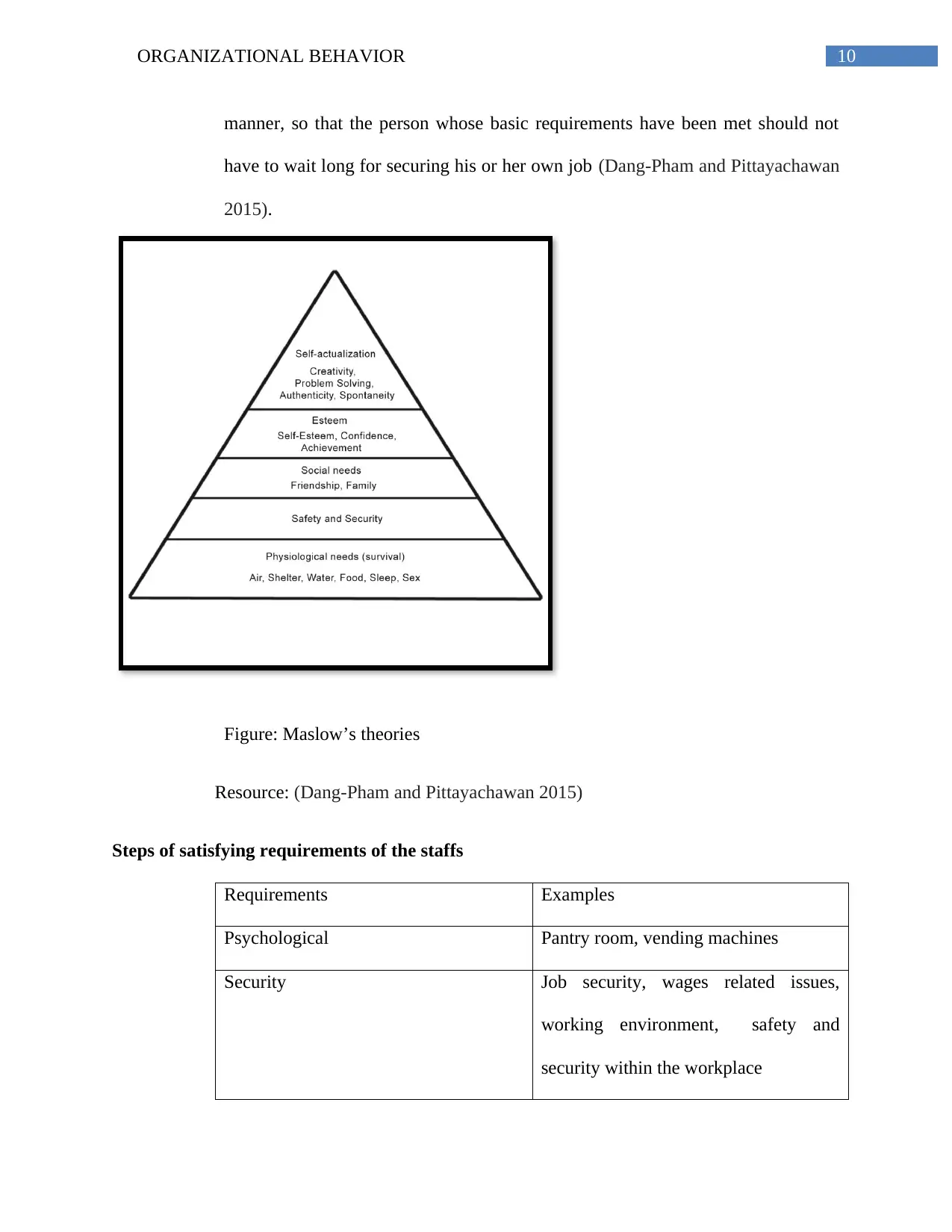
1. Psychological needs ( need of food, shelter, clothing and more)
2. The requirement of safety and security ( job security)
3. The need to belong (friendship within the workplace, acceptance from the colleagues)
4. The need of self-esteem (getting recognition for the good work)
5. Requirement of self-actualization ( fulfillment of the capacities)
most complex task and to execute that with perfection there has to be a requirement of vast
knowledge regarding this particular issue(Dang 2014).
The Content theories try to explain specific issues those actually motivate the employees
at work and these theories are more concerned with identifying the requirement of the
individuals and their strengths and the targets that they pursue to achieve to satisfy their desires.
Is short it can be said that the content theories focus on the factors that motivates the employees.
Process theories try to locate the relationship between the variables that are dynamic and
make up motivation(Dang-Pham and Pittayachawan 2015). These theories are mostly engaged
with how specific behaviors can be initiated, sustained or directed. These process theories put
focus on the process of the motivation.
Maslow’s theory of motivation
One of the most important and can be said a pioneering theory of motivation is the theory
introduced by Abraham Maslow. In his hierarchy of needs, Maslow said that individuals are
motivated by five basic requirements and if those requirements are met, then the management
can expect a huge boost in the level of productivity within the workplace. These five needs are
mentioned below;
1. Psychological needs ( need of food, shelter, clothing and more)
2. The requirement of safety and security ( job security)
3. The need to belong (friendship within the workplace, acceptance from the colleagues)
4. The need of self-esteem (getting recognition for the good work)
5. Requirement of self-actualization ( fulfillment of the capacities)
⊘ This is a preview!⊘
Do you want full access?
Subscribe today to unlock all pages.
Trusted by 1+ million students worldwide
9ORGANIZATIONAL BEHAVIOR
The needs which are mentioned are actually arranged according to the importance of
those within the workplace. Like when a lower level need is met or satisfied then the next
motivating factor will be the next need. For an example, if an employee’s psychological
needs are satisfied, then the individual will get further motivated when he gets the desired
job security. In this way, it can be said that the individuals of the organizations shall
always want to satisfy the next level need.
Maslow’s theory says that the employees must have the hierarchy of the needs
that would be counted from the basic needs to the highest level of the needs. There are
some points those should be considered while following Maslow’s theory of motivation,
and those are mentioned below;
When a set of requirements are satisfied, the next level of requirement
automatically becomes the motivator.
A need that is already satisfied cannot be considered as a motivating factor again.
A requirement that is not met can only becomes the object of motivation and the
manager has to focus on that specific need of the employee in order to motivate
him or her (Chen, Hsieh and Chen 2014).
The self-actualization part actually stimulates a need for more because of the peak
experience.
Maslow’s theories of motivation can surely be applied to the workplaces
in order to motivate the employees to enhance the work rate of them or
productivity of the workforce. To imply these tactics in the workplace a proper
work environment needs to be created in which the employees can work as per
their full potential. And the needs should be satisfied gradually and in a uniform
The needs which are mentioned are actually arranged according to the importance of
those within the workplace. Like when a lower level need is met or satisfied then the next
motivating factor will be the next need. For an example, if an employee’s psychological
needs are satisfied, then the individual will get further motivated when he gets the desired
job security. In this way, it can be said that the individuals of the organizations shall
always want to satisfy the next level need.
Maslow’s theory says that the employees must have the hierarchy of the needs
that would be counted from the basic needs to the highest level of the needs. There are
some points those should be considered while following Maslow’s theory of motivation,
and those are mentioned below;
When a set of requirements are satisfied, the next level of requirement
automatically becomes the motivator.
A need that is already satisfied cannot be considered as a motivating factor again.
A requirement that is not met can only becomes the object of motivation and the
manager has to focus on that specific need of the employee in order to motivate
him or her (Chen, Hsieh and Chen 2014).
The self-actualization part actually stimulates a need for more because of the peak
experience.
Maslow’s theories of motivation can surely be applied to the workplaces
in order to motivate the employees to enhance the work rate of them or
productivity of the workforce. To imply these tactics in the workplace a proper
work environment needs to be created in which the employees can work as per
their full potential. And the needs should be satisfied gradually and in a uniform
Paraphrase This Document
Need a fresh take? Get an instant paraphrase of this document with our AI Paraphraser
10ORGANIZATIONAL BEHAVIOR
manner, so that the person whose basic requirements have been met should not
have to wait long for securing his or her own job (Dang-Pham and Pittayachawan
2015).
Figure: Maslow’s theories
Resource: (Dang-Pham and Pittayachawan 2015)
Steps of satisfying requirements of the staffs
Requirements Examples
Psychological Pantry room, vending machines
Security Job security, wages related issues,
working environment, safety and
security within the workplace
manner, so that the person whose basic requirements have been met should not
have to wait long for securing his or her own job (Dang-Pham and Pittayachawan
2015).
Figure: Maslow’s theories
Resource: (Dang-Pham and Pittayachawan 2015)
Steps of satisfying requirements of the staffs
Requirements Examples
Psychological Pantry room, vending machines
Security Job security, wages related issues,
working environment, safety and
security within the workplace
11ORGANIZATIONAL BEHAVIOR
Belonging Acceptance from the colleagues, team
spirit, social activities with the
colleagues
Self-esteem Thriving in challenging situations
within the workplace, getting
recognition for good work, receiving
proper training regarding development
Self-actualization Working on challenging tasks, doing
creative work
Potential steps of satisfying employee’s needs
Figure made by the author
Alderfer’s ERG model
The theory of Clayton Alderfer divides Maslow’s five needs of the employees into three
parts; Existence, Relatedness and Growth.
Existence needs
This requirement involves all the material and the psychological needs like needs of air,
water, clothing, safety and many more that is closely related to Maslow’s first to levels of the
hierarchy(Beehr 2014).
Relatedness needs
This type of needs surrounds the external a social esteem along with the relationships
with others like colleagues and all the employees within the organizations. This depicts that the
Belonging Acceptance from the colleagues, team
spirit, social activities with the
colleagues
Self-esteem Thriving in challenging situations
within the workplace, getting
recognition for good work, receiving
proper training regarding development
Self-actualization Working on challenging tasks, doing
creative work
Potential steps of satisfying employee’s needs
Figure made by the author
Alderfer’s ERG model
The theory of Clayton Alderfer divides Maslow’s five needs of the employees into three
parts; Existence, Relatedness and Growth.
Existence needs
This requirement involves all the material and the psychological needs like needs of air,
water, clothing, safety and many more that is closely related to Maslow’s first to levels of the
hierarchy(Beehr 2014).
Relatedness needs
This type of needs surrounds the external a social esteem along with the relationships
with others like colleagues and all the employees within the organizations. This depicts that the
⊘ This is a preview!⊘
Do you want full access?
Subscribe today to unlock all pages.
Trusted by 1+ million students worldwide

1 out of 25


Related Documents


Your All-in-One AI-Powered Toolkit for Academic Success.
+13062052269
info@desklib.com
Available 24*7 on WhatsApp / Email
![[object Object]](/_next/static/media/star-bottom.7253800d.svg)
Unlock your academic potential
Copyright © 2020–2026 A2Z Services. All Rights Reserved. Developed and managed by ZUCOL.