Organizational Behavior and Leadership Report: A David & Co. Ltd
VerifiedAdded on 2020/06/06
|14
|4049
|51
Report
AI Summary
This report provides a comprehensive analysis of organizational behavior, focusing on the case of A David & Co. Ltd, a UK-based food and beverage company. It examines the influence of organizational culture, politics, and power on individuals and teams, exploring concepts such as power culture and Hofstede's cultural dimensions. The report evaluates content and process theories of motivation, including Maslow's hierarchy, Herzberg's two-factor theory, and Vroom's expectancy theory, in the context of goal achievement. Furthermore, it delves into the ways to build effective teams, discussing different team types and team dynamics, including Tuckman's stages of team development. Finally, the report applies key concepts and philosophies of organizational behavior to provide insights into leadership and management practices within the organization. The report aims to provide valuable insights into how organizations can optimize their performance by understanding and managing their organizational behavior.
ORGANIZATION AND BEHAVIOUR

Paraphrase This Document
Need a fresh take? Get an instant paraphrase of this document with our AI Paraphraser
Table of Content
INTRODUCTION...........................................................................................................................1
P1 Analyze how an organization’s culture politics and power influence individual and team...1
P2 Evaluate how content and process theories of motivation helps in goal achievement...........3
P3 Explaining the ways to makes an effective team....................................................................4
P4 Apply concepts and philosophies of organizational behavior within an organization...........7
CONCLUSION..............................................................................................................................10
REFERENCES..............................................................................................................................11
INTRODUCTION...........................................................................................................................1
P1 Analyze how an organization’s culture politics and power influence individual and team...1
P2 Evaluate how content and process theories of motivation helps in goal achievement...........3
P3 Explaining the ways to makes an effective team....................................................................4
P4 Apply concepts and philosophies of organizational behavior within an organization...........7
CONCLUSION..............................................................................................................................10
REFERENCES..............................................................................................................................11
INTRODUCTION
Organizational culture refers to set of experience, expectations, believes, philosophies
and values that guide the behavior of all the people and expressed in the self-image, working
practices and interaction with others. Every organization have their own values which are
followed to optimize their business performance. It is reflected in their corporate mission, vision,
norms and beliefs. A David & Co. Limited is a food and beverage company of UK that offers
fresh fruit, vegetables, exotic produce, bakery items and others and serve it to restaurant, hotels,
nursing homes, schools, government contracts and caterers. It generates an annual turnover of
GBP 10m to GBP 20m every year. The thrust of the assignment is to examine its culture and
investigate the way how it encourage all the individual and teams to achieve goals. The report
will also evaluate the need to make an effective team and apply relevant concepts & philosophies
of organizational behavior.
P1 Analyze how an organization’s culture politics and power influence individual and team
Organizational culture refers to shared assumptions, belief and values that helps in
directing and governing people behavior. Such values strongly affects all the people and dictate
their working style, act, behaviour and performance. According to Charles Handy, there may be
four kinds of culture includes following as described below:
Power culture: Organizations, in which, power is held in the hand of just few people and
influence the entire business unit.
Role culture: Such establishments works in a highly controllable environment and follow
strict rules and regulations by working under the long chain of command. All the people have
delegated authorities set in the hierarchy (Martin, 2014).
Task culture: When people works in a team to address specific issues, then, such culture
is followed by right mix of personalities, skills and leadership. Working in team always generate
effective and creative solutions.
Person culture: In such firms, every individual works uniquely and worked together for
their organization (Jan and Maqbool, 2015).
Considering all of these, it is clear that A David & Co. Ltd follows power culture,
because, in these company, all the major decisions, policies and strategies exists centrally in the
1 | P a g e
Organizational culture refers to set of experience, expectations, believes, philosophies
and values that guide the behavior of all the people and expressed in the self-image, working
practices and interaction with others. Every organization have their own values which are
followed to optimize their business performance. It is reflected in their corporate mission, vision,
norms and beliefs. A David & Co. Limited is a food and beverage company of UK that offers
fresh fruit, vegetables, exotic produce, bakery items and others and serve it to restaurant, hotels,
nursing homes, schools, government contracts and caterers. It generates an annual turnover of
GBP 10m to GBP 20m every year. The thrust of the assignment is to examine its culture and
investigate the way how it encourage all the individual and teams to achieve goals. The report
will also evaluate the need to make an effective team and apply relevant concepts & philosophies
of organizational behavior.
P1 Analyze how an organization’s culture politics and power influence individual and team
Organizational culture refers to shared assumptions, belief and values that helps in
directing and governing people behavior. Such values strongly affects all the people and dictate
their working style, act, behaviour and performance. According to Charles Handy, there may be
four kinds of culture includes following as described below:
Power culture: Organizations, in which, power is held in the hand of just few people and
influence the entire business unit.
Role culture: Such establishments works in a highly controllable environment and follow
strict rules and regulations by working under the long chain of command. All the people have
delegated authorities set in the hierarchy (Martin, 2014).
Task culture: When people works in a team to address specific issues, then, such culture
is followed by right mix of personalities, skills and leadership. Working in team always generate
effective and creative solutions.
Person culture: In such firms, every individual works uniquely and worked together for
their organization (Jan and Maqbool, 2015).
Considering all of these, it is clear that A David & Co. Ltd follows power culture,
because, in these company, all the major decisions, policies and strategies exists centrally in the
1 | P a g e
⊘ This is a preview!⊘
Do you want full access?
Subscribe today to unlock all pages.

Trusted by 1+ million students worldwide
hand of top-level managers who are board of directors such as CEO, CFO and Chairman. They
have key authority to make business decisions, devise plans and set vision, mission and
objectives that are conveyed it to all the other employees who are liable to follow and implement
the set rules & regulations.
Hofstede developed a theory of cultural dimension for cross-cultural communication. The
theory presents that culture significantly affects all the members’ values and manage their
behavior. It has various dimensions includes power distance index, individualism V collectivism,
uncertainty avoidance Index, masculinity V femininity, long-term Vs short-term orientation and
indulgence Vs restraints (Pavlovic, 2015). As stated in the case, that A David & Co. Ltd follows
power culture, therefore, it is obvious that people at lower level may feel inequality due to
unequal distribution of power. However, although, the central decision making authority exists in
the hand of top managers, still, as they invite subordinates and respect their opinion and views,
hence, the level of power distance is comparatively lower. With the help of active participation
of the workers in the business decisions, they feel that their efforts and contribution to the
organization are being valued by their respective seniors. Company also implement their
suggestions and views if they seem beneficial which provide a better feeling to everyone. Thus,
it becomes clear that A. David & Co. Ltd’s corporate values respect everyone.
The rise of globalization and digitalized technology strongly influenced and shaped the
culture in the 21st century. As earlier, decisions were centralized just in few hands who use their
own power to make decisions without involving subordinates. Thus, they follow autocratic style
whereas as the time changes, companies started involving subordinates too in the main decisions.
Now-a-days, leaders have a favorable attitude towards all the people as they feel that targets can
be achieved only after the mutual contribution of all. Moreover, participation of all the members
in the business decisions helps to know their unique advices and suggestions that might be
feasible and beneficial for the A. David & Co.
Organizational politics means number of activities that are linked with using influence
tactics so as to improve business interest. Individual with political skills tend to perform better in
having more personal power and helps to manage stress and the job demand. Power has a strong
influence over outcome and seen as a property viewpoint that is embedded in the hierarchical
structure of A. David & Co, which top authority uses in business decisions. They have power to
2 | P a g e
have key authority to make business decisions, devise plans and set vision, mission and
objectives that are conveyed it to all the other employees who are liable to follow and implement
the set rules & regulations.
Hofstede developed a theory of cultural dimension for cross-cultural communication. The
theory presents that culture significantly affects all the members’ values and manage their
behavior. It has various dimensions includes power distance index, individualism V collectivism,
uncertainty avoidance Index, masculinity V femininity, long-term Vs short-term orientation and
indulgence Vs restraints (Pavlovic, 2015). As stated in the case, that A David & Co. Ltd follows
power culture, therefore, it is obvious that people at lower level may feel inequality due to
unequal distribution of power. However, although, the central decision making authority exists in
the hand of top managers, still, as they invite subordinates and respect their opinion and views,
hence, the level of power distance is comparatively lower. With the help of active participation
of the workers in the business decisions, they feel that their efforts and contribution to the
organization are being valued by their respective seniors. Company also implement their
suggestions and views if they seem beneficial which provide a better feeling to everyone. Thus,
it becomes clear that A. David & Co. Ltd’s corporate values respect everyone.
The rise of globalization and digitalized technology strongly influenced and shaped the
culture in the 21st century. As earlier, decisions were centralized just in few hands who use their
own power to make decisions without involving subordinates. Thus, they follow autocratic style
whereas as the time changes, companies started involving subordinates too in the main decisions.
Now-a-days, leaders have a favorable attitude towards all the people as they feel that targets can
be achieved only after the mutual contribution of all. Moreover, participation of all the members
in the business decisions helps to know their unique advices and suggestions that might be
feasible and beneficial for the A. David & Co.
Organizational politics means number of activities that are linked with using influence
tactics so as to improve business interest. Individual with political skills tend to perform better in
having more personal power and helps to manage stress and the job demand. Power has a strong
influence over outcome and seen as a property viewpoint that is embedded in the hierarchical
structure of A. David & Co, which top authority uses in business decisions. They have power to
2 | P a g e
Paraphrase This Document
Need a fresh take? Get an instant paraphrase of this document with our AI Paraphraser
alter plans and implement necessary changes. Power has a strong influence over individual as
well as team performance. With reference to A. David & Co. participative style adopted by the
top managerial team helps to create a favorable attitude and perception among all the members,
as a result, they try to work hard and attain targets.
P2 Evaluate how content and process theories of motivation helps in goal achievement
It is really important for A. David & Co. to motivate their team members continuously, so
that, everyone feel encouraged and motivated to work hard and perform better to contribute in
the business success. There are various motivational theories that might be used by the firm such
as content theories and process theories.
Maslow’s theory of motivation is one of the important theory that is applied in the
corporate world and applied by A. David & Co’s managers too to motivate people. It follows a
hierarchical structure at first, every worker have basic physiological needs and they want clean,
comfortable and safe workplace. In this regards, firm provides reasonable working hours and
comfortable conditions along with timely breaks to workers. After such need fulfillment, people
need security needs including personal security, financial security and good health requirements.
In this, health insurance, protection from accident, secure compensation and others are provided
to people for job security (Driskell, Salas and Driskell, 2017). Afterwards, social need of the
workers is satisfied via developing a positive work environment where everyone respect each
other. Moreover, equal opportunity is provided to all without any discriminating behavior so that
no one feel isolated & depressed. Thereafter, esteem requirement is fulfilled by appraisal,
recognizing their performance, appraisal & promotions to an upper level. Lastly, self-
actualization needs of people is about everyone wants to do their best as much as they can.
Therefore, at this level, people are provided with challenging tasks and also invited to take part
in business decisions. By offering autonomy and flexibility at workplace, their self-actualization
needs are satisfied.
Herzberg developed a two factor motivation theory, in which, elements that motivate
people by job satisfaction is maintained whereas other factors that do not motivate people should
be removed (Acar, 2014). With reference to the case study, A. David & Co. offer challenging
work, consider workers importance, recognize their performance and allow participation of team
in decision-making to motivate people. A highly motivated team of workers are strongly
3 | P a g e
well as team performance. With reference to A. David & Co. participative style adopted by the
top managerial team helps to create a favorable attitude and perception among all the members,
as a result, they try to work hard and attain targets.
P2 Evaluate how content and process theories of motivation helps in goal achievement
It is really important for A. David & Co. to motivate their team members continuously, so
that, everyone feel encouraged and motivated to work hard and perform better to contribute in
the business success. There are various motivational theories that might be used by the firm such
as content theories and process theories.
Maslow’s theory of motivation is one of the important theory that is applied in the
corporate world and applied by A. David & Co’s managers too to motivate people. It follows a
hierarchical structure at first, every worker have basic physiological needs and they want clean,
comfortable and safe workplace. In this regards, firm provides reasonable working hours and
comfortable conditions along with timely breaks to workers. After such need fulfillment, people
need security needs including personal security, financial security and good health requirements.
In this, health insurance, protection from accident, secure compensation and others are provided
to people for job security (Driskell, Salas and Driskell, 2017). Afterwards, social need of the
workers is satisfied via developing a positive work environment where everyone respect each
other. Moreover, equal opportunity is provided to all without any discriminating behavior so that
no one feel isolated & depressed. Thereafter, esteem requirement is fulfilled by appraisal,
recognizing their performance, appraisal & promotions to an upper level. Lastly, self-
actualization needs of people is about everyone wants to do their best as much as they can.
Therefore, at this level, people are provided with challenging tasks and also invited to take part
in business decisions. By offering autonomy and flexibility at workplace, their self-actualization
needs are satisfied.
Herzberg developed a two factor motivation theory, in which, elements that motivate
people by job satisfaction is maintained whereas other factors that do not motivate people should
be removed (Acar, 2014). With reference to the case study, A. David & Co. offer challenging
work, consider workers importance, recognize their performance and allow participation of team
in decision-making to motivate people. A highly motivated team of workers are strongly
3 | P a g e
dedicated or committed to finish their delegated tasks and duties on time and contribute towards
attainment of organizational goals.
Both the above theories of motivation look at the internal needs and its resulting effort
made by people to fulfil them. Vroom’s expectancy theory states that performance of worker
depends on their skills, knowledge, personality, ability and experience, all these factors are
positively related to the motivation. As per the theory, expectancy is the belief that high efforts
made by worker helps to boost their performance. Thus, individual can be motivated by
rendering them sufficient resources, require enough skills and additional support from superiors
to complete the work (Furnham and MacRae 2017). Thus, A. David & Co. provide sufficient
resources such as fund, time and also guided by their reporting authorities through training and
development and guidance to finish the work. Help and direction provided by seniors encourage
and motivates people to focus on betterment and reach goals. Motivated team of workers work
efficiently with greater efforts which tends to increase their productivity to a great extent. It
pushed workers towards the goals and they put more energy to work creatively as well as
enthusiastically. They feel excited and enjoy work in order accomplish the set goals. However,
lack of motivation results in dissatisfaction, as a result, individual wish to change their current
job and look at other employment opportunities where they have more job securities, healthy
relationship with colleague, freedom and autonomy of work and flexibility at the workplace.
P3 Explaining the ways to makes an effective team
Team-working can be defined as a dynamic process where two or more people with
having different skills, knowledge and talent work towards the common defined goals. It plays
an important role in the workplace where everyone in the team work collaboratively and
cooperatively and helps each other to attain goals. A. David & Co. maintains a strong working
culture and all the workers work together in a team and share common set of targets. There are
different types of teams such as functional, problem-solving and project teams (Bowers, Hall and
Srinivasan, 2017). Functional team refers to group of people, in which, every member of the
team has expertise functional knowledge in different field, and all of the members work toward
the same goal. A. David & Co. has expertise people in the field of finance, operations, marketing
and HR. It helps in developing high performance teams with clear focus on their goals and
achieve superb results. However, problem-solving teams constitutes members who are able to
4 | P a g e
attainment of organizational goals.
Both the above theories of motivation look at the internal needs and its resulting effort
made by people to fulfil them. Vroom’s expectancy theory states that performance of worker
depends on their skills, knowledge, personality, ability and experience, all these factors are
positively related to the motivation. As per the theory, expectancy is the belief that high efforts
made by worker helps to boost their performance. Thus, individual can be motivated by
rendering them sufficient resources, require enough skills and additional support from superiors
to complete the work (Furnham and MacRae 2017). Thus, A. David & Co. provide sufficient
resources such as fund, time and also guided by their reporting authorities through training and
development and guidance to finish the work. Help and direction provided by seniors encourage
and motivates people to focus on betterment and reach goals. Motivated team of workers work
efficiently with greater efforts which tends to increase their productivity to a great extent. It
pushed workers towards the goals and they put more energy to work creatively as well as
enthusiastically. They feel excited and enjoy work in order accomplish the set goals. However,
lack of motivation results in dissatisfaction, as a result, individual wish to change their current
job and look at other employment opportunities where they have more job securities, healthy
relationship with colleague, freedom and autonomy of work and flexibility at the workplace.
P3 Explaining the ways to makes an effective team
Team-working can be defined as a dynamic process where two or more people with
having different skills, knowledge and talent work towards the common defined goals. It plays
an important role in the workplace where everyone in the team work collaboratively and
cooperatively and helps each other to attain goals. A. David & Co. maintains a strong working
culture and all the workers work together in a team and share common set of targets. There are
different types of teams such as functional, problem-solving and project teams (Bowers, Hall and
Srinivasan, 2017). Functional team refers to group of people, in which, every member of the
team has expertise functional knowledge in different field, and all of the members work toward
the same goal. A. David & Co. has expertise people in the field of finance, operations, marketing
and HR. It helps in developing high performance teams with clear focus on their goals and
achieve superb results. However, problem-solving teams constitutes members who are able to
4 | P a g e
⊘ This is a preview!⊘
Do you want full access?
Subscribe today to unlock all pages.
Trusted by 1+ million students worldwide
deal with the business problems. For instance, IT related issues struggled by the firm is solved by
a team of technical staff under the supervision and direction of IT expert.
Project team, on the other side, is a team which is created by involving members from
different functions and groups, but assigned to a project. Such team is framed to handle a specific
project like construction, repairing and maintenance, new software implementation and others.
The knowledge and talent of the team mates contribute towards achieving the set project aims
and objectives (Fiore and Georganta, 2017).
In the technology-led world, virtual team development plays a great role in the business.
It refers to a group of people all work together but from different geographical locations and rely
on communication technology i.e. fax, e-mail, video conferencing and others to communication
and stay in touch with each other (Colbert, Yee and George, 2016). In current age of advanced
technology, A. David & Co. also makes use of latest technologies such as electronic mail, fax
and others to form group where members work from distinctive locations, still, work together to
achieve the same shared goals.
Team dynamics can be defined as a behavioral relationship between all the group
members, all of them are assigned with the related tasks and activities within the business entity.
It is greatly affected by psychological forces that affect individual’s behavior and performance.
Nature of work, working environment, personalities, relationship among workers and other
factors form team dynamics.
Tuckman developed a team development theory which contains four stages; forming,
storming, norming and performing. At forming stage, all the workers of A. David & Co. are
highly dependent on leader for their guidance and direction. Moreover, individual is not very
clear with their roles and responsibilities. Later, storming stage comes, in which, members of the
team get familiar with the coworkers and also receive challenges. Although, all the workers are
clear about their purpose but lots of uncertainties persist. People also face power struggling
issues, at this, all the people needs to focus on foals and avoid distracting relationship &
emotional difficulties. Afterwards, at norming stage, every individual effort is recognized and
decisions are made by the leaders with group agreement (Tuckman’s team development theory,
2017). However, small decisions are delegated by David & Co’s key leaders to the individuals
working in the team. Here, people are strongly committed and work in unity to reach goals. At
5 | P a g e
a team of technical staff under the supervision and direction of IT expert.
Project team, on the other side, is a team which is created by involving members from
different functions and groups, but assigned to a project. Such team is framed to handle a specific
project like construction, repairing and maintenance, new software implementation and others.
The knowledge and talent of the team mates contribute towards achieving the set project aims
and objectives (Fiore and Georganta, 2017).
In the technology-led world, virtual team development plays a great role in the business.
It refers to a group of people all work together but from different geographical locations and rely
on communication technology i.e. fax, e-mail, video conferencing and others to communication
and stay in touch with each other (Colbert, Yee and George, 2016). In current age of advanced
technology, A. David & Co. also makes use of latest technologies such as electronic mail, fax
and others to form group where members work from distinctive locations, still, work together to
achieve the same shared goals.
Team dynamics can be defined as a behavioral relationship between all the group
members, all of them are assigned with the related tasks and activities within the business entity.
It is greatly affected by psychological forces that affect individual’s behavior and performance.
Nature of work, working environment, personalities, relationship among workers and other
factors form team dynamics.
Tuckman developed a team development theory which contains four stages; forming,
storming, norming and performing. At forming stage, all the workers of A. David & Co. are
highly dependent on leader for their guidance and direction. Moreover, individual is not very
clear with their roles and responsibilities. Later, storming stage comes, in which, members of the
team get familiar with the coworkers and also receive challenges. Although, all the workers are
clear about their purpose but lots of uncertainties persist. People also face power struggling
issues, at this, all the people needs to focus on foals and avoid distracting relationship &
emotional difficulties. Afterwards, at norming stage, every individual effort is recognized and
decisions are made by the leaders with group agreement (Tuckman’s team development theory,
2017). However, small decisions are delegated by David & Co’s key leaders to the individuals
working in the team. Here, people are strongly committed and work in unity to reach goals. At
5 | P a g e
Paraphrase This Document
Need a fresh take? Get an instant paraphrase of this document with our AI Paraphraser
final stage, members are able to work with challenging situation without any guidance from the
leader. The team has a high degree of autonomy. Although, disagreement took place but they are
resolved positively. All the members of the team does not need instruction, assistance and
direction from the leaders.
Belbin has presented nine roles to form a team at workplace in A. David & Co. that are
presented below:
Resource investigator is the person who uses their inquisitive nature to determine unique
ideas for maximizing team performance (Team dynamics, 2016).
Team worker is an individual who use their versatility to find the work and complete it
timely on the behalf of the team.
Coordinator needs strong focus on the team’s objective who delegate work to the team
members as per work specification.
Plant is defined as a person with creative thinking and problem solving skills uniquely.
Monitor evaluator is an individual who makes impartial judgment logically.
Specialist has an in-depth knowledge which is applied for team decisions.
Shaper is a person who assures continuous team movement and does not lose their focus.
They strive to work in high pressure, able to drive changes at the workplace and have
strength to combat obstacles (Driskell and et.al., 2017)
Implementer, as name itself, frame workable strategy and carry out work efficiently.
Completer finisher polishes and scrutinize the entire work performed by team to make it
error free and assure high quality standard.
With reference to A. David & Co. it create a positive working environment at the
workplace, in which, everyone values others effort and contribution and work collaboratively to
get the results. Despite this, participative style of leadership helps to motivate team members and
resolve conflicts at the workplace by involving all the members. It develop a positive attitude
among people. Moreover, understanding coworkers, support and guidance of the superiors and
strong bonding among team members helps to promote team-working practices and resultant
higher productivity. In addition, equality principle helps firm to provide equal opportunity and
right to everyone at no discriminating behavior.
6 | P a g e
leader. The team has a high degree of autonomy. Although, disagreement took place but they are
resolved positively. All the members of the team does not need instruction, assistance and
direction from the leaders.
Belbin has presented nine roles to form a team at workplace in A. David & Co. that are
presented below:
Resource investigator is the person who uses their inquisitive nature to determine unique
ideas for maximizing team performance (Team dynamics, 2016).
Team worker is an individual who use their versatility to find the work and complete it
timely on the behalf of the team.
Coordinator needs strong focus on the team’s objective who delegate work to the team
members as per work specification.
Plant is defined as a person with creative thinking and problem solving skills uniquely.
Monitor evaluator is an individual who makes impartial judgment logically.
Specialist has an in-depth knowledge which is applied for team decisions.
Shaper is a person who assures continuous team movement and does not lose their focus.
They strive to work in high pressure, able to drive changes at the workplace and have
strength to combat obstacles (Driskell and et.al., 2017)
Implementer, as name itself, frame workable strategy and carry out work efficiently.
Completer finisher polishes and scrutinize the entire work performed by team to make it
error free and assure high quality standard.
With reference to A. David & Co. it create a positive working environment at the
workplace, in which, everyone values others effort and contribution and work collaboratively to
get the results. Despite this, participative style of leadership helps to motivate team members and
resolve conflicts at the workplace by involving all the members. It develop a positive attitude
among people. Moreover, understanding coworkers, support and guidance of the superiors and
strong bonding among team members helps to promote team-working practices and resultant
higher productivity. In addition, equality principle helps firm to provide equal opportunity and
right to everyone at no discriminating behavior.
6 | P a g e
Working in team helps entity to survive successfully in the challenging and competitive
market with good strength of staff. However, at the same time, many-times, A. David & Co’s
leaders face issues such as team-conflicts, still, by mutual discussion with both the parties,
conflicts are dealt with for sound performance.
P4 Apply concepts and philosophies of organizational behavior within an organization
Path-goal theory of leadership is followed to influence people behavior and working
environment to reach goals. The main motivation behind applying such concept is boost
workforce empowerment and job satisfaction resulting greater productivity. The theory is linked
with Vroom’s motivation expectancy theory, in which, every activity performed by an individual
expects with an outcome.
7 | P a g e
market with good strength of staff. However, at the same time, many-times, A. David & Co’s
leaders face issues such as team-conflicts, still, by mutual discussion with both the parties,
conflicts are dealt with for sound performance.
P4 Apply concepts and philosophies of organizational behavior within an organization
Path-goal theory of leadership is followed to influence people behavior and working
environment to reach goals. The main motivation behind applying such concept is boost
workforce empowerment and job satisfaction resulting greater productivity. The theory is linked
with Vroom’s motivation expectancy theory, in which, every activity performed by an individual
expects with an outcome.
7 | P a g e
⊘ This is a preview!⊘
Do you want full access?
Subscribe today to unlock all pages.
Trusted by 1+ million students worldwide
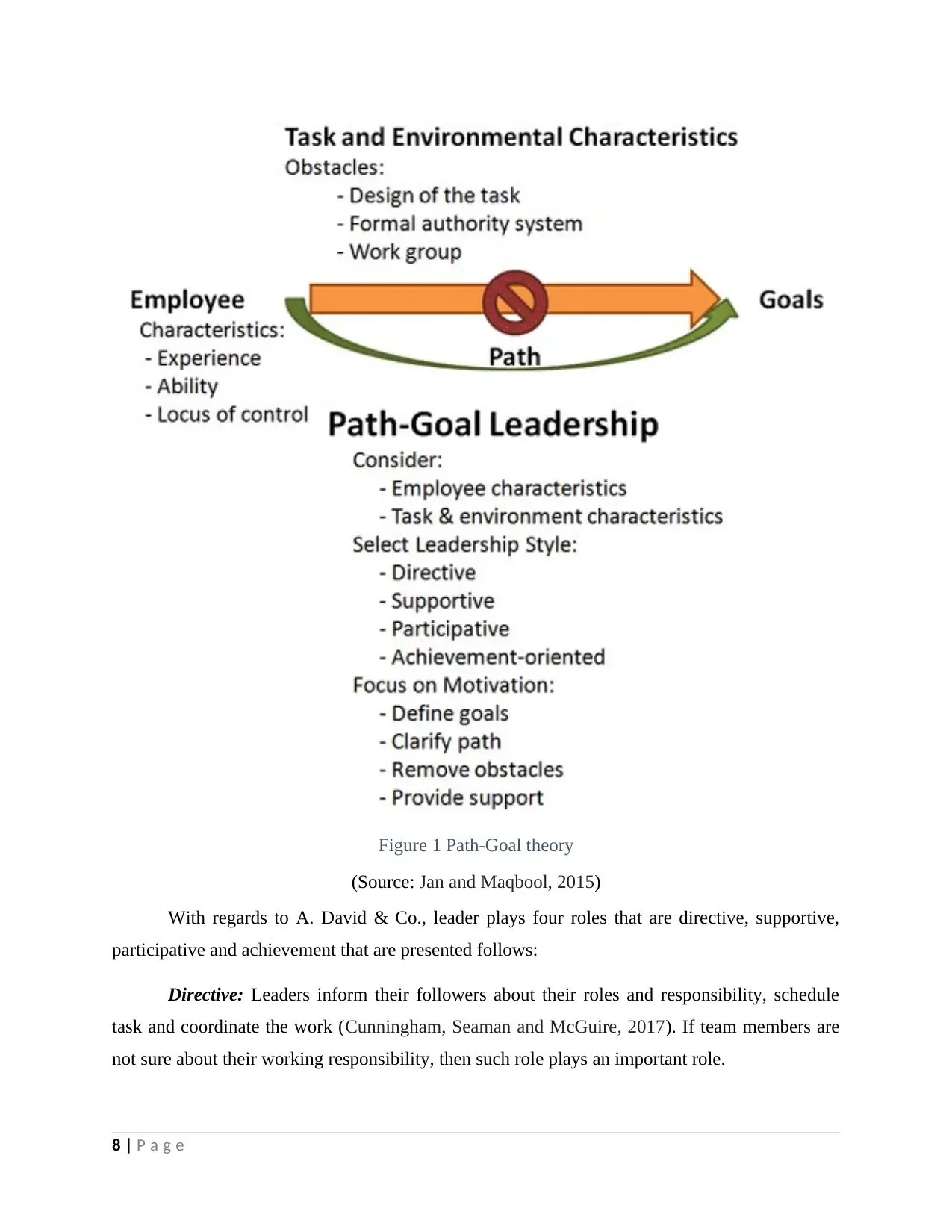
Figure 1 Path-Goal theory
(Source: Jan and Maqbool, 2015)
With regards to A. David & Co., leader plays four roles that are directive, supportive,
participative and achievement that are presented follows:
Directive: Leaders inform their followers about their roles and responsibility, schedule
task and coordinate the work (Cunningham, Seaman and McGuire, 2017). If team members are
not sure about their working responsibility, then such role plays an important role.
8 | P a g e
(Source: Jan and Maqbool, 2015)
With regards to A. David & Co., leader plays four roles that are directive, supportive,
participative and achievement that are presented follows:
Directive: Leaders inform their followers about their roles and responsibility, schedule
task and coordinate the work (Cunningham, Seaman and McGuire, 2017). If team members are
not sure about their working responsibility, then such role plays an important role.
8 | P a g e
Paraphrase This Document
Need a fresh take? Get an instant paraphrase of this document with our AI Paraphraser
Supportive: In this, leaders create a pleasant environment by expressing concerns for the
team and behave friendly and approachable. If workers perform challenging work, then, people
require support and guidance of their higher authority.
Participative: Now-a-days, leaders consult with their followers to make decisions. It is
approached mainly when subordinates are enough trained, expertise and talented and make
sound contribution in business decisions (Asmawi, Rahim and Zainuddin, 2015).
Achievement: Here, challenging tasks are delegated to the people who are expected to
make great contribution to assure high standard and meet expectations.
In accordance with the scenario, in different situation, A. David & Co’s leaders follow
different role to provide assistance to workers. Participative style is normally followed at all the
situations to determine opinions and views of subordinates which might prove beneficial for the
business unit (Jan and Maqbool, 2015).
There are many obstacles faced by A. David & Co which must be resolved appropriately
to maximize productivity and team performance. For instance, at the workplace, it is often seen
that many-times, workers may resist to changes as they are not familiar with and others.
However, good bonding and relationship among team helps leaders to manage changes favorably
by developing positive attitude among all. They are aware with the benefits of prospective
changes to accept it willingly.
Social capital theory of leadership states resources that are inherent in social relationship
and facilitates collective action. It include norms, mutual trust and network of association that
represents group members’ work together for commonly shared purpose (Teng, 2018). The
theory states that tangible and intangible business resources and its relationship affects team
members behavior of A David & Co. The theory applies to improve diversified group
performance, superior relationship and value derived from strategic alliances. In despite of this,
contingency theory of leadership states that a course of action is dependent on the internal and
external factors and leaders have duty to effectively apply their own style to respond prevailing
circumstances. Applying it to the selected case study, A. David & Co’s leaders build good
interpersonal relationship and express their concerns for the group members. However, playing a
role of initiator, they assign role, tasks, make plan and schedule work for timely completion and
9 | P a g e
team and behave friendly and approachable. If workers perform challenging work, then, people
require support and guidance of their higher authority.
Participative: Now-a-days, leaders consult with their followers to make decisions. It is
approached mainly when subordinates are enough trained, expertise and talented and make
sound contribution in business decisions (Asmawi, Rahim and Zainuddin, 2015).
Achievement: Here, challenging tasks are delegated to the people who are expected to
make great contribution to assure high standard and meet expectations.
In accordance with the scenario, in different situation, A. David & Co’s leaders follow
different role to provide assistance to workers. Participative style is normally followed at all the
situations to determine opinions and views of subordinates which might prove beneficial for the
business unit (Jan and Maqbool, 2015).
There are many obstacles faced by A. David & Co which must be resolved appropriately
to maximize productivity and team performance. For instance, at the workplace, it is often seen
that many-times, workers may resist to changes as they are not familiar with and others.
However, good bonding and relationship among team helps leaders to manage changes favorably
by developing positive attitude among all. They are aware with the benefits of prospective
changes to accept it willingly.
Social capital theory of leadership states resources that are inherent in social relationship
and facilitates collective action. It include norms, mutual trust and network of association that
represents group members’ work together for commonly shared purpose (Teng, 2018). The
theory states that tangible and intangible business resources and its relationship affects team
members behavior of A David & Co. The theory applies to improve diversified group
performance, superior relationship and value derived from strategic alliances. In despite of this,
contingency theory of leadership states that a course of action is dependent on the internal and
external factors and leaders have duty to effectively apply their own style to respond prevailing
circumstances. Applying it to the selected case study, A. David & Co’s leaders build good
interpersonal relationship and express their concerns for the group members. However, playing a
role of initiator, they assign role, tasks, make plan and schedule work for timely completion and
9 | P a g e
attainment of goals (Boer and et.al., 2017). Support and work specification enable leaders to
positively influence all the members and assure good progress.
CONCLUSION
From the findings of the study, it becomes clear that in every organization, behavior, culture and
norms regulate individual’s behavior, way of working and their relationship with the coworkers. The
research study bring out the fact that A. David and Co. motivates their workers through training &
development, participative style of leadership, freedom and flexibility, autonomy of work, appraisal,
promotion and other opportunities resultant high productivity. Despite this, effective teams are formed
through developing strong bonding, greater mutual understanding and participative leadership style.
Lastly, the report discussed that leader support and guidance encourages individual to strive hardly
towards the set goals to achieve targets.
10 | P a g e
positively influence all the members and assure good progress.
CONCLUSION
From the findings of the study, it becomes clear that in every organization, behavior, culture and
norms regulate individual’s behavior, way of working and their relationship with the coworkers. The
research study bring out the fact that A. David and Co. motivates their workers through training &
development, participative style of leadership, freedom and flexibility, autonomy of work, appraisal,
promotion and other opportunities resultant high productivity. Despite this, effective teams are formed
through developing strong bonding, greater mutual understanding and participative leadership style.
Lastly, the report discussed that leader support and guidance encourages individual to strive hardly
towards the set goals to achieve targets.
10 | P a g e
⊘ This is a preview!⊘
Do you want full access?
Subscribe today to unlock all pages.
Trusted by 1+ million students worldwide

1 out of 14


Related Documents


Your All-in-One AI-Powered Toolkit for Academic Success.
+13062052269
info@desklib.com
Available 24*7 on WhatsApp / Email
![[object Object]](/_next/static/media/star-bottom.7253800d.svg)
Unlock your academic potential
Copyright © 2020–2026 A2Z Services. All Rights Reserved. Developed and managed by ZUCOL.