Organizational Behaviour Analysis: Unilever PLC Culture & Performance
VerifiedAdded on 2023/06/04
|15
|5305
|369
Report
AI Summary
This report provides an in-depth analysis of organizational behaviour within Unilever PLC, examining its impact on employee performance and overall organizational effectiveness. The report explores various organizational cultures, including clan, adhocracy, market, and hierarchy cultures, and their relevance to Unilever's operations. It delves into Maslow's motivational theory and its influence on employee motivation and performance, discussing physiological, safety, belongingness, esteem, and self-actualization needs. Furthermore, the report provides an overview of Unilever's culture, politics, and power dynamics, and discusses the advantages of teamwork, benefits to leaders and team members, and group development theories. The analysis also relates effective teams to organizational behaviour concepts and includes a critical reflection on the values and relevance of effective team working in influencing workplace behaviour. The report concludes with recommendations for Unilever to foster a clan culture to enhance employee development and organizational performance. Desklib provides access to this and other solved assignments for students.
UNIT 12 –
ORGANIZATIONAL
BEHAVIOUR
ORGANIZATIONAL
BEHAVIOUR

Paraphrase This Document
Need a fresh take? Get an instant paraphrase of this document with our AI Paraphraser
TABLE OF CONTENT
INTRODUCTION...........................................................................................................................3
MAIN BODY..................................................................................................................................3
Part 1:...............................................................................................................................................3
Analysation of the organizational behaviour on the performance enhancements with in the
work place:...................................................................................................................................3
Discussing the various organizational cultures and theories related to the organization
“Unilever PLC.”:.........................................................................................................................5
The Maslow's motivational theory influencing the organizational culture and the employee's
performance in the context of the firm “Unilever plc.”:..............................................................6
Providing an overview of the Unilever plc.'s culture, politics and power of the organization
“Unilever PLC.”:.........................................................................................................................7
PART 2............................................................................................................................................8
Advantages of Working in Team.................................................................................................8
Teamwork benefits to Leader......................................................................................................9
Teamwork benefits to team members..........................................................................................9
Group Development Theories....................................................................................................10
Relation of Effective Teams with The Organizational Behaviour Concepts............................11
Critical Reflection......................................................................................................................12
CONCLUSION..............................................................................................................................12
REFERENCES................................................................................................................................1
INTRODUCTION...........................................................................................................................3
MAIN BODY..................................................................................................................................3
Part 1:...............................................................................................................................................3
Analysation of the organizational behaviour on the performance enhancements with in the
work place:...................................................................................................................................3
Discussing the various organizational cultures and theories related to the organization
“Unilever PLC.”:.........................................................................................................................5
The Maslow's motivational theory influencing the organizational culture and the employee's
performance in the context of the firm “Unilever plc.”:..............................................................6
Providing an overview of the Unilever plc.'s culture, politics and power of the organization
“Unilever PLC.”:.........................................................................................................................7
PART 2............................................................................................................................................8
Advantages of Working in Team.................................................................................................8
Teamwork benefits to Leader......................................................................................................9
Teamwork benefits to team members..........................................................................................9
Group Development Theories....................................................................................................10
Relation of Effective Teams with The Organizational Behaviour Concepts............................11
Critical Reflection......................................................................................................................12
CONCLUSION..............................................................................................................................12
REFERENCES................................................................................................................................1
INTRODUCTION
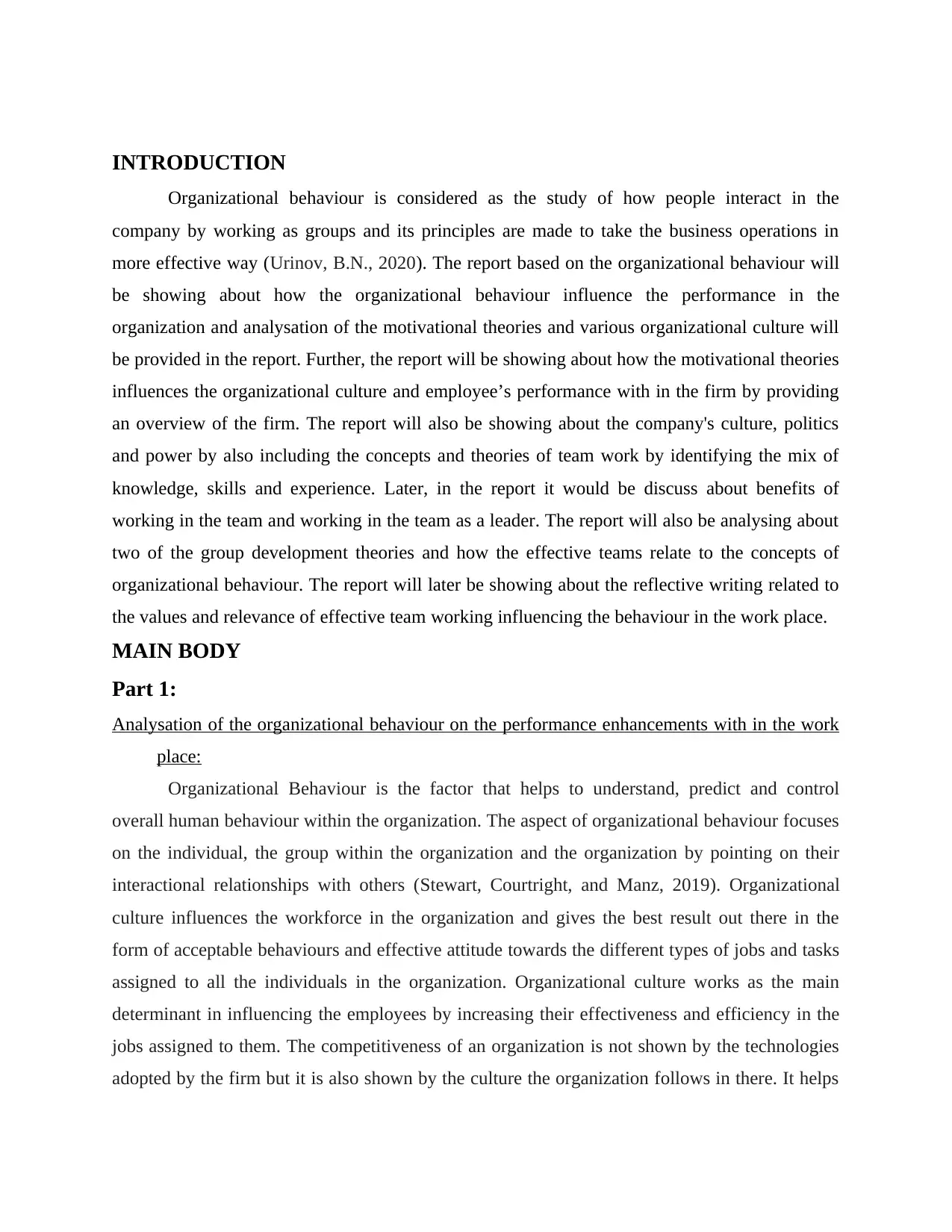
Organizational behaviour is considered as the study of how people interact in the
company by working as groups and its principles are made to take the business operations in
more effective way (Urinov, B.N., 2020). The report based on the organizational behaviour will
be showing about how the organizational behaviour influence the performance in the
organization and analysation of the motivational theories and various organizational culture will
be provided in the report. Further, the report will be showing about how the motivational theories
influences the organizational culture and employee’s performance with in the firm by providing
an overview of the firm. The report will also be showing about the company's culture, politics
and power by also including the concepts and theories of team work by identifying the mix of
knowledge, skills and experience. Later, in the report it would be discuss about benefits of
working in the team and working in the team as a leader. The report will also be analysing about
two of the group development theories and how the effective teams relate to the concepts of
organizational behaviour. The report will later be showing about the reflective writing related to
the values and relevance of effective team working influencing the behaviour in the work place.
MAIN BODY
Part 1:
Analysation of the organizational behaviour on the performance enhancements with in the work
place:
Organizational Behaviour is the factor that helps to understand, predict and control
overall human behaviour within the organization. The aspect of organizational behaviour focuses
on the individual, the group within the organization and the organization by pointing on their
interactional relationships with others (Stewart, Courtright, and Manz, 2019). Organizational
culture influences the workforce in the organization and gives the best result out there in the
form of acceptable behaviours and effective attitude towards the different types of jobs and tasks
assigned to all the individuals in the organization. Organizational culture works as the main
determinant in influencing the employees by increasing their effectiveness and efficiency in the
jobs assigned to them. The competitiveness of an organization is not shown by the technologies
adopted by the firm but it is also shown by the culture the organization follows in there. It helps
Organizational behaviour is considered as the study of how people interact in the
company by working as groups and its principles are made to take the business operations in
more effective way (Urinov, B.N., 2020). The report based on the organizational behaviour will
be showing about how the organizational behaviour influence the performance in the
organization and analysation of the motivational theories and various organizational culture will
be provided in the report. Further, the report will be showing about how the motivational theories
influences the organizational culture and employee’s performance with in the firm by providing
an overview of the firm. The report will also be showing about the company's culture, politics
and power by also including the concepts and theories of team work by identifying the mix of
knowledge, skills and experience. Later, in the report it would be discuss about benefits of
working in the team and working in the team as a leader. The report will also be analysing about
two of the group development theories and how the effective teams relate to the concepts of
organizational behaviour. The report will later be showing about the reflective writing related to
the values and relevance of effective team working influencing the behaviour in the work place.
MAIN BODY
Part 1:
Analysation of the organizational behaviour on the performance enhancements with in the work
place:
Organizational Behaviour is the factor that helps to understand, predict and control
overall human behaviour within the organization. The aspect of organizational behaviour focuses
on the individual, the group within the organization and the organization by pointing on their
interactional relationships with others (Stewart, Courtright, and Manz, 2019). Organizational
culture influences the workforce in the organization and gives the best result out there in the
form of acceptable behaviours and effective attitude towards the different types of jobs and tasks
assigned to all the individuals in the organization. Organizational culture works as the main
determinant in influencing the employees by increasing their effectiveness and efficiency in the
jobs assigned to them. The competitiveness of an organization is not shown by the technologies
adopted by the firm but it is also shown by the culture the organization follows in there. It helps
⊘ This is a preview!⊘
Do you want full access?
Subscribe today to unlock all pages.

Trusted by 1+ million students worldwide
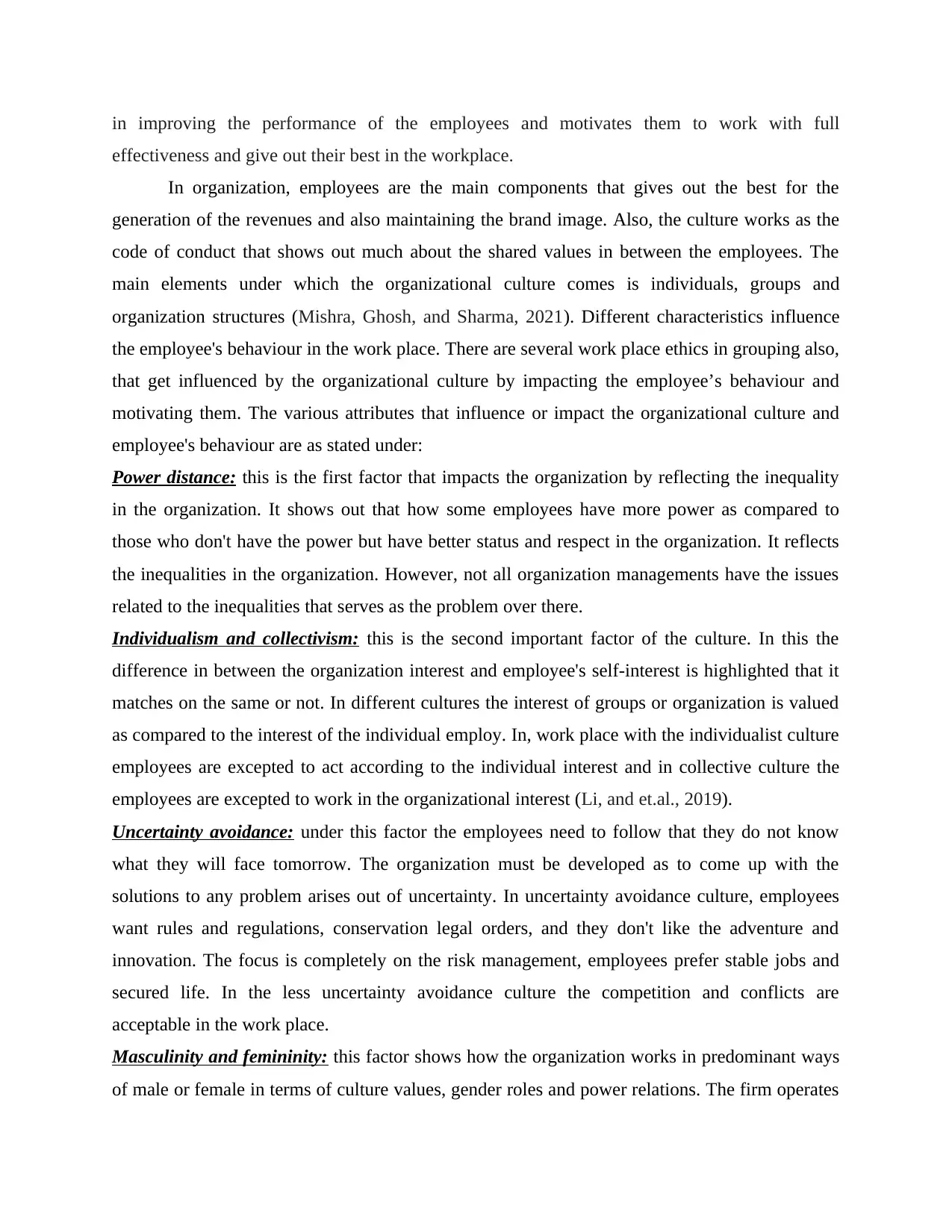
in improving the performance of the employees and motivates them to work with full
effectiveness and give out their best in the workplace.
In organization, employees are the main components that gives out the best for the
generation of the revenues and also maintaining the brand image. Also, the culture works as the
code of conduct that shows out much about the shared values in between the employees. The
main elements under which the organizational culture comes is individuals, groups and
organization structures (Mishra, Ghosh, and Sharma, 2021). Different characteristics influence
the employee's behaviour in the work place. There are several work place ethics in grouping also,
that get influenced by the organizational culture by impacting the employee’s behaviour and
motivating them. The various attributes that influence or impact the organizational culture and
employee's behaviour are as stated under:
Power distance: this is the first factor that impacts the organization by reflecting the inequality
in the organization. It shows out that how some employees have more power as compared to
those who don't have the power but have better status and respect in the organization. It reflects
the inequalities in the organization. However, not all organization managements have the issues
related to the inequalities that serves as the problem over there.
Individualism and collectivism: this is the second important factor of the culture. In this the
difference in between the organization interest and employee's self-interest is highlighted that it
matches on the same or not. In different cultures the interest of groups or organization is valued
as compared to the interest of the individual employ. In, work place with the individualist culture
employees are excepted to act according to the individual interest and in collective culture the
employees are excepted to work in the organizational interest (Li, and et.al., 2019).
Uncertainty avoidance: under this factor the employees need to follow that they do not know
what they will face tomorrow. The organization must be developed as to come up with the
solutions to any problem arises out of uncertainty. In uncertainty avoidance culture, employees
want rules and regulations, conservation legal orders, and they don't like the adventure and
innovation. The focus is completely on the risk management, employees prefer stable jobs and
secured life. In the less uncertainty avoidance culture the competition and conflicts are
acceptable in the work place.
Masculinity and femininity: this factor shows how the organization works in predominant ways
of male or female in terms of culture values, gender roles and power relations. The firm operates
effectiveness and give out their best in the workplace.
In organization, employees are the main components that gives out the best for the
generation of the revenues and also maintaining the brand image. Also, the culture works as the
code of conduct that shows out much about the shared values in between the employees. The
main elements under which the organizational culture comes is individuals, groups and
organization structures (Mishra, Ghosh, and Sharma, 2021). Different characteristics influence
the employee's behaviour in the work place. There are several work place ethics in grouping also,
that get influenced by the organizational culture by impacting the employee’s behaviour and
motivating them. The various attributes that influence or impact the organizational culture and
employee's behaviour are as stated under:
Power distance: this is the first factor that impacts the organization by reflecting the inequality
in the organization. It shows out that how some employees have more power as compared to
those who don't have the power but have better status and respect in the organization. It reflects
the inequalities in the organization. However, not all organization managements have the issues
related to the inequalities that serves as the problem over there.
Individualism and collectivism: this is the second important factor of the culture. In this the
difference in between the organization interest and employee's self-interest is highlighted that it
matches on the same or not. In different cultures the interest of groups or organization is valued
as compared to the interest of the individual employ. In, work place with the individualist culture
employees are excepted to act according to the individual interest and in collective culture the
employees are excepted to work in the organizational interest (Li, and et.al., 2019).
Uncertainty avoidance: under this factor the employees need to follow that they do not know
what they will face tomorrow. The organization must be developed as to come up with the
solutions to any problem arises out of uncertainty. In uncertainty avoidance culture, employees
want rules and regulations, conservation legal orders, and they don't like the adventure and
innovation. The focus is completely on the risk management, employees prefer stable jobs and
secured life. In the less uncertainty avoidance culture the competition and conflicts are
acceptable in the work place.
Masculinity and femininity: this factor shows how the organization works in predominant ways
of male or female in terms of culture values, gender roles and power relations. The firm operates
Paraphrase This Document
Need a fresh take? Get an instant paraphrase of this document with our AI Paraphraser
with both of the male and female employees and by determining the quantity of the employees
on the basis of different organization. Under this culture, jobs are allotted according to the males
and females in a way as per the tasks available and as per their personal capabilities. As per this
culture the chances of achieving in the goals and objectives are relatively high as compared to
any other culture. The employees performing under this culture performs with their better
capabilities and earns up more of the rewards as compared to their different attributes (Morin,
Maranon, and Litalien, 2020).
Organizational culture includes the moral to perform in the firm, law and regulation, and
custom, shaped for the employee behaviour. These are some facts that are transferred from the
old generation to the new generations. This is the aspect that helps all the employees to
differentiate themselves from the employees of the different company. The culture and the frame
work within the organization plays an important role to improve the performance and the
attributes to perform in the organization. Properly managed and improved work culture in the
organization could help and motivate all the employees to improve their overall efficiency and
work for achieving the personal and organizational objectives.
Discussing the various organizational cultures and theories related to the organization “Unilever
PLC.”:
There are different types of the organizational cultures that can be used within the organization
to have the smooth functioning and proper development within the firm, and can help to have the
proper results are discussed below:
Clan culture: this is the type of culture that helps the organization by offering in the friendly
working environment and behaviours in the company are maintained in the way that it seems like
the relationships, participation in different activities and tasks looks easy to be performed with in
the organization. The leaders that adopt this culture in the organization are considered to be one
of the best leaders as they are seen as the mentors and not the figure heads that only guides
towards the works. The clan culture is also called as collaborate culture (Lubis, and Hanum,
2020).
Pros: team's likes to work in good ways under this culture and facilitates a happy culture in
between the employees.
Cons: having more collaboration can turn the productivity towards the back foot.
on the basis of different organization. Under this culture, jobs are allotted according to the males
and females in a way as per the tasks available and as per their personal capabilities. As per this
culture the chances of achieving in the goals and objectives are relatively high as compared to
any other culture. The employees performing under this culture performs with their better
capabilities and earns up more of the rewards as compared to their different attributes (Morin,
Maranon, and Litalien, 2020).
Organizational culture includes the moral to perform in the firm, law and regulation, and
custom, shaped for the employee behaviour. These are some facts that are transferred from the
old generation to the new generations. This is the aspect that helps all the employees to
differentiate themselves from the employees of the different company. The culture and the frame
work within the organization plays an important role to improve the performance and the
attributes to perform in the organization. Properly managed and improved work culture in the
organization could help and motivate all the employees to improve their overall efficiency and
work for achieving the personal and organizational objectives.
Discussing the various organizational cultures and theories related to the organization “Unilever
PLC.”:
There are different types of the organizational cultures that can be used within the organization
to have the smooth functioning and proper development within the firm, and can help to have the
proper results are discussed below:
Clan culture: this is the type of culture that helps the organization by offering in the friendly
working environment and behaviours in the company are maintained in the way that it seems like
the relationships, participation in different activities and tasks looks easy to be performed with in
the organization. The leaders that adopt this culture in the organization are considered to be one
of the best leaders as they are seen as the mentors and not the figure heads that only guides
towards the works. The clan culture is also called as collaborate culture (Lubis, and Hanum,
2020).
Pros: team's likes to work in good ways under this culture and facilitates a happy culture in
between the employees.
Cons: having more collaboration can turn the productivity towards the back foot.
Adhocracy culture: this is the culture that is adopted by most of the start-ups and this focuses
on moving in fast and breaking in the things. This culture is also called as create culture. Under
this culture the employees are motivated to take the risks and to pursue the off the wall ideas.
This culture helps to have more of the innovation and learning and growth within the
organization related to the personal development of the employees and development of the
organization too.
Pros: provides with the huge amount of innovation and growth in the accordance of the
increased safety in the psychological needs.
Cons: this lack stability as so much is invested in bringing new initiative and sense of
intimidation for the new employees can be experienced.
Market culture: this is also known as the compete culture because It works by emphasizing on
the results. This culture works by making people win and accomplish the results that they want
to achieve. Employees working under this company culture can be found more goal focused and
can define the success in the easy ways (Ng, 2022).
Pros: the employees are more performance freak and focused towards the work.
Cons: encouragement of the constant competition can make the working environment toxic.
Hierarchy culture: this is also known as the control culture and is implemented in the work
environment that is more structured and focused on process. Under this culture more of the
cultures are dictated towards the existing procedures and does not work accordingly to bring in
new ideas and have free thinking.
Pros: lot of clarity can be experienced in the communication and expectation.
Cons: the environment can become inflexible and might be unsupportive even.
The Maslow's motivational theory influencing the organizational culture and the employee's
performance in the context of the firm “Unilever plc.”:
Physiological needs: this factor considered to all the biological necessities that are required for
the humans like food, sex, shelter, clothing, warmth, sleep, air, & drink etc. these all factors are
the one that makes the human survival easy. This all the things quoted are considered to be the
important as compared to any other needs and wants that are required by humans for their
survival (Marchisotti, Domingos, and ALMEIDA, 2018).
on moving in fast and breaking in the things. This culture is also called as create culture. Under
this culture the employees are motivated to take the risks and to pursue the off the wall ideas.
This culture helps to have more of the innovation and learning and growth within the
organization related to the personal development of the employees and development of the
organization too.
Pros: provides with the huge amount of innovation and growth in the accordance of the
increased safety in the psychological needs.
Cons: this lack stability as so much is invested in bringing new initiative and sense of
intimidation for the new employees can be experienced.
Market culture: this is also known as the compete culture because It works by emphasizing on
the results. This culture works by making people win and accomplish the results that they want
to achieve. Employees working under this company culture can be found more goal focused and
can define the success in the easy ways (Ng, 2022).
Pros: the employees are more performance freak and focused towards the work.
Cons: encouragement of the constant competition can make the working environment toxic.
Hierarchy culture: this is also known as the control culture and is implemented in the work
environment that is more structured and focused on process. Under this culture more of the
cultures are dictated towards the existing procedures and does not work accordingly to bring in
new ideas and have free thinking.
Pros: lot of clarity can be experienced in the communication and expectation.
Cons: the environment can become inflexible and might be unsupportive even.
The Maslow's motivational theory influencing the organizational culture and the employee's
performance in the context of the firm “Unilever plc.”:
Physiological needs: this factor considered to all the biological necessities that are required for
the humans like food, sex, shelter, clothing, warmth, sleep, air, & drink etc. these all factors are
the one that makes the human survival easy. This all the things quoted are considered to be the
important as compared to any other needs and wants that are required by humans for their
survival (Marchisotti, Domingos, and ALMEIDA, 2018).
⊘ This is a preview!⊘
Do you want full access?
Subscribe today to unlock all pages.
Trusted by 1+ million students worldwide
Safety needs: the safety needs are taken in to count once the psychological needs have been
fulfilled. Individual has to put efforts to experience over the order, control and predictability of
their lives. These needs are fulfilled by the close ones of the daily life like the police, businesses,
hospitals and education institutions, etc. The safety needs primarily consist emotional & financial
security, independence, property, well-being and health of the individual (Rao, Kulshrestha, and
Ramakrishnan, 2019).
Belongingness needs: the needs of the belongingness are considered to all the emotional needs
and the requirements that is needed by individual like to be included in the group meetings be the
part of team tasks, etc. The needs of belongingness include friendships, trust, and acceptance.
This is consisting of giving and taking in the things with affection.
Esteem needs: this needs are considered to the self-satisfaction requirements like self-respect,
personal attributes, etc. These needs are categorized into three different aspects which are esteem
needs and desire from the reputation and respects from fellow mates. Fulfilment of these needs
within the organization denotes that respect and dignity for the employee within the organization
is an important element (Shen, and et.al., 2021).
Self-actualization needs: the term of the self-actualization needs focus on the accomplishment
of the person's potential, self-fulfilment and the experiences. These needs are taken in the count
as the individual can do anything to make him/her show the odd one out.
Recommendations: thus as seen per above discussion the firm can have in the clan culture
within the organization that would help the firm to develop accordingly with the development of
their employees. This would help the firm to have all the development and enhancements in the
overall procedures (Steck, 2018). By working under this culture the company would be making
its employees to learn about the organizational goals and objective and make them develop the
abilities that can make them help the organization to achieve the objectives. The firm by
operating in the clan culture can have the most of the beneficial work force in their work place.
Under this culture the firm by adopting the need hierarchy theory of the Maslow can facilitate the
proper outcomes in the work place by giving all the facilities to the employees and fulfilling their
all needs. This would help the organization to keep their employees motivated and to have the
proper business operations.
fulfilled. Individual has to put efforts to experience over the order, control and predictability of
their lives. These needs are fulfilled by the close ones of the daily life like the police, businesses,
hospitals and education institutions, etc. The safety needs primarily consist emotional & financial
security, independence, property, well-being and health of the individual (Rao, Kulshrestha, and
Ramakrishnan, 2019).
Belongingness needs: the needs of the belongingness are considered to all the emotional needs
and the requirements that is needed by individual like to be included in the group meetings be the
part of team tasks, etc. The needs of belongingness include friendships, trust, and acceptance.
This is consisting of giving and taking in the things with affection.
Esteem needs: this needs are considered to the self-satisfaction requirements like self-respect,
personal attributes, etc. These needs are categorized into three different aspects which are esteem
needs and desire from the reputation and respects from fellow mates. Fulfilment of these needs
within the organization denotes that respect and dignity for the employee within the organization
is an important element (Shen, and et.al., 2021).
Self-actualization needs: the term of the self-actualization needs focus on the accomplishment
of the person's potential, self-fulfilment and the experiences. These needs are taken in the count
as the individual can do anything to make him/her show the odd one out.
Recommendations: thus as seen per above discussion the firm can have in the clan culture
within the organization that would help the firm to develop accordingly with the development of
their employees. This would help the firm to have all the development and enhancements in the
overall procedures (Steck, 2018). By working under this culture the company would be making
its employees to learn about the organizational goals and objective and make them develop the
abilities that can make them help the organization to achieve the objectives. The firm by
operating in the clan culture can have the most of the beneficial work force in their work place.
Under this culture the firm by adopting the need hierarchy theory of the Maslow can facilitate the
proper outcomes in the work place by giving all the facilities to the employees and fulfilling their
all needs. This would help the organization to keep their employees motivated and to have the
proper business operations.
Paraphrase This Document
Need a fresh take? Get an instant paraphrase of this document with our AI Paraphraser
Providing an overview of the Unilever plc.'s culture, politics and power of the organization
“Unilever PLC.”:
The firm follows the clan culture and the main motive of the firm is to serve the people by using
the data from social media and then presenting the work by changing and innovating the
products and services as per the needs and wants or by going trends in the market. This makes to
have a healthy relationship with in the market with their potential customers and by managing
the operations in this type of conditions the employees can bring in more ideas that could be
enhancing productivity in the company (Murphy, and Murphy, 2018).
Unilever plc. Have the powerful work culture that is properly followed by the employees within
the organization. The firm have also done some of the major changes to align the working
process of the company. Example: the firm by adopting the clan culture facilitated the best of
them with their employees and their potentially targeted market, this also makes the firm to have
commonality in the goals to be achieved.
Organizational politics is considered as the personal matter of the company. The politics
in the firm is influencing the culture of the organization and politics with in the firm consists of
factors like self-promotion, factionalism and office politics, etc. if the politics followed in the
firm is good and stable it will be benefiting to the employees as well as the organization itself.
Example: if the person in the organization is getting promoted with the help of personal relations
then the firm is following in the bad politics and this need to be taken care off and the person
with the real abilities should be promoted.
The organizational power refers to the ability of the higher authorities and the colleagues in the
organization to influence the behaviour of the various stake holders of the organization.
Example: the higher managing authority in the firm can allot the tasks to the individual as per the
abilities of the individuals but the employees working on the lower levels cannot do this.
PART 2
Advantages of Working in Team
Better Problem Solving – There are various problems that are faced by organizations in
their routine functioning. Such problems need to be addressed for ensuring the
competitive advantage of the company in the industry. Individual employees may face
problems in resolving or overcoming every problem but working in teams involves
“Unilever PLC.”:
The firm follows the clan culture and the main motive of the firm is to serve the people by using
the data from social media and then presenting the work by changing and innovating the
products and services as per the needs and wants or by going trends in the market. This makes to
have a healthy relationship with in the market with their potential customers and by managing
the operations in this type of conditions the employees can bring in more ideas that could be
enhancing productivity in the company (Murphy, and Murphy, 2018).
Unilever plc. Have the powerful work culture that is properly followed by the employees within
the organization. The firm have also done some of the major changes to align the working
process of the company. Example: the firm by adopting the clan culture facilitated the best of
them with their employees and their potentially targeted market, this also makes the firm to have
commonality in the goals to be achieved.
Organizational politics is considered as the personal matter of the company. The politics
in the firm is influencing the culture of the organization and politics with in the firm consists of
factors like self-promotion, factionalism and office politics, etc. if the politics followed in the
firm is good and stable it will be benefiting to the employees as well as the organization itself.
Example: if the person in the organization is getting promoted with the help of personal relations
then the firm is following in the bad politics and this need to be taken care off and the person
with the real abilities should be promoted.
The organizational power refers to the ability of the higher authorities and the colleagues in the
organization to influence the behaviour of the various stake holders of the organization.
Example: the higher managing authority in the firm can allot the tasks to the individual as per the
abilities of the individuals but the employees working on the lower levels cannot do this.
PART 2
Advantages of Working in Team
Better Problem Solving – There are various problems that are faced by organizations in
their routine functioning. Such problems need to be addressed for ensuring the
competitive advantage of the company in the industry. Individual employees may face
problems in resolving or overcoming every problem but working in teams involves

advantage of expertise by different members on different areas (Zhang and et.al., 2021).
Expertise treatment of problem is more likely to happen while working in teams.
Innovation Potential Enhancements – Most of the innovations takes place at the
intersection point. The point where the ideas and thoughts of people from different
backgrounds and culture interacts with each other is referred to as the point of
intersection.
Reduction in Mistakes – The another benefit associated with team work is that the
members working in a team makes fewer mistake. This is because of the reasons that the
minor mistakes by one can be corrected by the efforts of many.
Better creativity – During the brainstorming process in groups ideas generating from
different perspectives come together. Open and collaborative team discussions leads to
generation of more creative solutions in response to the issues that arises.
Teamwork benefits to Leader
Systematized Working – The advantage of team work to the leader is that whenever a
work is performed by forming of teams, it is completed in more organized and structured
manner. Further in cases of adverse results this systematic working makes it easier to
identify the person who is at fault or responsible for it.
Growth Opportunities – It is also one of the major advantage to the leader of company
with respect to teamwork. Every team member being expert at one or the other aspect
creates greater level of potentiality of success with respect to the project that is allotted to
the team (Wegge and Kemter-Hofmann, 2022). An organization gets greater scope to
take up more diverse projects and make them successful and get more returns. Such
returns increase the growth prospects of the company.
Communication Gaps – Working in a team effectively leaves no space for
communication gaps. Such a form of working enables understanding among the
individuals of each member in team so the conflicts or undesired activities are avoided
easily.
Employee Engagement – For the growth of business organization ensuring that
employees engage into the organizational activities and functions increasingly with
enthusiasm is very important after retaining its employees in the company. Effective team
work ensures that each and every member is contributing his part of work.
Expertise treatment of problem is more likely to happen while working in teams.
Innovation Potential Enhancements – Most of the innovations takes place at the
intersection point. The point where the ideas and thoughts of people from different
backgrounds and culture interacts with each other is referred to as the point of
intersection.
Reduction in Mistakes – The another benefit associated with team work is that the
members working in a team makes fewer mistake. This is because of the reasons that the
minor mistakes by one can be corrected by the efforts of many.
Better creativity – During the brainstorming process in groups ideas generating from
different perspectives come together. Open and collaborative team discussions leads to
generation of more creative solutions in response to the issues that arises.
Teamwork benefits to Leader
Systematized Working – The advantage of team work to the leader is that whenever a
work is performed by forming of teams, it is completed in more organized and structured
manner. Further in cases of adverse results this systematic working makes it easier to
identify the person who is at fault or responsible for it.
Growth Opportunities – It is also one of the major advantage to the leader of company
with respect to teamwork. Every team member being expert at one or the other aspect
creates greater level of potentiality of success with respect to the project that is allotted to
the team (Wegge and Kemter-Hofmann, 2022). An organization gets greater scope to
take up more diverse projects and make them successful and get more returns. Such
returns increase the growth prospects of the company.
Communication Gaps – Working in a team effectively leaves no space for
communication gaps. Such a form of working enables understanding among the
individuals of each member in team so the conflicts or undesired activities are avoided
easily.
Employee Engagement – For the growth of business organization ensuring that
employees engage into the organizational activities and functions increasingly with
enthusiasm is very important after retaining its employees in the company. Effective team
work ensures that each and every member is contributing his part of work.
⊘ This is a preview!⊘
Do you want full access?
Subscribe today to unlock all pages.
Trusted by 1+ million students worldwide
Teamwork benefits to team members
Enhanced Personal Growth – One of the most important benefit of working in a team to
the team members is the enhance level of personal growth. Interacting with the other
members of the team allows a particular team member to learn from their experiences,
knowledge, skills, abilities and talents. These no doubt increases the scope and pace of
personal development for each and every member working in the team.
Less Burnout – Having too much load over a single person is the main reason for the
employees feeling exhausted, stressed and burnout at the workplace. Benefits of working
in a team to its members include the advantage of getting the entire work to be done
being shared among all the members (Phina and et.al., 2018). This results in building of
mutual trust, and belongingness between the team members.
Increase in Productivity – Another advantage of team work is increase in productivity.
More people working together means that the motivation is high resulting is obtaining
enhanced outcomes. The level of communication is much better in team work which
makes it possible to deliver the results on time. The quality of output is enhanced by
effective team work.
Group Development Theories
BELBIN THEORY
The effective team performance is possible through clear assignment of roles and
responsibilities to each member. Belbin has given certain roles that are needed to be clearly
assigned among the team members in order to achieve harmony in work. The purpose is to make
the impact of weaknesses of the members in a team over the final output negligible. There must
of complete understanding among the team members with respect to their roles so that they can
minimize the weaknesses and effectively demonstrate their strengths in work they perform.
There are nine team roles according to this theory (Lynch, Lynch and Clemens, 2018). To begin
with the foremost role is resource investigator which means the role of introducing new ideas
into the team. Second role is the team worker role that ensures that the team works together for
ensuring that work gets done. The coordinator role means that the efforts of each team member
coordinates with every other member. Plan role means to outline the best possible solution for
handling complex problem. Monitor Evaluator role is the role of considering each members’
function and evaluating it effectively. The role of specialist is assigned to someone who has
Enhanced Personal Growth – One of the most important benefit of working in a team to
the team members is the enhance level of personal growth. Interacting with the other
members of the team allows a particular team member to learn from their experiences,
knowledge, skills, abilities and talents. These no doubt increases the scope and pace of
personal development for each and every member working in the team.
Less Burnout – Having too much load over a single person is the main reason for the
employees feeling exhausted, stressed and burnout at the workplace. Benefits of working
in a team to its members include the advantage of getting the entire work to be done
being shared among all the members (Phina and et.al., 2018). This results in building of
mutual trust, and belongingness between the team members.
Increase in Productivity – Another advantage of team work is increase in productivity.
More people working together means that the motivation is high resulting is obtaining
enhanced outcomes. The level of communication is much better in team work which
makes it possible to deliver the results on time. The quality of output is enhanced by
effective team work.
Group Development Theories
BELBIN THEORY
The effective team performance is possible through clear assignment of roles and
responsibilities to each member. Belbin has given certain roles that are needed to be clearly
assigned among the team members in order to achieve harmony in work. The purpose is to make
the impact of weaknesses of the members in a team over the final output negligible. There must
of complete understanding among the team members with respect to their roles so that they can
minimize the weaknesses and effectively demonstrate their strengths in work they perform.
There are nine team roles according to this theory (Lynch, Lynch and Clemens, 2018). To begin
with the foremost role is resource investigator which means the role of introducing new ideas
into the team. Second role is the team worker role that ensures that the team works together for
ensuring that work gets done. The coordinator role means that the efforts of each team member
coordinates with every other member. Plan role means to outline the best possible solution for
handling complex problem. Monitor Evaluator role is the role of considering each members’
function and evaluating it effectively. The role of specialist is assigned to someone who has
Paraphrase This Document
Need a fresh take? Get an instant paraphrase of this document with our AI Paraphraser
expertise on the key areas. The shaper role is performed by a team who can shape the efforts of
each member in achieving the ultimate goal. The planner of the team is known as handling or
performing the role of implementer. That team member who ensures that quality deliverables get
delivered by the team is called completer Finisher.
TUCKMAN THEORY
The theory suggests that there are five stages of team development. First is Forming
which is concerned with the team members’ introduction to one another. This includes
discussion over common topics such as skills they possess, their interests, background, etc.
Storming stage is where the concerns and discontentment of the team members are included,
requiring guidance of team leader (Robb, 2022). Norming stage is concerned with synchronizing
of team efforts with the goal to be achieved. Performing stage considers the awareness of
strengths and weaknesses of each team member to motivate them and accomplish the goals. Last
stage is Adjourning which is related to the disbanding of team after the completion of the project.
Relation of Effective Teams with The Organizational Behaviour Concepts
Organization Behaviour is based on certain fundamental concepts.
The first concept is the concept of Individual Differences. It means that each individual is
different and unique on its own right from the birth of such individual. Every person has
different experience in their life which creates great difference in their perspectives,
ideas, etc. from any other person. The personality, intelligence, abilities, talents are
different from person to person. It is linked with the effective team working in Uniliver as
the teams formed with the organization involves people of different talents and
backgrounds.
The next concept is called whole person, meaning that when an individual is hired within
an organization the skills, abilities, experience of the individual along with the pride,
likes, dislikes and prejudices (Buchanan and Huczynski, 2019). These attributed are not
possible to be separated all together from one person. This concept is related with
effective team work in Uniliver because the team leaders assign the tasks to each team
member by considering whole of their attributes.
Next is the concept of caused behaviour, interpreted as their always exist certain reason
behind any particular action by an individual. The behaviour of the team member in
Uniliver depends upon the actions taken by the leader.
each member in achieving the ultimate goal. The planner of the team is known as handling or
performing the role of implementer. That team member who ensures that quality deliverables get
delivered by the team is called completer Finisher.
TUCKMAN THEORY
The theory suggests that there are five stages of team development. First is Forming
which is concerned with the team members’ introduction to one another. This includes
discussion over common topics such as skills they possess, their interests, background, etc.
Storming stage is where the concerns and discontentment of the team members are included,
requiring guidance of team leader (Robb, 2022). Norming stage is concerned with synchronizing
of team efforts with the goal to be achieved. Performing stage considers the awareness of
strengths and weaknesses of each team member to motivate them and accomplish the goals. Last
stage is Adjourning which is related to the disbanding of team after the completion of the project.
Relation of Effective Teams with The Organizational Behaviour Concepts
Organization Behaviour is based on certain fundamental concepts.
The first concept is the concept of Individual Differences. It means that each individual is
different and unique on its own right from the birth of such individual. Every person has
different experience in their life which creates great difference in their perspectives,
ideas, etc. from any other person. The personality, intelligence, abilities, talents are
different from person to person. It is linked with the effective team working in Uniliver as
the teams formed with the organization involves people of different talents and
backgrounds.
The next concept is called whole person, meaning that when an individual is hired within
an organization the skills, abilities, experience of the individual along with the pride,
likes, dislikes and prejudices (Buchanan and Huczynski, 2019). These attributed are not
possible to be separated all together from one person. This concept is related with
effective team work in Uniliver because the team leaders assign the tasks to each team
member by considering whole of their attributes.
Next is the concept of caused behaviour, interpreted as their always exist certain reason
behind any particular action by an individual. The behaviour of the team member in
Uniliver depends upon the actions taken by the leader.
Human Dignity is the next concept of OB, means that there is need to treat each person
differently. In an organization there are number of persons working at different
designations giving them their status and power. Each employee of Uniliver is ensured to
be treated with respect and dignity irrespective of their position.
Organization are social systems is another concept outlining that the organizational
activities are also governed by the psychological and social laws. In an organization
informal system exist along with the formal systems which are dependent on one another.
Effective team leader of the company makes use of both the systems to get the quality
output.
Mutuality of interest is the second last concept of OB, stating that the need is mutual. To
be more clear organization needs employees in a same way and capacity the employees
need organization. Hence the goals of an organization must align with the individual
goals of the employees (Chitale, Mohanty and Dubey, 2019). Effective team working at
Uniliver is related to this concept of OB as the achievement of individual goals of
members is linked with the accomplishment of goals of the company.
The last concept of OB is named as holistic concept. The attainment of this concept is
widest as it is achieved only when all the above mentioned six concepts are attained. The
relation of all above six principles into the effective teams indirectly means relation of
this concept.
Critical Reflection
On the basis of the above in depth study I have concluded that the effective working of
corporates is ensured through effective team work. I have understood that such a pattern of
working is not only beneficial to the organization but also to the leader and members of such
teams. There are various theories that can be used for the purpose of development of teams. Two
such theories have been discussed in the above study. The Belbin’s theory is based on the ideal
areas of role that are needed to be assigned to different members of the team in order to achieve
the results that are expected. And the Tuckman theory describes that the team is developed with
the different events that takes place. The way in which the effective teams relate with the various
concepts of OB has been analysed by me.
differently. In an organization there are number of persons working at different
designations giving them their status and power. Each employee of Uniliver is ensured to
be treated with respect and dignity irrespective of their position.
Organization are social systems is another concept outlining that the organizational
activities are also governed by the psychological and social laws. In an organization
informal system exist along with the formal systems which are dependent on one another.
Effective team leader of the company makes use of both the systems to get the quality
output.
Mutuality of interest is the second last concept of OB, stating that the need is mutual. To
be more clear organization needs employees in a same way and capacity the employees
need organization. Hence the goals of an organization must align with the individual
goals of the employees (Chitale, Mohanty and Dubey, 2019). Effective team working at
Uniliver is related to this concept of OB as the achievement of individual goals of
members is linked with the accomplishment of goals of the company.
The last concept of OB is named as holistic concept. The attainment of this concept is
widest as it is achieved only when all the above mentioned six concepts are attained. The
relation of all above six principles into the effective teams indirectly means relation of
this concept.
Critical Reflection
On the basis of the above in depth study I have concluded that the effective working of
corporates is ensured through effective team work. I have understood that such a pattern of
working is not only beneficial to the organization but also to the leader and members of such
teams. There are various theories that can be used for the purpose of development of teams. Two
such theories have been discussed in the above study. The Belbin’s theory is based on the ideal
areas of role that are needed to be assigned to different members of the team in order to achieve
the results that are expected. And the Tuckman theory describes that the team is developed with
the different events that takes place. The way in which the effective teams relate with the various
concepts of OB has been analysed by me.
⊘ This is a preview!⊘
Do you want full access?
Subscribe today to unlock all pages.
Trusted by 1+ million students worldwide

1 out of 15


Related Documents


Your All-in-One AI-Powered Toolkit for Academic Success.
+13062052269
info@desklib.com
Available 24*7 on WhatsApp / Email
![[object Object]](/_next/static/media/star-bottom.7253800d.svg)
Unlock your academic potential
Copyright © 2020–2026 A2Z Services. All Rights Reserved. Developed and managed by ZUCOL.