Analysis of Organizational Behaviour and Motivation at 4Com PLC
VerifiedAdded on 2020/10/05
|15
|4462
|113
Report
AI Summary
This report provides a comprehensive analysis of organizational behaviour within 4Com PLC, a UK-based communication and networking services provider. It explores the significant impact of organizational culture, power dynamics, and political factors on employee behaviour, emphasizing the importance of cultural diversity, effective communication, and equitable distribution of authority. The report examines the motivational strategies employed by 4Com PLC, including rewards, recognition, and feedback, and evaluates the application of Maslow's Hierarchy of Needs, McClelland's Achievement Theory, and Skinner's Reinforcement Theory. Furthermore, it discusses the importance of cooperation and coordination within teams, highlighting how these factors contribute to achieving business goals. The report concludes by evaluating the various philosophies and concepts related to organizational behaviour, offering insights into how companies can meet their specific requirements and foster a positive and productive work environment. The analysis emphasizes the crucial role of leadership in shaping employee behaviour and the importance of creating a supportive and inclusive culture to drive innovation and long-term growth. The report also highlights how insufficient motivation can lead to reduced employee performance and emphasizes the need for companies to monitor individual performance and provide appropriate rewards and recognition.
UNIT 12
ORGANISATIONAL
BEHAVIOUR
ORGANISATIONAL
BEHAVIOUR

Paraphrase This Document
Need a fresh take? Get an instant paraphrase of this document with our AI Paraphraser
Table of Contents
INTRODUCTION..........................................................................................................................1
LO 1 ................................................................................................................................................1
Role of culture, power and politics on organisational behaviour ...............................................1
LO 2 ................................................................................................................................................3
Impact of motivational theories on performance of individuals and teams ...............................3
LO 3 ................................................................................................................................................8
Cooperation and coordination among teams ..............................................................................8
LO 4 ................................................................................................................................................9
Philosophies and concepts of organisational behaviour .............................................................9
CONCLUSION .............................................................................................................................11
REFERENCES .............................................................................................................................12
INTRODUCTION..........................................................................................................................1
LO 1 ................................................................................................................................................1
Role of culture, power and politics on organisational behaviour ...............................................1
LO 2 ................................................................................................................................................3
Impact of motivational theories on performance of individuals and teams ...............................3
LO 3 ................................................................................................................................................8
Cooperation and coordination among teams ..............................................................................8
LO 4 ................................................................................................................................................9
Philosophies and concepts of organisational behaviour .............................................................9
CONCLUSION .............................................................................................................................11
REFERENCES .............................................................................................................................12
INTRODUCTION
Organisational behaviour is defined as the way through which individuals behave in
organisations within corporate and team culture. For successfully achieving goals it is important
that all employees of organisation works in cooperation which is possible only when their
behaviour skills are defined and follows the ethics of organisation. The behaviour of individuals
in organisation is influenced by various factors and can significantly affect the performance of
employees as well as organisation (Wood and et.al., 2016).
The report will discuss the impact of culture and authority on behaviours of staff
members. It will also analyse that how leaders of 4 Com plc use different motivational strategies
to motivate their team members. 4Com plc is UK based organisation which aims at providing
communication and networking services. The aim of organisation is to deliver their clients highly
qualitative services so that communication facilities can be improved in the nation. The report
will also demonstrate the importance and methodologies of working with coordination and
cooperation in organisation so that business goals can be achieved in time and with available
resources. It will also evaluate the different philosophies related to organisational behaviour so
that companies can meet their requirements.
LO 1
Role of culture, power and politics on organisational behaviour
The behaviour of team members in 4Com plc is greatly affected by the cultural factors.
All individuals may have some cultural diversities. Thus, it is required that all team members and
organisational policies respect these cultural variations. 4Com plc ensure that cultural diversities
does not serve as the communication barrier between team mates. If staff members will not
understand the cultural deviations then they may not work with proper coordination and
cooperation with each other (Coccia, 2014). It will lead to reduced work quality and company
may face problems in resolving issue.
When employees are not able to manage the cultural factors then, it is also possible that
the same behaviour is reflected among customers as well. Thus, when they will deal with the
customer from other cultural background they may not understand the requirements of
consumers. Thus, the management of 4Com plc must ensure that all employees are trained to
1
Organisational behaviour is defined as the way through which individuals behave in
organisations within corporate and team culture. For successfully achieving goals it is important
that all employees of organisation works in cooperation which is possible only when their
behaviour skills are defined and follows the ethics of organisation. The behaviour of individuals
in organisation is influenced by various factors and can significantly affect the performance of
employees as well as organisation (Wood and et.al., 2016).
The report will discuss the impact of culture and authority on behaviours of staff
members. It will also analyse that how leaders of 4 Com plc use different motivational strategies
to motivate their team members. 4Com plc is UK based organisation which aims at providing
communication and networking services. The aim of organisation is to deliver their clients highly
qualitative services so that communication facilities can be improved in the nation. The report
will also demonstrate the importance and methodologies of working with coordination and
cooperation in organisation so that business goals can be achieved in time and with available
resources. It will also evaluate the different philosophies related to organisational behaviour so
that companies can meet their requirements.
LO 1
Role of culture, power and politics on organisational behaviour
The behaviour of team members in 4Com plc is greatly affected by the cultural factors.
All individuals may have some cultural diversities. Thus, it is required that all team members and
organisational policies respect these cultural variations. 4Com plc ensure that cultural diversities
does not serve as the communication barrier between team mates. If staff members will not
understand the cultural deviations then they may not work with proper coordination and
cooperation with each other (Coccia, 2014). It will lead to reduced work quality and company
may face problems in resolving issue.
When employees are not able to manage the cultural factors then, it is also possible that
the same behaviour is reflected among customers as well. Thus, when they will deal with the
customer from other cultural background they may not understand the requirements of
consumers. Thus, the management of 4Com plc must ensure that all employees are trained to
1
⊘ This is a preview!⊘
Do you want full access?
Subscribe today to unlock all pages.

Trusted by 1+ million students worldwide
manage the cultural aspects. It can also be done by strict monitoring policies which avoids any
discrimination based on culture.
On the other hand when 4Com plc values the culture of each employee then their will be
a stronger emotional bond between employees. The stronger bonding between team members
will make them more effective in problem solving skills and bringing innovation which is
essential for company's long term growth. Another factor which affect the organisational
behaviour is the authority and power.
When leaders and authorities in power have good communication and relations with other
team members then behaviour of individuals is positive towards them. In such cases employees
tend to more supportive and energetic (Kitchin, 2017). This behaviour of employees makes the
quality of operational activities highly effective. On the other hand if employees are not satisfied
with the authority and power given to their leaders then staff members of 4Com plc may not use
their skills with proficiency. In such situations the tendency of employee is to work with
minimum efficiency so that they can prove that leaders who are given power are not worthy of it.
Hence, it is very essential for 4Com plc to wisely allocate power authority.
Usually to avoid such negative behavioural aspect organisational leaders are highly
effective in communication and make every attempt to satisfy the expectations of other team
members without compromising organisational goals. 4Com plc works on the strategy that all
team members must participate in decision making so that they work for organisation with an
emotional appeal. When all team members are given authority to put their views in front of
management and power to take decisions in certain organisational attributes then employees have
more faithful behaviour towards company (Christina and et.al., 2014).
The policies of 4Com plc defines the ways in which its operational activities must be
executed and how individuals can form team. However apart from professional relations the
personal and emotional connectivity among team members is also one of the considerable factor
which can affect the performance. For instance if team members does not share any good bond
with each other than they will not be able to bring innovation or mutual agreement on matters.
The internal politics among social groups within organisation can have both positive and
negative impact on services of 4Com plc. Thus, company must ensure that all employees of
2
discrimination based on culture.
On the other hand when 4Com plc values the culture of each employee then their will be
a stronger emotional bond between employees. The stronger bonding between team members
will make them more effective in problem solving skills and bringing innovation which is
essential for company's long term growth. Another factor which affect the organisational
behaviour is the authority and power.
When leaders and authorities in power have good communication and relations with other
team members then behaviour of individuals is positive towards them. In such cases employees
tend to more supportive and energetic (Kitchin, 2017). This behaviour of employees makes the
quality of operational activities highly effective. On the other hand if employees are not satisfied
with the authority and power given to their leaders then staff members of 4Com plc may not use
their skills with proficiency. In such situations the tendency of employee is to work with
minimum efficiency so that they can prove that leaders who are given power are not worthy of it.
Hence, it is very essential for 4Com plc to wisely allocate power authority.
Usually to avoid such negative behavioural aspect organisational leaders are highly
effective in communication and make every attempt to satisfy the expectations of other team
members without compromising organisational goals. 4Com plc works on the strategy that all
team members must participate in decision making so that they work for organisation with an
emotional appeal. When all team members are given authority to put their views in front of
management and power to take decisions in certain organisational attributes then employees have
more faithful behaviour towards company (Christina and et.al., 2014).
The policies of 4Com plc defines the ways in which its operational activities must be
executed and how individuals can form team. However apart from professional relations the
personal and emotional connectivity among team members is also one of the considerable factor
which can affect the performance. For instance if team members does not share any good bond
with each other than they will not be able to bring innovation or mutual agreement on matters.
The internal politics among social groups within organisation can have both positive and
negative impact on services of 4Com plc. Thus, company must ensure that all employees of
2
Paraphrase This Document
Need a fresh take? Get an instant paraphrase of this document with our AI Paraphraser
organisation have interaction with every other individual so that compatibility and cultural issues
does not act as barrier to the growth of 4Com plc.
If 4Com plc will not consider the cultural and power related factors into management
then the internal conflicts among team members can prevent the organisation to achieve its goals
(Hashim and Wok, 2014). When customers of organisation analyse that the company does not
have control over the behaviour of employees then, they tend to avoid giving preference to such
organisation. Thus, 4Com plc must maintain a peaceful, innovative and encouraging culture so
that organisational behaviour of its employees can be helpful for organisation to achieve its
growth instead of creating barriers to it.
LO 2
Impact of motivational theories on performance of individuals and teams
The motivation is one of the most common tool used by 4Com plc to encourage its
employees. Motivation can be defined as the strategy, idea or concept which can provoke
individuals and team members to accomplish certain tasks. The motivational words from the
higher management authorities of 4Com plc inspires employees to perform their functional
activities with more effort. It also establishes a belief among employees that they have ability
and skills which can lead the development of company as well as themselves (Moerdyk and
et.al., 2015). During critical situations such as project failure or performance degradation also
company use different motivational theories to support their operational teams.
4Com plc use various techniques to motivate its employees. For instance every month
company provides staff rewards to employees which performs with excellence and have
successfully achieved their monthly targets. Such motivations in the form of rewards also creates
a healthy competition among other team members. All team members and individuals works
with their best effort so that they can get the reward and appreciation. The company uses both
positive and negative form of motivational theories which is essential for maintaining the quality
of its services along with the innovations.
For example the motivational tools such as appreciation, rewards can inspire employees
to bring more quality and innovation to achieve business goals (Junaid and Haar, 2015). On the
other hand company also uses tools such as feedbacks, ranking systems and penalties against
3
does not act as barrier to the growth of 4Com plc.
If 4Com plc will not consider the cultural and power related factors into management
then the internal conflicts among team members can prevent the organisation to achieve its goals
(Hashim and Wok, 2014). When customers of organisation analyse that the company does not
have control over the behaviour of employees then, they tend to avoid giving preference to such
organisation. Thus, 4Com plc must maintain a peaceful, innovative and encouraging culture so
that organisational behaviour of its employees can be helpful for organisation to achieve its
growth instead of creating barriers to it.
LO 2
Impact of motivational theories on performance of individuals and teams
The motivation is one of the most common tool used by 4Com plc to encourage its
employees. Motivation can be defined as the strategy, idea or concept which can provoke
individuals and team members to accomplish certain tasks. The motivational words from the
higher management authorities of 4Com plc inspires employees to perform their functional
activities with more effort. It also establishes a belief among employees that they have ability
and skills which can lead the development of company as well as themselves (Moerdyk and
et.al., 2015). During critical situations such as project failure or performance degradation also
company use different motivational theories to support their operational teams.
4Com plc use various techniques to motivate its employees. For instance every month
company provides staff rewards to employees which performs with excellence and have
successfully achieved their monthly targets. Such motivations in the form of rewards also creates
a healthy competition among other team members. All team members and individuals works
with their best effort so that they can get the reward and appreciation. The company uses both
positive and negative form of motivational theories which is essential for maintaining the quality
of its services along with the innovations.
For example the motivational tools such as appreciation, rewards can inspire employees
to bring more quality and innovation to achieve business goals (Junaid and Haar, 2015). On the
other hand company also uses tools such as feedbacks, ranking systems and penalties against
3
defaulters so that employees always have a fear that they have to maintain the necessary level of
quality otherwise they may face strict actions form the organisation.
However, it is also observed that the insufficient or inappropriate motivation can
discourage the employees and their performance can decline. For instance while working in a
team if any individual feels that his or her work is not appreciated in the team and his opinion are
not followed then their behaviour towards organisation and work may change. Such employees
may feel neglected and as a result they do not involve actively in operational activities and
decision making (Gagné and et.al., 2015). Such incidents are not beneficial for 4Com plc and
thus for avoiding such situations the company monitor the performance of every individual and
they are rewarded and appreciated on the basis of their own performance instead of their team
achievements. 4Com plc use concepts of various motivational theories for motivation purpose.
Some key theories used by organisation are as follows:
Maslow's theory of need:
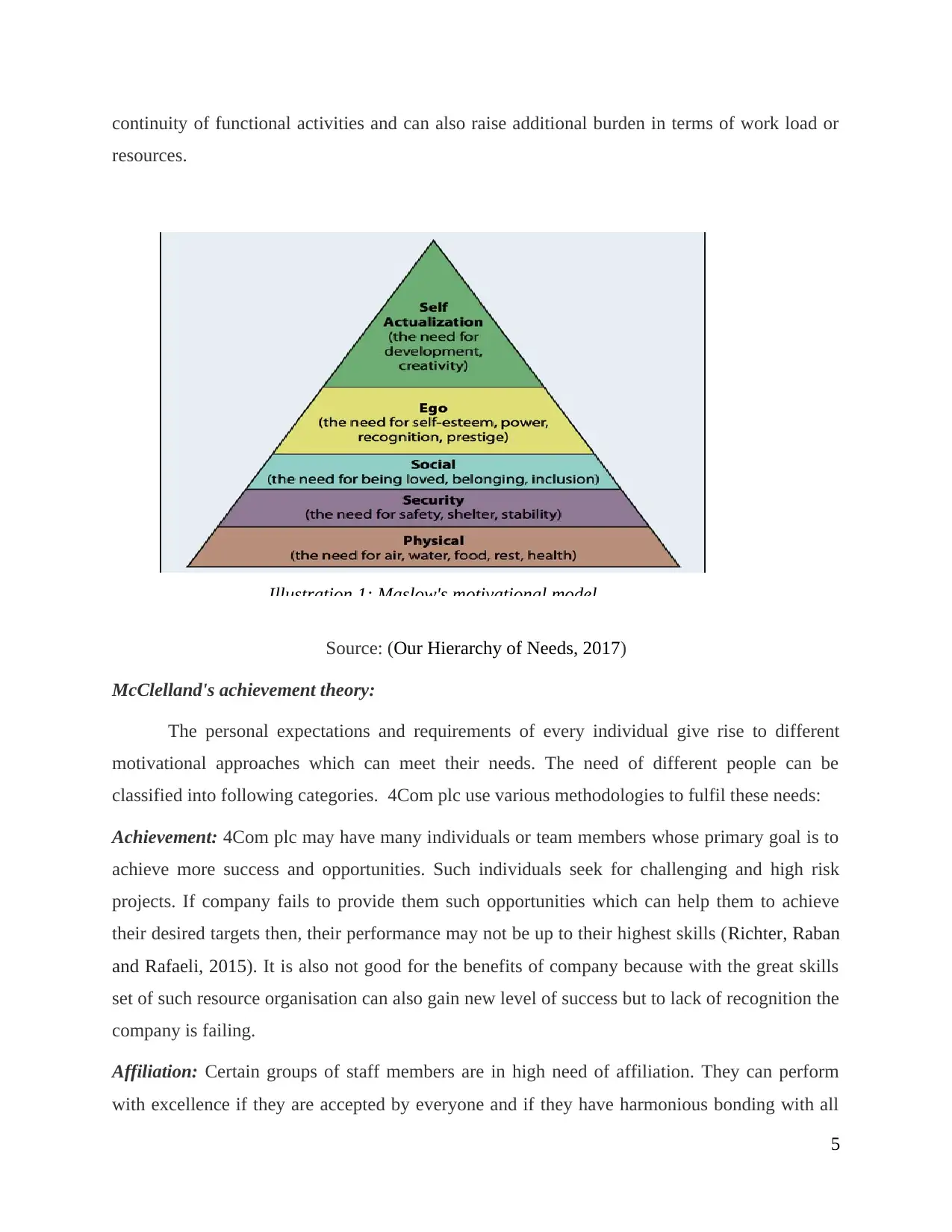
Maslow's need hierarchy can serve as the efficient model for defining the need so
individuals so that organisation can provide appropriate motivation. The self actualization needs
can be considered as the growth needs while all other needs in the model are known as basic
need. 4Com plc must first fullfil the lower level of needs in order to reach the growth needs. At
the initial level the goals of employees is to meet their basis needs. Like at the time of joining
hands with company the employees consider the facts like salary, working environment of
organisation, job security and attractive perks or facilities provided by the company.
These attributes have capability to attract the talented pool of employees within
organisation. 4Com plc ensures that its corporate culture does not encourage discriminatory
practices and all team members have easy and effective communication along with the emotional
bondings (Maslow's Hierarchy of Needs, 2018). The friendship and social circles motivates
employees to stay more hours at office. It also helps them to resolve complex issues with more
accuracy and effectiveness.
However, as soon as individuals become comfortable they realise the need of growth and
opportunities. If 4Com plc will not focus on the self actualization needs then they may not find
organisation useful for growth and can eventually quit. Such terminations can affect the
4
quality otherwise they may face strict actions form the organisation.
However, it is also observed that the insufficient or inappropriate motivation can
discourage the employees and their performance can decline. For instance while working in a
team if any individual feels that his or her work is not appreciated in the team and his opinion are
not followed then their behaviour towards organisation and work may change. Such employees
may feel neglected and as a result they do not involve actively in operational activities and
decision making (Gagné and et.al., 2015). Such incidents are not beneficial for 4Com plc and
thus for avoiding such situations the company monitor the performance of every individual and
they are rewarded and appreciated on the basis of their own performance instead of their team
achievements. 4Com plc use concepts of various motivational theories for motivation purpose.
Some key theories used by organisation are as follows:
Maslow's theory of need:
Maslow's need hierarchy can serve as the efficient model for defining the need so
individuals so that organisation can provide appropriate motivation. The self actualization needs
can be considered as the growth needs while all other needs in the model are known as basic
need. 4Com plc must first fullfil the lower level of needs in order to reach the growth needs. At
the initial level the goals of employees is to meet their basis needs. Like at the time of joining
hands with company the employees consider the facts like salary, working environment of
organisation, job security and attractive perks or facilities provided by the company.
These attributes have capability to attract the talented pool of employees within
organisation. 4Com plc ensures that its corporate culture does not encourage discriminatory
practices and all team members have easy and effective communication along with the emotional
bondings (Maslow's Hierarchy of Needs, 2018). The friendship and social circles motivates
employees to stay more hours at office. It also helps them to resolve complex issues with more
accuracy and effectiveness.
However, as soon as individuals become comfortable they realise the need of growth and
opportunities. If 4Com plc will not focus on the self actualization needs then they may not find
organisation useful for growth and can eventually quit. Such terminations can affect the
4
⊘ This is a preview!⊘
Do you want full access?
Subscribe today to unlock all pages.
Trusted by 1+ million students worldwide
continuity of functional activities and can also raise additional burden in terms of work load or
resources.
Source: (Our Hierarchy of Needs, 2017)
McClelland's achievement theory:
The personal expectations and requirements of every individual give rise to different
motivational approaches which can meet their needs. The need of different people can be
classified into following categories. 4Com plc use various methodologies to fulfil these needs:
Achievement: 4Com plc may have many individuals or team members whose primary goal is to
achieve more success and opportunities. Such individuals seek for challenging and high risk
projects. If company fails to provide them such opportunities which can help them to achieve
their desired targets then, their performance may not be up to their highest skills (Richter, Raban
and Rafaeli, 2015). It is also not good for the benefits of company because with the great skills
set of such resource organisation can also gain new level of success but to lack of recognition the
company is failing.
Affiliation: Certain groups of staff members are in high need of affiliation. They can perform
with excellence if they are accepted by everyone and if they have harmonious bonding with all
5
Illustration 1: Maslow's motivational model
resources.
Source: (Our Hierarchy of Needs, 2017)
McClelland's achievement theory:
The personal expectations and requirements of every individual give rise to different
motivational approaches which can meet their needs. The need of different people can be
classified into following categories. 4Com plc use various methodologies to fulfil these needs:
Achievement: 4Com plc may have many individuals or team members whose primary goal is to
achieve more success and opportunities. Such individuals seek for challenging and high risk
projects. If company fails to provide them such opportunities which can help them to achieve
their desired targets then, their performance may not be up to their highest skills (Richter, Raban
and Rafaeli, 2015). It is also not good for the benefits of company because with the great skills
set of such resource organisation can also gain new level of success but to lack of recognition the
company is failing.
Affiliation: Certain groups of staff members are in high need of affiliation. They can perform
with excellence if they are accepted by everyone and if they have harmonious bonding with all
5
Illustration 1: Maslow's motivational model
Paraphrase This Document
Need a fresh take? Get an instant paraphrase of this document with our AI Paraphraser
others. Thus, if 4Com plc will place such employees in customer management services or for
interaction with consumers then they can bring more effective results as compare to others.
Power: Leadership skills are the integral part of some individuals. If company will not provide
them opportunity to manage and lead others for achieving organisational goals then they may
feel neglected. It will make them less accountable and supportive to other functional activities of
company. For gaining the success 4Com plc must identify such leadership qualities in
individuals so that they can be given opportunities to lead and to show their skills. It will
generate huge confidence among such employees and they will be able to reach new levels of
quality and goals.
Skinner's reinforcement theory:
The key motivational principle used by 4Com plc is based on principle of reinforcement
theory. According to this theory the organisational behaviour can be regulated by means of
rewards or punishments. If organisation does not evaluate the performance and behaviour of
employees then team members or individuals may not make additional efforts to improve their
performance or for bringing innovations in their practices (Miner, 2015). Thus, for organisation
it will become challenging to sustain its growth or to overcome its competitive organisations.
4Com plc implement this theory in shorter intervals. For example along with appreciation
rewards to staff members every month company also takes strict disciplinary actions such as
termination or financial penalties if behaviour of employees is not in accordance with law or
company policies.
6
interaction with consumers then they can bring more effective results as compare to others.
Power: Leadership skills are the integral part of some individuals. If company will not provide
them opportunity to manage and lead others for achieving organisational goals then they may
feel neglected. It will make them less accountable and supportive to other functional activities of
company. For gaining the success 4Com plc must identify such leadership qualities in
individuals so that they can be given opportunities to lead and to show their skills. It will
generate huge confidence among such employees and they will be able to reach new levels of
quality and goals.
Skinner's reinforcement theory:
The key motivational principle used by 4Com plc is based on principle of reinforcement
theory. According to this theory the organisational behaviour can be regulated by means of
rewards or punishments. If organisation does not evaluate the performance and behaviour of
employees then team members or individuals may not make additional efforts to improve their
performance or for bringing innovations in their practices (Miner, 2015). Thus, for organisation
it will become challenging to sustain its growth or to overcome its competitive organisations.
4Com plc implement this theory in shorter intervals. For example along with appreciation
rewards to staff members every month company also takes strict disciplinary actions such as
termination or financial penalties if behaviour of employees is not in accordance with law or
company policies.
6
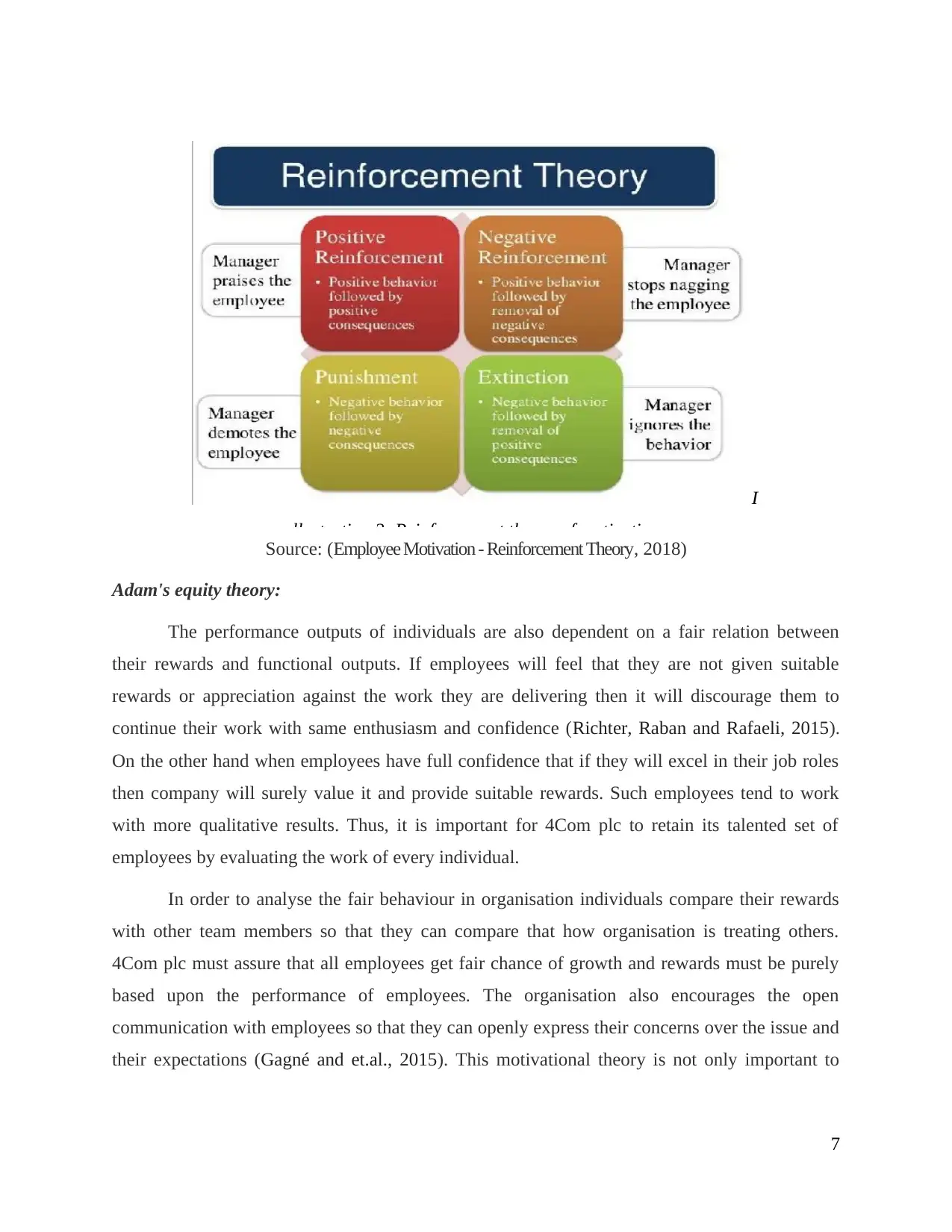
Source: (Employee Motivation - Reinforcement Theory, 2018)
Adam's equity theory:
The performance outputs of individuals are also dependent on a fair relation between
their rewards and functional outputs. If employees will feel that they are not given suitable
rewards or appreciation against the work they are delivering then it will discourage them to
continue their work with same enthusiasm and confidence (Richter, Raban and Rafaeli, 2015).
On the other hand when employees have full confidence that if they will excel in their job roles
then company will surely value it and provide suitable rewards. Such employees tend to work
with more qualitative results. Thus, it is important for 4Com plc to retain its talented set of
employees by evaluating the work of every individual.
In order to analyse the fair behaviour in organisation individuals compare their rewards
with other team members so that they can compare that how organisation is treating others.
4Com plc must assure that all employees get fair chance of growth and rewards must be purely
based upon the performance of employees. The organisation also encourages the open
communication with employees so that they can openly express their concerns over the issue and
their expectations (Gagné and et.al., 2015). This motivational theory is not only important to
7
I
llustration 2: Reinforcement theory of motivation
Adam's equity theory:
The performance outputs of individuals are also dependent on a fair relation between
their rewards and functional outputs. If employees will feel that they are not given suitable
rewards or appreciation against the work they are delivering then it will discourage them to
continue their work with same enthusiasm and confidence (Richter, Raban and Rafaeli, 2015).
On the other hand when employees have full confidence that if they will excel in their job roles
then company will surely value it and provide suitable rewards. Such employees tend to work
with more qualitative results. Thus, it is important for 4Com plc to retain its talented set of
employees by evaluating the work of every individual.
In order to analyse the fair behaviour in organisation individuals compare their rewards
with other team members so that they can compare that how organisation is treating others.
4Com plc must assure that all employees get fair chance of growth and rewards must be purely
based upon the performance of employees. The organisation also encourages the open
communication with employees so that they can openly express their concerns over the issue and
their expectations (Gagné and et.al., 2015). This motivational theory is not only important to
7
I
llustration 2: Reinforcement theory of motivation
⊘ This is a preview!⊘
Do you want full access?
Subscribe today to unlock all pages.
Trusted by 1+ million students worldwide
improve the work efficiency of employees but will also help company to retain the skilled human
resources for long term.
LO 3
Cooperation and coordination among teams
The success of 4Com plc is not achieved by the effort of an individual rather it is the
result of excellent team work and cooperation between different functional teams. The huge
range of operational activities of company cannot be achieve by the individuals alone. They need
support of individuals with different abilities and skills. Thus, to achieve tasks with efficiency
team work is always encouraged and value at 4Com plc.
However, the teams cannot achieve the desired outputs without cooperation and
coordination among team members. The first attempt to bring cooperation is that each of team
member must accept that they are working in a team and thus they share a common goal. In
order to achieve the shared goals team members must also share responsibility of success, failure
and execution of the project (Paull and Whitsed, 2018). The team leaders of 4Com plc can
develop coordination among their team members by giving them opportunities to communicate
and know each other personally apart from professional level.
Organisation can accomplish this by conducting small get together events or official
parties. It will allow team members to interact with other so that they can form their social
groups as well. Such openness and communication make it easy for the team members to share
their views and to develop plan which involves mutual agreement of all team members. The lack
of cooperation can give rise to internal conflicts in team. Such type of conflicts are not
considered as beneficial for the growth of 4Com plc.
When team members have conflicts then, instead of achieving organisational goals their
focus is on to compete with each other so that other can be declared as poorly efficient. Though
performance related competition is considered as healthy for sustaining innovation but when
such conflicts keep organisational goals as second priority then it may affect the long term
performance of company (Richter, Raban and Rafaeli, 2015). The team leaders and managers
can play a vital role in enhancing the cooperation among team members. The leaders must have
regular communication with each of the team members so that he or she can identify the
problems or issues which are influencing the performance as a team.
8
resources for long term.
LO 3
Cooperation and coordination among teams
The success of 4Com plc is not achieved by the effort of an individual rather it is the
result of excellent team work and cooperation between different functional teams. The huge
range of operational activities of company cannot be achieve by the individuals alone. They need
support of individuals with different abilities and skills. Thus, to achieve tasks with efficiency
team work is always encouraged and value at 4Com plc.
However, the teams cannot achieve the desired outputs without cooperation and
coordination among team members. The first attempt to bring cooperation is that each of team
member must accept that they are working in a team and thus they share a common goal. In
order to achieve the shared goals team members must also share responsibility of success, failure
and execution of the project (Paull and Whitsed, 2018). The team leaders of 4Com plc can
develop coordination among their team members by giving them opportunities to communicate
and know each other personally apart from professional level.
Organisation can accomplish this by conducting small get together events or official
parties. It will allow team members to interact with other so that they can form their social
groups as well. Such openness and communication make it easy for the team members to share
their views and to develop plan which involves mutual agreement of all team members. The lack
of cooperation can give rise to internal conflicts in team. Such type of conflicts are not
considered as beneficial for the growth of 4Com plc.
When team members have conflicts then, instead of achieving organisational goals their
focus is on to compete with each other so that other can be declared as poorly efficient. Though
performance related competition is considered as healthy for sustaining innovation but when
such conflicts keep organisational goals as second priority then it may affect the long term
performance of company (Richter, Raban and Rafaeli, 2015). The team leaders and managers
can play a vital role in enhancing the cooperation among team members. The leaders must have
regular communication with each of the team members so that he or she can identify the
problems or issues which are influencing the performance as a team.
8
Paraphrase This Document
Need a fresh take? Get an instant paraphrase of this document with our AI Paraphraser
Another significant reason which cause the conflicts among team members is that each
one consider others as less superior. The leaders must assign clear roles and responsibility. The
clarity in work functions will make employees more responsible and accountable towards work.
When team members are well aware about their duties they tend to perform their functions with
more concentration and accuracy. For achieving this accuracy even if they require support from
other members they do not hesitate to ask for it. Thus, it naturally brings cooperation between
team members (Hackett and et.al., 2018). When team members believes that their work and role
is not appreciated by leaders then begin to provide less support and cooperation to other team
members so that they can realise the importance of themselves. This attempt encourages the
errors as well as increases the time duration for accomplishing organisational goals. Hence,
leaders must address this situation as soon as possible.
The leaders and performance evaluation authorities must evaluate the performance of
each team member so that rewards can be given to every participant instead of leaders only. It
will inspire team members to perform their operational task with accuracy and efficiency. In
order to improve the cooperation at work place 4Com plc can also provide training to its
employees so that they can learn the ways of working as a team. The management of company
must also provide sufficient resources to every team member. The limited availability of
resources is also one of the factor which promotes non-cooperative behaviour among team
members. The individuals can also use the resource scarcity as the tool to shift their roles on
others. It generates conflicts and interpersonal differences (Miner, 2015). Team leaders can make
attempts to resolve work related conflicts so that it is not reflected in form of team which does
not have unity or coordination.
LO 4
Philosophies and concepts of organisational behaviour
Organisational behaviour concept has various philosophies and theoretical aspects which
reflects the impact of behavioural aspects on performance. Each individual has its own
perspective and identity. Thus, it is quite natural to have differences and to experience
difficulties while working in a team. The organisational behaviour concepts aims at resolving
and managing these conflicts in a way that they do not affect the team performance and goals of
company are kept at priority by the team members (Hacker, 2017). 4Com plc understand the
9
one consider others as less superior. The leaders must assign clear roles and responsibility. The
clarity in work functions will make employees more responsible and accountable towards work.
When team members are well aware about their duties they tend to perform their functions with
more concentration and accuracy. For achieving this accuracy even if they require support from
other members they do not hesitate to ask for it. Thus, it naturally brings cooperation between
team members (Hackett and et.al., 2018). When team members believes that their work and role
is not appreciated by leaders then begin to provide less support and cooperation to other team
members so that they can realise the importance of themselves. This attempt encourages the
errors as well as increases the time duration for accomplishing organisational goals. Hence,
leaders must address this situation as soon as possible.
The leaders and performance evaluation authorities must evaluate the performance of
each team member so that rewards can be given to every participant instead of leaders only. It
will inspire team members to perform their operational task with accuracy and efficiency. In
order to improve the cooperation at work place 4Com plc can also provide training to its
employees so that they can learn the ways of working as a team. The management of company
must also provide sufficient resources to every team member. The limited availability of
resources is also one of the factor which promotes non-cooperative behaviour among team
members. The individuals can also use the resource scarcity as the tool to shift their roles on
others. It generates conflicts and interpersonal differences (Miner, 2015). Team leaders can make
attempts to resolve work related conflicts so that it is not reflected in form of team which does
not have unity or coordination.
LO 4
Philosophies and concepts of organisational behaviour
Organisational behaviour concept has various philosophies and theoretical aspects which
reflects the impact of behavioural aspects on performance. Each individual has its own
perspective and identity. Thus, it is quite natural to have differences and to experience
difficulties while working in a team. The organisational behaviour concepts aims at resolving
and managing these conflicts in a way that they do not affect the team performance and goals of
company are kept at priority by the team members (Hacker, 2017). 4Com plc understand the
9
significance of organisational behaviour and for the same reasons it uses variety of motivation
techniques to encourage its teams for working with efficiency.
To make the working atmosphere of 4Com plc more productive the company analyses
the needs of individuals and value their efforts so that they can deliver their best services. The
social systems of organisation defines the scope of success and growth opportunities of
company. Therefore, 4Com plc aims at developing more influential formal as well as informal
groups. For instance to attract investors and customers the organisation uses variety of policies
like social and digital marketing, sales analysis and innovations in services. Similarly, to develop
the formal groups the organisation conducts parties or get together events so that employees and
other key stake holders can know and interact with each other.
The behavioural ethics of employees can regulate the response and attitude of customers
towards the organisation (Pradhan and et.al., 2017). For instance if company is promoted in
business market as a supporter of cultural discrimination then people may not find it suitable as
their service provider. Thus, the most basic and widely followed concept of organisational
behaviour is the policy of organisation to maintain human dignity within its structure and to
adopt a holistic approach for managing its business activities. The interpersonal conflicts among
team members can be managed by 4Com plc by following the mutual interests.
The decisions of company are based upon the mutual support rather than giving
preference to opinion of any single and particular individual. Human resources are the key
strength of the organisation. If company will not respect the employees then they will not pay
attention to the customers and hence company will be unable to establish itself as a leading
organisation. The leadership and motivational theories followed by 4Com plc are crucial for
supporting the concept of organisational behaviour.
The leaders continuously monitors the behaviour of its employees and team members to
analyse the factors which are affecting their performance. For bringing improvements in work
efficiency the organisation uses motivational concepts and theories. The motivation can cause an
employee or team member to coordinate with organisational policies for long term or can even
demotivate them to discontinue the work for organisation (Mahembe and Engelbrecht, 2014).
When employees feel that organisational behaviour is not meeting their expectations then they
can switch to other growing opportunities provided by different competitors of company.
10
techniques to encourage its teams for working with efficiency.
To make the working atmosphere of 4Com plc more productive the company analyses
the needs of individuals and value their efforts so that they can deliver their best services. The
social systems of organisation defines the scope of success and growth opportunities of
company. Therefore, 4Com plc aims at developing more influential formal as well as informal
groups. For instance to attract investors and customers the organisation uses variety of policies
like social and digital marketing, sales analysis and innovations in services. Similarly, to develop
the formal groups the organisation conducts parties or get together events so that employees and
other key stake holders can know and interact with each other.
The behavioural ethics of employees can regulate the response and attitude of customers
towards the organisation (Pradhan and et.al., 2017). For instance if company is promoted in
business market as a supporter of cultural discrimination then people may not find it suitable as
their service provider. Thus, the most basic and widely followed concept of organisational
behaviour is the policy of organisation to maintain human dignity within its structure and to
adopt a holistic approach for managing its business activities. The interpersonal conflicts among
team members can be managed by 4Com plc by following the mutual interests.
The decisions of company are based upon the mutual support rather than giving
preference to opinion of any single and particular individual. Human resources are the key
strength of the organisation. If company will not respect the employees then they will not pay
attention to the customers and hence company will be unable to establish itself as a leading
organisation. The leadership and motivational theories followed by 4Com plc are crucial for
supporting the concept of organisational behaviour.
The leaders continuously monitors the behaviour of its employees and team members to
analyse the factors which are affecting their performance. For bringing improvements in work
efficiency the organisation uses motivational concepts and theories. The motivation can cause an
employee or team member to coordinate with organisational policies for long term or can even
demotivate them to discontinue the work for organisation (Mahembe and Engelbrecht, 2014).
When employees feel that organisational behaviour is not meeting their expectations then they
can switch to other growing opportunities provided by different competitors of company.
10
⊘ This is a preview!⊘
Do you want full access?
Subscribe today to unlock all pages.
Trusted by 1+ million students worldwide

1 out of 15


Related Documents


Your All-in-One AI-Powered Toolkit for Academic Success.
+13062052269
info@desklib.com
Available 24*7 on WhatsApp / Email
![[object Object]](/_next/static/media/star-bottom.7253800d.svg)
Unlock your academic potential
Copyright © 2020–2026 A2Z Services. All Rights Reserved. Developed and managed by ZUCOL.