Organizational Behaviour Report: Analysis of Google LLC's Practices
VerifiedAdded on 2023/01/03
|13
|3506
|90
Report
AI Summary
This report delves into the realm of organizational behaviour, focusing on the application of various theories and models within Google LLC. It begins with an executive summary and an introduction to the subject, followed by a detailed exploration of organizational culture, communication, and motivation. The secondary research section examines Handy's Model, Hofstede's Model, and Schein's Model of organizational culture, alongside Shannon-Weaver, Barnlund, and Schramm communication models. Furthermore, it covers Maslow's need hierarchy theory, Herzberg's motivation-hygiene theory, and Vroom's expectancy theory. A primary research component, involving a questionnaire administered to Google LLC employees, assesses the practical implementation of these theories and their impact on the company's organizational culture. The report concludes with a summary of findings and a list of references.
Organizational
Behaviour
1
Behaviour
1

Paraphrase This Document
Need a fresh take? Get an instant paraphrase of this document with our AI Paraphraser
Executive Summary
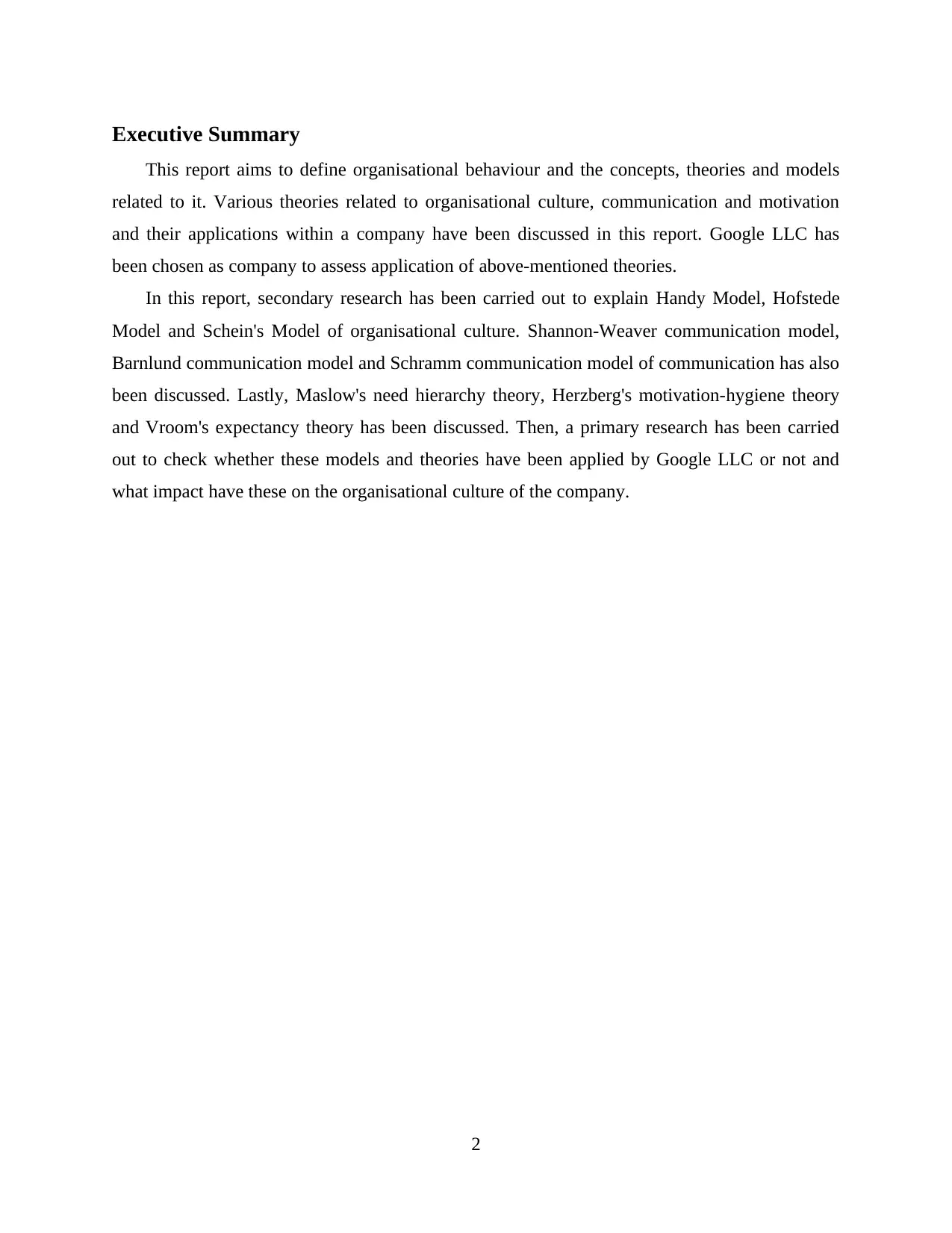
This report aims to define organisational behaviour and the concepts, theories and models
related to it. Various theories related to organisational culture, communication and motivation
and their applications within a company have been discussed in this report. Google LLC has
been chosen as company to assess application of above-mentioned theories.
In this report, secondary research has been carried out to explain Handy Model, Hofstede
Model and Schein's Model of organisational culture. Shannon-Weaver communication model,
Barnlund communication model and Schramm communication model of communication has also
been discussed. Lastly, Maslow's need hierarchy theory, Herzberg's motivation-hygiene theory
and Vroom's expectancy theory has been discussed. Then, a primary research has been carried
out to check whether these models and theories have been applied by Google LLC or not and
what impact have these on the organisational culture of the company.
2
This report aims to define organisational behaviour and the concepts, theories and models
related to it. Various theories related to organisational culture, communication and motivation
and their applications within a company have been discussed in this report. Google LLC has
been chosen as company to assess application of above-mentioned theories.
In this report, secondary research has been carried out to explain Handy Model, Hofstede
Model and Schein's Model of organisational culture. Shannon-Weaver communication model,
Barnlund communication model and Schramm communication model of communication has also
been discussed. Lastly, Maslow's need hierarchy theory, Herzberg's motivation-hygiene theory
and Vroom's expectancy theory has been discussed. Then, a primary research has been carried
out to check whether these models and theories have been applied by Google LLC or not and
what impact have these on the organisational culture of the company.
2
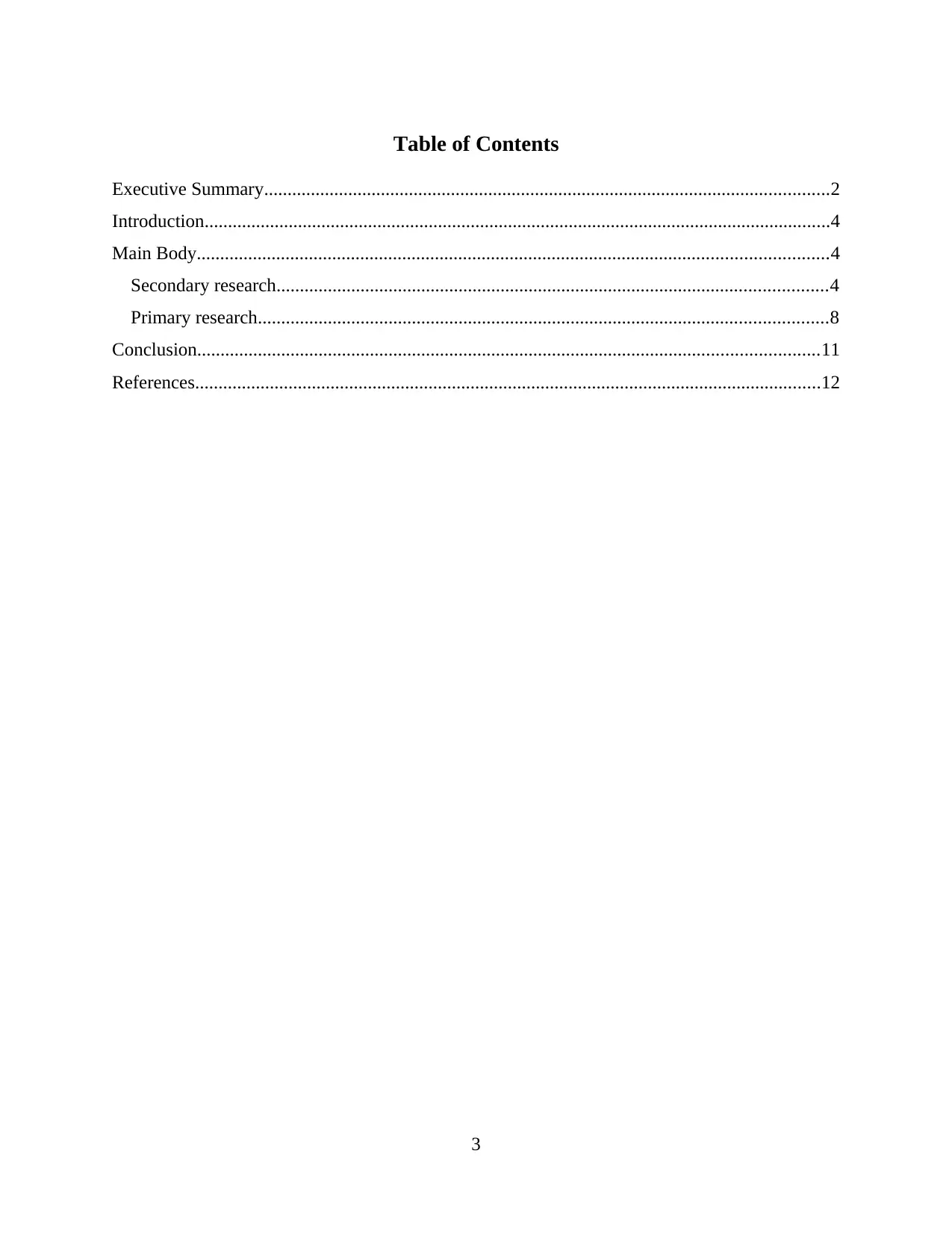
Table of Contents
Executive Summary.........................................................................................................................2
Introduction......................................................................................................................................4
Main Body.......................................................................................................................................4
Secondary research......................................................................................................................4
Primary research..........................................................................................................................8
Conclusion.....................................................................................................................................11
References......................................................................................................................................12
3
Executive Summary.........................................................................................................................2
Introduction......................................................................................................................................4
Main Body.......................................................................................................................................4
Secondary research......................................................................................................................4
Primary research..........................................................................................................................8
Conclusion.....................................................................................................................................11
References......................................................................................................................................12
3
⊘ This is a preview!⊘
Do you want full access?
Subscribe today to unlock all pages.

Trusted by 1+ million students worldwide
Introduction
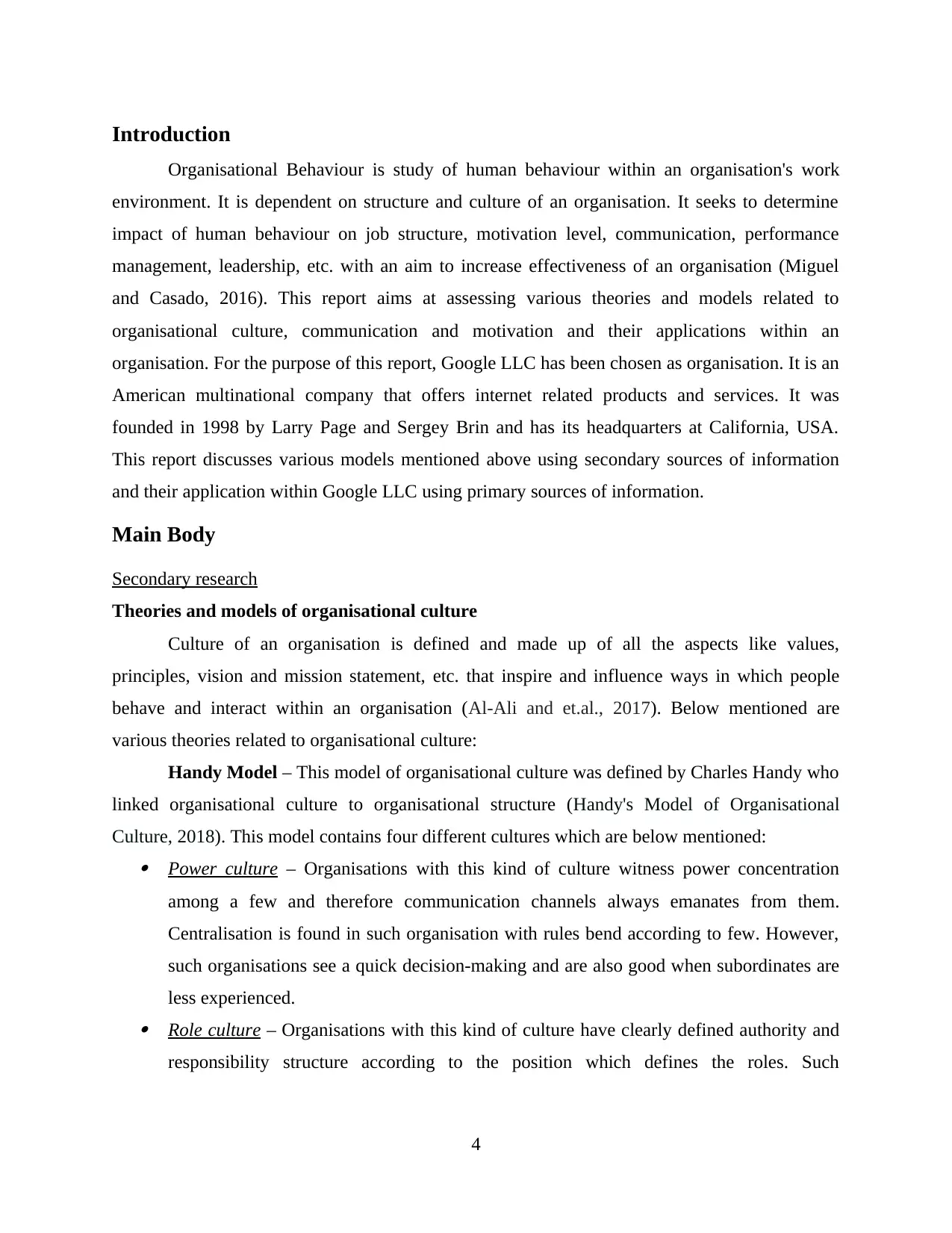
Organisational Behaviour is study of human behaviour within an organisation's work
environment. It is dependent on structure and culture of an organisation. It seeks to determine
impact of human behaviour on job structure, motivation level, communication, performance
management, leadership, etc. with an aim to increase effectiveness of an organisation (Miguel
and Casado, 2016). This report aims at assessing various theories and models related to
organisational culture, communication and motivation and their applications within an
organisation. For the purpose of this report, Google LLC has been chosen as organisation. It is an
American multinational company that offers internet related products and services. It was
founded in 1998 by Larry Page and Sergey Brin and has its headquarters at California, USA.
This report discusses various models mentioned above using secondary sources of information
and their application within Google LLC using primary sources of information.
Main Body
Secondary research
Theories and models of organisational culture
Culture of an organisation is defined and made up of all the aspects like values,
principles, vision and mission statement, etc. that inspire and influence ways in which people
behave and interact within an organisation (Al-Ali and et.al., 2017). Below mentioned are
various theories related to organisational culture:
Handy Model – This model of organisational culture was defined by Charles Handy who
linked organisational culture to organisational structure (Handy's Model of Organisational
Culture, 2018). This model contains four different cultures which are below mentioned: Power culture – Organisations with this kind of culture witness power concentration
among a few and therefore communication channels always emanates from them.
Centralisation is found in such organisation with rules bend according to few. However,
such organisations see a quick decision-making and are also good when subordinates are
less experienced. Role culture – Organisations with this kind of culture have clearly defined authority and
responsibility structure according to the position which defines the roles. Such
4
Organisational Behaviour is study of human behaviour within an organisation's work
environment. It is dependent on structure and culture of an organisation. It seeks to determine
impact of human behaviour on job structure, motivation level, communication, performance
management, leadership, etc. with an aim to increase effectiveness of an organisation (Miguel
and Casado, 2016). This report aims at assessing various theories and models related to
organisational culture, communication and motivation and their applications within an
organisation. For the purpose of this report, Google LLC has been chosen as organisation. It is an
American multinational company that offers internet related products and services. It was
founded in 1998 by Larry Page and Sergey Brin and has its headquarters at California, USA.
This report discusses various models mentioned above using secondary sources of information
and their application within Google LLC using primary sources of information.
Main Body
Secondary research
Theories and models of organisational culture
Culture of an organisation is defined and made up of all the aspects like values,
principles, vision and mission statement, etc. that inspire and influence ways in which people
behave and interact within an organisation (Al-Ali and et.al., 2017). Below mentioned are
various theories related to organisational culture:
Handy Model – This model of organisational culture was defined by Charles Handy who
linked organisational culture to organisational structure (Handy's Model of Organisational
Culture, 2018). This model contains four different cultures which are below mentioned: Power culture – Organisations with this kind of culture witness power concentration
among a few and therefore communication channels always emanates from them.
Centralisation is found in such organisation with rules bend according to few. However,
such organisations see a quick decision-making and are also good when subordinates are
less experienced. Role culture – Organisations with this kind of culture have clearly defined authority and
responsibility structure according to the position which defines the roles. Such
4
Paraphrase This Document
Need a fresh take? Get an instant paraphrase of this document with our AI Paraphraser
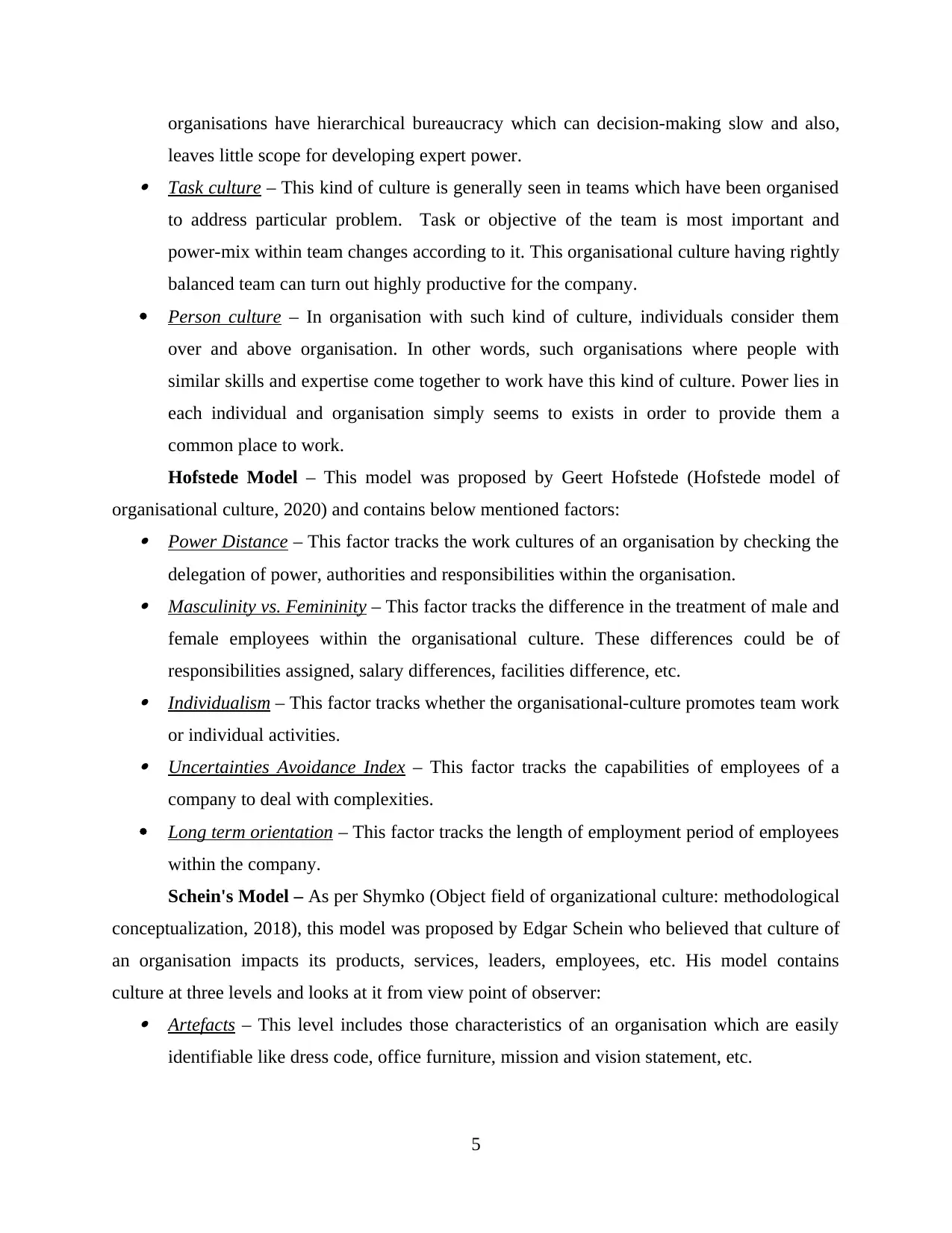
organisations have hierarchical bureaucracy which can decision-making slow and also,
leaves little scope for developing expert power. Task culture – This kind of culture is generally seen in teams which have been organised
to address particular problem. Task or objective of the team is most important and
power-mix within team changes according to it. This organisational culture having rightly
balanced team can turn out highly productive for the company.
Person culture – In organisation with such kind of culture, individuals consider them
over and above organisation. In other words, such organisations where people with
similar skills and expertise come together to work have this kind of culture. Power lies in
each individual and organisation simply seems to exists in order to provide them a
common place to work.
Hofstede Model – This model was proposed by Geert Hofstede (Hofstede model of
organisational culture, 2020) and contains below mentioned factors: Power Distance – This factor tracks the work cultures of an organisation by checking the
delegation of power, authorities and responsibilities within the organisation. Masculinity vs. Femininity – This factor tracks the difference in the treatment of male and
female employees within the organisational culture. These differences could be of
responsibilities assigned, salary differences, facilities difference, etc. Individualism – This factor tracks whether the organisational-culture promotes team work
or individual activities. Uncertainties Avoidance Index – This factor tracks the capabilities of employees of a
company to deal with complexities.
Long term orientation – This factor tracks the length of employment period of employees
within the company.
Schein's Model – As per Shymko (Object field of organizational culture: methodological
conceptualization, 2018), this model was proposed by Edgar Schein who believed that culture of
an organisation impacts its products, services, leaders, employees, etc. His model contains
culture at three levels and looks at it from view point of observer: Artefacts – This level includes those characteristics of an organisation which are easily
identifiable like dress code, office furniture, mission and vision statement, etc.
5
leaves little scope for developing expert power. Task culture – This kind of culture is generally seen in teams which have been organised
to address particular problem. Task or objective of the team is most important and
power-mix within team changes according to it. This organisational culture having rightly
balanced team can turn out highly productive for the company.
Person culture – In organisation with such kind of culture, individuals consider them
over and above organisation. In other words, such organisations where people with
similar skills and expertise come together to work have this kind of culture. Power lies in
each individual and organisation simply seems to exists in order to provide them a
common place to work.
Hofstede Model – This model was proposed by Geert Hofstede (Hofstede model of
organisational culture, 2020) and contains below mentioned factors: Power Distance – This factor tracks the work cultures of an organisation by checking the
delegation of power, authorities and responsibilities within the organisation. Masculinity vs. Femininity – This factor tracks the difference in the treatment of male and
female employees within the organisational culture. These differences could be of
responsibilities assigned, salary differences, facilities difference, etc. Individualism – This factor tracks whether the organisational-culture promotes team work
or individual activities. Uncertainties Avoidance Index – This factor tracks the capabilities of employees of a
company to deal with complexities.
Long term orientation – This factor tracks the length of employment period of employees
within the company.
Schein's Model – As per Shymko (Object field of organizational culture: methodological
conceptualization, 2018), this model was proposed by Edgar Schein who believed that culture of
an organisation impacts its products, services, leaders, employees, etc. His model contains
culture at three levels and looks at it from view point of observer: Artefacts – This level includes those characteristics of an organisation which are easily
identifiable like dress code, office furniture, mission and vision statement, etc.
5
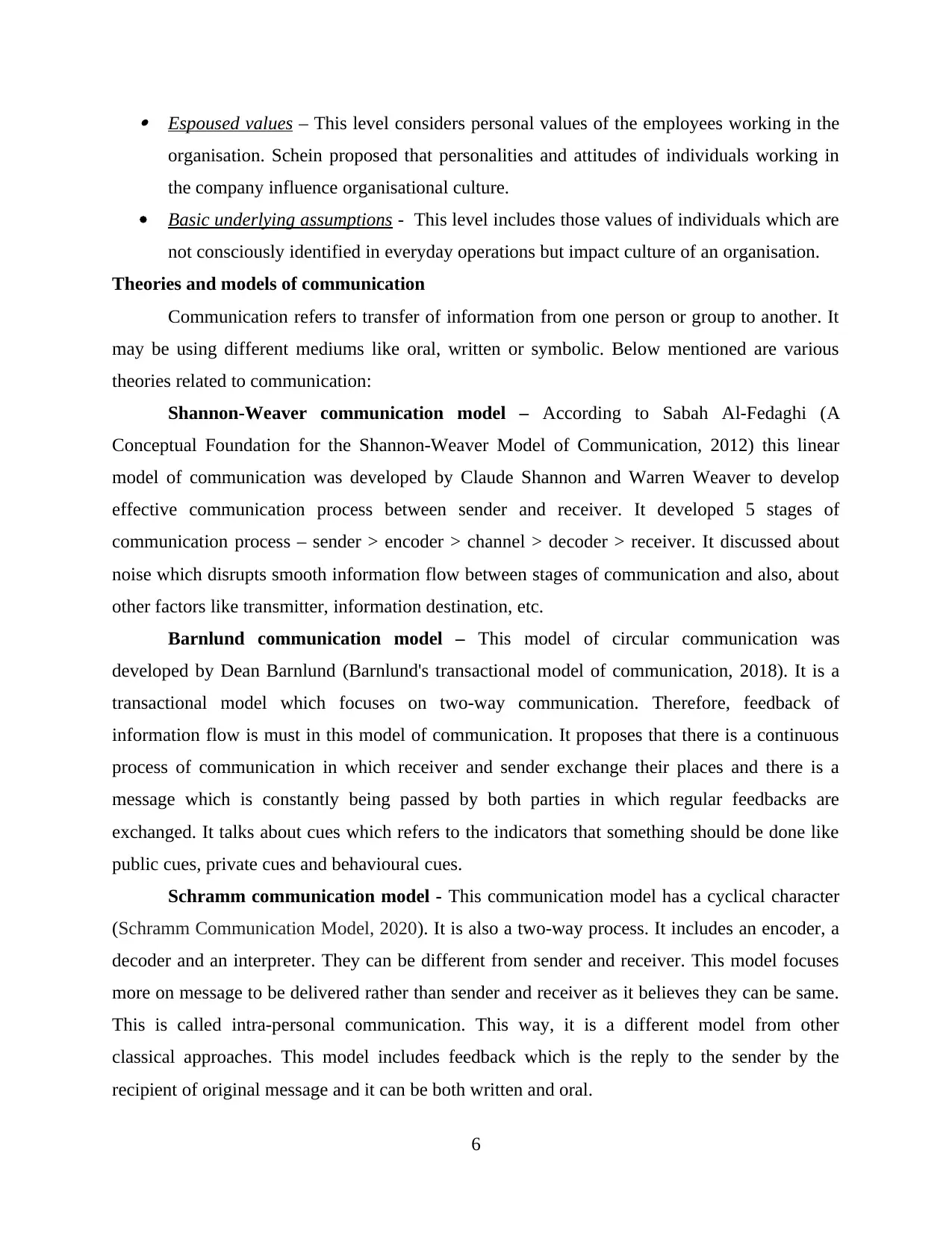
Espoused values – This level considers personal values of the employees working in the
organisation. Schein proposed that personalities and attitudes of individuals working in
the company influence organisational culture.
Basic underlying assumptions - This level includes those values of individuals which are
not consciously identified in everyday operations but impact culture of an organisation.
Theories and models of communication
Communication refers to transfer of information from one person or group to another. It
may be using different mediums like oral, written or symbolic. Below mentioned are various
theories related to communication:
Shannon-Weaver communication model – According to Sabah Al-Fedaghi (A
Conceptual Foundation for the Shannon-Weaver Model of Communication, 2012) this linear
model of communication was developed by Claude Shannon and Warren Weaver to develop
effective communication process between sender and receiver. It developed 5 stages of
communication process – sender > encoder > channel > decoder > receiver. It discussed about
noise which disrupts smooth information flow between stages of communication and also, about
other factors like transmitter, information destination, etc.
Barnlund communication model – This model of circular communication was
developed by Dean Barnlund (Barnlund's transactional model of communication, 2018). It is a
transactional model which focuses on two-way communication. Therefore, feedback of
information flow is must in this model of communication. It proposes that there is a continuous
process of communication in which receiver and sender exchange their places and there is a
message which is constantly being passed by both parties in which regular feedbacks are
exchanged. It talks about cues which refers to the indicators that something should be done like
public cues, private cues and behavioural cues.
Schramm communication model - This communication model has a cyclical character
(Schramm Communication Model, 2020). It is also a two-way process. It includes an encoder, a
decoder and an interpreter. They can be different from sender and receiver. This model focuses
more on message to be delivered rather than sender and receiver as it believes they can be same.
This is called intra-personal communication. This way, it is a different model from other
classical approaches. This model includes feedback which is the reply to the sender by the
recipient of original message and it can be both written and oral.
6
organisation. Schein proposed that personalities and attitudes of individuals working in
the company influence organisational culture.
Basic underlying assumptions - This level includes those values of individuals which are
not consciously identified in everyday operations but impact culture of an organisation.
Theories and models of communication
Communication refers to transfer of information from one person or group to another. It
may be using different mediums like oral, written or symbolic. Below mentioned are various
theories related to communication:
Shannon-Weaver communication model – According to Sabah Al-Fedaghi (A
Conceptual Foundation for the Shannon-Weaver Model of Communication, 2012) this linear
model of communication was developed by Claude Shannon and Warren Weaver to develop
effective communication process between sender and receiver. It developed 5 stages of
communication process – sender > encoder > channel > decoder > receiver. It discussed about
noise which disrupts smooth information flow between stages of communication and also, about
other factors like transmitter, information destination, etc.
Barnlund communication model – This model of circular communication was
developed by Dean Barnlund (Barnlund's transactional model of communication, 2018). It is a
transactional model which focuses on two-way communication. Therefore, feedback of
information flow is must in this model of communication. It proposes that there is a continuous
process of communication in which receiver and sender exchange their places and there is a
message which is constantly being passed by both parties in which regular feedbacks are
exchanged. It talks about cues which refers to the indicators that something should be done like
public cues, private cues and behavioural cues.
Schramm communication model - This communication model has a cyclical character
(Schramm Communication Model, 2020). It is also a two-way process. It includes an encoder, a
decoder and an interpreter. They can be different from sender and receiver. This model focuses
more on message to be delivered rather than sender and receiver as it believes they can be same.
This is called intra-personal communication. This way, it is a different model from other
classical approaches. This model includes feedback which is the reply to the sender by the
recipient of original message and it can be both written and oral.
6
⊘ This is a preview!⊘
Do you want full access?
Subscribe today to unlock all pages.
Trusted by 1+ million students worldwide
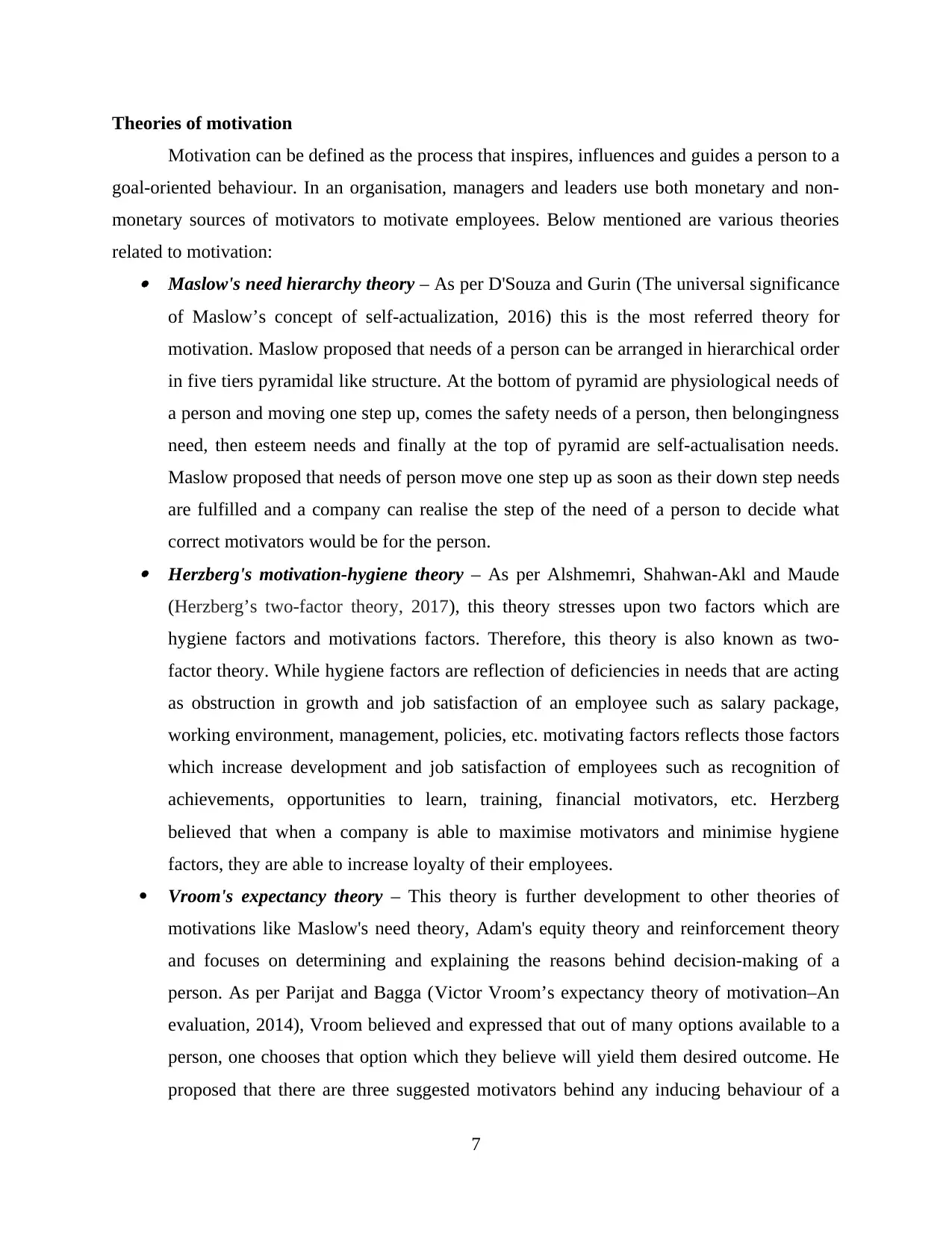
Theories of motivation
Motivation can be defined as the process that inspires, influences and guides a person to a
goal-oriented behaviour. In an organisation, managers and leaders use both monetary and non-
monetary sources of motivators to motivate employees. Below mentioned are various theories
related to motivation: Maslow's need hierarchy theory – As per D'Souza and Gurin (The universal significance
of Maslow’s concept of self-actualization, 2016) this is the most referred theory for
motivation. Maslow proposed that needs of a person can be arranged in hierarchical order
in five tiers pyramidal like structure. At the bottom of pyramid are physiological needs of
a person and moving one step up, comes the safety needs of a person, then belongingness
need, then esteem needs and finally at the top of pyramid are self-actualisation needs.
Maslow proposed that needs of person move one step up as soon as their down step needs
are fulfilled and a company can realise the step of the need of a person to decide what
correct motivators would be for the person. Herzberg's motivation-hygiene theory – As per Alshmemri, Shahwan-Akl and Maude
(Herzberg’s two-factor theory, 2017), this theory stresses upon two factors which are
hygiene factors and motivations factors. Therefore, this theory is also known as two-
factor theory. While hygiene factors are reflection of deficiencies in needs that are acting
as obstruction in growth and job satisfaction of an employee such as salary package,
working environment, management, policies, etc. motivating factors reflects those factors
which increase development and job satisfaction of employees such as recognition of
achievements, opportunities to learn, training, financial motivators, etc. Herzberg
believed that when a company is able to maximise motivators and minimise hygiene
factors, they are able to increase loyalty of their employees.
Vroom's expectancy theory – This theory is further development to other theories of
motivations like Maslow's need theory, Adam's equity theory and reinforcement theory
and focuses on determining and explaining the reasons behind decision-making of a
person. As per Parijat and Bagga (Victor Vroom’s expectancy theory of motivation–An
evaluation, 2014), Vroom believed and expressed that out of many options available to a
person, one chooses that option which they believe will yield them desired outcome. He
proposed that there are three suggested motivators behind any inducing behaviour of a
7
Motivation can be defined as the process that inspires, influences and guides a person to a
goal-oriented behaviour. In an organisation, managers and leaders use both monetary and non-
monetary sources of motivators to motivate employees. Below mentioned are various theories
related to motivation: Maslow's need hierarchy theory – As per D'Souza and Gurin (The universal significance
of Maslow’s concept of self-actualization, 2016) this is the most referred theory for
motivation. Maslow proposed that needs of a person can be arranged in hierarchical order
in five tiers pyramidal like structure. At the bottom of pyramid are physiological needs of
a person and moving one step up, comes the safety needs of a person, then belongingness
need, then esteem needs and finally at the top of pyramid are self-actualisation needs.
Maslow proposed that needs of person move one step up as soon as their down step needs
are fulfilled and a company can realise the step of the need of a person to decide what
correct motivators would be for the person. Herzberg's motivation-hygiene theory – As per Alshmemri, Shahwan-Akl and Maude
(Herzberg’s two-factor theory, 2017), this theory stresses upon two factors which are
hygiene factors and motivations factors. Therefore, this theory is also known as two-
factor theory. While hygiene factors are reflection of deficiencies in needs that are acting
as obstruction in growth and job satisfaction of an employee such as salary package,
working environment, management, policies, etc. motivating factors reflects those factors
which increase development and job satisfaction of employees such as recognition of
achievements, opportunities to learn, training, financial motivators, etc. Herzberg
believed that when a company is able to maximise motivators and minimise hygiene
factors, they are able to increase loyalty of their employees.
Vroom's expectancy theory – This theory is further development to other theories of
motivations like Maslow's need theory, Adam's equity theory and reinforcement theory
and focuses on determining and explaining the reasons behind decision-making of a
person. As per Parijat and Bagga (Victor Vroom’s expectancy theory of motivation–An
evaluation, 2014), Vroom believed and expressed that out of many options available to a
person, one chooses that option which they believe will yield them desired outcome. He
proposed that there are three suggested motivators behind any inducing behaviour of a
7
Paraphrase This Document
Need a fresh take? Get an instant paraphrase of this document with our AI Paraphraser
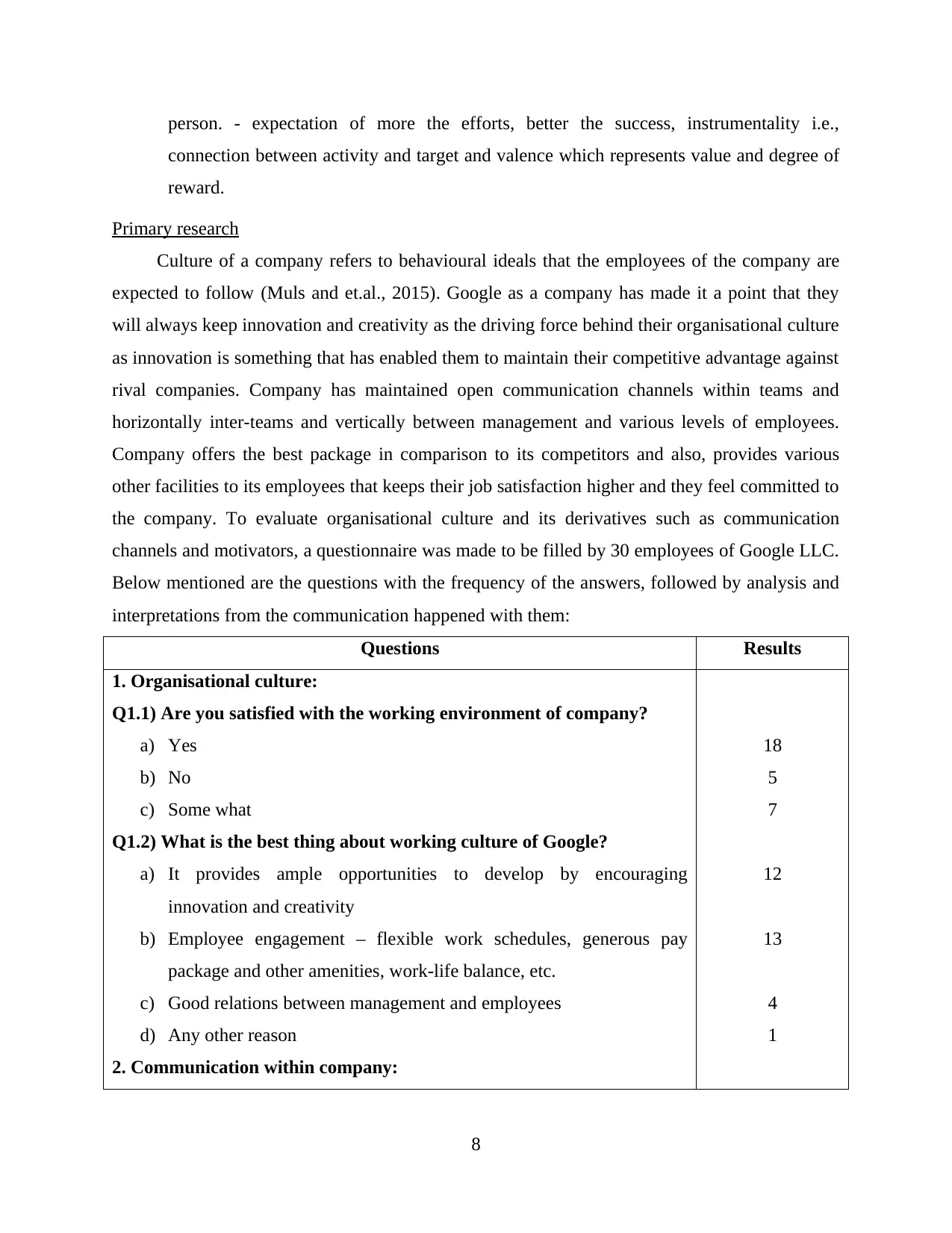
person. - expectation of more the efforts, better the success, instrumentality i.e.,
connection between activity and target and valence which represents value and degree of
reward.
Primary research
Culture of a company refers to behavioural ideals that the employees of the company are
expected to follow (Muls and et.al., 2015). Google as a company has made it a point that they
will always keep innovation and creativity as the driving force behind their organisational culture
as innovation is something that has enabled them to maintain their competitive advantage against
rival companies. Company has maintained open communication channels within teams and
horizontally inter-teams and vertically between management and various levels of employees.
Company offers the best package in comparison to its competitors and also, provides various
other facilities to its employees that keeps their job satisfaction higher and they feel committed to
the company. To evaluate organisational culture and its derivatives such as communication
channels and motivators, a questionnaire was made to be filled by 30 employees of Google LLC.
Below mentioned are the questions with the frequency of the answers, followed by analysis and
interpretations from the communication happened with them:
Questions Results
1. Organisational culture:
Q1.1) Are you satisfied with the working environment of company?
a) Yes
b) No
c) Some what
Q1.2) What is the best thing about working culture of Google?
a) It provides ample opportunities to develop by encouraging
innovation and creativity
b) Employee engagement – flexible work schedules, generous pay
package and other amenities, work-life balance, etc.
c) Good relations between management and employees
d) Any other reason
2. Communication within company:
18
5
7
12
13
4
1
8
connection between activity and target and valence which represents value and degree of
reward.
Primary research
Culture of a company refers to behavioural ideals that the employees of the company are
expected to follow (Muls and et.al., 2015). Google as a company has made it a point that they
will always keep innovation and creativity as the driving force behind their organisational culture
as innovation is something that has enabled them to maintain their competitive advantage against
rival companies. Company has maintained open communication channels within teams and
horizontally inter-teams and vertically between management and various levels of employees.
Company offers the best package in comparison to its competitors and also, provides various
other facilities to its employees that keeps their job satisfaction higher and they feel committed to
the company. To evaluate organisational culture and its derivatives such as communication
channels and motivators, a questionnaire was made to be filled by 30 employees of Google LLC.
Below mentioned are the questions with the frequency of the answers, followed by analysis and
interpretations from the communication happened with them:
Questions Results
1. Organisational culture:
Q1.1) Are you satisfied with the working environment of company?
a) Yes
b) No
c) Some what
Q1.2) What is the best thing about working culture of Google?
a) It provides ample opportunities to develop by encouraging
innovation and creativity
b) Employee engagement – flexible work schedules, generous pay
package and other amenities, work-life balance, etc.
c) Good relations between management and employees
d) Any other reason
2. Communication within company:
18
5
7
12
13
4
1
8
Q2.1) Are you satisfied with the communication flow in the company?
a) Yes
b) No
c) Somewhat
Q2.2) How does communication flow in the company?
a) Open communication
b) Close communication
c) Somewhere in the middle
3. Motivational efforts
Q3.1) Does company takes effort in motivating employees?
a) Yes, a lot
b) A little
c) Not a bit
Q3.2) What is the best motivator used by Google?
a) Generous pay package, bonuses, stock options, etc.
b) Amenities provided like parties, trips, sports, free meals, etc.
c) Good developmental opportunities – TGIF, flexible working hours,
flexibility to move within company, freedom to innovate, etc.
d) Other reasons
Q7) Any other change you would want in organisational behaviour of
Google...
18
3
9
17
3
10
25
5
0
8
10
7
3
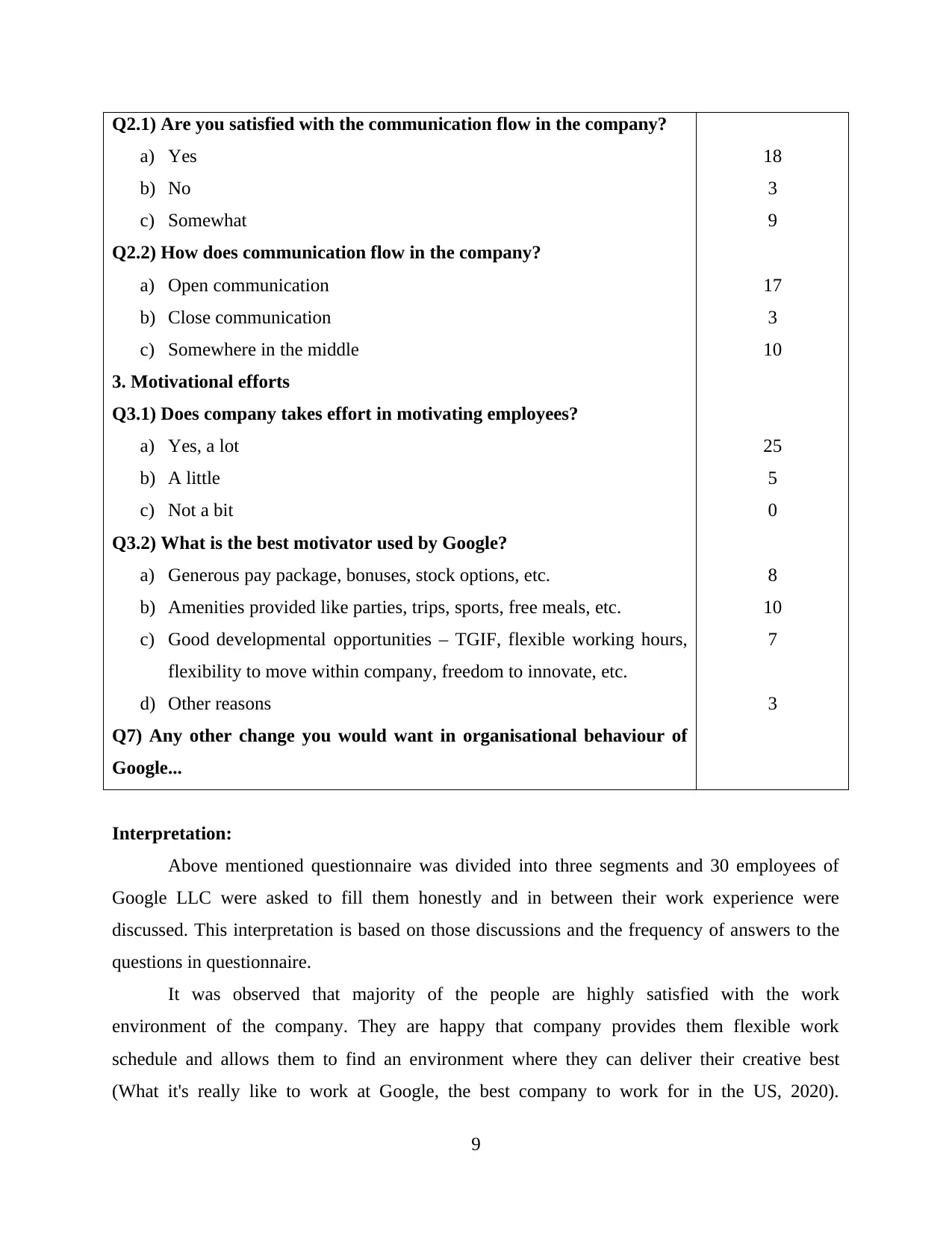
Interpretation:
Above mentioned questionnaire was divided into three segments and 30 employees of
Google LLC were asked to fill them honestly and in between their work experience were
discussed. This interpretation is based on those discussions and the frequency of answers to the
questions in questionnaire.
It was observed that majority of the people are highly satisfied with the work
environment of the company. They are happy that company provides them flexible work
schedule and allows them to find an environment where they can deliver their creative best
(What it's really like to work at Google, the best company to work for in the US, 2020).
9
a) Yes
b) No
c) Somewhat
Q2.2) How does communication flow in the company?
a) Open communication
b) Close communication
c) Somewhere in the middle
3. Motivational efforts
Q3.1) Does company takes effort in motivating employees?
a) Yes, a lot
b) A little
c) Not a bit
Q3.2) What is the best motivator used by Google?
a) Generous pay package, bonuses, stock options, etc.
b) Amenities provided like parties, trips, sports, free meals, etc.
c) Good developmental opportunities – TGIF, flexible working hours,
flexibility to move within company, freedom to innovate, etc.
d) Other reasons
Q7) Any other change you would want in organisational behaviour of
Google...
18
3
9
17
3
10
25
5
0
8
10
7
3
Interpretation:
Above mentioned questionnaire was divided into three segments and 30 employees of
Google LLC were asked to fill them honestly and in between their work experience were
discussed. This interpretation is based on those discussions and the frequency of answers to the
questions in questionnaire.
It was observed that majority of the people are highly satisfied with the work
environment of the company. They are happy that company provides them flexible work
schedule and allows them to find an environment where they can deliver their creative best
(What it's really like to work at Google, the best company to work for in the US, 2020).
9
⊘ This is a preview!⊘
Do you want full access?
Subscribe today to unlock all pages.
Trusted by 1+ million students worldwide
Company management has good relations with their subordinates and offers them generous
salary packages and other perks and allowances, allows them to maintain work-life balance by
arranging parties, trips, health check-ups, free gourmet food and outdoor sports facility.
Company has adopted free flow of communication in which there are open channels to connect
horizontally and vertically. Company top leaders regularly holds TGIF sessions where
employees can critically ask questions about company. It was also observed that Google
employees equally believe on financial and non-financial motivators of the company to be best
source of motivation.
However, there were others who identified the issues in the work culture of the company.
They told that though Google provides all the amenities, it fills the whole space of your life and
your eventually feel losing your independence. Open communication is allowed but since
everybody is expert, they are not ready to receive critical reviews from colleague who is at the
same level and sometimes, such things leads to development of politics within company which
not only leads to morale-breaking but also horse trading and manipulation (Google employees
confess all the things they hated most about working at Google, 2016). All this shows that
though there are good things about work culture of the company, there are factors where
company needs to improve.
Application of theories and models:
Based on the above analysis of organisational culture, communication channel and
motivational strategies adopted by Google LLC, it can be said that the company makes good use
of various theories and models to develop customised strategies that fit their organisation. It has
not applied any model or theory to point but has tried to adopt good points of them that can serve
their purpose.
Organisational culture models - Company follows innovation led culture. It does not fit
exactly anywhere in culture types of Handy’s model but does follow traits of role culture and
task culture, for there are defined roles of employees in their teams within company. In the
teams, innovating the process is the task that is paramount and power mix is decided according
to it. In Hofstede model, company reflects a good corporate culture as it promotes team culture
and provides good delegation of powers within team, there is no gender-based difference in
company and all the employees are developed to deal with any kind of uncertainty. Therefore,
company has good employee retention rate. As per Schein model, artefacts of the company are
10
salary packages and other perks and allowances, allows them to maintain work-life balance by
arranging parties, trips, health check-ups, free gourmet food and outdoor sports facility.
Company has adopted free flow of communication in which there are open channels to connect
horizontally and vertically. Company top leaders regularly holds TGIF sessions where
employees can critically ask questions about company. It was also observed that Google
employees equally believe on financial and non-financial motivators of the company to be best
source of motivation.
However, there were others who identified the issues in the work culture of the company.
They told that though Google provides all the amenities, it fills the whole space of your life and
your eventually feel losing your independence. Open communication is allowed but since
everybody is expert, they are not ready to receive critical reviews from colleague who is at the
same level and sometimes, such things leads to development of politics within company which
not only leads to morale-breaking but also horse trading and manipulation (Google employees
confess all the things they hated most about working at Google, 2016). All this shows that
though there are good things about work culture of the company, there are factors where
company needs to improve.
Application of theories and models:
Based on the above analysis of organisational culture, communication channel and
motivational strategies adopted by Google LLC, it can be said that the company makes good use
of various theories and models to develop customised strategies that fit their organisation. It has
not applied any model or theory to point but has tried to adopt good points of them that can serve
their purpose.
Organisational culture models - Company follows innovation led culture. It does not fit
exactly anywhere in culture types of Handy’s model but does follow traits of role culture and
task culture, for there are defined roles of employees in their teams within company. In the
teams, innovating the process is the task that is paramount and power mix is decided according
to it. In Hofstede model, company reflects a good corporate culture as it promotes team culture
and provides good delegation of powers within team, there is no gender-based difference in
company and all the employees are developed to deal with any kind of uncertainty. Therefore,
company has good employee retention rate. As per Schein model, artefacts of the company are
10
Paraphrase This Document
Need a fresh take? Get an instant paraphrase of this document with our AI Paraphraser
its values, mission and vision. Company respects value of its diverse employees and develop
policies to be culture-neutral.
Models of communication – Company follows open communication channel. In all the
communication models discussed, company follows two-way process wherein receiver
acknowledges information through feedback. All the communication happens in a written
manner which makes it a little easier to assess completion and accuracy of communication
process within company. This can however make things a little bureaucratic which is not good
for a company that is technology based and is present in digital business.
Motivational theories – Company adopts both financial and non-financial motivators. It has
made good uses of theories of motivation such as it continuously strives to improve on hygiene
factors of its employees so that job satisfaction can be maximised. Company analyses such
expected factors which are instrumental in success and valent for employees. It develops
estimation of motivational factors on the basis of need hierarchy pyramid. Company targets to
fulfil lower-level needs of employees so that they can develop higher level of needs. Those at
higher level of motivation have recognition needs which can be fulfilled by associating with a
large company.
Conclusion
Above report is aimed at assessing impact of organisational behaviour on organisational
effectiveness. Various theories and models related to organisational culture, communication and
motivation are covered in this report and application of those models in situational context of
Google LLC. Company has a defined organisational culture based on its values and application
of these models can help it refining its processes which will help it improve communication
channels within organisational structure and motivation of its employees.
11
policies to be culture-neutral.
Models of communication – Company follows open communication channel. In all the
communication models discussed, company follows two-way process wherein receiver
acknowledges information through feedback. All the communication happens in a written
manner which makes it a little easier to assess completion and accuracy of communication
process within company. This can however make things a little bureaucratic which is not good
for a company that is technology based and is present in digital business.
Motivational theories – Company adopts both financial and non-financial motivators. It has
made good uses of theories of motivation such as it continuously strives to improve on hygiene
factors of its employees so that job satisfaction can be maximised. Company analyses such
expected factors which are instrumental in success and valent for employees. It develops
estimation of motivational factors on the basis of need hierarchy pyramid. Company targets to
fulfil lower-level needs of employees so that they can develop higher level of needs. Those at
higher level of motivation have recognition needs which can be fulfilled by associating with a
large company.
Conclusion
Above report is aimed at assessing impact of organisational behaviour on organisational
effectiveness. Various theories and models related to organisational culture, communication and
motivation are covered in this report and application of those models in situational context of
Google LLC. Company has a defined organisational culture based on its values and application
of these models can help it refining its processes which will help it improve communication
channels within organisational structure and motivation of its employees.
11
References
Books and Journal
Al-Ali, A.A. and et.al., 2017. Change management through leadership: the mediating role of
organizational culture. International Journal of Organizational Analysis.
Alshmemri, M., Shahwan-Akl, L. and Maude, P., 2017. Herzberg’s two-factor theory. Life
Science Journal. 14(5). pp.12-16.
D'Souza, J. and Gurin, M., 2016. The universal significance of Maslow’s concept of self-
actualization. The Humanistic Psychologist. 44(2). p.210.
Miguel, J.C. and Casado, M.Á., 2016. GAFAnomy (Google, Amazon, Facebook and Apple): The
big four and the b-ecosystem. In Dynamics of big internet industry groups and future
trends (pp. 127-148). Springer, Cham.
Muls, A. and et.al., 2015. Influencing organisational culture: a leadership challenge. British
Journal of Nursing. 24(12) pp.633-638.
Parijat, P. and Bagga, S., 2014. Victor Vroom’s expectancy theory of motivation–An evaluation.
International Research Journal of Business and Management. 7(9). pp.1-8.
Shymko, V., 2018. Object field of organizational culture: methodological
conceptualization.International Journal of Organizational Analysis.
Online
A Conceptual Foundation for the Shannon-Weaver Model of Communication. 2012. [Online].
Available
through:<https://www.researchgate.net/publication/272964534_A_Conceptual_Foundat
ion_for_the_Shannon-Weaver_Model_of_Communication>
Barnlund's transactional model of communication. 2018. [Online]. Available
through:<https://www.businesstopia.net/communication/barnlund-transactional-model-
communication>
Google employees confess all the things they hated most about working at Google. 2016.
[Online]. Available through:< https://www.businessinsider.in/Google-employees-
confess-all-the-things-they-hated-most-about-working-at-Google/articleshow/
55947110.cms>
Handy's Model of Organisational Culture. 2018. [Online]. Available
through:<https://www.tutor2u.net/business/reference/models-of-organisational-culture-
handy>
Hofstede model of organisational culture. 2020. [Online]. Available
through:<https://www.managementstudyguide.com/hofstede-model.htm>
12
Books and Journal
Al-Ali, A.A. and et.al., 2017. Change management through leadership: the mediating role of
organizational culture. International Journal of Organizational Analysis.
Alshmemri, M., Shahwan-Akl, L. and Maude, P., 2017. Herzberg’s two-factor theory. Life
Science Journal. 14(5). pp.12-16.
D'Souza, J. and Gurin, M., 2016. The universal significance of Maslow’s concept of self-
actualization. The Humanistic Psychologist. 44(2). p.210.
Miguel, J.C. and Casado, M.Á., 2016. GAFAnomy (Google, Amazon, Facebook and Apple): The
big four and the b-ecosystem. In Dynamics of big internet industry groups and future
trends (pp. 127-148). Springer, Cham.
Muls, A. and et.al., 2015. Influencing organisational culture: a leadership challenge. British
Journal of Nursing. 24(12) pp.633-638.
Parijat, P. and Bagga, S., 2014. Victor Vroom’s expectancy theory of motivation–An evaluation.
International Research Journal of Business and Management. 7(9). pp.1-8.
Shymko, V., 2018. Object field of organizational culture: methodological
conceptualization.International Journal of Organizational Analysis.
Online
A Conceptual Foundation for the Shannon-Weaver Model of Communication. 2012. [Online].
Available
through:<https://www.researchgate.net/publication/272964534_A_Conceptual_Foundat
ion_for_the_Shannon-Weaver_Model_of_Communication>
Barnlund's transactional model of communication. 2018. [Online]. Available
through:<https://www.businesstopia.net/communication/barnlund-transactional-model-
communication>
Google employees confess all the things they hated most about working at Google. 2016.
[Online]. Available through:< https://www.businessinsider.in/Google-employees-
confess-all-the-things-they-hated-most-about-working-at-Google/articleshow/
55947110.cms>
Handy's Model of Organisational Culture. 2018. [Online]. Available
through:<https://www.tutor2u.net/business/reference/models-of-organisational-culture-
handy>
Hofstede model of organisational culture. 2020. [Online]. Available
through:<https://www.managementstudyguide.com/hofstede-model.htm>
12
⊘ This is a preview!⊘
Do you want full access?
Subscribe today to unlock all pages.
Trusted by 1+ million students worldwide

1 out of 13


Related Documents


Your All-in-One AI-Powered Toolkit for Academic Success.
+13062052269
info@desklib.com
Available 24*7 on WhatsApp / Email
![[object Object]](/_next/static/media/star-bottom.7253800d.svg)
Unlock your academic potential
Copyright © 2020–2026 A2Z Services. All Rights Reserved. Developed and managed by ZUCOL.