Organizational Behaviour Report: Home Retail Group and J Sainsbury PLC
VerifiedAdded on 2020/01/15
|15
|4073
|170
Report
AI Summary
This report provides a comprehensive analysis of organizational behaviour, focusing on the interplay between organizational structure, culture, leadership styles, and motivational theories. It begins by defining organizational behaviour and its significance, then delves into different types of organizational structures, including functional, flat, geographic, product, and hierarchical structures, as well as various organizational cultures such as role, task, and power cultures. The report compares the structures and cultures of Home Retail Group and J Sainsbury PLC, highlighting factors influencing individual behaviour at work. It further explores organizational theories, including classical, neoclassical, and modern theories, and examines different leadership styles, such as autocratic leadership. The report discusses the impact of leadership styles on motivation, compares the application of motivational theories, and evaluates their usefulness in the workplace. The conclusion summarizes the key findings and emphasizes the importance of understanding organizational behaviour for effective management and leadership. The report uses Home Retail Group and J Sainsbury PLC as case studies to illustrate the concepts discussed.
Organizational Behaviour

Paraphrase This Document
Need a fresh take? Get an instant paraphrase of this document with our AI Paraphraser
Table of Contents
INTRODUCTION...........................................................................................................................1
TASK 1............................................................................................................................................1
1.1 Different types of organizational structure and culture.........................................................1
1.2 Comparing the structure and culture of two firms................................................................3
1.3 Factors affecting the individual behavior at work.................................................................4
2.2 Organizational theories underpinning the practices of management....................................5
2.1 Different leadership styles.....................................................................................................6
2.3 Evaluating different approaches to management..................................................................7
3.1 Impact of different leadership style on motivating...............................................................7
3.2 Comparing the application of different motivational theories..............................................8
3.3 Usefulness of motivational theories......................................................................................8
CONCLUSION................................................................................................................................9
REFERENCES..............................................................................................................................10
INTRODUCTION...........................................................................................................................1
TASK 1............................................................................................................................................1
1.1 Different types of organizational structure and culture.........................................................1
1.2 Comparing the structure and culture of two firms................................................................3
1.3 Factors affecting the individual behavior at work.................................................................4
2.2 Organizational theories underpinning the practices of management....................................5
2.1 Different leadership styles.....................................................................................................6
2.3 Evaluating different approaches to management..................................................................7
3.1 Impact of different leadership style on motivating...............................................................7
3.2 Comparing the application of different motivational theories..............................................8
3.3 Usefulness of motivational theories......................................................................................8
CONCLUSION................................................................................................................................9
REFERENCES..............................................................................................................................10
Illustration Index
Illustration 1: Functional structure...................................................................................................4
Illustration 2: Hierarchical organizational structure........................................................................5
1
Illustration 1: Functional structure...................................................................................................4
Illustration 2: Hierarchical organizational structure........................................................................5
1
⊘ This is a preview!⊘
Do you want full access?
Subscribe today to unlock all pages.

Trusted by 1+ million students worldwide
INTRODUCTION
Organizational behaviour can be defined as the study of individual and group
performance within the organization. In other words, this study is helpful to examine behaviour
of humans working in the organization. It focuses on impact of job performance, leadership,
motivation, communication, structure, etc (French, Rayner, Rees and Rumbles, 2011). Present
report is about Home Retail Group which is one of the leading general merchandise and home
retailer, headquartered at UK. This report covers relationship between organizational structure
and culture. Further, it covers different approaches to management and leadership. Moreover, it
stresses on different ways of using motivational theories in organisations. Lastly, it also includes
mechanisms for developing effective teamwork in the organisation.
2
Organizational behaviour can be defined as the study of individual and group
performance within the organization. In other words, this study is helpful to examine behaviour
of humans working in the organization. It focuses on impact of job performance, leadership,
motivation, communication, structure, etc (French, Rayner, Rees and Rumbles, 2011). Present
report is about Home Retail Group which is one of the leading general merchandise and home
retailer, headquartered at UK. This report covers relationship between organizational structure
and culture. Further, it covers different approaches to management and leadership. Moreover, it
stresses on different ways of using motivational theories in organisations. Lastly, it also includes
mechanisms for developing effective teamwork in the organisation.
2
Paraphrase This Document
Need a fresh take? Get an instant paraphrase of this document with our AI Paraphraser
COMPANY INTRODUCTION
Home Retail Group is one of the leading general merchandise and home retailers. It has
Habitat, Homebase and Argos is formed form Home Retail Group. Argos is a leading retailer for
multi-channel products. On the other hand, Homebase is leading retail for garden and home
products (Home retail group at a glance, 2015). Habitat provides greater choice with
contemporary styling with premium quality. In addition to this, they also provide financial
services which offer its customers with insurance products and credit facilities. Moreover, they
also render online services to their customers (Contact us, 2015). Customers can order their
products online and it will be delivered to their door steps.
Further, they also conduct research and surveys with the help of which they understand their
customer’s needs, requirements and accordingly they provide services which the help of which
they satisfy them. They are known to provide quality services. They also understand their
employee’s requirements and focus on retaining them (About us, 2015). Firstly, they identify the
areas in which their employees and accordingly they provide them with proper training so that
they can overcome their weaknesses and it also helps them in enhancing their skills and
knowledge.
They update their technology frequently because they know the importance of adopting new
and improved technology. This is very helpful in retaining their customers and in providing them
with better services (Home Retail, 2015). They collect their customers information and
accordingly understand them as per their customers need and wants further they also provide
them products and services.
3
Home Retail Group is one of the leading general merchandise and home retailers. It has
Habitat, Homebase and Argos is formed form Home Retail Group. Argos is a leading retailer for
multi-channel products. On the other hand, Homebase is leading retail for garden and home
products (Home retail group at a glance, 2015). Habitat provides greater choice with
contemporary styling with premium quality. In addition to this, they also provide financial
services which offer its customers with insurance products and credit facilities. Moreover, they
also render online services to their customers (Contact us, 2015). Customers can order their
products online and it will be delivered to their door steps.
Further, they also conduct research and surveys with the help of which they understand their
customer’s needs, requirements and accordingly they provide services which the help of which
they satisfy them. They are known to provide quality services. They also understand their
employee’s requirements and focus on retaining them (About us, 2015). Firstly, they identify the
areas in which their employees and accordingly they provide them with proper training so that
they can overcome their weaknesses and it also helps them in enhancing their skills and
knowledge.
They update their technology frequently because they know the importance of adopting new
and improved technology. This is very helpful in retaining their customers and in providing them
with better services (Home Retail, 2015). They collect their customers information and
accordingly understand them as per their customers need and wants further they also provide
them products and services.
3
TASK 1
1.1 Different types of organizational structure and culture
In order to operate effectively and efficiently it is very essential for the organizations to
follow different types of organizational culture and structure.
Organizational structure: Organizational structure is very important for the organizations, it is
helpful in allocating resources, supervising and coordinating which assist in achieving
organizational goals and objectives (Wilson, 2013). In addition to this, it is helpful in
determining how the power, responsibilities and roles are divided among the employees in the
firm.
Mainly firm follow four types of structures which are as follows:
Functional structure: According to this structure, the firm is divided into different
departments like marketing, finance, HR, operations, etc. All these departments are controlled
and managed by the department head and all the department heads are controlled by top most
management. For example, Home Retail Group follows this organizational structure in which
they divide their firm into different departments. This structure is very helpful in achieving goals
and objectives easily.
Flat structure: Those organizations where there are less than 30 members, this type of
structure are adopted. The member in this type of structure is less so each member has close
interaction and decisions are also taken very fast (Jackson and Parry, 2011). Further, members
can interact easily with anyone as there is no sequence in flow of information, all member are
informed at a time.
Geographic structure: When organizations have different offices and unites, then this
type of structure is adopted. For example, McDonald has business in different parts of the world
and they use this type of organizational structure for better management.
Product structure: In this structure, division is done on the basis of product lines. There
are firms which provide different kinds of products of services to customers. With the help for
this structure, organization is able to operate their functions efficiently. For example, in a small
shop divisions may be according to the type of products they sell like general merchandise,
sports, housewares, etc.
Hierarchical structure: In this type of structure, the information flows from top to bottom
or bottom to top. For example, J Sainsbury PLC adopts this structure where all the information
4
1.1 Different types of organizational structure and culture
In order to operate effectively and efficiently it is very essential for the organizations to
follow different types of organizational culture and structure.
Organizational structure: Organizational structure is very important for the organizations, it is
helpful in allocating resources, supervising and coordinating which assist in achieving
organizational goals and objectives (Wilson, 2013). In addition to this, it is helpful in
determining how the power, responsibilities and roles are divided among the employees in the
firm.
Mainly firm follow four types of structures which are as follows:
Functional structure: According to this structure, the firm is divided into different
departments like marketing, finance, HR, operations, etc. All these departments are controlled
and managed by the department head and all the department heads are controlled by top most
management. For example, Home Retail Group follows this organizational structure in which
they divide their firm into different departments. This structure is very helpful in achieving goals
and objectives easily.
Flat structure: Those organizations where there are less than 30 members, this type of
structure are adopted. The member in this type of structure is less so each member has close
interaction and decisions are also taken very fast (Jackson and Parry, 2011). Further, members
can interact easily with anyone as there is no sequence in flow of information, all member are
informed at a time.
Geographic structure: When organizations have different offices and unites, then this
type of structure is adopted. For example, McDonald has business in different parts of the world
and they use this type of organizational structure for better management.
Product structure: In this structure, division is done on the basis of product lines. There
are firms which provide different kinds of products of services to customers. With the help for
this structure, organization is able to operate their functions efficiently. For example, in a small
shop divisions may be according to the type of products they sell like general merchandise,
sports, housewares, etc.
Hierarchical structure: In this type of structure, the information flows from top to bottom
or bottom to top. For example, J Sainsbury PLC adopts this structure where all the information
4
⊘ This is a preview!⊘
Do you want full access?
Subscribe today to unlock all pages.
Trusted by 1+ million students worldwide
flows from top to bottom (Saks and Gruman, 2011). The only drawback in this structure is that
this process makes the flow of information or decision making slow.
Organizational culture: It can be defined as the system of shared values, assumptions and
beliefs which are helpful for employees in behaving in a practical manner.
Following are the different type of organizational culture which firms can adopt:
Role culture: In this culture, all members in the organization are assigned different roles
which they have to follow. This is helpful in improving performance as employees are well
aware of the job which they have to perform. For example, project management, marketing, legal
compliance and sales.
Task culture: In order to achieve the desired goals and objectives, teams are made and
each of the teams is given different tasks which they have to achieve in the given time.
Power culture: Under this culture, leaders have the power to give directions or in making
decisions. Leader plays an important role in supporting their members so as to achieve the
organizational goals and objectives (Hogg and Terry, 2014). This type of culture is followed by
Home Retail Group as they have different departments which are controlled by a leader. This is
very helpful in making quick decisions and in understanding the drawback of each member.
1.2 Comparing the structure and culture of two firms
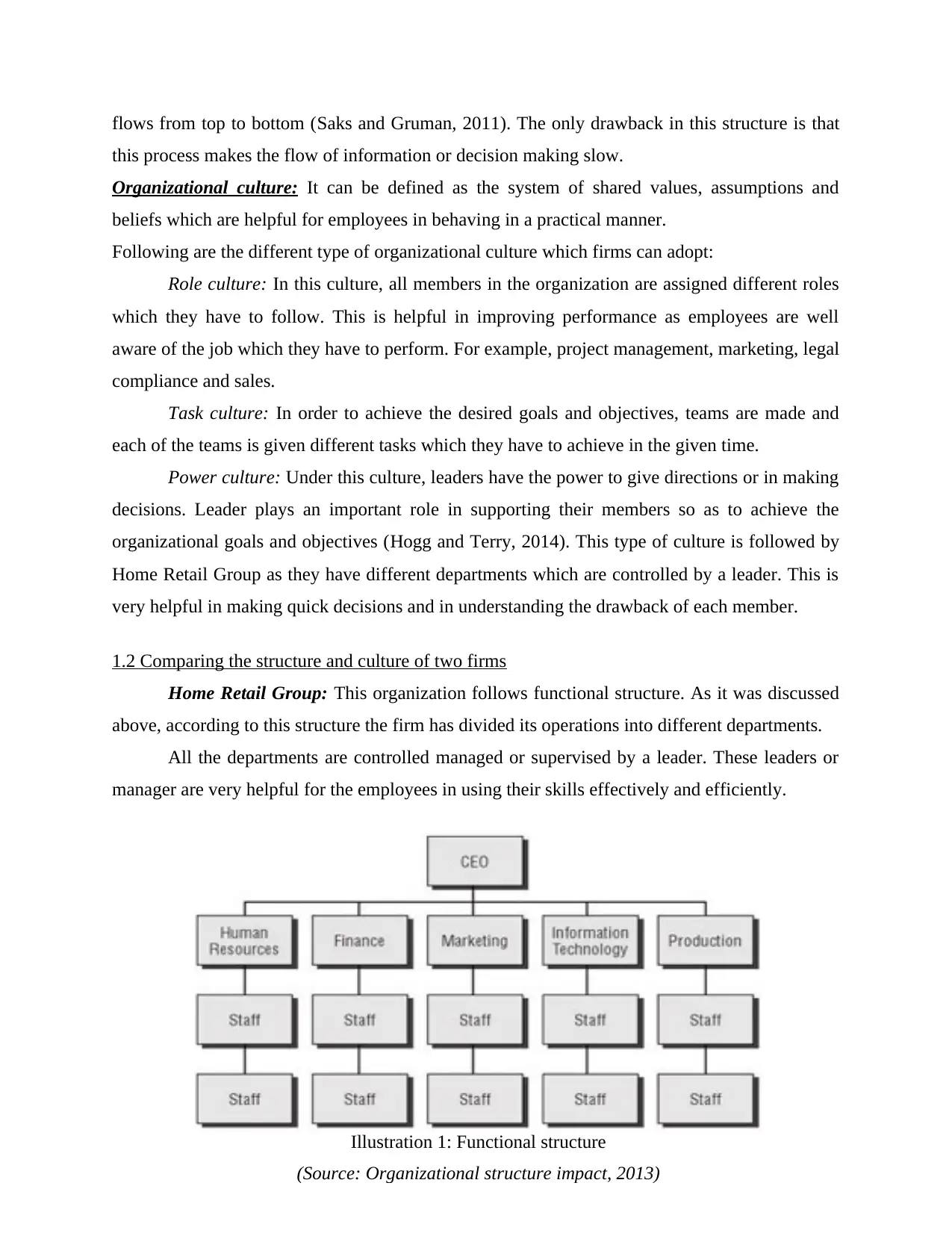
Home Retail Group: This organization follows functional structure. As it was discussed
above, according to this structure the firm has divided its operations into different departments.
All the departments are controlled managed or supervised by a leader. These leaders or
manager are very helpful for the employees in using their skills effectively and efficiently.
5Illustration 1: Functional structure
(Source: Organizational structure impact, 2013)
this process makes the flow of information or decision making slow.
Organizational culture: It can be defined as the system of shared values, assumptions and
beliefs which are helpful for employees in behaving in a practical manner.
Following are the different type of organizational culture which firms can adopt:
Role culture: In this culture, all members in the organization are assigned different roles
which they have to follow. This is helpful in improving performance as employees are well
aware of the job which they have to perform. For example, project management, marketing, legal
compliance and sales.
Task culture: In order to achieve the desired goals and objectives, teams are made and
each of the teams is given different tasks which they have to achieve in the given time.
Power culture: Under this culture, leaders have the power to give directions or in making
decisions. Leader plays an important role in supporting their members so as to achieve the
organizational goals and objectives (Hogg and Terry, 2014). This type of culture is followed by
Home Retail Group as they have different departments which are controlled by a leader. This is
very helpful in making quick decisions and in understanding the drawback of each member.
1.2 Comparing the structure and culture of two firms
Home Retail Group: This organization follows functional structure. As it was discussed
above, according to this structure the firm has divided its operations into different departments.
All the departments are controlled managed or supervised by a leader. These leaders or
manager are very helpful for the employees in using their skills effectively and efficiently.
5Illustration 1: Functional structure
(Source: Organizational structure impact, 2013)
Paraphrase This Document
Need a fresh take? Get an instant paraphrase of this document with our AI Paraphraser
Leaders guide their members so that they can understand their roles and responsibilities
clearly and organizational goals can be achieved easily. In accordance with the structure, all the
operations are divided into departments and this is helpful in accomplishing given tasks on time
(Heldman, Cram, 2013).
On the other hand, Home Retail Group follows power culture. It was discussed above;
this culture gives authorities and power to the leader who is head of the departments. They help
their member and give them orders which have to be followed by employees in each department
(Hassard and Pym, 2012). This culture is helpful in controlling employees so that they can focus
on achieving organizational goals and objectives.
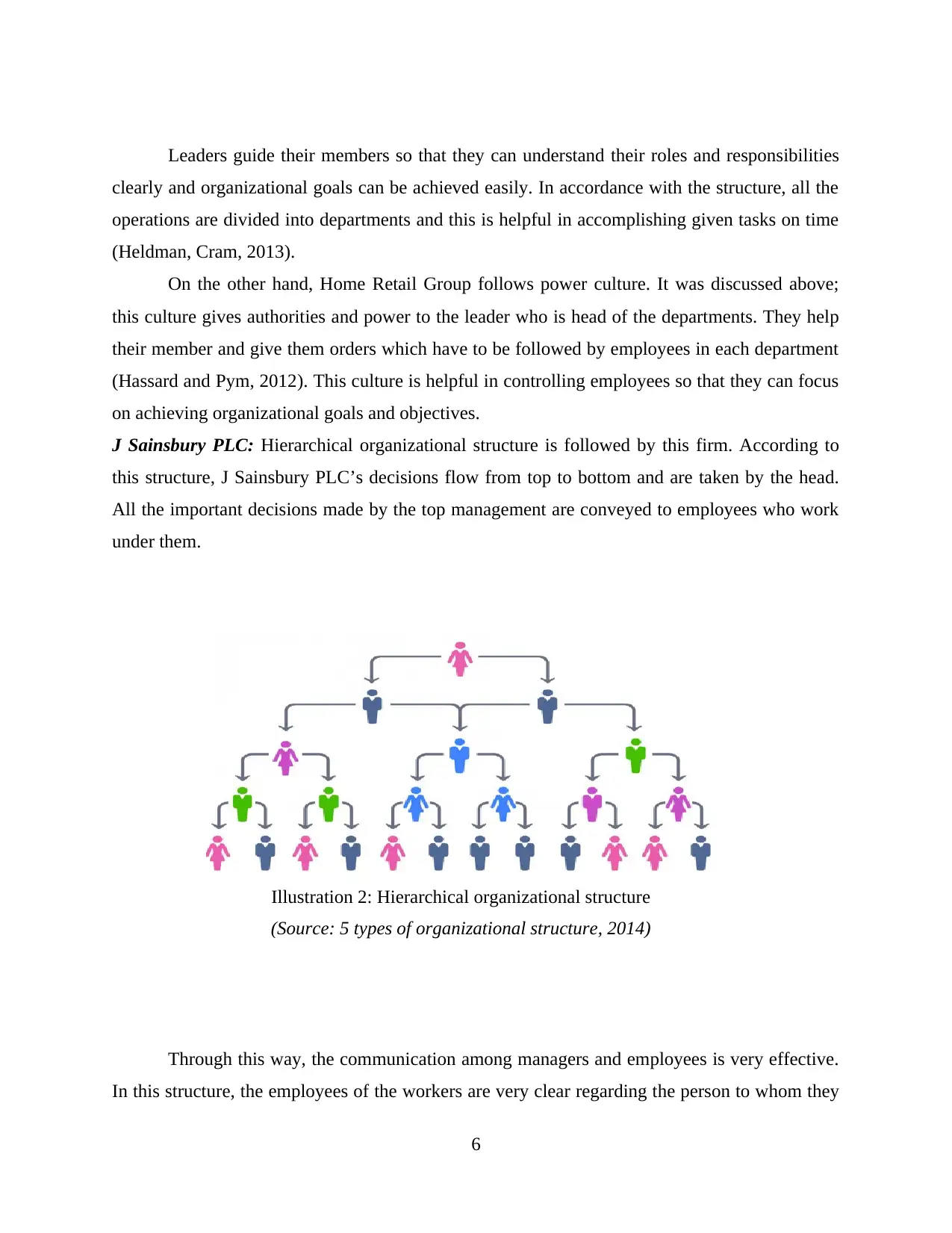
J Sainsbury PLC: Hierarchical organizational structure is followed by this firm. According to
this structure, J Sainsbury PLC’s decisions flow from top to bottom and are taken by the head.
All the important decisions made by the top management are conveyed to employees who work
under them.
Through this way, the communication among managers and employees is very effective.
In this structure, the employees of the workers are very clear regarding the person to whom they
6
Illustration 2: Hierarchical organizational structure
(Source: 5 types of organizational structure, 2014)
clearly and organizational goals can be achieved easily. In accordance with the structure, all the
operations are divided into departments and this is helpful in accomplishing given tasks on time
(Heldman, Cram, 2013).
On the other hand, Home Retail Group follows power culture. It was discussed above;
this culture gives authorities and power to the leader who is head of the departments. They help
their member and give them orders which have to be followed by employees in each department
(Hassard and Pym, 2012). This culture is helpful in controlling employees so that they can focus
on achieving organizational goals and objectives.
J Sainsbury PLC: Hierarchical organizational structure is followed by this firm. According to
this structure, J Sainsbury PLC’s decisions flow from top to bottom and are taken by the head.
All the important decisions made by the top management are conveyed to employees who work
under them.
Through this way, the communication among managers and employees is very effective.
In this structure, the employees of the workers are very clear regarding the person to whom they
6
Illustration 2: Hierarchical organizational structure
(Source: 5 types of organizational structure, 2014)
can convey their issues. It is also helpful in recruitment process, J Sainsbury PLC are able to
select employees who are highly skilled and knowledgeable.
On the other hand, J Sainsbury PLC adopts task culture. In this type of culture, firm has
divided their operation into different groups and each of the group is assigned different tasks
which they need to complete on the given time (Morgan, 2014). This type of culture is very
helpful in achieving desired goals and objectives as they know the goals which make it easy to
design the path through which they can achieve it.
1.3 Factors affecting the individual behaviour at work
There are many factors which affect individual behaviour at work, few factors are as
follows:
Communication: In order to develop coordination among the employees, effective
communication is very important. It is helpful in maintaining a strong relationship with the
employees and in understanding them (Jafri, 2012). When there is lack in communication, then it
negatively affects behaviour of the individuals working in the organization.
Family and personal life: There are many chances were personal or family life affects the
individual behaviour. If the personal and family life does work according the expectation of
individuals, then this affects the behaviour at work. They will not be able to work with full
concentration and this may also demotivate them.
Management or leadership: Management and leader highly affect the behaviour of organization
as they are the one who provide guidance and support to their employees. In addition to this, the
main role played by them is to motivate their employees. Motivation is very helpful in enhancing
their performance level. In case, the leaders of the management are not supportive, then this
would negatively affect performance of the employees as they will not be able to perform with
their full efficiency or concentration.
Reasons to understanding the individual behaviour by managers:
Punctuality: Punctuality shows the willingness and dedication of employees towards the
organization. It is helpful in knowing the desire and willingness of the employees towards
achieving goals and objectives of the organization (Tohidi, 2011).
7
select employees who are highly skilled and knowledgeable.
On the other hand, J Sainsbury PLC adopts task culture. In this type of culture, firm has
divided their operation into different groups and each of the group is assigned different tasks
which they need to complete on the given time (Morgan, 2014). This type of culture is very
helpful in achieving desired goals and objectives as they know the goals which make it easy to
design the path through which they can achieve it.
1.3 Factors affecting the individual behaviour at work
There are many factors which affect individual behaviour at work, few factors are as
follows:
Communication: In order to develop coordination among the employees, effective
communication is very important. It is helpful in maintaining a strong relationship with the
employees and in understanding them (Jafri, 2012). When there is lack in communication, then it
negatively affects behaviour of the individuals working in the organization.
Family and personal life: There are many chances were personal or family life affects the
individual behaviour. If the personal and family life does work according the expectation of
individuals, then this affects the behaviour at work. They will not be able to work with full
concentration and this may also demotivate them.
Management or leadership: Management and leader highly affect the behaviour of organization
as they are the one who provide guidance and support to their employees. In addition to this, the
main role played by them is to motivate their employees. Motivation is very helpful in enhancing
their performance level. In case, the leaders of the management are not supportive, then this
would negatively affect performance of the employees as they will not be able to perform with
their full efficiency or concentration.
Reasons to understanding the individual behaviour by managers:
Punctuality: Punctuality shows the willingness and dedication of employees towards the
organization. It is helpful in knowing the desire and willingness of the employees towards
achieving goals and objectives of the organization (Tohidi, 2011).
7
⊘ This is a preview!⊘
Do you want full access?
Subscribe today to unlock all pages.
Trusted by 1+ million students worldwide
Task performance: When management understands skills and qualities of their employees, then
they will be able to assign task more effectively. They should know efficiency of each employee
and accordingly they should be assigned the task.
2.2 Organizational theories underpinning the practices of management
There are many organizational theories which firm can adopt and these theories are very
important in underpinning practices of management. Following are the few of the organizational
theories:
Classical theory In increasing the efficiency of the firm, it is
very helpful as this theory mainly focuses on
different concepts. They provide guidelines
with the help of which the firm focus on
improving employee’s performance level.
Neoclassical theory This approach understands the individual and
group behaviour and mainly focus on
developing relationships.
Modern theory This is based on a concept that firm is a system
which has to adopt change according to
modifications which takes place in the
environment (Symon and Cassell, 2012).
Fayol's 14 principles It is a systematic way in which all the
responsibilities towards the organization are
divided. It is very helpful for the organization
to maintain discipline.
The above given theories are very helpful for the firm in underpinning the practices of
management. They act like guidelines which help the employees in performing their job more
effectively.
8
they will be able to assign task more effectively. They should know efficiency of each employee
and accordingly they should be assigned the task.
2.2 Organizational theories underpinning the practices of management
There are many organizational theories which firm can adopt and these theories are very
important in underpinning practices of management. Following are the few of the organizational
theories:
Classical theory In increasing the efficiency of the firm, it is
very helpful as this theory mainly focuses on
different concepts. They provide guidelines
with the help of which the firm focus on
improving employee’s performance level.
Neoclassical theory This approach understands the individual and
group behaviour and mainly focus on
developing relationships.
Modern theory This is based on a concept that firm is a system
which has to adopt change according to
modifications which takes place in the
environment (Symon and Cassell, 2012).
Fayol's 14 principles It is a systematic way in which all the
responsibilities towards the organization are
divided. It is very helpful for the organization
to maintain discipline.
The above given theories are very helpful for the firm in underpinning the practices of
management. They act like guidelines which help the employees in performing their job more
effectively.
8
Paraphrase This Document
Need a fresh take? Get an instant paraphrase of this document with our AI Paraphraser
2.1 Different leadership styles
There are many types of leadership styles which can be followed by the organizations.
Firms select leadership style in accordance with the type of structure and culture they follow.
Each and every leadership style has own merits and demerits. Following are the leadership styles
followed by J Sainsbury PLC and Home Retail Group:
Autocratic leadership style: This type of leadership style is followed by Home Retail Group.
According to this style, all the decisions are taken by the top management only. Employees are
not involved in the decision making. Employees feel rejected and de-motivated as they are not
allowed to take decisions. All the change decisions taken by the top management have to be
followed by the workers (Aktaş, Çiçek and Kıyak, 2011). Everyone wants to the free in this
context this leadership style is less effective.
Democratic leadership style: This leadership style is followed by Sainsbury PLC. According to
this leadership style, employees and management both are involved in the decision making. In all
the important decision to be taken, management allows employees in making decision making.
This is very helpful in motivating workers as they are involved in the decision making process.
This style is very helpful in motivating and encouraging the employees working in the
organization.
2.3 Evaluating different approaches to management
There are many approaches to management which organizations can follow. These
approaches are very helpful in organizing and making future plans. Following are the approaches
followed by Sainsbury PLC and Home Retail Group:
Contingency theory: This management approach is followed by Sainsbury PLC. In this approach
in order to manage its organizations in setting up management principles and values there are
many universal practical applications (Haslam, Knippenberg, Platow and Ellemers, 2014).
Further, organizations are able to select or hire candidates with high skills and knowledge which
is very helpful for the organization to grow.
Administrative theory: This management approach is followed by Home Retail Group.
According to this approach, it includes clear division of labours, formalized administrative
structure and delegation of powers. In other words, organization has divided responsibilities,
power and roles to different departments; this is very helpful in achieving the desired goals and
9
There are many types of leadership styles which can be followed by the organizations.
Firms select leadership style in accordance with the type of structure and culture they follow.
Each and every leadership style has own merits and demerits. Following are the leadership styles
followed by J Sainsbury PLC and Home Retail Group:
Autocratic leadership style: This type of leadership style is followed by Home Retail Group.
According to this style, all the decisions are taken by the top management only. Employees are
not involved in the decision making. Employees feel rejected and de-motivated as they are not
allowed to take decisions. All the change decisions taken by the top management have to be
followed by the workers (Aktaş, Çiçek and Kıyak, 2011). Everyone wants to the free in this
context this leadership style is less effective.
Democratic leadership style: This leadership style is followed by Sainsbury PLC. According to
this leadership style, employees and management both are involved in the decision making. In all
the important decision to be taken, management allows employees in making decision making.
This is very helpful in motivating workers as they are involved in the decision making process.
This style is very helpful in motivating and encouraging the employees working in the
organization.
2.3 Evaluating different approaches to management
There are many approaches to management which organizations can follow. These
approaches are very helpful in organizing and making future plans. Following are the approaches
followed by Sainsbury PLC and Home Retail Group:
Contingency theory: This management approach is followed by Sainsbury PLC. In this approach
in order to manage its organizations in setting up management principles and values there are
many universal practical applications (Haslam, Knippenberg, Platow and Ellemers, 2014).
Further, organizations are able to select or hire candidates with high skills and knowledge which
is very helpful for the organization to grow.
Administrative theory: This management approach is followed by Home Retail Group.
According to this approach, it includes clear division of labours, formalized administrative
structure and delegation of powers. In other words, organization has divided responsibilities,
power and roles to different departments; this is very helpful in achieving the desired goals and
9
objectives easily. Through this, organizations support their employees for setting up the goals
and path through which they can achieve it.
3.1 Impact of different leadership style on motivating
As it was discussed above Home Retail Group follows autocratic leadership style.
Following are the impact on the organization:
Ensuring roles and responsibility: This leadership style is very helpful to ensure all the
employee’s roles and responsibilities are effectively followed or not. In addition to this, leaders
or managers of the organization ensure that all the tasks given to the department are followed
efficiently or not.
Ineffective decision making: All the decisions are taken by the top management according to the
knowledge and experience mangers possess. There are chances that the decisions made by
managers may go wrong (Zolfani, Chen, Rezaeiniya and Tamošaitienė, 2012). When more and
more people are involved, then the risk of making wrong decisions decreases. Moreover, when
more people are involved, then decisions can also be taken very quickly.
De-motivation: As workers are not involved in decision making, this makes them feel
disconnected, de-motivated and neglected by the firm. As a result, it highly affects the
performance of the workers.
Control over business: This type of leadership styles is adopted in order to ensure that all the
business operations are being followed effectively or not. Employees tend to follow the orders
given by the managers.
3.2 Comparing the application of different motivational theories
There are many motivational theories which firm can follow. Among these motivational
theories is Maslow hierarchy of needs theory is the best theory. Home Retail Group follows
Maslow needs theory. Comparisons of motivational theories are as follows:
Setting up goal: With the help of this theory employees set up goals which are very essential for
achieving the organizational goals and objectives. Path can be determined easily when
employees set up goals. Thus, this motivational theory is very helpful for the organization in
motivating and in achieving the desired goals (Sweetman, Luthans, Avey and Luthans, 2011).
Process motivation: In any kind of event or occurrence of scientific research, this theory is used
and it is mainly caused by input.
10
and path through which they can achieve it.
3.1 Impact of different leadership style on motivating
As it was discussed above Home Retail Group follows autocratic leadership style.
Following are the impact on the organization:
Ensuring roles and responsibility: This leadership style is very helpful to ensure all the
employee’s roles and responsibilities are effectively followed or not. In addition to this, leaders
or managers of the organization ensure that all the tasks given to the department are followed
efficiently or not.
Ineffective decision making: All the decisions are taken by the top management according to the
knowledge and experience mangers possess. There are chances that the decisions made by
managers may go wrong (Zolfani, Chen, Rezaeiniya and Tamošaitienė, 2012). When more and
more people are involved, then the risk of making wrong decisions decreases. Moreover, when
more people are involved, then decisions can also be taken very quickly.
De-motivation: As workers are not involved in decision making, this makes them feel
disconnected, de-motivated and neglected by the firm. As a result, it highly affects the
performance of the workers.
Control over business: This type of leadership styles is adopted in order to ensure that all the
business operations are being followed effectively or not. Employees tend to follow the orders
given by the managers.
3.2 Comparing the application of different motivational theories
There are many motivational theories which firm can follow. Among these motivational
theories is Maslow hierarchy of needs theory is the best theory. Home Retail Group follows
Maslow needs theory. Comparisons of motivational theories are as follows:
Setting up goal: With the help of this theory employees set up goals which are very essential for
achieving the organizational goals and objectives. Path can be determined easily when
employees set up goals. Thus, this motivational theory is very helpful for the organization in
motivating and in achieving the desired goals (Sweetman, Luthans, Avey and Luthans, 2011).
Process motivation: In any kind of event or occurrence of scientific research, this theory is used
and it is mainly caused by input.
10
⊘ This is a preview!⊘
Do you want full access?
Subscribe today to unlock all pages.
Trusted by 1+ million students worldwide

1 out of 15


Related Documents


Your All-in-One AI-Powered Toolkit for Academic Success.
+13062052269
info@desklib.com
Available 24*7 on WhatsApp / Email
![[object Object]](/_next/static/media/star-bottom.7253800d.svg)
Unlock your academic potential
Copyright © 2020–2026 A2Z Services. All Rights Reserved. Developed and managed by ZUCOL.