HRM39: Managing People Assignment - Behavioural Analysis Report

Verified

Added on  2019/09/20

|3
|579
|375
Report
AI Summary
This report is based on an HRM39 Managing People assignment, which involves analyzing an experience within an organizational setting, focusing on leadership, group dynamics, and individual behavior. The assignment requires the student to select a relevant experience, provide a rationale, and apply appropriate concepts, theories, and models to analyze the situation. Key areas of focus include organizational and group settings, observation, and the application of frameworks such as the Johari window and concepts from previous workshops on groups, leadership, and emotional intelligence. The report aims to provide a multi-dimensional analysis, including the identification of managing and developing people issues, and the application of models like Drucker's and Torrington's frameworks. The report concludes with reflections on professional practice, emphasizing the importance of understanding assumptions, values, and perceptions in the context of the experience.
Document Page
s
HRM39 MANAGING PEOPLE Lecturer: Barry Lee Scherer
Observing and Interpreting Behaviour
Workshop - Week beginning 5 December 2016
LEARNING OBJECTIVES
By the end of this session you should be able to:
Identify and evaluate an appropriate experience to use as a basis for your first assessment.
Clarify the rationale for your selected experience.
Identify appropriate concepts, theories and/or models that will help you with your observations and
interpretation of behaviour in an organisational or work setting and apply these;
Consider the importance of assumptions, values and perceptions in understanding experiences
involving misunderstanding or conflict.
Identify key elements in the organisational setting, the task and the group that help to understand
and
explain what took place.
WHAT IS YOUR ASSESSMENT TASK?
“Select one or two appropriate and authentic experiences. Rationale for the selection: what was the
context? What were the managing and developing people issues involved? How were you involved?
“Application of appropriate concepts, theories and/or models to examine the chosen experience(s) to
create a multi-dimensional analysis of the selected experience(s)”
PROGRESS REVIEW:
1. HAVE YOU IDENTIFIED AN APPROPRIATE EXPERIENCE?
Briefly identify the experience (involving who and what issues?)
2. RATIONALE
Why and how is this important to you?
What learning? From what did you learn?
Authentic experience with opportunity for analysis and reflection
Fits assignment brief? Managing people issues? Which models do you draw upon?
Your model of managing people?
tabler-icon-diamond-filled.svg

Paraphrase This Document

Need a fresh take? Get an instant paraphrase of this document with our AI Paraphraser
Document Page
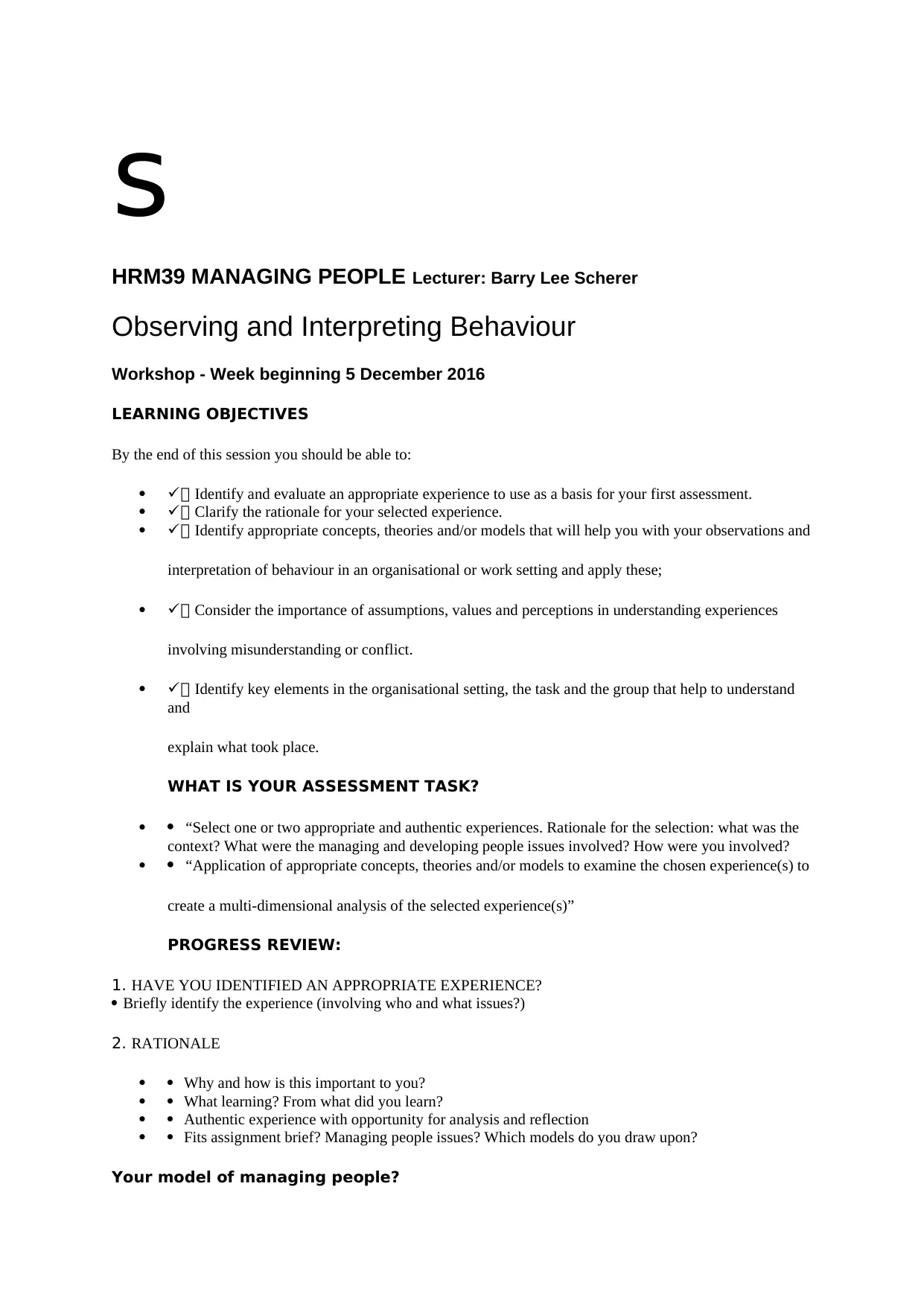
DRUCKER
Setting objectives and goals
Dividing the work
Motivating (rewarding), communicating
(integrating)
Measuring – establishing goals and
targets; analyse, appraise and interpret
performance
Developing people: developing human
assets
TORRINGTON
● Staffing objectives -‘getting the right people in the right jobs at the right times’
● Performance objectives: assisting the organisation to motivate its employees and ensure that they perform
well. Includes training and development, reward and performance systems
● Change management objectives includes recruitment and development of people with the necessary leadership
and change management skills, and rewards to underpin change.
● Administration objectives include the maintenance of accurate employee data: recruitment, contracts,
performance; attendance, training; organisational compliance with legal requirements (law, health and safety
3. DESCRIPTION AND ANALYSIS - AN INTEGTRATIVE FRAMEWORK FOR ANALYSIS
1

Organisational and group setting
What did you observe? Provide illustrations and evidence.
4. ANALYSIS AND CHOICE OF FRAMEWORKS. SUGGESTED FRAMEWORKS:
Concepts from previous workshops: Groups, models of group work; emotional intelligence;
leadership, influencing and persuasion; experiential learning; learning cycle framework; reflection and
professional practice
ADDITIONAL FRAMEWORKS: Gabarro, John and Kotter, John 1993 “Managing your boss”
Harvard Business Review May-June
Document Page
Luft, Joseph 1961 “Johari window” Human Relations Training News (reprint)
http://www.convivendo.net/wp-content/uploads/2009/05/johari-window-articolo-originale.pdf
5. CONCLUSIONS AND YOUR PROFESSIONAL PRACTICE
1
Based on: Homans, George C 1998 The Human Group (Routledge), and Ancona, Deborah
B 1992 “Bridging the Boundary” Administrative Science Quarterly Vol 37 p. 634, and
McCaskey, Michael B “Framework for analysing groups” Harvard Business School case
4800009
chevron_up_icon
1 out of 3
circle_padding
hide_on_mobile
zoom_out_icon
[object Object]