Effective Change Management: Case Studies in Organizational Leadership
VerifiedAdded on 2023/06/15
|12
|2655
|197
Case Study
AI Summary
This document presents a series of case studies focused on change management within organizations. The first case explores the implementation of multitasking and its impact on employee satisfaction and organizational productivity, emphasizing the need for adaptability and clear communication. The second case examines resistance to change and strategies for overcoming it, highlighting the importance of employee involvement and trust-building. The third case analyzes the benefits and costs of upgrading to a tech-savvy system, underscoring the significance of technological advancement in achieving competitive advantage. Each case study provides insights into the challenges and opportunities associated with organizational change, offering practical recommendations for effective implementation and management. This resource, contributed by a student, is available on Desklib, a platform offering a range of study tools and solved assignments.
Running head: CASE STUDY ON CHANGE MANAGEMENT
CASE STUDY ON CHANGE MANAGEMENT
Name of the Student
Name of the University
Authors Note
CASE STUDY ON CHANGE MANAGEMENT
Name of the Student
Name of the University
Authors Note

Paraphrase This Document
Need a fresh take? Get an instant paraphrase of this document with our AI Paraphraser
1CASE STUDY ON CHANGE MANAGEMENT
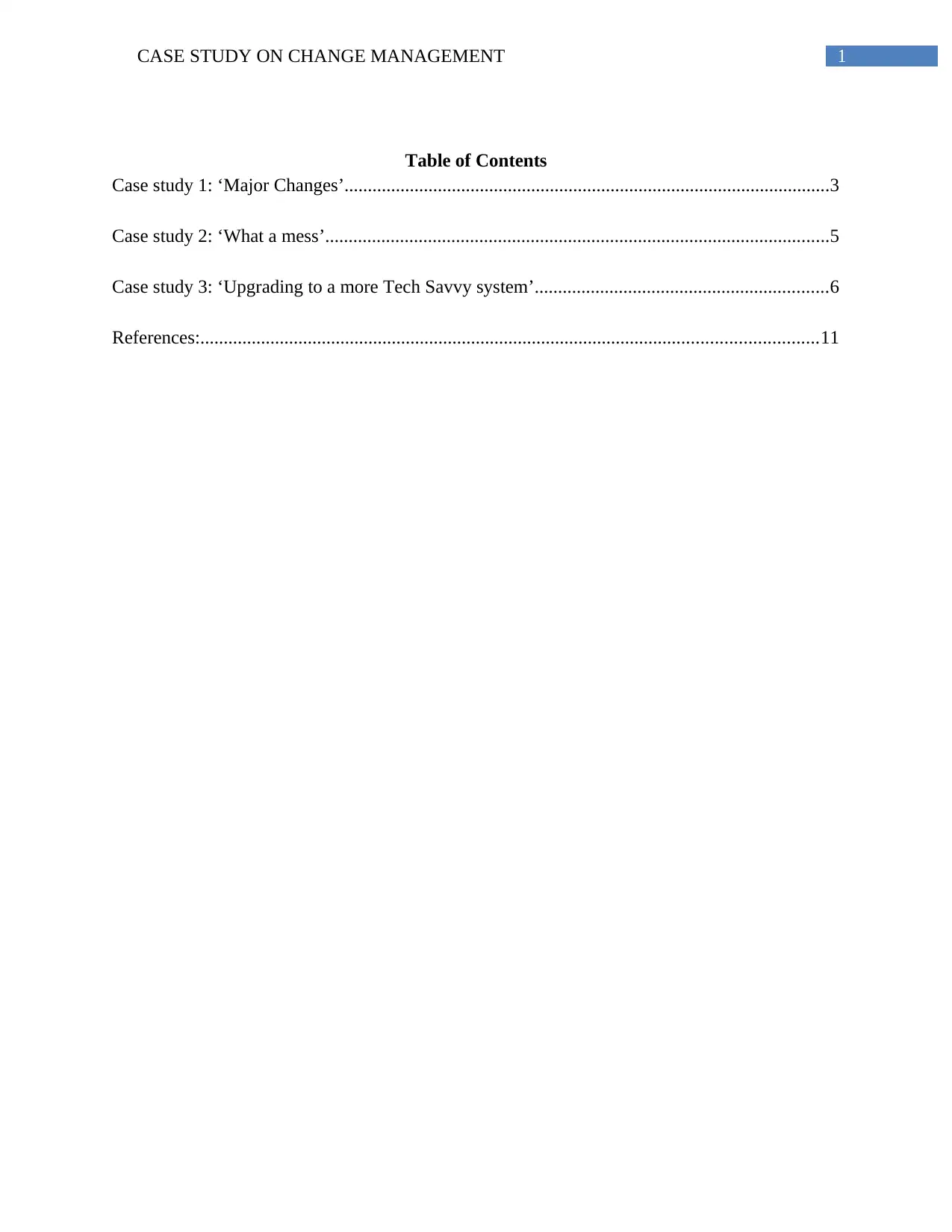
Table of Contents
Case study 1: ‘Major Changes’........................................................................................................3
Case study 2: ‘What a mess’............................................................................................................5
Case study 3: ‘Upgrading to a more Tech Savvy system’...............................................................6
References:....................................................................................................................................11
Table of Contents
Case study 1: ‘Major Changes’........................................................................................................3
Case study 2: ‘What a mess’............................................................................................................5
Case study 3: ‘Upgrading to a more Tech Savvy system’...............................................................6
References:....................................................................................................................................11
2CASE STUDY ON CHANGE MANAGEMENT
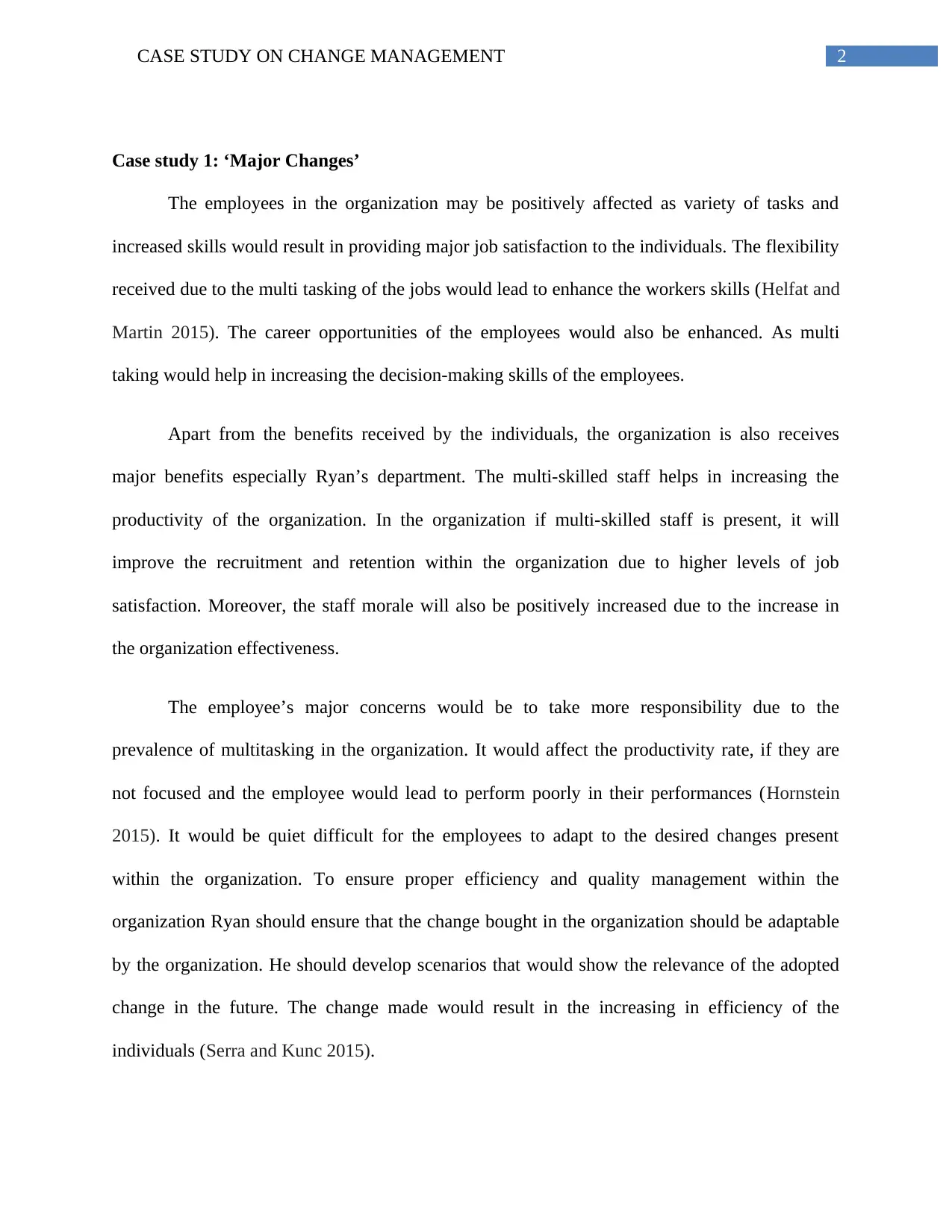
Case study 1: ‘Major Changes’
The employees in the organization may be positively affected as variety of tasks and
increased skills would result in providing major job satisfaction to the individuals. The flexibility
received due to the multi tasking of the jobs would lead to enhance the workers skills (Helfat and
Martin 2015). The career opportunities of the employees would also be enhanced. As multi
taking would help in increasing the decision-making skills of the employees.
Apart from the benefits received by the individuals, the organization is also receives
major benefits especially Ryan’s department. The multi-skilled staff helps in increasing the
productivity of the organization. In the organization if multi-skilled staff is present, it will
improve the recruitment and retention within the organization due to higher levels of job
satisfaction. Moreover, the staff morale will also be positively increased due to the increase in
the organization effectiveness.
The employee’s major concerns would be to take more responsibility due to the
prevalence of multitasking in the organization. It would affect the productivity rate, if they are
not focused and the employee would lead to perform poorly in their performances (Hornstein
2015). It would be quiet difficult for the employees to adapt to the desired changes present
within the organization. To ensure proper efficiency and quality management within the
organization Ryan should ensure that the change bought in the organization should be adaptable
by the organization. He should develop scenarios that would show the relevance of the adopted
change in the future. The change made would result in the increasing in efficiency of the
individuals (Serra and Kunc 2015).
Case study 1: ‘Major Changes’
The employees in the organization may be positively affected as variety of tasks and
increased skills would result in providing major job satisfaction to the individuals. The flexibility
received due to the multi tasking of the jobs would lead to enhance the workers skills (Helfat and
Martin 2015). The career opportunities of the employees would also be enhanced. As multi
taking would help in increasing the decision-making skills of the employees.
Apart from the benefits received by the individuals, the organization is also receives
major benefits especially Ryan’s department. The multi-skilled staff helps in increasing the
productivity of the organization. In the organization if multi-skilled staff is present, it will
improve the recruitment and retention within the organization due to higher levels of job
satisfaction. Moreover, the staff morale will also be positively increased due to the increase in
the organization effectiveness.
The employee’s major concerns would be to take more responsibility due to the
prevalence of multitasking in the organization. It would affect the productivity rate, if they are
not focused and the employee would lead to perform poorly in their performances (Hornstein
2015). It would be quiet difficult for the employees to adapt to the desired changes present
within the organization. To ensure proper efficiency and quality management within the
organization Ryan should ensure that the change bought in the organization should be adaptable
by the organization. He should develop scenarios that would show the relevance of the adopted
change in the future. The change made would result in the increasing in efficiency of the
individuals (Serra and Kunc 2015).
⊘ This is a preview!⊘
Do you want full access?
Subscribe today to unlock all pages.

Trusted by 1+ million students worldwide
3CASE STUDY ON CHANGE MANAGEMENT
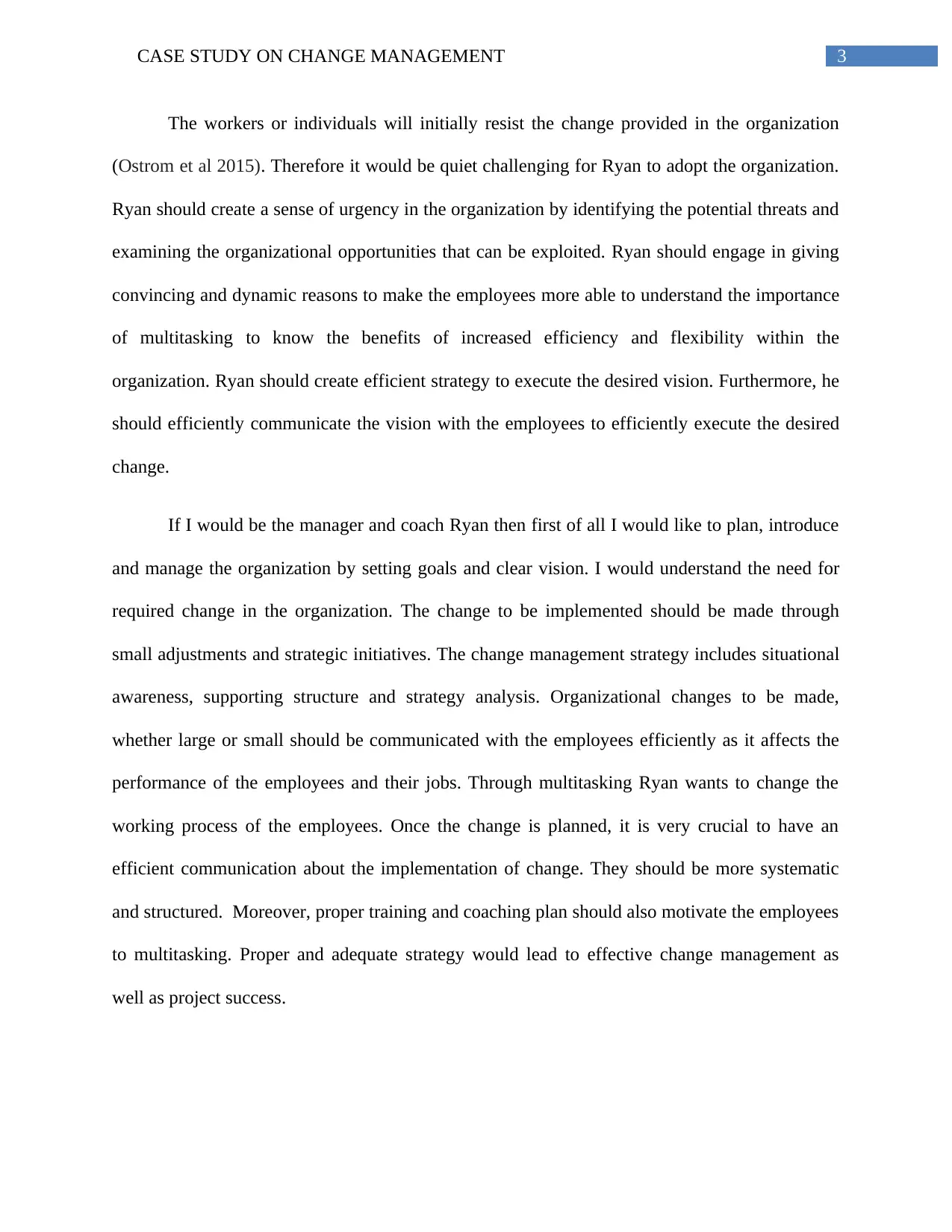
The workers or individuals will initially resist the change provided in the organization
(Ostrom et al 2015). Therefore it would be quiet challenging for Ryan to adopt the organization.
Ryan should create a sense of urgency in the organization by identifying the potential threats and
examining the organizational opportunities that can be exploited. Ryan should engage in giving
convincing and dynamic reasons to make the employees more able to understand the importance
of multitasking to know the benefits of increased efficiency and flexibility within the
organization. Ryan should create efficient strategy to execute the desired vision. Furthermore, he
should efficiently communicate the vision with the employees to efficiently execute the desired
change.
If I would be the manager and coach Ryan then first of all I would like to plan, introduce
and manage the organization by setting goals and clear vision. I would understand the need for
required change in the organization. The change to be implemented should be made through
small adjustments and strategic initiatives. The change management strategy includes situational
awareness, supporting structure and strategy analysis. Organizational changes to be made,
whether large or small should be communicated with the employees efficiently as it affects the
performance of the employees and their jobs. Through multitasking Ryan wants to change the
working process of the employees. Once the change is planned, it is very crucial to have an
efficient communication about the implementation of change. They should be more systematic
and structured. Moreover, proper training and coaching plan should also motivate the employees
to multitasking. Proper and adequate strategy would lead to effective change management as
well as project success.
The workers or individuals will initially resist the change provided in the organization
(Ostrom et al 2015). Therefore it would be quiet challenging for Ryan to adopt the organization.
Ryan should create a sense of urgency in the organization by identifying the potential threats and
examining the organizational opportunities that can be exploited. Ryan should engage in giving
convincing and dynamic reasons to make the employees more able to understand the importance
of multitasking to know the benefits of increased efficiency and flexibility within the
organization. Ryan should create efficient strategy to execute the desired vision. Furthermore, he
should efficiently communicate the vision with the employees to efficiently execute the desired
change.
If I would be the manager and coach Ryan then first of all I would like to plan, introduce
and manage the organization by setting goals and clear vision. I would understand the need for
required change in the organization. The change to be implemented should be made through
small adjustments and strategic initiatives. The change management strategy includes situational
awareness, supporting structure and strategy analysis. Organizational changes to be made,
whether large or small should be communicated with the employees efficiently as it affects the
performance of the employees and their jobs. Through multitasking Ryan wants to change the
working process of the employees. Once the change is planned, it is very crucial to have an
efficient communication about the implementation of change. They should be more systematic
and structured. Moreover, proper training and coaching plan should also motivate the employees
to multitasking. Proper and adequate strategy would lead to effective change management as
well as project success.
Paraphrase This Document
Need a fresh take? Get an instant paraphrase of this document with our AI Paraphraser
4CASE STUDY ON CHANGE MANAGEMENT
Case study 2: ‘What a mess’
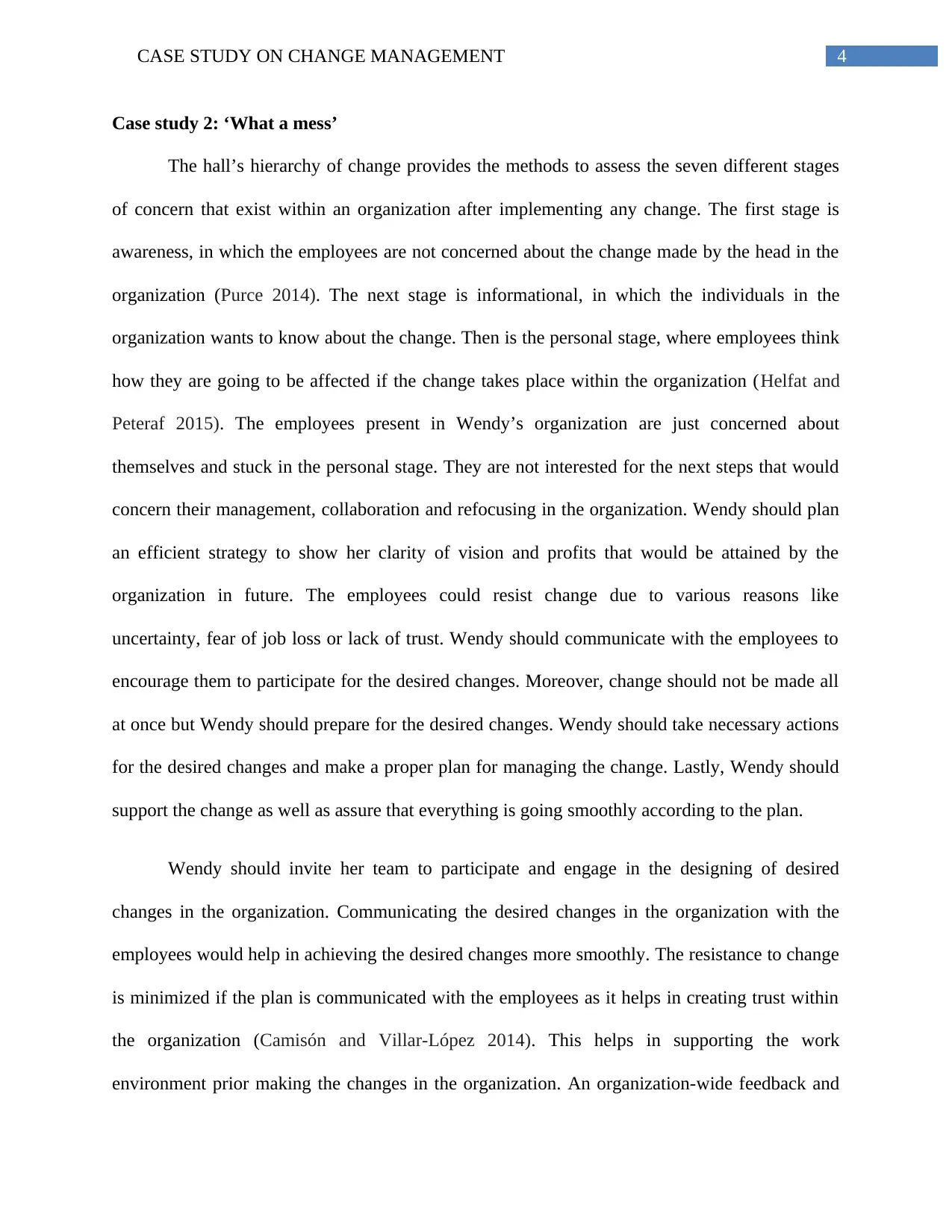
The hall’s hierarchy of change provides the methods to assess the seven different stages
of concern that exist within an organization after implementing any change. The first stage is
awareness, in which the employees are not concerned about the change made by the head in the
organization (Purce 2014). The next stage is informational, in which the individuals in the
organization wants to know about the change. Then is the personal stage, where employees think
how they are going to be affected if the change takes place within the organization (Helfat and
Peteraf 2015). The employees present in Wendy’s organization are just concerned about
themselves and stuck in the personal stage. They are not interested for the next steps that would
concern their management, collaboration and refocusing in the organization. Wendy should plan
an efficient strategy to show her clarity of vision and profits that would be attained by the
organization in future. The employees could resist change due to various reasons like
uncertainty, fear of job loss or lack of trust. Wendy should communicate with the employees to
encourage them to participate for the desired changes. Moreover, change should not be made all
at once but Wendy should prepare for the desired changes. Wendy should take necessary actions
for the desired changes and make a proper plan for managing the change. Lastly, Wendy should
support the change as well as assure that everything is going smoothly according to the plan.
Wendy should invite her team to participate and engage in the designing of desired
changes in the organization. Communicating the desired changes in the organization with the
employees would help in achieving the desired changes more smoothly. The resistance to change
is minimized if the plan is communicated with the employees as it helps in creating trust within
the organization (Camisón and Villar-López 2014). This helps in supporting the work
environment prior making the changes in the organization. An organization-wide feedback and
Case study 2: ‘What a mess’
The hall’s hierarchy of change provides the methods to assess the seven different stages
of concern that exist within an organization after implementing any change. The first stage is
awareness, in which the employees are not concerned about the change made by the head in the
organization (Purce 2014). The next stage is informational, in which the individuals in the
organization wants to know about the change. Then is the personal stage, where employees think
how they are going to be affected if the change takes place within the organization (Helfat and
Peteraf 2015). The employees present in Wendy’s organization are just concerned about
themselves and stuck in the personal stage. They are not interested for the next steps that would
concern their management, collaboration and refocusing in the organization. Wendy should plan
an efficient strategy to show her clarity of vision and profits that would be attained by the
organization in future. The employees could resist change due to various reasons like
uncertainty, fear of job loss or lack of trust. Wendy should communicate with the employees to
encourage them to participate for the desired changes. Moreover, change should not be made all
at once but Wendy should prepare for the desired changes. Wendy should take necessary actions
for the desired changes and make a proper plan for managing the change. Lastly, Wendy should
support the change as well as assure that everything is going smoothly according to the plan.
Wendy should invite her team to participate and engage in the designing of desired
changes in the organization. Communicating the desired changes in the organization with the
employees would help in achieving the desired changes more smoothly. The resistance to change
is minimized if the plan is communicated with the employees as it helps in creating trust within
the organization (Camisón and Villar-López 2014). This helps in supporting the work
environment prior making the changes in the organization. An organization-wide feedback and
5CASE STUDY ON CHANGE MANAGEMENT
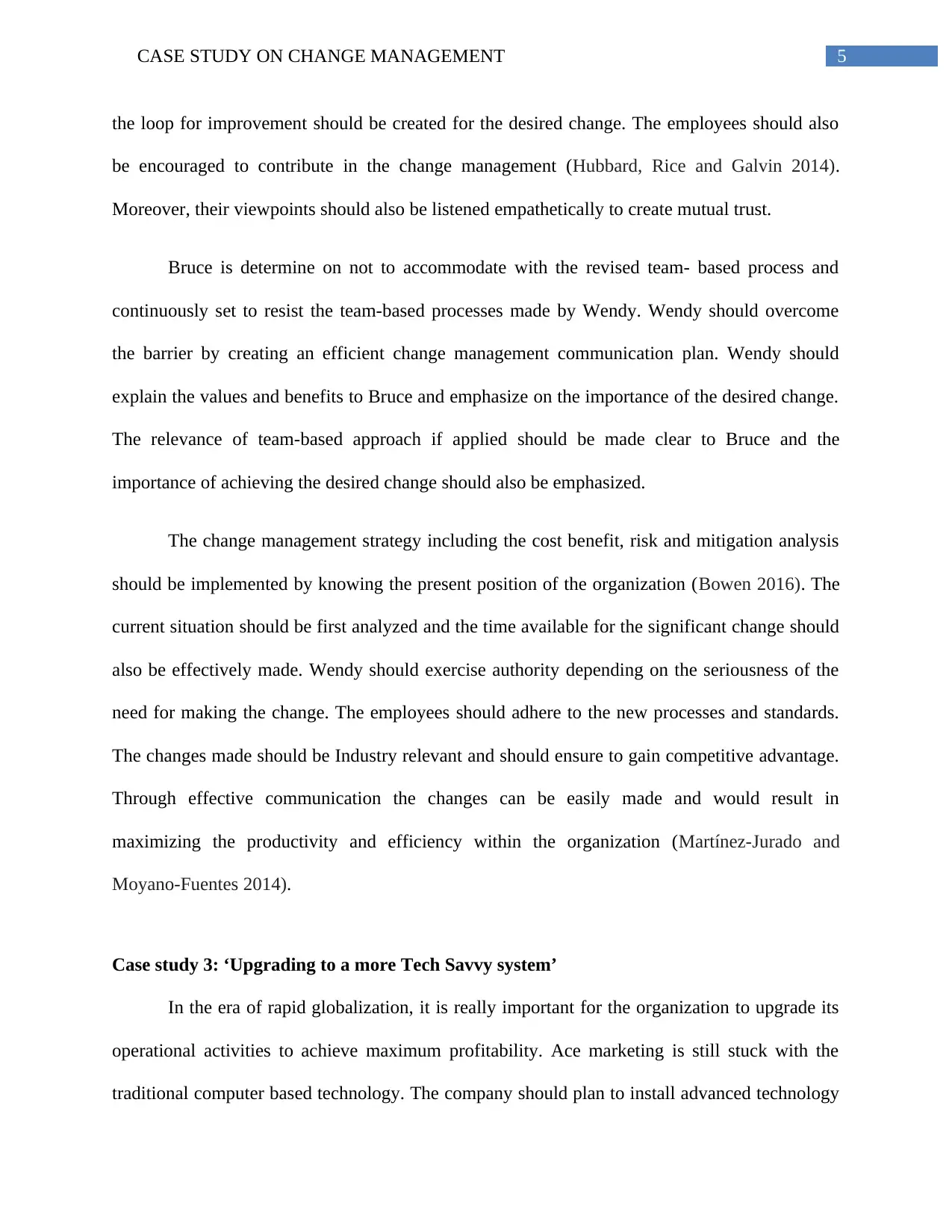
the loop for improvement should be created for the desired change. The employees should also
be encouraged to contribute in the change management (Hubbard, Rice and Galvin 2014).
Moreover, their viewpoints should also be listened empathetically to create mutual trust.
Bruce is determine on not to accommodate with the revised team- based process and
continuously set to resist the team-based processes made by Wendy. Wendy should overcome
the barrier by creating an efficient change management communication plan. Wendy should
explain the values and benefits to Bruce and emphasize on the importance of the desired change.
The relevance of team-based approach if applied should be made clear to Bruce and the
importance of achieving the desired change should also be emphasized.
The change management strategy including the cost benefit, risk and mitigation analysis
should be implemented by knowing the present position of the organization (Bowen 2016). The
current situation should be first analyzed and the time available for the significant change should
also be effectively made. Wendy should exercise authority depending on the seriousness of the
need for making the change. The employees should adhere to the new processes and standards.
The changes made should be Industry relevant and should ensure to gain competitive advantage.
Through effective communication the changes can be easily made and would result in
maximizing the productivity and efficiency within the organization (Martínez-Jurado and
Moyano-Fuentes 2014).
Case study 3: ‘Upgrading to a more Tech Savvy system’
In the era of rapid globalization, it is really important for the organization to upgrade its
operational activities to achieve maximum profitability. Ace marketing is still stuck with the
traditional computer based technology. The company should plan to install advanced technology
the loop for improvement should be created for the desired change. The employees should also
be encouraged to contribute in the change management (Hubbard, Rice and Galvin 2014).
Moreover, their viewpoints should also be listened empathetically to create mutual trust.
Bruce is determine on not to accommodate with the revised team- based process and
continuously set to resist the team-based processes made by Wendy. Wendy should overcome
the barrier by creating an efficient change management communication plan. Wendy should
explain the values and benefits to Bruce and emphasize on the importance of the desired change.
The relevance of team-based approach if applied should be made clear to Bruce and the
importance of achieving the desired change should also be emphasized.
The change management strategy including the cost benefit, risk and mitigation analysis
should be implemented by knowing the present position of the organization (Bowen 2016). The
current situation should be first analyzed and the time available for the significant change should
also be effectively made. Wendy should exercise authority depending on the seriousness of the
need for making the change. The employees should adhere to the new processes and standards.
The changes made should be Industry relevant and should ensure to gain competitive advantage.
Through effective communication the changes can be easily made and would result in
maximizing the productivity and efficiency within the organization (Martínez-Jurado and
Moyano-Fuentes 2014).
Case study 3: ‘Upgrading to a more Tech Savvy system’
In the era of rapid globalization, it is really important for the organization to upgrade its
operational activities to achieve maximum profitability. Ace marketing is still stuck with the
traditional computer based technology. The company should plan to install advanced technology
⊘ This is a preview!⊘
Do you want full access?
Subscribe today to unlock all pages.
Trusted by 1+ million students worldwide
6CASE STUDY ON CHANGE MANAGEMENT
for improving their contact management and sales processing system within the organization.
Technology in workplace currently is no longer a luxury but necessity. Organization without
installing technological savvy is more likely to fail. Ace marketing should make their business
more efficient as it would be easier to track the employee’s performance. The tedious tasks that
once needed long hours to be performed can now be easily completed within few hours (Too and
Weaver 2014). To gain competitive advantage is the major requirement nowadays for the
organization to implement new or innovative change strategy in the organization.
Online sales tools and using digital marketing enhance the growth of the corporation and
promote rapid increase in the productivity of the organization (Smith 2014). The communication
process becomes more effective both within the internal and external business environment.
Modern spreadsheets such as Excel helps accuracy and accounting programs like QuickBooks
allow adequately keeping the inventory, maintaining and recording sales (Bauer and Matzler
2014). Moreover, the updated technology helps in managing the pay bills and handle payrolls.
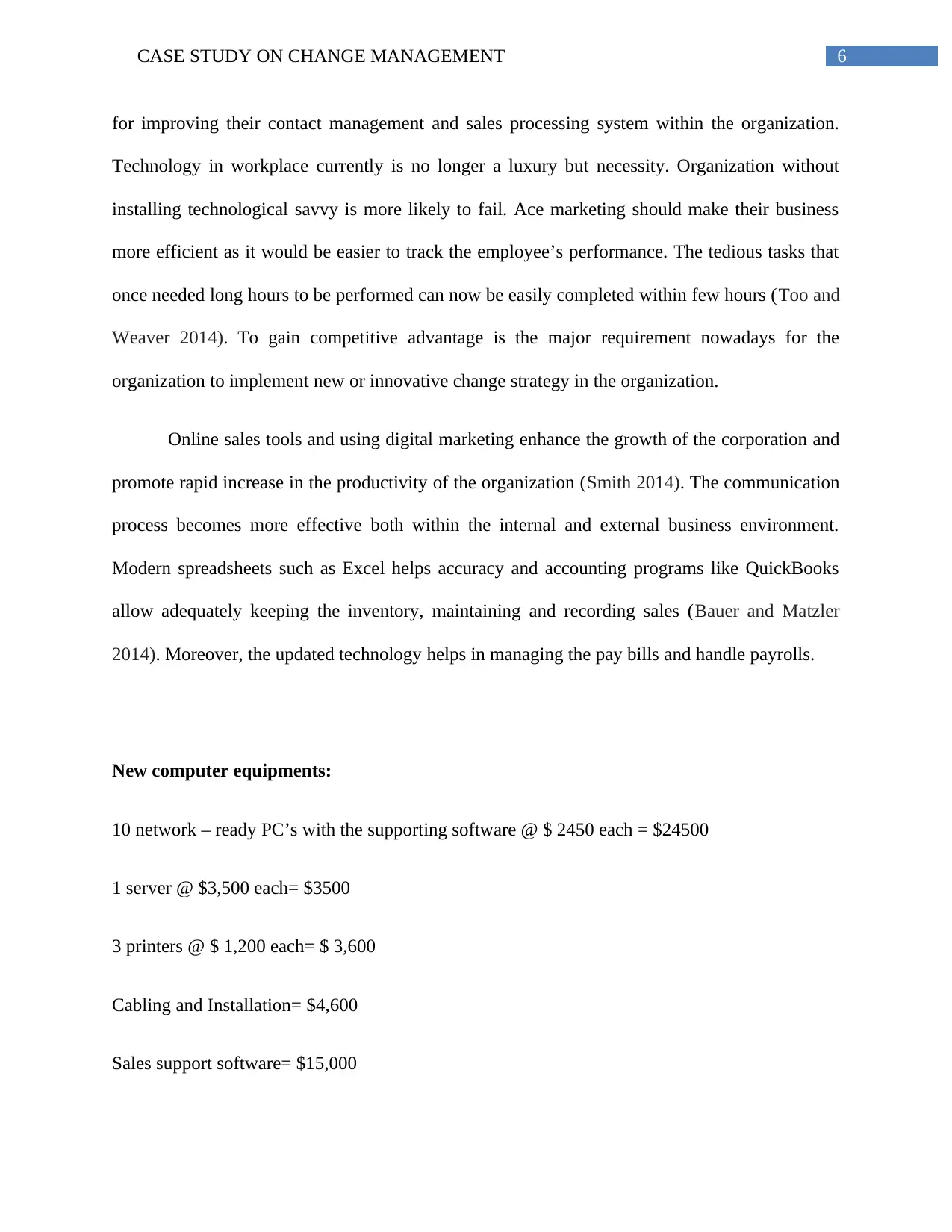
New computer equipments:
10 network – ready PC’s with the supporting software @ $ 2450 each = $24500
1 server @ $3,500 each= $3500
3 printers @ $ 1,200 each= $ 3,600
Cabling and Installation= $4,600
Sales support software= $15,000
for improving their contact management and sales processing system within the organization.
Technology in workplace currently is no longer a luxury but necessity. Organization without
installing technological savvy is more likely to fail. Ace marketing should make their business
more efficient as it would be easier to track the employee’s performance. The tedious tasks that
once needed long hours to be performed can now be easily completed within few hours (Too and
Weaver 2014). To gain competitive advantage is the major requirement nowadays for the
organization to implement new or innovative change strategy in the organization.
Online sales tools and using digital marketing enhance the growth of the corporation and
promote rapid increase in the productivity of the organization (Smith 2014). The communication
process becomes more effective both within the internal and external business environment.
Modern spreadsheets such as Excel helps accuracy and accounting programs like QuickBooks
allow adequately keeping the inventory, maintaining and recording sales (Bauer and Matzler
2014). Moreover, the updated technology helps in managing the pay bills and handle payrolls.
New computer equipments:
10 network – ready PC’s with the supporting software @ $ 2450 each = $24500
1 server @ $3,500 each= $3500
3 printers @ $ 1,200 each= $ 3,600
Cabling and Installation= $4,600
Sales support software= $15,000
Paraphrase This Document
Need a fresh take? Get an instant paraphrase of this document with our AI Paraphraser
7CASE STUDY ON CHANGE MANAGEMENT
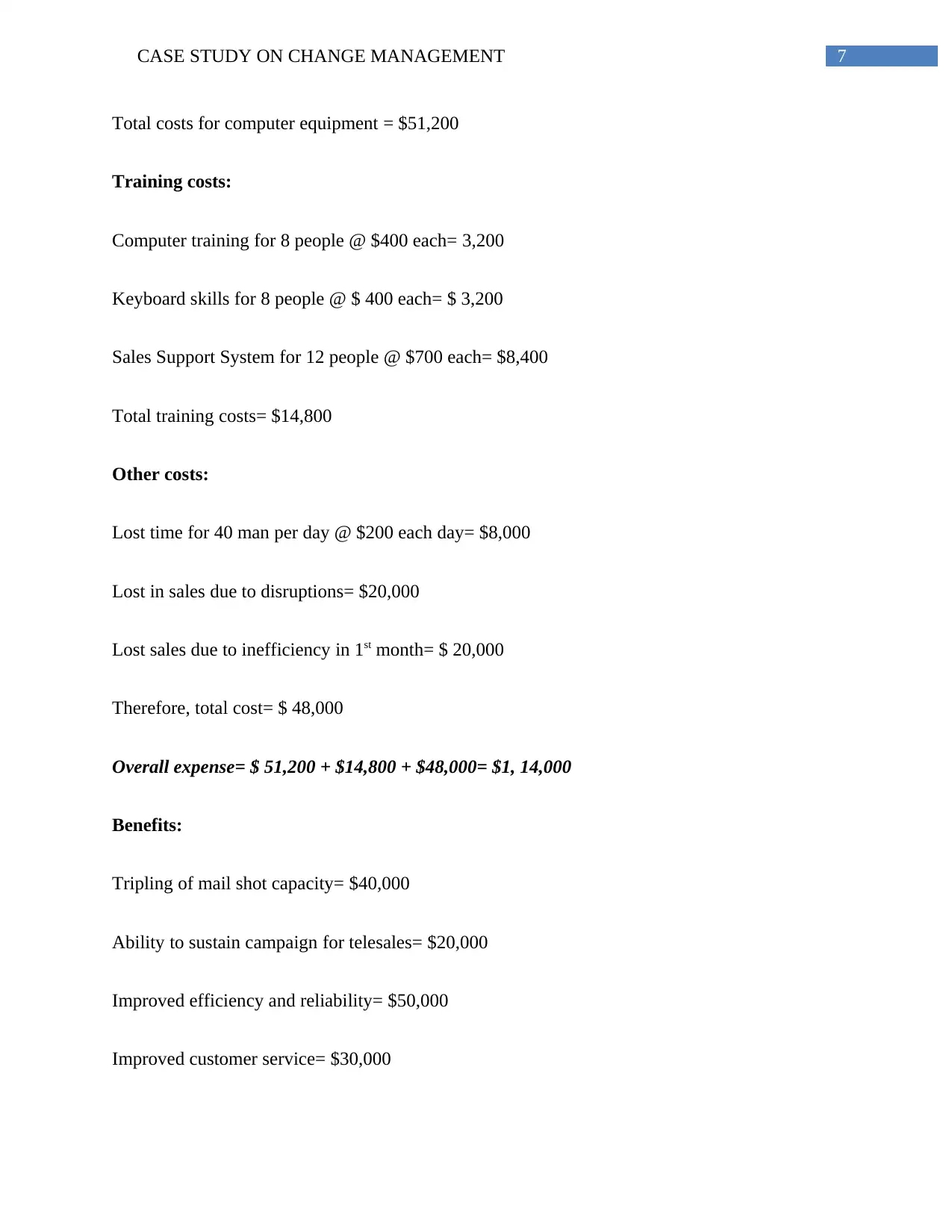
Total costs for computer equipment = $51,200
Training costs:
Computer training for 8 people @ $400 each= 3,200
Keyboard skills for 8 people @ $ 400 each= $ 3,200
Sales Support System for 12 people @ $700 each= $8,400
Total training costs= $14,800
Other costs:
Lost time for 40 man per day @ $200 each day= $8,000
Lost in sales due to disruptions= $20,000
Lost sales due to inefficiency in 1st month= $ 20,000
Therefore, total cost= $ 48,000
Overall expense= $ 51,200 + $14,800 + $48,000= $1, 14,000
Benefits:
Tripling of mail shot capacity= $40,000
Ability to sustain campaign for telesales= $20,000
Improved efficiency and reliability= $50,000
Improved customer service= $30,000
Total costs for computer equipment = $51,200
Training costs:
Computer training for 8 people @ $400 each= 3,200
Keyboard skills for 8 people @ $ 400 each= $ 3,200
Sales Support System for 12 people @ $700 each= $8,400
Total training costs= $14,800
Other costs:
Lost time for 40 man per day @ $200 each day= $8,000
Lost in sales due to disruptions= $20,000
Lost sales due to inefficiency in 1st month= $ 20,000
Therefore, total cost= $ 48,000
Overall expense= $ 51,200 + $14,800 + $48,000= $1, 14,000
Benefits:
Tripling of mail shot capacity= $40,000
Ability to sustain campaign for telesales= $20,000
Improved efficiency and reliability= $50,000
Improved customer service= $30,000
8CASE STUDY ON CHANGE MANAGEMENT
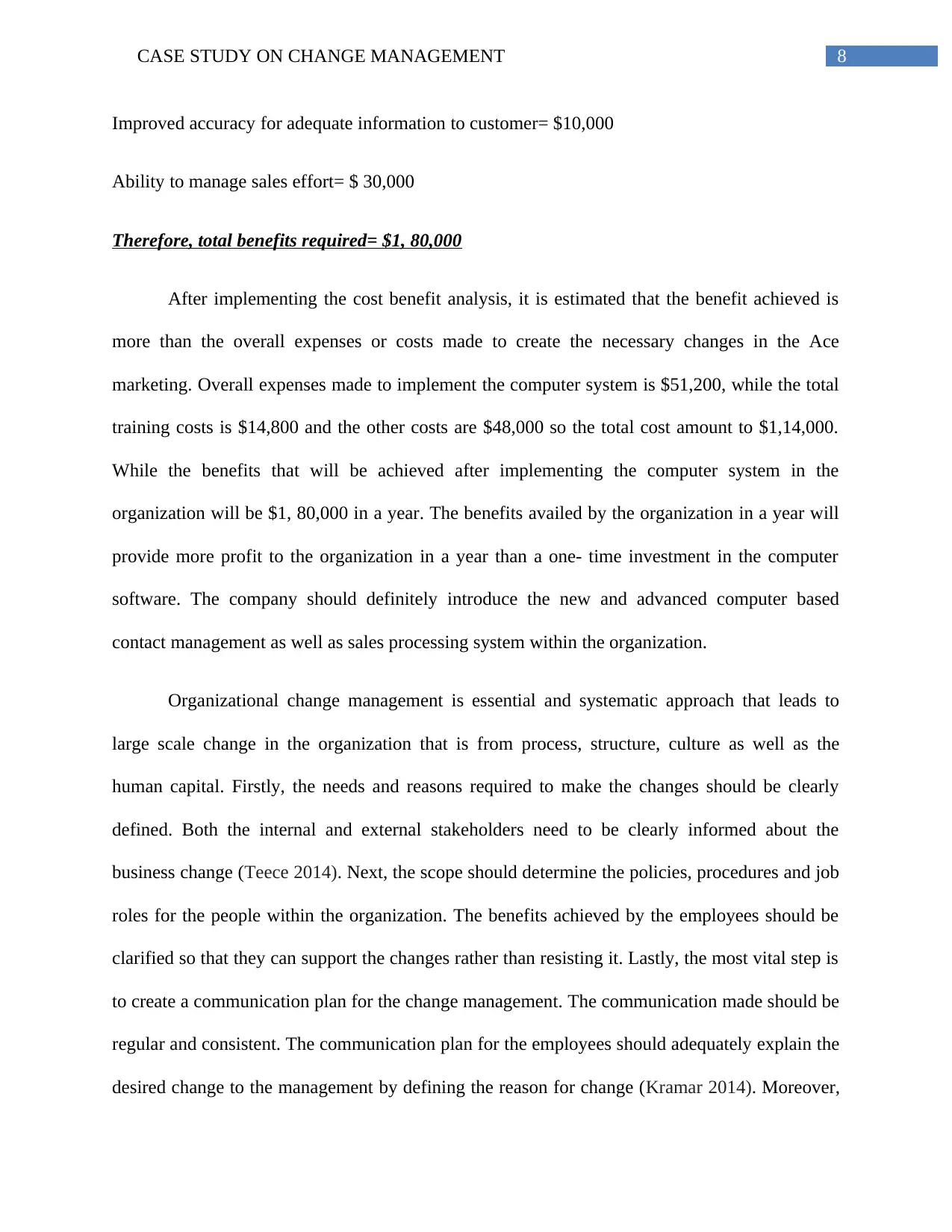
Improved accuracy for adequate information to customer= $10,000
Ability to manage sales effort= $ 30,000
Therefore, total benefits required= $1, 80,000
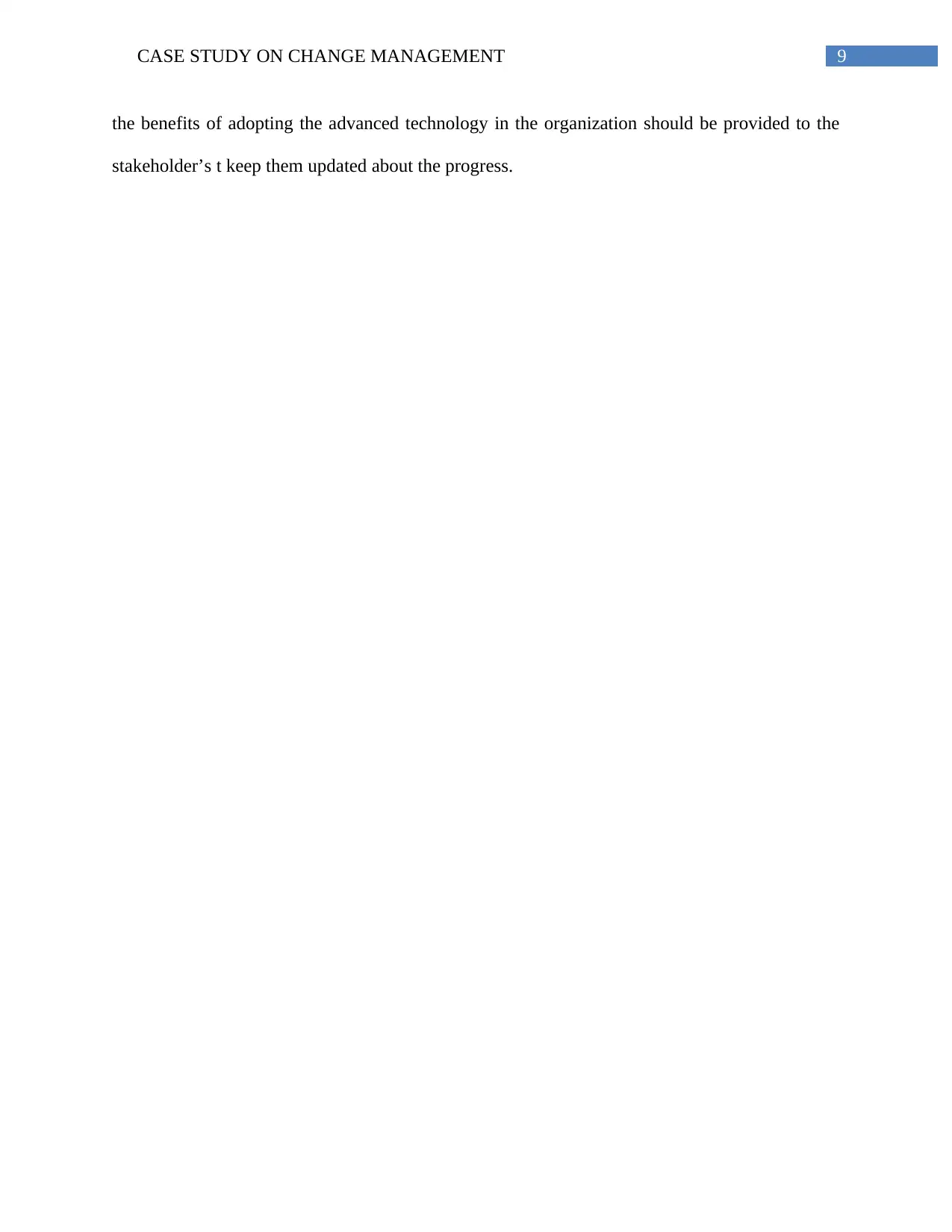
After implementing the cost benefit analysis, it is estimated that the benefit achieved is
more than the overall expenses or costs made to create the necessary changes in the Ace
marketing. Overall expenses made to implement the computer system is $51,200, while the total
training costs is $14,800 and the other costs are $48,000 so the total cost amount to $1,14,000.
While the benefits that will be achieved after implementing the computer system in the
organization will be $1, 80,000 in a year. The benefits availed by the organization in a year will
provide more profit to the organization in a year than a one- time investment in the computer
software. The company should definitely introduce the new and advanced computer based
contact management as well as sales processing system within the organization.
Organizational change management is essential and systematic approach that leads to
large scale change in the organization that is from process, structure, culture as well as the
human capital. Firstly, the needs and reasons required to make the changes should be clearly
defined. Both the internal and external stakeholders need to be clearly informed about the
business change (Teece 2014). Next, the scope should determine the policies, procedures and job
roles for the people within the organization. The benefits achieved by the employees should be
clarified so that they can support the changes rather than resisting it. Lastly, the most vital step is
to create a communication plan for the change management. The communication made should be
regular and consistent. The communication plan for the employees should adequately explain the
desired change to the management by defining the reason for change (Kramar 2014). Moreover,
Improved accuracy for adequate information to customer= $10,000
Ability to manage sales effort= $ 30,000
Therefore, total benefits required= $1, 80,000
After implementing the cost benefit analysis, it is estimated that the benefit achieved is
more than the overall expenses or costs made to create the necessary changes in the Ace
marketing. Overall expenses made to implement the computer system is $51,200, while the total
training costs is $14,800 and the other costs are $48,000 so the total cost amount to $1,14,000.
While the benefits that will be achieved after implementing the computer system in the
organization will be $1, 80,000 in a year. The benefits availed by the organization in a year will
provide more profit to the organization in a year than a one- time investment in the computer
software. The company should definitely introduce the new and advanced computer based
contact management as well as sales processing system within the organization.
Organizational change management is essential and systematic approach that leads to
large scale change in the organization that is from process, structure, culture as well as the
human capital. Firstly, the needs and reasons required to make the changes should be clearly
defined. Both the internal and external stakeholders need to be clearly informed about the
business change (Teece 2014). Next, the scope should determine the policies, procedures and job
roles for the people within the organization. The benefits achieved by the employees should be
clarified so that they can support the changes rather than resisting it. Lastly, the most vital step is
to create a communication plan for the change management. The communication made should be
regular and consistent. The communication plan for the employees should adequately explain the
desired change to the management by defining the reason for change (Kramar 2014). Moreover,
⊘ This is a preview!⊘
Do you want full access?
Subscribe today to unlock all pages.
Trusted by 1+ million students worldwide
9CASE STUDY ON CHANGE MANAGEMENT
the benefits of adopting the advanced technology in the organization should be provided to the
stakeholder’s t keep them updated about the progress.
the benefits of adopting the advanced technology in the organization should be provided to the
stakeholder’s t keep them updated about the progress.
Paraphrase This Document
Need a fresh take? Get an instant paraphrase of this document with our AI Paraphraser
10CASE STUDY ON CHANGE MANAGEMENT
References:
Bauer, F. and Matzler, K., 2014. Antecedents of M&A success: The role of strategic
complementarity, cultural fit, and degree and speed of integration. Strategic management
journal, 35(2), pp.269-291.
Bowen, D.E., 2016. The changing role of employees in service theory and practice: An
interdisciplinary view. Human Resource Management Review, 26(1), pp.4-13.
Camisón, C. and Villar-López, A., 2014. Organizational innovation as an enabler of
technological innovation capabilities and firm performance. Journal of business research, 67(1),
pp.2891-2902.
Helfat, C.E. and Martin, J.A., 2015. Dynamic managerial capabilities: Review and assessment of
managerial impact on strategic change. Journal of Management, 41(5), pp.1281-1312.
Helfat, C.E. and Peteraf, M.A., 2015. Managerial cognitive capabilities and the microfoundations
of dynamic capabilities. Strategic Management Journal, 36(6), pp.831-850.
Hornstein, H.A., 2015. The integration of project management and organizational change
management is now a necessity. International Journal of Project Management, 33(2), pp.291-
298.
Hubbard, G., Rice, J. and Galvin, P., 2014. Strategic management. Pearson Australia.
Kramar, R., 2014. Beyond strategic human resource management: is sustainable human resource
management the next approach?. The International Journal of Human Resource
Management, 25(8), pp.1069-1089.
References:
Bauer, F. and Matzler, K., 2014. Antecedents of M&A success: The role of strategic
complementarity, cultural fit, and degree and speed of integration. Strategic management
journal, 35(2), pp.269-291.
Bowen, D.E., 2016. The changing role of employees in service theory and practice: An
interdisciplinary view. Human Resource Management Review, 26(1), pp.4-13.
Camisón, C. and Villar-López, A., 2014. Organizational innovation as an enabler of
technological innovation capabilities and firm performance. Journal of business research, 67(1),
pp.2891-2902.
Helfat, C.E. and Martin, J.A., 2015. Dynamic managerial capabilities: Review and assessment of
managerial impact on strategic change. Journal of Management, 41(5), pp.1281-1312.
Helfat, C.E. and Peteraf, M.A., 2015. Managerial cognitive capabilities and the microfoundations
of dynamic capabilities. Strategic Management Journal, 36(6), pp.831-850.
Hornstein, H.A., 2015. The integration of project management and organizational change
management is now a necessity. International Journal of Project Management, 33(2), pp.291-
298.
Hubbard, G., Rice, J. and Galvin, P., 2014. Strategic management. Pearson Australia.
Kramar, R., 2014. Beyond strategic human resource management: is sustainable human resource
management the next approach?. The International Journal of Human Resource
Management, 25(8), pp.1069-1089.
11CASE STUDY ON CHANGE MANAGEMENT
Martínez-Jurado, P.J. and Moyano-Fuentes, J., 2014. Lean management, supply chain
management and sustainability: a literature review. Journal of Cleaner Production, 85, pp.134-
150.
Ostrom, A.L., Parasuraman, A., Bowen, D.E., Patricio, L. and Voss, C.A., 2015. Service
research priorities in a rapidly changing context. Journal of Service Research, 18(2), pp.127-159.
Purce, J., 2014. The impact of corporate strategy on human resource management. New
Perspectives on Human Resource Management (Routledge Revivals), 67.
Serra, C.E.M. and Kunc, M., 2015. Benefits realisation management and its influence on project
success and on the execution of business strategies. International Journal of Project
Management, 33(1), pp.53-66.
Smith, W.K., 2014. Dynamic decision making: A model of senior leaders managing strategic
paradoxes. Academy of Management Journal, 57(6), pp.1592-1623.
Teece, D.J., 2014. The foundations of enterprise performance: Dynamic and ordinary capabilities
in an (economic) theory of firms. The Academy of Management Perspectives, 28(4), pp.328-352.
Too, E.G. and Weaver, P., 2014. The management of project management: A conceptual
framework for project governance. International Journal of Project Management, 32(8),
pp.1382-1394.
Martínez-Jurado, P.J. and Moyano-Fuentes, J., 2014. Lean management, supply chain
management and sustainability: a literature review. Journal of Cleaner Production, 85, pp.134-
150.
Ostrom, A.L., Parasuraman, A., Bowen, D.E., Patricio, L. and Voss, C.A., 2015. Service
research priorities in a rapidly changing context. Journal of Service Research, 18(2), pp.127-159.
Purce, J., 2014. The impact of corporate strategy on human resource management. New
Perspectives on Human Resource Management (Routledge Revivals), 67.
Serra, C.E.M. and Kunc, M., 2015. Benefits realisation management and its influence on project
success and on the execution of business strategies. International Journal of Project
Management, 33(1), pp.53-66.
Smith, W.K., 2014. Dynamic decision making: A model of senior leaders managing strategic
paradoxes. Academy of Management Journal, 57(6), pp.1592-1623.
Teece, D.J., 2014. The foundations of enterprise performance: Dynamic and ordinary capabilities
in an (economic) theory of firms. The Academy of Management Perspectives, 28(4), pp.328-352.
Too, E.G. and Weaver, P., 2014. The management of project management: A conceptual
framework for project governance. International Journal of Project Management, 32(8),
pp.1382-1394.
⊘ This is a preview!⊘
Do you want full access?
Subscribe today to unlock all pages.
Trusted by 1+ million students worldwide

1 out of 12


Related Documents


Your All-in-One AI-Powered Toolkit for Academic Success.
+13062052269
info@desklib.com
Available 24*7 on WhatsApp / Email
![[object Object]](/_next/static/media/star-bottom.7253800d.svg)
Unlock your academic potential
Copyright © 2020–2026 A2Z Services. All Rights Reserved. Developed and managed by ZUCOL.