Organizational Leadership: Approaches to Change Management Report

Verified

Added on  2023/02/02

|9
|553
|29
Report
AI Summary
This report examines the importance of organizational change and its impact on business objectives. It explores various leadership approaches, including directing, coaching, supporting, and delegating, which are crucial for managing change effectively. The report highlights the significance of adapting leadership styles to internal and external drivers of change, such as technological advancements and competitive pressures. By understanding these approaches, leaders can navigate changes, such as changes in strategies, procedures, technology, processes, and culture, to achieve business objectives. The report also references key literature on organizational change and leadership, offering a comprehensive understanding of the topic. The conclusion emphasizes the necessity of implementing technological and competitor-driven changes to stay ahead in the market.
Document Page
Understanding and
Leading Change
tabler-icon-diamond-filled.svg

Paraphrase This Document

Need a fresh take? Get an instant paraphrase of this document with our AI Paraphraser
Document Page
Content Covered
Introduction
Leadership approaches to deal with change
Conclusion
References
Document Page
Introduction
Organisational change is an important concept to understand in this complex
world. An organization will change its culture, strategies, technology and other
attributes of the organization in response to failure in an attempt to achieve
goals and objectives. The changes in an organisation occurs when the
standards are changed. These changes can be continuous or for a distinct
period of time because a business firm basically makes alterations to improve
its existence in the market
Document Page
Leadership approaches to deal with change.
The organisation and leaders may only try to stimulate and support the change.
The leaders who can effectively result to organisation change, that comes from
both internal and external sources. The leader of Talent Plus has certain
leadership approaches that are helpful and adaptable for them. The following
are the leadership approaches which deal to organisation change -
Directing – This approach is defined by one-way communication in which the
leader of talent plus defines the roles of the team or individual. This is high in
directive behaviour but low in supportive behaviour.
tabler-icon-diamond-filled.svg

Paraphrase This Document

Need a fresh take? Get an instant paraphrase of this document with our AI Paraphraser
Document Page
Cont.….
Coaching The leader of talent plus render information, directs their
employees that how to perform their operations and support them. This
supports high supportive and high directive behaviour This approach is use for
the development of their employees
Supporting – The leader shares decision-making responsibilities with the
workers and work with the team together. This approach having high level of
supportive behaviour but low level of directive behaviour. The leader support
their employees without telling them how to perform their task and bring
autonomy in their job.
Document Page
Cont.….
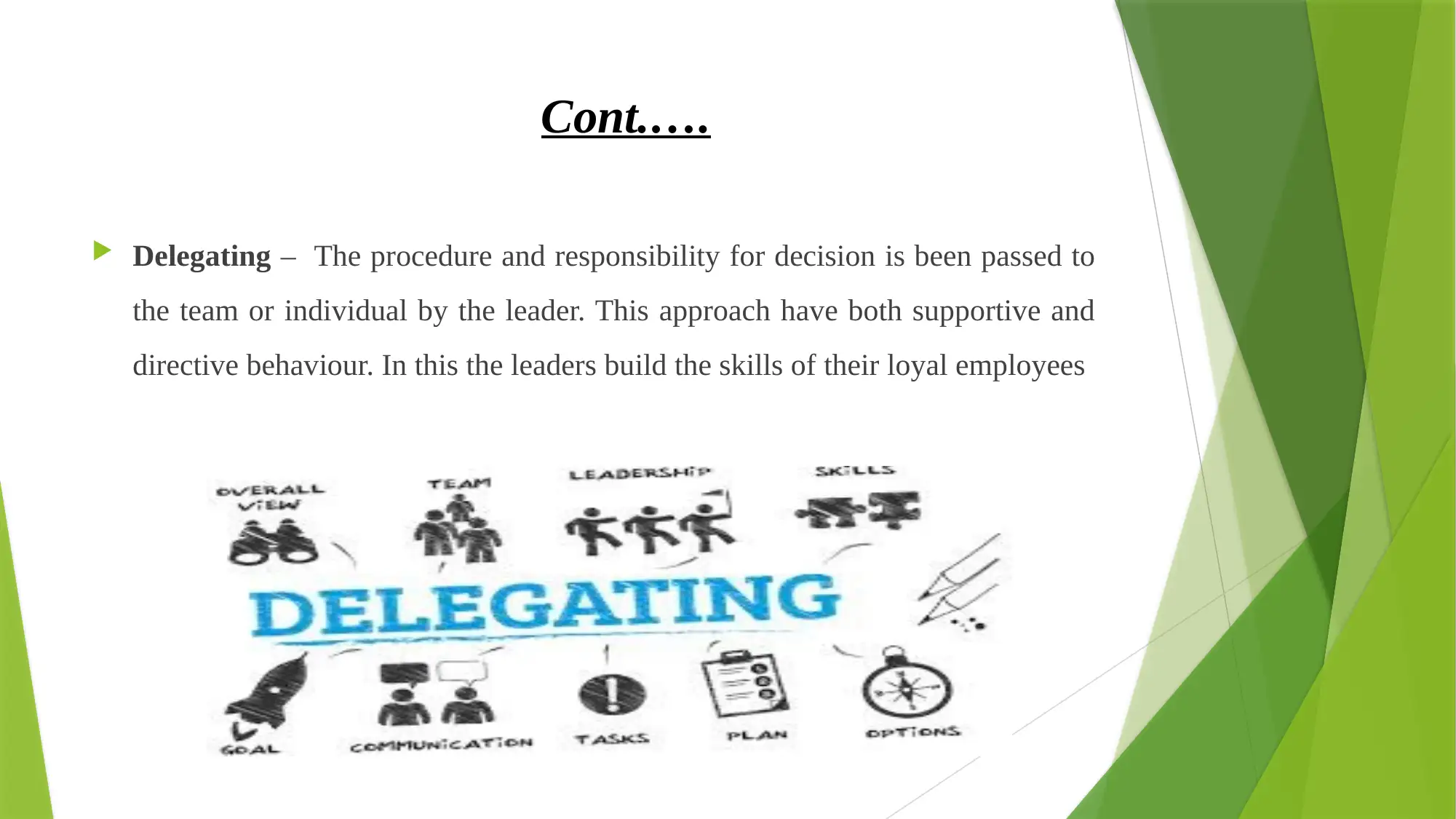
Delegating – The procedure and responsibility for decision is been passed to
the team or individual by the leader. This approach have both supportive and
directive behaviour. In this the leaders build the skills of their loyal employees
Document Page
Conclusion
As per the above mentioned report it has been concluded that, Organisational
change is an important segment and it is all about a process or change.
Business organisations change their strategies, procedure, technology,
processes and culture in order to achieve their business objectives effectively.
The internal and external drivers of change that affect leadership style and
individual or team behaviour. In order to cope up with all these situations it is
essential for management to implement technological and competitor driver
changes.
tabler-icon-diamond-filled.svg

Paraphrase This Document

Need a fresh take? Get an instant paraphrase of this document with our AI Paraphraser
Document Page
References
Alvesson, M. and Sveningsson, S., 2015. Changing organizational culture:
Cultural change work in progress. Routledge.
Aslan, S. and Reigeluth, C. M., 2013. Educational technologists: Leading change
for a new paradigm of education. TechTrends. 57(5). pp.18-24.
Brown, B. C., 2012. Leading complex change with post-conventional
consciousness. Journal of Organizational Change Management. 25(4). pp.560-
575.
Doppelt, B., 2017. Leading change toward sustainability: A change-management
guide for business, government and civil society. Routledge.
Document Page
THANK YOU
chevron_up_icon
1 out of 9
circle_padding
hide_on_mobile
zoom_out_icon
[object Object]