Organizational Change Report: Leadership, Culture, and Models
VerifiedAdded on 2023/03/17
|23
|5311
|66
Report
AI Summary
This report delves into the multifaceted realm of organizational change, examining its significance in maintaining a competitive edge within the dynamic business landscape. It meticulously explores the core concepts of change management, organizational culture, and the influential role of coaching leadership. The report outlines the challenges inherent in change management, such as conflict, planning difficulties, poor communication, resistance, and stakeholder commitment issues. It then provides an in-depth analysis of various organizational cultures, including bureaucratic, community, competitive, and entrepreneurial models, and their impact on the success of change initiatives. Furthermore, the report presents a comprehensive overview of change management processes, encompassing models like Kotter's Change Model, the ADKAR model, and the Deming Cycle, providing practical frameworks for effective implementation. It also underscores the importance of leadership, particularly coaching leadership, in fostering a culture of continuous improvement and value-based principles. Finally, it emphasizes the stages of building a coaching culture within an organization and provides a conclusion that summarizes the key findings and implications of the research.
ORGANIZATION CHANGE 1
Organization Change
Name:
Institution:
Course:
Tutor:
Date:
Table of Contents
1-1 Introduction..................................................................................................................2
1-1.1 Change management...............................................................................................3
1-1.3 Challenges of change management.....................................................................4
Organization Change
Name:
Institution:
Course:
Tutor:
Date:
Table of Contents
1-1 Introduction..................................................................................................................2
1-1.1 Change management...............................................................................................3
1-1.3 Challenges of change management.....................................................................4

Paraphrase This Document
Need a fresh take? Get an instant paraphrase of this document with our AI Paraphraser
ORGANIZATION CHANGE 2
1-1.3.1 Conflict...............................................................................................................4
1-1.3.2 Planning.............................................................................................................................5
1-1.3.3 Poor communication.......................................................................................................5
1-1.3.4 Resistance.........................................................................................................................5
1-1.3.5 In the adequate commitment of stakeholders........................................................6
1-2 Organizational culture.................................................................................................7
1-2.1 Types of organizational culture.............................................................................7
1-2.1.1 Bureaucratic organizational culture............................................................................8
1-2.1.2 Community organizational culture..............................................................................9
1-2.2.3 Competitive Organizational culture.............................................................................9
1-2.2.4 Entrepreneurial organizational culture.......................................................................9
1-2.2 The change management process for business and societal change...............10
1-2. 3 Change administration procedure......................................................................10
1-2.3.1 Kottlers Change Model................................................................................................10
1-2.3.2 ADKAR model................................................................................................................11
1-2.3.3 Deming Cycle change model.......................................................................................13
1-2.2 Role of leadership in the organizational change.................................................14
1-2.2.1 Coaching leadership style...........................................................................................14
1-2.2 .2 Coaching fundamentals..............................................................................................14
1-2.2 .3 Coaching Culture' at the Workplace........................................................................15
1-2.3 Building a coaching culture.................................................................................16
1-2.3.1 Stages of building a coaching culture within an organization...........................17
1-2.4 Value-Based cultures..........................................................................................17
1-2.4 Conclusion..............................................................................................................19
1-1.3.1 Conflict...............................................................................................................4
1-1.3.2 Planning.............................................................................................................................5
1-1.3.3 Poor communication.......................................................................................................5
1-1.3.4 Resistance.........................................................................................................................5
1-1.3.5 In the adequate commitment of stakeholders........................................................6
1-2 Organizational culture.................................................................................................7
1-2.1 Types of organizational culture.............................................................................7
1-2.1.1 Bureaucratic organizational culture............................................................................8
1-2.1.2 Community organizational culture..............................................................................9
1-2.2.3 Competitive Organizational culture.............................................................................9
1-2.2.4 Entrepreneurial organizational culture.......................................................................9
1-2.2 The change management process for business and societal change...............10
1-2. 3 Change administration procedure......................................................................10
1-2.3.1 Kottlers Change Model................................................................................................10
1-2.3.2 ADKAR model................................................................................................................11
1-2.3.3 Deming Cycle change model.......................................................................................13
1-2.2 Role of leadership in the organizational change.................................................14
1-2.2.1 Coaching leadership style...........................................................................................14
1-2.2 .2 Coaching fundamentals..............................................................................................14
1-2.2 .3 Coaching Culture' at the Workplace........................................................................15
1-2.3 Building a coaching culture.................................................................................16
1-2.3.1 Stages of building a coaching culture within an organization...........................17
1-2.4 Value-Based cultures..........................................................................................17
1-2.4 Conclusion..............................................................................................................19
ORGANIZATION CHANGE 3
1-3 List References..........................................................................................................20
1-3 List References..........................................................................................................20
⊘ This is a preview!⊘
Do you want full access?
Subscribe today to unlock all pages.

Trusted by 1+ million students worldwide
ORGANIZATION CHANGE 4
1-1 Introduction
Change is an integral part of business strategy to ensure tier continual
competitive advantage in the market. Organizational change refers to the process of
transforming the organizational structure, working methods, know-hows, strategies, and
culture to affect change towards the desired outcome (Storm 2015). According to the
study conducted by McKinsey consulting firm, organizations that undertook
management change attained considerable performance improvement. The study
reported that out of 45%, companies that underwent through the organizational change,
36% of the company managers indicated that the process succeeded in enhancing the
work performance, supplier, customer and employee relations, increased revenue
collections as well as a reduction on the production cost (Агаева, Agaeva, Баурина and
Baurina 2016). The current paper thus is an exploration of the organizational change
regarding the organizational culture and the effect of coaching leadership kind on the
organizational modification.
In the current competitive world, change is constant among the organizations that
are always striving to adapt to the changing market demand and competition.
Organizational change is classified as either internal or external. The internal factors
have identified those forces that are occurring with the organization and controlled by
the elements within the organizations. The internal forces include factors such as
employees and managers (Whelan and Somerville 2013). While the external factors
entail those that are occurring from the outside of the organizations envenomed and are
construed outside the organizations. The external factors thus include factors such as
demographic, social, values, society, government, and customer.
1-1.1 Change management
Change management refers to the collective term of all approaches used to aid
the individual in process in an organization in making a particular change. The main
purpose of change management is to ensure that all the desired change are achieved
by the placed standardized procedures to reduce and eliminate any negative impact
1-1 Introduction
Change is an integral part of business strategy to ensure tier continual
competitive advantage in the market. Organizational change refers to the process of
transforming the organizational structure, working methods, know-hows, strategies, and
culture to affect change towards the desired outcome (Storm 2015). According to the
study conducted by McKinsey consulting firm, organizations that undertook
management change attained considerable performance improvement. The study
reported that out of 45%, companies that underwent through the organizational change,
36% of the company managers indicated that the process succeeded in enhancing the
work performance, supplier, customer and employee relations, increased revenue
collections as well as a reduction on the production cost (Агаева, Agaeva, Баурина and
Baurina 2016). The current paper thus is an exploration of the organizational change
regarding the organizational culture and the effect of coaching leadership kind on the
organizational modification.
In the current competitive world, change is constant among the organizations that
are always striving to adapt to the changing market demand and competition.
Organizational change is classified as either internal or external. The internal factors
have identified those forces that are occurring with the organization and controlled by
the elements within the organizations. The internal forces include factors such as
employees and managers (Whelan and Somerville 2013). While the external factors
entail those that are occurring from the outside of the organizations envenomed and are
construed outside the organizations. The external factors thus include factors such as
demographic, social, values, society, government, and customer.
1-1.1 Change management
Change management refers to the collective term of all approaches used to aid
the individual in process in an organization in making a particular change. The main
purpose of change management is to ensure that all the desired change are achieved
by the placed standardized procedures to reduce and eliminate any negative impact
Paraphrase This Document
Need a fresh take? Get an instant paraphrase of this document with our AI Paraphraser
ORGANIZATION CHANGE 5
that might result in poor product or service. Change management dates back to the
center century and has evolved from the foundational understandings to more
conceptual underpinnings. During 1900 professional worked on studying on how human
beings and human system embrace change thus led to the emergence of change
management. Researchers such as Arnold Van Gennep presented change as incidents
taking place in three stages that are: parting from our presernt status, transition and
reincorporating into the future. In 1948 Kurt Lewin introduced three sites that are:
unfreezing, moving and freezing and the change management process (Burnes and
Bargal 2017). This contoured to transform and numerous models adopted until the
current century, where authors such as John Kotter, Spencer Johnson have developed
different tools to manage change.
1-1.2 Goals of organizational change management
Organizational change has different objectives and goals. Some of the objections
include:
a) To address problems and improve culture- every organization undergoing the
rough the change process always aims at reducing and eliminating problems that
exist within an organization. Some of the organizational problems can be
inadequate staff and poor motivation strategy. Through increasing the number of
stress, and adopting training and rewarding strategies, organizations thus need
to undergo through structural change that needs proper management to ensure
the attainment of the objectives.
b) To establish the principles for change- Change management process aims at
creating the boundary limit that must be attained to guarantee successful
change. Change principles we diligently followed ensures the satisfaction of the
change expectations (Hassan and Rohrbaugh 2012).
c) To identify and empower the change team- change process is always attainable
through the engagement with change team and against such employee and
change leaders. Change management thus is essential in powering the entire
that might result in poor product or service. Change management dates back to the
center century and has evolved from the foundational understandings to more
conceptual underpinnings. During 1900 professional worked on studying on how human
beings and human system embrace change thus led to the emergence of change
management. Researchers such as Arnold Van Gennep presented change as incidents
taking place in three stages that are: parting from our presernt status, transition and
reincorporating into the future. In 1948 Kurt Lewin introduced three sites that are:
unfreezing, moving and freezing and the change management process (Burnes and
Bargal 2017). This contoured to transform and numerous models adopted until the
current century, where authors such as John Kotter, Spencer Johnson have developed
different tools to manage change.
1-1.2 Goals of organizational change management
Organizational change has different objectives and goals. Some of the objections
include:
a) To address problems and improve culture- every organization undergoing the
rough the change process always aims at reducing and eliminating problems that
exist within an organization. Some of the organizational problems can be
inadequate staff and poor motivation strategy. Through increasing the number of
stress, and adopting training and rewarding strategies, organizations thus need
to undergo through structural change that needs proper management to ensure
the attainment of the objectives.
b) To establish the principles for change- Change management process aims at
creating the boundary limit that must be attained to guarantee successful
change. Change principles we diligently followed ensures the satisfaction of the
change expectations (Hassan and Rohrbaugh 2012).
c) To identify and empower the change team- change process is always attainable
through the engagement with change team and against such employee and
change leaders. Change management thus is essential in powering the entire
ORGANIZATION CHANGE 6
process such provision of the required skills, finance, and training to the change
agents.
d) To align the change objectives with the employee objectives-
e) Employees are the key resources of organizations. Thus any change should
ensure that employee objectives are also aligned to the change objectives. By
aligning both, the employee and change objectives ensure improved
performance as it reduces any probability of change resistance from the
employees.
f) To communicate the importance of change- change management has a key role
in communicating the need for change through extensive communication with the
employee on the importance of change. Employees thus should know their
responsibilities in the realization of the desired change.
1-1.3 Challenges of change management
Change management is always faced with numerous challenges that fail the
change. Some of the changes are:
1-1.3.1 Conflict
Projected organizational change can, at times, evoke emotions such as
uncertainty among the stakeholders, especially employee who may end up transferring
their anger, fear, and frustrations to one another (Clausen and Kragh 2018). The
unresolved conflict hurts the organizational performance since it reduces the team
performance and leads to a waste of time as one of the resources. Thus it is upon the
leader to help the entire employee to overcome such conflict the Ayub adopting the best
change model and steps.
1-1.3.2 Planning
Change always entails the transformation of numerous aspects within the
organization such as structure, to introduce new systems. Planning for such change at
times pose challenges since it requires the organization to eliminate some important
aspects such as reducing the number of employees. Thus proper planning will ensure a
process such provision of the required skills, finance, and training to the change
agents.
d) To align the change objectives with the employee objectives-
e) Employees are the key resources of organizations. Thus any change should
ensure that employee objectives are also aligned to the change objectives. By
aligning both, the employee and change objectives ensure improved
performance as it reduces any probability of change resistance from the
employees.
f) To communicate the importance of change- change management has a key role
in communicating the need for change through extensive communication with the
employee on the importance of change. Employees thus should know their
responsibilities in the realization of the desired change.
1-1.3 Challenges of change management
Change management is always faced with numerous challenges that fail the
change. Some of the changes are:
1-1.3.1 Conflict
Projected organizational change can, at times, evoke emotions such as
uncertainty among the stakeholders, especially employee who may end up transferring
their anger, fear, and frustrations to one another (Clausen and Kragh 2018). The
unresolved conflict hurts the organizational performance since it reduces the team
performance and leads to a waste of time as one of the resources. Thus it is upon the
leader to help the entire employee to overcome such conflict the Ayub adopting the best
change model and steps.
1-1.3.2 Planning
Change always entails the transformation of numerous aspects within the
organization such as structure, to introduce new systems. Planning for such change at
times pose challenges since it requires the organization to eliminate some important
aspects such as reducing the number of employees. Thus proper planning will ensure a
⊘ This is a preview!⊘
Do you want full access?
Subscribe today to unlock all pages.
Trusted by 1+ million students worldwide
ORGANIZATION CHANGE 7
seamless transition of the new system, delegation of duties and implementation and
utilization of resources effectively.
1-1.3.3 Poor communication
Communication is essential to every organization since it set the foundation of all
the activities within and outside the organizations. A leader delegate duty through
communication thus fails to communicate the intended cache by the leaders tends to
break the relationship between employees and employers. Thus through proper
communication, employees can get the incident change and understand while the
change is important.
1-1.3.4 Resistance
Naturally, people are resistant creature, thus tend to resist any change in their
comfortable lives and way of doing things. In organizations, employees tend to resist
any change due to fear of uncertainty and poor communication on the importance of the
change, thus leading to protests and go-slows. Such events reduce organizational
performance as well, as the failure of the change implementation.
1-1.3.5 In the adequate commitment of stakeholders
Change implication plan, and action is great; however, it becomes useless when
there is no commitment among the stakeholders such as employees and the employers.
The change leaders should encourage the stakeholders to embrace the desired change
by starting at the top leaders downwards to the employees. Organizational change
management needs a systematic process to reduce and minimize the obstacles that
might be faced during the change process. The steps include:
a) Identification of the issue to be improved
b) Presentation of the desired change to the change team
c) Planning of the desired change
d) Provision of the required resources to enhance the change
e) Communication of the change to all the stakeholders
f) Implementation of the change
seamless transition of the new system, delegation of duties and implementation and
utilization of resources effectively.
1-1.3.3 Poor communication
Communication is essential to every organization since it set the foundation of all
the activities within and outside the organizations. A leader delegate duty through
communication thus fails to communicate the intended cache by the leaders tends to
break the relationship between employees and employers. Thus through proper
communication, employees can get the incident change and understand while the
change is important.
1-1.3.4 Resistance
Naturally, people are resistant creature, thus tend to resist any change in their
comfortable lives and way of doing things. In organizations, employees tend to resist
any change due to fear of uncertainty and poor communication on the importance of the
change, thus leading to protests and go-slows. Such events reduce organizational
performance as well, as the failure of the change implementation.
1-1.3.5 In the adequate commitment of stakeholders
Change implication plan, and action is great; however, it becomes useless when
there is no commitment among the stakeholders such as employees and the employers.
The change leaders should encourage the stakeholders to embrace the desired change
by starting at the top leaders downwards to the employees. Organizational change
management needs a systematic process to reduce and minimize the obstacles that
might be faced during the change process. The steps include:
a) Identification of the issue to be improved
b) Presentation of the desired change to the change team
c) Planning of the desired change
d) Provision of the required resources to enhance the change
e) Communication of the change to all the stakeholders
f) Implementation of the change
Paraphrase This Document
Need a fresh take? Get an instant paraphrase of this document with our AI Paraphraser
ORGANIZATION CHANGE 8
g) Evaluation of the change
h) Celebrating the success
According to Herminingsih and Gozali (2014) states that the change process is
driven by numerous strategic considerations such as the need for more integrated ways
of working and need to enhance performance. The strategic concerns thus lead to
structured change programs based on the assumptions that change management
entails the inadequate collection of interventions that are always considered as the main
objectives, manageable and quantifiable.
1-2 Organizational culture
The phrase organizational culture surfaced from Dr. Elliot Jaques in 1951, and it
refers to the values and actions that result to the uniqueness of an organization in terms
of social and psychological characteristics.
When an organization is experiencing an unhealthy culture, then change is
inevitable. The organization thus needs to change its culture since without change; the
new objective and process is not successful. According to Ko (2014) the organization,
cultural change is essential in reducing employee turnover, positively influencing the
employee behaviors, improving the organizational performance, enhancing
organization’s customer, supplier and employees relations as well as effective
achievement of the organizational objectives. The cultural change is always faced with
numerous challenging such as employee resistance thus leading to failure of the
organizational change. Numerous methodologies and techniques have been developed
to help in adopting organizational change, and these include:
Peter Senge's Fifth Discipline that is essential in understanding the organization
learning with a focus on the core dynamic of culture change (Eisler 2015). According to
Senge, the disciplines are team education, system intelligence, individual mastery,
intellectual models, and construction of common vision.
g) Evaluation of the change
h) Celebrating the success
According to Herminingsih and Gozali (2014) states that the change process is
driven by numerous strategic considerations such as the need for more integrated ways
of working and need to enhance performance. The strategic concerns thus lead to
structured change programs based on the assumptions that change management
entails the inadequate collection of interventions that are always considered as the main
objectives, manageable and quantifiable.
1-2 Organizational culture
The phrase organizational culture surfaced from Dr. Elliot Jaques in 1951, and it
refers to the values and actions that result to the uniqueness of an organization in terms
of social and psychological characteristics.
When an organization is experiencing an unhealthy culture, then change is
inevitable. The organization thus needs to change its culture since without change; the
new objective and process is not successful. According to Ko (2014) the organization,
cultural change is essential in reducing employee turnover, positively influencing the
employee behaviors, improving the organizational performance, enhancing
organization’s customer, supplier and employees relations as well as effective
achievement of the organizational objectives. The cultural change is always faced with
numerous challenging such as employee resistance thus leading to failure of the
organizational change. Numerous methodologies and techniques have been developed
to help in adopting organizational change, and these include:
Peter Senge's Fifth Discipline that is essential in understanding the organization
learning with a focus on the core dynamic of culture change (Eisler 2015). According to
Senge, the disciplines are team education, system intelligence, individual mastery,
intellectual models, and construction of common vision.
ORGANIZATION CHANGE 9
1-2.1 Types of organizational culture
Different organizational cultures have different types of charters, such as fun-loving,
rule-bound, caring, cold, and impersonal, among many others. The organizational
culture type is associated with the underlying assumptions, beliefs m value, and the
atmosphere as well as personalities of the employees. According to Young (2016) the
current business organizations culture are formed from the competing values, thus led
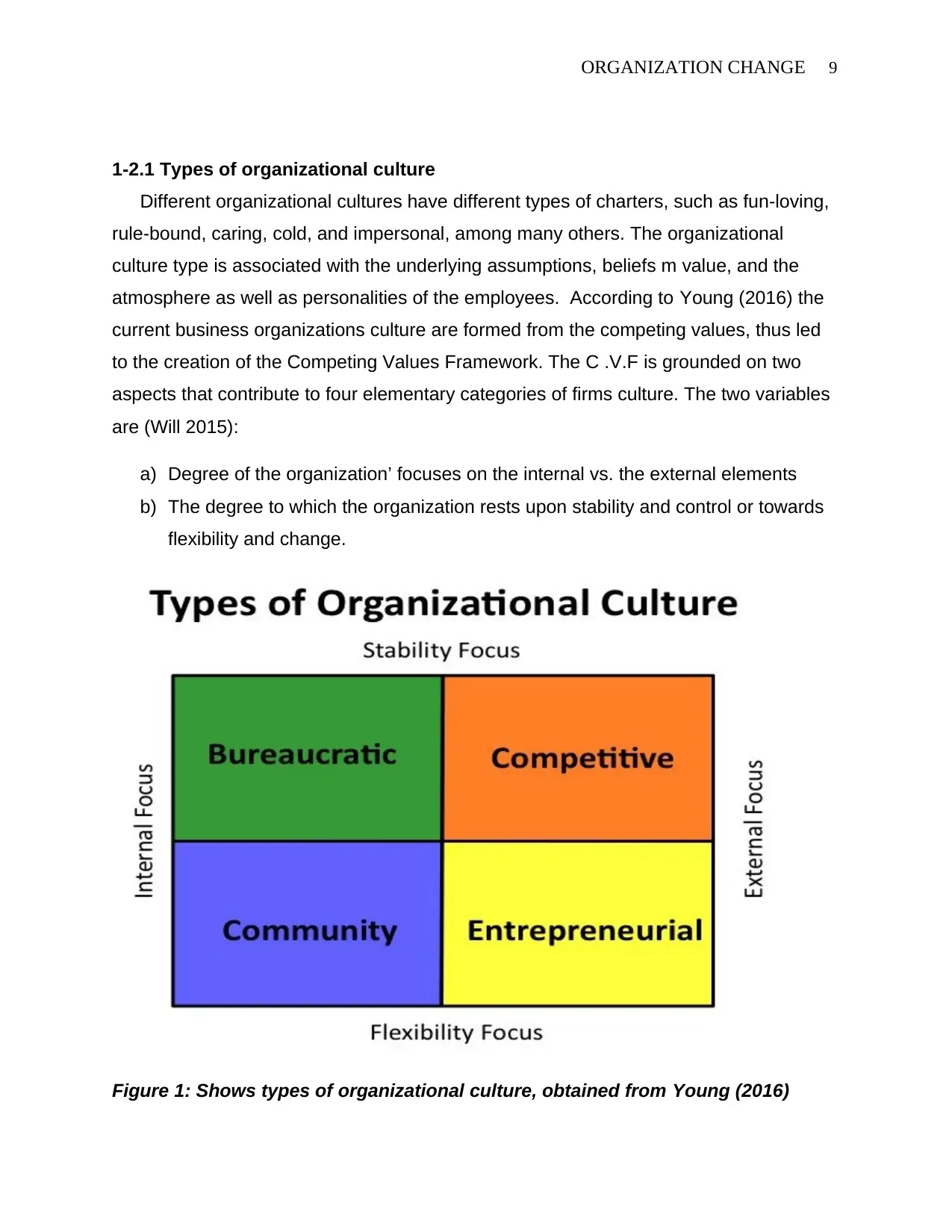
to the creation of the Competing Values Framework. The C .V.F is grounded on two
aspects that contribute to four elementary categories of firms culture. The two variables
are (Will 2015):
a) Degree of the organization’ focuses on the internal vs. the external elements
b) The degree to which the organization rests upon stability and control or towards
flexibility and change.
Figure 1: Shows types of organizational culture, obtained from Young (2016)
1-2.1 Types of organizational culture
Different organizational cultures have different types of charters, such as fun-loving,
rule-bound, caring, cold, and impersonal, among many others. The organizational
culture type is associated with the underlying assumptions, beliefs m value, and the
atmosphere as well as personalities of the employees. According to Young (2016) the
current business organizations culture are formed from the competing values, thus led
to the creation of the Competing Values Framework. The C .V.F is grounded on two
aspects that contribute to four elementary categories of firms culture. The two variables
are (Will 2015):
a) Degree of the organization’ focuses on the internal vs. the external elements
b) The degree to which the organization rests upon stability and control or towards
flexibility and change.
Figure 1: Shows types of organizational culture, obtained from Young (2016)
⊘ This is a preview!⊘
Do you want full access?
Subscribe today to unlock all pages.
Trusted by 1+ million students worldwide
ORGANIZATION CHANGE
10
1-2.1.1 Bureaucratic organizational culture
Bureaucratic organizational culture denotes to a formal carefully distinct
structured efforts envelopment that rest on the hierarchical events in the management
of the organization (Burcu 2012). Beaurocratic organizational culture focus on the
competence, consistency and dependability of the organization’s activities, however, the
culture is criticized by the low level of productivity, financial management, reduced
employee morale, and innovation.
1-2.1.2 Community organizational culture
Refers to a culture characterized by teamwork in an organization, thus resulting
in high performance since employees are association-oriented and always
communicate themselves more openly (Ko 2014).
1-2.2.3 Competitive Organizational culture
Competitive organizational culture refers to the organizational culture that is more
pervasive, goal –oriented and customer-focused those emphasizing strongly of results
deliverance (Gabriel 2015). Competitive organizational culture is always governed by
policies and procedures that aim at responding positively to the market demands and
needs.
1-2.2.4 Entrepreneurial organizational culture
Entrepreneurial organizational culture refers to the organizational environment
characterized by numerous creativity, experiments, and risk-taking among the
employees. According to Karyotakis and Moustakis (2016), there is no best
organizational culture over others, and the choice of each culture majorly depends on
the organization's goals as well as alignment of the culture and the objectives. The
success of organizational culture; thus, majorly depends on the leadership style
adopted in the implementation of the organizations’ change. According to different
10
1-2.1.1 Bureaucratic organizational culture
Bureaucratic organizational culture denotes to a formal carefully distinct
structured efforts envelopment that rest on the hierarchical events in the management
of the organization (Burcu 2012). Beaurocratic organizational culture focus on the
competence, consistency and dependability of the organization’s activities, however, the
culture is criticized by the low level of productivity, financial management, reduced
employee morale, and innovation.
1-2.1.2 Community organizational culture
Refers to a culture characterized by teamwork in an organization, thus resulting
in high performance since employees are association-oriented and always
communicate themselves more openly (Ko 2014).
1-2.2.3 Competitive Organizational culture
Competitive organizational culture refers to the organizational culture that is more
pervasive, goal –oriented and customer-focused those emphasizing strongly of results
deliverance (Gabriel 2015). Competitive organizational culture is always governed by
policies and procedures that aim at responding positively to the market demands and
needs.
1-2.2.4 Entrepreneurial organizational culture
Entrepreneurial organizational culture refers to the organizational environment
characterized by numerous creativity, experiments, and risk-taking among the
employees. According to Karyotakis and Moustakis (2016), there is no best
organizational culture over others, and the choice of each culture majorly depends on
the organization's goals as well as alignment of the culture and the objectives. The
success of organizational culture; thus, majorly depends on the leadership style
adopted in the implementation of the organizations’ change. According to different
Paraphrase This Document
Need a fresh take? Get an instant paraphrase of this document with our AI Paraphraser
ORGANIZATION CHANGE
11
leadership styles work different in different organizational culture, and the choice needs
to depend on the objective of the organizations.
1-2.2 The change management process for business and societal change
Change management refers to the collective term of all methods, approaches,
and techniques used to aid individuals, groups, and organizations in transforming from
one culture to the other in a more seamless way (Kim and Lee 2015). Organizations
change due to numerous reasons such as technological advancement, development of
new customer behaviors, development of the strategies, the entrant of more
competitors, and the need to use available resources among many others.
Organizational change management thus refers to the approaches used in maintaining
and controlling all the aspect need to transform the organizations such as technology,
raw material, and employees, while change management majorly focuses on the
employees and the teams affected during the transition.
1-2. 3 Change administration procedure
Alteration management process is always as evidence of steps and activities that
involve the team and the change leaders in order to meet the desired objectives
(Lehmann 2017). Two numerous major elements have been developed n to enhance
change in organizations. The most common modules are:
1-2.3.1 Kottlers Change Model
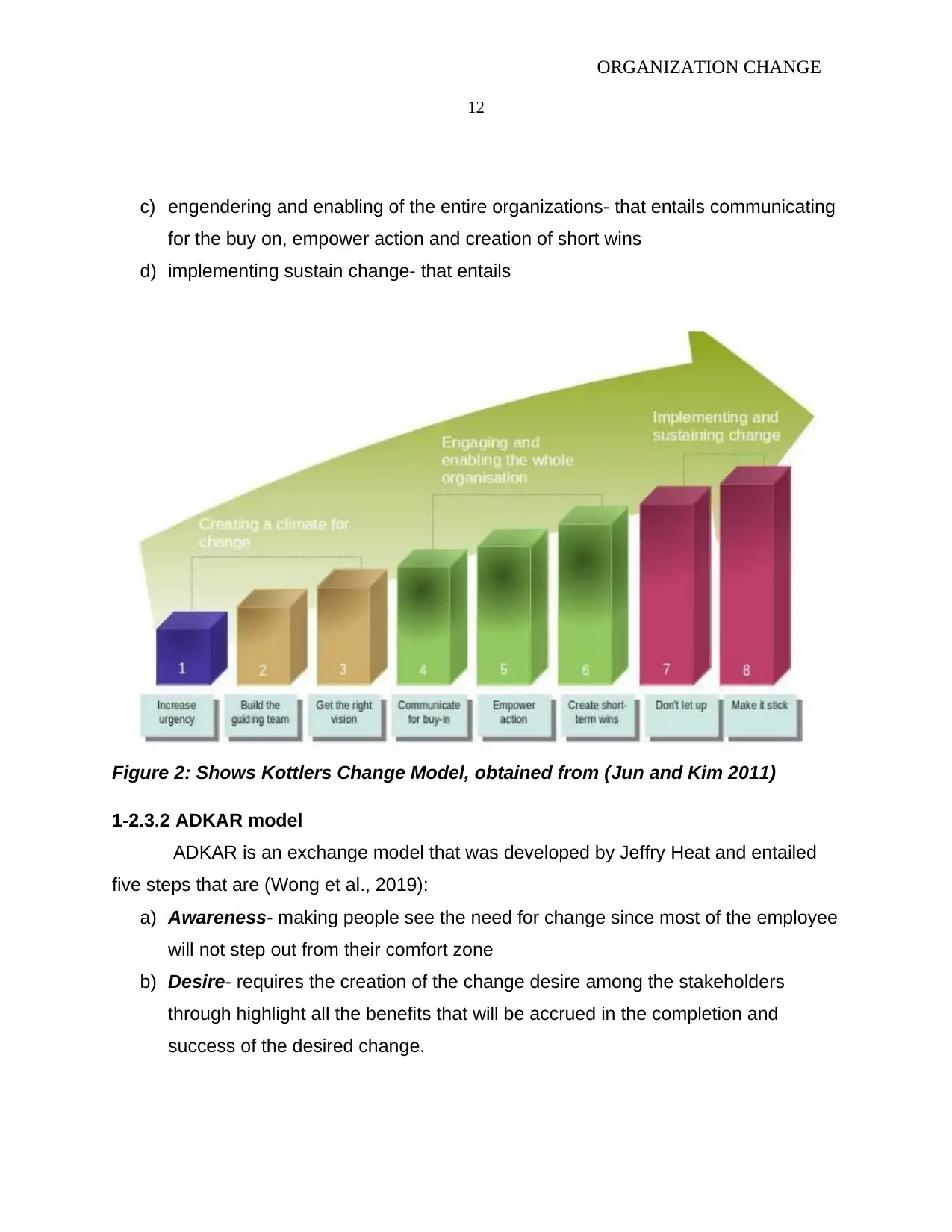
Kottlers Change Model was introduced by John Kotter in 1991 to aid organizations in
implementing the desired changes through systematically following eight steps of
change. The eight steps are covered under there major groups that are (Jun and Kim
2011):
a) creation of change climate- this entails
b) increasing urgency, the building of the guiding team and getting off the right
visions
11
leadership styles work different in different organizational culture, and the choice needs
to depend on the objective of the organizations.
1-2.2 The change management process for business and societal change
Change management refers to the collective term of all methods, approaches,
and techniques used to aid individuals, groups, and organizations in transforming from
one culture to the other in a more seamless way (Kim and Lee 2015). Organizations
change due to numerous reasons such as technological advancement, development of
new customer behaviors, development of the strategies, the entrant of more
competitors, and the need to use available resources among many others.
Organizational change management thus refers to the approaches used in maintaining
and controlling all the aspect need to transform the organizations such as technology,
raw material, and employees, while change management majorly focuses on the
employees and the teams affected during the transition.
1-2. 3 Change administration procedure
Alteration management process is always as evidence of steps and activities that
involve the team and the change leaders in order to meet the desired objectives
(Lehmann 2017). Two numerous major elements have been developed n to enhance
change in organizations. The most common modules are:
1-2.3.1 Kottlers Change Model
Kottlers Change Model was introduced by John Kotter in 1991 to aid organizations in
implementing the desired changes through systematically following eight steps of
change. The eight steps are covered under there major groups that are (Jun and Kim
2011):
a) creation of change climate- this entails
b) increasing urgency, the building of the guiding team and getting off the right
visions
ORGANIZATION CHANGE
12
c) engendering and enabling of the entire organizations- that entails communicating
for the buy on, empower action and creation of short wins
d) implementing sustain change- that entails
Figure 2: Shows Kottlers Change Model, obtained from (Jun and Kim 2011)
1-2.3.2 ADKAR model
ADKAR is an exchange model that was developed by Jeffry Heat and entailed
five steps that are (Wong et al., 2019):
a) Awareness- making people see the need for change since most of the employee
will not step out from their comfort zone
b) Desire- requires the creation of the change desire among the stakeholders
through highlight all the benefits that will be accrued in the completion and
success of the desired change.
12
c) engendering and enabling of the entire organizations- that entails communicating
for the buy on, empower action and creation of short wins
d) implementing sustain change- that entails
Figure 2: Shows Kottlers Change Model, obtained from (Jun and Kim 2011)
1-2.3.2 ADKAR model
ADKAR is an exchange model that was developed by Jeffry Heat and entailed
five steps that are (Wong et al., 2019):
a) Awareness- making people see the need for change since most of the employee
will not step out from their comfort zone
b) Desire- requires the creation of the change desire among the stakeholders
through highlight all the benefits that will be accrued in the completion and
success of the desired change.
⊘ This is a preview!⊘
Do you want full access?
Subscribe today to unlock all pages.
Trusted by 1+ million students worldwide

1 out of 23


Related Documents


Your All-in-One AI-Powered Toolkit for Academic Success.
+13062052269
info@desklib.com
Available 24*7 on WhatsApp / Email
![[object Object]](/_next/static/media/star-bottom.7253800d.svg)
Unlock your academic potential
Copyright © 2020–2025 A2Z Services. All Rights Reserved. Developed and managed by ZUCOL.