Change Management: Analyzing Organizational Change and Failure Factors

Verified

Added on  2023/06/15

|7
|1434
|457
Discussion Board Post
AI Summary
This assignment consists of a discussion post focusing on change management within organizations. It begins by defining organizational change as the modification of existing structures and the incorporation of new features to gain a competitive advantage. It highlights the importance of change for contemporary organizations in fast-moving environments, emphasizing the need to meet customer demands and adopt new technologies. The discussion then shifts to the reasons why change management fails, citing poor planning, lack of resources, inadequate leadership support, and poor stakeholder engagement. Case examples like Nokia's failed hybrid model and Avinor's cultural mismatch are used to illustrate these points. The assignment concludes by stressing the importance of aligning organizational culture with implemented changes to ensure success.
Document Page
Running head: CHANGE MANAGEMENT
Management of Change
Name of the Student:
Name of the University:
Author’s Note:
tabler-icon-diamond-filled.svg

Paraphrase This Document

Need a fresh take? Get an instant paraphrase of this document with our AI Paraphraser
Document Page
2CHANGE MANAGEMENT
Table of Contents
Topic 1.............................................................................................................................................3
Blog 1: Concept of organizational change...................................................................................3
Blog2: Importance of organizational change for the contemporary organization.......................3
Topic 2.............................................................................................................................................4
Blog 3: Discussion of the reason for which the change management fails in an organization. . .4
Blog 4: Discussion of the further reason for the failure of change management in an
organization.................................................................................................................................5
References........................................................................................................................................6
Document Page
3CHANGE MANAGEMENT
Topic 1
Blog 1: Concept of organizational change
Organizational change refers to the modification of the existing structure in an
organization. However, incorporation of the new features or developments of the new
infrastructure in an organization is also associated with the organization change. In order to gain
competitive advantages it is crucial for an organization to carry out their business operation
efficiently and effectively (Morin et al., 2016). Any business should embrace change in their
organization to achieve the success. Change allows the business to alter their working
environment. On the other hand, some internal and external forces are associated with the
organizational change as these make an easy way through which the change can occur
frequently. Political, social, economic and technological factors involved in the change
management. However, change can be positive or negative. It may lead the organization towards
success or affect its continuity (Benzer et al., 2017). In the contemporary organization, change
can improve the efficiency of the staffs as well as the organizational performance. On the other
hand, it can be said that individuals are accustomed to a specific lifestyle and any variation in
this life can be termed as change. In an organization, change may bring positive culture in the
workplace that will lead the organization to meet the goals.
Blog2: Importance of organizational change for the contemporary organization
Fast moving environment is crucial for any business in the recent years to gain the
competitive advantage in the global market. However, without incorporating a change in the
system the business will lose their competitive edge (Burke, 2017). Without a change, the
business cannot be able to meet the demand of the customers and to build the base of the
Document Page
4CHANGE MANAGEMENT
customer loyalty. Implementation of the change in the contemporary organization makes the
organization dynamic. On the other hand, organizational change enables the business owner to
address the issues in their system and develop a necessary solution to mitigate such changes.
When an organization face changes then they need to identify the scope of the changes from
which they get benefits. Change focuses on the adoption of new technology that is crucial for
every organization (Doppelt, 2017). Through the implementation of the changes in an
organization, the contemporary organization can increase their productivity. Customer needs
change over the time, as a result, it is important for the organization to embrace change and meet
the growing demand of the customers. Therefore, change gives an opportunity to the employees
to learn more and develop their skills, which makes them creative and allows them to share new
ideas regarding the organizational success. Training is a crucial part of the organizational change
to develop the skill of the employees.
Topic 2
Blog 3: Discussion of the reason for which the change management fails in an organization
Poor planning of the change management is a big reason for the failure of new changes
in an organization (McLean, Antony & Dahlgaard, 2017). However, often the leaders in an
organization focus on the implementation of a new system in a business without preparing a
proper planning. This affects the success of a change management in an organization. Lack of
resources is another barrier to the successful change management. Due to lack of financial and
human resources change management fails. On the other hand, inadequate support from the
leaders is another big reason for the failure of change management as if the stakeholders are not
involved properly then it is hard for the organization to facilitate change. As for example, Nokia
tabler-icon-diamond-filled.svg

Paraphrase This Document

Need a fresh take? Get an instant paraphrase of this document with our AI Paraphraser
Document Page
5CHANGE MANAGEMENT
has introduced an open source strategy and created a hybrid model in their business to gain
competitive advantages. However, the stakeholders’ engagement in this process was very poor as
there was a communication gap (Ciesielska, 2017). Hence, the stakeholders were unable to share
their vision with the leader. It is important for an organization to engage their stakeholders while
transferring their business from one-step to another (Eberhart et al., 2017). Due to the poor
collaboration of stakeholders implementation of the hybrid model in Nokia failed and the
position of Nokia in the mobile technology market becomes affected.
Blog 4: Discussion of the further reason for the failure of change management in an
organization
Leaders often focus more on the system rather than the people of an organization while
implementing a change in the organization (McLean, Antony & Dahlgaard, 2017). This is a big
factor for, which the organizational change fails. On the other hand, a mismatch between the
organizational culture and the new system is another big reason that affects the success of the
organizational change. As for example, Avinor is the Norwegian airport management and air
navigation service provider faced challenges during their change management. However, there
was a mismatch between the implemented change and the type of the organizational culture
(Lofquist, 2011). They have implemented a new operation system in their business. During this
process, the authority of the organization did not follow the organization culture, which led the
organization to face issues during their change management. However, it is important for the
organization to implement change that should fit with organizational culture to gain success.
Hence, in the context of Avinor, the change management failed due to the dissimilarities between
the implemented change and the organizational culture.
Document Page
6CHANGE MANAGEMENT
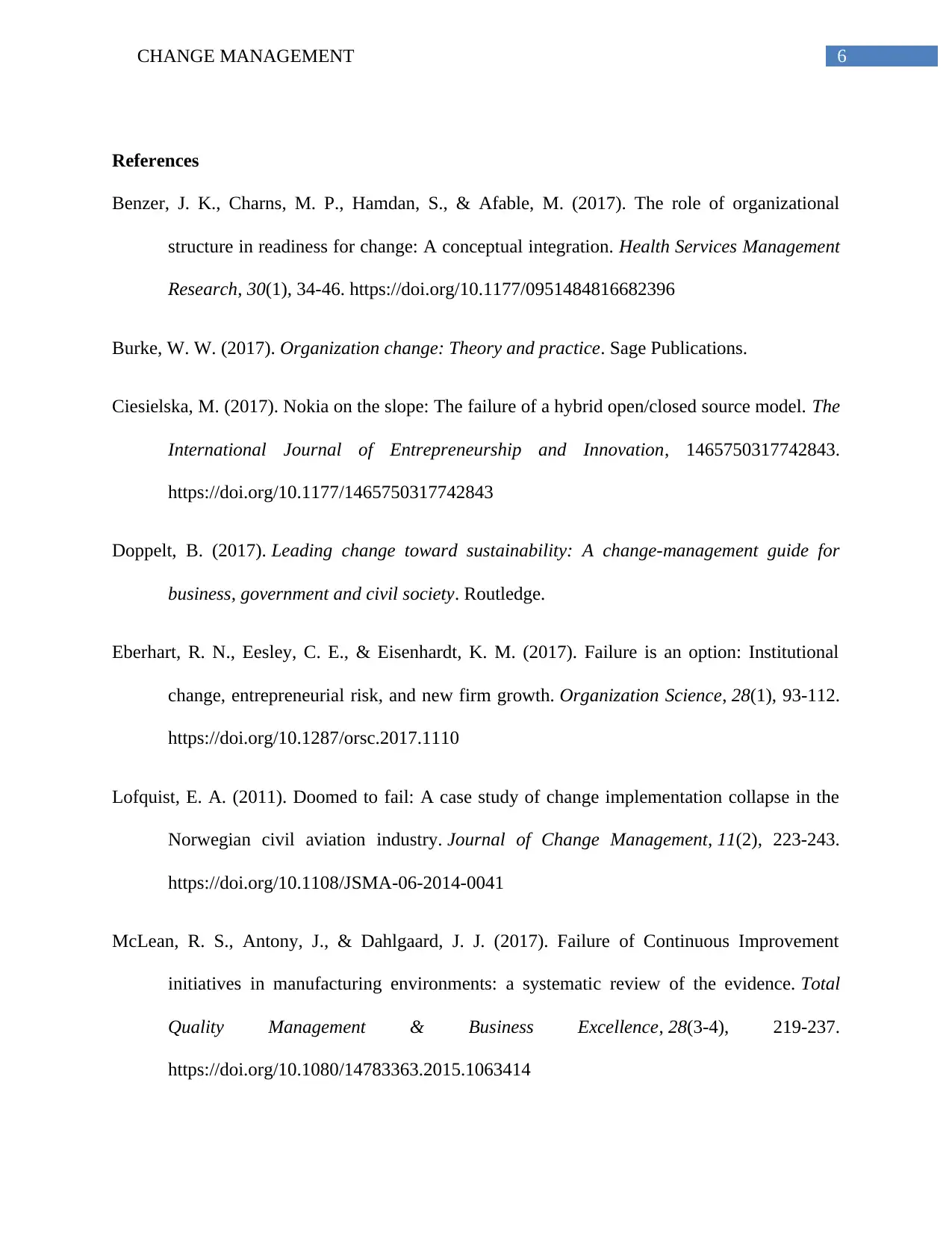
References
Benzer, J. K., Charns, M. P., Hamdan, S., & Afable, M. (2017). The role of organizational
structure in readiness for change: A conceptual integration. Health Services Management
Research, 30(1), 34-46. https://doi.org/10.1177/0951484816682396
Burke, W. W. (2017). Organization change: Theory and practice. Sage Publications.
Ciesielska, M. (2017). Nokia on the slope: The failure of a hybrid open/closed source model. The
International Journal of Entrepreneurship and Innovation, 1465750317742843.
https://doi.org/10.1177/1465750317742843
Doppelt, B. (2017). Leading change toward sustainability: A change-management guide for
business, government and civil society. Routledge.
Eberhart, R. N., Eesley, C. E., & Eisenhardt, K. M. (2017). Failure is an option: Institutional
change, entrepreneurial risk, and new firm growth. Organization Science, 28(1), 93-112.
https://doi.org/10.1287/orsc.2017.1110
Lofquist, E. A. (2011). Doomed to fail: A case study of change implementation collapse in the
Norwegian civil aviation industry. Journal of Change Management, 11(2), 223-243.
https://doi.org/10.1108/JSMA-06-2014-0041
McLean, R. S., Antony, J., & Dahlgaard, J. J. (2017). Failure of Continuous Improvement
initiatives in manufacturing environments: a systematic review of the evidence. Total
Quality Management & Business Excellence, 28(3-4), 219-237.
https://doi.org/10.1080/14783363.2015.1063414
Document Page
7CHANGE MANAGEMENT
Morin, A. J., Meyer, J. P., Bélanger, É., Boudrias, J. S., Gagné, M., & Parker, P. D. (2016).
Longitudinal associations between employees’ beliefs about the quality of the change
management process, affective commitment to change and psychological
empowerment. human relations, 69(3), 839-867.
https://doi.org/10.1177/0018726715602046
chevron_up_icon
1 out of 7
circle_padding
hide_on_mobile
zoom_out_icon
[object Object]