University Project: Lead and Manage Organisational Change - BSB80615
VerifiedAdded on 2022/09/28
|21
|3843
|24
Project
AI Summary
This project report analyzes the need for organizational change within Tassie Hardrock Enterprises, focusing on operational and human resource improvements. It begins with an executive summary and table of contents, followed by an in-depth environmental analysis including strategic change needs, policy reviews, PEST and SWOT analyses. The report proposes a change management project plan with a cost-benefit analysis, risk management plan, resource requirements, and a Gantt chart. An education plan, discussion of barriers to risk management, change management process, and a gap analysis are also included. The project culminates with stakeholder analysis, role-play scripts, and answers to questions related to the case study, offering a comprehensive approach to managing organizational change. The report provides a detailed assessment of the company's internal and external environment, identifies strategic change needs, and suggests best practices for change management, including cost-benefit analysis, communication strategies, and risk assessment. The project also includes a discussion of barriers, education plans, and a gap analysis to evaluate the effectiveness of the change management process.
Running head: LEAD AND MANAGE ORGANISATIONAL CHANGE
Lead and Manage Organisational Change
Name of the Student
Name of the University
Author Note
Lead and Manage Organisational Change
Name of the Student
Name of the University
Author Note

Paraphrase This Document
Need a fresh take? Get an instant paraphrase of this document with our AI Paraphraser
1LEAD AND MANAGE ORGANISATIONAL CHANGE
Executive Summary
The report intends to analyse the change occurred in the operations and human resources of
Tassie Hardrock Enterprises. The paper describes the operational functions of the house and
proposes change policies. With reference to organisational objectives, strategic analysis is
done on the environment and suggested the best practices change management model. The
cost-benefit analysis, communication and education strategy, risk assessment and change
management plan are discussed.
Executive Summary
The report intends to analyse the change occurred in the operations and human resources of
Tassie Hardrock Enterprises. The paper describes the operational functions of the house and
proposes change policies. With reference to organisational objectives, strategic analysis is
done on the environment and suggested the best practices change management model. The
cost-benefit analysis, communication and education strategy, risk assessment and change
management plan are discussed.
2LEAD AND MANAGE ORGANISATIONAL CHANGE
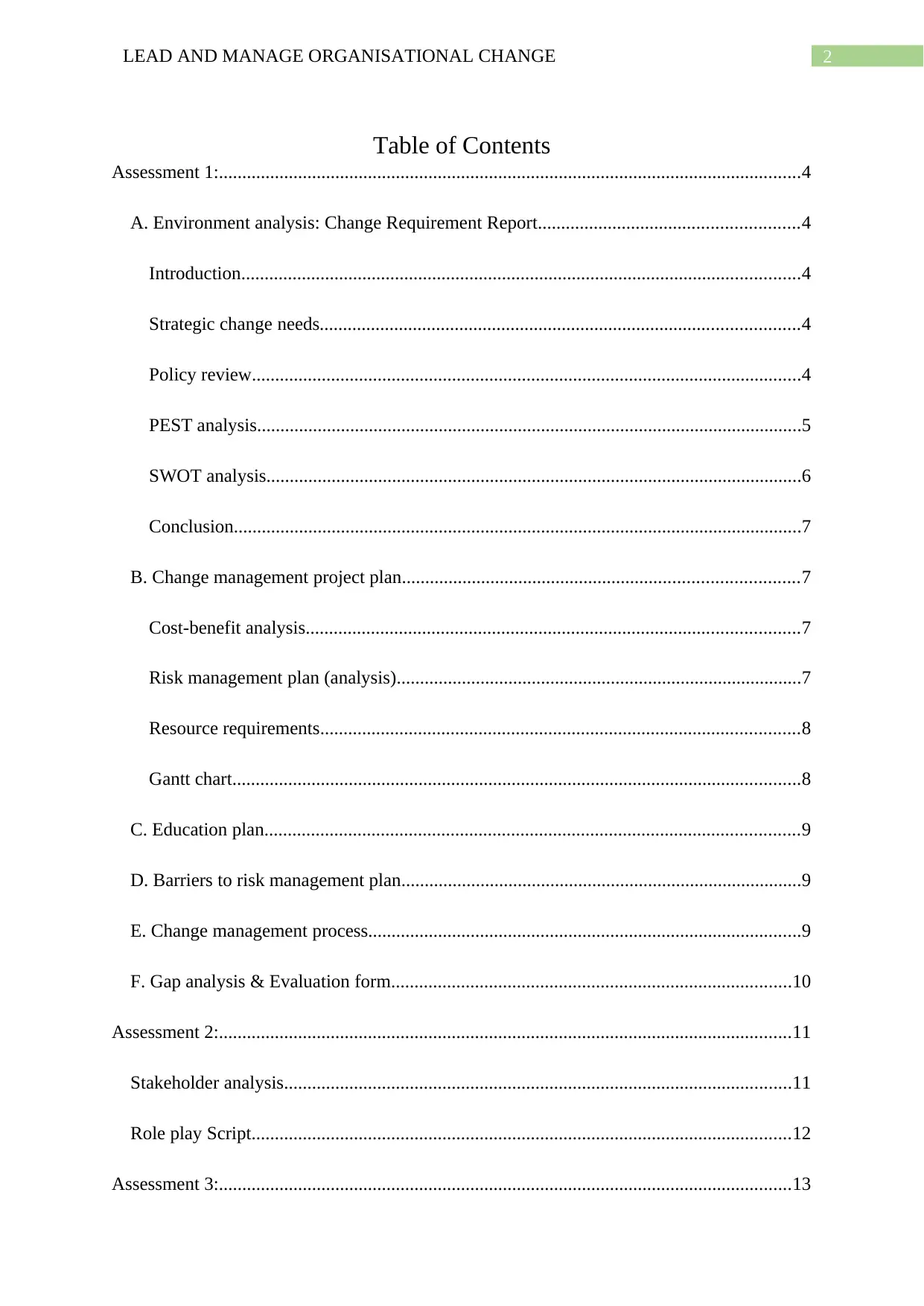
Table of Contents
Assessment 1:.............................................................................................................................4
A. Environment analysis: Change Requirement Report........................................................4
Introduction........................................................................................................................4
Strategic change needs.......................................................................................................4
Policy review......................................................................................................................4
PEST analysis.....................................................................................................................5
SWOT analysis...................................................................................................................6
Conclusion..........................................................................................................................7
B. Change management project plan.....................................................................................7
Cost-benefit analysis..........................................................................................................7
Risk management plan (analysis).......................................................................................7
Resource requirements.......................................................................................................8
Gantt chart..........................................................................................................................8
C. Education plan...................................................................................................................9
D. Barriers to risk management plan......................................................................................9
E. Change management process.............................................................................................9
F. Gap analysis & Evaluation form......................................................................................10
Assessment 2:...........................................................................................................................11
Stakeholder analysis.............................................................................................................11
Role play Script....................................................................................................................12
Assessment 3:...........................................................................................................................13
Table of Contents
Assessment 1:.............................................................................................................................4
A. Environment analysis: Change Requirement Report........................................................4
Introduction........................................................................................................................4
Strategic change needs.......................................................................................................4
Policy review......................................................................................................................4
PEST analysis.....................................................................................................................5
SWOT analysis...................................................................................................................6
Conclusion..........................................................................................................................7
B. Change management project plan.....................................................................................7
Cost-benefit analysis..........................................................................................................7
Risk management plan (analysis).......................................................................................7
Resource requirements.......................................................................................................8
Gantt chart..........................................................................................................................8
C. Education plan...................................................................................................................9
D. Barriers to risk management plan......................................................................................9
E. Change management process.............................................................................................9
F. Gap analysis & Evaluation form......................................................................................10
Assessment 2:...........................................................................................................................11
Stakeholder analysis.............................................................................................................11
Role play Script....................................................................................................................12
Assessment 3:...........................................................................................................................13
⊘ This is a preview!⊘
Do you want full access?
Subscribe today to unlock all pages.

Trusted by 1+ million students worldwide
3LEAD AND MANAGE ORGANISATIONAL CHANGE
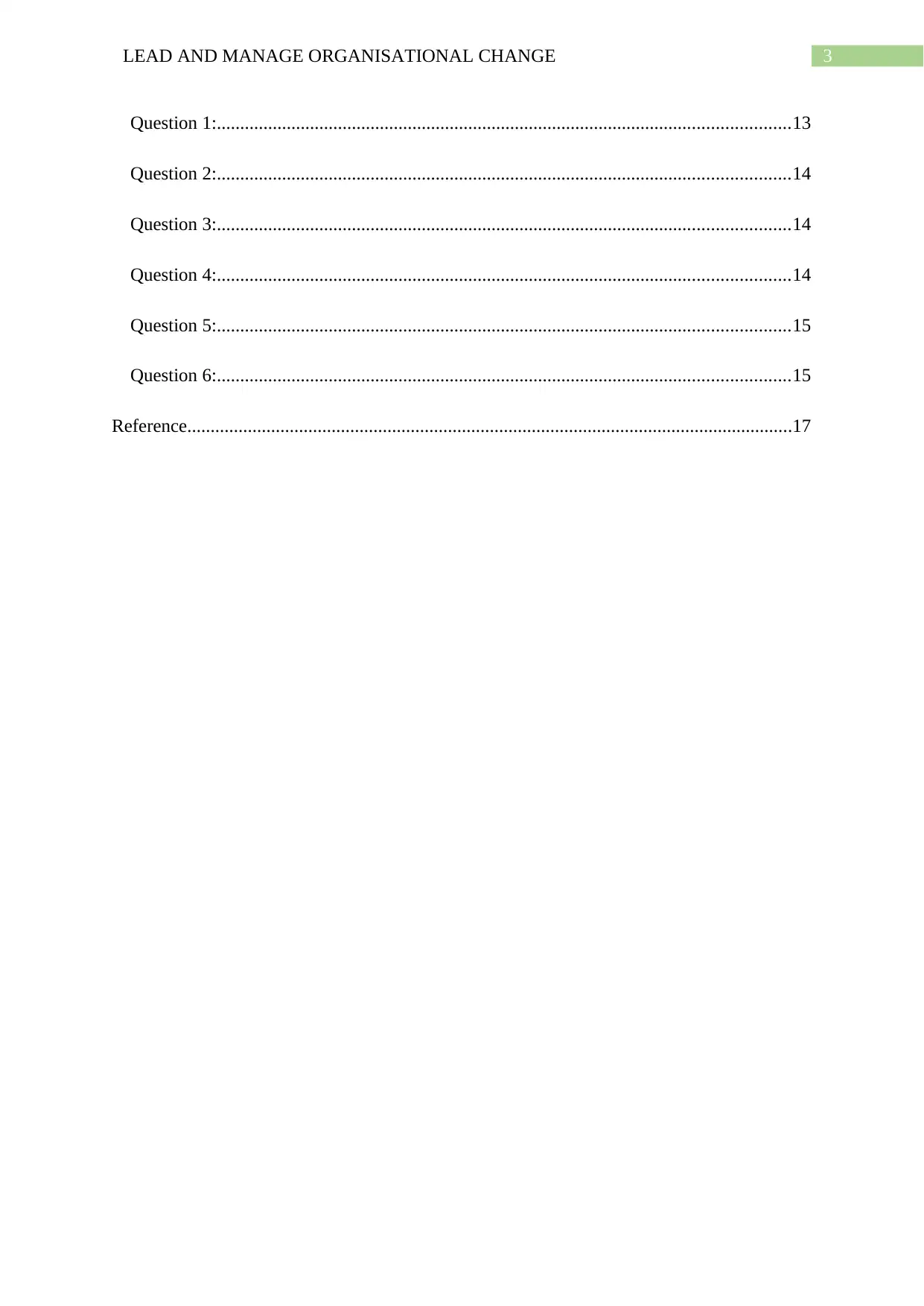
Question 1:...........................................................................................................................13
Question 2:...........................................................................................................................14
Question 3:...........................................................................................................................14
Question 4:...........................................................................................................................14
Question 5:...........................................................................................................................15
Question 6:...........................................................................................................................15
Reference..................................................................................................................................17
Question 1:...........................................................................................................................13
Question 2:...........................................................................................................................14
Question 3:...........................................................................................................................14
Question 4:...........................................................................................................................14
Question 5:...........................................................................................................................15
Question 6:...........................................................................................................................15
Reference..................................................................................................................................17
Paraphrase This Document
Need a fresh take? Get an instant paraphrase of this document with our AI Paraphraser
4LEAD AND MANAGE ORGANISATIONAL CHANGE
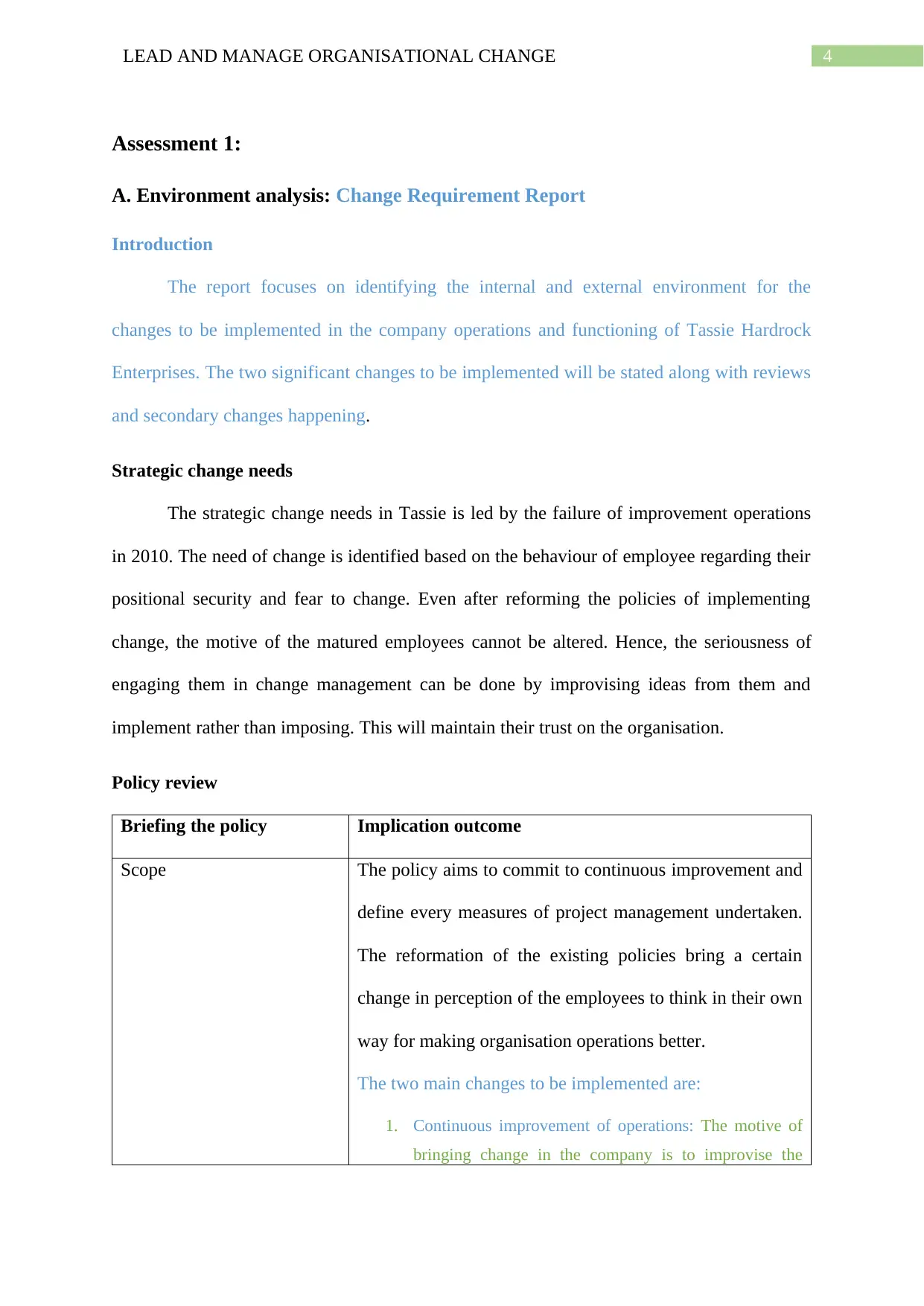
Assessment 1:
A. Environment analysis: Change Requirement Report
Introduction
The report focuses on identifying the internal and external environment for the
changes to be implemented in the company operations and functioning of Tassie Hardrock
Enterprises. The two significant changes to be implemented will be stated along with reviews
and secondary changes happening.
Strategic change needs
The strategic change needs in Tassie is led by the failure of improvement operations
in 2010. The need of change is identified based on the behaviour of employee regarding their
positional security and fear to change. Even after reforming the policies of implementing
change, the motive of the matured employees cannot be altered. Hence, the seriousness of
engaging them in change management can be done by improvising ideas from them and
implement rather than imposing. This will maintain their trust on the organisation.
Policy review
Briefing the policy Implication outcome
Scope The policy aims to commit to continuous improvement and
define every measures of project management undertaken.
The reformation of the existing policies bring a certain
change in perception of the employees to think in their own
way for making organisation operations better.
The two main changes to be implemented are:
1. Continuous improvement of operations: The motive of
bringing change in the company is to improvise the
Assessment 1:
A. Environment analysis: Change Requirement Report
Introduction
The report focuses on identifying the internal and external environment for the
changes to be implemented in the company operations and functioning of Tassie Hardrock
Enterprises. The two significant changes to be implemented will be stated along with reviews
and secondary changes happening.
Strategic change needs
The strategic change needs in Tassie is led by the failure of improvement operations
in 2010. The need of change is identified based on the behaviour of employee regarding their
positional security and fear to change. Even after reforming the policies of implementing
change, the motive of the matured employees cannot be altered. Hence, the seriousness of
engaging them in change management can be done by improvising ideas from them and
implement rather than imposing. This will maintain their trust on the organisation.
Policy review
Briefing the policy Implication outcome
Scope The policy aims to commit to continuous improvement and
define every measures of project management undertaken.
The reformation of the existing policies bring a certain
change in perception of the employees to think in their own
way for making organisation operations better.
The two main changes to be implemented are:
1. Continuous improvement of operations: The motive of
bringing change in the company is to improvise the
5LEAD AND MANAGE ORGANISATIONAL CHANGE
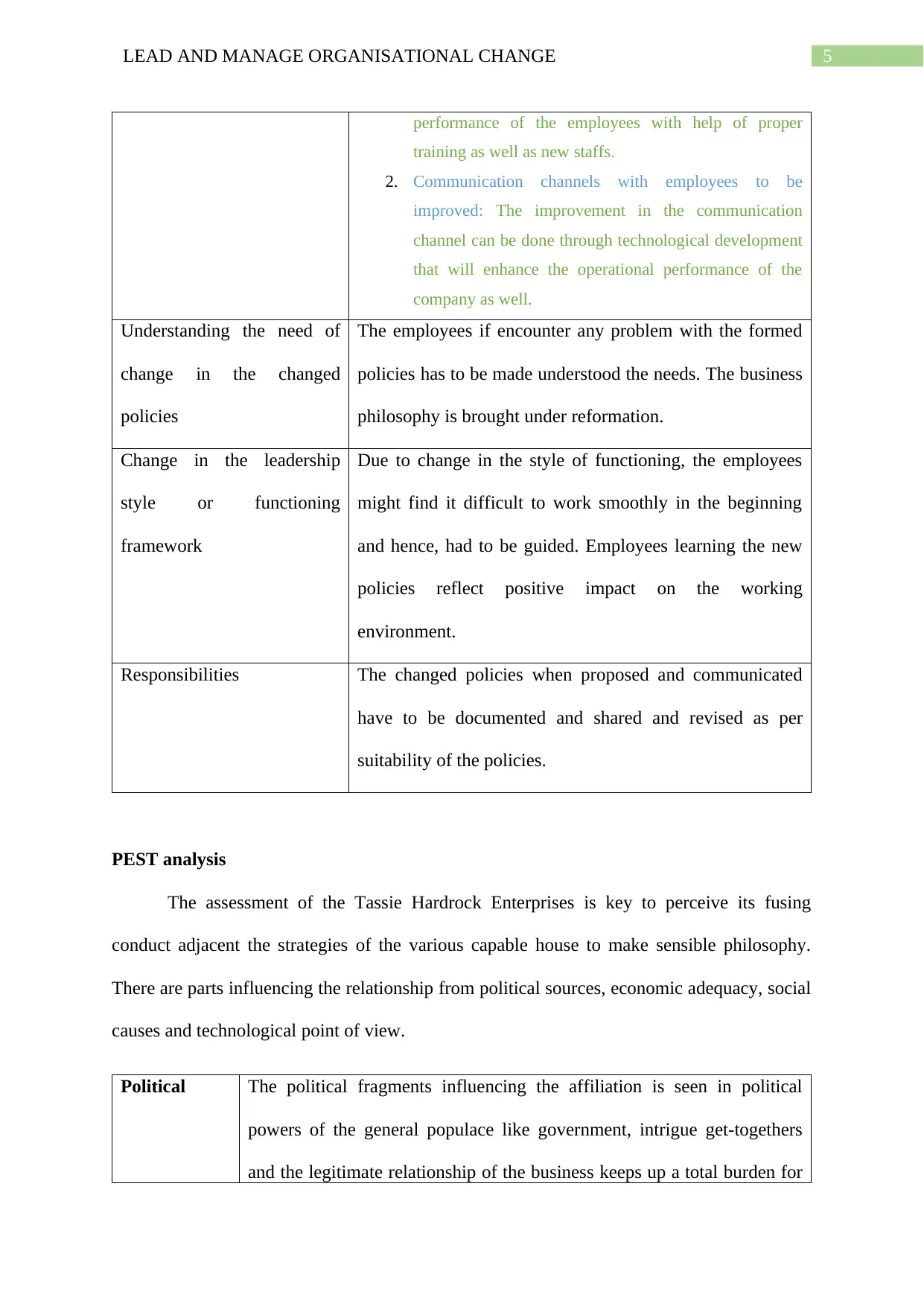
performance of the employees with help of proper
training as well as new staffs.
2. Communication channels with employees to be
improved: The improvement in the communication
channel can be done through technological development
that will enhance the operational performance of the
company as well.
Understanding the need of
change in the changed
policies
The employees if encounter any problem with the formed
policies has to be made understood the needs. The business
philosophy is brought under reformation.
Change in the leadership
style or functioning
framework
Due to change in the style of functioning, the employees
might find it difficult to work smoothly in the beginning
and hence, had to be guided. Employees learning the new
policies reflect positive impact on the working
environment.
Responsibilities The changed policies when proposed and communicated
have to be documented and shared and revised as per
suitability of the policies.
PEST analysis
The assessment of the Tassie Hardrock Enterprises is key to perceive its fusing
conduct adjacent the strategies of the various capable house to make sensible philosophy.
There are parts influencing the relationship from political sources, economic adequacy, social
causes and technological point of view.
Political The political fragments influencing the affiliation is seen in political
powers of the general populace like government, intrigue get-togethers
and the legitimate relationship of the business keeps up a total burden for
performance of the employees with help of proper
training as well as new staffs.
2. Communication channels with employees to be
improved: The improvement in the communication
channel can be done through technological development
that will enhance the operational performance of the
company as well.
Understanding the need of
change in the changed
policies
The employees if encounter any problem with the formed
policies has to be made understood the needs. The business
philosophy is brought under reformation.
Change in the leadership
style or functioning
framework
Due to change in the style of functioning, the employees
might find it difficult to work smoothly in the beginning
and hence, had to be guided. Employees learning the new
policies reflect positive impact on the working
environment.
Responsibilities The changed policies when proposed and communicated
have to be documented and shared and revised as per
suitability of the policies.
PEST analysis
The assessment of the Tassie Hardrock Enterprises is key to perceive its fusing
conduct adjacent the strategies of the various capable house to make sensible philosophy.
There are parts influencing the relationship from political sources, economic adequacy, social
causes and technological point of view.
Political The political fragments influencing the affiliation is seen in political
powers of the general populace like government, intrigue get-togethers
and the legitimate relationship of the business keeps up a total burden for
⊘ This is a preview!⊘
Do you want full access?
Subscribe today to unlock all pages.
Trusted by 1+ million students worldwide
6LEAD AND MANAGE ORGANISATIONAL CHANGE
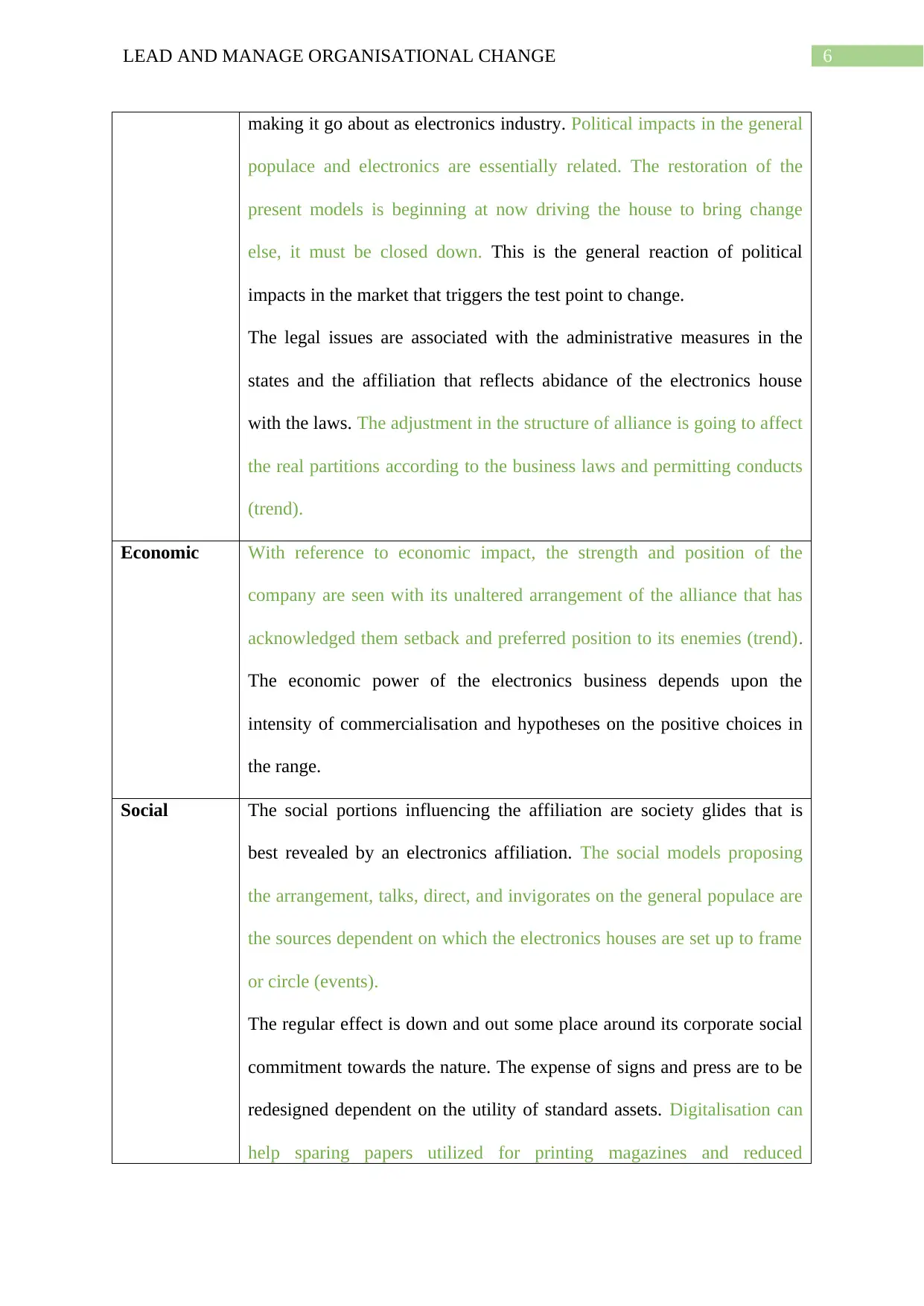
making it go about as electronics industry. Political impacts in the general
populace and electronics are essentially related. The restoration of the
present models is beginning at now driving the house to bring change
else, it must be closed down. This is the general reaction of political
impacts in the market that triggers the test point to change.
The legal issues are associated with the administrative measures in the
states and the affiliation that reflects abidance of the electronics house
with the laws. The adjustment in the structure of alliance is going to affect
the real partitions according to the business laws and permitting conducts
(trend).
Economic With reference to economic impact, the strength and position of the
company are seen with its unaltered arrangement of the alliance that has
acknowledged them setback and preferred position to its enemies (trend).
The economic power of the electronics business depends upon the
intensity of commercialisation and hypotheses on the positive choices in
the range.
Social The social portions influencing the affiliation are society glides that is
best revealed by an electronics affiliation. The social models proposing
the arrangement, talks, direct, and invigorates on the general populace are
the sources dependent on which the electronics houses are set up to frame
or circle (events).
The regular effect is down and out some place around its corporate social
commitment towards the nature. The expense of signs and press are to be
redesigned dependent on the utility of standard assets. Digitalisation can
help sparing papers utilized for printing magazines and reduced
making it go about as electronics industry. Political impacts in the general
populace and electronics are essentially related. The restoration of the
present models is beginning at now driving the house to bring change
else, it must be closed down. This is the general reaction of political
impacts in the market that triggers the test point to change.
The legal issues are associated with the administrative measures in the
states and the affiliation that reflects abidance of the electronics house
with the laws. The adjustment in the structure of alliance is going to affect
the real partitions according to the business laws and permitting conducts
(trend).
Economic With reference to economic impact, the strength and position of the
company are seen with its unaltered arrangement of the alliance that has
acknowledged them setback and preferred position to its enemies (trend).
The economic power of the electronics business depends upon the
intensity of commercialisation and hypotheses on the positive choices in
the range.
Social The social portions influencing the affiliation are society glides that is
best revealed by an electronics affiliation. The social models proposing
the arrangement, talks, direct, and invigorates on the general populace are
the sources dependent on which the electronics houses are set up to frame
or circle (events).
The regular effect is down and out some place around its corporate social
commitment towards the nature. The expense of signs and press are to be
redesigned dependent on the utility of standard assets. Digitalisation can
help sparing papers utilized for printing magazines and reduced
Paraphrase This Document
Need a fresh take? Get an instant paraphrase of this document with our AI Paraphraser
7LEAD AND MANAGE ORGANISATIONAL CHANGE
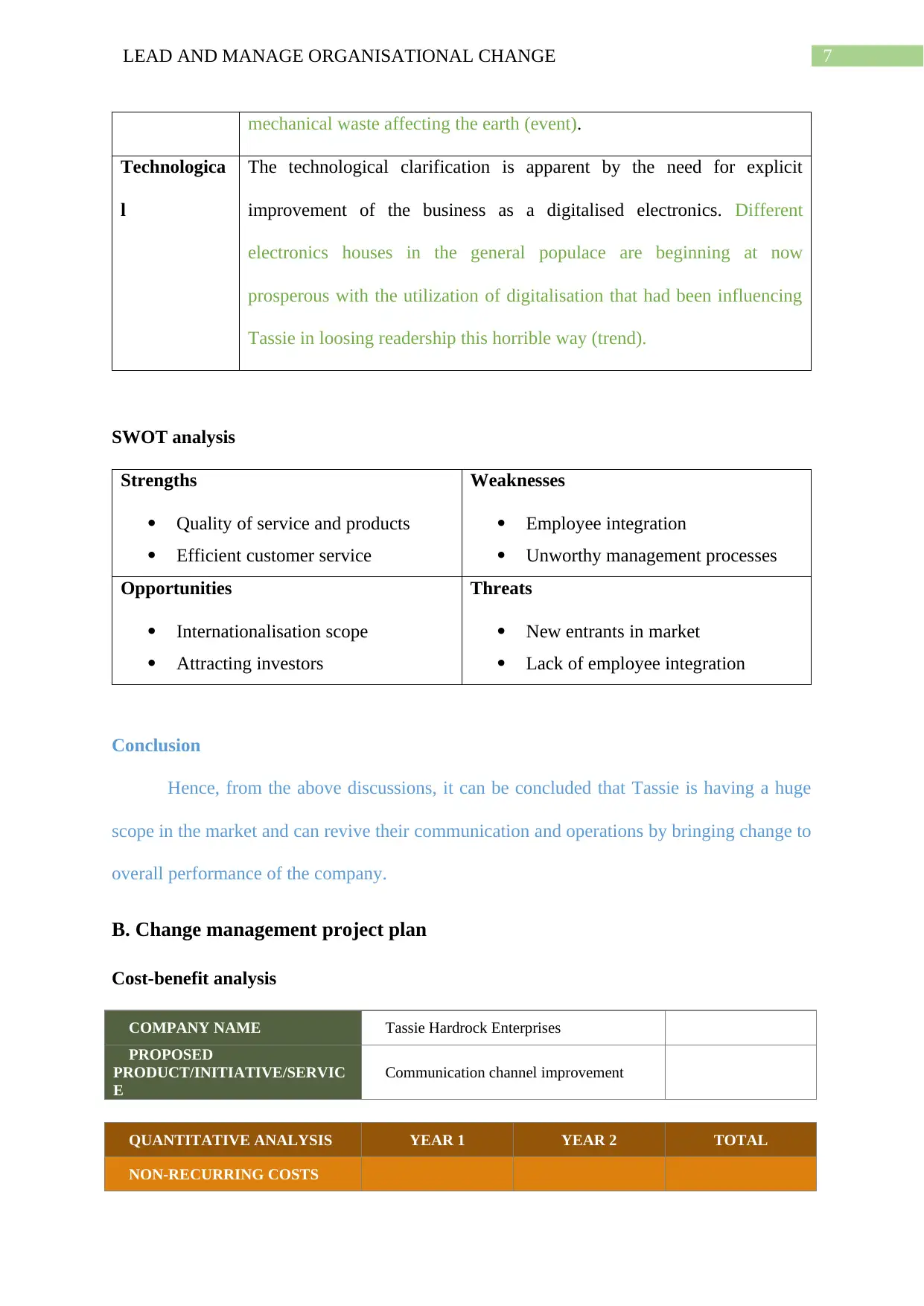
mechanical waste affecting the earth (event).
Technologica
l
The technological clarification is apparent by the need for explicit
improvement of the business as a digitalised electronics. Different
electronics houses in the general populace are beginning at now
prosperous with the utilization of digitalisation that had been influencing
Tassie in loosing readership this horrible way (trend).
SWOT analysis
Strengths
Quality of service and products
Efficient customer service
Weaknesses
Employee integration
Unworthy management processes
Opportunities
Internationalisation scope
Attracting investors
Threats
New entrants in market
Lack of employee integration
Conclusion
Hence, from the above discussions, it can be concluded that Tassie is having a huge
scope in the market and can revive their communication and operations by bringing change to
overall performance of the company.
B. Change management project plan
Cost-benefit analysis
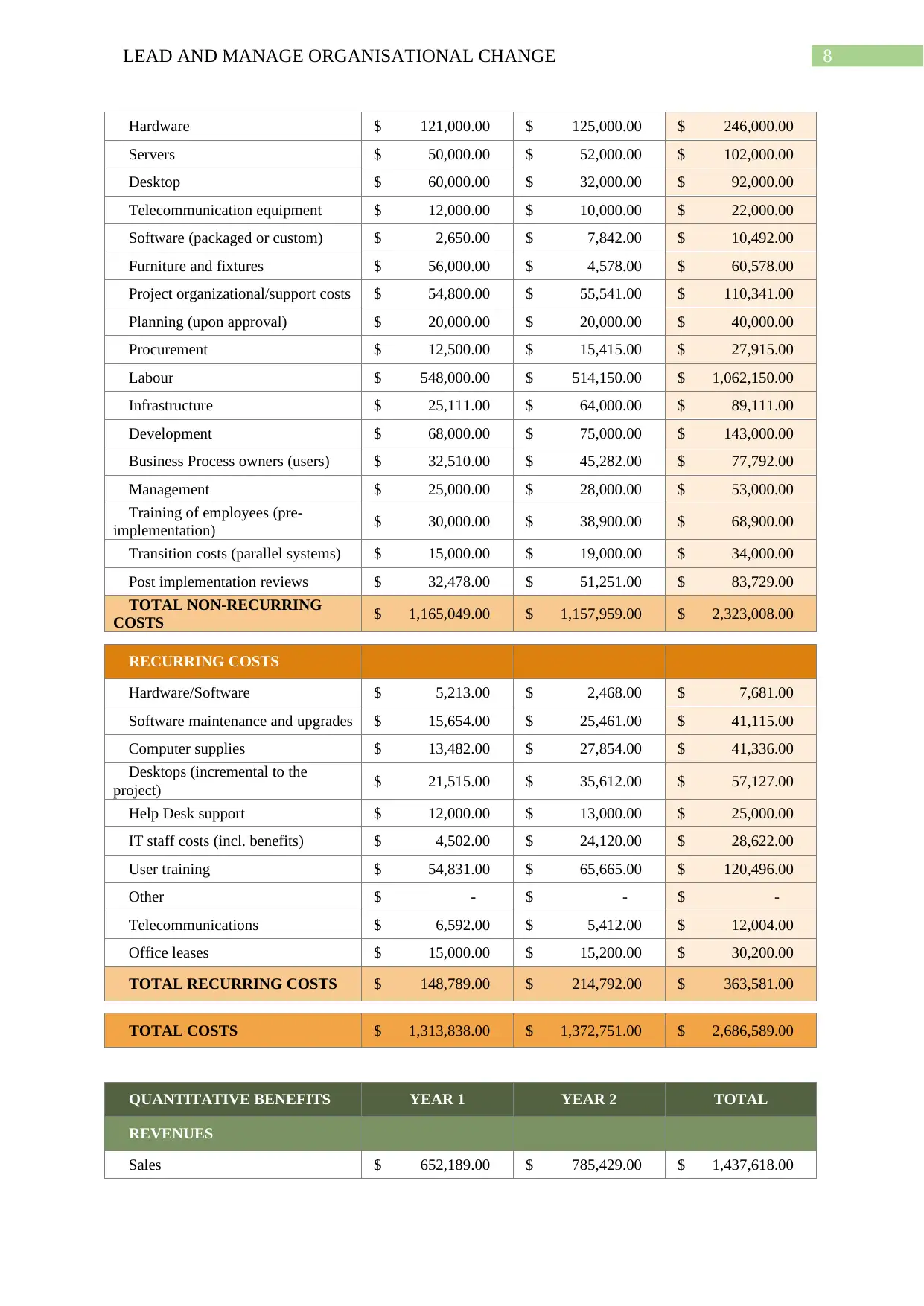
COMPANY NAME Tassie Hardrock Enterprises
PROPOSED
PRODUCT/INITIATIVE/SERVIC
E
Communication channel improvement
QUANTITATIVE ANALYSIS YEAR 1 YEAR 2 TOTAL
NON-RECURRING COSTS
mechanical waste affecting the earth (event).
Technologica
l
The technological clarification is apparent by the need for explicit
improvement of the business as a digitalised electronics. Different
electronics houses in the general populace are beginning at now
prosperous with the utilization of digitalisation that had been influencing
Tassie in loosing readership this horrible way (trend).
SWOT analysis
Strengths
Quality of service and products
Efficient customer service
Weaknesses
Employee integration
Unworthy management processes
Opportunities
Internationalisation scope
Attracting investors
Threats
New entrants in market
Lack of employee integration
Conclusion
Hence, from the above discussions, it can be concluded that Tassie is having a huge
scope in the market and can revive their communication and operations by bringing change to
overall performance of the company.
B. Change management project plan
Cost-benefit analysis
COMPANY NAME Tassie Hardrock Enterprises
PROPOSED
PRODUCT/INITIATIVE/SERVIC
E
Communication channel improvement
QUANTITATIVE ANALYSIS YEAR 1 YEAR 2 TOTAL
NON-RECURRING COSTS
8LEAD AND MANAGE ORGANISATIONAL CHANGE
Hardware $ 121,000.00 $ 125,000.00 $ 246,000.00
Servers $ 50,000.00 $ 52,000.00 $ 102,000.00
Desktop $ 60,000.00 $ 32,000.00 $ 92,000.00
Telecommunication equipment $ 12,000.00 $ 10,000.00 $ 22,000.00
Software (packaged or custom) $ 2,650.00 $ 7,842.00 $ 10,492.00
Furniture and fixtures $ 56,000.00 $ 4,578.00 $ 60,578.00
Project organizational/support costs $ 54,800.00 $ 55,541.00 $ 110,341.00
Planning (upon approval) $ 20,000.00 $ 20,000.00 $ 40,000.00
Procurement $ 12,500.00 $ 15,415.00 $ 27,915.00
Labour $ 548,000.00 $ 514,150.00 $ 1,062,150.00
Infrastructure $ 25,111.00 $ 64,000.00 $ 89,111.00
Development $ 68,000.00 $ 75,000.00 $ 143,000.00
Business Process owners (users) $ 32,510.00 $ 45,282.00 $ 77,792.00
Management $ 25,000.00 $ 28,000.00 $ 53,000.00
Training of employees (pre-
implementation) $ 30,000.00 $ 38,900.00 $ 68,900.00
Transition costs (parallel systems) $ 15,000.00 $ 19,000.00 $ 34,000.00
Post implementation reviews $ 32,478.00 $ 51,251.00 $ 83,729.00
TOTAL NON-RECURRING
COSTS $ 1,165,049.00 $ 1,157,959.00 $ 2,323,008.00
RECURRING COSTS
Hardware/Software $ 5,213.00 $ 2,468.00 $ 7,681.00
Software maintenance and upgrades $ 15,654.00 $ 25,461.00 $ 41,115.00
Computer supplies $ 13,482.00 $ 27,854.00 $ 41,336.00
Desktops (incremental to the
project) $ 21,515.00 $ 35,612.00 $ 57,127.00
Help Desk support $ 12,000.00 $ 13,000.00 $ 25,000.00
IT staff costs (incl. benefits) $ 4,502.00 $ 24,120.00 $ 28,622.00
User training $ 54,831.00 $ 65,665.00 $ 120,496.00
Other $ - $ - $ -
Telecommunications $ 6,592.00 $ 5,412.00 $ 12,004.00
Office leases $ 15,000.00 $ 15,200.00 $ 30,200.00
TOTAL RECURRING COSTS $ 148,789.00 $ 214,792.00 $ 363,581.00
TOTAL COSTS $ 1,313,838.00 $ 1,372,751.00 $ 2,686,589.00
QUANTITATIVE BENEFITS YEAR 1 YEAR 2 TOTAL
REVENUES
Sales $ 652,189.00 $ 785,429.00 $ 1,437,618.00
Hardware $ 121,000.00 $ 125,000.00 $ 246,000.00
Servers $ 50,000.00 $ 52,000.00 $ 102,000.00
Desktop $ 60,000.00 $ 32,000.00 $ 92,000.00
Telecommunication equipment $ 12,000.00 $ 10,000.00 $ 22,000.00
Software (packaged or custom) $ 2,650.00 $ 7,842.00 $ 10,492.00
Furniture and fixtures $ 56,000.00 $ 4,578.00 $ 60,578.00
Project organizational/support costs $ 54,800.00 $ 55,541.00 $ 110,341.00
Planning (upon approval) $ 20,000.00 $ 20,000.00 $ 40,000.00
Procurement $ 12,500.00 $ 15,415.00 $ 27,915.00
Labour $ 548,000.00 $ 514,150.00 $ 1,062,150.00
Infrastructure $ 25,111.00 $ 64,000.00 $ 89,111.00
Development $ 68,000.00 $ 75,000.00 $ 143,000.00
Business Process owners (users) $ 32,510.00 $ 45,282.00 $ 77,792.00
Management $ 25,000.00 $ 28,000.00 $ 53,000.00
Training of employees (pre-
implementation) $ 30,000.00 $ 38,900.00 $ 68,900.00
Transition costs (parallel systems) $ 15,000.00 $ 19,000.00 $ 34,000.00
Post implementation reviews $ 32,478.00 $ 51,251.00 $ 83,729.00
TOTAL NON-RECURRING
COSTS $ 1,165,049.00 $ 1,157,959.00 $ 2,323,008.00
RECURRING COSTS
Hardware/Software $ 5,213.00 $ 2,468.00 $ 7,681.00
Software maintenance and upgrades $ 15,654.00 $ 25,461.00 $ 41,115.00
Computer supplies $ 13,482.00 $ 27,854.00 $ 41,336.00
Desktops (incremental to the
project) $ 21,515.00 $ 35,612.00 $ 57,127.00
Help Desk support $ 12,000.00 $ 13,000.00 $ 25,000.00
IT staff costs (incl. benefits) $ 4,502.00 $ 24,120.00 $ 28,622.00
User training $ 54,831.00 $ 65,665.00 $ 120,496.00
Other $ - $ - $ -
Telecommunications $ 6,592.00 $ 5,412.00 $ 12,004.00
Office leases $ 15,000.00 $ 15,200.00 $ 30,200.00
TOTAL RECURRING COSTS $ 148,789.00 $ 214,792.00 $ 363,581.00
TOTAL COSTS $ 1,313,838.00 $ 1,372,751.00 $ 2,686,589.00
QUANTITATIVE BENEFITS YEAR 1 YEAR 2 TOTAL
REVENUES
Sales $ 652,189.00 $ 785,429.00 $ 1,437,618.00
⊘ This is a preview!⊘
Do you want full access?
Subscribe today to unlock all pages.
Trusted by 1+ million students worldwide
9LEAD AND MANAGE ORGANISATIONAL CHANGE
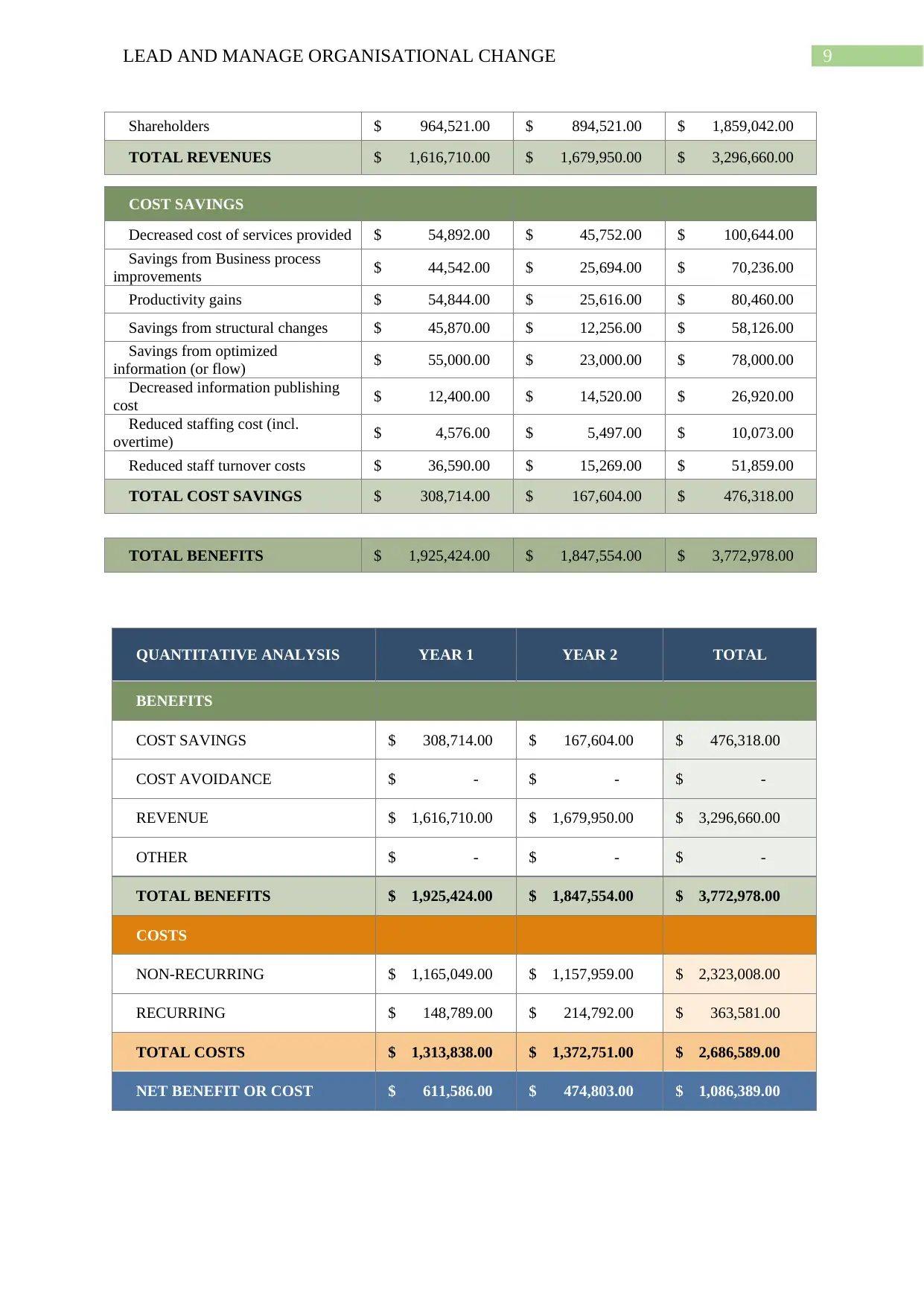
Shareholders $ 964,521.00 $ 894,521.00 $ 1,859,042.00
TOTAL REVENUES $ 1,616,710.00 $ 1,679,950.00 $ 3,296,660.00
COST SAVINGS
Decreased cost of services provided $ 54,892.00 $ 45,752.00 $ 100,644.00
Savings from Business process
improvements $ 44,542.00 $ 25,694.00 $ 70,236.00
Productivity gains $ 54,844.00 $ 25,616.00 $ 80,460.00
Savings from structural changes $ 45,870.00 $ 12,256.00 $ 58,126.00
Savings from optimized
information (or flow) $ 55,000.00 $ 23,000.00 $ 78,000.00
Decreased information publishing
cost $ 12,400.00 $ 14,520.00 $ 26,920.00
Reduced staffing cost (incl.
overtime) $ 4,576.00 $ 5,497.00 $ 10,073.00
Reduced staff turnover costs $ 36,590.00 $ 15,269.00 $ 51,859.00
TOTAL COST SAVINGS $ 308,714.00 $ 167,604.00 $ 476,318.00
TOTAL BENEFITS $ 1,925,424.00 $ 1,847,554.00 $ 3,772,978.00
QUANTITATIVE ANALYSIS YEAR 1 YEAR 2 TOTAL
BENEFITS
COST SAVINGS $ 308,714.00 $ 167,604.00 $ 476,318.00
COST AVOIDANCE $ - $ - $ -
REVENUE $ 1,616,710.00 $ 1,679,950.00 $ 3,296,660.00
OTHER $ - $ - $ -
TOTAL BENEFITS $ 1,925,424.00 $ 1,847,554.00 $ 3,772,978.00
COSTS
NON-RECURRING $ 1,165,049.00 $ 1,157,959.00 $ 2,323,008.00
RECURRING $ 148,789.00 $ 214,792.00 $ 363,581.00
TOTAL COSTS $ 1,313,838.00 $ 1,372,751.00 $ 2,686,589.00
NET BENEFIT OR COST $ 611,586.00 $ 474,803.00 $ 1,086,389.00
Shareholders $ 964,521.00 $ 894,521.00 $ 1,859,042.00
TOTAL REVENUES $ 1,616,710.00 $ 1,679,950.00 $ 3,296,660.00
COST SAVINGS
Decreased cost of services provided $ 54,892.00 $ 45,752.00 $ 100,644.00
Savings from Business process
improvements $ 44,542.00 $ 25,694.00 $ 70,236.00
Productivity gains $ 54,844.00 $ 25,616.00 $ 80,460.00
Savings from structural changes $ 45,870.00 $ 12,256.00 $ 58,126.00
Savings from optimized
information (or flow) $ 55,000.00 $ 23,000.00 $ 78,000.00
Decreased information publishing
cost $ 12,400.00 $ 14,520.00 $ 26,920.00
Reduced staffing cost (incl.
overtime) $ 4,576.00 $ 5,497.00 $ 10,073.00
Reduced staff turnover costs $ 36,590.00 $ 15,269.00 $ 51,859.00
TOTAL COST SAVINGS $ 308,714.00 $ 167,604.00 $ 476,318.00
TOTAL BENEFITS $ 1,925,424.00 $ 1,847,554.00 $ 3,772,978.00
QUANTITATIVE ANALYSIS YEAR 1 YEAR 2 TOTAL
BENEFITS
COST SAVINGS $ 308,714.00 $ 167,604.00 $ 476,318.00
COST AVOIDANCE $ - $ - $ -
REVENUE $ 1,616,710.00 $ 1,679,950.00 $ 3,296,660.00
OTHER $ - $ - $ -
TOTAL BENEFITS $ 1,925,424.00 $ 1,847,554.00 $ 3,772,978.00
COSTS
NON-RECURRING $ 1,165,049.00 $ 1,157,959.00 $ 2,323,008.00
RECURRING $ 148,789.00 $ 214,792.00 $ 363,581.00
TOTAL COSTS $ 1,313,838.00 $ 1,372,751.00 $ 2,686,589.00
NET BENEFIT OR COST $ 611,586.00 $ 474,803.00 $ 1,086,389.00
Paraphrase This Document
Need a fresh take? Get an instant paraphrase of this document with our AI Paraphraser
10LEAD AND MANAGE ORGANISATIONAL CHANGE
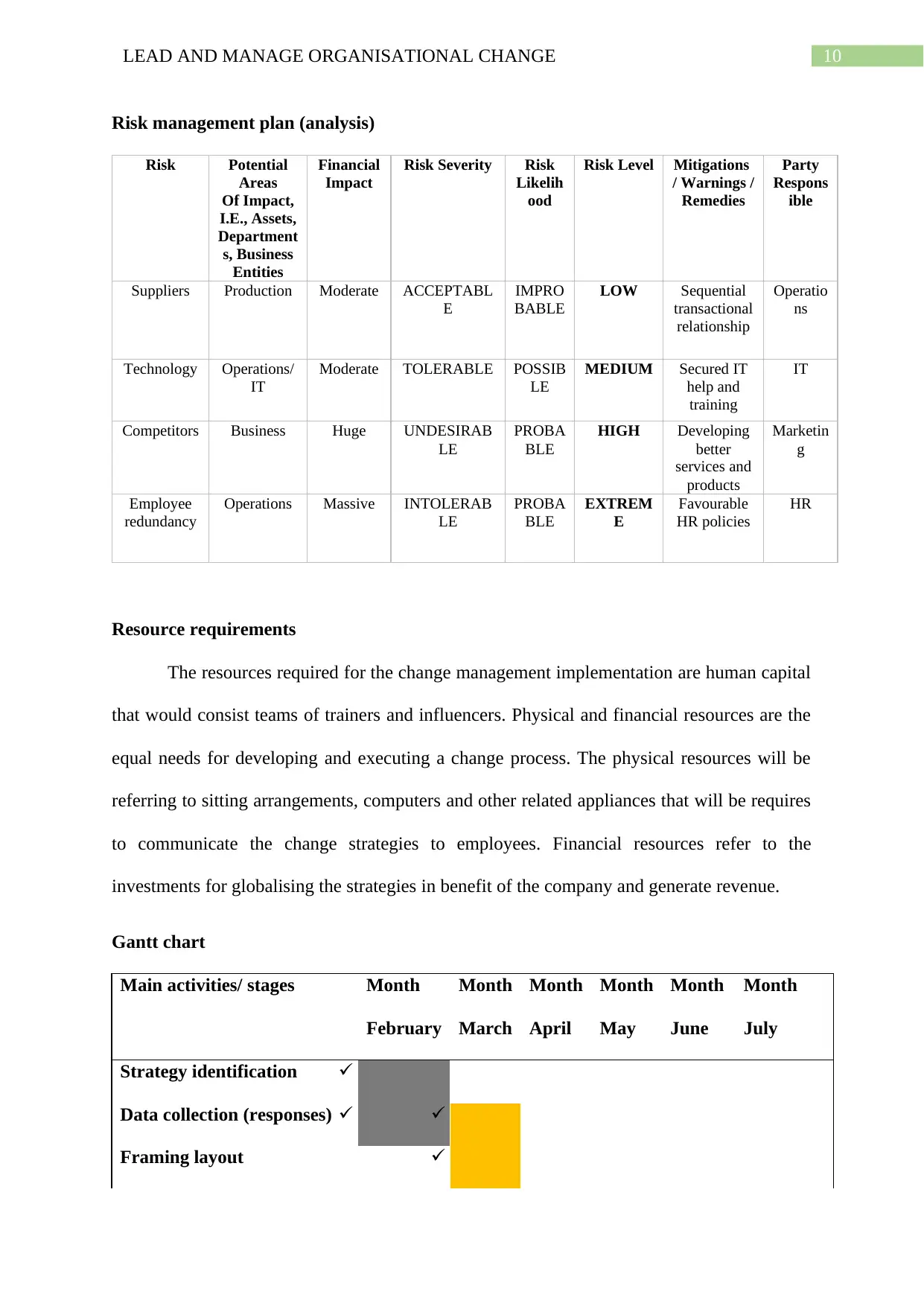
Risk management plan (analysis)
Risk Potential
Areas
Of Impact,
I.E., Assets,
Department
s, Business
Entities
Financial
Impact
Risk Severity Risk
Likelih
ood
Risk Level Mitigations
/ Warnings /
Remedies
Party
Respons
ible
Suppliers Production Moderate ACCEPTABL
E
IMPRO
BABLE
LOW Sequential
transactional
relationship
Operatio
ns
Technology Operations/
IT
Moderate TOLERABLE POSSIB
LE
MEDIUM Secured IT
help and
training
IT
Competitors Business Huge UNDESIRAB
LE
PROBA
BLE
HIGH Developing
better
services and
products
Marketin
g
Employee
redundancy
Operations Massive INTOLERAB
LE
PROBA
BLE
EXTREM
E
Favourable
HR policies
HR
Resource requirements
The resources required for the change management implementation are human capital
that would consist teams of trainers and influencers. Physical and financial resources are the
equal needs for developing and executing a change process. The physical resources will be
referring to sitting arrangements, computers and other related appliances that will be requires
to communicate the change strategies to employees. Financial resources refer to the
investments for globalising the strategies in benefit of the company and generate revenue.
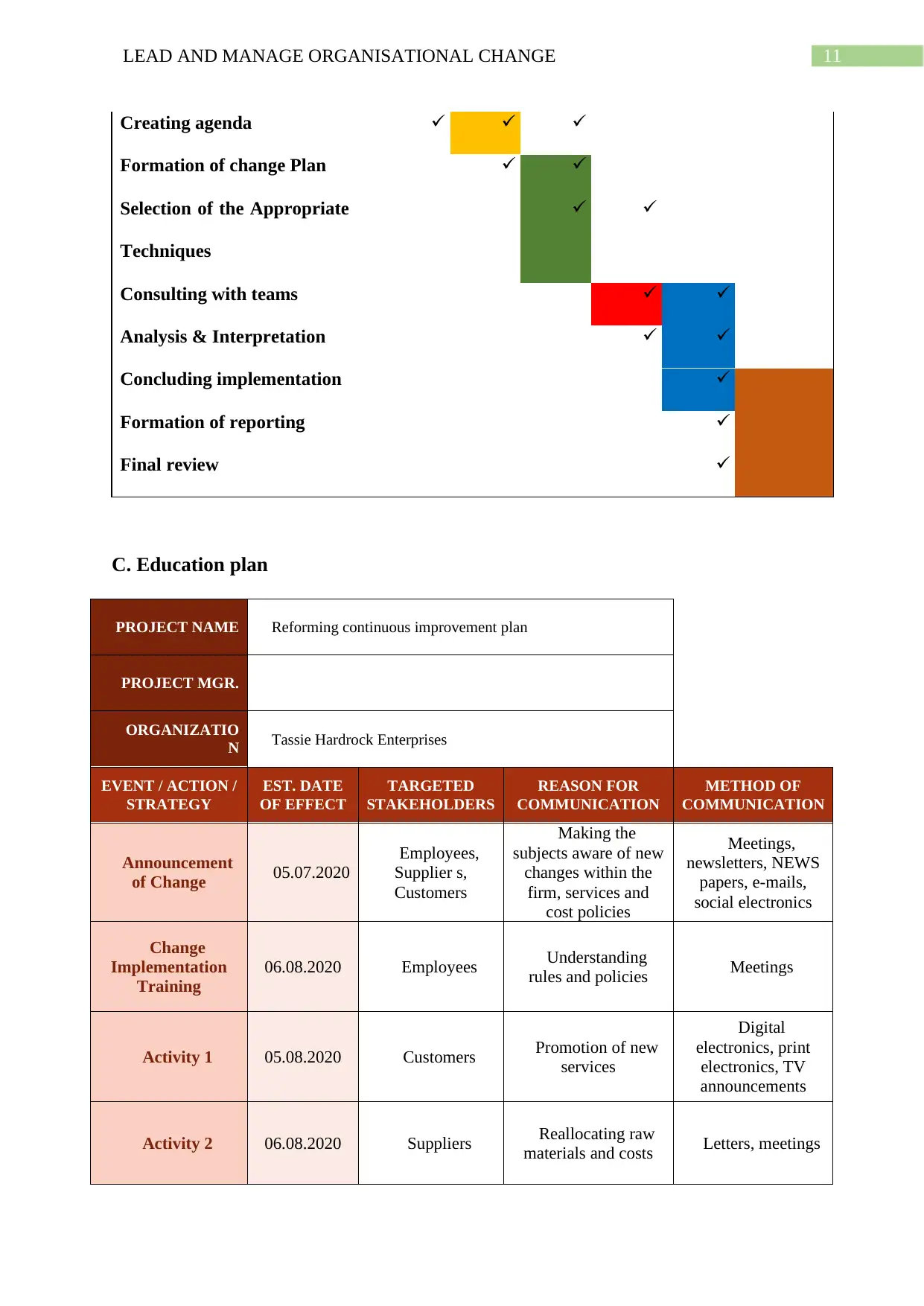
Gantt chart
Main activities/ stages Month
February
Month
March
Month
April
Month
May
Month
June
Month
July
Strategy identification
Data collection (responses)
Framing layout
Risk management plan (analysis)
Risk Potential
Areas
Of Impact,
I.E., Assets,
Department
s, Business
Entities
Financial
Impact
Risk Severity Risk
Likelih
ood
Risk Level Mitigations
/ Warnings /
Remedies
Party
Respons
ible
Suppliers Production Moderate ACCEPTABL
E
IMPRO
BABLE
LOW Sequential
transactional
relationship
Operatio
ns
Technology Operations/
IT
Moderate TOLERABLE POSSIB
LE
MEDIUM Secured IT
help and
training
IT
Competitors Business Huge UNDESIRAB
LE
PROBA
BLE
HIGH Developing
better
services and
products
Marketin
g
Employee
redundancy
Operations Massive INTOLERAB
LE
PROBA
BLE
EXTREM
E
Favourable
HR policies
HR
Resource requirements
The resources required for the change management implementation are human capital
that would consist teams of trainers and influencers. Physical and financial resources are the
equal needs for developing and executing a change process. The physical resources will be
referring to sitting arrangements, computers and other related appliances that will be requires
to communicate the change strategies to employees. Financial resources refer to the
investments for globalising the strategies in benefit of the company and generate revenue.
Gantt chart
Main activities/ stages Month
February
Month
March
Month
April
Month
May
Month
June
Month
July
Strategy identification
Data collection (responses)
Framing layout
11LEAD AND MANAGE ORGANISATIONAL CHANGE
Creating agenda
Formation of change Plan
Selection of the Appropriate
Techniques
Consulting with teams
Analysis & Interpretation
Concluding implementation
Formation of reporting
Final review
C. Education plan
PROJECT NAME Reforming continuous improvement plan
PROJECT MGR.
ORGANIZATIO
N Tassie Hardrock Enterprises
EVENT / ACTION /
STRATEGY
EST. DATE
OF EFFECT
TARGETED
STAKEHOLDERS
REASON FOR
COMMUNICATION
METHOD OF
COMMUNICATION
Announcement
of Change 05.07.2020
Employees,
Supplier s,
Customers
Making the
subjects aware of new
changes within the
firm, services and
cost policies
Meetings,
newsletters, NEWS
papers, e-mails,
social electronics
Change
Implementation
Training
06.08.2020 Employees Understanding
rules and policies Meetings
Activity 1 05.08.2020 Customers Promotion of new
services
Digital
electronics, print
electronics, TV
announcements
Activity 2 06.08.2020 Suppliers Reallocating raw
materials and costs Letters, meetings
Creating agenda
Formation of change Plan
Selection of the Appropriate
Techniques
Consulting with teams
Analysis & Interpretation
Concluding implementation
Formation of reporting
Final review
C. Education plan
PROJECT NAME Reforming continuous improvement plan
PROJECT MGR.
ORGANIZATIO
N Tassie Hardrock Enterprises
EVENT / ACTION /
STRATEGY
EST. DATE
OF EFFECT
TARGETED
STAKEHOLDERS
REASON FOR
COMMUNICATION
METHOD OF
COMMUNICATION
Announcement
of Change 05.07.2020
Employees,
Supplier s,
Customers
Making the
subjects aware of new
changes within the
firm, services and
cost policies
Meetings,
newsletters, NEWS
papers, e-mails,
social electronics
Change
Implementation
Training
06.08.2020 Employees Understanding
rules and policies Meetings
Activity 1 05.08.2020 Customers Promotion of new
services
Digital
electronics, print
electronics, TV
announcements
Activity 2 06.08.2020 Suppliers Reallocating raw
materials and costs Letters, meetings
⊘ This is a preview!⊘
Do you want full access?
Subscribe today to unlock all pages.
Trusted by 1+ million students worldwide

1 out of 21


Related Documents


![Organisational Change Report: Fit Life Fitness Clubs - [Course Name]](/_next/image/?url=https%3A%2F%2Fdesklib.com%2Fmedia%2Fimages%2Fls%2F759ea260d83e42cfad7c7615a9414229.jpg&w=256&q=75)


Your All-in-One AI-Powered Toolkit for Academic Success.
+13062052269
info@desklib.com
Available 24*7 on WhatsApp / Email
![[object Object]](/_next/static/media/star-bottom.7253800d.svg)
Unlock your academic potential
Copyright © 2020–2026 A2Z Services. All Rights Reserved. Developed and managed by ZUCOL.