Organizational Change Management Report: Case Study Analysis
VerifiedAdded on 2022/10/15
|17
|4308
|35
Report
AI Summary
This report provides a detailed analysis of organizational change management, focusing on a case study to evaluate the application of contemporary change management practices. The report begins with an executive summary and introduction, identifying a specific change initiative within the organization and highlighting its importance. It then proceeds to analyze the need for change using SWOT and Force Field analyses, assessing the organization's strengths, weaknesses, opportunities, and threats, as well as the driving and restraining forces related to the change. The report also examines the concept of change readiness, identifying factors that influence it and suggesting strategies to achieve it. Various approaches to change, such as empowerment, participative leadership, and systems thinking, are evaluated. The report further explores different change models, including change characterized by scale and open systems theory, and identifies a suitable model for implementation. Approaches for managing change resistance are discussed, followed by a consideration of ethical and responsible approaches to planning and implementing change. The report culminates in a series of recommendations and an implementation action plan, offering practical steps for the organization to improve its change management practices. Finally, the report concludes with a summary of the findings and a list of references.
Organizational change management

Paraphrase This Document
Need a fresh take? Get an instant paraphrase of this document with our AI Paraphraser
Executive summary
The changing context of business environment is largely affecting institutional operations and
related ideologies. Organizational change management is a crucial process which is liable to
improve the operational significance and frameworks based on the affecting environmental
factors. The impacts of changes in an organizational context remains functional in both negative
as well as positive dimensions. It involves differential association of various other factors which
are included across the defined ideologies for change management. This report defines a
situation related to organizational change management. Different dimensions related to the
process are evaluated and analysed under this report. In addition to this, change models and
implementation factors are also included in order to facilitate changes across the available
change management possibilities. A set of reliable recommendations are also provided in this
report which can be used to frame a suitable change management plan.
2
The changing context of business environment is largely affecting institutional operations and
related ideologies. Organizational change management is a crucial process which is liable to
improve the operational significance and frameworks based on the affecting environmental
factors. The impacts of changes in an organizational context remains functional in both negative
as well as positive dimensions. It involves differential association of various other factors which
are included across the defined ideologies for change management. This report defines a
situation related to organizational change management. Different dimensions related to the
process are evaluated and analysed under this report. In addition to this, change models and
implementation factors are also included in order to facilitate changes across the available
change management possibilities. A set of reliable recommendations are also provided in this
report which can be used to frame a suitable change management plan.
2
Table of contents
Introduction......................................................................................................................................4
Identification of a change initiative within the organisation...........................................................4
Importance of change......................................................................................................................5
Analyse, diagnose and justify the need for change..........................................................................5
SWOT analysis............................................................................................................................5
Force field Analysis.....................................................................................................................6
Achieving change readiness............................................................................................................7
Identification and justification for the approach to change.............................................................8
Evaluation of change models and identification of a model for change implementation within the
organisation......................................................................................................................................9
Approaches for managing change resistance.................................................................................11
Ethical and responsible approaches to planning and implementing change..................................12
Recommendations..........................................................................................................................12
Implementation action plan...........................................................................................................13
Conclusion.....................................................................................................................................14
References:....................................................................................................................................15
3
Introduction......................................................................................................................................4
Identification of a change initiative within the organisation...........................................................4
Importance of change......................................................................................................................5
Analyse, diagnose and justify the need for change..........................................................................5
SWOT analysis............................................................................................................................5
Force field Analysis.....................................................................................................................6
Achieving change readiness............................................................................................................7
Identification and justification for the approach to change.............................................................8
Evaluation of change models and identification of a model for change implementation within the
organisation......................................................................................................................................9
Approaches for managing change resistance.................................................................................11
Ethical and responsible approaches to planning and implementing change..................................12
Recommendations..........................................................................................................................12
Implementation action plan...........................................................................................................13
Conclusion.....................................................................................................................................14
References:....................................................................................................................................15
3
⊘ This is a preview!⊘
Do you want full access?
Subscribe today to unlock all pages.

Trusted by 1+ million students worldwide
INTRODUCTION
Change management is an important segment for any organization. It defines the differences
which are available in context of advanced business processes, cultural modifications and
structural designs associations. New skills and behavioural aspects are also a major part of the
systematic approaches related to facilitate an organizational change management process. A
typical organization change management includes improved communication, setting expectations
and demanding reduction in misinformation factors. Agreement for a common vision and
efficient leadership for execution are some of the basic requirements related to an organizational
change management process. This report explains the various aspects which are included under a
major organization change management process. Different sections which indicate the
importance and need for the respective change initiative all across the provided segments. SWOT
and force field analysis is carried out for identifying the possible ways for implementing the
organizational change management process. Different change models and implementation factors
are analysed in order to facilitate changes across the available change management possibilities.
A set of feasible recommendations are also provided in this report which can be used to justify
the required possibilities under a suitable change management plan.
Identification of a change initiative within the organisation
In the last three years, the organization has undertaken changes across its centralized work
planning and scheduling for practicing control and work dispatch for the extensive field work
force. This change in the work distribution system is carried out to facilitate sustainable delivery
across the channels. But there has been a major lacking in context of workforce morale related to
the organization. This chance is not quite appreciated by the workforce included under this
particular organization. According to the views of Hornstein (2015), the changes of this kind
have been evident in creating feeling of discontentment across the workforce. This unsatisfactory
feeling is liable to develop negative impacts on the operational usability factor all along the
provided sectors. This is a major reason which has led to an increment in in the sickness absence
levels. The organization has been suffering negative consequences of this change all across its
operational dimensions. Factors such as asset failure, regulatory changes and customer service
4
Change management is an important segment for any organization. It defines the differences
which are available in context of advanced business processes, cultural modifications and
structural designs associations. New skills and behavioural aspects are also a major part of the
systematic approaches related to facilitate an organizational change management process. A
typical organization change management includes improved communication, setting expectations
and demanding reduction in misinformation factors. Agreement for a common vision and
efficient leadership for execution are some of the basic requirements related to an organizational
change management process. This report explains the various aspects which are included under a
major organization change management process. Different sections which indicate the
importance and need for the respective change initiative all across the provided segments. SWOT
and force field analysis is carried out for identifying the possible ways for implementing the
organizational change management process. Different change models and implementation factors
are analysed in order to facilitate changes across the available change management possibilities.
A set of feasible recommendations are also provided in this report which can be used to justify
the required possibilities under a suitable change management plan.
Identification of a change initiative within the organisation
In the last three years, the organization has undertaken changes across its centralized work
planning and scheduling for practicing control and work dispatch for the extensive field work
force. This change in the work distribution system is carried out to facilitate sustainable delivery
across the channels. But there has been a major lacking in context of workforce morale related to
the organization. This chance is not quite appreciated by the workforce included under this
particular organization. According to the views of Hornstein (2015), the changes of this kind
have been evident in creating feeling of discontentment across the workforce. This unsatisfactory
feeling is liable to develop negative impacts on the operational usability factor all along the
provided sectors. This is a major reason which has led to an increment in in the sickness absence
levels. The organization has been suffering negative consequences of this change all across its
operational dimensions. Factors such as asset failure, regulatory changes and customer service
4
Paraphrase This Document
Need a fresh take? Get an instant paraphrase of this document with our AI Paraphraser
delivery have been largely incorporated across the available set of operational changes across the
organization.
Importance of change
Change for an organizational structure is highly important as it provides the required pace and
direction for growth. Each of the related aspects such as customer trends, technological changes
and socioeconomic conditions have been changing widely. This require a more adaptive and
responsive form of organizational management process. Change provides an opportunity to adapt
the latest trends and accomplish goals based on available resources. According to the views of
Cameron and Green (2015), change provides an organizational structure with significant
opportunities to flourish using the available set of resources and technological aspects. A
regulated change process provides an opportunity to the employees for learning new skills and
adding value to the different exercises. Organizational change leads to development of new
ideologies and innovation based patterns for simplifying the process of operation in an
organisation. It also enhances the available set of opportunities for facilitating individual as well
as organizational growth.
Analyse, diagnose and justify the need for change
SWOT analysis
Strengths
As the organization operates in sustainable energy and power delivery, there are infinite
scope for its development. The related industry is full of opportunities which is a major
strength for the organization.
It has a rigorous and frequent auditing system along with regulated internal and external
inspections (Fernandez and Rainey, 2017).
Conventional employment terms and conditions
Additional employee benefits such as sick pay and schemes for pension.
Weaknesses
The customer complaints rate are higher than general and large improvements are
required in this area.
5
organization.
Importance of change
Change for an organizational structure is highly important as it provides the required pace and
direction for growth. Each of the related aspects such as customer trends, technological changes
and socioeconomic conditions have been changing widely. This require a more adaptive and
responsive form of organizational management process. Change provides an opportunity to adapt
the latest trends and accomplish goals based on available resources. According to the views of
Cameron and Green (2015), change provides an organizational structure with significant
opportunities to flourish using the available set of resources and technological aspects. A
regulated change process provides an opportunity to the employees for learning new skills and
adding value to the different exercises. Organizational change leads to development of new
ideologies and innovation based patterns for simplifying the process of operation in an
organisation. It also enhances the available set of opportunities for facilitating individual as well
as organizational growth.
Analyse, diagnose and justify the need for change
SWOT analysis
Strengths
As the organization operates in sustainable energy and power delivery, there are infinite
scope for its development. The related industry is full of opportunities which is a major
strength for the organization.
It has a rigorous and frequent auditing system along with regulated internal and external
inspections (Fernandez and Rainey, 2017).
Conventional employment terms and conditions
Additional employee benefits such as sick pay and schemes for pension.
Weaknesses
The customer complaints rate are higher than general and large improvements are
required in this area.
5
Objectives and operations are largely influenced by the department managers and very
less consultation is made with the workforce.
The final decisions lack majority of workforce as the manager is liable to take them
independently.
Threats
Out of the line payment and disconnection policy as compared to other supplier
organizations can make this organization out of business.
Availability of individual centred roles and responsibilities initiate a lack of team work
and collaboration between departments (Al-Haddad and Kotnour, 2015).
Lack of a consistent approach for change from the managers and the departmental
perspectives.
Opportunities
The organization provides significant opportunities for its workforce by providing
provisions of annual bonuses for departments achieving their targets.
Application of significant change management process to increase workforce integration
and management.
The drastic increase in global demand of sustainable energy supplies are an important
opportunity for the organization (Petrou et al. 2018).
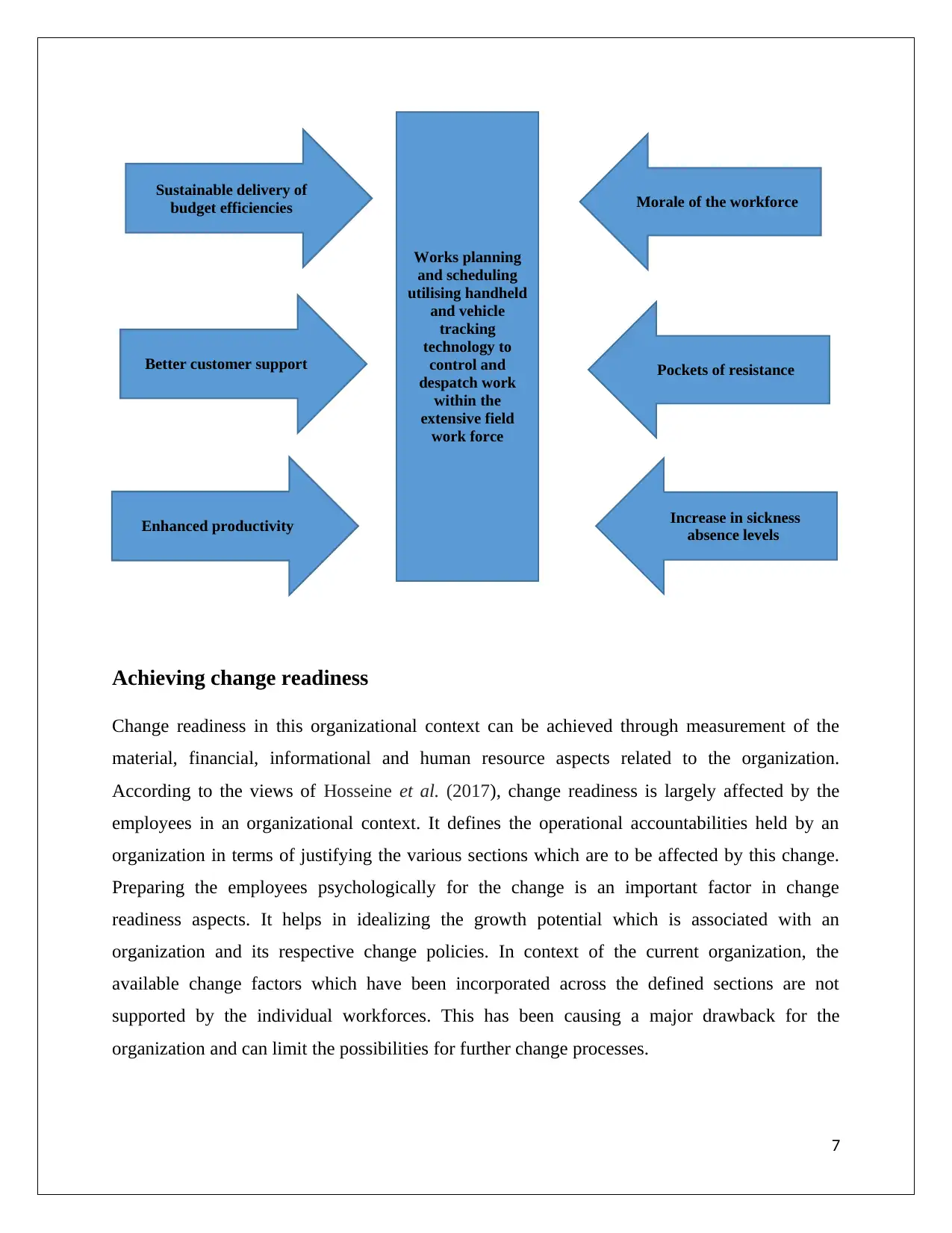
Force field Analysis
6
less consultation is made with the workforce.
The final decisions lack majority of workforce as the manager is liable to take them
independently.
Threats
Out of the line payment and disconnection policy as compared to other supplier
organizations can make this organization out of business.
Availability of individual centred roles and responsibilities initiate a lack of team work
and collaboration between departments (Al-Haddad and Kotnour, 2015).
Lack of a consistent approach for change from the managers and the departmental
perspectives.
Opportunities
The organization provides significant opportunities for its workforce by providing
provisions of annual bonuses for departments achieving their targets.
Application of significant change management process to increase workforce integration
and management.
The drastic increase in global demand of sustainable energy supplies are an important
opportunity for the organization (Petrou et al. 2018).
Force field Analysis
6
⊘ This is a preview!⊘
Do you want full access?
Subscribe today to unlock all pages.
Trusted by 1+ million students worldwide
Achieving change readiness
Change readiness in this organizational context can be achieved through measurement of the
material, financial, informational and human resource aspects related to the organization.
According to the views of Hosseine et al. (2017), change readiness is largely affected by the
employees in an organizational context. It defines the operational accountabilities held by an
organization in terms of justifying the various sections which are to be affected by this change.
Preparing the employees psychologically for the change is an important factor in change
readiness aspects. It helps in idealizing the growth potential which is associated with an
organization and its respective change policies. In context of the current organization, the
available change factors which have been incorporated across the defined sections are not
supported by the individual workforces. This has been causing a major drawback for the
organization and can limit the possibilities for further change processes.
7
Works planning
and scheduling
utilising handheld
and vehicle
tracking
technology to
control and
despatch work
within the
extensive field
work force
Sustainable delivery of
budget efficiencies
Better customer support
Enhanced productivity
Morale of the workforce
Pockets of resistance
Increase in sickness
absence levels
Change readiness in this organizational context can be achieved through measurement of the
material, financial, informational and human resource aspects related to the organization.
According to the views of Hosseine et al. (2017), change readiness is largely affected by the
employees in an organizational context. It defines the operational accountabilities held by an
organization in terms of justifying the various sections which are to be affected by this change.
Preparing the employees psychologically for the change is an important factor in change
readiness aspects. It helps in idealizing the growth potential which is associated with an
organization and its respective change policies. In context of the current organization, the
available change factors which have been incorporated across the defined sections are not
supported by the individual workforces. This has been causing a major drawback for the
organization and can limit the possibilities for further change processes.
7
Works planning
and scheduling
utilising handheld
and vehicle
tracking
technology to
control and
despatch work
within the
extensive field
work force
Sustainable delivery of
budget efficiencies
Better customer support
Enhanced productivity
Morale of the workforce
Pockets of resistance
Increase in sickness
absence levels
Paraphrase This Document
Need a fresh take? Get an instant paraphrase of this document with our AI Paraphraser
In order to initiate any major change at this position, the organization must build a confident
stand for the available possibilities and a supportive framework has to be implanted. This will
help in guiding the various processes and attributes that are linked to the available set of
operations. In order to facilitate an advantageous process for change readiness process across the
organization, it must consider these factors:
Commitment: A sustainable and successful completion of the change management
process across the organizational central agenda is very important for the success of a
change. The ability of organization and degree of resolve are the two important aspects
which are linked to avail strategic development of change management process
(Cummings et al. 2016).
Cultural readiness: The organization must have a major alignment between the
proposed changes and cultural norms related to an organization.
Capacity readiness: Factors such as experiences and historical knowledge, abilities,
skills and current knowledge across the change management process can be helpful in
guiding the operability factor all along the change acceptability (Holten and Brenner,
2015).
Identification and justification for the approach to change
Following are the various approaches for change in this organization:
Empowerment
This approach involves inclusion of an organizational condition which is used to
empower the involved staffs for better decision making and planning of the changes across the
desired departments. Factors such as improve employee involvement, redistributed authority,
shared decision making, increased flexibility factors and enhanced adaptability for the
organization. This approach prepares the workforce by providing them appropriate power and
control on various sections of the departmental change management process (Heckmann et al.
2016). This helps in guiding the respective ideologies and preparing the employees for any
change and its management process.
Participative leadership
8
stand for the available possibilities and a supportive framework has to be implanted. This will
help in guiding the various processes and attributes that are linked to the available set of
operations. In order to facilitate an advantageous process for change readiness process across the
organization, it must consider these factors:
Commitment: A sustainable and successful completion of the change management
process across the organizational central agenda is very important for the success of a
change. The ability of organization and degree of resolve are the two important aspects
which are linked to avail strategic development of change management process
(Cummings et al. 2016).
Cultural readiness: The organization must have a major alignment between the
proposed changes and cultural norms related to an organization.
Capacity readiness: Factors such as experiences and historical knowledge, abilities,
skills and current knowledge across the change management process can be helpful in
guiding the operability factor all along the change acceptability (Holten and Brenner,
2015).
Identification and justification for the approach to change
Following are the various approaches for change in this organization:
Empowerment
This approach involves inclusion of an organizational condition which is used to
empower the involved staffs for better decision making and planning of the changes across the
desired departments. Factors such as improve employee involvement, redistributed authority,
shared decision making, increased flexibility factors and enhanced adaptability for the
organization. This approach prepares the workforce by providing them appropriate power and
control on various sections of the departmental change management process (Heckmann et al.
2016). This helps in guiding the respective ideologies and preparing the employees for any
change and its management process.
Participative leadership
8
Improving employee commitment and organizational values are the two core ideologies
related to the participative leadership approach for a change management process. According to
the views of Smollan (2015), this approach for change is more likely to facilitate a better control
and authority for managing changes as proposed. The period of change under this particular
section is largely supported by an adaptive, resilient and resourceful behaviour by the staff
members. This approach is liable to generate a highly responsible and involved set of operations
which ultimately leads to improved form of change management process.
System thinking
Working in an integrated and collaborative manner is the key to provide suitable change
management approaches. System thinking improves the leading as well as participating
possibilities all along the process and can be ideal for approaching a major change management
process. According to the views of Ybema et al. (2019), system thinking provides ample
opportunities for managing a suitable interaction between the managers and the employees which
ultimately improves possibilities of success in a change management process. Alignment of
impacted personal and facilities have a major role to play in order to facilitating efficient change
management process. There are accountabilities which are sustained with the availability of
proposed fragments and are interlinked to avail better change management process across the
organization.
Evaluation of change models and identification of a model for change
implementation within the organisation
There are a number of change models which can be evaluated across the provided set of
operations. These models are highly appreciated in terms of implementing changes across the
organization with sufficient support. Some of the most influential change models are discussed in
the later sections.
Change characterised by scale: This theory of organizational change management
depicts that the extent up to which different sections and components of the organization
fitting together defines the development of a successful change management process. It
defines the organizational structure as a means to provide more relativeness to the
9
related to the participative leadership approach for a change management process. According to
the views of Smollan (2015), this approach for change is more likely to facilitate a better control
and authority for managing changes as proposed. The period of change under this particular
section is largely supported by an adaptive, resilient and resourceful behaviour by the staff
members. This approach is liable to generate a highly responsible and involved set of operations
which ultimately leads to improved form of change management process.
System thinking
Working in an integrated and collaborative manner is the key to provide suitable change
management approaches. System thinking improves the leading as well as participating
possibilities all along the process and can be ideal for approaching a major change management
process. According to the views of Ybema et al. (2019), system thinking provides ample
opportunities for managing a suitable interaction between the managers and the employees which
ultimately improves possibilities of success in a change management process. Alignment of
impacted personal and facilities have a major role to play in order to facilitating efficient change
management process. There are accountabilities which are sustained with the availability of
proposed fragments and are interlinked to avail better change management process across the
organization.
Evaluation of change models and identification of a model for change
implementation within the organisation
There are a number of change models which can be evaluated across the provided set of
operations. These models are highly appreciated in terms of implementing changes across the
organization with sufficient support. Some of the most influential change models are discussed in
the later sections.
Change characterised by scale: This theory of organizational change management
depicts that the extent up to which different sections and components of the organization
fitting together defines the development of a successful change management process. It
defines the organizational structure as a means to provide more relativeness to the
9
⊘ This is a preview!⊘
Do you want full access?
Subscribe today to unlock all pages.
Trusted by 1+ million students worldwide
employees and thus facilitating the change management process effectively. The formal
relationship patterns related to the groups and individuals act as a driving force behind
the available set of operations during a change management process (Cordery et al.
2015).
Open Systems Theory: The open system theory defines organizations as a single unit
which is liable to interact with its external environment and facilitate changes
accordingly. This theory defines environmental factors as a major source of defining the
organizational processes and achieving major changes across the system. These factors
help in guiding the cultural values and ethical dimensions across the organization. It
helps in building a sense of responsibility for each of the defined sections and attain a
more simplified form of relativeness. The relativeness developed due to this factor helps
in guiding the process of change management as the outer environmental forces act
together and enhance the relativeness (Ceulemans et al. 2015).
Process theories: There are a number of process theories which are integrated across the
sections and facilitate an ideal perspective on the change management process. Some of
these theories are discussed below:
Dialectical theory: This theory defines availability of distinctive goals which create
conflicts across an organizational system lead to change. It can be ideal in order to
resolve issues between two or more groups and individuals whose interests are
conflicting. Providing a change management process in the design can initiate a better
relationship between the concerned parties and also initiate conflict resolution.
Evolutionary theory: The evolution theory defines change management as a process
under any organizational structure. It develops with the availability of a continuous cycle
of variation, selection and retention. This theory describes change as a process pattern
which is liable to happen after certain duration of time (Schumacher et al. 2016).
Life cycle theory: The life cycle theory suggests change as a progressive process which
emerges as stages of sequences happen in an organisation. These stages are cumulative
in nature and thus the availability of change remains certain after a certain interval of
time.
Teleological theory: The teleological theory provides unfolded cycles of specific goals,
implementation, evaluation and learning factors all along the defined sections. This
10
relationship patterns related to the groups and individuals act as a driving force behind
the available set of operations during a change management process (Cordery et al.
2015).
Open Systems Theory: The open system theory defines organizations as a single unit
which is liable to interact with its external environment and facilitate changes
accordingly. This theory defines environmental factors as a major source of defining the
organizational processes and achieving major changes across the system. These factors
help in guiding the cultural values and ethical dimensions across the organization. It
helps in building a sense of responsibility for each of the defined sections and attain a
more simplified form of relativeness. The relativeness developed due to this factor helps
in guiding the process of change management as the outer environmental forces act
together and enhance the relativeness (Ceulemans et al. 2015).
Process theories: There are a number of process theories which are integrated across the
sections and facilitate an ideal perspective on the change management process. Some of
these theories are discussed below:
Dialectical theory: This theory defines availability of distinctive goals which create
conflicts across an organizational system lead to change. It can be ideal in order to
resolve issues between two or more groups and individuals whose interests are
conflicting. Providing a change management process in the design can initiate a better
relationship between the concerned parties and also initiate conflict resolution.
Evolutionary theory: The evolution theory defines change management as a process
under any organizational structure. It develops with the availability of a continuous cycle
of variation, selection and retention. This theory describes change as a process pattern
which is liable to happen after certain duration of time (Schumacher et al. 2016).
Life cycle theory: The life cycle theory suggests change as a progressive process which
emerges as stages of sequences happen in an organisation. These stages are cumulative
in nature and thus the availability of change remains certain after a certain interval of
time.
Teleological theory: The teleological theory provides unfolded cycles of specific goals,
implementation, evaluation and learning factors all along the defined sections. This
10
Paraphrase This Document
Need a fresh take? Get an instant paraphrase of this document with our AI Paraphraser
theory is also based on the fact that change is an important process and an organizational
structure incorporates it after a certain point of time (van der Voet, 2016).
The analysis done in the above sections depict the various theories and models which are
based on providing subsequent possibilities across the channel. In order to apply a theoretical
framework for the current organization, change characterised by scale theory must be used. The
main reason for the selection of this theory is its operational dimensions. This theory describes
open system for an organization which has all of its segments and departments aligned together
in order to fit within a similar context. It impacts the inclusion of people, cultures and structural
in a single dimension for managing operations effectively. The main issue associated with
change management process of the current organization is related to the unavailability of a
relativeness between the management and the workforce in terms of change management.
Inclusion of this theory can change this scenario and facilitate diverse form of operations all
across the organizational change management system. It will be a major help for the institution
on order to sustain the respective changes and also equip new changes across the organization
(May and Stahl, 2017). The increase in relativity and belongingness for the employees can
enhance the possibility for change management process success within each and every set of
department.
Approaches for managing change resistance
Following are the different approaches for managing change resistance
Participation and involvement
Negotiation and agreement
Education and communication
Facilitation and support
Manipulation and co-optation
Explicit and implicit coercion
Ethical and responsible approaches to planning and implementing change
In order to include ethical and responsible approaches to planning and change implementation
the organization must conduct independent surveys and polls for accepting a change
11
structure incorporates it after a certain point of time (van der Voet, 2016).
The analysis done in the above sections depict the various theories and models which are
based on providing subsequent possibilities across the channel. In order to apply a theoretical
framework for the current organization, change characterised by scale theory must be used. The
main reason for the selection of this theory is its operational dimensions. This theory describes
open system for an organization which has all of its segments and departments aligned together
in order to fit within a similar context. It impacts the inclusion of people, cultures and structural
in a single dimension for managing operations effectively. The main issue associated with
change management process of the current organization is related to the unavailability of a
relativeness between the management and the workforce in terms of change management.
Inclusion of this theory can change this scenario and facilitate diverse form of operations all
across the organizational change management system. It will be a major help for the institution
on order to sustain the respective changes and also equip new changes across the organization
(May and Stahl, 2017). The increase in relativity and belongingness for the employees can
enhance the possibility for change management process success within each and every set of
department.
Approaches for managing change resistance
Following are the different approaches for managing change resistance
Participation and involvement
Negotiation and agreement
Education and communication
Facilitation and support
Manipulation and co-optation
Explicit and implicit coercion
Ethical and responsible approaches to planning and implementing change
In order to include ethical and responsible approaches to planning and change implementation
the organization must conduct independent surveys and polls for accepting a change
11
management initiative. This will increase the cooperation driven ideology across different
departments and will also strengthen the required possibilities for collective decision making.
According to the views of (Yousef, 2017), the ethical orientation of change management
processes in organizations have been affected largely by the increased demand of business
expansion and growth. These possibilities have led to limitations in context of ethical
considerations and thus the organizations have been facing a major lacking in terms of ethical
considerations. In the current context, change planning is carried out through a stiff inclination
towards factors such as increased productivity and reduced resources. The demands are fulfilled
on the basis of desired scale and limited approach towards the usability index related to the
process. In addition to this, the limited usability of ethics is also functionally feasible for the
organizations in longer run. It helps in managing the contextual factors with limited resources
and also limit the expenses for a change management process.
Following are some of the approaches which can be used to include ethical and responsible
aspects in planning and implementation of changes:
Defining ethical guidelines for each of the departments and the organization as whole.
Conduction of workshops and training campaigns for providing a better idea related to
ethical orientation of an organisation (Arif et al. 2017).
Taking informed decisions and making effective changes based on consent and approval.
RECOMMENDATIONS
Providing clear definitions for the change and including its alignment with the desired
business goals
Determination of change impacts and aspects which may be affected
Development of a clear and convincing communication strategy
Providing effective training and education to the relevant groups
Implementation of a support structure for the change management process (Imran et al.
2017).
Change management process measurement
12
departments and will also strengthen the required possibilities for collective decision making.
According to the views of (Yousef, 2017), the ethical orientation of change management
processes in organizations have been affected largely by the increased demand of business
expansion and growth. These possibilities have led to limitations in context of ethical
considerations and thus the organizations have been facing a major lacking in terms of ethical
considerations. In the current context, change planning is carried out through a stiff inclination
towards factors such as increased productivity and reduced resources. The demands are fulfilled
on the basis of desired scale and limited approach towards the usability index related to the
process. In addition to this, the limited usability of ethics is also functionally feasible for the
organizations in longer run. It helps in managing the contextual factors with limited resources
and also limit the expenses for a change management process.
Following are some of the approaches which can be used to include ethical and responsible
aspects in planning and implementation of changes:
Defining ethical guidelines for each of the departments and the organization as whole.
Conduction of workshops and training campaigns for providing a better idea related to
ethical orientation of an organisation (Arif et al. 2017).
Taking informed decisions and making effective changes based on consent and approval.
RECOMMENDATIONS
Providing clear definitions for the change and including its alignment with the desired
business goals
Determination of change impacts and aspects which may be affected
Development of a clear and convincing communication strategy
Providing effective training and education to the relevant groups
Implementation of a support structure for the change management process (Imran et al.
2017).
Change management process measurement
12
⊘ This is a preview!⊘
Do you want full access?
Subscribe today to unlock all pages.
Trusted by 1+ million students worldwide

1 out of 17


Related Documents

![Employee Relations Report: BSBHRM604 for Bounce Fitness - [Semester]](/_next/image/?url=https%3A%2F%2Fdesklib.com%2Fmedia%2Fimages%2Fms%2Fb6f54ffcf813439cac50c3f932712051.jpg&w=256&q=75)


Your All-in-One AI-Powered Toolkit for Academic Success.
+13062052269
info@desklib.com
Available 24*7 on WhatsApp / Email
![[object Object]](/_next/static/media/star-bottom.7253800d.svg)
Unlock your academic potential
Copyright © 2020–2025 A2Z Services. All Rights Reserved. Developed and managed by ZUCOL.