Change Management Strategies and Employee Impact: Splash Analysis
VerifiedAdded on 2022/08/24
|18
|5917
|16
Report
AI Summary
This report examines change management practices within Splash, a prominent retail corporation in the Middle East. The study explores how employees perceive organizational change and its effect on their commitment. It investigates the background, purpose, and statement of the problem, highlighting the challenges of implementing changes in the company. The literature review covers employee perceptions, the role of transparency, and language's influence on change. The research methodology and the planned changes of the organization are discussed, followed by an evaluation of the development of change and the challenges faced during implementation. The report also provides recommendations and concludes with a summary of the key findings, emphasizing the importance of clear change management plans, employee involvement, and supportive strategies to ensure successful change implementation and maintain employee commitment. The report emphasizes the significance of understanding employee perspectives and addressing resistance to change for effective organizational transformation.

Management

Paraphrase This Document
Need a fresh take? Get an instant paraphrase of this document with our AI Paraphraser
Management 1
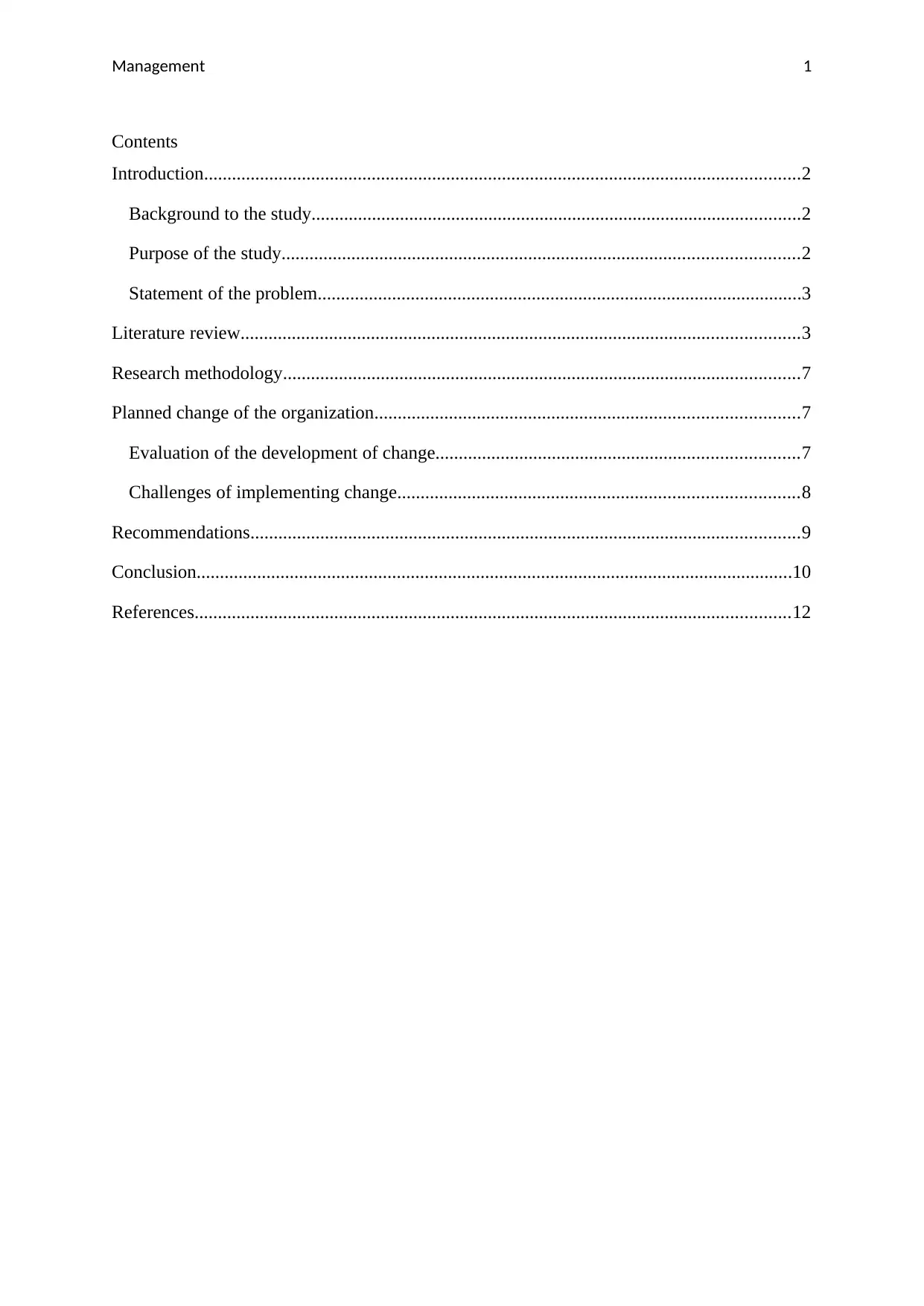
Contents
Introduction................................................................................................................................2
Background to the study.........................................................................................................2
Purpose of the study...............................................................................................................2
Statement of the problem........................................................................................................3
Literature review........................................................................................................................3
Research methodology...............................................................................................................7
Planned change of the organization...........................................................................................7
Evaluation of the development of change..............................................................................7
Challenges of implementing change......................................................................................8
Recommendations......................................................................................................................9
Conclusion................................................................................................................................10
References................................................................................................................................12
Contents
Introduction................................................................................................................................2
Background to the study.........................................................................................................2
Purpose of the study...............................................................................................................2
Statement of the problem........................................................................................................3
Literature review........................................................................................................................3
Research methodology...............................................................................................................7
Planned change of the organization...........................................................................................7
Evaluation of the development of change..............................................................................7
Challenges of implementing change......................................................................................8
Recommendations......................................................................................................................9
Conclusion................................................................................................................................10
References................................................................................................................................12
Management 2
Introduction
The implementation of change within the organizations appear to be challenging in
most of the organizations. The change management is a resolute and proactive discipline
linked with anticipating and enabling people’s response to change along with the resistance
which seizures change initiatives. This paper aims at comprehending how employees observe
organizational change and its effect on their obligation to the organization by inspecting the
execution of change within Splash which is one of the major retail corporations in the Middle
East. Splash is the first fashion retailer to win and secure sixth place in the Great Place to
work 2016 awards (Splash, 2020) .
Splash has been involved with the constant changes as it has constantly upgraded and
evolved stores, procedures, products, and people. The destiny of Splash has been built by the
way it is dependent and how well it adapts to and effectively faces pressure to change. The
company faced a challenge in making difficult decisions to endure in the short term along
with being justifiable in the long term. This report guises at how the execution of a clear
change plan can assist in minimizing the persons issue rising as a sign of the organizational
change.
Background to the study
The pressure of change comes from the variety of internal and external sources and as
a consequence, the business environment has become active and intricate. Such dynamism
and intricateness have been seen in the social, financial, political and resource-based crisis
which dominates the organization for change.
The external changes faced by Splash are conveyed with the existing legislation and
its suggestively effects on the company. The report defines the challenge of change
management in its holding structure. The changes are continued within Splash on both
leadership and operational level. The executive team members are replaced by the new
leaders. Splash originally has adopted a cost-cutting and organizational turnaround strategy
(Mbandu, 2016). Such a strategy has rationalized operations and procedures within the
business along with executing centralized control and decision-making structures.
Introduction
The implementation of change within the organizations appear to be challenging in
most of the organizations. The change management is a resolute and proactive discipline
linked with anticipating and enabling people’s response to change along with the resistance
which seizures change initiatives. This paper aims at comprehending how employees observe
organizational change and its effect on their obligation to the organization by inspecting the
execution of change within Splash which is one of the major retail corporations in the Middle
East. Splash is the first fashion retailer to win and secure sixth place in the Great Place to
work 2016 awards (Splash, 2020) .
Splash has been involved with the constant changes as it has constantly upgraded and
evolved stores, procedures, products, and people. The destiny of Splash has been built by the
way it is dependent and how well it adapts to and effectively faces pressure to change. The
company faced a challenge in making difficult decisions to endure in the short term along
with being justifiable in the long term. This report guises at how the execution of a clear
change plan can assist in minimizing the persons issue rising as a sign of the organizational
change.
Background to the study
The pressure of change comes from the variety of internal and external sources and as
a consequence, the business environment has become active and intricate. Such dynamism
and intricateness have been seen in the social, financial, political and resource-based crisis
which dominates the organization for change.
The external changes faced by Splash are conveyed with the existing legislation and
its suggestively effects on the company. The report defines the challenge of change
management in its holding structure. The changes are continued within Splash on both
leadership and operational level. The executive team members are replaced by the new
leaders. Splash originally has adopted a cost-cutting and organizational turnaround strategy
(Mbandu, 2016). Such a strategy has rationalized operations and procedures within the
business along with executing centralized control and decision-making structures.
⊘ This is a preview!⊘
Do you want full access?
Subscribe today to unlock all pages.

Trusted by 1+ million students worldwide
Management 3
Purpose of the study
The execution of a clear change management plan supports employees in remaining
committed to the organization. The purpose of the study is to evaluate the approach adopted
for executing the change in Splash and its impact on the workers. The objective of the study
is to:
Regulate how the management of change in Splash impacted the person’s insights of
change.
To inspect the problems faced while execution of recent changes.
To govern what assists workers necessitated during the change procedure.
Statement of the problem
A major change has taken place in Splash within a short space of time. Therefore,
there is always a risk of change momentous change strategies. The changes taken place in the
organization are enhancement of the corporate culture, eliminate hazardous chemicals from
the supply chain, train employees in circularity and lessen the fibres which can create scarce
forests and lessening quantity produced for the specific styles.
The precise impact of the several changes on the workers within the organization is
generally not evaluated. On the other side, the behaviour of the employees in the initial case
proposes a level of trust and commitment that has deteriorated over time. The means of the
change management advise a method for executing change more efficiently. In order to be
changed to be successful, there is a requirement to be contextualized as per the precise
circumstances and properly executed and assisted in the organization.
Literature review
The upsurge in the incidence of organizational change has caused a substantial
amount of research in the last years into the contests concerning planning, execution, and
management of change.
Employee perceptions and experiences of change: According to Al-Ali, et al. 2017, the
association between workers and organizational change focuses on the variances with
concern to the configuration of the employees as well as the variation of dispositional and
Purpose of the study
The execution of a clear change management plan supports employees in remaining
committed to the organization. The purpose of the study is to evaluate the approach adopted
for executing the change in Splash and its impact on the workers. The objective of the study
is to:
Regulate how the management of change in Splash impacted the person’s insights of
change.
To inspect the problems faced while execution of recent changes.
To govern what assists workers necessitated during the change procedure.
Statement of the problem
A major change has taken place in Splash within a short space of time. Therefore,
there is always a risk of change momentous change strategies. The changes taken place in the
organization are enhancement of the corporate culture, eliminate hazardous chemicals from
the supply chain, train employees in circularity and lessen the fibres which can create scarce
forests and lessening quantity produced for the specific styles.
The precise impact of the several changes on the workers within the organization is
generally not evaluated. On the other side, the behaviour of the employees in the initial case
proposes a level of trust and commitment that has deteriorated over time. The means of the
change management advise a method for executing change more efficiently. In order to be
changed to be successful, there is a requirement to be contextualized as per the precise
circumstances and properly executed and assisted in the organization.
Literature review
The upsurge in the incidence of organizational change has caused a substantial
amount of research in the last years into the contests concerning planning, execution, and
management of change.
Employee perceptions and experiences of change: According to Al-Ali, et al. 2017, the
association between workers and organizational change focuses on the variances with
concern to the configuration of the employees as well as the variation of dispositional and
Paraphrase This Document
Need a fresh take? Get an instant paraphrase of this document with our AI Paraphraser
Management 4
personality features. Such variations led to the intricacy of planning and executing change.
The employees in Splash observe and experience change contrarily and such perceptions
have a substantial impact on the accomplishment of the change.
As per the opinions of Wilkins, Butt & Annabi, 2018, Splash has been quite
intentional about forming the culture it desires. One of the aspects focused by the Splash is
transparency. The idea behind this intention is to break down the barricades, inspire ingenuity
and association. The employees in the organization also feel inspired by the transparency.
The culture comes down to behavioral conducts and Splash through an ethos of transparency
and liberty has created a habit of creativity. The company has experienced that focusing on
the transparency helps in engaging to the people. The employees like to be part of somewhat
when there are no hidden plans and they experience an authentic outlook.
As per the opinions of Siddique, 2018, the role of language has a significant role in
the framework of change than simply a tool for facilitating change. The language of change is
generally created on the fear framework, the inspiration to change is generally driven by
anxiety influencing effective consequence of the proposed change. The employees in the
Splash interprets change through past experiences, preceding exposures, social connections
and prompts from the environment. Embracing organizational change leads to acceptance of
change reflecting the desired organizational identity to assist regularly desired change.
Challenges in implementation of change: According to Yu & Lee, 2018, Splash has
advanced several change managements models to guide in the procedure of change. It is
because the company faces planned changes. The reason for failure in the Splash ranges from
the lack of understanding adjacent company’s capability for change to human elements like
worker confrontation toward organizational change.
Rafferty & Jimmieson, 2017, consider that employees struggling in Splash to adjust
change have recorded feeling of menace, alienation, uncertainty, and anxiety resulting in the
increased workforce stress along with absenteeism and turnover. The failure of the
personality features. Such variations led to the intricacy of planning and executing change.
The employees in Splash observe and experience change contrarily and such perceptions
have a substantial impact on the accomplishment of the change.
As per the opinions of Wilkins, Butt & Annabi, 2018, Splash has been quite
intentional about forming the culture it desires. One of the aspects focused by the Splash is
transparency. The idea behind this intention is to break down the barricades, inspire ingenuity
and association. The employees in the organization also feel inspired by the transparency.
The culture comes down to behavioral conducts and Splash through an ethos of transparency
and liberty has created a habit of creativity. The company has experienced that focusing on
the transparency helps in engaging to the people. The employees like to be part of somewhat
when there are no hidden plans and they experience an authentic outlook.
As per the opinions of Siddique, 2018, the role of language has a significant role in
the framework of change than simply a tool for facilitating change. The language of change is
generally created on the fear framework, the inspiration to change is generally driven by
anxiety influencing effective consequence of the proposed change. The employees in the
Splash interprets change through past experiences, preceding exposures, social connections
and prompts from the environment. Embracing organizational change leads to acceptance of
change reflecting the desired organizational identity to assist regularly desired change.
Challenges in implementation of change: According to Yu & Lee, 2018, Splash has
advanced several change managements models to guide in the procedure of change. It is
because the company faces planned changes. The reason for failure in the Splash ranges from
the lack of understanding adjacent company’s capability for change to human elements like
worker confrontation toward organizational change.
Rafferty & Jimmieson, 2017, consider that employees struggling in Splash to adjust
change have recorded feeling of menace, alienation, uncertainty, and anxiety resulting in the
increased workforce stress along with absenteeism and turnover. The failure of the
Management 5
organizational change initiative has been attributed to employee resistance which has
hampered the procedure of change. Although the changes have been executed for positive
reasons, augmented pressure while changes resulting in negative responses to change.
According to Zaabi, Singh & Ajmal, 2017, the changes in Splash took place in 3
stages, an unveiling phase, a mid-course phase, and a accomplishment phase. The change
initiatives in the organization necessitate planning, effort, and assistance from the senior
management majorly during the early phase to construct a substantial case for the proposed
change. Although the impetus required to be continued in the whole change procedure to
make sure its eventual success. The changes have taken place in Splash experiences core
confrontations or unexpected factors which impend to wreck advancement. Splash is having a
greater level of dissatisfaction due to redundancies are executed and uncertainty concerning
the direction of change.
As per the opinions of Al Mehrzi, & Singh, 2016, the challenges faced by Splash in
the execution of change can be improved through the behavior of the employees. Splash for
a long time is having equivalent weighting between fact individuals attain goals and the way
they do it. Splash understands well the way behaviour influence to the workers on the
demonstrative level and where engagement takes place. The company values to the
employees the way they do their job. The high recitalists are having high engagement and
behave in a cooperative and respectful manner.
As per the opinions of Zairi, 2019, Splash believes in constant improvement and has a
great concern in improving the challenges to be faced in the execution of the change process.
The changes can be properly executed by enhancing corporate culture. The company has
made its corporate culture on the basis of teamwork and open communication with the safety
standards. It enhances productivity and the way the organization conducts its business
activities. Splash provides training to the workers to undertake accountabilities for the
change. The training makes employees remain committed to working environments. It also
reduces to the worked related accidents.
organizational change initiative has been attributed to employee resistance which has
hampered the procedure of change. Although the changes have been executed for positive
reasons, augmented pressure while changes resulting in negative responses to change.
According to Zaabi, Singh & Ajmal, 2017, the changes in Splash took place in 3
stages, an unveiling phase, a mid-course phase, and a accomplishment phase. The change
initiatives in the organization necessitate planning, effort, and assistance from the senior
management majorly during the early phase to construct a substantial case for the proposed
change. Although the impetus required to be continued in the whole change procedure to
make sure its eventual success. The changes have taken place in Splash experiences core
confrontations or unexpected factors which impend to wreck advancement. Splash is having a
greater level of dissatisfaction due to redundancies are executed and uncertainty concerning
the direction of change.
As per the opinions of Al Mehrzi, & Singh, 2016, the challenges faced by Splash in
the execution of change can be improved through the behavior of the employees. Splash for
a long time is having equivalent weighting between fact individuals attain goals and the way
they do it. Splash understands well the way behaviour influence to the workers on the
demonstrative level and where engagement takes place. The company values to the
employees the way they do their job. The high recitalists are having high engagement and
behave in a cooperative and respectful manner.
As per the opinions of Zairi, 2019, Splash believes in constant improvement and has a
great concern in improving the challenges to be faced in the execution of the change process.
The changes can be properly executed by enhancing corporate culture. The company has
made its corporate culture on the basis of teamwork and open communication with the safety
standards. It enhances productivity and the way the organization conducts its business
activities. Splash provides training to the workers to undertake accountabilities for the
change. The training makes employees remain committed to working environments. It also
reduces to the worked related accidents.
⊘ This is a preview!⊘
Do you want full access?
Subscribe today to unlock all pages.
Trusted by 1+ million students worldwide
Management 6
Assisting employees in building commitment to change: According to Kurniawan,
Christiananta & Ellitan, 2018), Splash assists the employees towards change by focusing on
the people. One of the ways used by the company is to call employees partners. Splash
clearly defines communal accountability for the customers along with the consequences
desired. So, the company concentrates on comprising partners in the decisions and resolutions
along with inspiring them to form the finest experience. It has been observed by the company
that persons who are asked to be intricate also feel inspired and take individual
accountability. It makes a difference and engages employees more.
According to Leybourne, 2016, Splash believes in offering fresh trends before the
competitor companies. Splash even focuses more on the management’s capability as a change
agent to appropriately detect and connect the context of change. It even prepares employees
appropriately, cognitively and emotionally for the change. Executing change without the
obligatory commitment of employees is tougher and even more likely to fail. More
commitment to the change initiative, more likely to result in success. Splash even makes use
of supportive strategies to retain and increase organizational commitment.
As per the opinions of Akbar, Rashid & Farooq, 2018, the company has decided to
eliminate hazardous chemicals from the supply chain, train employees in circularity and
lessen the fibers which come form scarce forests. Such changes will make brand more
sustainable. Such a holistic approach will implement changes and enable the right things to
do ethically and commercially. On the other side, Splash conducts practices of reducing the
quantity produced for the specific style. The company minimizes the acquaintance to the
single product along with creating artificial insufficiency. It is because Splash believes that
lesser the availability and more will be desire of the object outcome. The added benefit of
manufacturing lower quantity is that a style suffers from poor sales when there is the
availability of the higher volume. The company is having higher management which is liable
for guiding the employees concerning change.
According to Gover, Halinski & Duxbury, 2016, Splash has even utilized a trust-
based approach to execute change to hasten the process of change. This approach even
Assisting employees in building commitment to change: According to Kurniawan,
Christiananta & Ellitan, 2018), Splash assists the employees towards change by focusing on
the people. One of the ways used by the company is to call employees partners. Splash
clearly defines communal accountability for the customers along with the consequences
desired. So, the company concentrates on comprising partners in the decisions and resolutions
along with inspiring them to form the finest experience. It has been observed by the company
that persons who are asked to be intricate also feel inspired and take individual
accountability. It makes a difference and engages employees more.
According to Leybourne, 2016, Splash believes in offering fresh trends before the
competitor companies. Splash even focuses more on the management’s capability as a change
agent to appropriately detect and connect the context of change. It even prepares employees
appropriately, cognitively and emotionally for the change. Executing change without the
obligatory commitment of employees is tougher and even more likely to fail. More
commitment to the change initiative, more likely to result in success. Splash even makes use
of supportive strategies to retain and increase organizational commitment.
As per the opinions of Akbar, Rashid & Farooq, 2018, the company has decided to
eliminate hazardous chemicals from the supply chain, train employees in circularity and
lessen the fibers which come form scarce forests. Such changes will make brand more
sustainable. Such a holistic approach will implement changes and enable the right things to
do ethically and commercially. On the other side, Splash conducts practices of reducing the
quantity produced for the specific style. The company minimizes the acquaintance to the
single product along with creating artificial insufficiency. It is because Splash believes that
lesser the availability and more will be desire of the object outcome. The added benefit of
manufacturing lower quantity is that a style suffers from poor sales when there is the
availability of the higher volume. The company is having higher management which is liable
for guiding the employees concerning change.
According to Gover, Halinski & Duxbury, 2016, Splash has even utilized a trust-
based approach to execute change to hasten the process of change. This approach even
Paraphrase This Document
Need a fresh take? Get an instant paraphrase of this document with our AI Paraphraser
Management 7
decreased the resistance to change. The company has even evaluated the united possessions
of managerial communication, employee contribution, and trust in the administrator to the
organizational change. Splash is having a strong positive association between employee
contribution, managerial communication, and supervisory trust. It increases the feeling of job
significance and makes employees remain committed to the organization.
According to the opinions of King, Newman & Luthans, 2016, the company even
trains and inspires its employees to be sensitive to the needs and wants of the customers. The
managers and employees are required to be conscious of the way customers react on the
floor. The company permits its sales associates and managers to lead in customer research.
They are guided to intently listen and keep in notice the customer comments and observe the
styles wanted by the customers. Splash is made up on the basic rule of ‘giving customers
what they want’ within the short duration of time. The company even promote changes in the
organization through the modest customer research competences. The product offerings
reflect the unique needs of the customers and demands in the form of climate, physical and
cultural differences. The differences in the product offerings are mainly enabled by regular
interactions between the creative team and store managers.
According to Ababneh, 2016, the employees in Splash trains to the employees to
watch, listen and be attentive to the slight signals offered by the customers. It can assist the
company in taking shape of the trend. The fast the company responds; the more is the
chances of getting succeed in offering the appropriate merchandise. Splash has even enabled
stores with sophisticated technology-driven systems. It enables information to travel rapidly
from the stores to the headquarters. It makes a Splash to respond quickly to the developing
trend.
Research methodology
The availability of sufficient data on the execution of the clear change management
plan of Splash enables the research work on the “commitment of the employees towards
organization”. The secondary data has been used in the whole research study. Subsequently,
the information has been attained through books, websites, journal articles, magazines, and
decreased the resistance to change. The company has even evaluated the united possessions
of managerial communication, employee contribution, and trust in the administrator to the
organizational change. Splash is having a strong positive association between employee
contribution, managerial communication, and supervisory trust. It increases the feeling of job
significance and makes employees remain committed to the organization.
According to the opinions of King, Newman & Luthans, 2016, the company even
trains and inspires its employees to be sensitive to the needs and wants of the customers. The
managers and employees are required to be conscious of the way customers react on the
floor. The company permits its sales associates and managers to lead in customer research.
They are guided to intently listen and keep in notice the customer comments and observe the
styles wanted by the customers. Splash is made up on the basic rule of ‘giving customers
what they want’ within the short duration of time. The company even promote changes in the
organization through the modest customer research competences. The product offerings
reflect the unique needs of the customers and demands in the form of climate, physical and
cultural differences. The differences in the product offerings are mainly enabled by regular
interactions between the creative team and store managers.
According to Ababneh, 2016, the employees in Splash trains to the employees to
watch, listen and be attentive to the slight signals offered by the customers. It can assist the
company in taking shape of the trend. The fast the company responds; the more is the
chances of getting succeed in offering the appropriate merchandise. Splash has even enabled
stores with sophisticated technology-driven systems. It enables information to travel rapidly
from the stores to the headquarters. It makes a Splash to respond quickly to the developing
trend.
Research methodology
The availability of sufficient data on the execution of the clear change management
plan of Splash enables the research work on the “commitment of the employees towards
organization”. The secondary data has been used in the whole research study. Subsequently,
the information has been attained through books, websites, journal articles, magazines, and
Management 8
newspapers. The secondary research does not necessitate to be made on the large scale
(Pasian, 2016). The study does not even require to capitalize money and advance efforts on
the data assortment. The secondary data is generally battered and stowed in the electronic
platform so the time can be utilized in the term of quality (Van der Voet, Steijn & Kuipers,
2017). The secondary data is necessitated to be reviewed thoroughly to know the legitimacy
of the information provided. Sometimes, it has been realised that the secondary research is
not precise according to the requirements so the disagreement can be faced and research can
be realised unproductive. There can be even probabilities of obsolete information in the
circumstance of marketing research and provide slight worth (Ameen, et al. 2018).
The data has been attained through the secondary sources which subsidize to the
deliberation of the human circumstances in diverse frameworks. The pre-understanding has
been deliberated for the procedure of scheduling and investigating. The secondary research
even comprises background and circumstances so that falsifications is undertaken to produce
any data. Some interpretations have been evaluated from qualitative research (Lasrado,
2018).
The secondary data has been regarded as a frequent research method utilized to
analyze the text data. On the other side, secondary research provides knowledge along with
the understanding of the phenomenon. Add on, it is a particular amplification of the
framework by the methodological sorting procedure of coding and categorizing themes. In
order to improve the validity of secondary research, at least 2 researchers should perform the
investigates distinctly (Sinaga, et al. 2018).
Planned change of the organization
Splash has planned some changes to implement in the organisation as given below:
The changes in Splash has been executed on the operational level. Splash has decided
to enhance corporate culture. It has been made possible by signifying employees that
their involvement if perilous. The personnel were invited to share their thoughts
concerning routine operations and company culture.
newspapers. The secondary research does not necessitate to be made on the large scale
(Pasian, 2016). The study does not even require to capitalize money and advance efforts on
the data assortment. The secondary data is generally battered and stowed in the electronic
platform so the time can be utilized in the term of quality (Van der Voet, Steijn & Kuipers,
2017). The secondary data is necessitated to be reviewed thoroughly to know the legitimacy
of the information provided. Sometimes, it has been realised that the secondary research is
not precise according to the requirements so the disagreement can be faced and research can
be realised unproductive. There can be even probabilities of obsolete information in the
circumstance of marketing research and provide slight worth (Ameen, et al. 2018).
The data has been attained through the secondary sources which subsidize to the
deliberation of the human circumstances in diverse frameworks. The pre-understanding has
been deliberated for the procedure of scheduling and investigating. The secondary research
even comprises background and circumstances so that falsifications is undertaken to produce
any data. Some interpretations have been evaluated from qualitative research (Lasrado,
2018).
The secondary data has been regarded as a frequent research method utilized to
analyze the text data. On the other side, secondary research provides knowledge along with
the understanding of the phenomenon. Add on, it is a particular amplification of the
framework by the methodological sorting procedure of coding and categorizing themes. In
order to improve the validity of secondary research, at least 2 researchers should perform the
investigates distinctly (Sinaga, et al. 2018).
Planned change of the organization
Splash has planned some changes to implement in the organisation as given below:
The changes in Splash has been executed on the operational level. Splash has decided
to enhance corporate culture. It has been made possible by signifying employees that
their involvement if perilous. The personnel were invited to share their thoughts
concerning routine operations and company culture.
⊘ This is a preview!⊘
Do you want full access?
Subscribe today to unlock all pages.
Trusted by 1+ million students worldwide
Management 9
The company has decided to eliminate hazardous chemicals from the supply chain,
train employees in circularity and lessen the fibres which can create scarce forests.
Such changes will make brand more sustainable (Business News Daily, 2019).
Splash conducts practices of reducing the quantity produced for the specific style. The
company minimizes the acquaintance to the single product along with creating
artificial insufficiency.
Evaluation of the development of change
Splash has experienced that imposing change from the top is likely to experience the
management of change destructively. On the other side, change executed in the collaboration
with the workers is normally regarded as more optimistic. Splash has greatly experienced
positive experiences in the management of change. The functioning of the company has been
made better through the execution of changes (Kurniawan & Christiananta, 2016). The
overarching strategy implied by Splash has helped in attaining growth by diversification with
vertical integrations. The strategy has adapted manufacturers, designs, distributes and
merchandizing clothes within the two weeks of the unique design. It is in blunt contrast to the
approximate 6 months taken to produce clothes in the retail fashion industry. Splash has been
able to own its supply chain and compete on its haste to the market along with exemplifying
the notion of ‘fast fashion’. The company has been used to deliver fashionable and trendy
outfits through Just in time production (Celik & Ozsoy, 2016).
The theory of change has been monitored and evaluated in Splash. It is a significant
part of the company to manage change comprising the management and inspiration of the
human resources. The decisions are taken by Splash during the change process significantly
influenced the association between the organization and personnel. The motivated staff of the
company performs better and more satisfied with the jobs. The motivation level of the
employees in Splash has been improved through the change process. The employees are even
motivated by Splash by offering higher competitive wages (Haelterman, 2019).
The change process in Splash even leads to active communication and response. It is
also deliberated as a vital component in employee assistance and change management. The
application of good communication skills even led to the receiving of change in a more rapid
The company has decided to eliminate hazardous chemicals from the supply chain,
train employees in circularity and lessen the fibres which can create scarce forests.
Such changes will make brand more sustainable (Business News Daily, 2019).
Splash conducts practices of reducing the quantity produced for the specific style. The
company minimizes the acquaintance to the single product along with creating
artificial insufficiency.
Evaluation of the development of change
Splash has experienced that imposing change from the top is likely to experience the
management of change destructively. On the other side, change executed in the collaboration
with the workers is normally regarded as more optimistic. Splash has greatly experienced
positive experiences in the management of change. The functioning of the company has been
made better through the execution of changes (Kurniawan & Christiananta, 2016). The
overarching strategy implied by Splash has helped in attaining growth by diversification with
vertical integrations. The strategy has adapted manufacturers, designs, distributes and
merchandizing clothes within the two weeks of the unique design. It is in blunt contrast to the
approximate 6 months taken to produce clothes in the retail fashion industry. Splash has been
able to own its supply chain and compete on its haste to the market along with exemplifying
the notion of ‘fast fashion’. The company has been used to deliver fashionable and trendy
outfits through Just in time production (Celik & Ozsoy, 2016).
The theory of change has been monitored and evaluated in Splash. It is a significant
part of the company to manage change comprising the management and inspiration of the
human resources. The decisions are taken by Splash during the change process significantly
influenced the association between the organization and personnel. The motivated staff of the
company performs better and more satisfied with the jobs. The motivation level of the
employees in Splash has been improved through the change process. The employees are even
motivated by Splash by offering higher competitive wages (Haelterman, 2019).
The change process in Splash even leads to active communication and response. It is
also deliberated as a vital component in employee assistance and change management. The
application of good communication skills even led to the receiving of change in a more rapid
Paraphrase This Document
Need a fresh take? Get an instant paraphrase of this document with our AI Paraphraser
Management 10
manner. It even encouraged assistance and comprehension from the pertinent stakeholders.
The changes faced while the change management plan is thoroughly allied to the
communication. The participation has been realised as a significant driver of the employee
commitment enhancing morale and excellence of effort. Splash has also amended changes
through the high technology information system (Garad & Martis, 2017). The technology like
customized hand-held computers and logistics capabilities has assisted the company is
collaborating with other companies. Such computers have a great role in processing data on
the orders, sales data and customer reactions to the products in the stores. The effective
communication and updated real-time exchange between stores and manufacturing units have
assisted Splash to update real-time exchange (Aslam, Muqadas & Imran, 2018).
Challenges of implementing change
The execution of the changes in the organization creates challenges. The execution of
the changes never run smoothly and can be confronted in the form of:
Lack of communication: The failure to communicate intended changes have created
challenges for Splash. The rumours and speculation has sweep the company. The lack of trust
among the employees even made difficult to embrace change mainly when they are
uninformed of the requirements. The employees in the organisation are required to know
what is taking place as ambiguity can interrupt the organization (DeGhetto, Russell & Ferris,
2017). The organisation should comprehend the planned updates to align objectives and feel
connected. The communication must be dual as employees can assist change procedures with
the appreciated ideas.
Failed embrace: It is great to initiate a plan, but it is of no use when employees are not
completely committed to the plans. The company can embrace new philosophies to break the
barriers faced in the change process. The decision making in the Splash generally starts at the
top but such needs to be consistent throughout. The precedent can be set as a leader and the
inclination to change can dropdown. Everyone in the organization needs to be on the board
otherwise risk can be faced dissent (Baker & Warren, 2016).
manner. It even encouraged assistance and comprehension from the pertinent stakeholders.
The changes faced while the change management plan is thoroughly allied to the
communication. The participation has been realised as a significant driver of the employee
commitment enhancing morale and excellence of effort. Splash has also amended changes
through the high technology information system (Garad & Martis, 2017). The technology like
customized hand-held computers and logistics capabilities has assisted the company is
collaborating with other companies. Such computers have a great role in processing data on
the orders, sales data and customer reactions to the products in the stores. The effective
communication and updated real-time exchange between stores and manufacturing units have
assisted Splash to update real-time exchange (Aslam, Muqadas & Imran, 2018).
Challenges of implementing change
The execution of the changes in the organization creates challenges. The execution of
the changes never run smoothly and can be confronted in the form of:
Lack of communication: The failure to communicate intended changes have created
challenges for Splash. The rumours and speculation has sweep the company. The lack of trust
among the employees even made difficult to embrace change mainly when they are
uninformed of the requirements. The employees in the organisation are required to know
what is taking place as ambiguity can interrupt the organization (DeGhetto, Russell & Ferris,
2017). The organisation should comprehend the planned updates to align objectives and feel
connected. The communication must be dual as employees can assist change procedures with
the appreciated ideas.
Failed embrace: It is great to initiate a plan, but it is of no use when employees are not
completely committed to the plans. The company can embrace new philosophies to break the
barriers faced in the change process. The decision making in the Splash generally starts at the
top but such needs to be consistent throughout. The precedent can be set as a leader and the
inclination to change can dropdown. Everyone in the organization needs to be on the board
otherwise risk can be faced dissent (Baker & Warren, 2016).
Management 11
Lack of pre-established goals: The challenges are also faced due to the lack of pre-established
goals. It is just a first step to adopt and execute a procedure framework but faces
organizational resistance due to non-clarity of value and ineffectually assigning resources. It
is because there is no administrative principle for the prioritization. Moreover, the company
lacking pre-defined goals is likely to joint directly into the strategic facets of the procedure
enhancement like procedure mapping (Caldwell & Caldwell, 2016). It can be difficult
because without goals or plans for the premeditated features, the company risk deteriorating
resources on pointless tasks such as plotting all the procedures, irrespective of the value.
Recommendations
Splash is recommended to assess the change management team in order to evaluate
the establishment’s willingness to change. Such valuations can comprise culture and history
evaluation, organizational valuations, worker investigation, change valuations and sponsor
valuations. The assessments offer the organisation with the perceptions into the challenges
and prospects which are faced while the change procedure (Kaabi, Elanain & Ajmal, 2018).
Splash is recommended to measure the possibility of change through the size of the change,
how many persons will be exaggerated and is it regular or thorough change.
Splash is even recommended to do communication and communication planning
properly. The managers in the organization undertake that if they interconnect properly with
the workers, their job is completed. But managers are required to repeat their messages six to
seven times in order to set changes in the mind of the employees. The managers should
deliberate three components like a viewers, what is interconnected and when it is to be
communicated (Drewniak, 2017). The managers are even required to create insight for the
need of change along with creating a desire among the personnel. Appropriate messages
should be shared at the appropriate time at each step of the change process.
Splash is recommended to first offer change management training for the managers. It
is because the managers are having more impact over the employee’s inspiration to change
other persons in the organization. Although the managers are the most problematic group to
persuade for the change, they are the source of confrontation (Baddah, 2016). It is quite
Lack of pre-established goals: The challenges are also faced due to the lack of pre-established
goals. It is just a first step to adopt and execute a procedure framework but faces
organizational resistance due to non-clarity of value and ineffectually assigning resources. It
is because there is no administrative principle for the prioritization. Moreover, the company
lacking pre-defined goals is likely to joint directly into the strategic facets of the procedure
enhancement like procedure mapping (Caldwell & Caldwell, 2016). It can be difficult
because without goals or plans for the premeditated features, the company risk deteriorating
resources on pointless tasks such as plotting all the procedures, irrespective of the value.
Recommendations
Splash is recommended to assess the change management team in order to evaluate
the establishment’s willingness to change. Such valuations can comprise culture and history
evaluation, organizational valuations, worker investigation, change valuations and sponsor
valuations. The assessments offer the organisation with the perceptions into the challenges
and prospects which are faced while the change procedure (Kaabi, Elanain & Ajmal, 2018).
Splash is recommended to measure the possibility of change through the size of the change,
how many persons will be exaggerated and is it regular or thorough change.
Splash is even recommended to do communication and communication planning
properly. The managers in the organization undertake that if they interconnect properly with
the workers, their job is completed. But managers are required to repeat their messages six to
seven times in order to set changes in the mind of the employees. The managers should
deliberate three components like a viewers, what is interconnected and when it is to be
communicated (Drewniak, 2017). The managers are even required to create insight for the
need of change along with creating a desire among the personnel. Appropriate messages
should be shared at the appropriate time at each step of the change process.
Splash is recommended to first offer change management training for the managers. It
is because the managers are having more impact over the employee’s inspiration to change
other persons in the organization. Although the managers are the most problematic group to
persuade for the change, they are the source of confrontation (Baddah, 2016). It is quite
⊘ This is a preview!⊘
Do you want full access?
Subscribe today to unlock all pages.
Trusted by 1+ million students worldwide

1 out of 18


Related Documents


Your All-in-One AI-Powered Toolkit for Academic Success.
+13062052269
info@desklib.com
Available 24*7 on WhatsApp / Email
![[object Object]](/_next/static/media/star-bottom.7253800d.svg)
Unlock your academic potential
Copyright © 2020–2026 A2Z Services. All Rights Reserved. Developed and managed by ZUCOL.