University Report: Organizational Behavior and Conflict Management

Verified

Added on  2020/03/16

|7
|1161
|51
Report
AI Summary
This report analyzes two articles on conflict management and resolution within organizations. The first article views conflict as essential for effective group function, exploring conflict management, resolution, and negotiation. It highlights different causes of conflict and suggests using cooperativeness and assertiveness models. The second article emphasizes constructive conflict management through open communication, mutual benefit relationships, and teamwork. The report compares and contrasts the articles, highlighting similarities in the importance of conflict and the use of discussion/dialogue while noting differences in their conclusions regarding conflict management tools. The report also assesses a student's responses to questions about the topic and concludes that 'problem solving' is the most effective management style.
Document Page
Running head: ORGANIZATIONAL BEHAVIOR & MANAGEMENT 1
MGNT 803 ORGANIZATIONAL BEHAVIOUR & MANAGEMENT
Name
University
Professor (Tutor)
Course
City/State
Date
tabler-icon-diamond-filled.svg

Paraphrase This Document

Need a fresh take? Get an instant paraphrase of this document with our AI Paraphraser
Document Page
ORGANIZATIONAL BEHAVIOR & MANAGEMENT 2
Organizational Behavior & Management
References
Kiitam, A., McLay, A. and Pilli, T. (2016). Managing conflict in organisational change.
International Journal of Agile Systems and Management, 9(2), p.114.
Mayer, C. and Louw, L. (2009). Organisational conflict: Reflections on managing conflict,
identities and values in a selected South African organisation. SA Journal of Human Resource
Management, 7(1).
UNDERSTANDING CONFLICT MANAGEMENT AND RESOLUTION IN SCOTTS
GARMENTS LTD. (2015). ELK Asia Pacific Journal of Human Resource Management and
Organisational Behaviour.
The author’s view point and the purpose of the first article
Conflict is a process which occur when one party perceives the other party has or is
negatively about to affect something that the first cares about.
In the first article, the author views conflict as good and necessary to a group to perform
its functions effectively. This is because conflicts energize debates, improve responsiveness,
increase cohesion, and re-examine assumptions among the members of the group.
The author addresses conflict, conflict management, conflict resolution, and highlights
ways of coming up with valid outcomes for the good of both parties. The article highlights,
conflict to be as a result of two or more parties differing in ideologies, incompatibility of goals,
Document Page
ORGANIZATIONAL BEHAVIOR & MANAGEMENT 3
different interpretation of some facts, and also disagreements of a behavioral expectations of an
organization. The author suggests that cooperativeness and assertiveness models should be used
to address conflict resolution. The article clear outlines the avoidance applicable when the
problem is trivial, relationship conflict, and when time is needed to cool (UNDERSTANDING
CONFLICT MANAGEMENT AND RESOLUTION IN SCOTTS GARMENTS LTD, 2015).
Strengths and limitations
The journal is important and relevant because it address different types of conflicts,
different ways of solving conflicts, taking into considerations the interests of all parties involved.
The paper suggests negotiations, comprising, collaboration, and competing as measures to handle
a conflict. The article in contradiction, points conflict as hindrance to any groups’ effective
performance. The paper did not address comprehensive the destructive form of conflicts leaving
organization with little information on how to address the same (Mayer and Louw, 2009).
Value or contributions
The article stated, the human relations view (1940-1970) of conflicts as natural and
inevitable in day to day life. He gives massive information on constructive forms of conflicts.
The article greatly points out that people should focus on discussion and should respect
conflicting parties’ interests and facts (Kiitam, McLay and Pilli, 2016).
References
Stevahn, L. and King, J. (2005). Managing Conflict Constructively in Program Evaluation.
Evaluation, 11(4), pp.415-427.
Document Page
ORGANIZATIONAL BEHAVIOR & MANAGEMENT 4
Tjosvold, D., Wong, A. and Feng Chen, N. (2014). Constructively Managing Conflicts in
Organizations. Annual Review of Organizational Psychology and Organizational Behavior, 1(1),
pp.545-568.
https://www.researchgate.net/publication/
261181240_Constructively_Managing_Conflicts_in_Organizations?enrichId=rgreq-e92a038c-
a13b-46bb-9589-
625c478c5f76&enrichSource=Y292ZXJQYWdlOzI2MTE4MTI0MDtBUzo5OTYxMDEzNTYy
OTgyNUAxNDAwNzYwMzE1MTE5&el=1_x_3
The author’s view point and the purpose of the second article
The author suggests the following constructive ways of managing conflicts in
organizations; providing free expression of one’s own views, listen and understand opposing
ones, and then integrate them. Further, the article clearly indicates that, mutual benefit
relationships are preliminaries or antecedents for open-minded discussions. The paper addresses
the skills and relationship that can help managers to deal with conflict complexities, broaden and
deepened thinking on open-minded discussion, check when one’s own thinking or idea is
inappropriate. Throughout the work teamwork is brought out as useful as it promotes open
discussions by the parties. Through review of the literature review, the article amplifies
teamwork as a vehicle that promotes diverse perspectives and integrating them. Different
frameworks to establish model of constructive conflict management has been pointed out. The
paper further points at dialogue as a high quality solution approach. Various researches have
suggested different ways of arriving at the end goal of the paper, for instance, mutual benefit
relationship forms the foundation of open-mindedness discussion, dynamics of open-minded
tabler-icon-diamond-filled.svg

Paraphrase This Document

Need a fresh take? Get an instant paraphrase of this document with our AI Paraphraser
Document Page
ORGANIZATIONAL BEHAVIOR & MANAGEMENT 5
discussion lead to skills and norms which managers and employees need (Stevahn and King,
2005).
Strengths and limitations
The paper demonstrates conflict as an important aspect since it provides the room for
conventional thinking to be challenged, threatened, opportunities identified, and new solutions
found. The open-minded solutions addressed in the paper strengthen relationships and restores
respect among the partners. Individual benefits are also pointed out as one feels connected to
others. The overall strength of the paper lies in the fact it outlines different managing styles
which include; integrating, obliging, compromising, dominating and avoiding. On limitations,
the paper provides different concepts and terms that are closely related and which may obscure
the process and considers traditional methods of conflict management.
Value or contributions
Different models as used in the paper help the readers to understand the antecedent
actions to open-minded discussion of conflict management. Finally, the paper proposes all the
perspectives put together which lead to mutual benefit relationship.
Similarities and differences
In both articles conflict is consider important. Discussions and dialogue are pointed in
both articles as ways of settling disputes. The second paper clearly indicates teamwork as a
vehicle that promotes cohesion within the parties while the first article overlooks the strength of
teamwork.
Difference in conclusion
Document Page
ORGANIZATIONAL BEHAVIOR & MANAGEMENT 6
The first article concludes by highlighting negotiation process as a vital tool of managing
conflicts while the second paper adopted mutual benefit relation process as an antecedent to
open-minded discussions.
The second article author employs a wide review of literature which provides more detailed
approach to constructive conflict management (Tjosvold, Wong and Feng Chen, 2014).
Questions about the topic
Conflict resolution approaches.
Conflict management approaches.
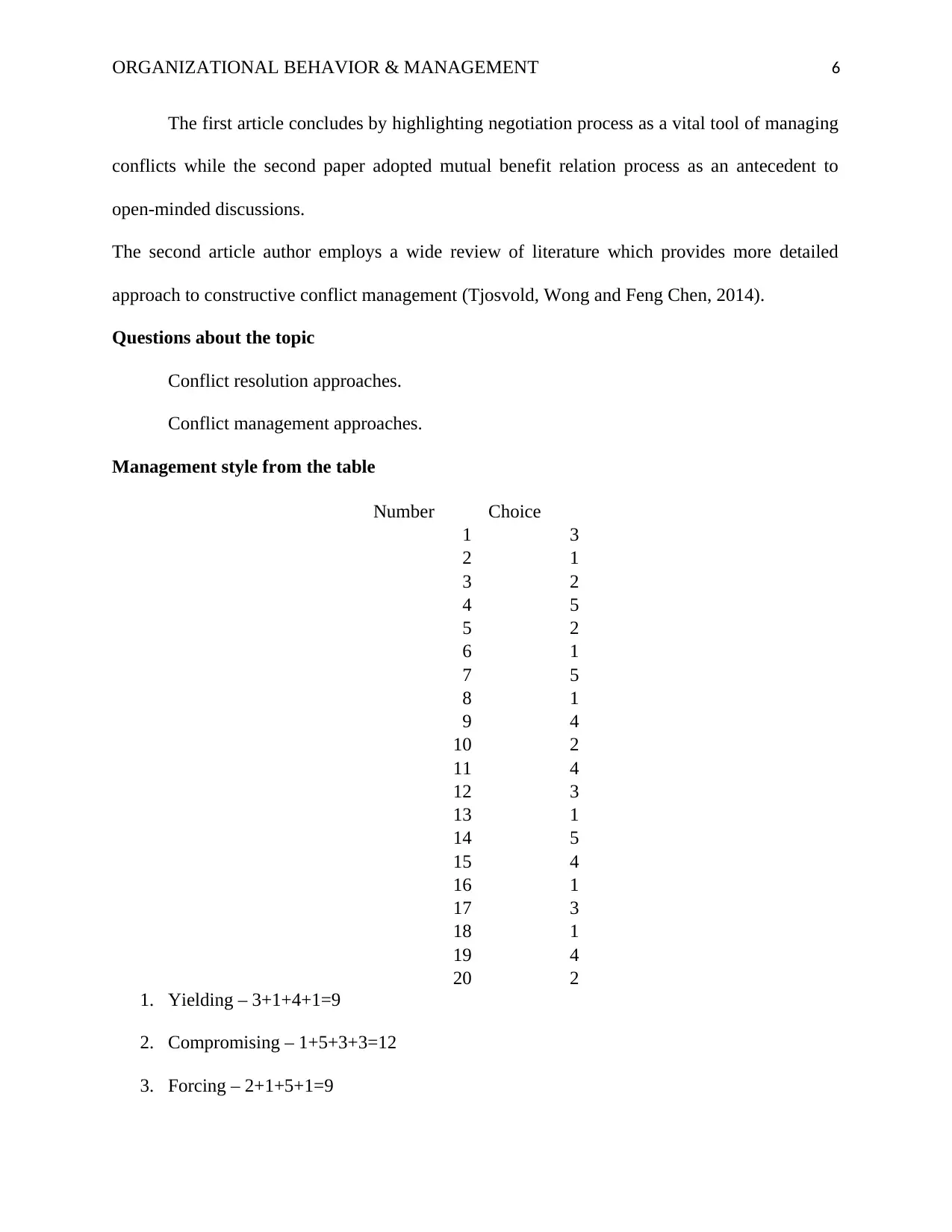
Management style from the table
Number Choice
1 3
2 1
3 2
4 5
5 2
6 1
7 5
8 1
9 4
10 2
11 4
12 3
13 1
14 5
15 4
16 1
17 3
18 1
19 4
20 2
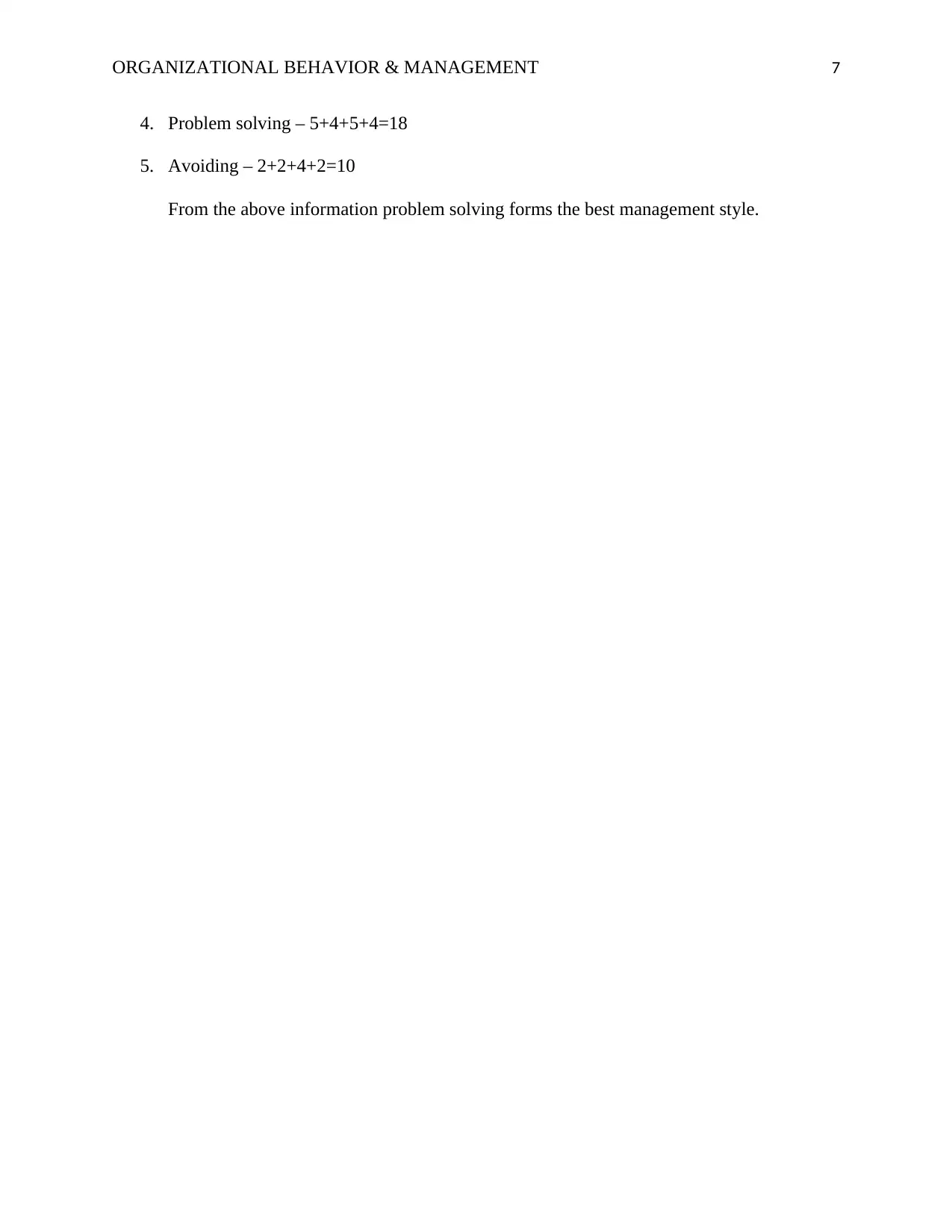
1. Yielding – 3+1+4+1=9
2. Compromising – 1+5+3+3=12
3. Forcing – 2+1+5+1=9
Document Page
ORGANIZATIONAL BEHAVIOR & MANAGEMENT 7
4. Problem solving – 5+4+5+4=18
5. Avoiding – 2+2+4+2=10
From the above information problem solving forms the best management style.
chevron_up_icon
1 out of 7
circle_padding
hide_on_mobile
zoom_out_icon
[object Object]