Organizational Culture: True/False, Multiple Choice & Essay Questions
VerifiedAdded on  2020/05/08
|10
|1069
|531
Homework Assignment
AI Summary
This homework assignment delves into the multifaceted aspects of organizational culture, providing a comprehensive assessment through a variety of question formats. It begins with a series of true/false questions designed to test fundamental understanding of cultural impacts on strategy, organizational levels, and values. The assignment progresses to multiple-choice questions, exploring key concepts like social system stability, sense-making, and the competing values framework. These questions examine different cultural types, including clan, adhocracy, and hierarchical cultures, and their respective characteristics. Finally, the assignment concludes with an essay question, prompting a deeper analysis of hierarchical culture, its definition within the competing values framework, its impact on employees, and its potential drawbacks. The assignment utilizes references from Fugate & Kinicki (2015) and Neck, Houghton & Murray (2015) to support the concepts.
Organizational Culture
Paraphrase This Document
Need a fresh take? Get an instant paraphrase of this document with our AI Paraphraser

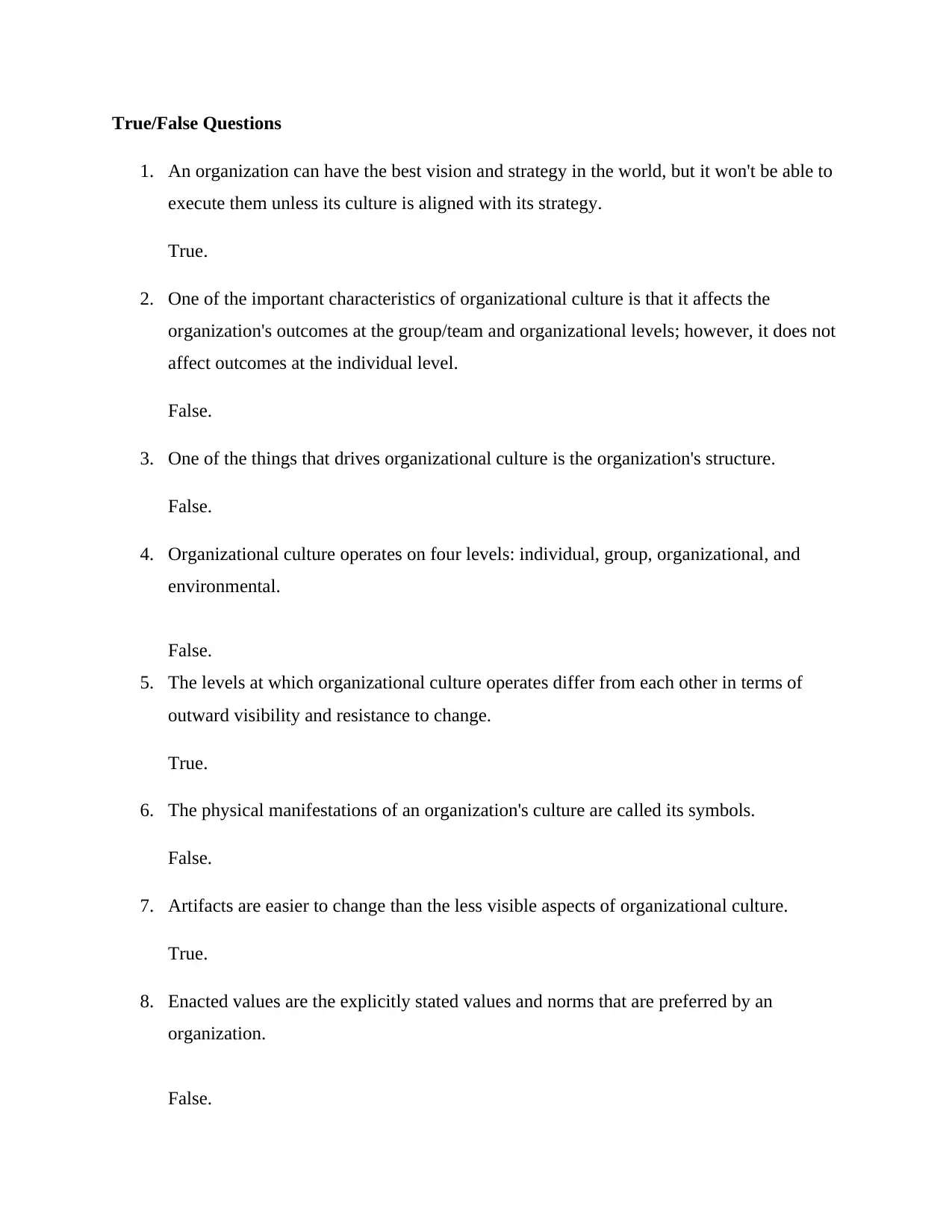
True/False Questions
1. An organization can have the best vision and strategy in the world, but it won't be able to
execute them unless its culture is aligned with its strategy.
True.
2. One of the important characteristics of organizational culture is that it affects the
organization's outcomes at the group/team and organizational levels; however, it does not
affect outcomes at the individual level.
False.
3. One of the things that drives organizational culture is the organization's structure.
False.
4. Organizational culture operates on four levels: individual, group, organizational, and
environmental.
False.
5. The levels at which organizational culture operates differ from each other in terms of
outward visibility and resistance to change.
True.
6. The physical manifestations of an organization's culture are called its symbols.
False.
7. Artifacts are easier to change than the less visible aspects of organizational culture.
True.
8. Enacted values are the explicitly stated values and norms that are preferred by an
organization.
False.
1. An organization can have the best vision and strategy in the world, but it won't be able to
execute them unless its culture is aligned with its strategy.
True.
2. One of the important characteristics of organizational culture is that it affects the
organization's outcomes at the group/team and organizational levels; however, it does not
affect outcomes at the individual level.
False.
3. One of the things that drives organizational culture is the organization's structure.
False.
4. Organizational culture operates on four levels: individual, group, organizational, and
environmental.
False.
5. The levels at which organizational culture operates differ from each other in terms of
outward visibility and resistance to change.
True.
6. The physical manifestations of an organization's culture are called its symbols.
False.
7. Artifacts are easier to change than the less visible aspects of organizational culture.
True.
8. Enacted values are the explicitly stated values and norms that are preferred by an
organization.
False.

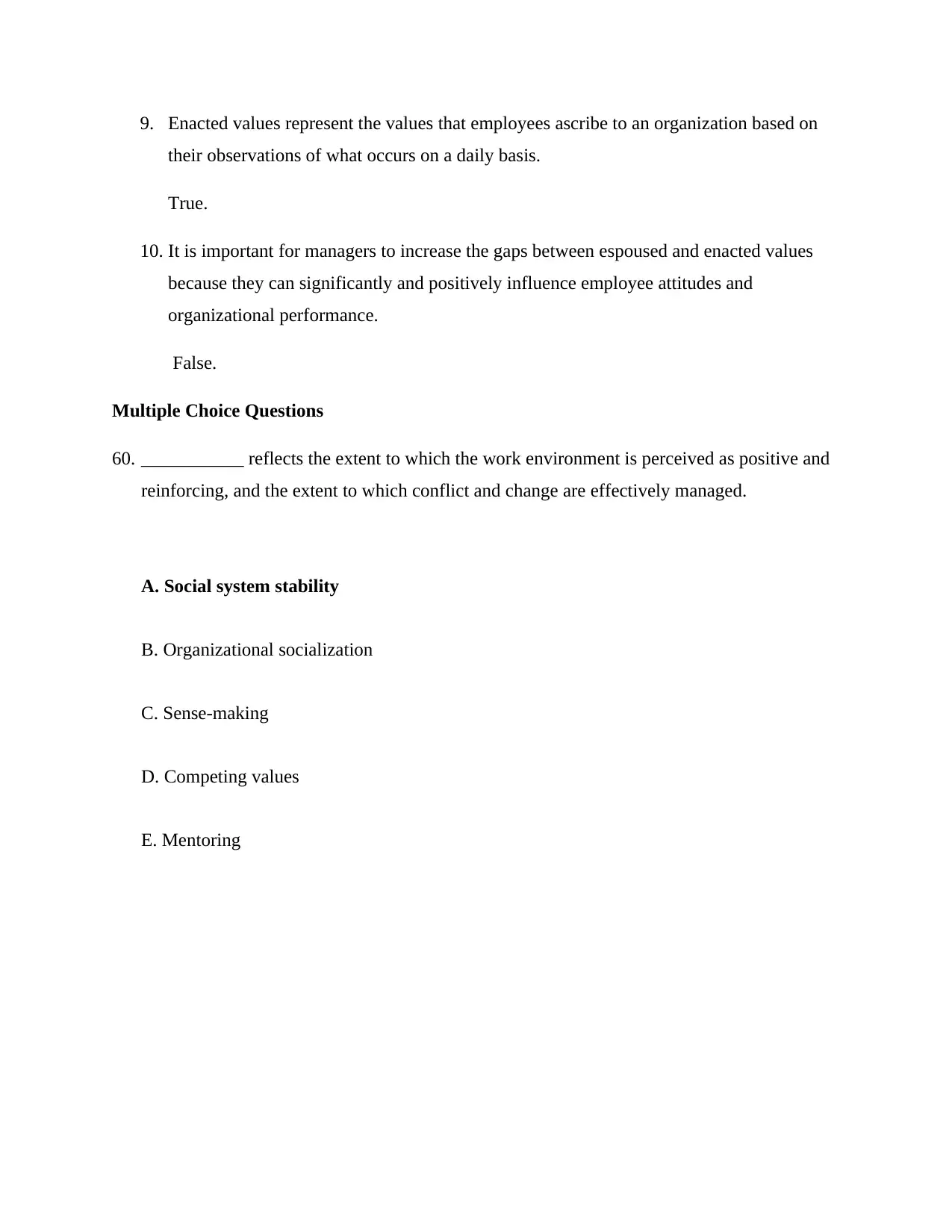
9. Enacted values represent the values that employees ascribe to an organization based on
their observations of what occurs on a daily basis.
True.
10. It is important for managers to increase the gaps between espoused and enacted values
because they can significantly and positively influence employee attitudes and
organizational performance.
False.
Multiple Choice Questions
60. ___________ reflects the extent to which the work environment is perceived as positive and
reinforcing, and the extent to which conflict and change are effectively managed.
A. Social system stability
B. Organizational socialization
C. Sense-making
D. Competing values
E. Mentoring
their observations of what occurs on a daily basis.
True.
10. It is important for managers to increase the gaps between espoused and enacted values
because they can significantly and positively influence employee attitudes and
organizational performance.
False.
Multiple Choice Questions
60. ___________ reflects the extent to which the work environment is perceived as positive and
reinforcing, and the extent to which conflict and change are effectively managed.
A. Social system stability
B. Organizational socialization
C. Sense-making
D. Competing values
E. Mentoring
⊘ This is a preview!⊘
Do you want full access?
Subscribe today to unlock all pages.

Trusted by 1+ million students worldwide

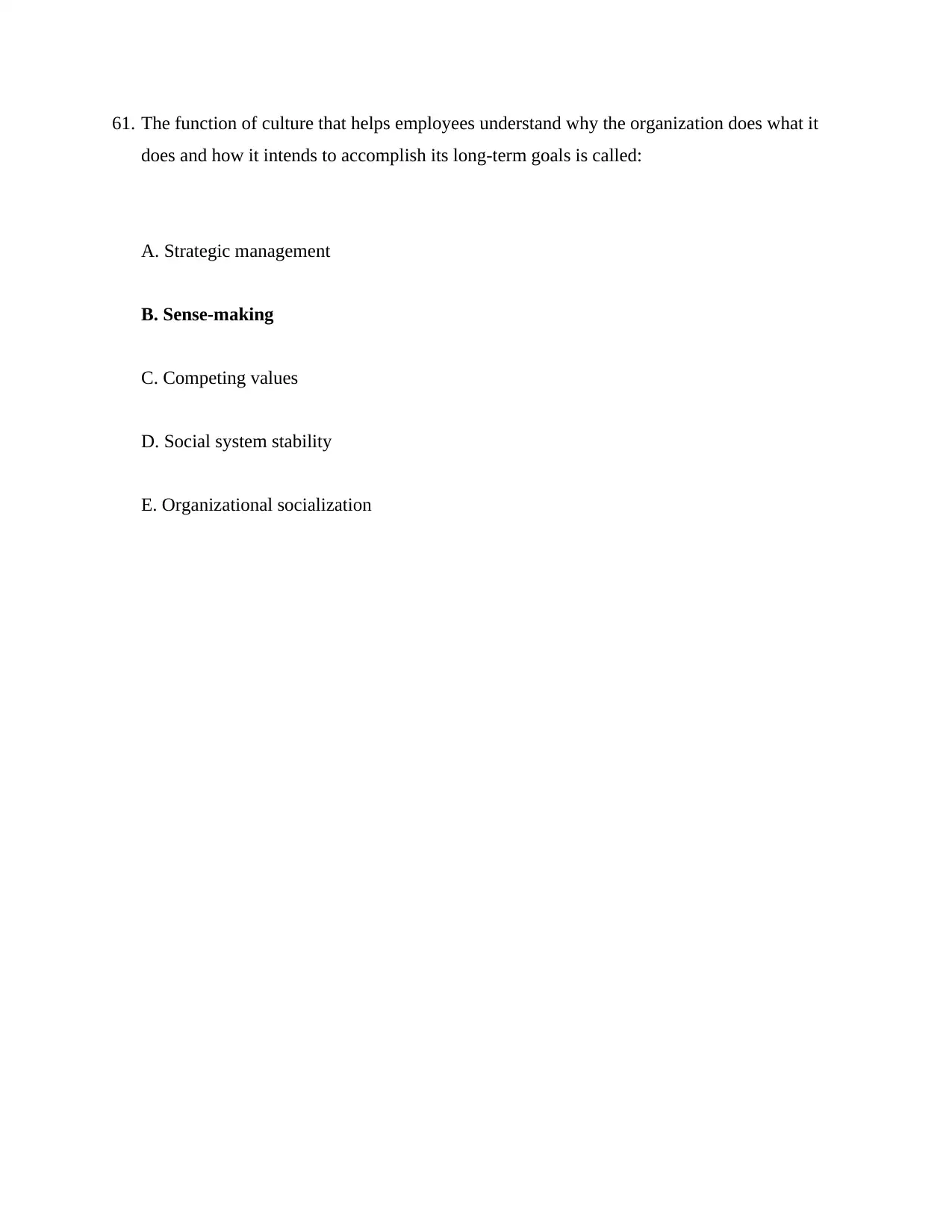
61. The function of culture that helps employees understand why the organization does what it
does and how it intends to accomplish its long-term goals is called:
A. Strategic management
B. Sense-making
C. Competing values
D. Social system stability
E. Organizational socialization
does and how it intends to accomplish its long-term goals is called:
A. Strategic management
B. Sense-making
C. Competing values
D. Social system stability
E. Organizational socialization
Paraphrase This Document
Need a fresh take? Get an instant paraphrase of this document with our AI Paraphraser

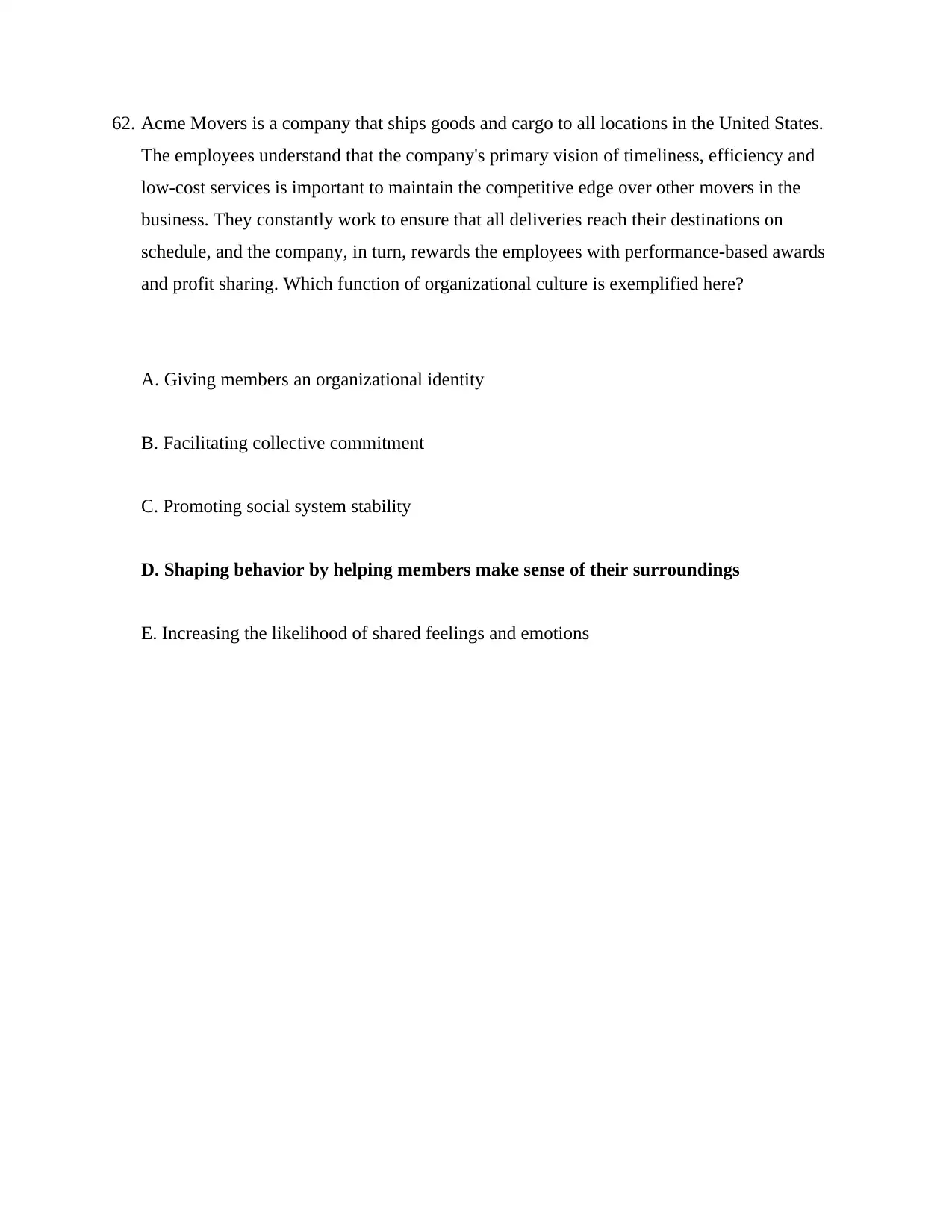
62. Acme Movers is a company that ships goods and cargo to all locations in the United States.
The employees understand that the company's primary vision of timeliness, efficiency and
low-cost services is important to maintain the competitive edge over other movers in the
business. They constantly work to ensure that all deliveries reach their destinations on
schedule, and the company, in turn, rewards the employees with performance-based awards
and profit sharing. Which function of organizational culture is exemplified here?
A. Giving members an organizational identity
B. Facilitating collective commitment
C. Promoting social system stability
D. Shaping behavior by helping members make sense of their surroundings
E. Increasing the likelihood of shared feelings and emotions
The employees understand that the company's primary vision of timeliness, efficiency and
low-cost services is important to maintain the competitive edge over other movers in the
business. They constantly work to ensure that all deliveries reach their destinations on
schedule, and the company, in turn, rewards the employees with performance-based awards
and profit sharing. Which function of organizational culture is exemplified here?
A. Giving members an organizational identity
B. Facilitating collective commitment
C. Promoting social system stability
D. Shaping behavior by helping members make sense of their surroundings
E. Increasing the likelihood of shared feelings and emotions

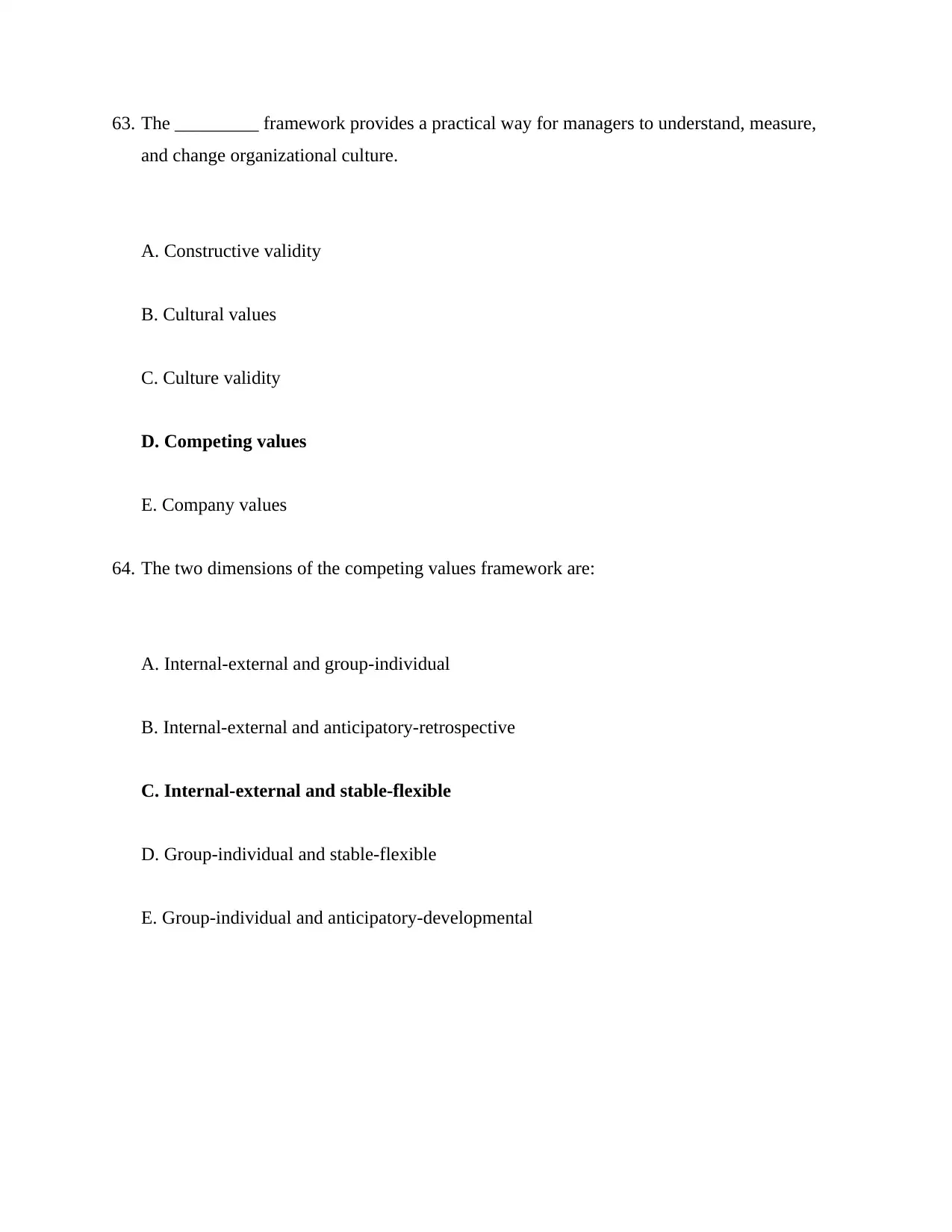
63. The _________ framework provides a practical way for managers to understand, measure,
and change organizational culture.
A. Constructive validity
B. Cultural values
C. Culture validity
D. Competing values
E. Company values
64. The two dimensions of the competing values framework are:
A. Internal-external and group-individual
B. Internal-external and anticipatory-retrospective
C. Internal-external and stable-flexible
D. Group-individual and stable-flexible
E. Group-individual and anticipatory-developmental
and change organizational culture.
A. Constructive validity
B. Cultural values
C. Culture validity
D. Competing values
E. Company values
64. The two dimensions of the competing values framework are:
A. Internal-external and group-individual
B. Internal-external and anticipatory-retrospective
C. Internal-external and stable-flexible
D. Group-individual and stable-flexible
E. Group-individual and anticipatory-developmental
⊘ This is a preview!⊘
Do you want full access?
Subscribe today to unlock all pages.

Trusted by 1+ million students worldwide

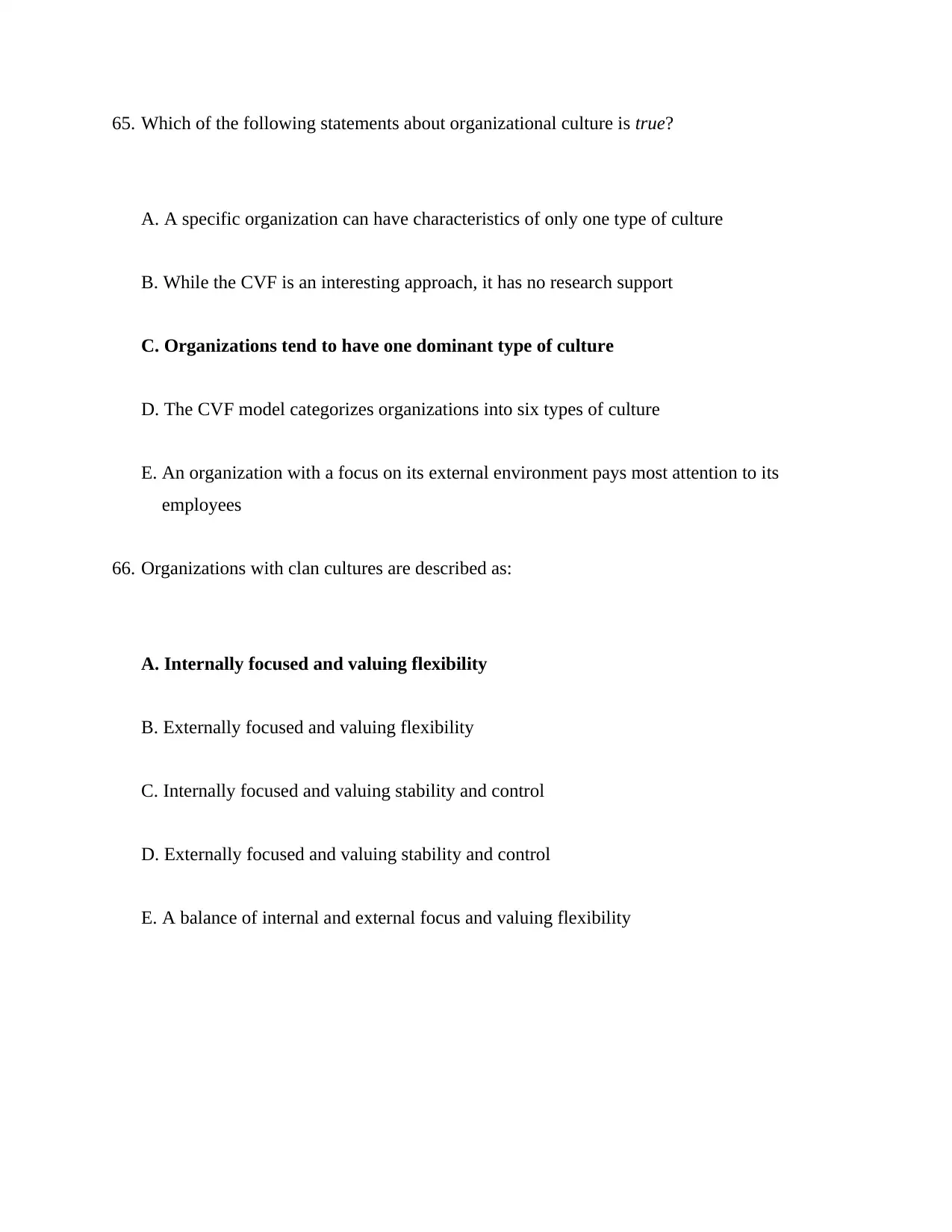
65. Which of the following statements about organizational culture is true?
A. A specific organization can have characteristics of only one type of culture
B. While the CVF is an interesting approach, it has no research support
C. Organizations tend to have one dominant type of culture
D. The CVF model categorizes organizations into six types of culture
E. An organization with a focus on its external environment pays most attention to its
employees
66. Organizations with clan cultures are described as:
A. Internally focused and valuing flexibility
B. Externally focused and valuing flexibility
C. Internally focused and valuing stability and control
D. Externally focused and valuing stability and control
E. A balance of internal and external focus and valuing flexibility
A. A specific organization can have characteristics of only one type of culture
B. While the CVF is an interesting approach, it has no research support
C. Organizations tend to have one dominant type of culture
D. The CVF model categorizes organizations into six types of culture
E. An organization with a focus on its external environment pays most attention to its
employees
66. Organizations with clan cultures are described as:
A. Internally focused and valuing flexibility
B. Externally focused and valuing flexibility
C. Internally focused and valuing stability and control
D. Externally focused and valuing stability and control
E. A balance of internal and external focus and valuing flexibility
Paraphrase This Document
Need a fresh take? Get an instant paraphrase of this document with our AI Paraphraser

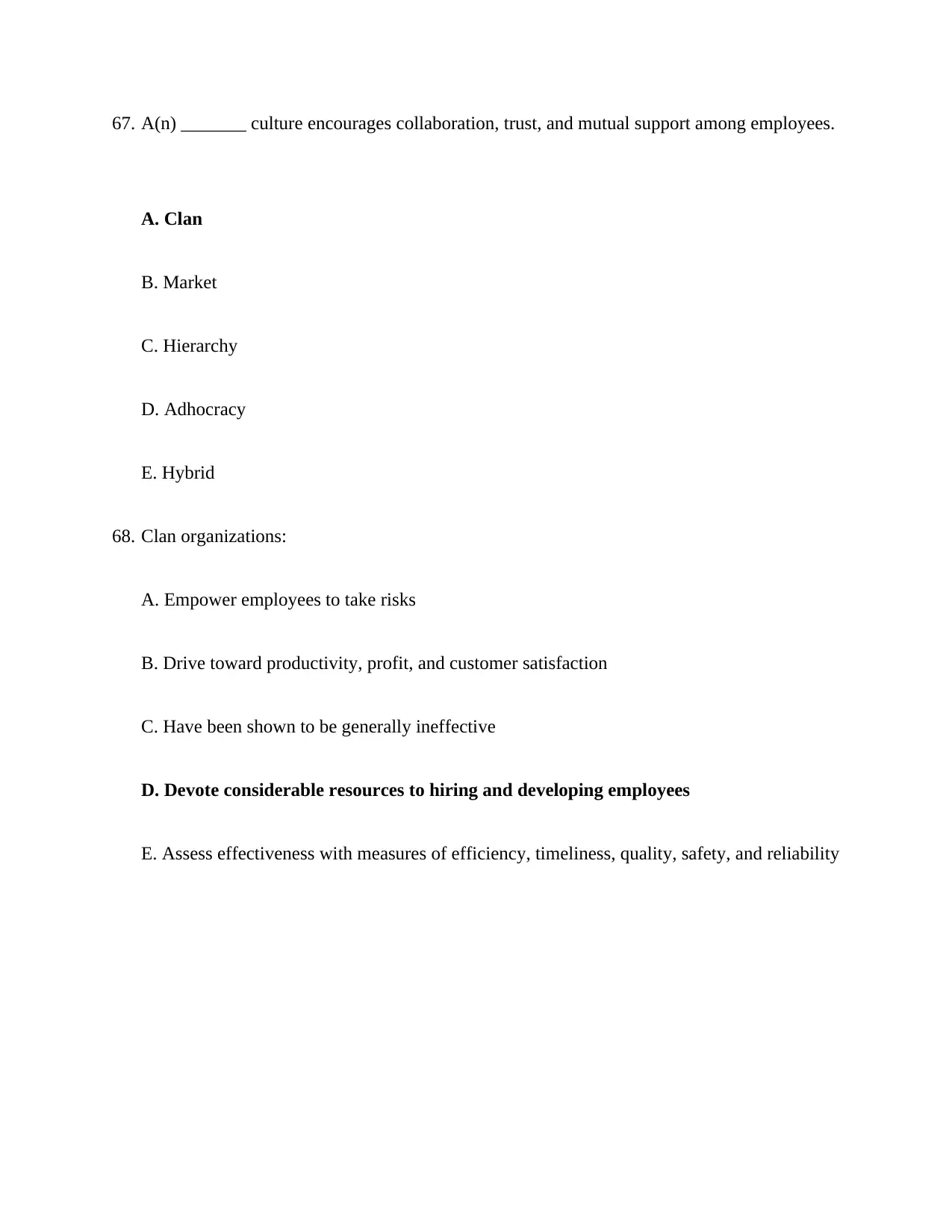
67. A(n) _______ culture encourages collaboration, trust, and mutual support among employees.
A. Clan
B. Market
C. Hierarchy
D. Adhocracy
E. Hybrid
68. Clan organizations:
A. Empower employees to take risks
B. Drive toward productivity, profit, and customer satisfaction
C. Have been shown to be generally ineffective
D. Devote considerable resources to hiring and developing employees
E. Assess effectiveness with measures of efficiency, timeliness, quality, safety, and reliability
A. Clan
B. Market
C. Hierarchy
D. Adhocracy
E. Hybrid
68. Clan organizations:
A. Empower employees to take risks
B. Drive toward productivity, profit, and customer satisfaction
C. Have been shown to be generally ineffective
D. Devote considerable resources to hiring and developing employees
E. Assess effectiveness with measures of efficiency, timeliness, quality, safety, and reliability

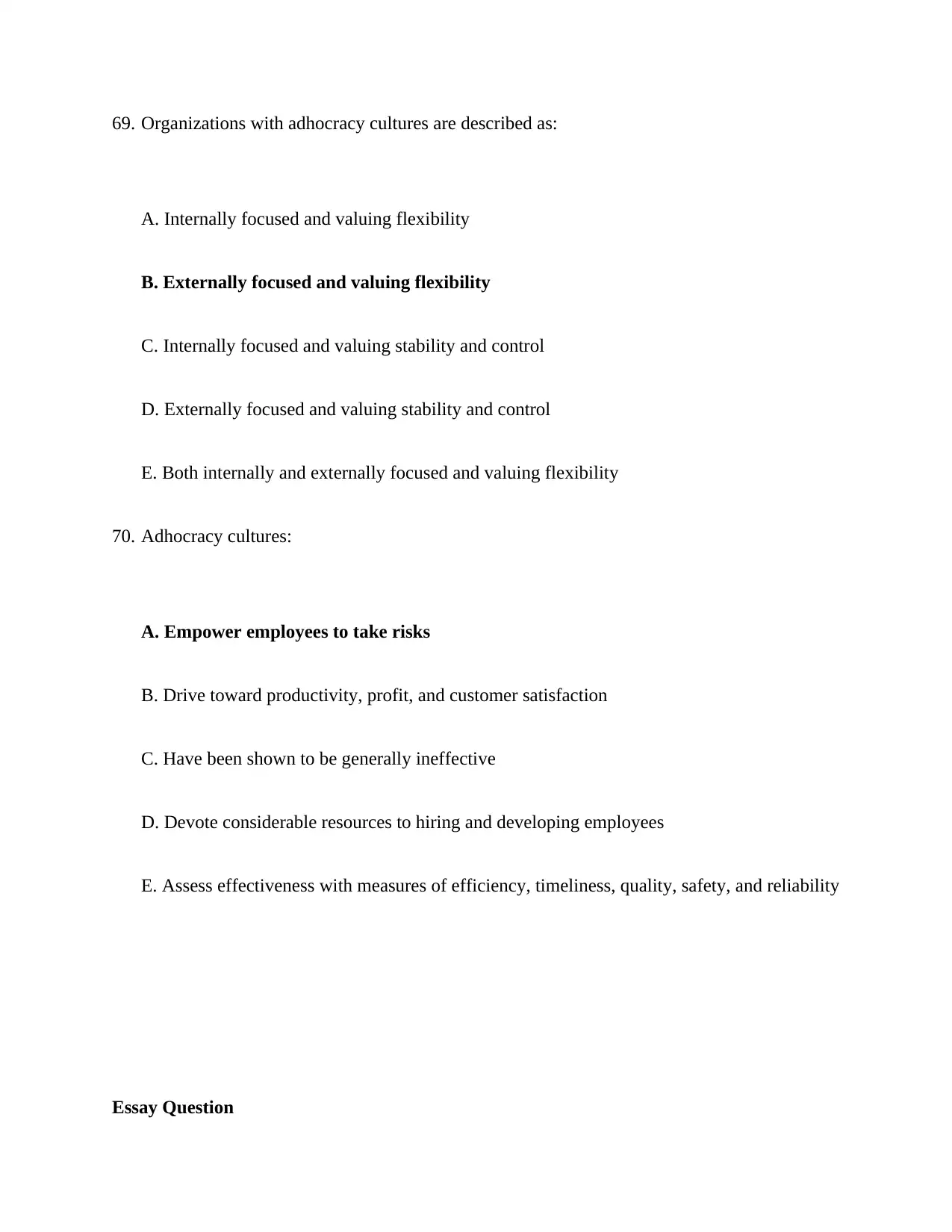
69. Organizations with adhocracy cultures are described as:
A. Internally focused and valuing flexibility
B. Externally focused and valuing flexibility
C. Internally focused and valuing stability and control
D. Externally focused and valuing stability and control
E. Both internally and externally focused and valuing flexibility
70. Adhocracy cultures:
A. Empower employees to take risks
B. Drive toward productivity, profit, and customer satisfaction
C. Have been shown to be generally ineffective
D. Devote considerable resources to hiring and developing employees
E. Assess effectiveness with measures of efficiency, timeliness, quality, safety, and reliability
Essay Question
A. Internally focused and valuing flexibility
B. Externally focused and valuing flexibility
C. Internally focused and valuing stability and control
D. Externally focused and valuing stability and control
E. Both internally and externally focused and valuing flexibility
70. Adhocracy cultures:
A. Empower employees to take risks
B. Drive toward productivity, profit, and customer satisfaction
C. Have been shown to be generally ineffective
D. Devote considerable resources to hiring and developing employees
E. Assess effectiveness with measures of efficiency, timeliness, quality, safety, and reliability
Essay Question
⊘ This is a preview!⊘
Do you want full access?
Subscribe today to unlock all pages.

Trusted by 1+ million students worldwide

Hierarchical culture is a kind of organizational culture in which corporate levels and structures
are clearly demarcated. It means that firstly items are assessed on the basis of importance and
then ranked accordingly.
Hierarchical culture is defined in Competing Values Framework (CVF) as structured and
formalized work atmosphere which has an internal emphasis and believes in stability and control
over elasticity. Application of various control mechanisms and reliable internal processes are
developed as a result of this orientation. The measurement of effectiveness is done on the basis
of competence, quality, trustworthiness and care taken in the production and distribution of
goods and services.
Working in a hierarchical culture helps a ground level employee to rise up in the hierarchy
through promotion which increases job satisfaction. Also, such culture does not favor the senior
managers and there are provisions for their replacement. It is argued that this model stifles
originality and employee initiative due to control and strictness.
are clearly demarcated. It means that firstly items are assessed on the basis of importance and
then ranked accordingly.
Hierarchical culture is defined in Competing Values Framework (CVF) as structured and
formalized work atmosphere which has an internal emphasis and believes in stability and control
over elasticity. Application of various control mechanisms and reliable internal processes are
developed as a result of this orientation. The measurement of effectiveness is done on the basis
of competence, quality, trustworthiness and care taken in the production and distribution of
goods and services.
Working in a hierarchical culture helps a ground level employee to rise up in the hierarchy
through promotion which increases job satisfaction. Also, such culture does not favor the senior
managers and there are provisions for their replacement. It is argued that this model stifles
originality and employee initiative due to control and strictness.
1 out of 10
Related Documents
Your All-in-One AI-Powered Toolkit for Academic Success.
 +13062052269
info@desklib.com
Available 24*7 on WhatsApp / Email
Unlock your academic potential
Copyright © 2020–2025 A2Z Services. All Rights Reserved. Developed and managed by ZUCOL.