University Essay: Defining Organizational Culture in a Global Context

Verified

Added on  2020/03/07

|6
|872
|33
Essay
AI Summary
This essay explores the concept of organizational culture, examining its various definitions and the factors that contribute to its diversity. The author discusses how cultural differences arise from geography, time, and shared values within communities and organizations. The essay highlights the importance of shared beliefs, values, and assumptions in shaping behaviors and organizational governance. It emphasizes the need for individuals to understand and adapt to evolving cultures. The conclusion stresses the impact of organizational culture on individual behavior and the importance of fostering positive cultural practices through transparency, effective communication, and collaboration. The paper also includes a detailed bibliography with relevant sources supporting the discussion on organizational culture.
Document Page
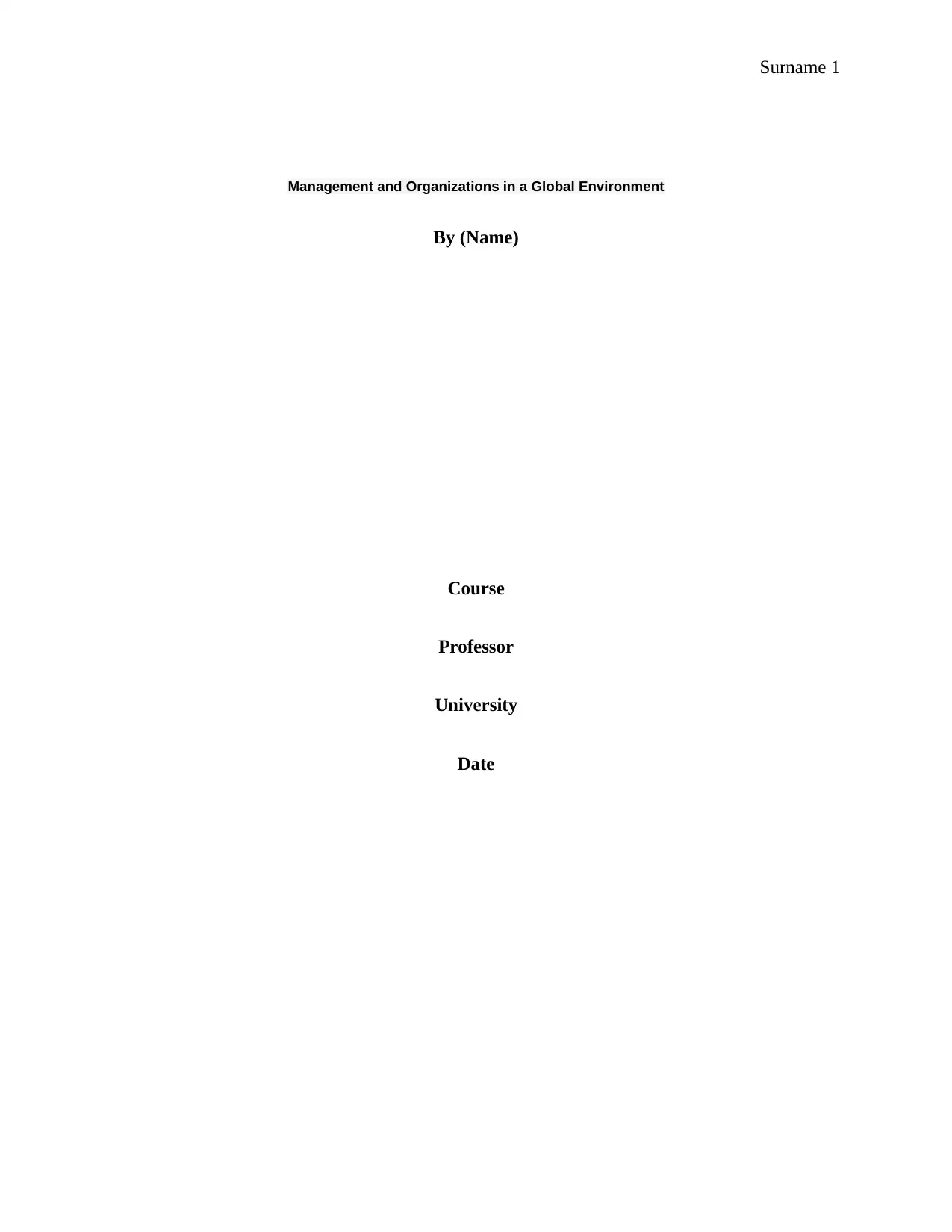
Surname 1
Management and Organizations in a Global Environment
By (Name)
Course
Professor
University
Date
tabler-icon-diamond-filled.svg

Paraphrase This Document

Need a fresh take? Get an instant paraphrase of this document with our AI Paraphraser
Document Page
Surname 2
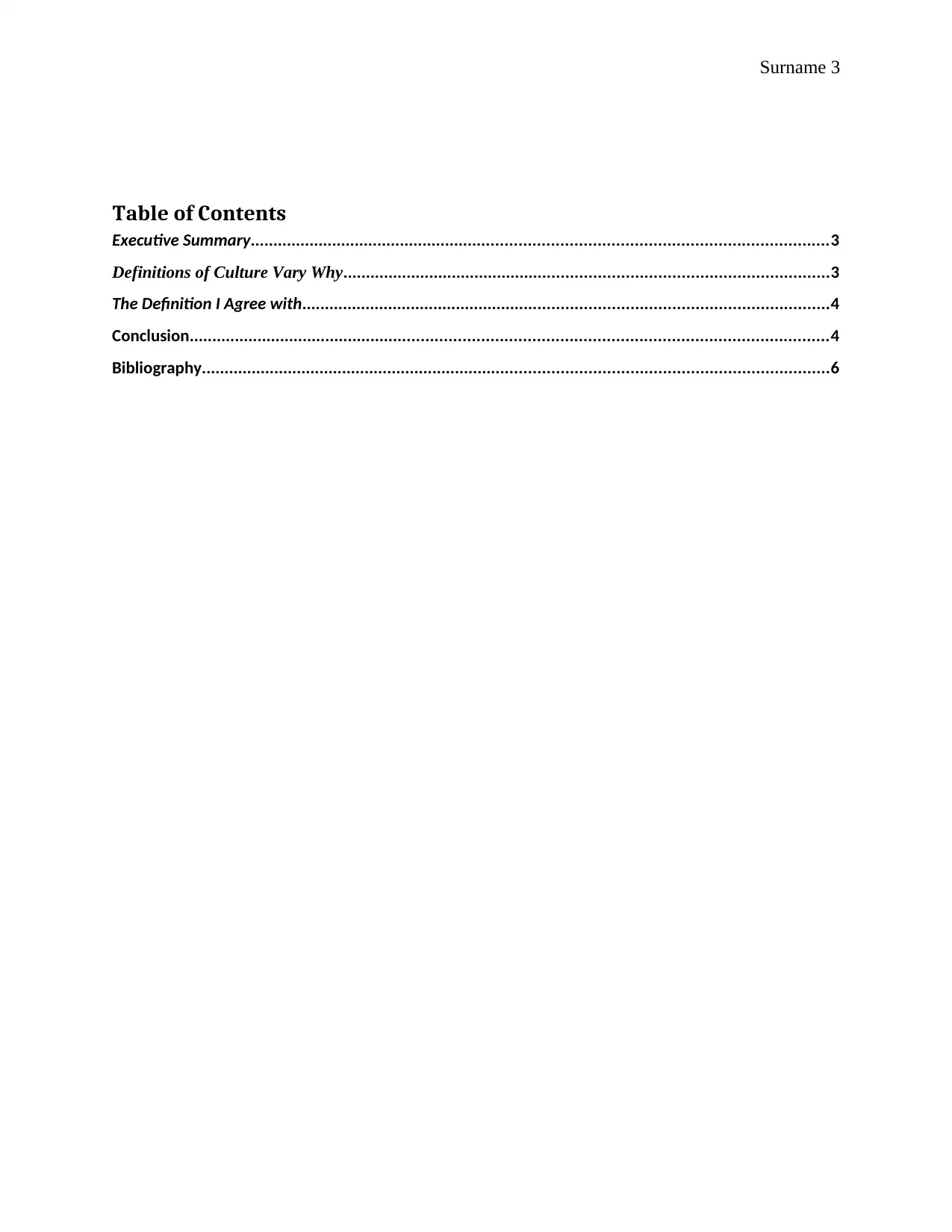
Executive Summary
This paper explores the activity of organizational culture which is an issue that has been
raised in several debates. There exist various definitions of organizational culture and therefore,
individuals’ experiences a challenge to understand how it correlates with the significant elements
which include the system of incentives and structures in the organizations (Schein, 2010. Pp.10).
There is need to embrace good approaches which can lead an individual into preserving,
analyzing and transforming various cultures. In case an individual chooses to define culture, it
provides them with an opportunity to recognize the challenges and also develop as well as design
improved cultures.
Document Page
Surname 3
Table of Contents
Executive Summary..............................................................................................................................3
Definitions of Culture Vary Why..........................................................................................................3
The Definition I Agree with...................................................................................................................4
Conclusion...........................................................................................................................................4
Bibliography.........................................................................................................................................6
Document Page
Surname 4
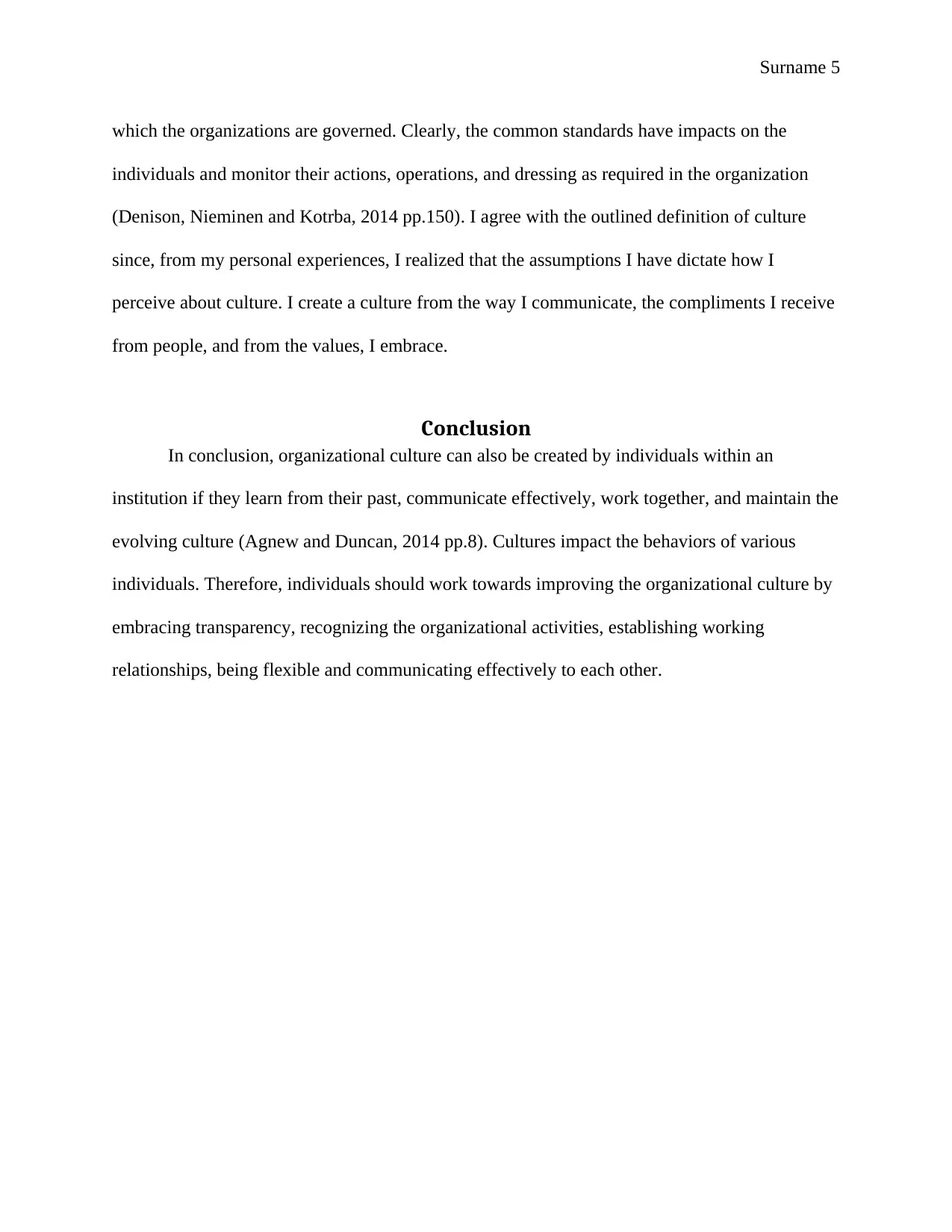
Definitions of Culture Vary Why
I think people’s definition of culture varies due to various reasons. For instance, cultures
change due to geography or the physical setting. This implies that there exist so many people in
the world who have different cultures which is referred to as the cultural diversity (Martinez,
Beaulieu, Gibbons, Pronovost and Wang, 2015 pp.333). There are several things which features
our planet and hence cause the many definitions of cultures. For example, the physical features
include the vegetation which exists naturally, landforms, and climates. Also, human beings are
characterized by the geographical aspects since their activities which include agriculture, systems
of transport, towns, cities, and industries impact the culture definitions (Glisson, 2015 pp.248).
Moreover, various communities define culture from the dances, sports, dressing styles, etiquette
and other components of culture which dominates the world. I also think culture definitions vary
due to time. This is evident since the cultural differences differ depending on the individual
thoughts and how they use the available time. Cultures change due to the factors of time which
include meaning, value, how it can be measured, allocated and also divided. For this reason, the
interpretations of culture vary amongst individuals (Alvesson and Sveningsson, 2015 pp.15).
Various people may define culture basing on the span of time they spend in a certain
organization. In addition, cultures may change due to the various beliefs, values, and attitudes in
which people share. From my opinion, the policies, life orientations, behaviors and assumptions I
embrace facilitates too many definitions of culture.
The Definition I Agree with
Despite the fact that culture is a complicated phrase to define; I agree that it is a system
which contains shared beliefs, values, and assumptions, which facilitates behaviors and ways in
tabler-icon-diamond-filled.svg

Paraphrase This Document

Need a fresh take? Get an instant paraphrase of this document with our AI Paraphraser
Document Page
Surname 5
which the organizations are governed. Clearly, the common standards have impacts on the
individuals and monitor their actions, operations, and dressing as required in the organization
(Denison, Nieminen and Kotrba, 2014 pp.150). I agree with the outlined definition of culture
since, from my personal experiences, I realized that the assumptions I have dictate how I
perceive about culture. I create a culture from the way I communicate, the compliments I receive
from people, and from the values, I embrace.
Conclusion
In conclusion, organizational culture can also be created by individuals within an
institution if they learn from their past, communicate effectively, work together, and maintain the
evolving culture (Agnew and Duncan, 2014 pp.8). Cultures impact the behaviors of various
individuals. Therefore, individuals should work towards improving the organizational culture by
embracing transparency, recognizing the organizational activities, establishing working
relationships, being flexible and communicating effectively to each other.
Document Page
Surname 6
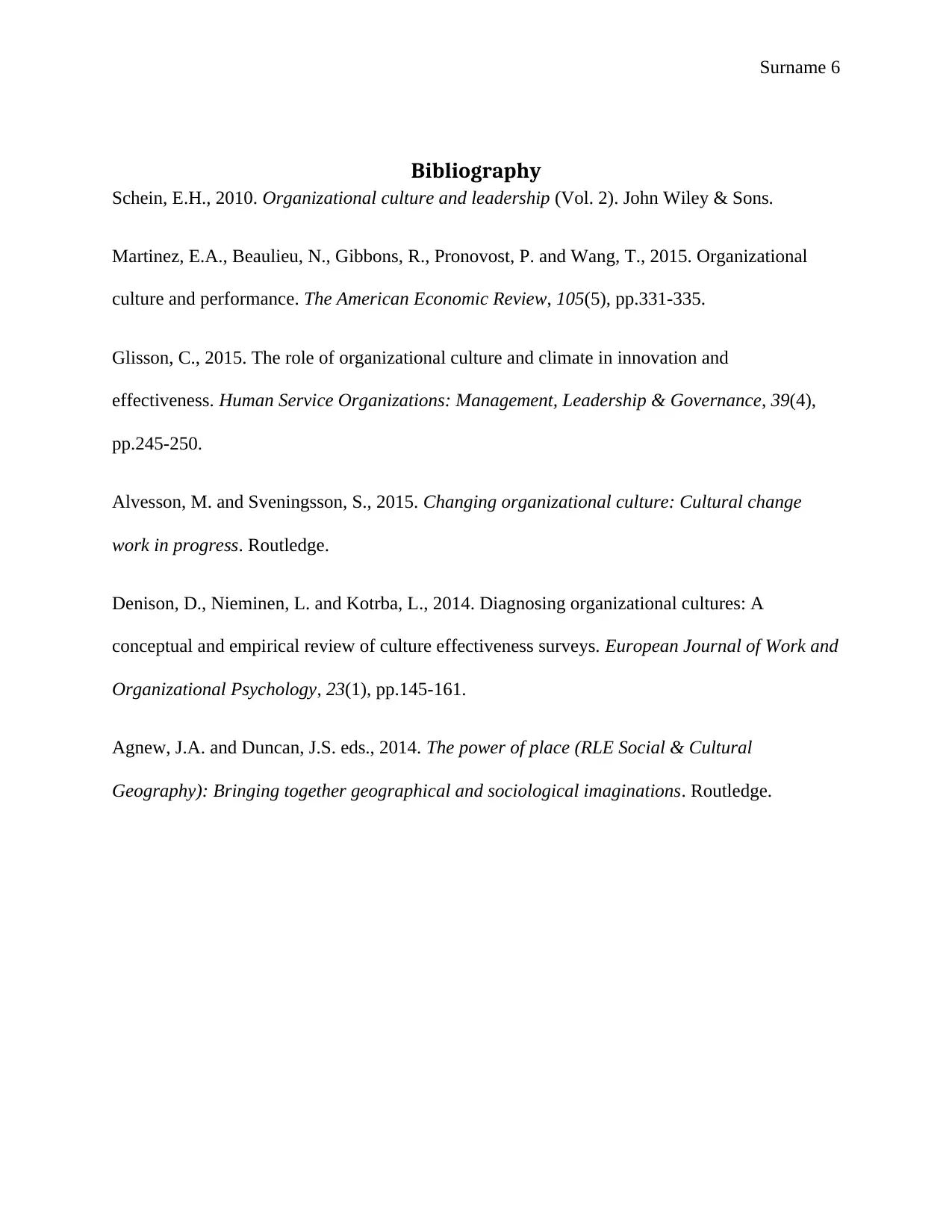
Bibliography
Schein, E.H., 2010. Organizational culture and leadership (Vol. 2). John Wiley & Sons.
Martinez, E.A., Beaulieu, N., Gibbons, R., Pronovost, P. and Wang, T., 2015. Organizational
culture and performance. The American Economic Review, 105(5), pp.331-335.
Glisson, C., 2015. The role of organizational culture and climate in innovation and
effectiveness. Human Service Organizations: Management, Leadership & Governance, 39(4),
pp.245-250.
Alvesson, M. and Sveningsson, S., 2015. Changing organizational culture: Cultural change
work in progress. Routledge.
Denison, D., Nieminen, L. and Kotrba, L., 2014. Diagnosing organizational cultures: A
conceptual and empirical review of culture effectiveness surveys. European Journal of Work and
Organizational Psychology, 23(1), pp.145-161.
Agnew, J.A. and Duncan, J.S. eds., 2014. The power of place (RLE Social & Cultural
Geography): Bringing together geographical and sociological imaginations. Routledge.
chevron_up_icon
1 out of 6
circle_padding
hide_on_mobile
zoom_out_icon
[object Object]