Organizational Culture Analysis: Types, Management, and Effects
VerifiedAdded on 2021/01/02
|12
|3338
|293
Report
AI Summary
This report delves into the multifaceted concept of organizational culture, examining its definition as a shared system of values, beliefs, and assumptions that shape the social and psychological environment of a workplace. It outlines four primary types of organizational culture: Task, Power, Person, and Role, and emphasizes the importance of a strong, manageable culture for fostering employee motivation, productivity, and overall organizational success. The report explores the key elements influencing culture, such as management attention, recruitment strategies, and reward systems. It further discusses the management of organizational culture, highlighting the roles of leaders, teamwork, and training in shaping a positive and effective work environment. The report also examines the impact of culture on organizations, including its effects on employee engagement, goal achievement, and adaptation to change, while applying scientific management and human relations theory to control organizational culture.
Organizational Culture

Paraphrase This Document
Need a fresh take? Get an instant paraphrase of this document with our AI Paraphraser
Table of Contents
INTRODUCTION...........................................................................................................................1
Main Body.......................................................................................................................................1
Organizational culture.................................................................................................................1
Importance Of Culture in Organization......................................................................................2
Organizational culture management...........................................................................................2
Management of organizational culture to at extent....................................................................3
Understanding the effect of culture on organizations.................................................................5
CONCLUSION................................................................................................................................7
REFERENCES................................................................................................................................8
INTRODUCTION...........................................................................................................................1
Main Body.......................................................................................................................................1
Organizational culture.................................................................................................................1
Importance Of Culture in Organization......................................................................................2
Organizational culture management...........................................................................................2
Management of organizational culture to at extent....................................................................3
Understanding the effect of culture on organizations.................................................................5
CONCLUSION................................................................................................................................7
REFERENCES................................................................................................................................8
INTRODUCTION
Organizational culture is reflects method of shared values, beliefs and assumptions that
highly contributes to psychological and social environment of the organization. Organizational
culture also impacts on an individual and group in performing their daily managerial activities.
There are mainly four types of culture in the organization like Task, Power, Person and Role
which are discussed in below report. Moreover, report aims in showing strong and manageable
culture of an organization. In addition to this, the effect of culture on organization is also
specified in this report. Lastly, scientific management and human relations theory is applied
below in order to control organizational culture.
MAIN BODY
Organizational culture.
Organizational culture shows how people feel about its perception, management,
authority, goals and objectives. Moreover, culture encompasses behaviours, values of an
individual that helps in contributing to the social and psychological atmosphere of organization.
The culture shapes and guides behaviour of every member toward desirable goal of business. In
addition to this, organizational culture also powers and influences many features of workplace
life (Alvesson, 2012). The place where people works must be strong enough in terms of beliefs,
behaviours, expectations and ideas which helps in generation effective culture. If all these terms
are generated highly, the employees are encouraged to communicate easily with each other
within an organization. Further, the workplace must be developed by applying various strategies
and approaches in the management system. In addition to this, the focus must be made on
organizational culture which emphasizes on employees positively. Moreover, if workers are
highly motivated by the organizational culture, it helps in achieving high performance level in
market. Further, the profitability and production is also achieved with higher efficiency of
organization. In addition to this, the culture is impacted by various elements which should be
modified and improved in order to achieve goals and objectives of the company (Büschgens,
Bausch and Balkin, 2013). These elements can be
Attention of managers and team.
Strategy of recruiting and selecting new individual.
Making criteria for giving awards.
1
Organizational culture is reflects method of shared values, beliefs and assumptions that
highly contributes to psychological and social environment of the organization. Organizational
culture also impacts on an individual and group in performing their daily managerial activities.
There are mainly four types of culture in the organization like Task, Power, Person and Role
which are discussed in below report. Moreover, report aims in showing strong and manageable
culture of an organization. In addition to this, the effect of culture on organization is also
specified in this report. Lastly, scientific management and human relations theory is applied
below in order to control organizational culture.
MAIN BODY
Organizational culture.
Organizational culture shows how people feel about its perception, management,
authority, goals and objectives. Moreover, culture encompasses behaviours, values of an
individual that helps in contributing to the social and psychological atmosphere of organization.
The culture shapes and guides behaviour of every member toward desirable goal of business. In
addition to this, organizational culture also powers and influences many features of workplace
life (Alvesson, 2012). The place where people works must be strong enough in terms of beliefs,
behaviours, expectations and ideas which helps in generation effective culture. If all these terms
are generated highly, the employees are encouraged to communicate easily with each other
within an organization. Further, the workplace must be developed by applying various strategies
and approaches in the management system. In addition to this, the focus must be made on
organizational culture which emphasizes on employees positively. Moreover, if workers are
highly motivated by the organizational culture, it helps in achieving high performance level in
market. Further, the profitability and production is also achieved with higher efficiency of
organization. In addition to this, the culture is impacted by various elements which should be
modified and improved in order to achieve goals and objectives of the company (Büschgens,
Bausch and Balkin, 2013). These elements can be
Attention of managers and team.
Strategy of recruiting and selecting new individual.
Making criteria for giving awards.
1
⊘ This is a preview!⊘
Do you want full access?
Subscribe today to unlock all pages.

Trusted by 1+ million students worldwide
Rules and policy of an organization.
Promotional criteria.
Importance of Culture in Organisation.
People believe that culture is very significant part in the organisation which helps in
influencing their values, views, hopes, fears, loyalties and many more. In building the strong
relation within the organisation, positive culture is necessary (Hubbard, Stein and Mehan, 2013).
The strong and healthy corporate culture is helpful in retaining valuable workers and also
reduces the human resource costs from the organisation.
Organizational culture management.
The people also debates in term of whether organizational culture can be managed or not.
But if the professionals and experts are involved, then the management of culture is performed
easily and flexibly. In addition to this, the culture is vital which should be enthusiastic and happy
that helps in motivating employees in their working. In addition to this, the encouraged and
motivated workers contributes in adding values and standard to an organization. Moreover, brand
representation is a root of an organizational culture (Nica, 2013). In addition to this, the culture
can be managed by appointing skilled and knowledgeable employees in the organization. The
culture depends on behaviours of people working in every department, subsidiaries divisions,
etc. In order to manage culture, behaviours and nature of these members must be identified and
handled carefully. Moreover, leaders, managers, directors, senior managers and so on are the
people responsible in managing the organizational culture effectively. In addition to this, they
play an important role in managing the culture at great extent. The culture of the organization is
very significant in shaping the performance and practices of every employee's. The managers
should pay attention in removing conflicts within the organization which sets the culture at top
level (Azanza, Moriano and Molero, 2013). In addition to this, for a better and effective change
in management, several issues are mitigated like,
Atmosphere of organization: The climate of firm should be relevant and suitable for
every employee's. In addition to this, the workers need and requirements must be fulfilled
which encourages them in performing at high level in organization.
Leaders as experts: In order to manage the culture of an organization leaders guide
every members by applying innovative techniques and methods. The process of
2
Promotional criteria.
Importance of Culture in Organisation.
People believe that culture is very significant part in the organisation which helps in
influencing their values, views, hopes, fears, loyalties and many more. In building the strong
relation within the organisation, positive culture is necessary (Hubbard, Stein and Mehan, 2013).
The strong and healthy corporate culture is helpful in retaining valuable workers and also
reduces the human resource costs from the organisation.
Organizational culture management.
The people also debates in term of whether organizational culture can be managed or not.
But if the professionals and experts are involved, then the management of culture is performed
easily and flexibly. In addition to this, the culture is vital which should be enthusiastic and happy
that helps in motivating employees in their working. In addition to this, the encouraged and
motivated workers contributes in adding values and standard to an organization. Moreover, brand
representation is a root of an organizational culture (Nica, 2013). In addition to this, the culture
can be managed by appointing skilled and knowledgeable employees in the organization. The
culture depends on behaviours of people working in every department, subsidiaries divisions,
etc. In order to manage culture, behaviours and nature of these members must be identified and
handled carefully. Moreover, leaders, managers, directors, senior managers and so on are the
people responsible in managing the organizational culture effectively. In addition to this, they
play an important role in managing the culture at great extent. The culture of the organization is
very significant in shaping the performance and practices of every employee's. The managers
should pay attention in removing conflicts within the organization which sets the culture at top
level (Azanza, Moriano and Molero, 2013). In addition to this, for a better and effective change
in management, several issues are mitigated like,
Atmosphere of organization: The climate of firm should be relevant and suitable for
every employee's. In addition to this, the workers need and requirements must be fulfilled
which encourages them in performing at high level in organization.
Leaders as experts: In order to manage the culture of an organization leaders guide
every members by applying innovative techniques and methods. The process of
2
Paraphrase This Document
Need a fresh take? Get an instant paraphrase of this document with our AI Paraphraser
leadership is very significant in deciding effectiveness of cultural changes in
organization. The leaders act as a mentor and influences every individual in terms of
rewarding them for their good and effective work.
Team work: The organisational culture is managed highly by making various teams and
groups in the organisation. In addition to this, it is a common and important feature which
helps in reducing workload of the employee's. In every team, the work is allotted to every
individual according to their skills and talent of working. This emphasizes in more
production and profitability of the organisation.
Training and development: This can be used as a tool in the organisation to manage the
culture and environment effectively (Moriano and Molero, 2013). Moreover, the
employees are provided efficient training in order to perform every activities that results
in better quality and quantity.
Management of organisational culture to an extent.
The culture of an organisation can be managed depending on values and customs of
company. In addition to this, the cultural ethics must be strengthened and refined in order to
manage it effectively. Moreover, organisational culture is managed by determining various types
of culture in the management. In order to know various cultures, the Handy model can be used to
it:
Power Culture: This is the strong and powerful culture which helps in determining power of
organisation. In the organisation, power is held by few members who influences the culture in
entire firm. In addition to this, there are some policies, rules and regulations in the power culture.
If the organisation is running through power culture, then it can be managed by following the
rules of company. In addition to this, management of power culture can be managed in
organisation to an extent by following every legal terms and rules of the company. Moreover,
these rules decide what is to be done and what is not to be done by employees in the organisation
(Bortolotti, Boscari and Danese, 2015). The main consequences of this culture helps in making
rapid decisions in terms of managing the organization effectively.
The organisation who follows power culture also swifts to their decisions as they are not
stable and confident to it. In addition to this, the managers must take actions in order to improve
this conflict in the organisation. Moreover, they should make stiff and confidential decisions in
order to manage the business more effectively and efficiently.
3
organization. The leaders act as a mentor and influences every individual in terms of
rewarding them for their good and effective work.
Team work: The organisational culture is managed highly by making various teams and
groups in the organisation. In addition to this, it is a common and important feature which
helps in reducing workload of the employee's. In every team, the work is allotted to every
individual according to their skills and talent of working. This emphasizes in more
production and profitability of the organisation.
Training and development: This can be used as a tool in the organisation to manage the
culture and environment effectively (Moriano and Molero, 2013). Moreover, the
employees are provided efficient training in order to perform every activities that results
in better quality and quantity.
Management of organisational culture to an extent.
The culture of an organisation can be managed depending on values and customs of
company. In addition to this, the cultural ethics must be strengthened and refined in order to
manage it effectively. Moreover, organisational culture is managed by determining various types
of culture in the management. In order to know various cultures, the Handy model can be used to
it:
Power Culture: This is the strong and powerful culture which helps in determining power of
organisation. In the organisation, power is held by few members who influences the culture in
entire firm. In addition to this, there are some policies, rules and regulations in the power culture.
If the organisation is running through power culture, then it can be managed by following the
rules of company. In addition to this, management of power culture can be managed in
organisation to an extent by following every legal terms and rules of the company. Moreover,
these rules decide what is to be done and what is not to be done by employees in the organisation
(Bortolotti, Boscari and Danese, 2015). The main consequences of this culture helps in making
rapid decisions in terms of managing the organization effectively.
The organisation who follows power culture also swifts to their decisions as they are not
stable and confident to it. In addition to this, the managers must take actions in order to improve
this conflict in the organisation. Moreover, they should make stiff and confidential decisions in
order to manage the business more effectively and efficiently.
3
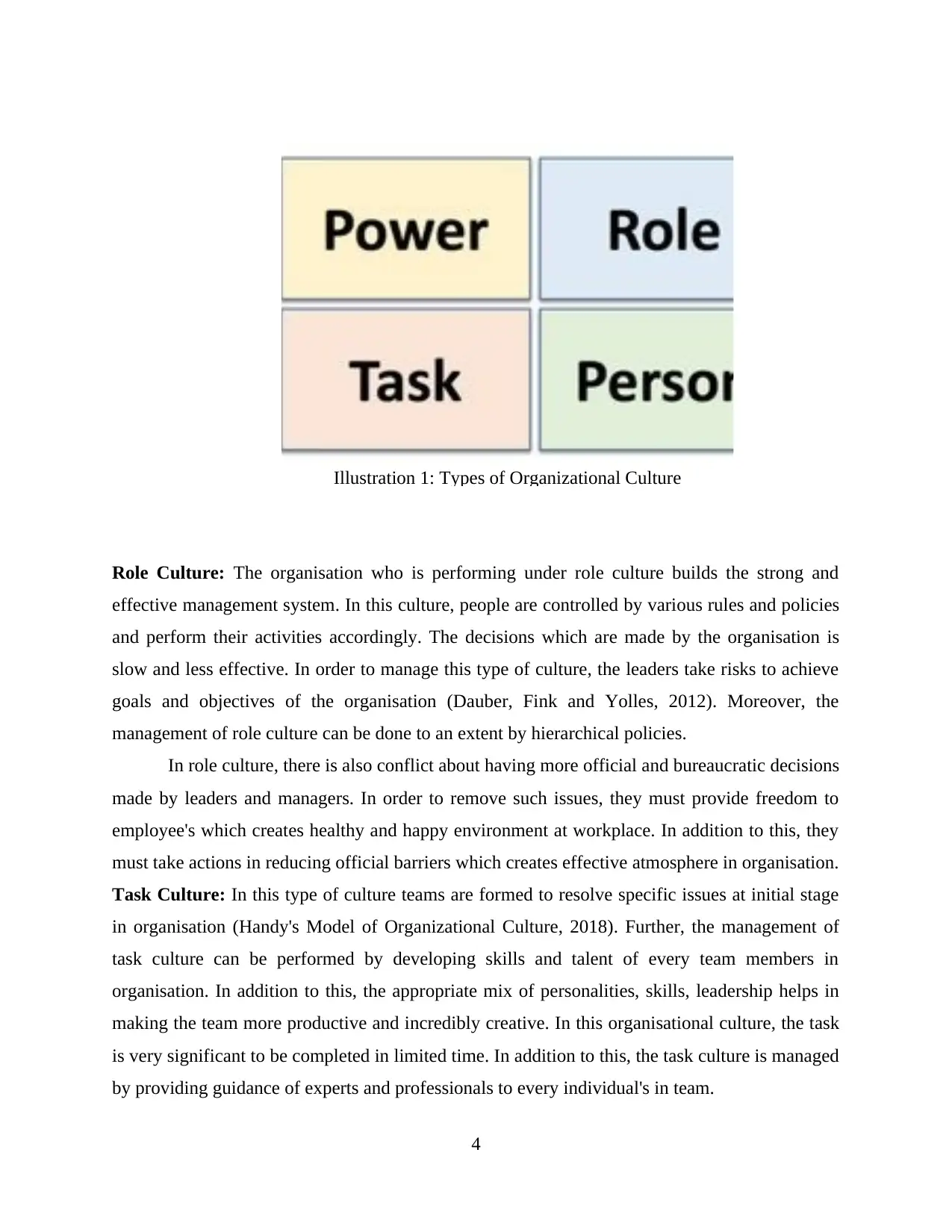
Role Culture: The organisation who is performing under role culture builds the strong and
effective management system. In this culture, people are controlled by various rules and policies
and perform their activities accordingly. The decisions which are made by the organisation is
slow and less effective. In order to manage this type of culture, the leaders take risks to achieve
goals and objectives of the organisation (Dauber, Fink and Yolles, 2012). Moreover, the
management of role culture can be done to an extent by hierarchical policies.
In role culture, there is also conflict about having more official and bureaucratic decisions
made by leaders and managers. In order to remove such issues, they must provide freedom to
employee's which creates healthy and happy environment at workplace. In addition to this, they
must take actions in reducing official barriers which creates effective atmosphere in organisation.
Task Culture: In this type of culture teams are formed to resolve specific issues at initial stage
in organisation (Handy's Model of Organizational Culture, 2018). Further, the management of
task culture can be performed by developing skills and talent of every team members in
organisation. In addition to this, the appropriate mix of personalities, skills, leadership helps in
making the team more productive and incredibly creative. In this organisational culture, the task
is very significant to be completed in limited time. In addition to this, the task culture is managed
by providing guidance of experts and professionals to every individual's in team.
4
Illustration 1: Types of Organizational Culture
effective management system. In this culture, people are controlled by various rules and policies
and perform their activities accordingly. The decisions which are made by the organisation is
slow and less effective. In order to manage this type of culture, the leaders take risks to achieve
goals and objectives of the organisation (Dauber, Fink and Yolles, 2012). Moreover, the
management of role culture can be done to an extent by hierarchical policies.
In role culture, there is also conflict about having more official and bureaucratic decisions
made by leaders and managers. In order to remove such issues, they must provide freedom to
employee's which creates healthy and happy environment at workplace. In addition to this, they
must take actions in reducing official barriers which creates effective atmosphere in organisation.
Task Culture: In this type of culture teams are formed to resolve specific issues at initial stage
in organisation (Handy's Model of Organizational Culture, 2018). Further, the management of
task culture can be performed by developing skills and talent of every team members in
organisation. In addition to this, the appropriate mix of personalities, skills, leadership helps in
making the team more productive and incredibly creative. In this organisational culture, the task
is very significant to be completed in limited time. In addition to this, the task culture is managed
by providing guidance of experts and professionals to every individual's in team.
4
Illustration 1: Types of Organizational Culture
⊘ This is a preview!⊘
Do you want full access?
Subscribe today to unlock all pages.
Trusted by 1+ million students worldwide
This is a culture where organization becomes matrix in order to complete the task. On the
other hand, sometimes the task is not completed in limited time, which arises issues within the
firm. Moreover, managers must take actions in order to encourage employees to complete their
task in the organisation.
Person Culture: The person culture in the organisation reflects the uniqueness and superiority
of every employee's towards the firm. In this organisation, the people are gathered for working
effectively by expressing their views and ideas in the business (Wiewiora and et.al., 2013). In
order to manage this kind of organisational culture, managers and leaders provide equal training
and resources to every individual in the group.
The person culture reflects behaviour of every individual towards organization. In order
to manage the culture of firm, managers must take actions to improve their nature and behaviours
that helps in more production of firm.
Understanding the effect of culture on organizations.
The culture refers to the method and system of values, behaviours, beliefs, etc that is
shared by every members of an organisation. The differences in this culture will effect on the
aims, goals and perceptions of business. Moreover, every organisation has its own culture that is
followed fundamentally to achieve high goals and objectives of firm. In addition to this, the
culture has negative and positive aspects which impacts on the organisation. The culture must be
healthy and fruitful that effects positively on every employee's in order to work more effectively.
In today's competitive world, every firm is focused on maintaining its culture by reducing
negative elements from the business. In addition to this, the environment should not be complex
which effects negatively on workers and it also results in decrease of profitability. The leaders
and managers must pay attention to make culture stable and enhanced which effects the
organisation positively (Choo, 2013). In addition to this, every employee must be involved in
every activities that lead to better and effective organizational culture. Moreover, the culture
must be highly empowered by experts and professionals which lead in achieving high potential
goals and aims of company. The main effect of culture on organisation can be:
Every employee must be encouraged to participate in daily managerial activities.
The goals and objectives are achieved efficiently.
Healthy and friendly atmosphere is created in organisation.
Workers are highly motivated towards their work.
5
other hand, sometimes the task is not completed in limited time, which arises issues within the
firm. Moreover, managers must take actions in order to encourage employees to complete their
task in the organisation.
Person Culture: The person culture in the organisation reflects the uniqueness and superiority
of every employee's towards the firm. In this organisation, the people are gathered for working
effectively by expressing their views and ideas in the business (Wiewiora and et.al., 2013). In
order to manage this kind of organisational culture, managers and leaders provide equal training
and resources to every individual in the group.
The person culture reflects behaviour of every individual towards organization. In order
to manage the culture of firm, managers must take actions to improve their nature and behaviours
that helps in more production of firm.
Understanding the effect of culture on organizations.
The culture refers to the method and system of values, behaviours, beliefs, etc that is
shared by every members of an organisation. The differences in this culture will effect on the
aims, goals and perceptions of business. Moreover, every organisation has its own culture that is
followed fundamentally to achieve high goals and objectives of firm. In addition to this, the
culture has negative and positive aspects which impacts on the organisation. The culture must be
healthy and fruitful that effects positively on every employee's in order to work more effectively.
In today's competitive world, every firm is focused on maintaining its culture by reducing
negative elements from the business. In addition to this, the environment should not be complex
which effects negatively on workers and it also results in decrease of profitability. The leaders
and managers must pay attention to make culture stable and enhanced which effects the
organisation positively (Choo, 2013). In addition to this, every employee must be involved in
every activities that lead to better and effective organizational culture. Moreover, the culture
must be highly empowered by experts and professionals which lead in achieving high potential
goals and aims of company. The main effect of culture on organisation can be:
Every employee must be encouraged to participate in daily managerial activities.
The goals and objectives are achieved efficiently.
Healthy and friendly atmosphere is created in organisation.
Workers are highly motivated towards their work.
5
Paraphrase This Document
Need a fresh take? Get an instant paraphrase of this document with our AI Paraphraser
Employees are supportive to each other within organisation.
The organisation is socially developed through positive impact of culture on it.
Technological changes are adapted in firm.
Long term existence in competitive market.
The healthy culture helps in maintaining the discipline factor within the organisation. In
addition to this, the employee also co-operate with each other in terms of production process
(Büschgens, Bausch and Balkin, 2013). Moreover, managers also take decisions focusing on
customer's demand and requirements towards their product and services. Moreover, the effect of
culture can be understood by different theories.
Scientific Management Theory
This is the theory and method that helps in synthesizing and analysing workflows in the
organisation (Alvesson, 2012). The main aim of this perspective is to improve the efficiency and
productivity of the business. Moreover, the scientific theory helps to understand the effect of
culture on organizations. The theory helps in separating work among team members according to
their skills and knowledge which makes the healthy culture that effects the organisation.
This theory helps in reducing the cost and also increases the production with help of
advanced techniques. In addition to this, the low cost and more production keeps the
culture flexible that effects on organisation.
The products and services are provided with advance quality by effective supervision in
firm. The culture is maintained healthy by removing disputes among the members in the
organisation (Taylor, 2018). Moreover, conflicts between the management and labours is
also reduced which helps in creating happy atmosphere that effects the organisation
positively.
In addition to this, the scientific management theory also aims in increasing the
production level of firm (Uzkurt and et.al., 2013). Moreover, it helps in increasing the
wages of efficient and skilled employee's that motivates in working more effectively.
The training and development process is applied by managers and leaders which
encourages employee's to work with innovative techniques and methods.
The resources are also used wisely and are saved for future emergency needs. This
resources can be machines, money, workers, equipment and many more which are
utilized appropriately in organisation. Moreover, inefficiencies are avoided in
6
The organisation is socially developed through positive impact of culture on it.
Technological changes are adapted in firm.
Long term existence in competitive market.
The healthy culture helps in maintaining the discipline factor within the organisation. In
addition to this, the employee also co-operate with each other in terms of production process
(Büschgens, Bausch and Balkin, 2013). Moreover, managers also take decisions focusing on
customer's demand and requirements towards their product and services. Moreover, the effect of
culture can be understood by different theories.
Scientific Management Theory
This is the theory and method that helps in synthesizing and analysing workflows in the
organisation (Alvesson, 2012). The main aim of this perspective is to improve the efficiency and
productivity of the business. Moreover, the scientific theory helps to understand the effect of
culture on organizations. The theory helps in separating work among team members according to
their skills and knowledge which makes the healthy culture that effects the organisation.
This theory helps in reducing the cost and also increases the production with help of
advanced techniques. In addition to this, the low cost and more production keeps the
culture flexible that effects on organisation.
The products and services are provided with advance quality by effective supervision in
firm. The culture is maintained healthy by removing disputes among the members in the
organisation (Taylor, 2018). Moreover, conflicts between the management and labours is
also reduced which helps in creating happy atmosphere that effects the organisation
positively.
In addition to this, the scientific management theory also aims in increasing the
production level of firm (Uzkurt and et.al., 2013). Moreover, it helps in increasing the
wages of efficient and skilled employee's that motivates in working more effectively.
The training and development process is applied by managers and leaders which
encourages employee's to work with innovative techniques and methods.
The resources are also used wisely and are saved for future emergency needs. This
resources can be machines, money, workers, equipment and many more which are
utilized appropriately in organisation. Moreover, inefficiencies are avoided in
6
maintaining resources which does not create chaos in the business enterprise. This
positive culture effects on the organisation effectively.
Human relations Theory
The theory of human relations is based on the effective idea that helps in motivating
employees by rewarding them financially and socially. The financial rewards involves money or
cash prizes which highly encourages the workers and creates healthy culture that effects on
organisation. Moreover, the social rewards can be praising, sense of belongingness, emotions,
feelings, and many more factors are present, that also creates better and effective environment
which effects on the business enterprise. Moreover, the employees are provided training to work
in developed and advanced manner. This theory is applied to maintain relationship within the
organisation and outside it (Zilber, 2012). By adapting this theory, the character and quality of
employees are identified which helps in maintaining human relations within the organisation. In
addition to this, human relation theory helps in understanding the effect of culture on
organization.
The psychological problems are solved in people by this theory and brings the healthy
outcome from them, which effects on organisation.
The social needs and requirements of the people are fulfilled that creates happy and
satisfied atmosphere in the organisation.
In addition to this, the new ideas and techniques are executed by teamwork that helps in
maintaining effective culture which effects on the organisation.
CONCLUSION
From the above report, it can be concluded that culture helps to guide and shape the
behaviour of an individual towards achieving desirable aim of the organization. Further, culture
plays an important role in attaining production and profitability with higher efficiency of
organization. The organisational culture is maintained by appointing skilled and knowledgeable
employees in the business enterprise. It is also identified that the person culture in the
organisation is significant in reflecting the uniqueness and superiority of every employee towards
the firm. Further, it can be said that the organisational culture can be managed to an extent
depending on customs and values of the company. It is also known that culture must be healthy
and that effects positively on every workers to work more effectively. Lastly, it can be ended that
7
positive culture effects on the organisation effectively.
Human relations Theory
The theory of human relations is based on the effective idea that helps in motivating
employees by rewarding them financially and socially. The financial rewards involves money or
cash prizes which highly encourages the workers and creates healthy culture that effects on
organisation. Moreover, the social rewards can be praising, sense of belongingness, emotions,
feelings, and many more factors are present, that also creates better and effective environment
which effects on the business enterprise. Moreover, the employees are provided training to work
in developed and advanced manner. This theory is applied to maintain relationship within the
organisation and outside it (Zilber, 2012). By adapting this theory, the character and quality of
employees are identified which helps in maintaining human relations within the organisation. In
addition to this, human relation theory helps in understanding the effect of culture on
organization.
The psychological problems are solved in people by this theory and brings the healthy
outcome from them, which effects on organisation.
The social needs and requirements of the people are fulfilled that creates happy and
satisfied atmosphere in the organisation.
In addition to this, the new ideas and techniques are executed by teamwork that helps in
maintaining effective culture which effects on the organisation.
CONCLUSION
From the above report, it can be concluded that culture helps to guide and shape the
behaviour of an individual towards achieving desirable aim of the organization. Further, culture
plays an important role in attaining production and profitability with higher efficiency of
organization. The organisational culture is maintained by appointing skilled and knowledgeable
employees in the business enterprise. It is also identified that the person culture in the
organisation is significant in reflecting the uniqueness and superiority of every employee towards
the firm. Further, it can be said that the organisational culture can be managed to an extent
depending on customs and values of the company. It is also known that culture must be healthy
and that effects positively on every workers to work more effectively. Lastly, it can be ended that
7
⊘ This is a preview!⊘
Do you want full access?
Subscribe today to unlock all pages.
Trusted by 1+ million students worldwide

scientific theory helps in reducing the cost and human relation theory supports in maintaining
relationship within the organisation.
8
relationship within the organisation.
8
Paraphrase This Document
Need a fresh take? Get an instant paraphrase of this document with our AI Paraphraser
REFERENCES
Books and Journals
Alvesson, M., 2012. Understanding organizational culture. Sage.
Azanza, G., Moriano, J.A. and Molero, F., 2013. Authentic leadership and organizational
culture as drivers of employees’ job satisfaction. Revista de Psicología del Trabajo y de
las Organizaciones, 29(2).
Bortolotti, T., Boscari, S. and Danese, P., 2015. Successful lean implementation: Organizational
culture and soft lean practices. International Journal of Production Economics .160.
pp.182-201.
Büschgens, T., Bausch, A. and Balkin, D.B., 2013. Organizational culture and innovation: A
meta‐analytic review. Journal of product innovation management .30(4). pp.763-781.
Choo, C.W., 2013. Information culture and organizational effectiveness. International Journal of
Information Management .33(5). pp.775-779.
Dauber, D., Fink, G. and Yolles, M., 2012. A configuration model of organizational
culture. Sage Open .2(1). p.2158244012441482.
Hubbard, L.A., Stein, M.K. and Mehan, H., 2013. Reform as learning: School reform,
organizational culture, and community politics in San Diego. Routledge.
Moriano, J.A. and Molero, F., 2013. Authentic leadership and organizational culture as drivers
of employees’ job satisfaction. Revista de Psicología del Trabajo y de las
Organizaciones, 29(2).
Nica, E., 2013. Organizational culture in the public sector. Economics, Management and
Financial Markets .8(2). p.179.
Uzkurt, C. and et.al., 2013. Role of innovation in the relationship between organizational culture
and firm performance: A study of the banking sector in Turkey. European Journal of
innovation management .16(1). pp.92-117.
Wiewiora, A. and et.al., 2013. Organizational culture and willingness to share knowledge: A
competing values perspective in Australian context. International Journal of Project
Management .31(8). pp.1163-1174.
Zilber, T.B., 2012. The relevance of institutional theory for the study of organizational
culture. Journal of Management Inquiry .21(1). pp.88-93.
9
Books and Journals
Alvesson, M., 2012. Understanding organizational culture. Sage.
Azanza, G., Moriano, J.A. and Molero, F., 2013. Authentic leadership and organizational
culture as drivers of employees’ job satisfaction. Revista de Psicología del Trabajo y de
las Organizaciones, 29(2).
Bortolotti, T., Boscari, S. and Danese, P., 2015. Successful lean implementation: Organizational
culture and soft lean practices. International Journal of Production Economics .160.
pp.182-201.
Büschgens, T., Bausch, A. and Balkin, D.B., 2013. Organizational culture and innovation: A
meta‐analytic review. Journal of product innovation management .30(4). pp.763-781.
Choo, C.W., 2013. Information culture and organizational effectiveness. International Journal of
Information Management .33(5). pp.775-779.
Dauber, D., Fink, G. and Yolles, M., 2012. A configuration model of organizational
culture. Sage Open .2(1). p.2158244012441482.
Hubbard, L.A., Stein, M.K. and Mehan, H., 2013. Reform as learning: School reform,
organizational culture, and community politics in San Diego. Routledge.
Moriano, J.A. and Molero, F., 2013. Authentic leadership and organizational culture as drivers
of employees’ job satisfaction. Revista de Psicología del Trabajo y de las
Organizaciones, 29(2).
Nica, E., 2013. Organizational culture in the public sector. Economics, Management and
Financial Markets .8(2). p.179.
Uzkurt, C. and et.al., 2013. Role of innovation in the relationship between organizational culture
and firm performance: A study of the banking sector in Turkey. European Journal of
innovation management .16(1). pp.92-117.
Wiewiora, A. and et.al., 2013. Organizational culture and willingness to share knowledge: A
competing values perspective in Australian context. International Journal of Project
Management .31(8). pp.1163-1174.
Zilber, T.B., 2012. The relevance of institutional theory for the study of organizational
culture. Journal of Management Inquiry .21(1). pp.88-93.
9
Online
Handy's Model of Organizational Culture. 2018. [Online] Available through:
<https://www.tutor2u.net/business/reference/models-of-organisational-culture-handy>
Taylor. F. 2018. Scientific Management Theory. [Online] Available through:
<https://www.toolshero.com/quality-management/scientific-management/>
10
Handy's Model of Organizational Culture. 2018. [Online] Available through:
<https://www.tutor2u.net/business/reference/models-of-organisational-culture-handy>
Taylor. F. 2018. Scientific Management Theory. [Online] Available through:
<https://www.toolshero.com/quality-management/scientific-management/>
10
⊘ This is a preview!⊘
Do you want full access?
Subscribe today to unlock all pages.
Trusted by 1+ million students worldwide

1 out of 12


Related Documents


![Argumentative Essay on Organizational Behaviour - [University Name]](/_next/image/?url=https%3A%2F%2Fdesklib.com%2Fmedia%2Fimages%2Fhj%2Fb90705dcd0914a5ca9afd01837d6f50c.jpg&w=256&q=75)


Your All-in-One AI-Powered Toolkit for Academic Success.
+13062052269
info@desklib.com
Available 24*7 on WhatsApp / Email
![[object Object]](/_next/static/media/star-bottom.7253800d.svg)
Unlock your academic potential
Copyright © 2020–2026 A2Z Services. All Rights Reserved. Developed and managed by ZUCOL.